
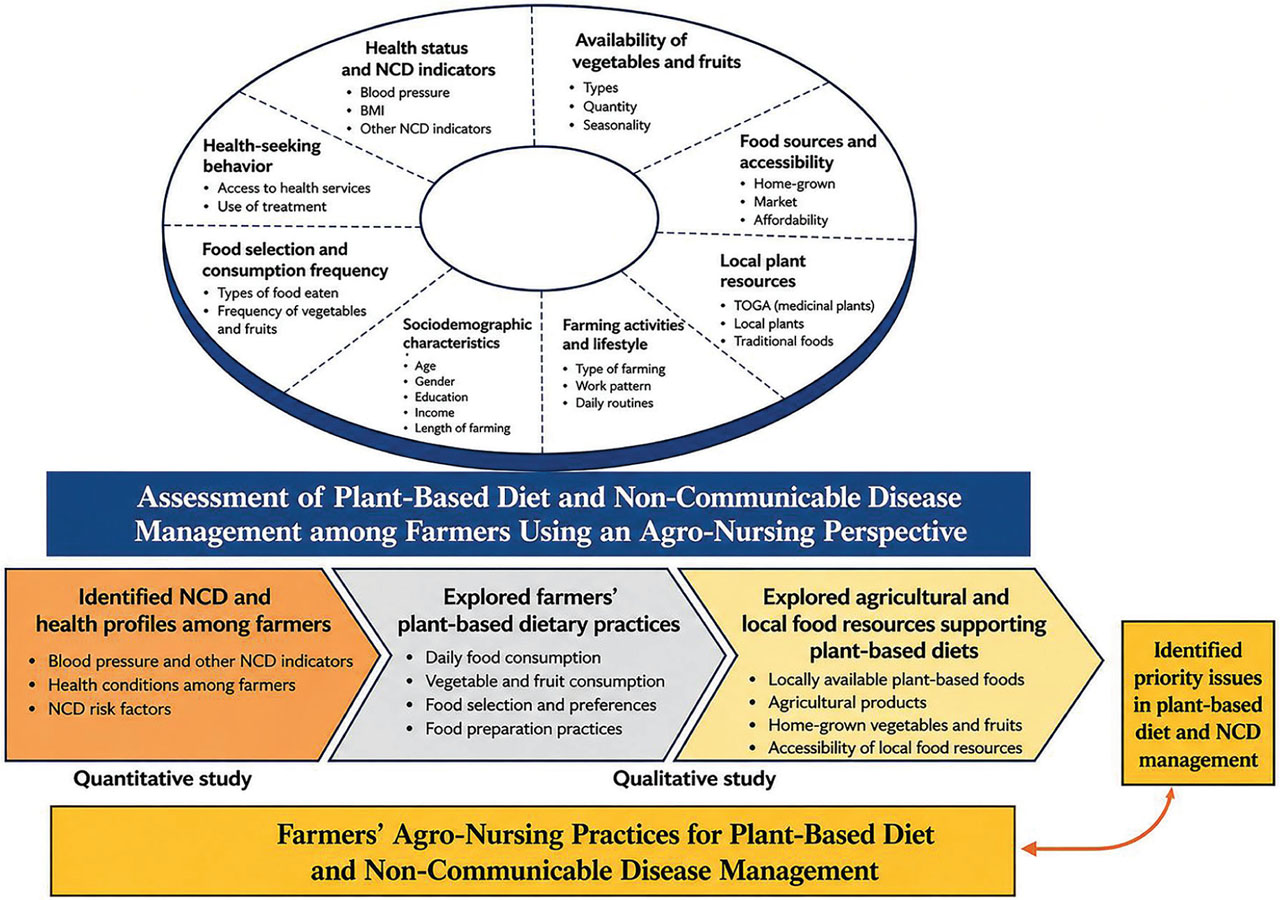
Figure 1.
Methodological framework.
Table 1.
Characteristic of participants.
| Characteristic of participants | n | % |
|---|---|---|
| Age (years) | ||
| Duration of hypertension (year) | 10.03 | 6.67 |
| Gender | ||
| Female | 25 | 96.20 |
| Male | 1 | 3.80 |
| Religion | ||
| Islam | 26 | 100.00 |
| Ethnic | ||
| Madura | 26 | 100.00 |
| Education level | ||
| Elementary school | 18 | 69.20 |
| Junior high school | 2 | 7.70 |
| Senior high school | 1 | 3.80 |
| Not attending school | 1 | 3.80 |
| Occupation | ||
| Farmer | 24 | 92.30 |
| Not working | 2 | 7.70 |
| BMI (kg/m2) | ||
| Systolic blood pressure | ||
| Hypertension grade 1 (140–159) | 15 | 57.70 |
| Hypertension grade 2 (>160) | 11 | 42.30 |
| Diastolic blood pressure | ||
| Hypertension grade 1 (90–99) | 17 | 65.40 |
| Hypertension grade 2 (>100) | 9 | 34.60 |
Table 2.
The main finding of the research based on the results of the FGD, several themes were obtained, which are described in the following table.
| Theme | Sub theme | Category | Statement |
|---|---|---|---|
| Actual behavior control | 1.1 Dietary pattern related to hypertension | 1.1.1 Local food contributing to hypertension | “Eating too many salty foods such as salted fish, shrimp paste, and various kinds.” |
| “Drinking coffee twice a day and smoking one pack a day.” | |||
| “ I often eat coconut milk and fatty foods such as gulai (an Indonesian curry-like dish cooked with rich spices and coconut milk), rawon (a traditional Indonesian beef soup flavored with black keluak nuts, giving it a dark color and unique taste), goat satay.” | |||
| 1.2.1 Dietary management during high blood pressure | “…. I limit the amount of food that contains coconut milk, and I also reduce the amount of salt in the dishes I make.” | ||
| “Eat clear vegetable soup often with side dishes.” | |||
| “Since I had high blood pressure, I reduced my coffee and cigarette intake.” | |||
| 1.2 Consumption of fruit and vegetable | 1.2.1 Fruit consumption | “I often eat fruit if there is fruit from my own tree, like papaya and bananas.” | |
| “I often eat papaya, bananas, oranges and watermelon.” | |||
| 1.2.2 Vegetable consumption | “The easiest to make is clear soup made from moringa leaves, spinach or long beans.” | ||
| “I usually also boiled vegetables such as bean sprouts and mustard greens” | |||
| “Lodeh (a traditional Indonesian vegetable dish cooked in coconut milk) are also often eaten, but because it contains coconut milk, it is limited.” | |||
| 1.3 Health seeking behavior toward hypertension | 1.3.1 Use of traditional remedies | “I follow my parents’ habits, usually using grated raw cucumber and drinking the water.” | |
| “Boil the avocado leaves, then drink the boiled water.” | |||
| “They went to a wise man to ask for blessed water.” | |||
| 1.3.2 Conventional medicine | “If it’s serious, go to the health center.” | ||
| “I go to the paramedic at the Sub-Health Center if I can’t stand it anymore” | |||
| “ I buy it myself from the pharmacy. As a father, you have to prepare it yourself.” | |||
| 1.3.3 Posyandu (Integrated Health Service Pos for) NCD program | “I usually attend the health checking for the elderly, the program is good.” | ||
| “If I’m sick, I’ll contact the cadre and ask when the elderly posyandu will be held, I’ll check at the posyandu at the same time.” | |||
| “Posyandu for the elderly usually has a healthy menu to prevent high blood pressure.” | |||
| “The elderly Posyandu is currently still inactive due to the corona, so I didn’t check my blood pressure at the elderly Posyandu.” | |||
| 1.4 Use of fruits and vegetables for hypertension management | 1.4.1 Fruit for maintaining hypertension | “Star fruit can also lower high blood pressure.” | |
| “Watermelon, melon, soursop are usually what people eat if they have high blood pressure.” | |||
| “If I have a headache from high blood pressure, I eat watermelon.” | |||
| 1.4.2 Vegetable for maintaining hypertension | “Most people with high blood pressure boil avocado and bay leaves and drink the water.” | ||
| “Grass jelly can also be eaten directly to lower blood pressure.” | |||
| “If it’s vegetables, I usually cook moringa leaves.” | |||
| “Drinking cucumber drink can immediately control blood pressure, so grate the cucumber and drink the water.” | |||
| 1.5 Attitude toward dietary habits | 1.5.1 Refusal of salty food | P1. Yes, I feel a bit unwell, I get dizzy when I eat something salty, you know. | |
| P2. “Food that is too salty can make me feel unwell, sir.” | |||
| P4. “We only eat when we feel hungry.” | |||
| 1.5.2 Daily eating behaviors | P5. “We usually eat rice, simple vegetables, tofu, tempeh, and only rarely chicken” | ||
| P6. “We usually eat pindang (a traditional Indonesian fish dish), but if it is expensive, we eat tofu and tempeh instead.” | |||
| 1.6 Subjective norms | 1.6.1 Economic factors influencing dietary behaviors | P4. Yes, it’s an economic factor, especially in these times, right? (laughs) | |
| 1.6.2 Motivation to comply with social norms | P8. “Village people like salty food. But they’ve started to reduce it.” | ||
| P3. “…then eat lots of coconut milk and drink coffee.” | |||
| P10. “If you don’t drink coffee, it doesn’t taste good (laughs).” | |||
| P6. “We have coffee first. At home, after the morning prayer, we always drink coffee.” | |||
| 1.6.3 Society’s negative behaviors | P6. “…coffee and cigarettes.” | ||
| P8. Yes, later, but in the afternoon, they drink coffee, there are also those who drink coffee again in the afternoon. | |||
| P9. …Yes, Madurese people like sedep (savory taste). | |||
| P5. “ When I eat vegetables, I eat them without adding salt. My father says it’s not tasty enough. My husband is fine, he doesn’t have high blood pressure. It’s just me.” | |||
| Behavioral intention | 1.7 Perceived behavioral control | 1.7.1 Positive perception in the community | P4. “It’s the mind, that’s it.” |
| P7. No money (laughs), tired, economic factors, family problems | |||
| P3. Yes, sir, farmers have coffee for breakfast. | |||
| P4. “It’s weak, you know.” | |||
| P12. “When you feel dizzy, drink coffee…” | |||
| 1.7.2 Motivation to eat healthy. | P6. Yes, if you already know that it’s not healthy (laughs) | ||
| P8. “But most people who have high blood pressure take leaves. Avocado leaves, bay leaves.” | |||
| P9. “The right blood pressure, so it can be controlled.” | |||
| P4. Yes, the cheapest are papaya, banana, orange and watermelon, if they are cheap, buy them. |
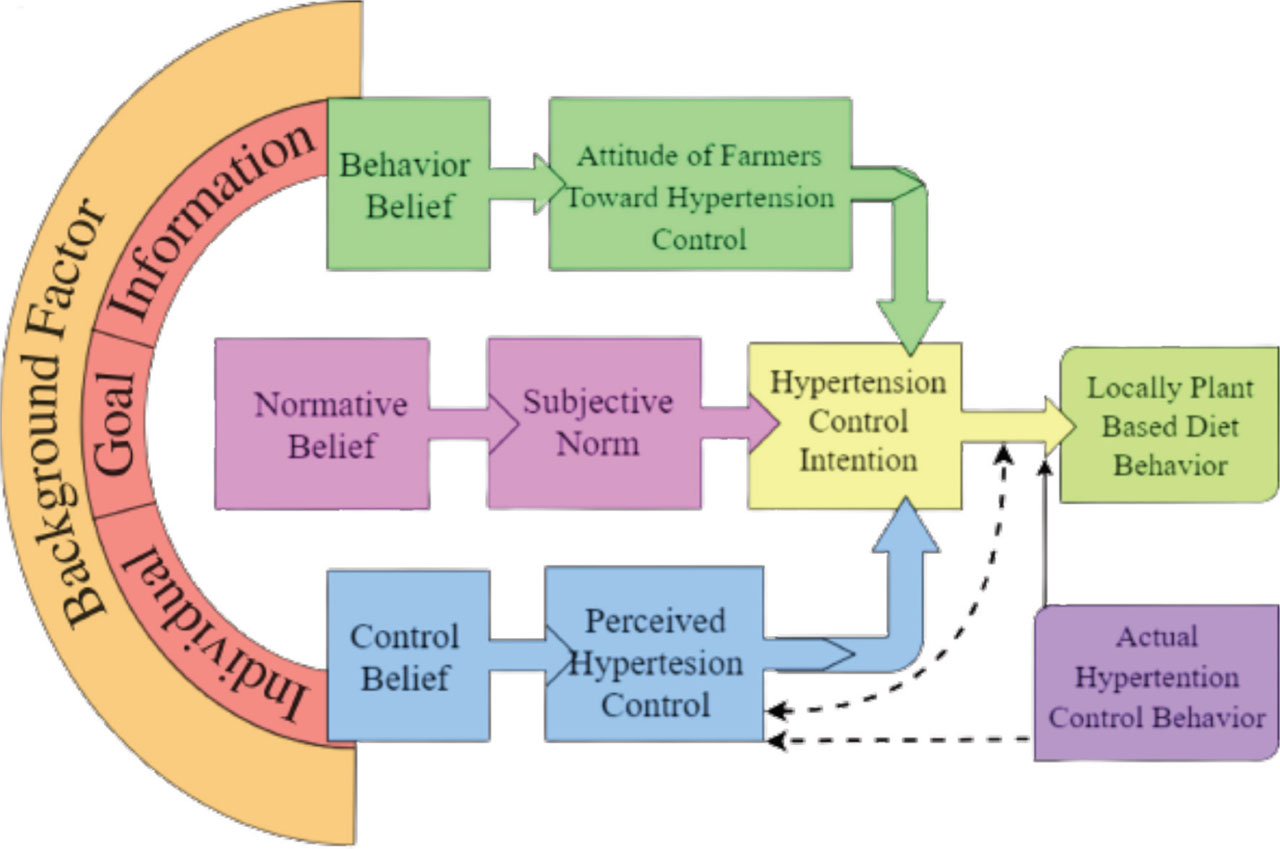
Figure 2.
Conceptualization of the finding.