
1. Introduction
Farmers have a daily consumption pattern that already accommodates the needs of vegetables. The value of local wisdom in an area also lies in the consumption patterns of its people. The problem of a lack of public awareness in fulfilling the consumption of vegetables and fruit is a current phenomenon. This will certainly have an impact on health problems that will arise, one of which is non-communicable diseases (NCDs). and fruits. The plant-based diet was integrated into daily activities, enabling farmers with hypertension to better manage their condition through the regular consumption of vegetables and fruits. NCDs account for about 12.8% of the total 7.5 million deaths in the world (WHO, 2024), one of which is hypertension. The prevalence of hypertension in Indonesia has reached 33.4%, and in East Java province at 20.43%.1,2 The agricultural community is a community that has a high risk of experiencing health problems,3 including hypertension. 4,5,6 Hypertension in the population who work as farmers in Indonesia aged 18 years and over reaches 36.1%.7 Based on our previous research, in the agricultural area, the percentage of pre-systolic hypertension (20.1%) and systolic hypertension grades 1 and 2 (25.1%) and diastolic hypertension grades 1 and 2 (35.8%) were found.8 This shows the high incidence of hypertension, which represents a problem of NCD among farmers, underscoring the need for care management through an agro-nursing approach.
The agricultural sector is one of the employment sectors that can be a source of livelihood, where around 30.46% of the Indonesian population works in the agricultural sector.9 According to the Development Area Unit Santuan Wilayah Pengembangan (SWP) Jember Bondowoso Situbondo in the East Java Spatial Planning Policy, agriculture is the leading sector in Bondowoso Regency, contributing the largest share to the regional Gross Domestic Product, particularly through rice and corn commodities, meaning that the area also has high potential for natural resources such as vegetables and fruits.10 The abundance of natural agricultural resources should serve as an alternative for the management of hypertension as part of NCDs. However, this is inversely proportional to the high cases of hypertension in the agricultural sector. Therefore, it is necessary to optimize this potential with a plant-based diet for hypertension management with an agro-nursing approach.
Based on our previous research related to health problems in farmers, there are still many farmers who have poor nutritional status due to unhealthy consumption patterns, and many farmers who experience hypertension problems. Meanwhile, according to the theory of planned behavior, farmers should have trusted norms and an existing desire to be healthy in accordance with what they want. Therefore, the consumption pattern for vegetables and fruit among farmers is an important thing to pay attention to.
This study aimed to explore farmers’ consumption patterns of vegetables and fruits and to examine how these dietary practices contribute to the management of hypertension within the agricultural community.
2. Methods
2.1. Study design and setting
This study used a qualitative approach that was carried out in Patemon and Banjarsengon Village in Jember Regency. The selection of research areas is based on the percentage of most farmers who have hypertension in the area. From the population of farmers in the research area, 25 informants were selected using the maximum variation sampling method for focus group discussions (FGDs). The variations considered in this study included farmers’ consumption patterns of vegetables and fruits as well as their health conditions. We applied the Theory of Planned Behavior to explore farmers’ consumption patterns and to examine their health conditions related to hypertension. The study was conducted from August to October 2021. Data were collected through FGDs, covering aspects such as dietary patterns, food processing methods, sources of food ingredients, types of food consumed, health-seeking behaviors, and daily activity routines. Information on the quantity and frequency of vegetable and fruit consumption was also obtained, reflecting the integration of plant-based diets into farmers’ daily menus.
2.2. Ethical consideration
Ethics committee of Universitas Jember in Indonesia approved this study. All informants interviewed had given their written consent prior to their participation in our research.
2.3. Data collection
Data were collected through participant observation (PO) in the community and FGDs. Both emic and etic perspectives were examined to maintain objectivity and capture relevant patterns.11 The study was conducted in 2 selected areas, Banjarsengon and Patemon villages. This area was selected because of the high prevalence of hypertension among farmers in these communities. Participants included farmers and community health workers (CHW). The objectives of the study were explained to all participants, and they provided informed consent voluntarily. The FGDs were initiated with the guiding question: “What are your thoughts on food and fruit consumption in relation to hypertension prevention?”(Figure 1).
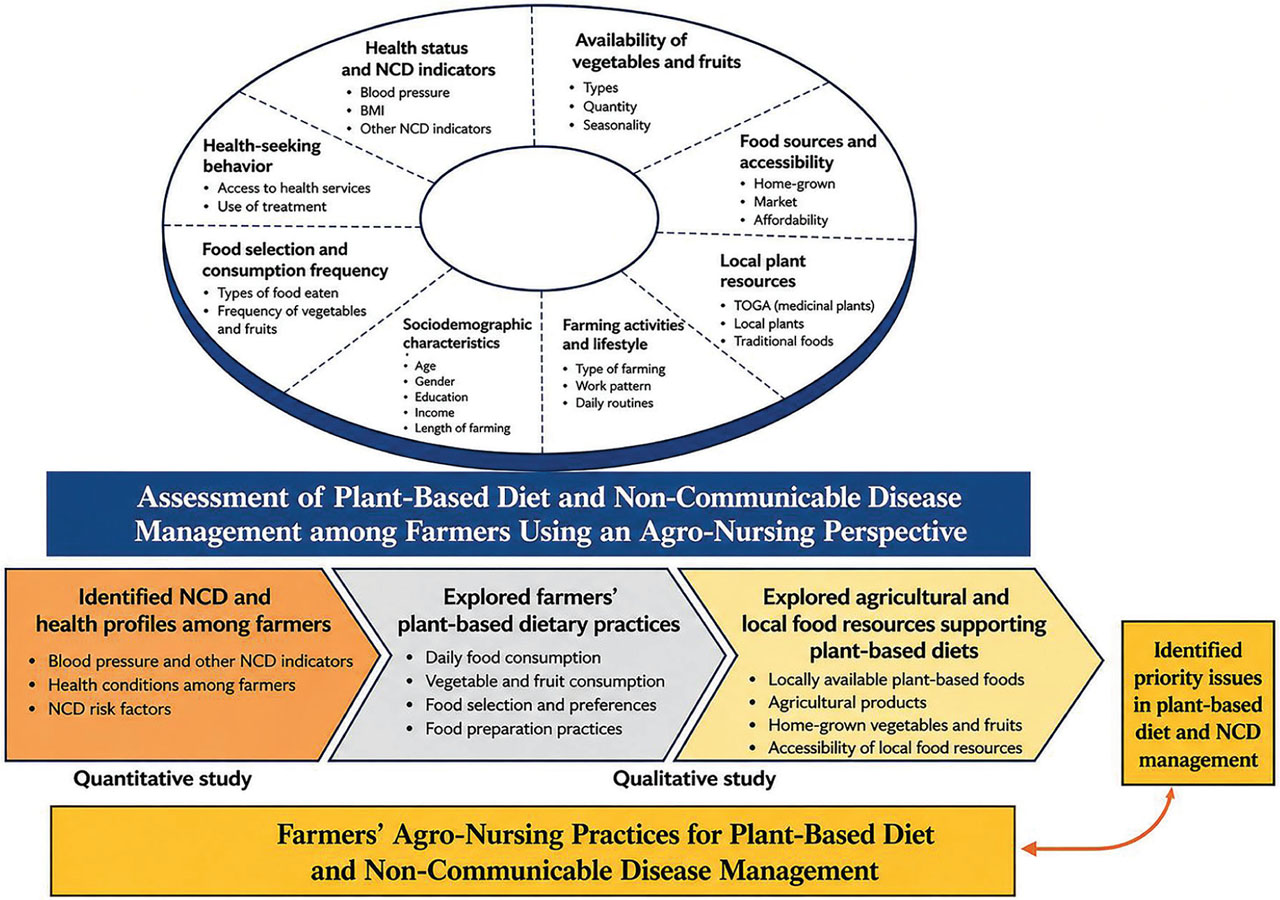
Figure 1.
Methodological framework.
2.4. PO
We used PO to capture the authentic picture of farmers’ food consumption in relation to hypertension. We observed farmers’ dietary practices, particularly their plant-based diet. Since the researchers were residents of the community, we easily gained access and trust from the farmers and the community. Finally, the farmers described their consumption patterns to improve their health status and to maintain their hypertension at a manageable level.
We applied Leininger’s PO phase, which includes observation, participation, and reflection enablers,12 which were performed as protocols for PO in this study. The protocols in the PO activities were as follows: preparing, determining the focus, setting, recording, and maintaining observations. In the preparatory activities, we collected information related to the procedures for caring for adolescents by farmers with hypertension and their plant-based consumption. Because the research team all have the same cultural background, we searched for key informants consisting of farmers who have hypertension and used to work in the morning. The next stage was determining the focus of observation, which consisted of the following steps: the descriptive (describing the problem of farmers), focus (focusing on the food consumption model and their relation to a plant-based diet) and choosing phases (deepening the farmers’ understanding about the importance of consuming vegetables and fruits). Furthermore, the researchers recorded observations through observational field notes, including participant activities, interactions, and routines.
2.5. Data analysis
The records of FGD’s and PO results were transcribed. Then, we read them to obtain a thematic view of the farmers’ patterns of consumption of vegetables and fruits, their behavior that may contribute to their hypertension. We used Leininger’s 4 phases of analysis for qualitative data11 to obtain a thematic view in this study.
First, we pursued an emic focus and paid attention to etic data as well as the purposes of the survey form recorded. We transcribed data from the FGD, PO, and field notes. Furthermore, we coded all the data described. Then, the codes were classified according to Domains of Inquiry (DOI), and we analyzed meaning in context. Third, we ranked data that were repeatedly reviewed to discover recurrent patterns, similarities, and different meanings in context. In this phase, we confirmed the saturation of data. Data were analyzed to show patterns of the meaning of findings, taking into account further credibility and confirmation of results. In this phase, we described the meaning of the text as categories. In the last phase, we unified and interpreted data and settled the formulation of new discoveries in this study as a pattern of plant-based diet in farmers and their routine about their consumption and what vegetables and fruits they often consume. We conducted a literature data analysis process in which we went back and forth between each step, confirming data with the key informants and informants. Then, we reviewed each step, confirming data with the key informants at all stages.
3. Results
The study included 26 informants, and data saturation was achieved at this number. All participants were Muslim, with a mean age of 53.26 years. The participants varied in terms of gender, occupation, duration of hypertension, and educational background (Table 1).
Table 1.
Characteristic of participants.
| Characteristic of participants | n | % |
|---|---|---|
| Age (years) | ||
| Duration of hypertension (year) | 10.03 | 6.67 |
| Gender | ||
| Female | 25 | 96.20 |
| Male | 1 | 3.80 |
| Religion | ||
| Islam | 26 | 100.00 |
| Ethnic | ||
| Madura | 26 | 100.00 |
| Education level | ||
| Elementary school | 18 | 69.20 |
| Junior high school | 2 | 7.70 |
| Senior high school | 1 | 3.80 |
| Not attending school | 1 | 3.80 |
| Occupation | ||
| Farmer | 24 | 92.30 |
| Not working | 2 | 7.70 |
| BMI (kg/m2) | ||
| Systolic blood pressure | ||
| Hypertension grade 1 (140–159) | 15 | 57.70 |
| Hypertension grade 2 (>160) | 11 | 42.30 |
| Diastolic blood pressure | ||
| Hypertension grade 1 (90–99) | 17 | 65.40 |
| Hypertension grade 2 (>100) | 9 | 34.60 |
Table 1 presents the characteristics of the 26 participants. The majority were female (96.2%), and all participants were Muslim of Madurese ethnicity. Most participants had only completed elementary school (69.2%), while a few had attained junior or senior high school education. The mean age was 53.26 years, with an average duration of hypertension of 10.03 years. Nearly all participants were farmers (92.3%). The mean body mass index (BMI) was 24.38 (SD = 4.90). Regarding blood pressure, 57.7% of participants had systolic values consistent with grade 1 hypertension and 42.3% with grade 2 hypertension. For diastolic pressure, 65.4% were categorized as grade 1 hypertension and 34.6% as grade 2 hypertension.
Leininger’s Sunrise Model was used as a guiding framework for the analysis. The findings revealed 7 patterns that were synthesized into 2 overarching themes (Table 2). Informants elaborated on the cultural dimensions of dietary practices among farmers in the area, noting that vegetables and fruits were considered secondary to coffee and cigarettes.
Table 2.
The main finding of the research based on the results of the FGD, several themes were obtained, which are described in the following table.
| Theme | Sub theme | Category | Statement |
|---|---|---|---|
| Actual behavior control | 1.1 Dietary pattern related to hypertension | 1.1.1 Local food contributing to hypertension | “Eating too many salty foods such as salted fish, shrimp paste, and various kinds.” |
| “Drinking coffee twice a day and smoking one pack a day.” | |||
| “ I often eat coconut milk and fatty foods such as gulai (an Indonesian curry-like dish cooked with rich spices and coconut milk), rawon (a traditional Indonesian beef soup flavored with black keluak nuts, giving it a dark color and unique taste), goat satay.” | |||
| 1.2.1 Dietary management during high blood pressure | “…. I limit the amount of food that contains coconut milk, and I also reduce the amount of salt in the dishes I make.” | ||
| “Eat clear vegetable soup often with side dishes.” | |||
| “Since I had high blood pressure, I reduced my coffee and cigarette intake.” | |||
| 1.2 Consumption of fruit and vegetable | 1.2.1 Fruit consumption | “I often eat fruit if there is fruit from my own tree, like papaya and bananas.” | |
| “I often eat papaya, bananas, oranges and watermelon.” | |||
| 1.2.2 Vegetable consumption | “The easiest to make is clear soup made from moringa leaves, spinach or long beans.” | ||
| “I usually also boiled vegetables such as bean sprouts and mustard greens” | |||
| “Lodeh (a traditional Indonesian vegetable dish cooked in coconut milk) are also often eaten, but because it contains coconut milk, it is limited.” | |||
| 1.3 Health seeking behavior toward hypertension | 1.3.1 Use of traditional remedies | “I follow my parents’ habits, usually using grated raw cucumber and drinking the water.” | |
| “Boil the avocado leaves, then drink the boiled water.” | |||
| “They went to a wise man to ask for blessed water.” | |||
| 1.3.2 Conventional medicine | “If it’s serious, go to the health center.” | ||
| “I go to the paramedic at the Sub-Health Center if I can’t stand it anymore” | |||
| “ I buy it myself from the pharmacy. As a father, you have to prepare it yourself.” | |||
| 1.3.3 Posyandu (Integrated Health Service Pos for) NCD program | “I usually attend the health checking for the elderly, the program is good.” | ||
| “If I’m sick, I’ll contact the cadre and ask when the elderly posyandu will be held, I’ll check at the posyandu at the same time.” | |||
| “Posyandu for the elderly usually has a healthy menu to prevent high blood pressure.” | |||
| “The elderly Posyandu is currently still inactive due to the corona, so I didn’t check my blood pressure at the elderly Posyandu.” | |||
| 1.4 Use of fruits and vegetables for hypertension management | 1.4.1 Fruit for maintaining hypertension | “Star fruit can also lower high blood pressure.” | |
| “Watermelon, melon, soursop are usually what people eat if they have high blood pressure.” | |||
| “If I have a headache from high blood pressure, I eat watermelon.” | |||
| 1.4.2 Vegetable for maintaining hypertension | “Most people with high blood pressure boil avocado and bay leaves and drink the water.” | ||
| “Grass jelly can also be eaten directly to lower blood pressure.” | |||
| “If it’s vegetables, I usually cook moringa leaves.” | |||
| “Drinking cucumber drink can immediately control blood pressure, so grate the cucumber and drink the water.” | |||
| 1.5 Attitude toward dietary habits | 1.5.1 Refusal of salty food | P1. Yes, I feel a bit unwell, I get dizzy when I eat something salty, you know. | |
| P2. “Food that is too salty can make me feel unwell, sir.” | |||
| P4. “We only eat when we feel hungry.” | |||
| 1.5.2 Daily eating behaviors | P5. “We usually eat rice, simple vegetables, tofu, tempeh, and only rarely chicken” | ||
| P6. “We usually eat pindang (a traditional Indonesian fish dish), but if it is expensive, we eat tofu and tempeh instead.” | |||
| 1.6 Subjective norms | 1.6.1 Economic factors influencing dietary behaviors | P4. Yes, it’s an economic factor, especially in these times, right? (laughs) | |
| 1.6.2 Motivation to comply with social norms | P8. “Village people like salty food. But they’ve started to reduce it.” | ||
| P3. “…then eat lots of coconut milk and drink coffee.” | |||
| P10. “If you don’t drink coffee, it doesn’t taste good (laughs).” | |||
| P6. “We have coffee first. At home, after the morning prayer, we always drink coffee.” | |||
| 1.6.3 Society’s negative behaviors | P6. “…coffee and cigarettes.” | ||
| P8. Yes, later, but in the afternoon, they drink coffee, there are also those who drink coffee again in the afternoon. | |||
| P9. …Yes, Madurese people like sedep (savory taste). | |||
| P5. “ When I eat vegetables, I eat them without adding salt. My father says it’s not tasty enough. My husband is fine, he doesn’t have high blood pressure. It’s just me.” | |||
| Behavioral intention | 1.7 Perceived behavioral control | 1.7.1 Positive perception in the community | P4. “It’s the mind, that’s it.” |
| P7. No money (laughs), tired, economic factors, family problems | |||
| P3. Yes, sir, farmers have coffee for breakfast. | |||
| P4. “It’s weak, you know.” | |||
| P12. “When you feel dizzy, drink coffee…” | |||
| 1.7.2 Motivation to eat healthy. | P6. Yes, if you already know that it’s not healthy (laughs) | ||
| P8. “But most people who have high blood pressure take leaves. Avocado leaves, bay leaves.” | |||
| P9. “The right blood pressure, so it can be controlled.” | |||
| P4. Yes, the cheapest are papaya, banana, orange and watermelon, if they are cheap, buy them. |
3.1. Theme I: Actual behavior control
The behavior of the farmers in this village is based on the local culture that has existed from generation to generation. Farmers have the mindset that when they go to work, the most important thing for them to consume is a cup of coffee and a cigarette. The consumption of vegetables and fruits typically occurred as side dishes during lunch or upon returning home.
Theme 1 has 3 categories; the first is a dietary pattern related to hypertension. This category emerged from data citations, such as “we eat too often salty foods such as salted fish, shrimp paste and other foods that contain a high amount of salt” (P2 and P4). For the consumption of fruits and vegetables, participants noted: “I often eat fruit if there is fruit from the tree itself, such as papaya and bananas.” (P6 and P8). Regarding health-seeking behavior toward hypertension, the following statements were obtained: “I follow the habits of my parents, usually I use grated raw cucumber and drink the water” (P7 and P8) and “I buy it from the pharmacy, since I usually have to prepare it for myself.” (P10 and P11).
The results of PO showed that the habit of consuming too salty food is still commonplace and is done by the community. However, people continue to consume fruits and vegetables, especially those they can get from their own fields. And when they are sick, the initial treatment is self-medicating either traditionally or using drugs.
3.2. Theme II: Behavioral intention
Behavioral intention is a desire that turns into a form of behavior that is determined by 3 factors, namely attitude toward behavior, subjective norm, and perceived behavioral control. For attitude toward dietary habits, this was reflected in the statement: “Food is too salty, it can make me feel unwell” (P2). The quote indicates that farmers’ behavior can change due to the effects caused by consuming excessively salty food. For subjective norms, which refer to external influences shaping an individual’s perception of behavior, one participant expressed: Yes, it’s an economic factor, you know, especially during this time (laughs). This suggests that economic conditions are among the factors that can influence an individual’s willingness to change behavior.
For the category of perceived behavior, which relates to the individual’s self-perception or ability regarding the individual’s control over a behavior, a respondent stated: Yes, if you already know that, then it is not healthy (laughs). This indicates that respondents are able to recognize and perceive appropriate health-related behaviors, which can support efforts to improve health status, particularly in relation to hypertension.
PO indicated that the behavior of farmers with hypertension actually also have a desire to change their behavior, but indeed several factors can influence this, such as economic factors and local culture that do not like to eat breakfast with vegetables and fruit.
4. Discussion
The findings indicated that the behavior of farmers in meeting their nutritional needs is still considered quite good through the utilization of vegetables and fruits grown in private gardens. Furthermore, the theory of the Planned Behavioral Model was internalized in the daily activities of farmers in Jember District. The internalization of the plant-based diet in the lives of farmers can be seen from the consumption patterns of farmers who still utilize local natural resources as a form of wisdom from the Pandalungan tribe. The plant-based diet combined with the theory of planned behavior was used to guide our discussion of the findings (Figure 2).
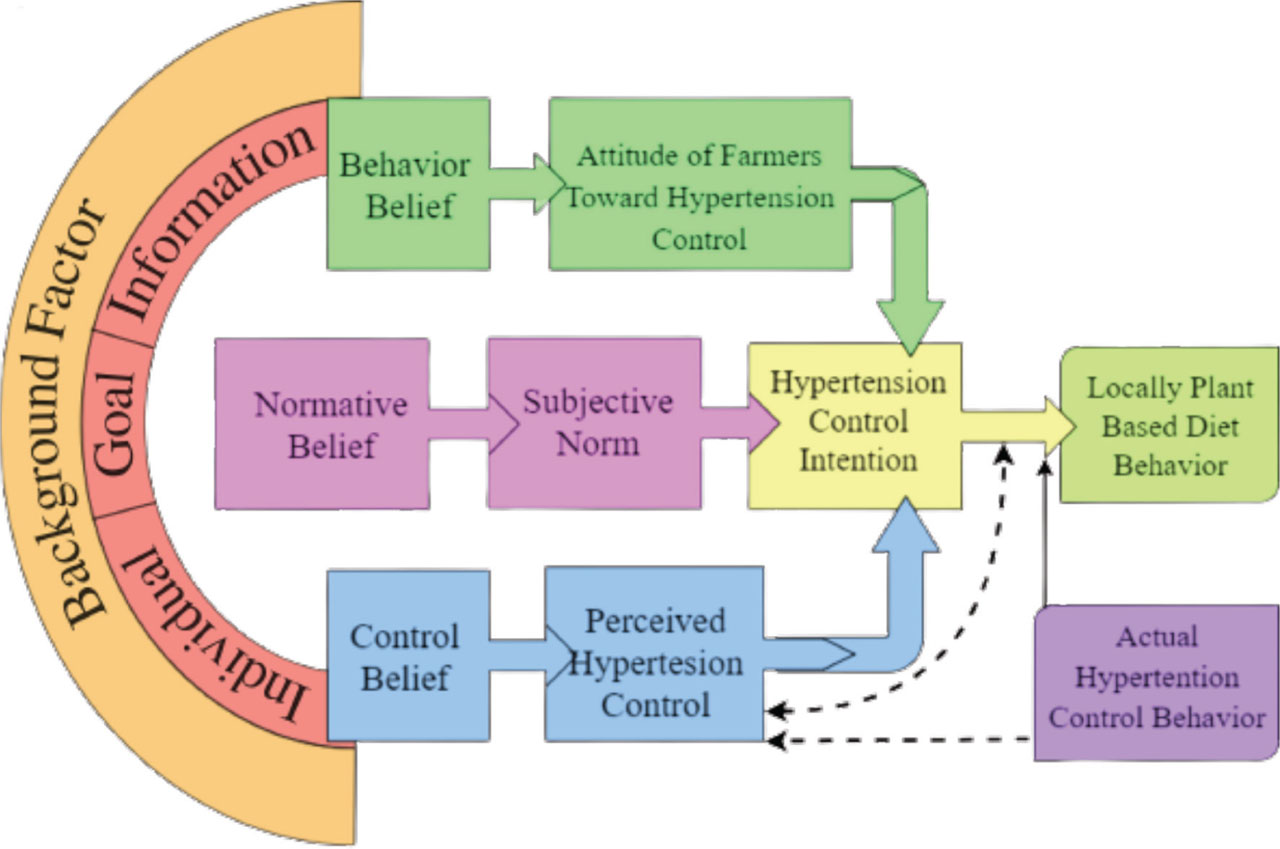
Figure 2.
Conceptualization of the finding.
4.1. Actual behavioral control for plant-based diet in NCD management
The farmers in this area have controlled behavior when it comes to eating patterns by maintaining a menu of vegetables and fruits associated with NCDs. The pattern of fruit and vegetable intake that has been internalized into daily life is one of the keys for farmers and families to be able to overcome problems related to the management of NCDs, especially hypertension suffered by farmers. This can happen because this activity has been going on for decades in the area. They also believe that a healthy lifestyle, apart from lifestyle and diet, can also be obtained from the prayers they have been praying, because the majority of farmers in Patemon and Banjarsengon villages are Muslim.13 For this reason, the essential value for actual behavioral control is that farmers can carry out a plant-based diet by consuming vegetables and fruits that are already available in their own backyard.
4.2. Behavioral intention for plant-based diet in NCD management
Our findings of behavioral intention were described as attitude toward, subjective form, and perceived behavior. The results showed that the farmers change their behavioral intention by forming a new intention about health that occurs due to hypertension problems, any changes from outside themselves can also change the behavior or desires of farmers in health management, especially for hypertension where this is indicated by increasing the intake of plant-based diets, so that the condition of blood pressure which is one of the determinants of hypertension can be controlled properly. These findings may be explained by the fact that farmers cannot play their own role without the participation of their families and health workers to achieve the ultimate goal of improving health status. This illustration also illustrates that the plant-based diet presented cannot be separated from the role of the family, such as the selection of vegetables, processing, and serving.
The results of the study showed that the management of NCDs can be achieved by changing behavior in the consumption of plant-based diets, both vegetables and fruits; in addition, reducing the consumption of salty foods is also something that needs to be followed up to be able to do a good pattern of hypertension management. The regulation of other factors that can influence the behavior of farmers also needs to be monitored and modified, such as increasing the amount of consumption of vegetables and fruit that can be obtained, either from their own gardens or by buying them. A plant-based diet is also necessary, without leaving the rules in terms of content and benefits of the type of vegetable diet taken. This indicated that every family needs to define they plant based diet based on capability of family and farmers himself, and make a norms that are structured as a standard reference for each family member to set their diet for daily used so that the roles and responsibilities will be done to achieve the good management of NCD and plant based diet in development tasks based on local wisdom of the Indonesian context.
4.3. Limitations
First, conducting exploratory research was hindered by challenges in gaining access and building trust with farmers and the community. In addition, supervision and observation required a high level of rigor, particularly in relation to observing Madurese culture. However, the research team minimized these challenges through a thorough PO approach. This process was further supported by the team’s background, as several members were indigenous to the Pandalungan cultural research area.
Second, there is a potential for bias on the part of researchers, which can distort the data and insights gained from it. Due to the intimate nature of research, there is potential for ethical and interpersonal issues to emerge. Finally, the storytelling nature of an exploratory research approach may disrupt the interpretation of the data, although the research team has maintained trustworthiness through the data collection methods of FGD and PO.
The results indicated that farmers’ existing dietary habits already incorporate plant-based foods; however, this qualitative exploration did not measure direct changes in blood pressure values following dietary intake. Previous studies have demonstrated that higher consumption of vegetables and fruits is associated with lower blood pressure.14,15,16 Thus, while our findings do not provide quantitative proof of blood pressure control, they underscore the relevance of culturally grounded dietary practices that can be further developed into nursing interventions for hypertension management.
5. Conclusions
This study concludes that plant-based diets, particularly the regular intake of vegetables and fruits, are deeply integrated into farmers’ daily lives and may serve as a supportive component in managing hypertension. Although this study did not demonstrate direct evidence of blood pressure reduction, the findings suggest opportunities for nursing interventions to optimize culturally embedded dietary practices as part of community-based hypertension management.
Acknowledgments
The author would like to thank the Faculty of Nursing and the Department of Research and Community Engagement of the University of Jember for facilitating research funding No. 2892/UN25.3.1/LT/2021.
Notes
[3] Supported by This project was supported by the Faculty of Nursing and the Department of Research and Community Engagement of the University of Jember (No. 2892/UN25.3.1/LT/2021).