
1. Introduction
Nursing practice holds an important place and plays a central role in the hospital setting. It is carried out in 2 dimensions: technical and relational. Although these may seem simple, their complexity lies in the fact that they are part of a humanistic approach, requiring the care of the person as a whole entity. Such care is more likely to bring us into contact with the person’s intense emotions, reflecting their fears and suffering.1
Therefore, the nurse is called upon to recognize the patient’s feelings, understand their experiences, reduce their anxiety, and help restore their physiological and psychological balance. Moreover, hospitalization is perceived by the patient as an experience that disrupts daily activities and changes their social environment. However, this period can also promote personal growth and development.2
According to Paterson and Zderad3, the hospital setting encourages the patient to establish a relationship with the nurse, who is also required to maintain it. For the nurse, the hospital environment is familiar, whereas for others, it is unfamiliar and often uncomfortable.
In this perspective, Peplau emphasizes that the nurse-patient relationship emerges and contributes to illustrating a new conception of nursing care, one that is part of a holistic approach to the person being cared for. The nurse-patient relationship, or interpersonal interactions, are thus seen as carriers of care or as elements likely to promote healing.4
For Carl Rogers, considered the father of the concept of the helping relationship, it is a therapeutic relationship in which the helper (the nurse) is primarily focused on the other (the patient), on their experiences and suffering. Empathy is considered the foundation of the helping relationship and is defined as a deep sense of understanding from the helper, who grasps the difficulty of the person being helped as if entering their world putting themselves in their place to perceive what they are experiencing and how they are experiencing it. The helper thus provides the comfort the person needs, without identifying with their experience or feeling their emotions themselves. The informal helping relationship is mainly based on empathy, and during a formal interview, the helper creates a climate of empathic understanding, a source of trust and therapeutic connection which forms the basis of the support offered to the person being helped.5
Empathy is a fundamental pillar of nursing practice. In fact, Dr. Jorland6 emphasizes that empathy is the most appropriate approach in the nurse–patient relationship. Not only does it support treatment, but it also facilitates the therapeutic relationship. By making the effort to understand their patients, nurses improve their practice.
Thus, empathy allows nurses to go beyond technical tasks to provide holistic care. As Vega points out, « each patient is first and foremost a unique individual with their own history, values, needs, resources, and limitations. This implies that care must be personalized and take into account the entire biopsychosocial context.7
The emergency department is the gateway to the hospital and the first point of contact for patients. It is also considered the primary setting where patients fears and anxieties are first encountered. At this level, priority is given to life-threatening risks and technical interventions. The patient’s apparent lack of consciousness or amnesia reinforces the idea that they are unaware of their situation or have forgotten it, leading to the psychological aspect being considered secondary. Yet, it is precisely in this context that the nurse must partially step away from emergency technical care to focus on the patient’s experience. This approach enhances overall care through relational nursing, thus having a positive impact on the patient’s condition. 8,9,10
In this regard, emergency physician Valette11 emphasizes that patient care begins with relational nursing. When an exchange is possible, a dialogue is established between the patient and the caregiver. This relational dimension is essential, as it fosters trust, allows for a better understanding of the patient’s needs, and enables care to be tailored to their experience, thus contributing to more comprehensive and humane care.
In Morocco, according to studies conducted by Sema-Métra-Maroc, in the hospital setting, patients’ care needs are not properly identified. Technical care is prioritized at the expense of relational care, and a disconnect between theoretical protocols based on patients’ needs and the practical reality dominates the execution of nursing tasks.12
The emergency context in Morocco is severely affected by a lack of equipment and qualified personnel, while health needs continue to grow steadily. Indeed, faced with increasing patient attendance and the urgent nature of care, it is not always easy to combine speed with availability. This situation often leads to conflicts and misunderstandings, resulting in aggression and dissatisfaction directed at healthcare staff, who find themselves in the crosshairs of the population. Moreover, due to the lack of information provided to service users, nurses observe a rise in anxiety, worsening of medical conditions, and an increase in violent incidents.13,14
The speed and quality of performing technical procedures should not justify neglecting communication and patient information. In fact, empathy, combined with effective communication, forms the foundation of a humanistic and holistic therapeutic relationship. Thus, combining technical care with a relational approach helps establish a relationship of interdependence between the patient and the nurse, where the well-being of one directly influences the well-being of the other. « Patients expect from healthcare providers not only technical competence, but also a compassionate human presence » one that goes beyond the mere intervention and takes into account the human dimension of care.15,16
In response to patients’ new expectations, practitioners must offer a new quality of care that also takes into account the psychological and emotional environment of the patient: How can we better adapt to highly anxious patients, patients suffering from serious illnesses, or traumatized patients? All of these individuals deserve a personalized, humanistic approach before a technical one. Therefore, it is legitimate to question the level of empathy among nurses in the emergency department.
The present study aims to measure the level of empathy among nurses working in the emergency department of CHU Hassan II in Fez. This study also seeks to identify the factors influencing this empathy, to understand the situation and developing proposals and recommendations to contribute to the improvement of professional practices.
2. Methods
This is a descriptive cross-sectional study conducted over 2 months (December 2024–January 2025), involving a sample of 74 nurses working in the emergency department of CHU Hassan II in Fez. A census sampling method was used, where all eligible nurses working in the emergency department during the study period were invited to participate in the study. The inclusion criteria were nurses working in the emergency department who agreed to participate in the study and completed the questionnaire. In contrast, nurses who were absent during the data collection period or who declined to participate were excluded from the study.
Data were collected using a structured anonymous questionnaire, which included socio-demographic information (age, gender, professional profile, years of experience, time spent working in the emergency department, work schedule, educational background, perception of staffing levels, perception of stress, relationship with patients, and continuing education in the humanization of nursing care) and Jefferson Scale of Empathy—Health Professional version (JSE-HP).
Empathy was measured using the French version of the Jefferson Scale of Empathy—Health Professional version (JSE-HP), originally developed by Hojat and translated and validated into French by Zenasni et al. (2012).17 In the present study, the internal consistency of the Jefferson Scale of Empathy—Health Professional version (JSE-HP) was assessed using Cronbach’s alpha coefficient.
For Hojat, the cognitive dimension is central to clinical empathy. The scale consists of 20 items reflecting various empathic attitudes or positions, rated on a 7-point Likert scale.
This is a self-administered questionnaire. Participants are asked to indicate, on a Likert scale (from 1 = “strongly disagree” to 7 = “strongly agree”), the extent to which they agree with each item. Each participant obtains a total score ranging from 20 to 140, which corresponds to an increasing degree of empathy.18
The data were entered, coded, and analyzed using the statistical analysis software Statistical Package for the Social Sciences (SPSS) (IBM Corporation, Armonk, New York, United States).
2.1. Ethical considerations
This study was conducted in accordance with the ethical principles governing research involving human participants and in compliance with the Declaration of Helsinki. Participation in the study was voluntary. All participants were informed about the objectives of the study, and informed consent was obtained before data collection.
Anonymity and confidentiality of the collected data were strictly ensured, and no personal or identifiable information was recorded. Participants were also informed of their right to withdraw from the study at any time without any consequences.
Data collection commenced only after formal authorization had been obtained from the competent authorities (reference no. 614/2024). The study did not involve any physical or psychological risk to the participants.
3. Results
A total of 80 questionnaires were collected. Six questionnaires were excluded from the analysis due to incomplete responses that prevented the calculation of the total JSE-HP score. Only fully completed questionnaires were included in the final analysis. Moreover, no missing data were identified among the questionnaires included in the final analysis. The participation rate was 92%. The demographic characteristics of the nurses are presented in Table 1.
Table 1.
The socio-demographic characteristics studied, CHU Hassan II Fes (n = 74).
| Factors | n (%) |
|---|---|
| Gender | |
| Male | 30 (40.5) |
| Female | 44 (59.5) |
| Age (years) | |
| 20–30 | 38 (51.4) |
| 31–40 | 27 (36.5) |
| 41–50 | 9 (12.2) |
| Profile | |
| Registered nurse | 53 (71.6) |
| Anesthesia Nurse | 8 (10.8) |
| Emergency and intensive care nurse | 13 (17.6) |
| Professional experience. (year) | |
| 5–10 | 23 (31.1) |
| 10–20 | 18 (24.3) |
| 20–30 | 30 (40.5) |
| 30–40 | 3 (4.1) |
| Time working in the emergency department. (year) | |
| <1 | 2 (2.7) |
| 1–5 | 29 (39.2) |
| 5–10 | 21 (28.4) |
| 10–20 | 22 (29.7) |
| Work mode | |
| Regular hours | 10 (13.5) |
| Shift work | 64 (86.5) |
| Choice of study program | |
| Your own choice | 36 (48.6) |
| Under family influence | 9 (12.2) |
| By chance | 29 (39.2) |
| Stress | |
| Never | 2 (2.7) |
| Sometimes | 22 (29.7) |
| Often | 14 (18.9) |
| Very often | 36 (48.6) |
The distribution of JSE-HP scores is presented in Figure 1. The distribution was approximately normal, indicating that most nurses’ empathy scores were clustered around the mean. In addition, the JSE-HP demonstrated good internal consistency in this study sample, with a Cronbach’s alpha coefficient of 0.84.
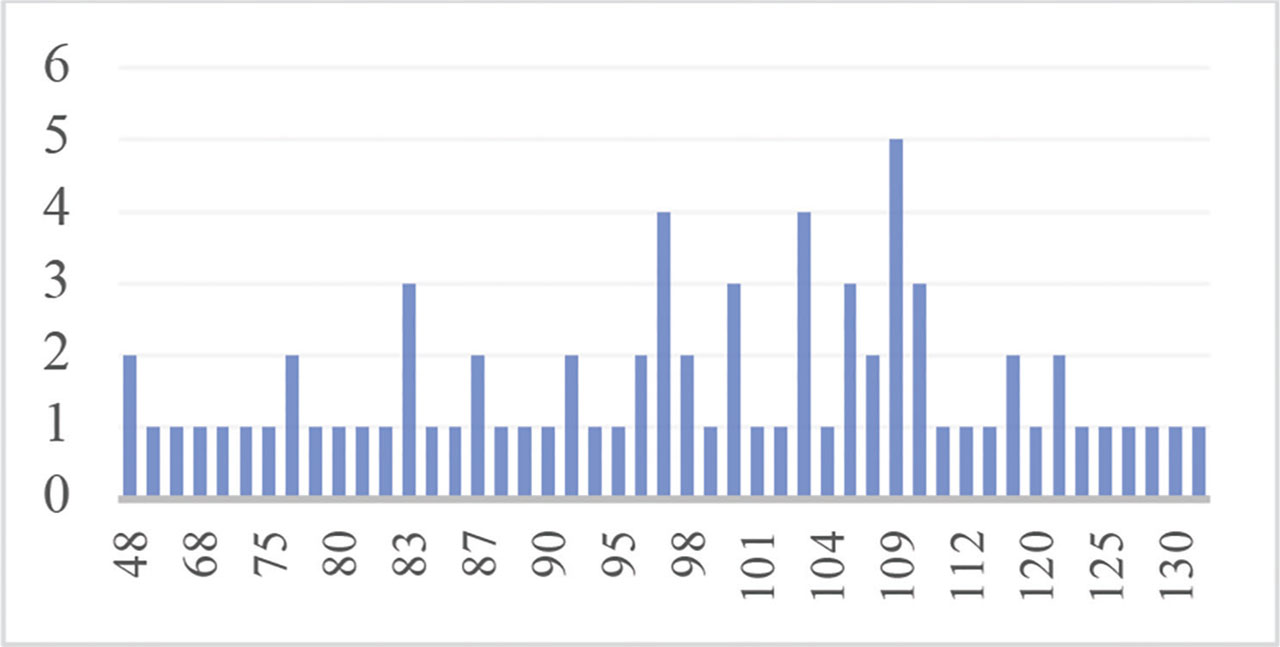
Figure 1.
The mean total Jefferson Scale of Empathy score among nurses was 97.68 ± 18.03 (range: 48–133).
The mean total Jefferson scores according to the various socio-demographic characteristics are presented in Table 2.
Table 2.
Distribution of mean JSE-HP scores according to the factors studied.
| Factors | Mean JSE-HP score |
|---|---|
| Gender | |
| Male | 101.10 |
| Female | 95.34 |
| Age (years) | |
| 20–30 | 93.08 |
| 31–40 | 100.00 |
| 41–50 | 110.11 |
| Profile | |
| Registered nurse | 97.87 |
| Anesthesia nurse | 104.00 |
| Emergency and intensive care nurse | 93.00 |
| Professional experience. (year) | |
| 5–10 | 93.22 |
| 10–20 | 94.33 |
| 20–30 | 101.90 |
| 30–40 | 109.67 |
| Time working in the emergency department. (year) | |
| <1 | 94.00 |
| 1–5 | 94.07 |
| 5–10 | 95.52 |
| 10–20 | 104.82 |
| Work mode | |
| Regular hours | 105.30 |
| Shift work | 96.48 |
| Choice of study program | |
| Your own choice | 101.17 |
| Under family influence | 96.44 |
| By chance | 93.72 |
| Stress | |
| Never | 60.50 |
| Sometimes | 101.05 |
| Often | 99.79 |
| Very often | 96.86 |
To identify factors related to the Jefferson Empathy Scale, we conducted bivariate analyses. For each factor, the P-value was calculated. Only factors with a P-value <0.05 were considered significantly associated with the total Jefferson score. Statistical analysis shows a significant correlation between the Jefferson score and age, professional experience, and experience in the emergency department. Significance tests from the bivariate analysis are presented in Table 3.
Table 3.
Results of the significance tests from the bivariate analysis.
| Factors | Total JSE-HP score |
|---|---|
| Gender | 0.17 |
| Age | 0.01 < 0.05 |
| Profile | 0.39 |
| Professional experience | 0.04 < 0.05 |
| Time working in the emergency department | 0.03 < 0.05 |
| Work mode | 0.15 |
| Choice of study program | 0.25 |
| Stress | 0.49 |
Bivariate analyses were conducted to examine the association between the total JSE-HP score and participants’ characteristics. A multiple linear regression analysis was performed to identify independent predictors of empathy among nurses. The total JSE-HP score was used as the dependent variable, and relevant variables were included as independent variables (Table 4).
Table 4.
Multiple linear regression of JSE-HP among nurses, Fez, Morocco (n = 74).
| Independent variable | Unstandardized β | SE* | Standardized β | t | P-value |
|---|---|---|---|---|---|
| (Constante) | 159.03 | 46.86 | − | 3.40 | 0.001 |
| Gender | −7.79 | 4.60 | −0.21 | −1.69 | 0.095 |
| Age | 0.67 | 6.01 | 0.02 | 0.11 | 0.910 |
| Profile | −0.29 | 3.12 | −0.01 | −0.09 | 0.920 |
| Professional experience | 1.48 | 4.36 | 0.07 | 0.34 | 0.730 |
| Time working in the emergency department | 2.00 | 3.26 | 0.09 | 0.61 | 0.540 |
| Work mode | −9.63 | 6.80 | −0.18 | −1.41 | 0.160 |
| Choice of study program | −3.60 | 2.30 | −1.18 | −1.56 | 0.120 |
| stress | 0.60 | 2.30 | 0.03 | 0.26 | 0.790 |
The results showed that none of the variables included in the model were statistically significant predictors of empathy (all P > 0.05).
4. Discussion
The objective of this study was to measure the level of empathy among nurses working in the emergency department using the Jefferson Scale of Empathy-Health Professional (JSE-HP), to compare our results with those of previously published studies, and to identify the factors influencing empathy among emergency department nurses.
4.1. Factors associated with the Jefferson score
4.1.1. Gender
The results of our study show no statistically significant association between nurses’ gender and their Jefferson empathy scores. However, we observed that the mean Jefferson score among female nurses was lower than that of their male counterparts. These findings are consistent with a French study that also found no relationship between gender and empathy.19 Similarly, the results of another study conducted at the Isfahan University of Medical Sciences in Iran, titled Nurses’ Empathy in Different Departments, also found no association between nurses’ gender and empathy.20
However, these results contradict those found in the literature on empathy among healthcare professionals, notably a study conducted by Hojat in the United States, which showed that women scored higher on empathy than men.21 Similarly, a study conducted in Seoul on 317 residents highlighted a statistically significant relationship between the female gender and higher empathy scores.22 These results can be explained by the fact that women tend to be more emotionally sensitive and place greater importance on interpersonal relationships than men.23 Indeed, they are more likely to adopt humanistic behaviors and to be more socially engaged. Moreover, Roter et al.24 demonstrated that female physicians are more likely to engage in collaborative behaviors, provide counseling related to psychosocial aspects, and participate in emotional discussions.
4.1.2. Age
The results of our study reveal a statistically significant association between the Jefferson Scale of Empathy-Health Professional (JSE-HP) (P = 0.01) and nurses’ age. We observed that as nurses’ age increases, their total Jefferson empathy score also tends to be higher. Nurses over the age of 40 achieved a mean score of 110 on the Jefferson Scale of Empathy-Health Professional (JSE-HP), whereas those under the age of 30 had a mean score of 93. These findings support the conclusions of previous studies, particularly those conducted in France, which highlighted a progression of empathy with increasing age.16 These results may be explained by several factors. First, over the years, nurses tend to develop greater emotional intelligence, which enables them to interact more effectively with patients. Moreover, emotional intelligence is positively associated with high-quality nurse–patient relationships, improved psychological well-being, and greater life satisfaction.25 In contrast, age does not appear to be a determining factor in the level of empathy in a study conducted in Tunisia, where the results showed no significant relationship between participants’ age and empathy.26
4.1.3. Professional experience
Our results reveal a statistically significant correlation between the Jefferson Scale (P = 0.04 < 0.05) and overall professional experience, as well as between the Jefferson Scale (P = 0.03 < 0.05) and experience specifically in the emergency department. Accordingly, we observed a progression in the mean Jefferson score in relation to the number of years of nursing experience. Numerous studies have shown a positive correlation between professional experience and Jefferson empathy scores; in other words, more experienced professionals tend to exhibit higher levels of empathy. Consequently, our findings confirm those of an Iranian study on nurses’ empathy across different hospital departments. In that study as well, professional experience was significantly correlated with Jefferson empathy scores.20 This observation aligns with a study conducted in Singapore on the development of empathy in healthcare settings, which emphasized that accumulating professional experience enhances the understanding of patients’ emotions and needs, thereby improving the ability to demonstrate empathy.27 However, the results of another study conducted at the Faculty of Medicine of Sfax in Tunisia on empathy among young physicians did not demonstrate a correlation between empathy and seniority.26 Similarly, a study conducted in Iran highlighted a decrease in empathy levels according to the nursing education level, with fourth-year students demonstrating lower empathy scores than first-year students.28
4.1.4. Absence of association
The results of our study highlight the absence of an association between the total Jefferson Scale score and factors such as: Nurses’ profiles, Work mode, Choice of study program Perceived stress. Thus, we observed that the level of empathy is more pronounced among nurses working in anesthesia and intensive care compared to other profiles. Regarding work mode, nurses working regular daytime hours obtained higher mean empathy scores than those working on a shift. Regarding their choice of study program, nurses who selected their specialization based on personal conviction achieved higher mean empathy scores. However, our results indicate that the most empathetic nurses also tend to report higher levels of work-related stress, despite the absence of a statistically significant association. Moreover, a Quebec study revealed an association between levels of empathy and psychological distress as well as the well-being of nurses. Additionally, the study found a correlation between empathy and well-being, indicating that nurses with higher well-being scores also achieved higher empathy scores.29
4.2. The level of empathy among nurses in our study compared to the literature
To better understand the variations in empathy levels among healthcare professionals, several studies have been conducted using the Jefferson Scale of Empathy (JSE-HP) in different countries. Total Jefferson Scale scores varied across studies; As shown in Table 5, the main studies conducted, including our own, are summarized for comparison.
Table 5.
Comparison of mean total Jefferson scores with the literature.
| Studies | Population | Instruments | Mean JSE-HP score |
|---|---|---|---|
| Quebec, Canada | 40 emergency nurses | JSE-HP | 92.88 |
| Tonekābon, Iran | 122 students in training | JSE-HPS | 91.80 |
| Ispahan, Iran | 112 nurses | JSE-HP | 87.59 |
| Our study, Fez, Morocco | 74 emergency nurses | JSE-HP | 97.68 |
The table above compares the results of our study conducted at Hassan II University Hospital in Fez, Morocco, with 3 other studies carried out in 2 countries, specifically in Canada and Iran.
In Canada (Quebec), 40 nurses working in emergency departments participated in a study entitled “The Relationship Between Empathy and Well-Being Among Emergency Nurses.” The mean Jefferson Scale of Empathy (JSE-HP) score was 92.88.29
In Iran (Tonekābon), 122 nursing students in training participated in a study entitled “Changes in the level of nursing students’ empathy during 4 years of education.” The mean JSE-HP score was 91.8.28
In Iran (Isfahan), 112 nurses participated in a study entitled “Nurses’ Empathy in Different wards.” The mean JSE-HP score was 87.59.20
In Morocco (Hassan II University Hospital, Fez), 74 emergency nurses participated in our study entitled “Evaluation of Empathy in Nursing Practice in the Emergency Department.” The mean JSE-HP score was 97.68.
Limitations
This study has some limitations that should be acknowledged. First, studies investigating empathy in emergency departments are rare, and national data on this topic are limited, which restricts the ability to compare our findings. Second, the study was conducted in a single center with a relatively small sample size, and some nurses declined to participate, which may limit the generalizability of the results. Third, the cross-sectional design of the study does not allow for causal inferences. Finally, the use of a self-reported questionnaire may introduce response bias. Future studies with larger, multicenter samples are recommended to further explore factors associated with empathy among nurses.
5. Conclusions
This study, conducted to evaluate empathy in nursing practice within the emergency department of Hassan II University Hospital in Fez, provided a general insight into the concept of empathy and its importance in nursing care. Nurses have long been unfairly perceived through the stereotypical myth of being purely technical practitioners, neglecting the relational aspect of care toward patients. This issue formed the rationale for our study. Indeed, our work allowed us to objectively measure the degree of relational engagement that nurses have with their patients. It is worth noting that, by the end of this study, empathy in its entirety was shown to hold a legitimate place in nursing practice in the emergency department. This research revealed the presence of certain empathetic and humane staff who are concerned not only with the patient’s illness but also with how the illness is experienced, as well as with the patient’s personal, social, and historical context. Despite the urgency of the setting, this group of professionals attempts to incorporate empathy into their daily practice of patient care. We also found a significant association between empathy and certain factors such as age and professional experience. Older and more experienced nurses were shown to exhibit higher levels of empathy. However, it is important to highlight the ongoing persistence of a predominantly technical vision among some staff one that aligns with an objective paradigm focused on the patient and their disease. This perspective tends to regard empathy as secondary, placing greater emphasis on technical procedures and care centered on the physical body. In conclusion, empathy holds a central and essential role in nursing practice. It offers nurses the opportunity to establish a foundation of mutual listening and trust, which undoubtedly forms the cornerstone of effective patient care.