
1. Introduction
Iron deficiency anemia (IDA) remains one of the most prevalent nutritional disorders globally, with approximately 40% of cases identified in infants by 6 months of age.1 In Latin America, IDA continues to pose a significant public health concern, affecting 4%–19% of children under 6 months.2 This early stage of life represents a critical window for physical, cognitive, motor, and behavioral development, necessitating a sufficient intake of nutrients, particularly iron, at the recommended daily intake of 0.27 mg/d. From 2 months onward, physiological hemoglobin levels naturally decline, a process typically mitigated by iron reserves accumulated during the third trimester of gestation and supported by exclusive breastfeeding (EBF). Additional reserves can be ensured through late umbilical cord clamping (2–3 min post-delivery), which extends iron sufficiency until approximately 6 months of age.3,4
Low hemoglobin concentrations are disproportionately observed in low- and middle-income countries (LMICs), where the long-term consequences of anemia—including impaired learning capacity, increased susceptibility to infections, and growth delays—can perpetuate the cycle of poverty.1 In Peru, the burden is particularly high, with national estimates indicating anemia prevalence rates of up to 48.5%, placing the country among the most affected in the region.2,5,6,7 In response, iron supplementation using ferrous sulfate (FS) has been adopted as a cost-effective and accessible intervention, provided free of charge through all public health institutions. FS is typically administered in a 125 mg/mL concentration using a 30 mL dropper, with the dosage tailored to the infant’s body weight.3
According to national protocols, full-term infants should receive uninterrupted prophylactic iron supplementation from 4 months to 12 months of age at a preventive dose of 2 mg/kg/d. Although EBF provides iron content ranging from 0.3 mg/L to 0.4 mg/L with a high absorption rate (approximately 50%), it is insufficient to meet the needs of rapidly growing infants. Thus, supplementation is essential to maintain adequate iron stores and prevent anemia.3,8,9,10
Since 2007, the Peruvian government has introduced health policies to ensure universal access to iron supplementation. However, substantial programmatic changes were implemented in 2019 through the “Meta 4” initiative, which involved trained community health workers (“social actors”) in the monitoring of iron intake via 3 monthly home visits. Despite these efforts, the initiative had limited success due to inadequate oversight and regulation of field activities.11,12 In 2023, the strategy transitioned to “Commitment 1,” a more rigidly supervised model that showed preliminary success in reducing anemia prevalence. However, limited budgetary allocations have constrained its scalability and long-term sustainability.13 Moreover, researchers argue that the active participation and daily commitment of parents and caregivers are pivotal for achieving consistent adherence—beyond merely complying with monitoring visits.14
Non-adherence to iron supplementation remains a significant challenge in public health programs, particularly among infants. The World Health Organization (WHO) identifies multiple dimensions that influence adherence, including institutional factors, socioeconomic status, treatment-related circumstances, and individual-level attributes of both the child and the caregiver.15 In Peru, the region of Cajamarca—marked by the country’s highest poverty rate (44.5%)—has a correspondingly high prevalence of anemia (34.9%). The province of Jaén, where this study was conducted, is particularly affected, with poverty rates exceeding 76.8%.16
Understanding the factors contributing to poor adherence and their relationship to hemoglobin levels is crucial for developing more effective interventions and enhancing health outcomes of vulnerable populations. While prior studies have examined iron adherence and its associated determinants, they often lack comprehensive assessments that encompass individual, family, social, and institutional domains. Furthermore, few studies directly link adherence with measurable hematological outcomes such as hemoglobin concentration.
This study addresses these gaps by focusing on a unique population—6-month-old infants in Peru who began iron supplementation at 4 months of age while exclusively breastfed. This setting enables the isolated assessment of iron supplementation efficacy before the introduction of complementary foods, thereby minimizing potential confounding factors. By evaluating the direct impact of FS adherence on hemoglobin levels and identifying multidimensional factors associated with non-adherence, this study provides critical insights for refining national anemia prevention strategies.
1.1. Objective
To determine the relationship between hemoglobin levels, adherence to ferrous sulfate supplementation, and the associated individual, family, social, and institutional factors among 6-month-old infants in a Peruvian health center.
2. Methods
2.1. Design and sample
A cross-sectional study was conducted at the Los Sauces Health Center in the city of Jaén, located in northern Peru (<500 m above sea level), which does not have a height adjustment for Hm.3,17 Data were collected from November to December 2024. The data were mapped according to the official child registry (nominal register) by age group. The sample was applied to all children during that time in a representative manner (N = 57) and, therefore, was considered a non-probability census-type sampling.
For this study, infants of both sexes between 6 months and 1 year of age were included at their sixth Growth and Development Control (CRED). In Peru, CRED check-ups are conducted monthly during the first year of life. At the sixth CRED check-up, which corresponds to the child’s sixth month, the first hemoglobin measurement is routinely performed, allowing for the evaluation of hemoglobin levels at this age. It was based on healthy, full-term newborns (≥37 weeks) with adequate weight (≥2500 g) due to physiological differences and postnatal erythropoiesis between full-term and premature infants or in newborns with low birth weight in relation to hemoglobin levels and iron supplementation guidelines.18
Infants from 6 months of age were intentionally selected because this is the age at which the first hemoglobin check is performed in all public health institutions in Peru. In contrast, premature infants were excluded because their population is relatively small. Therefore, the focus was on full-term infants to ensure population homogeneity, considering those whose hemoglobin levels were obtained on the same day as their CRED check, allowing for a consistent analysis aligned with the country’s current protocols. Also excluded were children whose mothers did not consent to participate, as well as those diagnosed with hematological problems, including anemia not associated with iron deficiency. Infants born to mothers with anemia were also excluded, as maternal anemia has been associated with reduced fetal iron stores and lower hemoglobin levels during the first months of life, potentially increasing the risk of early-onset anemia.
2.2. Tools
A structured data collection form was used to obtain the participants’ hemoglobin levels. The assignment of hemoglobin levels was taken into account as stipulated by the Ministry of Health of Peru (MINSA), which coincides with that indicated by the WHO: Adequate ≥11.0 gr/dL and inadequate <7 gr/dL to 10.9 gr/dL. Similarly, for the classification of anemia, the ranges are as follows: <7.0 g/dL (severe anemia), 7.0–9.9 g/dL (moderate anemia), 10.0–10.9 g/dL (mild anemia), and 11.0–14.0 g/dL (without anemia).9
To measure adherence, the total combined adherence (ATC) was taken into consideration, which is based on the average of 2 methods according to the guidelines established by Pagès-Puigdemont and Valverde-Merino19, the direct adherence (AD) through laboratory results obtained by a capillary blood sample taken from the infant’s finger, with the measurement of the hemoglobin concentration in blood as a physiological indicator of adherence, and the indirect adherence (AI) with the survey, for precise data. In this research, a Likert scale with 4 response criteria was used, developed ad hoc with 4 dimensions: individual (12 indicators), family (5 indicators), social (2 indicators), and institutional (4 indicators).
The overall cohort was categorized dichotomously: Yes (72–144 points) and No (<72 points), based on the data distribution according to the 50th percentile. In addition, the ROC curve was used to identify the cut-off point, in agreement with previous studies that establish an adherence threshold of 65%, equivalent to taking the supplement 4 d a week.20 The 4 dimensions were classified into high (76%–100%), half (26%–75%), and low (0%–25%) levels. Absolute criteria based on specific score ranges, determined based on the total, were used.21
The instrument’s reliability was pretested with 15 participating children during October 2024 at the same institution, using infants who turned 6 months old in that month and had similar characteristics prior to the actual data collection. The internal consistency of the entire instrument was 0.89 and for its dimensions: individual (0.80), family (0.83), social (0.81), and institutional (0.86), as measured by Cronbach’s alpha. Five experts with doctoral degrees assessed the validity, and the Aiken V test yielded a value of 0.93, confirming its validity.
2.3. Data collection
A nurse with clinical and research experience was responsible for data collection, and another nursing professional supervised the data collection process. During the data collection process, the anonymity of the data obtained was maintained by current ethical guidelines. The collected data were verified after completing the instruments and before the participants left the health center.
The first contact with the mothers was via phone call or WhatsApp to remind them of their child’s checkup appointment. The mothers participated in the study after their child received care at CRED, and they were assured they would receive their child’s hemoglobin test results. The test and laboratory results were obtained during the checkup. The objectives and procedures were explained in a trusting environment, reinforced by the nursing professional in charge of CRED care. In this way, participation was part of a supportive care program.
2.4. Ethical considerations
The research adhered to the Helsinki International Ethical Guidelines and considered the provisions of Supreme Decree No. 021-2017-SA of the Peruvian Ministry of Health, which outlines guidelines for health research involving minors. Participant autonomy was always considered, with informed consent obtained from parents or legal guardians, as well as adherence to the principles of justice and non-maleficence. The study was approved by the Faculty Council of the National University of Cajamarca (Peru) through Resolution No. 646-2024-FCS-UNC.
2.5. Data analysis
The chi-square test was used to assess the level of association between the variables. Variables were presented as frequencies and percentages. A bivariate logistic regression analysis was performed to identify candidate variables for the multivariate model. Those with a P-value <0.2 in the bivariate analysis were included in the multivariate logistic regression analysis to control for potential confounders and get more precise relationships.
Variables with a significant association in this final analysis were identified based on crude odds ratios (ORs) and adjusted ORs (AORs) with 95% confidence intervals (CIs). The Hosmer and Lemeshow goodness-of-fit test was used to assess the adequacy of the final model. Additionally, the variance inflation factor (VIF) was calculated to verify the presence of multicollinearity among the variables.
3. Results
Among the 57.6-month-old infants included in the study, 42.1% were found to be anemic, while 57.9% had adequate hemoglobin levels (≥11.0 g/dL) (Table 1). In terms of sex distribution, 54.4% of the participants were male and 45.6% were female. Most mothers were aged 21–30 years (47.4%), with the predominant educational level being secondary education (80.7%), followed by primary education (14.0%) and tertiary education (5.3%). The vast majority were homemakers (89.5%), with a smaller proportion engaged in commerce (10.5%). Regarding socioeconomic status, 75.4% of families were classified as poor, 19.3% as extremely poor, and only 5.3% as non-poor. The majority of participants (68.4%) resided in rural areas, while 31.6% were from urban settings.
Table 1.
Characteristics of the participating population.
| Criteria | n | % | 95% CI | P-value |
|---|---|---|---|---|
| Anemia | 0.000 | |||
| Yes | 24 | 42.1 | 38.5–45.7 | |
| No | 33 | 57.9 | 55.3–60.5 | |
| Sex of the infant | 0.050 | |||
| Man | 31 | 54.4 | 51.7–47.1 | |
| Women | 26 | 45.6 | 42.9–47.1 | |
| Mother’s age | 0.010 | |||
| 16–20 years old | 21 | 36.8 | 33.2–39.7 | |
| 21–30 years old | 27 | 47.4 | 45.7–50.1 | |
| 30< | 9 | 15.8 | 13.1–18.5 | |
| Mother’s educational level | 0.000 | |||
| Primary | 8 | 14.0 | 11.7–16.3 | |
| Secondary | 46 | 80.7 | 77.5–83.3 | |
| Superior | 3 | 5.3 | 2.1–8.5 | |
| Occupation | 0.060 | |||
| Housewife | 51 | 89.5 | 85.4–92.6 | |
| Trade | 6 | 10.5 | 8.4–13.6 | |
| Socioeconomic status | 0.012 | |||
| Not poor | 3 | 5.3 | 2.1–8.5 | |
| Poor | 43 | 75.4 | 72.5–78.3 | |
| Extreme poverty | 11 | 19.3 | 16.8–22.8 | |
| Area of origin | 0.020 | |||
| Rural | 39 | 68.4 | 65.9–71.9 | |
| Urban | 18 | 31.6 | 28.1–34.1 |
Statistical analysis revealed significant associations between adherence to ferrous sulfate and several sociodemographic variables: the presence of anemia (P = 0.000), maternal age (P = 0.010), maternal educational level (P = 0.000), socioeconomic status (P = 0.012), and area of residence (P = 0.020) (Table 1).
Table 2 illustrates a statistically significant relationship between hemoglobin status and adherence (P < 0.001). Among infants with adequate hemoglobin, 50.9% adhered to supplementation, compared to only 3.5% among those with inadequate hemoglobin. Conversely, 38.6% of non-adherent infants presented with inadequate hemoglobin levels.
Table 2.
Hemoglobin level and adherence to ferrous sulfate in 6-month-old children.
| Criteria | Adherents | Non-adherent | Total | |||
|---|---|---|---|---|---|---|
| n | % | n | % | n | % | |
| Adequate hemoglobin | 29 | 50.9 | 4 | 7.0 | 33 | 57.9 |
| Inadequate hemoglobin | 2 | 3.5 | 22 | 38.6 | 24 | 42.1 |
| Total | 31 | 54.4 | 26 | 45.6 | 57 | 100 |
As shown in Table 3, 57.9% of infants had hemoglobin values ≥11.0 g/dL, indicating no anemia. 36.8% exhibited mild anemia (10.0–10.9 g/dL) and 5.3% had moderate anemia (7.0–9.9 g/dL). No cases of severe anemia (hemoglobin level <7.0 g/dL) were reported.
Table 3.
Hemoglobin values in 6-month-old children (n = 57).
| Values | Criteria | n | % |
|---|---|---|---|
| <7.0 g/dL | Severe anemia | 0 | 0.0 |
| 7.0–9.9 g/dL | Moderate anemia | 3 | 5.3 |
| 10.0–10.9 g/dL | Mild anemia | 21 | 36.8 |
| ≥11.0 g/dL | Without anemia | 33 | 57.9 |
Adherence stratified by domain (Table 4) revealed that the individual (75.4%) and family (70.2%) dimensions were predominantly associated with low adherence. In contrast, the institutional domain showed a high adherence level (86.0%), while the social domain demonstrated a medium level (47.4%). ORs for non-adherence were significantly elevated for individual (OR = 1.80; 95% CI: 1.20–2.70; P = 0.005) and family (OR = 1.50; 95% CI: 1.10–2.05; P = 0.020) factors. In contrast, protective associations were observed in the social (OR = 0.75; 95% CI: 0.60–0.95; P = 0.010) and institutional (OR = 0.65; 95% CI: 0.45–0.90; P = 0.005) domains.
Table 4.
Factors associated with prophylactic adherence with ferrous sulfate in 6-month-old children.
| Factors and Level* | n | % | OR | 95% CI | P-value |
|---|---|---|---|---|---|
| Individual | 1.80 | 1.20–2.70 | 0.005 | ||
| High | 14 | 24.6 | |||
| Half | 0 | 0.0 | |||
| Low | 43 | 75.4 | |||
| Familiar | 1.50 | 1.10–2.05 | 0.020 | ||
| High | 11 | 19.3 | |||
| Half | 6 | 10.5 | |||
| Low | 40 | 70.2 | |||
| Social | 0.75 | 0.60–0.95 | 0.010 | ||
| High | 13 | 22.8 | |||
| Half | 27 | 47.4 | |||
| Low | 17 | 29.8 | |||
| Institutional | 0.65 | 0.45–0.90 | 0.005 | ||
| High | 49 | 86.0 | |||
| Half | 0 | 0.0 | |||
| Low | 8 | 14.0 |
* The values shown represent the level of adherence observed for each factor: low, half, or high; OR values >1 indicate an increase in the probability of non-adherence, while OR <1 indicate a decrease and greater protection for adherence;P ≥ 0.05, there is no significant relationship with non-adherence.
Multivariate logistic regression (Table 5) showed that the individual factor was the strongest predictor of hemoglobin levels, with children exposed to unfavorable individual factors having 2.8 times higher odds of having inadequate hemoglobin after adjusting for other variables (AOR = 2.8; 95% CI: 1.6–5.0; P = 0.001). The family factor was also significantly associated with hemoglobin status (AOR = 2.0; 95% CI: 1.2–3.0; P < 0.001). In contrast, the social factor showed a non-significant trend toward increased risk of inadequate hemoglobin (AOR = 1.5; 95% CI: 0.9–2.7; P = 0.080) and the institutional factor had the weakest association, which was not statistically significant (AOR = 1.3; 95% CI: 0.7–2.4; P = 0.240).
Table 5.
Factors associated with hemoglobin level in 6-month-old children.
| Factors | Hemoglobin (%) | COR | AOR | P-value | |
|---|---|---|---|---|---|
| Adequate | Inadequate | (95% CI) | (95% CI) | ||
| Individual | 3 (5.3) | 11 (19.3) | 3.2 (1.8–5.6) | 2.8 (1.6–5.0) | 0.001 |
| Familiar | 8 (14.0) | 9 (15.8) | 2.1 (1.3–3.4) | 2.0 (1.2–3.0) | 0.000 |
| Social | 4 (7.0) | 5 (8.8) | 1.8 (1.0–3.0) | 1.5 (0.9–2.7) | 0.080 |
| Institutional | 16 (28.1) | 1 (1.8) | 1.5 (0.8–2.8) | 1.3 (0.7–2.4) | 0.240 |
| Total | 31 (54.4) | 26 (45.6) | – | – | – |
[i] Note: OR (95% CI), crude OR with its confidence interval; OR values >1 indicate influence or harm with hemoglobin levels; AOR (95% CI), AOR with its confidence interval; AOR values >1 indicate greater influence with hemoglobin levels after adjustment; A P-value <0.05 indicates a significant correlation of each factor with the hemoglobin level; The Hosmer and Lemeshow test = 0.412 showed that the model fits well; AOR, adjusted odds ratio; CI, confidence interval; OR, odds ratio.
Adherence levels across hemoglobin categories were further illustrated in Figure 1. Infants with hemoglobin levels of ≥11.0 g/dL exhibited the highest adherence, with AD at 57.9% and AI at 50.9%, resulting in a total combined adherence (TCA) of 54.4%. For those with hemoglobin values between 10.0 and 10.9 g/dL, adherence declined markedly: AD = 36.8%, AI = 3.5%, and ATC = 20.15%. The lowest adherence was seen in infants with hemoglobin levels of 7.0–9.9 g/dL: AD = 5.3%, AI = 0.0%, and ATC = 2.65%, underscoring a strong correlation between hemoglobin status and adherence behavior.
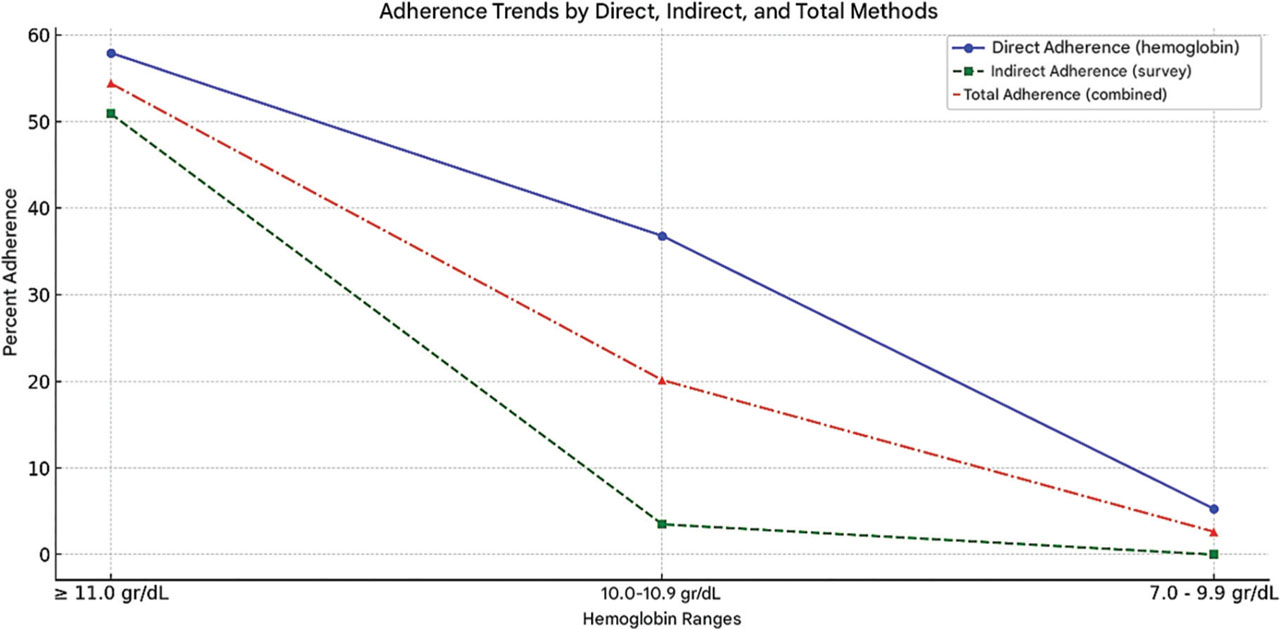
Figure 1.
Adhesion to ferrous sulfate according to direct and indirect methods.
4. Discussion
Iron supplementation remains the cornerstone of Peru’s national strategy to combat IDA among infants. Despite its availability and official endorsement, adherence to iron supplementation remains suboptimal, undermining the success of public health efforts. This study found an adherence rate of 54.4%, which is notably below the 65% threshold identified by Agegnehu et al.19 and the 75% benchmark set by MINSA for programmatic effectiveness. 22 These findings underscore the critical need to move beyond distribution and access and to focus on behavioral, educational, and structural determinants of adherence.
Notably, 57.9% of the sample population had adequate hemoglobin levels (≥11.0 g/dL), while 42.1% were anemic, with cases of mild and moderate anemia persisting. These rates, although lower than the national average, are still concerning given the narrow age range and the standardized supplementation protocol applied. National data show limited progress in reducing anemia prevalence, with rates remaining stagnant over time despite successive policy reforms.23 Structural barriers such as poverty, health literacy gaps, and systemic limitations in public health infrastructure may explain this disconnect, as suggested by Díaz et al.24
The statistically significant association between ferrous sulfate (FS) adherence and hemoglobin status (P = 0.00) confirms previous findings from studies such as Caizalitin-Toctaguano et al.25, which demonstrated that non-adherence is a major determinant of anemia in infants. In our study, 45.6% of children with inadequate hemoglobin levels were non-adherent, reinforcing the direct link between adherence behavior and hematologic outcomes. This emphasizes the importance of adherence not only as a compliance metric but as a predictive factor for biological efficacy.
Among the factors influencing adherence, individual and family dimensions emerged as the most significant. These findings are consistent with existing literature. For example, Ventura Solano and Soto Prudencio26, Silitonga et al.27, and Ibazeta-Estela and Penadillo-Contreras28 highlighted that caregiver perceptions, daily routines, maternal knowledge, and attitudes critically shape adherence behavior. Ureta et al.29further emphasized that such factors affect not only the initiation of supplementation but also its daily continuity—a key consideration in infant care.
Educational attainment and maternal age were also significant predictors of adherence, suggesting that interventions must be tailored to sociocultural and developmental contexts of caregivers. In this study, mothers with only primary or secondary education had significantly lower adherence rates than those with higher education. This suggests that cognitive understanding, health beliefs, and prioritization of infant care tasks may vary based on educational exposure, and thus health education strategies must be contextually adapted.
While institutional and social domains were not as strongly associated with non-adherence, they appear to play a protective role. High institutional adherence (86.0%) may reflect improved infrastructure, availability of supplements, and more rigorous supervision under programs like “Compromiso 1.” Ugwu et al.30 similarly observed that institutional reinforcement, especially through follow-up visits and consistent messaging, enhances compliance. However, passive availability alone is insufficient without proactive family and individual-level engagement.
Interestingly, among all predictor variables, individual-level factors had the highest (AOR = 2.8), confirming their dominant role in determining both adherence and hemoglobin outcomes. This aligns with Frizzi et al.31, who argued that personal factors—including the caregiver’s perceived benefits of supplementation, infant temperament, and ability to incorporate FS into daily feeding practices—are central to intervention success. Such insights support the design of personalized, behavior-based adherence support models, which could be more effective than uniform policy mandates.
At the policy level, the findings question the sufficiency of Peru’s current Technical Health Standard No. 213-2024, which emphasizes supply and distribution of iron supplements but does not adequately address behavioral and adherence determinants.32 Unlike the updated national TB control strategy (Standard No. 221-2024), which integrates adherence tracking and behavioral counseling, anemia control protocols remain largely pharmacological and reactive.33 This creates a critical gap in care and monitoring. The current study advocates for integrated public health protocols that include adherence monitoring, community-based education, digital reminder systems, and nurse-led follow-up, especially in high-risk and low-resource regions.
Implementing these strategies may, however, be challenging due to workforce limitations, especially in rural areas where the patient load is high and nursing resources are stretched thin. Therefore, building inter-professional collaboration, task shifting, and incorporating community health agents could offer feasible solutions. Furthermore, the use of mobile technology and SMS-based adherence reminders may help bridge gaps in follow-up, especially where human resource deployment is constrained.
Limitations and future directions
Despite its contributions, this study has several limitations. First, the sample was limited to a single health center in a high-poverty region, which restricts generalizability. Second, adherence was measured using a Likert-scale instrument, which, although validated (Cronbach’s α = 0.89), may still be subject to social desirability and recall bias. While the combination of direct (hemoglobin-based) and indirect (self-reported) measures offers strength, future studies should explore objective tracking tools, such as digital adherence monitoring devices.
Additionally, the cross-sectional design limits causal inferences. Longitudinal studies are needed to establish temporal relationships between supplementation, adherence behavior, and hemoglobin trends over time. Such designs would also allow for the assessment of intervention efficacy, particularly community-based or tech-enhanced adherence strategies.
5. Conclusions
This study highlights the critical role of adherence to ferrous sulfate supplementation in improving hemoglobin levels among 6-month-old infants in a resource-limited setting in Peru. Despite national efforts to provide universal access to iron supplements, adherence remains suboptimal, with just over half of the infant population complying with prescribed regimens. Notably, individual and family-level factors emerged as the strongest predictors of both adherence and hematologic outcomes, underscoring the need for behaviorally informed, care-giver-centered interventions.
While institutional and social support structures demonstrated protective effects, these alone are insufficient without sustained engagement from caregivers. The findings emphasize the importance of integrating adherence monitoring and behavioral support into national anemia control strategies—an approach currently absent from existing technical guidelines. Strengthening health education, tailoring support to maternal sociodemographic contexts, and enhancing intersectoral collaboration will be essential to improving adherence and reducing the burden of anemia.
Future policies must prioritize not only the supply of supplements but also the factors that determine their effective utilization. Comprehensive, multi-level interventions—spanning individual behavior, family dynamics, institutional practices, and social infrastructure—are essential to achieving sustainable reductions in childhood anemia in low-resource settings.