
1. Introduction
Hemodialysis (HD) is the most commonly used renal replacement therapy among patients with end-stage renal disease.1,2 Currently, the most common type of vascular access in prevalent patients is arteriovenous fistula (AVF; 70.9%) in Türkiye. Catheters are used by 28.2% of monitored patients.2 Long-lasting and effective vascular access is critical for patients. During the conventional HD treatment (4 h, thrice-weekly), 6 large-bore needles are inserted per week for patients, totaling a minimum of 312 insertions annually. However, the process of cannulation is often accompanied by various emotional responses.3,4
It is well known that prolonged and repeated exposure to needles for lifesaving treatments can result in some issues, such as needle fear and phobia among patients with chronic disease.4 Fear is typically characterized as a close alarm response to an immediate, real, or perceived threat,5 and is associated with low valence (negative affect) and high arousal levels.6 Needle fear is anxiety caused by the use of needles or injections,7 and it is estimated that 2 out of every 3 people are afraid of needles.8 A phobia is also characterized by intense fear and anxiety related to a specific situation or stimulus.5 Approximately 10% of the global population is estimated to experience needle phobia, which can pose life-threatening risks due to the avoidance of medical procedures.9,10
According to Duncanson et al.4 “The prevalence estimates yielded suggest a need for routine screening of needle fear via validated patient-reported measures in chronic disease cohorts where needle exposure is high” (p. 11). Several studies have investigated the fear of injection among pediatric patients, those undergoing dental treatment or vaccinations, and patients with chronic diseases requiring injections.4,11,12 In previous studies, patients’ injection-related fears have been evaluated using various methods, such as clinical expert assessments, standardized scales, and self-report perceptions. “The Diabetes Fear of Injecting and Self-Testing Questionnaire” (D-FISQ), which is a validated tool utilized worldwide, was developed by Snoek et al.11 to evaluate the fear of self-injection (FSI) and blood glucose testing in patients with insulin-treated diabetes in the Netherlands. It was a 30-item (2 subscales) and 4-point Likert-type scale ranging from 0 ([almost] never) and 3 ([almost] always). Moreover, a shorter version of the D-FISQ consisting of 15 items was developed by Mollema et al. (Table 1).12 It is also estimated that the fear of injection is prevalent among the dialysis population.4,13,14,15 A recent study has reported that 25.0%–47.0% of patients with kidney failure experience needle fear, depending on the methods used for determining fear.4 There are only a limited number of studies on the fear of injection in patients undergoing HD. In a Dutch study including 45 patients undergoing HD, Mulder et al.13 found that 44.4% of the patients had a fear of injections (cannulation). In that study, the fear of injection of patients was measured using “the Dialysis Fear of Injection Questionnaire” (DFIQ), which was modified from the abbreviated D-FISQ. The authors also indicated that more refinement of the DFIQ is required.13 In an Australian study of 551 chronic dialysis patients, Shanahan et al.14 found that 36.0% of the patients suffered from needle fear (assessed with a single question: “Have you ever been afraid of needles?”).
Table 1.
Item content of the FSI subscale of the D-FISQ and the HD-FIQ.
| Item No. | Snoek et al. (original English version of the FSI). (When I have to inject myself) | Mollema et al. (abbreviated English version of the FSI). (When I have to inject myself) | Celik and Pinar (Turkish version of the FSI). (When I have to inject myself) | In the present study (HD-FIQ). (When a needle must be inserted into a vascular access for HD) |
|---|---|---|---|---|
| 1 | I feel afraid. | I become restless. | I become restless. | I feel tense. |
| 2 | I start to sweat. | I feel tense. | I feel tense. | I feel afraid. |
| 3 | I become restless. | I feel afraid. | I feel afraid. | I feel nervous. |
| 4 | I try to avoid it. | I worry about it. | I worry about it. | I brood about it. |
| 5 | I feel tense. | I feel nervous. | I feel nervous. | |
| 6 | I get a stomachache. | I brood about it. | I brood about it. | |
| 7 | I panic. | |||
| 8 | I worry about it. | |||
| 9 | My heart starts pounding. | |||
| 10 | I feel nervous. | |||
| 11 | I start trembling. | |||
| 12 | I feel anxious. | |||
| 13 | I have trouble breathing. | |||
| 14 | I try to postpone it. | |||
| 15 | I get angry. |
Previous studies on various populations have shown that several factors, including personal characteristics, genetic factors, past experiences, and environmental factors, influence needle fear.5,15 For example, women are more likely than men to report needle fear. In addition, it tends to start to decline with age.5 However, different factors (study design, sample size, sampling strategy, participant characteristics, and the methodologies utilized for measuring needle fear, etc.) may also contribute to varying results.4 In a study conducted in patients undergoing HD, the fear of injection was found to be related to HD vintage, anxiety, and depression.13 Interestingly, in another study, patients’ unpleasant experiences with cannulation for HD, such as failure during the initial development stage, were reported to lead to needle phobia.16 Studies have also demonstrated that the fear of injections among patients undergoing HD is not influenced by gender,13,14 age, vascular access type, location of dialysis treatment (urban, rural, or home),14 or the use of topical anesthetic cream.13
On the other hand, several studies have shown that patients’ concerns regarding injections or fear of needles influence their adherence to prescribed treatment regimens.4,17 In Shanahan et al.’s study, 14 37.0% of patients undergoing dialysis with a phobia of needles indicated that this phobia influenced their choice of treatment method. In a study by McLaughlin et al.,18 needle phobia was reported as the primary barrier to self-care HD or home HD (47.0%) among in-center patients undergoing HD. Shamasneh et al.19 found that a contributing factor to patients’ refusal of AVF was a fear of needles (15.1%). Shafi et al.20 reported that fear of catheters (33.9%) and needles (24.5%) was a prevalent cause of treatment refusal among patients with a medical indication for HD.
Consequently, the early recognition of fear of injections in patients undergoing HD is essential, as it can lead to treatment rejection or avoidance. However, there is currently no instrument available to measure fear of injections in Turkish patients undergoing HD. Therefore, this study aimed to investigate the psychometric features of the Turkish version of the modified Hemo-dialysis Fear of Injecting Questionnaire (HD-FIQ) for patients undergoing HD. Our results will help in identifying patients’ fears regarding injections and facilitate the development and execution of effective management strategies to address them.
2. Methods
2.1. Design
This methodological study was carried out in a large city in Türkiye, utilizing a convenience sample of 123 patients from a single HD center. In this study, the sample size was determined based on the number of scale items (6). To explore the scale’s factor structure, a sample size of 5 or 10 times the total number of items in the scale is advised.21 Our sample size was sufficient to conduct factor analysis. The sample size required for the study was also calculated using a “web-based sample size calculator”22 with the following parameters: minimum acceptable Cronbach’s alpha coefficient: 0.70, expected Cronbach’s alpha coefficient: 0.80, significance level (α): 0.1 (1-tailed test), power: 80%, number of items: 6. Thus, the sample size required was calculated as 93 (with 5.0% expected dropout, ndroP=98).
The inclusion criteria were: (1) aged ≥18 years, (2) undergoing maintenance HD for at least 1 month, and (3) being able to speak Turkish. The exclusion criteria were as follows: (1) unstable clinical status and (2) a history of cancer, severe psychiatric or neurological comorbidities. A total of 118 patients who met the inclusion criteria were enrolled in the study. Finally, 100 patients (62.0% male) agreed to participate (response rate: 81.8%). Figure 1 shows the Strengthening the Reporting of Observational Studies in Epidemiology (STROBE) flow diagram of the study design.
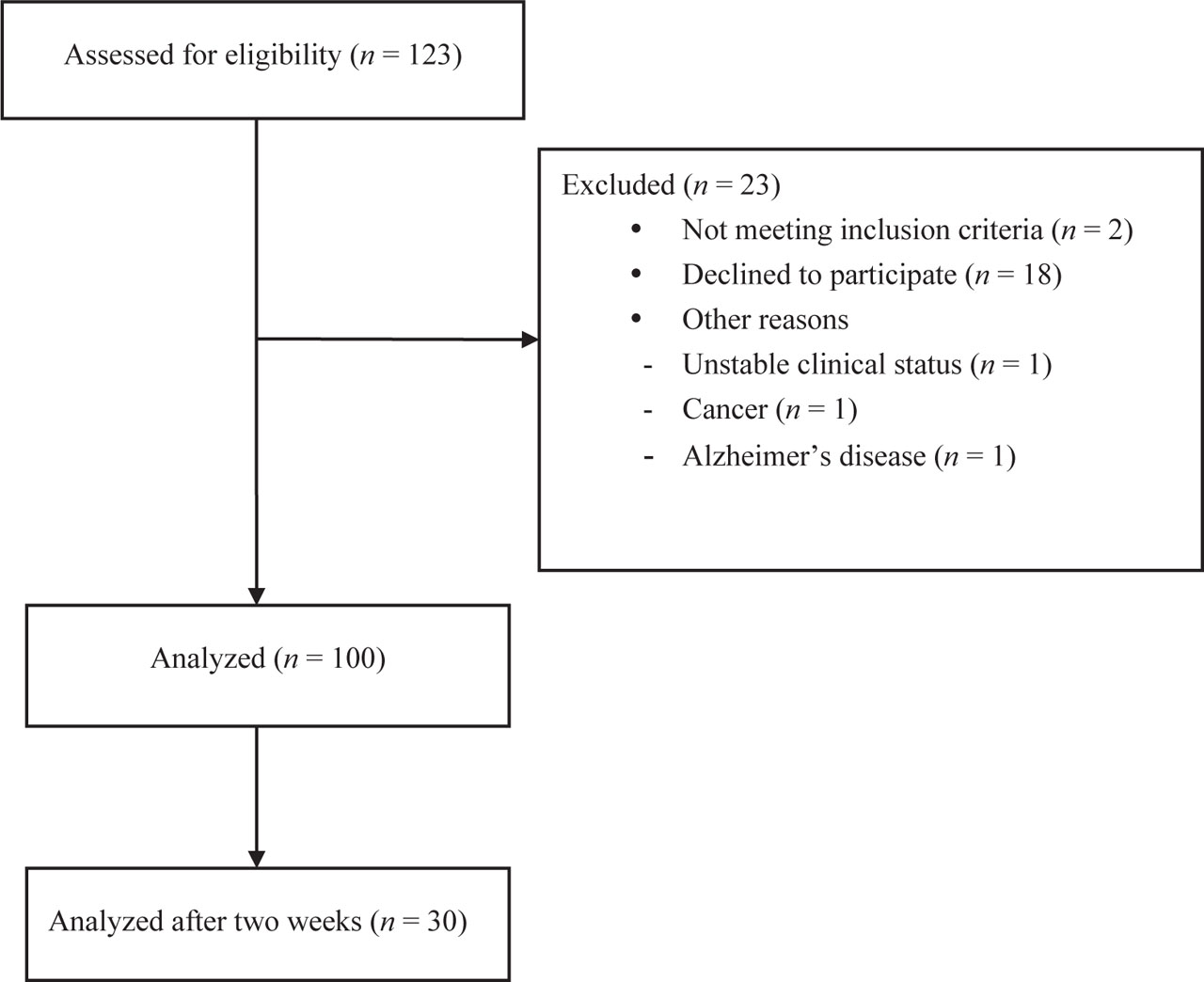
Figure 1.
STROBE flow diagram of the study design.
Note: STROBE: Strengthening the Reporting of Observational Studies in Epidemiology.
2.2. Measures
2.2.1. Participant characteristics
A personal information form was designed based on the relevant literature. The first section of the form included sociodemographic characteristics. The second section contained disease characteristics (dialysis vintage, the presence of chronic disease, dialysis frequency, the presence of residual urine output, type of vascular access, and the application status of a topical anesthetic cream before cannulation, etc.). The patients were asked to report if they felt fear of injections just before HD. The patients also rated their fear of injections with a visual analog scale (VAS) ranging from 1 (no fear) to 10 (very intense fear). The VAS score was classified into 4 categories: “1: no fear,” “2–4: low fear,” “5–7: medium fear,” and “8–10: high fear.”23,24
2.2.2. State anxiety
The Turkish version of the State Scale of the State-Trait Anxiety Inventory (STAI-S) was used to assess state (situational) anxiety among patients. The 20-item and 4-point Likert-type scale is scored between 1 (not at all) and 4 (very much so). The total scale score is between 20 and 80. Higher scores reflect greater levels of state anxiety.25 The STAI-S score is classified as follows: “low: 20–39,” “medium: 40–59,” and “high: 60–80.”23,26 The internal consistency values for the scale were found as 0.83 and 0.92.25 The Cronbach’s alpha coefficient of the STAI-S in the present study was calculated as 0.95.
2.2.3. Fear of injections
The validity and reliability study of the Turkish version of the shortened D-FISQ was conducted among patients with diabetes by Celik and Pinar.27 In this study, we focused on only the dimension of the FSI of the scale (Table 1). The 6-item and 4-point Likert-type subscale is scored from 1 (almost never) to 4 (almost always), differing from the original English version. The total subscale score is calculated based on the sum of each item score (range: 6–24), with higher scores associated with greater fear. The results for this dimension demonstrated high internal consistency (Cronbach’s alpha = 0.93), stability over time (intraclass correlation coefficient [ICC] = 0.93), and divergent validity with state anxiety.27
2.3. Procedure
At the outset of the study, we aimed to conduct a validity and reliability study of the Turkish version of the DFIQ. Unfortunately, we were unable to reach the authors who adapted the scale via email. Therefore, we decided to modify the D-FISQ to assess patients’ fears regarding injections. Permission to use the instrument was obtained from the authors who developed the original scale via email (Professor Frank J. Snoek, Ph.D., 24 November 2019), as well as those who conducted the scale’s Turkish validity and reliability study (Selda Celik, Ph.D., 27 November 2019).
Since the original version was already in Turkish, no formal translation or cross-cultural verification was necessary for the FSI subscale. Only minor modifications were made to item descriptions to align with the target population, following the World Health Organization (WHO) guidelines for translation and adaptation of instruments.28 All items were specifically modified to assess the fear regarding cannulation in patients undergoing HD. In the instruction section of the FSI subscale, “When I have to inject myself” was changed to “When a needle must be inserted into a vascular access for HD” in the HD-FIQ. In addition to this change, no other modifications were made to the item pool (Table 1).
Before the study, the content validity index (CVI) was calculated at the item (item-CVI) and scale levels (scale-CVI).29 An expert group (1 linguist, 3 nurses, and 2 nephrologists) was assigned with assessing the clarity (understandability) and relevance (appropriateness) using a 4-point scale (“1: not relevant/not clear,” “2: somewhat relevant/clear,” “3: quite relevant/clear,” and “4: highly relevant/clear”).30,31 The item-CVI was computed as the number of experts who rated 3 or 4 divided by the number of experts. In the panel of 6 experts, the item-CVI should not be <0.78. The item-CVI was found between 0.83 and 1.00. The scale-CVI was also calculated as the average proportion of the items on the scale rated 3 or 4. A scale-CVI score of 0.90 or above was considered acceptable.29 The scale-CVI was found to be 0.94 for relevance and 1.00 for clarity. As a consequence, all items demonstrated high validity with respect to clarity and relevance, and the modified version’s content validity was confirmed. The draft scale, called the HD-FIQ, was tested with 15 patients who had characteristics similar to the sample group. All of the statements on the HD-FIQ were easily understood by all patients. The participants in the pilot test were excluded from the final sample.
2.4. Data collection
Approval to conduct the study was obtained from the Yüksek İhisas University Non-Interventional Research Ethics Committee (date: 07 February 2020; decision no: 2020/01/01), as well as the Medical Director of the related HD center. Written informed consent was obtained from the participants. The study was performed in accordance with the ethical standards of the Helsinki Declaration (2013).
Between May and June 2020, the researcher conducted face-to-face interviews with patients just before cannulation for HD, each lasting about 10–15 min. The HD-FIQ was administered again 2 weeks later to 30 patients from the study group to determine the test–retest reliability of the HD-FIQ.
2.5. Data analysis
The data collected were analyzed using the IBM Statistical Package for Social Sciences version 23.0 (IBM Corporation, Armonk, New York, United States). Descriptive statistics such as mean (M), median, standard deviation (SD), frequency distributions, and percentages were calculated for variables. The normality of the data was examined by the one-sample Kolmogorov–Smirnovtest.
The reliability of the HD-FIQ was tested by examining internal consistency using Cronbach’s alpha coefficient, and the test–retest reliability using paired-samples t-test and ICC (average measure). The Cronbach’s alpha value was evaluated as follows: 0.70–0.95, good reliability, and above 0.95, redundancy. An ICC value of 0.70 was defined as the threshold for reliability, with values above 0.90 indicating excellent reliability.32 Pearson’s correlation coefficients were utilized to calculate item-to-total correlations and inter-item correlations, as the assumptions of parametric tests were met. Correlations >0.50 were considered strong, and correlations <0.30 were considered weak.32 High inter-item correlations (>0.80) were also accepted as an indication of redundancy.33 The 2 criteria were determined to eliminate poorly functioning items in the scale: the corrected item-total correlation (CITC) coefficient (<0.30) and Cronbach’s alpha coefficient if the item was deleted (>0.10).34
The validity of the scale was investigated in terms of face and content validity, construct validity, concurrent validity, convergent validity, and known-group validity. The construct validity of the HD-FIQ was examined by exploratory factor analysis using the Kaiser–Meyer–Olkin measure, Bartlett’s test of sphericity, and the scree test. The principal component analysis (PCA; varimax rotation with Kaiser normalization) was also computed to determine the component loadings of the HD-FIQ. Spearman’s rho correlation coefficient, a non-parametric statistical test, was used to assess the concurrent validity of the HD-FIQ with HD vintage and the STAI-S scores and convergent validity with the severity of injection fear as measured by the VAS. The HD-FIQ total score was hypothesized to correlate with HD vintage (Hypothesis 1), the STAIS scores (Hypothesis 2), and the VAS-fear scores (Hypothesis 3). To investigate the known group validity of the HD-FIQ, the scale total scores were classified by 3 variables: the presence of injection fear (yes/no), the intensity of fear (no, low, medium, and high fear), and the severity of state anxiety (medium/high anxiety). Since we determined that these variables were not normally distributed, we decided to use non-parametric statistical tests. The differences for continuous variables were tested by the Mann–Whitney U test (for 2 groups) and the Kruskal–Wallis test (for 4 groups). After the Kruskal–Wallis test, the post hoc, the Mann–Whitney U test with a Bonferroni correction was performed to assess the pairwise comparisons, and a P-value of 0.0083 was considered statistically significant for the 4-group comparisons (P < 0.05/number of comparisons). A P-value of <0.05 was considered statistically significant in other analyses. In particular, the following hypotheses were formulated: Hypothesis 4: Patients with a fear of injection, as compared to patients without fear, would have higher HD-FIQ scores, Hypothesis 5: Patients with a high fear of injections would have higher scores on the HD-FIQ than other patients, and Hypothesis 6: Patients with high levels of state anxiety would have higher scores on the HD-FIQ than other patients.
3. Results
3.1. Sociodemographic and disease characteristics
Patients’ mean age was 62.99 years (SD = 16.34) and median HD vintage was 60 months (range: 1–396). The types of vascular access were AVF (87.0%) and catheter (13.0%). A total of 48% of the patients suffered from mild to severe fear of injection. It was found that any topical anesthetic cream was not used routinely to prevent pain before cannulation for HD, and any intervention to reduce fear in patients who had a fear of injection was not performed. The mean VAS-fear score was 2.62 (SD = 2.19). Other sociodemographic and disease characteristics of the patients are summarized in Tables 2 and 3.
Table 2.
Descriptions of participant characteristics and comparison of the HD-FIQ scores by participant characteristics (N = 100).
| Variables | n (%) | HD-FIQ | ||
|---|---|---|---|---|
| M (SD) | z† | P-value | ||
| Gender | ||||
| Female | 38 (38.0) | 5.95 (3.01) | –0.06 | 0.951 |
| Male | 62 (62.0) | 6.26 (3.32) | ||
| Marital status | ||||
| Married | 58 (58.0) | 6.41 (3.50) | –0.68 | 0.495 |
| Unmarried | 42 (42.0) | 5.76 (2.74) | ||
| Education level | ||||
| Literate/primary school (5 years) | 39 (39.0) | 6.44 (3.23) | –1.08 | 0.281 |
| Secondary school or greater (≥6 years) | 61 (61.0) | 5.95 (3.20) | ||
| Employment status | ||||
| Working | 20 (20.0) | 5.65 (2.56) | –0.68 | 0.498 |
| Not working | 80 (80.0) | 6.26 (3.34) | ||
| Income level | ||||
| Adequate | 20 (20.0) | 5.35 (2.25) | 2.16 | 0.339 |
| Moderate | 45 (45.0) | 6.16 (3.42) | ||
| Inadequate | 35 (35.0) | 6.57 (3.35) | ||
| Comorbidity | ||||
| Yes | 76 (76.0) | 6.07 (2.90) | −0.38 | 0.703 |
| No | 24 (24.0) | 6.38 (4.06) | ||
| Dialysis frequency | ||||
| Twice weekly | 8 (8.0) | 7.00 (3.16) | –1.05 | 0.294 |
| 3 times weekly | 92 (92.0) | 6.07 (3.21) | ||
| Residual urine output | ||||
| Yes | 12 (12.0) | 6.08 (3.03) | –0.14 | 0.886 |
| No | 88 (88.0) | 6.15 (3.24) | ||
| Vascular access | ||||
| AVF | 87 (87.0) | 6.39 (3.30) | –2.73 | 0.006 |
| Catheter | 13 (13.0) | 4.46 (1.66) | ||
| Injection fear | ||||
| Yes | 48 (48.0) | 8.46 (3.32) | –9.15 | <0.001 |
| No | 52 (52.0) | 4.00 (0.01) | ||
| Intensity of injection fear (n = 48) | ||||
| No | 52 (52.0) | 4.00 (0.01) | 89.23 | <0.001 |
| Mild | 31 (31.0 | 6.97 (1.96) | ||
| Medium | 11 (11.0) | 9.18 (2.09) | ||
| High | 6 (6.0) | 14.83 (2.86) | ||
| Intensity of anxiety | ||||
| Medium | 32 (32.0) | 6.06 (4.47) | –2.70 | 0.007 |
| High | 68 (68.0) | 6.18 (2.43) | ||
Table 3.
Means, SDs, ranges, medians, and comparison of the HD-FIQ scores by various parameters (n = 100).
| Variables | M (SD) | Range | Median | HD-FIQ | |
|---|---|---|---|---|---|
| r† | P | ||||
| Age (years) | 62.99 (16.34) | 21–96 | 63.00 | 0.14 | 0.157 |
| Dialysis vintage (months) | 88.61 (85.03) | 1–396 | 60.00 | –0.40 | <0.001 |
| Intensity of injection fear (VAS) | 2.62 (2.19) | 1–9 | 1.00 | 0.96 | <0.001 |
| STAI-S | 61.87 (6.50) | 50–75 | 63.00 | 0.33 | 0.001 |
3.2. State anxiety
The mean total STAI-S score of the patients was 61.87 (SD = 6.50; Table 3). In all, 32 patients (32.0%) had moderate anxiety, while 68 patients (68.0%) had severe anxiety (Table 2).
3.3. Reliability analysis
In this study, the initial scale had high internal consistency (Cronbach’s alpha coefficient = 0.97), suggesting potential item redundancy.32 The inter-item correlation matrix also demonstrated that 2 items (Item 1: I become restless, and Item 4: I worry about it) had correlations of over 0.80 with other items on the scale, which may indicate item redundancy.33 As a result, these items were removed from the item pool, and the final version of the scale was composed of 4 items, with a total score of 4–16 (Table 1).
The reliability analysis was repeated for the revised scale. The results showed that the final scale had good internal consistency (Cronbach’s alpha coefficient = 0.89) and inter-item correlations (range = 0.67–0.80). All CITCs for the HD-FIQ were >0.30,35 which ranged from 0.83 to 0.88 (Table 4). The internal consistency could not be improved with the deletion of items. Therefore, we decided to include every item in the HD-FIQ. Test-retest reliability was also high for the scale32 with ICC of 0.94 (95% confidence interval [CI] = 0.92–0.96, P < 0.001; Table 5). Based on the paired samples t-test results, there was no difference between the test and retest scores for the HD-FIQ (P > 0.05; Table 5).
Table 4.
Item means, SDs, CITC, CAID, component loading, and inter-item correlation matrix of the HD-FIQ (n = 100).
| Item No | M (SD) | CITC | CAIDa | Component loading† | Item 1 r* | Item 2 r* | Item 3 r* |
|---|---|---|---|---|---|---|---|
| 1 | 1.57 (0.86) | 0.88 | 0.89 | 0.94 | – | ||
| 2 | 1.69 (0.88) | 0.87 | 0.89 | 0.93 | 0.80 | – | |
| 3 | 1.44 (0.83) | 0.87 | 0.89 | 0.93 | 0.71 | 0.72 | – |
| 4 | 1.50 (0.88) | 0.83 | 0.90 | 0.91 | 0.70 | 0.67 | 0.75 |
3.4. Validity analysis
3.4.1. Construct validity
The Kaiser–Meyer–Olkin measure of sampling adequacy was 0.82. The Bartlett’s test of sphericity was statistically significant (χ2 = 377.377, df = 6, P < 0.001). These results showed that the dataset was appropriate for factor analysis. Data extraction was performed using the PCA, which yielded one retained factor with an eigenvalue greater than one for further analysis. The factor accounted for 85.4% of the total variance. The scale’s factor structure was confirmed using scree plot analysis. The rotated component matrix indicated that all objects were loaded on the same factor. All components had factor loadings above 0.40 (range: 0.91–0.94). “I feel tense” (loading of 0.94) was the highest loading item within this factor, whereas “I brood about it” (loading of 0.91) was the lowest loading item (Table 4).
3.4.2. Concurrent validity
The HD vintage and the STAI-S scores were used as the criterion measures to establish concurrent validity of the HD-FIQ scores. As seen in Table 3, there was a negative correlation between the HD-FIQ scores and HD vintage (r = −0.40, P < 0.001), and a significant positive correlation with the STAI-S scores (r = 0.33, P = 0.001).
3.4.3. Convergent validity
In this study, the correlation between the HD-FIQ and VAS-fear scores was evaluated. The HD-FIQ scores were positively correlated with the VAS-fear scores (r = 0.96, P < 0.001; Table 3).
3.4.4. Known-group validity
The patients’ scale scores were compared based on the presence of injection fear and its intensity (assessed with the VAS-fear scores) to verify the known-group validity. Patients with a fear of injections had higher scores on the HD-FIQ than those without fear (z = −9.15, P < 0.001). The Kruskal–Wallis test also revealed a significant difference among the groups with respect to the intensity of injection fear (χ2 = 89.23, P < 0.001; Table 2). Patients with mild and medium fear had greater HD-FIQ scores than those with no fear (z = −6.82, P < 0.001; z = −7.95, P < 0.001, respectively). Patients with high fear had also significantly higher HD-FIQ scores than those with no fear (z = −7.88, P < 0.001), and mild fear (z = −2.81, P = 0.003). Furthermore, the HD-FIQ scores were compared based on the severity of anxiety to verify the known-group validity. Patients with high anxiety had higher HD-FIQ scores than those with medium anxiety (z = −2.70, P = 0.007; Table 2).
3.5. Fear of injections
The mean HD-FIQ score of the patients was 6.14 (SD = 3.20, median = 6.00, range = 4–16). As shown in Table 4, the most reported item was “I feel afraid” (item 2, M = 1.69, SD = 0.88). The least frequently reported item was “I feel nervous” (item 3, M = 1.44, SD = 0.83). The Mann–Whitney U test showed a significant difference in the scale scores according to the type of vascular access (Table 2). Patients with AVF had significantly higher HD-FIQ scores than those with the catheter (z = − 2.73, P = 0.006). According to Pearson’s correlation coefficients, dialysis vintage was significantly negatively correlated (r = −0.40, P < 0.001), whereas VAS-fear (r = 0.96, P < 0.001) and the STAI-S scores (r = 0.33, P = 0.001) were positively correlated with the HD-FIQ scores (Table 3).
4. Discussion
This study examined the psychometric features of the Turkish version of the modified HD-FIQ for patients undergoing HD. In the present study, the face and content validity of the instrument were established. Our findings showed the one-factor solution to be the best fit for the data. One component was also consistent with the theoretical structure of the FSI subscale of the D-FISQ.12,27
The result of this study confirmed the internal consistency of the HD-FIQ (Cronbach’s alpha = 0.89). This finding is similar to findings reported for the FSI sub-scale of the D-FISQ by Mollema et al.12 and Celik and Pinar27 (Cronbach’s alpha = 0.89, 0.81, respectively). The HD-FIQ also had excellent test–retest reliability with a 2-week period (ICC = 0.94), indicating that the scale was fairly stable and consistent. These results are consistent with a previous study that identified the test–retest reliability as excellent (ICC = 0.93) for the FSI subscale after 2 weeks of the first evaluation.27 But contrary to this study, Mollema et al.12 reported lower test–retest reliability for the same domain after 3- and 15-month intervals (ICCs = 0.58 and 0.68, respectively).
In the current study, HD vintage and the STAI-S scores were selected to determine the concurrent validity of the HD-FIQ, and the correlation between the scale scores and each variable was evaluated. The results demonstrated that higher fear scores were associated with decreased treatment duration and increased anxiety levels among patients undergoing HD. Significant correlations were determined between the HD-FIQ scores, HD vintage, and the STAI-S scores in the present study. The results supported the concurrent validity of the scale, thereby affirming Hypotheses 1 and 2. Our findings were congruent with a previous study,13 suggesting that the fear of injection was significantly negatively correlated with HD vintage, and positively correlated with anxiety. Similarly, Mollema et al.12 reported that there is a relationship between injection fear and anxiety in patients with insulin-treated diabetes.
Additionally, the correlation between the HD-FIQ and VAS-fear scores was examined to confirm the convergent validity. The HD-FIQ scores were significantly positively correlated with the VAS-fear scores, indicating a potential relationship with increased fear intensity. This result was in line with expectations; thus, the convergent validity of the HD-FIQ was confirmed, providing support for Hypothesis 3.
The known-group validity was assessed by examining differences in the mean HD-FIQ scores according to the presence of injection fear and its intensity, as well as the severity of anxiety. Compared with patients with no fear of injection, those who suffered from the fear had significantly higher HD-FIQ scores. Consistent with our expectations, patients who experience high levels of fear tend to have higher scores on the scale than those with no fear or mild fear. Moreover, patients were divided into 2 groups regarding the severity of anxiety to evaluate the known-group validity of the HD-FIQ. Patients who experience high levels of anxiety tend to have higher scores on the scale than those with medium anxiety. Patients who experience high levels of fear of injections may also have increased anxiety levels just before the cannulation procedure. Several studies have highlighted the relationship between fear and anxiety.7,12,13,27 This finding is consistent with the findings reported by Celik and Pinar,27 who found that fear of injection was higher in patients with moderate to severe anxiety than in patients with mild anxiety, suggesting a substantial association between fear and anxiety. The overall results supported the known-group validity of the scale, thereby affirming Hypotheses 4, 5, and 6.
This study has some limitations. First, a single-center, convenience sample, and a cross-sectional design may limit the generalizability of our findings. Therefore, our results should be interpreted with caution due to the limited diversity of the sample, which primarily consisted of urban-dwelling, mostly unemployed males with a mean age of 63, and with secondary school or higher education. Second, the fact that data collection took place during the Coronavirus disease 2019 (COVID-19) pandemic may have affected patients’ psychological situation, which in turn might have influenced their willingness to participate in the study. Nevertheless, the participation rate was relatively high (81.8%). The study did not collect data regarding patients’ reasons for refusal (e.g., anxiety or avoidance) and the characteristics of non-responders, limiting the ability to compare responders and non-responders. The data also limit the ability to fully determine potential selection bias. Third, our findings were based on self-reported data, which may have led to recall bias. Fourth, the PCA confirmed the unidimensionality of the HD-FIQ; however, a Rasch analysis was not performed due to the sample size (n = 100) being inadequate for producing conclusive results in this study. Finally, the limited number of items in the scale may have resulted in a bandwidth effect, leading to overly narrow measurements that could restrict precision. Future studies should consider utilizing longer or more comprehensive instruments to capture the full range of the construct. Additionally, future studies including multi-center trials with large sample sizes and more diverse populations should be conducted to ensure the external validity of the HD-FIQ and provide more robust evidence that applies across different contexts. It is also recommended to assess the robustness of the instrument through Rasch modeling. Longitudinal follow-up studies could further illuminate the potential impacts of time and patient-centered interventions on injection fears.
5. Conclusions
The HD-FIQ is an assessment tool that focuses on the injection fear of patients undergoing HD. The initial psychometric assessment of the modified scale indicated that it is a valid, and reliable instrument for evaluating the fear of injection among patients. The HD-FIQ may be applied at key points in patient care, such as before HD treatment initiation or during routine follow-ups. The results may help identify patients with a high fear of injections for referral to a specialist, enabling the implementation of tailored education, counseling, or supportive interventions accordingly, thereby facilitating more patient-centered care for patients undergoing HD. The HD-FIQ may also be used to monitor the impact of various interventions on patients’ fear of injections, ensuring that care is tailored to individual needs.
Acknowledgments
The author thanks all the patients who took the time to participate in this study.
Notes
[13] Declarations
Part of this study was presented as an oral presentation at the II. International Cappadocia Health and Life Congress held in Nevşehir, Türkiye, 22–23 August 2025.
[14] Contributed by Authors contributions
BK: Conceptualization, Methodology, Validation, Investigation, Formal analysis, Data Curation, Writing-Original Draft, Review & Editing, Supervision.