
1. Introduction
The organizational commitment of nursing staff, while restoring, maintaining, and promoting human health, will significantly increase professional commitment and lead to the better achievement of organizational goals.1 Ethics is a series of acquired traits and qualities that humans accept as ethical principles. In nursing, ethics is the foundation for behavioral standards and provides a framework for nurses’ actions.2 Increasing workload in nurses leads to more exposure to ethical issues and sometimes disrespect, which can lead to increased dissatisfaction.3 Ethical distress is unavoidable due to the prioritization of budget and work-related issues over patient’s safety and care. If personnel, successful managers, and insurance agents themselves behave ethically, the agents will exhibit a high commitment to their company.4 Merging ethical values is an important dimension of organizational culture, and the presence of misalignment or ethics gaps affects the quality of care being delivered, the morale, and the behavior of the staff and the organization’s image in the community.5
Organizational commitment is employee’s level of identification and participation with organizational goals and values.6 It is the individual’s tendency to put enough energy and loyalty in favor of the social system and the willingness to continue paying service in an organization.7 Organizational commitment is influenced by personal and structural factors and the employee’s previous experience.8 A person with high organizational commitment will show great effort and even sacrifice to achieve the goals of the organization.9 He/she adopts his/her identity from the organization, participates and engages with it, and enjoys being its member.10 Increasing the level of job satisfaction, involving personnel in the affairs of the organization, and being accepted by the management are factors affecting organizational commitment.11 Organizational commitment has been assumed as one of the predictors of intention to leave so that nurses who have less commitment and attachment to their workplace are more likely to quit their job, which will seriously disrupt the daily activities of the hospital.12,13
The ethical climate of an organization is measured by the ethical dimensions of an organization.14 The framework presented by Cullen et al.15 for measuring employees’ perceptions of the ethical climate is a combination of the theoretical structures of cognitive development, the ethical theory of Kohlberg, and the places of analysis. In the self-centered dimension and the place of individual analysis, ethics becomes instrumental. In the humanitarian dimension and the place of individual analysis, ethics becomes of a caring type, and in the basic dimension and place of international analysis, it finds the role of adherence to principles, laws, and codes of ethics. Available evidence shows that organizational ethical climate crucially predicts behaviors.16 There is a relationship between nurses’ perceptions of ethical climate and their individual interests.17,18 These ethical principles and values can serve as a source for nurses’ decision-making and practice. The current study seeks to examine the relationship between ethical climate, organizational commitment, and ethical behavior of the nurses working at the Hamadan University of Medical Sciences. Figure 1 illustrates the conceptual model and the study hypotheses presented for review, including:
There is a relationship between the perception of ethical climate and nurses’ organizational commitment.
There is a relationship between organizational commitment and nurses’ ethical behavior.
There is a relationship between perceptions of ethical climate and nurses’ ethical behavior.
There is a relationship between the perception of ethical climate, organizational commitment, and nurses’ ethical behavior.
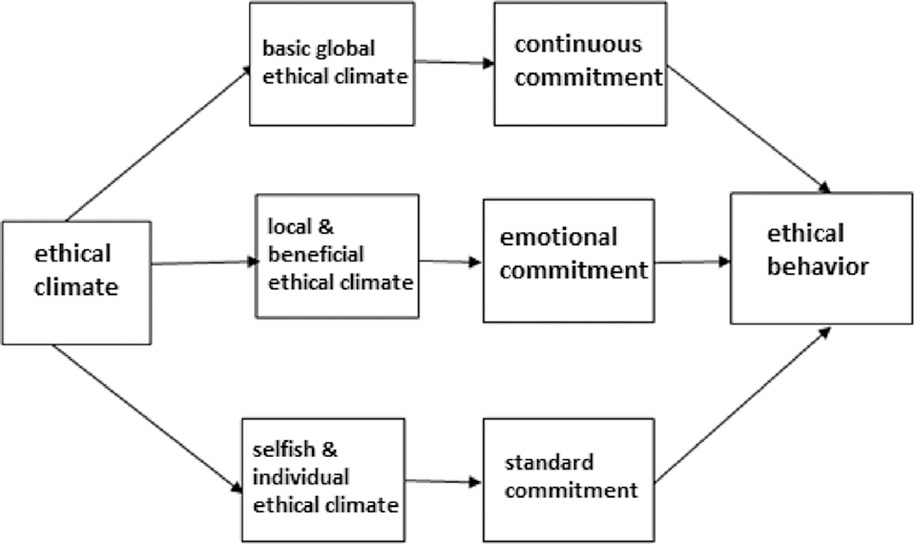
Figure 1.
Conceptual model and the study hypotheses.
2. Methods
In the current study, a fundamental method (Structural Equation Modeling) is used to examine the effective variables on ethical behavior, while considering the mediating effect of organizational commitment in the ethical climate of Hamadan University of Medical Sciences.
The research sample consists of the nurses working at the treatment-educational centers of Hamadan University of Medical Sciences who had the criteria for entering the study. Entry criteria included education level of at least a bachelor’s degree and work experience of at least one year or more in the inpatient departments. Nurses, who incompletely answered the questionnaire or were employed in departments of the hospital other than the inpatient department, were excluded from the study.
The samples were selected by proportional, stratified random. The population of the sample, based on the previous samples,19 with a correlative coefficient of 0.24 between the organizational commitment and ethical climate, the significance level of 5%, and power of 90%, given the following formula and the possibility of a 10% drop in the sample, the extent of the total sample was estimated to be 280 nurses.
The calculation of sample size is given in Eq. (1).
The research tools included the demographic data questionnaire, Allen & Mayer organizational commitment questionnaire, Cullen & Victor ethical climate questionnaire, and Peterson ethical behavior questionnaire.
2.1. Organizational commitment questionnaire
In this study, the Allen and Meyer organizational commitment questionnaire was used. The questionnaire has 3 domains including affective commitment, continuous commitment, and normative commitment, each of which is assessed with 8 questions. The questionnaire has a 5-point Likert scale. In this questionnaire, the expressions 4-5-6-8-9-12-18-19-21-24 were scored in reverse order.
2.2. Ethical climate questionnaire
The Cullen & Victor (1988) ethical climate questionnaire has been designed based on Kohlberg’s theory (1981) on three ethical dimensions including egoism (maximizing self-interest), benevolence (maximizing individual interests as much as possible) and principles (adherence to global principles and beliefs in dimensions of theoretical ethical climate) are created which include individual egoism (individual benefit), global egoism (productivity), individualistic principles (personal ethics), regional egoism (organizational benefit), individual benevolence (friendship), regional ethical principles (organizational rules and standards), regional benevolence (group interests), global ethical principles (professional rules and codes) as well as global benevolence (social responsibility and subordinates’ interests). The dimensions of the questionnaire were determined through confirmatory factor analysis. The findings showed that the assumption of the nine dimensions created by this model fits the data better than the previously used five-part model.14,15
Each of the nine dimensions was assessed through 4 questions. The questionnaire scale is based on a 5-point Likert scale. The overall score and each dimension of the questionnaire are calculated by summing the scores.
2.3. Ethical behavior questionnaire
The results of the research on the Peterson ethical behavior questionnaire show that most ethical climate dimensions act as a predictive factor for the non-observance of ethical behavior, so the aspects of this questionnaire can greatly predict certain types of immoral behaviors. The questionnaire merges nine items to form interrelated ethical behaviors. It has a 5-point Likert scale and the total score is calculated by summing the scores.
The organizational commitment questionnaire has been used in nursing research, and its validity has been proved. Internal reliability in Nabizadeh Gharghozar et al.20 and Neves et al.21 research was 87% and 82%, respectively.
The validity of the ethical climate questionnaire underwent content validity and reliability tests through Cronbach’s alpha coefficient (89%) in the study of Heidari et al.,22 Mohammad Najafi’s study (1389), and Cronbach’s alpha reliability coefficient (76/0).23
The ethical behavior questionnaire in Peterson’s14 study showed that the reliability is appropriate enough by being 0.82, and in Heidari et al.’s22 research was 89% through Cronbach’s alpha coefficient. The validity of the questionnaire was obtained in the form of content validity, and the reliability has been set to 76% in the Najafi study (2010)16 and 89% in the DeVellis24 study.
The data analysis was performed using AMOS V.23 and SPSS V.23 software. The significance level of the p value was assumed to be <0.05. We used model fitness indices to evaluate the suitability of the model. The indices used included X2, X2/df, GFI, AGFI, RMSEA, CFI, and NNFI.
2.4. Ethical considerations
The current scheme was approved by the ethical code and the specific ID of IR.UMSHA.REC.1396.601 at the Research Council of Hamadan University of Medical Sciences. Moreover, the confidentiality of the subjects’ information, their willing participation in the research by giving written consent, the explanation of the research goals to the subjects, and honesty in collecting and analyzing the data were among the ethical considerations taken into account during the research.
3. Results
The mean age of the participating nurses was 32.13 and the standard deviation was 6.192. About 98.3% of the nurses were females, among which 86.5% of the nurses were married and the rest were single. The educational level of the nurses (94.3%) was B.S. Most nurses’ shifts (61.8%) were rotational and night shifts were in the least frequency (5.4%). About 91.8% of the study units (nurses) did not have any membership in the Ethics Committee.
The highest average of the organizational commitment dimension belonged to a continuous commitment with 25.09 ± 7.16, and the lowest average was for affective commitment with 15 ± 4.68. The highest average of the perception of ethical climate was related to regional benevolence with 16.6 ± 3.4, with the lowest average belonging to global benevolence with the amount of 2 ± 0.061. Furthermore, the mean and standard deviation of the ethical behavior was 19.89 ± 4.79. The findings indicate that the highest correlation coefficient belongs to the two variables of total ethical climate and affective commitment (r = 0.37, p < 0.001).
Organizational commitment had a significant relationship with the dimensions of the ethical climate of global egoism (r = 0.24, p < 0.001), individual ethical principles (r = 0.16, p = 0.006), regional egoism (r = 0.25, p < 0.001), individual benevolence (r = 0.21, p = 0.001,), regional ethical principles (r = 0.13, p = 0.031), regional benevolence (r = 0.20, p = 0.001), global ethical principles (r = 0.17, p = 0.004,), global benevolence (r = 0.28, p < 0.001), and total ethical climate (r = 0.28, p < 0.001; Table 1).
Table 1.
Relationshipbetween ethical climate perception and nurses’ organizational commitment.
| Pearson correlation (r) | Organizational commitment | ||||
|---|---|---|---|---|---|
| Affective commitment | Continuous commitment | Normative commitment | Total | ||
| Ethical climate | Individual egoism | 0.307*** | 0.063 | 0.230*** | 0.240*** |
| Global egoism | –0.029 | 0.054 | –0.173 | –0.054 | |
| Individual ethical principles | 0.319*** | 0.073 | 0.222*** | 0.247*** | |
| Regional egoism | 0.162** | 0.052 | 0.185** | 0.164** | |
| Individual benevolence | 0.227*** | 0.132* | 0.130* | 0.208*** | |
| Regional ethical principles | 0.327*** | 0.019 | 0.177** | 0.201** | |
| Regional benevolence | 0.187** | 0.004 | 0.143* | 0.129* | |
| Global ethical principles | 0.279*** | –0.004 | 0.174** | 0.170** | |
| Global benevolence | 0.327*** | 0.166** | 0.177** | 0.281*** | |
| Total | 0.372*** | 0.098 | 0.222*** | 0.279*** | |
The findings revealed that, by the Peterson correlation, there is not a significant relationship between organizational commitment and its dimensions with ethical behavior (Table 2).
Table 2.
Relationship between nurses’ organizational commitment and their ethical behaviors.
| Pearson correlation (r) | Organizational commitment | |||
|---|---|---|---|---|
| Affective commitment | Continuous commitment | Normative commitment | Total | |
| Ethical behavior | –0.008 | 0.065 | 0.008 | 0.036 |
Moreover, according to the results, the maximum correlation coefficient belongs to two variables of ethical climate perception, i.e., individual benevolence and ethical behavior (r = 0.23, p < 0.001; Table 3).
Table 3.
Relationship between nurses’ ethical climate and behaviors.
| Variables | r |
|---|---|
| Individual egoism | 0.039 |
| Global egoism | –0.038 |
| Individual ethical principles | 0.061 |
| Regional egoism | 0.079 |
| Individual benevolence | 0.227*** |
| Regional ethical principles | 0.033 |
| Regional benevolence | 0.096 |
| Global ethical principles | 0.062 |
| Global benevolence | 0.067 |
| Total | 0.085 |
The results show that the organizational commitment variable does not play a mediating role in this model (Figure 2). The perceptions of ethical climate influence organizational commitment (beta = 3.261). The perception of ethical climate influences ethical behavior (beta = 0.121). Furthermore, organizational commitment does not show a significant effect on behavior (Table 4).
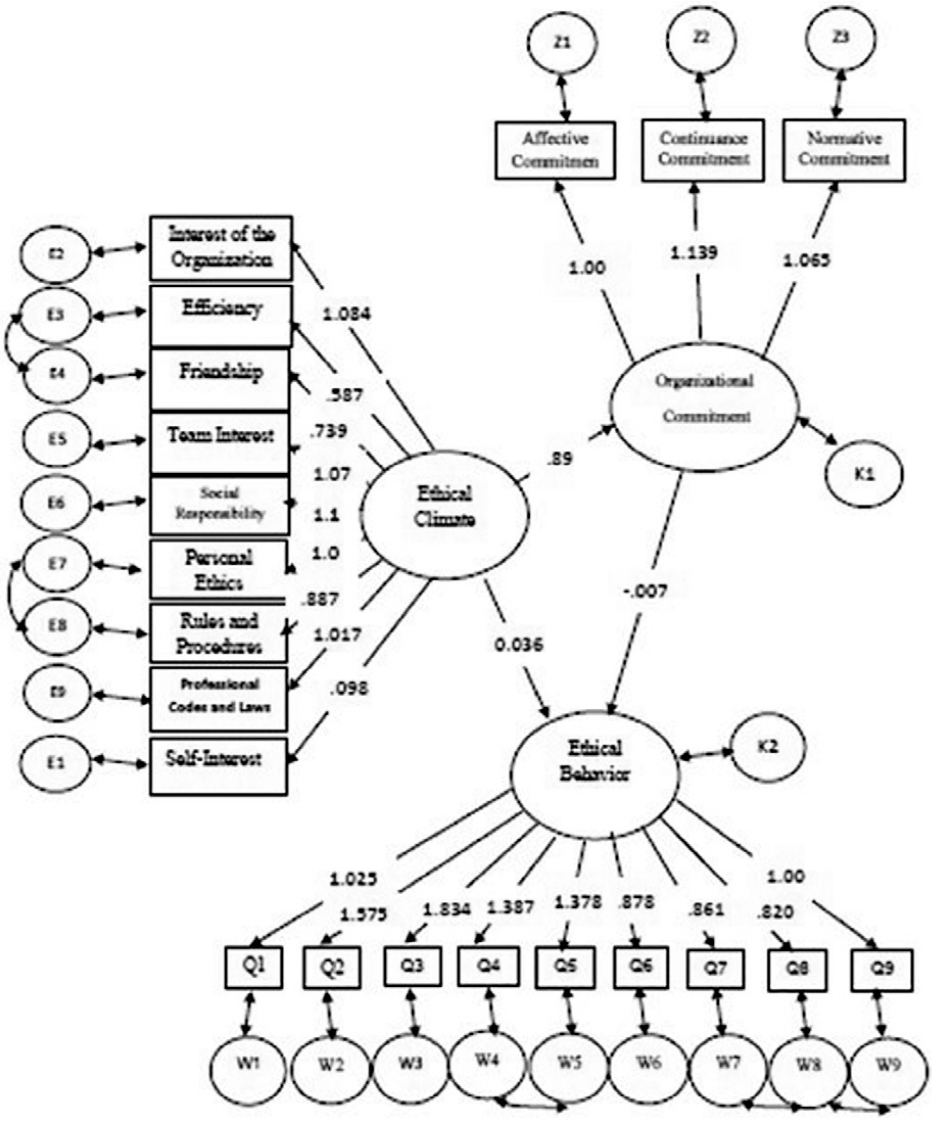
Figure 2.
Path diagram that shows the factor loads of the observed variables after modifications in the latent variables (ethical climate, organizational commitment, and ethical behavior).
4. Discussion
The nurses’ perceptions of the ethical climate of treatment-educational centers were more related to individual egoism (self-interest), productivity, and individual basic ethics (individual behavior), and were less based on global benevolence (social responsibility and subordinate interests), regional benevolence (group interests), regional egoism (organizational profit), and regional ethical principles (organizational rules and standards). In terms of the analysis status, it was more individualistic, regional, and global, suggesting the impact of capitalist system dominance on people’s perception of ethical climate and individual benefit, and the avoidance of the ethical climate of global ethics (rules and codes of practice) and global benevolence (social responsibility and the interests of subordinates) in the nursing community, which distances themselves of the purpose of humans’ creation and nursing human mission. In the study of Heidari et al.22, the highest perception of ethical climate by nurses was personal ethics and then group interests (regional benevolence) and, in terms of analysis status, was more individualistic than regional and global.
There is a relationship between the two variables of total ethical climate and affective commitment and total ethical climate and normative commitment. Organizational commitment has a relationship with the ethical climates of global egoism, individual ethical principles, regional egoism, individual benevolence, regional ethical principles, regional benevolence, global ethics, global benevolence, and total ethical climate.
Teresi et al. 23 showed that there is a significant relationship between ethical climate and affective commitment. Teymoori et al.25 report a direct and significant relationship between the ethical climate and organizational commitment. The results of Cullen et al.15 and Jalali et al.’s26 research, revealed that ethical climate and organizational commitment are directly and strongly correlated. Hassanian and Shayan27 found that there was a significant and negative relationship between the nurses’ ethical behavior and perceptions of some ethical climate. In another research, it was concluded that there is a correlation between nurses’ perceptions of hospital ethical climate and behavior.18
Responsible nursing activities also require reflective and critical thinking, complex problem-solving ability, ethical decision-making, and better application of laws.28 The ethical principles are related to benevolence, prestige, respect, independence, social justice, and vocational performance.29 Ethical principles determine nurses’ clinical decision-making processes, the management of practical activities, professional interactions, and research.28 Nurses with higher affective and normative commitment have greater skills in handling conflicts with their supervisors, subordinates, or colleagues.9
Total, normative, affective, and continuous organizational commitment was not related to ethical behavior. While the results of Grego-Planer’s30 research confirmed that there was a positive relationship between the organizational commitment and the behaviors of employees. Sumardjo and Supriadi’s31 research confirms that result. Evidence from Pagliaro et al.’s32 study showed the effects of ethical climate(s) on employees’ behavior. Ethics influences organizational outcomes, and these effects are largely mediated through the mechanisms of ethics modification and organizational continuity.
On the relationship between perceptions of ethical climate, organizational commitment, and nurses’ ethical behaviors, since the ethical climate is predictive of ethical behavior, organizations’ managers should prepare the grounds for the development of ethical behaviors. In other words, they should provide an ethical climate at the workplace based on the observance of global basic ethics (vocational laws and codes) and refrain from an egoist ethical climate, which is based on individual and group interests, to decrease unethical behaviors at the workplace. There is a stronger relationship between ethical climate dimensions and its total score.14 In this regard, ethical climate dimensions specifically predict ethical behavior. Abou Hashish33 found out that there was a relationship between nurses’ perceptions of overall ethics, organizational commitment, and job satisfaction. Ashfaq et al.’s34 research showed that organizational commitment mediated the relationship between ethical climate and ethical behavior. Another study showed that the effect of ethical climate on the ethical behavior of employees is driven by organizational commitment.32
Dinc and Huric35 showed that medical centers can influence job satisfaction and organizational commitment through the development of a caring and legal ethics climate.
Other researchers have also shown that the benevolent, legal, basic, and independent climate has a positive relationship with commitment and the instrumental climate has a negative relationship with commitment.36,37 Managers should strive to enhance the levels of both affective and normative commitment in their organizations and the ethical leadership of managers plays a significant role in developing employees and ethical organizational cultures.38
In this study, in order to evaluate the suitability of the model, model fitness indices were used. The maximum likelihood method has been used for estimations. Here, factor load values >0.4 imply the acceptability of the conceptual model. In general, the model fitness results were obtained as follows:
Based on the results, the conceptual model is validated on the basis of X2/df, GFI, AGFI, RMSEA, and CFI indices. The NNFI index is also close to the reference value of 0.90, confirming the conceptual model.
The organizational commitment variable does not play a mediating role in the model. In other words, increasing the score of ethical climate perception increases the score of organizational commitment, but this does not significantly affect ethical behavior. Although ethical climate influences organizational commitment (beta = 3.261) and ethical climate affects behavior (beta = 0.121), organizational commitment does not significantly affect behavior.
One of the innovations in this article was to investigate and analyze the effect of organizational commitment on the ethical climate and moral behavior of nurses. This topic is new and innovative because it directly addresses the psychological and organizational complexities that affect nurses’ ethical behavior. Innovation in this article can be seen in several ways: (a) Examining the effect of organizational commitment: This article examines the effect of organizational commitment on the moral behavior of nurses, which is an innovative topic that has not been studied so far. (b) A word to better understand the relationship between ethical climate, organizational commitment, and ethical behavior of nurses is an innovative approach in ethical and organizational research. (c) Providing practical recommendations: This article not only deals with theoretical analysis, but also practical recommendations to improve ethical climate and ethical behavior. It presents in health organizations that can help progress and innovation in this field. Therefore, innovation in this article is not only observed at the level of the topic and research approach, but also at the level of providing practical recommendations and using advanced data analysis techniques. These innovations can help improve the quality of medical and health care and increase patient satisfaction. It is suggested that other variables affecting the ethical behavior and organizational commitment of the treatment staff should be conducted with a larger sample size in future studies.
5. Conclusions
There was a significant relationship between ethical climate and nurses’ ethical behaviors in the individual benevolent dimension. The finding declared that the organizational commitment does not play a mediating role in this model. Ethical climate influences organizational commitment and ethical behavior, but organizational commitment does not affect behavior. It appears that the presence of an ethical climate promotes organizational commitment in nursing departments. Nursing managers could offer ground for improving nurses’ ethical behavior. It is recommended that managers and nursing planners, in order to improve the ethical behavior and organizational commitment of nurses through their policy-making, adjust the ethical climate toward the global basic ethics and benevolent ethics and incorporate the organizational commitment of value constructs into organizational concepts.
Acknowledgments
This paper is the result of an approved research at Hamadan University of Medical Sciences by the ethical code and the specific ID of IR.UMSHA.REC.1396.601, code 9609215912, and funded by the Vice-Chancellor for Research. The authors wish to thank the Vice-Chancellor for Research of Hamadan University of Medical Sciences who supported this study and all participants and managers for their great help in conducting this research.
Notes
[7] Ethical approval
This study was approved by the ethical code and the specific ID of IR.UMSHA.REC.1396.601 at the Research Council of Hamadan University of Medical Sciences.
[8] Conflicts of interest Conflicts of interest
All contributing authors declare no conflicts of interest.