
1. Introduction
As the increasing pace of aging,1 the changes of Chinese family structure and policy, more and more older adults choose to live in nursing care homes, meanwhile, after the elderly individuals move into nursing care homes, their life experiences undergo significant changes due to the influences of the living environment, activity patterns, and family dynamics,2 The overall level of social engagement among elderly individuals in Chinese nursing homes remains notably low,3 characterized by a reluctance to communicate or interact with others. Concurrently, prolonged bed rest and a lack of daytime activities contribute to sleep disorders, resulting in increased daytime sleepiness.4 Moreover, age-related frailty leads to a decline in physical function and mobility among older adults,5 further exacerbating the reduction in physical activity levels (PALs) in these settings. Consequently, elderly individuals are more inclined to participate in sedentary activities, such as playing mahjong or taking short walks within the confines of the nursing care homes.3,6 However, the PAL of these activities preferred by older individuals often falls below recommended guidelines,7 recent studies have shown that insufficient physical activities (PA) can contribute to a decline in physical function and increased frailty among older adults, so through those regular activities could not be enough to promote the physical health and delay frailty of the elderly.5,8 However, it is important to recognize that frailty is a dynamic process. Effective intervention measures can significantly enhance the physical function of older adults and slow the progression of frailty.9
Chinese traditional agricultural culture has a profound connection with activities such as gardening, vegetable planting, and flower tending. These activities not only provide enjoyment but also offer numerous health benefits for older adults. Engaging in such activities allows them to connect with nature and experience the therapeutic effects of being outdoors while nurturing living plants. This alignment with traditional values and practices further enhances their significance in promoting well-being among the elderly. The American Horticulture Therapy Association (AHTA) defined horticulture therapy (HT) as an effective method that exploits planting, growing, and horticulture activities from society, education, psychology, body, and other aspects to help people who need to improve in such aspects as body and spirit to adjust.10 Besides, horticultural activities (HA) is one of the HT and also one kind of PA, which includes all activities related to plants, gardens, and so on.11 Meanwhile, HA offer several advantages, including ease of implementation, environmental sustainability, and low cost. As a result, they have gained acceptance among an increasing number of older adults in nursing care homes as a novel intervention method. Numerous studies have demonstrated the positive effects of HA on the well-being of older individuals.12 HA has introduced a novel therapeutic approach for dementia residents in nursing homes, enhancing cognitive function.13,14 Furthermore, participation in HA has demonstrated potential for alleviating mental health issues in older adults, including reductions in stress levels and depression. Additionally, engagement in HA has been linked to increased life satisfaction and a positive influence on happiness and interpersonal relationships among elder residents in nursing care homes.15 Moreover, it has enhanced physical functional abilities and daily living skills.16
Additionally, investigators in my research group have confirmed the positive effects of HA on frail older adults residing in nursing care homes. However, during the implementation of this intervention, we faced numerous challenges and obstacles. Issues such as poor compliance, resource shortages, and various other implementation barriers were common, disrupting the smooth execution of the activities and impacting the overall effectiveness of the intervention. To date, the barriers and facilitators associated with implementing HA in nursing care homes have not been fully explored. Therefore, a qualitative descriptive study was conducted to provide a clearer and more intuitive understanding of the factors that both hinder and promote the implementation of HA in these settings. Simultaneously, to ensure a smooth implementation process, the research group requires a comprehensive framework to effectively evaluate the perspectives of frail older adults and other individuals involved in the activities. This framework will help gather valuable insights that can inform future interventions and enhance participant engagement.
The Ottawa Model of Research Use (OMRU) is an interactive model of research use encompassing 6 key elements: practice environment, potential adopters, the evidence-based innovation, transfer strategies, adoption, and outcomes.17 The first step of OMRU involves conducting an assessment of the first 3 components: practice environment, potential adopters, and the evidence-based innovation, to monitor implementation intervention strategies and adoption, and evaluate outcomes.18 OMRU helps researcher to adjust evidencebased practice based on different practice environment, and to ensure sustainable use, tailored strategies to address the barriers and to implement the guidelines. Currently, some scholars have employed the OMRU to assess existing practice guidelines, practice environments, and potential adopters. By utilizing this model, they have developed strategies to address obstacles and provide guidance for effective implementation. This approach facilitates a more structured analysis of the factors influencing the adoption of interventions in various settings.17,18 In line with the OMRU, this qualitative research was conducted to evaluate potential adopters and the practice environment. In this study, potential adopters included frail older adults and employees participating in HA, while the practice environment encompassed cultural, social, organizational, economic, and uncontrollable factors related to the execution of HA. The insights gained from this evaluation aim to provide solutions for overcoming obstacles before formal implementation and to modify the horticultural program based on identified facilitators. Ultimately, our goal is to establish a solid foundation for effective and reasonable horticultural interventions for elderly individuals in nursing care homes in the future.
2. Methods
2.1. Design
We used a qualitative descriptive study,19 and semi-structured interviews to identify the barriers and facilitators of implementing HA in nursing care homes. This qualitative study was mainly carried out according to the assessment of the practice environment, potential adopters of the OMRU.
2.2. Setting
The initial intervention and subsequent study were conducted at a nursing care home in Henan, China.20 The HA intervention encompassed a range of activities, including planting, handicraft making, outdoor viewing, and derivative activities like sharing harvested fruits and preparing salads, all seamlessly integrated into the daily routines of the care home. The HA intervention spanned 24 weeks, with sessions held twice weekly lasting 60 min each. Each session comprised 3 parts: pre-activity preparation and warm-up, the main activity, and a summary discussion. Some activities were themed around Chinese festivals or solar terms coinciding with the period. For instance, during the Dragon Boat Festival, themed “Dragon Boat in May,” the elder participated in planting wormwood and crafting sachets. Additionally, self-sustaining activities were included, such as the theme “Green Food” in Week 13, where seniors prepared vegetable salads using lettuce they had grown and shared them with others. This nursing care home, the largest of its kind in the province, offers comprehensive medical and nursing care services and is well-equipped with abundant medical resources, social workers, doctors, and nurses, facilitating the successful implementation of the HA intervention.
2.3. Study participants
Participants were selected by the researcher using a purposive sampling strategy from a nursing care home in Henan province, China. Sampling continued until theoretical saturation was reached, indicating that no new themes or content were emerging. Subsequently, interviews were conducted with 1 or 2 elder participants, at which point the decision was made to conclude the data collection process.
The participants in this nursing home were selected based on the following inclusion criteria: (1) older people age >60 years, (2) the score of the FRAIL-NH Scale over 7 points, (3) had participated in HA within 2 years, (4) the score of mini-mental state examination (MMSE) over 27 points, (5) no visual, auditory, and verbal expression impairments, (6) no serious skeletal, muscular diseases and serious physical diseases, (7) able to walk independently without help, (8) the score of activities of daily living (ADL) over 41 points, (9) consent to participate. Exclusion criteria are as follows: (1) severe mental and psychological impairment, (2) have bone and joint surgery, such as hip and knee replacement surgery and so on within 6 months, (3) be allergic to flowers and plants.
Personnel involved in HA at this nursing care home were selected based on the following inclusion criteria: (1) individuals must be social workers, doctors, or nurses employed at the nursing care home; (2) they should possess relevant professional qualifications, including a practice certification and a college degree or higher; (3) they must provide informed consent to participate. Probationary staffs were excluded from the selection process.
2.4. Data collection
Prior to the formal data collection, we conducted a pilot interview from March to May 2023. This phase aimed to refine the interview content and assess the feasibility and practicality of the interview process. Additionally, it provided us with an opportunity to familiarize ourselves with the general background of the research participants, which is beneficial for conducting effective data collection.
The formal process of interviewing and data collection was conducted from October 2023 to February 2024. Prior to each interview, the researcher introduced and explained the purpose of the study, assuring participants that their information would be kept confidential and used solely for research purposes. Face-to-face semi-structured interviews were employed to gather data from participants. Example questions directed at the elderly included: (1) What is your understanding of HA? (2) In your opinion, is it crucial for nursing care homes to implement HA? Why or why not? (3) Would you like to participate in HA? If so, what are your reasons? (4) What challenges do you foresee in implementing HA within this nursing care home? Example questions for the personnel in nursing care homes included: (1) How would you define HA? (2) In your opinion, is it crucial to conduct HA for older people in nursing care homes? Why or why not? (3) What are your thoughts on the challenges involved in organizing HA in nursing care homes? (4) What suggestions do you have for facilitating the implementation of HA?
The flexible duration of 30–40 min facilitates comprehensive discussions, allowing for in-depth exploration of topics. Adjusting the order of questions based on interviewee responses enhances the natural flow and depth of the conversation. Scheduling interviews at convenient times and locations demonstrates respect for participants’ comfort and accessibility. During the interviews, active listening and gentle guidance are employed to elicit authentic responses, while attentively capturing non-verbal cues, such as facial expressions and body language, which enriches the data collected. Overall, these considerations contribute to a thorough and insightful interview process, ensuring that participants feel valued and understood while providing meaningful information. Throughout the entire process, interviews were audio recorded using a mobile phone to ensure accurate capture of the interview content. Concurrently, important information was documented in a notebook. During the interviews, the researcher attentively observed the interviewee’s facial expressions and incorporated these observations into the notes. To maintain clarity and organization, the researcher promptly compiled this information immediately following the conclusion of each interview.
2.5. Data analysis
Conventional content analysis is defined as a research method for the subjective interpretation of the content of text data through the systematic classification process of coding and identifying themes or patterns,21 and the goal of content analysis is “to provide knowledge and understanding of the phenomenon under study.”22 Data analysis started with reading all data repeatedly, then, data were read word by word to derive codes, researcher transcribed the recording within 24 h after the interview, listened and checked the recording repeatedly to ensure the accuracy.
This research used NVivo20 software to manage data. The coding process involved sorting codes into categories, followed by the development of subcategories and defining each code. Two investigators conducted an in-depth review of the transcripts, ensuring comprehensive coverage of all data. Finally, the entire dataset underwent thorough scrutiny to confirm that all essential information was accurately coded, leading to a robust analysis of the findings. The picture of analysis process by using NVivo software was shown (Figure 1).
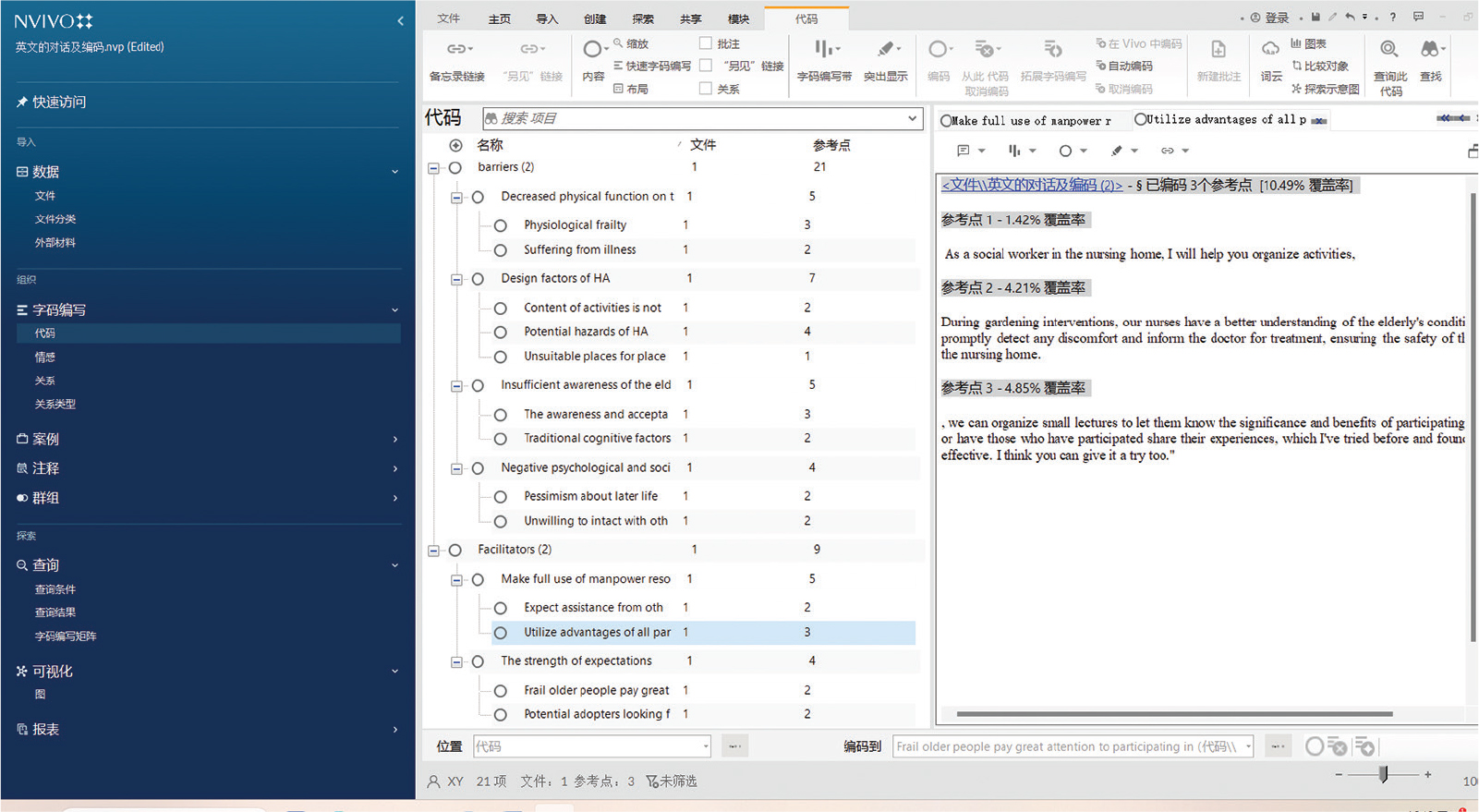
Figure 1.
The analysis process.
2.6. Ethical considerations
This study was approved by the Life Sciences Ethics Review Committee of Zhengzhou University (ZZUIRB2021-54). All participants were made aware of the study’s objectives. We assured them that the interview materials would be used solely for research purposes and would not contain any personal or private information. Participants retained the right to withdraw from the study at any point.
3. Results
A total of 6 older adults and 5 personnel participated in the study, representing a typical demographic of elderly individuals who have engaged in gardening activities, as well as nursing home staff. The elderly were 5 women and 1 man, ages ranged from 72 years to 88 years, with a mean age of 82.17 years (standard deviation [SD] = 6.59), E# denoted the number of the older adults, and the older people’s demographic data were shown (Table 1). The personnel were 5 women, ages ranged from 21 years to 41 years, with a mean age of 31.8 years (SD = 8.17), including 3 social workers (3 women), 1 nurse (1 woman) and 1 doctor (1 woman), the average length of working were 9.5 Years (SD = 6.84). S# denoted the number of the social workers, N# denotes the nurse and D# denoted the doctor, these personnel’ demographic data were shown (Table 2). Due to the gender imbalance commonly found in nursing care homes, where there are significantly more women than men, and given that participants were purposefully selected from those who had participated in the HA program, the number of male elderly participants in this study is relatively low. Furthermore, the nursing home staffing includes a significantly higher number of female social workers and nurses, resulting in the inclusion of only 1 male medical staff member for the interviews. Nevertheless, this sample selection remains representative of the overall population within the nursing home setting.
Table 1.
Characteristics of the elderly.
| Number | Age (years) | Gender | Duration of living (year) | Educational level | Occupational status |
|---|---|---|---|---|---|
| E1 | 80 | Female | 4 | Primary school | Farmer |
| E2 | 72 | Female | 7 | Primary school | Retired |
| E3 | 88 | Male | 3 | Primary school | Retired |
| E4 | 88 | Female | 3 | Senior school | Retired |
| E5 | 78 | Female | 8 | Primary school | Retired |
| E6 | 87 | Female | 8 | Primary school | Farmer |
Table 2.
Characteristics of the personnel.
| Number | Age (years) | Gender | Work experience (year) | Educational level | Occupational status |
|---|---|---|---|---|---|
| S1 | 37 | Female | 10 | Undergraduate | Social worker |
| S2 | 34 | Female | 10 | Undergraduate | Social worker |
| S3 | 21 | Female | 2 | Undergraduate | Social worker |
| N | 26 | Female | 5 | Undergraduate | Nurse |
| D | 41 | Female | 20 | Undergraduate | Doctor |
Two categories were extracted: the barriers and facilitators of implementing HA in nursing care homes. The barriers included 4 themes and facilitators included 2 themes, both theme and sub-themes of the facilitators and barriers were presented (Table 3). Each theme was explained by using the participant’s direct quotations.
Table 3.
Categories from data analysis.
| Category and themes | Number of reference points |
|---|---|
| Barriers | |
| Insufficient awareness of the elderly | |
| The awareness and acceptance of older people for activities are low | 3 |
| Traditional cognitive factors | 2 |
| Negative psychological and social state of the elderly | |
| Pessimistic about later life | 2 |
| Unwilling to intact with others | 2 |
| Decreased physical function on the elderly | |
| Physiological frailty | 3 |
| Suffering from illness | 2 |
| Design factors of HA | |
| Content of activities is not attractive | 2 |
| Potential hazards of HA | 4 |
| Unsuitable places for placement | 1 |
| Facilitators | |
| The strength of expectations | |
| The frail elderly wish to participate | 2 |
| Personnel looking forward to participate | 3 |
| Make full use of manpower resource | |
| Utilize advantages of all parties | 2 |
| Expect assist from others | 2 |
3.1. Category 1: Barriers
3.1.1. Theme 1: Insufficient awareness of the elderly
Although numerous studies have demonstrated that regular participation in PA is beneficial for health, there remains a need to encourage the older adults to engage in these activities more frequently,23 and older adults still hold the belief that exercising and participating in activities are of little value. Gardening activities, which fall under this category, are often perceived by the elderly as meaningless. This perception represents a significant barrier to the initiation of HA among this population.
The awareness and acceptance of older people of activities are low
Many older adults do not fully grasp the benefits of participating in activities and often hold biased perceptions regarding HA.
I have participated in calligraphy class, is that not mean taking part in activities? I think that participating in horticultural activities is boring. (E2)
I always playing chess and walking around, from bathroom to canteen and then return back, isn’t that participating in activities? (E3)
Rather than enjoying the pleasure and positive benefits of physical function from gardening, some seniors just only want to get vegetables and fruits for free, so the enthusiasm of the elderly for participating HA is still in a low degree. (S2)
Traditional cognitive factors
Some older adults are hesitant to engage in HA due to the influence of gender stereotypes and traditional ideologies.
I remember that there were some activities that I did not want to participate, such as some flower arrangements, because I thought those activities were not suitable for our men. (E3)
Certain crafts, such as creating flower bouquets and flower bags, are often favored by grandmothers, while some grandfathers perceive these activities as traditionally feminine. Consequently, men may exhibit greater reluctance to participate, leading to a naturally lower level of male involvement in these activities compared to their female counterparts. (S1)
3.1.2. Theme 2: Negative psychological and social state of the elderly
In nursing care homes, the lack of social activities and limited contact with family and friends can lead to social isolation among older adults.14 Consequently, they are more prone to experiencing negative emotions such as loneliness and depression, which can adversely affect their overall quality of life and could also impact the older adults’ level of enthusiasm for participating in activities.15
Pessimistic about the later life
Some older individuals have lost interest in the future and view participation in any activities as meaningless.
I am so old that I will die, I do not want to join in gardening activities. (E2)
Sometimes I especially feel sad and I always think that I will die immediately, I do not want to join in anything else and I think everything is boring. (E5)
Unwilling to intact with others
Social isolation is a significant risk factor for poor mental health among the elderly. The absence of social connections and meaningful relationships can lead to feelings of emptiness, sadness, and low self-esteem. Consequently, some older adults may prefer solitude, making them even less likely to participate in activities with others.
It’s too noisy when there are too many people. I prefer quiet places. (E1)
I came to the nursing home for peace and quiet. I didn’t want to be associated with other people. I think those activities and those older adults will disturb my peace. (E4)
3.1.3. Theme3: Decreased physical function on the elderly
Older adults often exhibit reluctance or even avoidance of participation in activities due to mobility challenges and difficulties associated with movement. This decline in physical function can be attributed to the natural process of frailty as well as the pain associated with various health conditions.3
Physiological frailty
As older adults age, the degree of frailty progressively increases, leading to a decline in physical function and adversely affecting their ability to engage in PA.24
A few years ago, my health was much better, but now, as I getting older, I feel that my body is not as strong as it used to be. I constantly feel tired and lack the motivation to move. (E3)
Suffering from illness
The prevalence of chronic diseases among older adults is on the rise, resulting in many experiencing diminished physical function and limitations in their ability to engage in PA due to illness.25
When I walking, my knees and waist ache terribly, making it impossible for me to engage in horticultural activities—I can’t even lift a pot. (E4)
3.1.4. Theme 4: Design factors of HA
In addition to factors associated with the elderly individuals themselves, the quality of activity design plays a crucial role in influencing participants’ enthusiasm and the overall success of activity implementation.
The content of activities is not attractive
Some gardening activities may not be appealing to certain older adults, leading to poor participation rates.
I don’t enjoy growing cos lettuce and tomatoes, they didn’t thrive last time. I prefer cultivating flowers instead. (E3)
These activities are too tiring for me, and I do not want to take part in them. (E4)
For instance, if someone dislikes roses, they might avoid activities involving them, possibly leading to agitation. (D)
Potential hazards of HA
Due to the decline in physical function among older adults, they face a heightened risk of safety incidents. Some seniors, as well as care staff, believe that interventions in nursing care homes may increase the likelihood of injury among this population.
It’s difficult to move due to my bad legs and feet, and I fear falling when participating in activities. (E5)
Horticultural activities involve lifting pots and using tools, which may deter older individuals from participating due to concerns about potential danger. (S2)
Due to slower reactions, older individuals may accidentally cut their fingers when using sharp shovels during planting activities. (S3)
Some older adults may be allergy to some flowers, and they may hurt their hands when using tools. (D)
Unsuitable places for placement
Certain activities have overlooked the necessity for suitable spaces to accommodate participants, thereby posing barriers to effective implementation.
I enjoy gardening, but the challenge is finding a suitable place to put my flowers. We ended up placing the pots in our room, but there’s no sunlight, resulting in many plants dying. (E6)
3.2. Category 2: Facilitators
3.2.1. Theme 1: The strength of expectations
Certain activities have overlooked the necessity for suitable spaces to accommodate participants, thereby posing barriers to effective implementation.
The frail elderly wish to participate
Frail elder individuals place a high importance on participating in PA due to the perceived health benefits it offers.
Despite facing numerous challenges in participation, I firmly believe in the positive impact of these activities on our overall well-being. Engaging in HA allows us to breathe fresher air outdoors, utilize our hands frequently, and keep our minds active, all of which contribute to improved mood and physical function. Furthermore, horticultural activities not only enhance manual dexterity but also stimulate cognitive engagement, potentially aiding in the prevention of Alzheimer’s disease. (E1)
Being more active both physically and mentally through activities improves my health. Since my family doesn’t visit often, I spend most of my time alone. However, tending to the flowers brings me joy and lifts my spirits. (E6)
Personnel looking forward to participate
Personnel involved in HA also recognize the essential role of horticultural interventions in nursing care homes for promoting the overall physical and mental well-being of the elderly.
The primary objective of all our activities for the elderly in nursing care homes is to enhance their health. Participation in HA promotes greater physical activity, which is essential for their overall well-being. (S1)
Mitigating sedentary behavior is crucial for the elderly. We recognize the significance of interventions, and I am confident that the implementation of HA can play a significant role in maintaining the health of older individuals. (N)
3.2.2. Theme 2: Make full use of manpower resource
The integration of medical and nursing care within homes for elder individuals leads to more personalized and comprehensive healthcare. Nurses, social workers, and doctors should collaborate closely to provide support throughout the activity process. This collaborative approach ensures that the needs of the elderly are effectively met, resulting in improved overall health outcomes.
Utilize advantages of all parties
The collaboration among workers from diverse occupations leverages their individual strengths to support activities effectively.
I contribute to organizing and facilitating activities. (S1)
Our familiarity with the conditions of older adults during activities enables us to promptly identify any abnormal symptoms, allowing us to alert doctors for timely treatment. This ensures the safety of the elderly to a certain extent. (N)
We are equipped to provide emergency assistance in critical situations, such as when an elderly individual experiences a fall or sustains an injury. (D)
Expect assist from others
Collaboration among various professionals is crucial for the seamless implementation of HA for elderly residents in nursing care homes.
Social workers recognize the importance of leveraging their professional expertise to facilitate activities, while also acknowledging the necessity of support from nurses and doctors to guarantee the safety of the elderly.
In order to ensure their safety, we should also ask nurses and doctors for help. (S1)
Nurses understand their role in assisting, while also recognizing the valuable contributions of social workers and physicians.
Social workers excel in communication and play a crucial role in HA, thereby complementing the efforts of nurses and physicians to ensure the smooth implementation of these initiatives. (N)
4. Discussion
Research has demonstrated that the motivation of elder individuals to engage in PA is influenced by both behavioral and environmental factors,9 and the assessment of potential adopters and the practice environment confirmed that both barriers and facilitators influence the participation of older adults in nursing care homes, shaped by self-perception and environmental factors. Therefore, it is essential to enhance the enthusiasm for engaging in HA among older individuals and to refine intervention strategies by addressing the obstacles identified in this study, ensuring the smooth implementation of these activities.
4.1. Assisting elderly individuals in enhancing accurate cognition is crucial
Social cognitive theory indicates that individual cognition positively influences behavior; furthermore, individual motivation and actions are the outcomes of cognitive processes.26 Due to diverse physical conditions and varying self-perceptions, many older adults demonstrate reluctance or neglect toward engaging in daily PA. Additionally, research indicates that the overall PAL among the elderly in China remains significantly low, falling below the recommended guidelines.7 Additionally, the activities undertaken are often simplistic in nature. However, numerous studies have demonstrated that HA can significantly enhance the physical functional abilities and independence of the elderly.16,27,28
Through the assessment of potential barriers and facilitators, this study has identified a critical obstacle to implementation: the incorrect perception among elder individuals regarding the necessity and safety of participating in HA. Some older adults believe these activities are unnecessary and fear HA may increase fatigue or pose safety risks. To address this issue, researcher and personnel related to HA should proactively introduce the benefits of PA and HA through video presentations and oral discussions before formal interventions commence. This approach aims to foster a positive initial perception of activities among elder residents in nursing care homes. Additionally, researchers can engage older individuals who have previously participated in HA to share their experiences and insights with those who are hesitant to join. This peer interaction can help residents gain a deeper understanding of the benefits of HA on physical health, potentially increasing their willingness to participate. Ultimately, cultivating positive cognitive attitudes can enhance older adults’ focus on their physical well-being, thereby encouraging greater participation.
This approach aims to cultivate a positive initial understanding of activities among elder residents in nursing care homes. Additionally, researchers can enlist the help of elder individuals who have previously participated in HA to share their experiences and insights with those older adults who are hesitant to join; in this way, elder residents can gain a better understanding of the positive effects of HA on physical health and may become more willing to participate. Absolutely, fostering positive cognitive attitudes can indeed increase older adults’ attention to their physical health, thereby improving their willingness to participate.
However, it’s crucial to address the negative emotions that older adults may experience, such as sadness, disappointment, and anxiety.29 These emotions can serve as significant barriers to engagement in activities, particularly in the later stages of life when physical frailty and other challenges are prevalent. Therefore, researcher, nurses, doctors, and social workers should pay great attention to their emotional changes, providing timely psychological support is essential for reducing negative emotions and then promoting their engagement enthusiasm.
4.2. Refining the intervention program of HA
PAs serve as an umbrella term encompassing various forms of exercise and leisure-time PA. It is defined as any bodily movement generated by skeletal muscles that necessitates energy expenditure. On the other hand, exercise refers to planned, structured, repetitive movements that involve progression in intensity,30 and HA is a kind of PA, which could make a great impact on older people’s health.
Through the assessment of potential adopters, we identified issues such as insufficient promotion and a lack of appeal in the content design of activities. Additionally, venue restrictions highlighted in the environmental assessment posed further obstacles, hindering the smooth implementation of the activities and dampening the enthusiasm of the older adults to participate. While intervention barriers persist, insights from interviews can guide targeted adjustments to the program in advance. For instance, pre-communication with the elderly about activity content and plant preferences can help mitigate dropout rates and enhance compliance. Moreover, considerations such as gender and living habits factors will ensure diversity and personalization within HA. Simultaneously, proactive communication with nursing care homes regarding space constraints is essential for resolving plant placement issues.
4.3. Strengthen multi-party cooperation to ensure the implementation of HA smoothly
Facilitating multi-party cooperation is essential for the seamless implementation of HA. Group interventions have demonstrated the ability to enhance individuals’ self-esteem, promote a sense of belonging, facilitate skill development, and create positive emotional experiences.31 Collaboration among the research group, including researcher, nurses, social workers and doctors, could ensure the success of the program by pooling resources, sharing expertise, and providing comprehensive support to participants.
Researchers oversee the revision and detailed implementation of HA content, nurses and social workers coordinate and ensure the safety and well-being of the participants, while doctors are on hand to address any unforeseen issues that may arise during the activities. By working together and conducting assessments of security contingency plans, the research group can effectively ensure the seamless implementation of HA while prioritizing the safety and satisfaction of the participants.
4.4. Limitations
In this qualitative research, the limited number of older adults in nursing care homes may impact the generalizability of the findings. Additionally, the accuracy of key content extracted from the paper could be influenced by the author’s knowledge reserve, potentially introducing bias.
5. Conclusions
Gardening has always been a popular recreational activity among Chinese older adults, and recent research has shown that HA can effectively lower physiological stress levels,32 promote physical, psycho-mental and social health, then help to get high quality of life.33,34 The limited opportunities for frail older adults in nursing care homes to participate in HA pose significant challenges. Moreover, the encountered difficulties during implementation underscore the necessity for more tailored approaches in these settings. This study was carried out from 2 perspectives based on OMRU: potential adopters and practice environment, through conducting qualitative research to explore the true thoughts of the elderly, social workers, nurses, and doctors, as well as presenting the barriers and facilitators of HA implementation currently in nursing care homes. Future interventions should be customized to address challenges faced by frail older adults in nursing care homes when participating in HA or other PA. These challenges include inadequate awareness, negative psychological and social states of the older adults, and the design of activities. This may entail efforts to enhance older adults’ accurate and positive perception of PA and HA. This can be achieved through refining the activities program, strengthening multi-party cooperation, and implementing additional security measures to ensure safety. These actions are essential for encouraging their participation and maximizing the benefits of such activities for their physical health. By addressing these barriers and facilitators, promoting a supportive environment, effective changes and improvements can be implemented to enhance HA and promote the overall well-being of elderly individuals in nursing care homes.
Notes
[2] Contributed by Author contributions
NXY designed and conceptualized the study, collected and analyzed data, drafted the manuscript. WJJ made critical revisions to the manuscript and gave final approval of the version to.
[3] Ethical approval
This study had approved by the Life Sciences Ethics Review Committee of Zhengzhou University (ZZUIRB2021-54).
[4] Conflicts of interest Conflicts of interest
All contributing authors declare no conflicts of interest.