
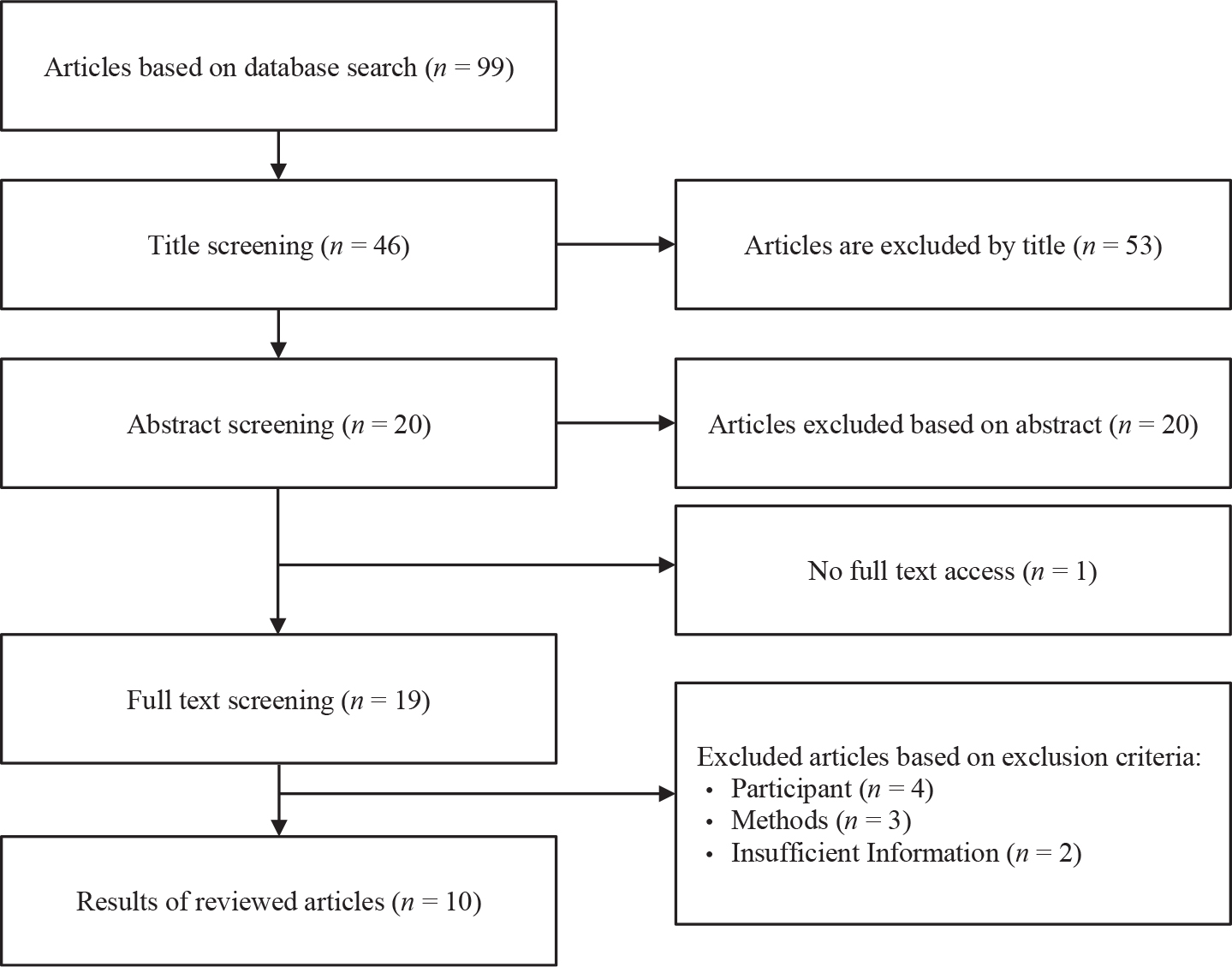
Figure 1.
PRISMA flow diagram of study selection for the systematic review.
Table 1.
Descriptive data.
| Variables | Number of studies | ||||
|---|---|---|---|---|---|
| Design | |||||
| Experimental | 1 | ||||
| Quasi-experimental | 9 | ||||
| Participant | |||||
| Undergraduate nursing student | 8 | ||||
| Pediatric nursing student | 1 | ||||
| Nurse | 1 | ||||
| Location | |||||
| Turkey | 2 | ||||
| China | 5 | ||||
| Spain | 1 | ||||
| Australia | 1 | ||||
| Palestine | 1 | ||||
| Instrument | |||||
| JSENS | 1 | ||||
| JSE-HPs | 1 | ||||
| JSE-HPS version | 4 | ||||
| Jefferson Physician Empathy Scale | 1 | ||||
| KCES | 2 | ||||
| ESS–B | 1 | ||||
Table 2.
Characteristics of included studies and the educational outcomes for empathy.
| Study | Aim/design | Participant | Intervention | Measurement | Result |
|---|---|---|---|---|---|
| Gür and Yilmaz (2020)4 | Aim: Investigating the effectiveness of the MBET program on empathy and age discrimination in nursing students Design: Two-group experimental design. Data collection: Pre-test and post-test with an 8-week intervention (no follow-up) | Undergraduate nursing students at the faculty of health sciences | MBET |
|
|
| Yang et al. (2022) | Aim: Improving the empathy competence of nursing undergraduate internship students using the Structured Empathy Educational Program Design: Two-group quasi experimental design. Data collection: Pre-test and post-test with an 2-week intervention (no follow-up) | Undergraduate nursing internship students | Structured EEM based on Delphi Technique |
|
|
| Arrogante et al. (2022)42 | Aim: To assess the impact of HFS training toward older people and empathy. Design: One-group quasi experimental design. Data collection: Pre-test and post-test with a 2.5-month intervention (no follow-up) | Undergraduate nursing students | HFS training |
|
|
| Ding et al. (2020)49 | Aim: Develop and evaluate the effectiveness of an empathy learning module. Design: Two-group quasi experimental design. Data collection: Pre-test and post-test with an 7-month intervention (no follow-up) | Pediatric nursing students | KSS module |
| After training, there was a significant increase in empathy in the experimental group, indicating the effectiveness of SSC training toward empathy |
| Peng et al. (2020) | Aim: To evaluate the effect of VDT toward empathy, and provide practical reasons to optimize dementia treatment for future use. Design: One-group quasi experimental design. Data collection: Pre-test and post-test with a 1-month intervention (no follow-up) | Undergraduate nursing students | Watch a movie called Still Alice and VDT simulation |
| Students’ empathy increases after watching movies and participating in the VDT simulation |
| Heidke et al. (2018) | Aim: Evaluating the impact of educational innovations that incorporate the patient’s voice and perspective on empathy Design: One-group quasi experimental design. Data collection: Pre-test and post-test with a 12-week intervention (no follow-up) | Undergraduate nursing students | Redesign learning to include the voices and perspectives of various patients from various population groups. | KCES | Following the given learning design resulted in an increase in empathy levels |
| Cingol et al. (2021) | Aim: To investigate the impact of the INC on cultural sensitivity and empathy levels. Design: Two-group quasi experimental design. Data collection: Pre-test and post-test with a 6-month intervention (no follow-up) | Undergraduate nursing students | INC | ESS–B | There was no significant difference in students’ levels of empathy or cultural sensitivity after the intervention |
| Ayed et al. (2021) | Aim: The purpose of this study was to evaluate how HFS affected self-awareness, empathy, and PCC Design: One group quasi experimental design. Data collection: Pre-test and post-test with an 4-week intervention (no follow-up) | Undergraduate nursing students | HFS |
| After participating in the intervention program, there was a significant increase in self-awareness, empathy, and PCC |
| Shao et al. (2018)43 | Aim: The purpose of this study was to determine whether simulation-based empathic communication training improves nurses’ ability to recognize and respond to parents’ emotions with empathy. Design: One-group quasi experimental design. Data collection: Pre-test and post-test with an 3-month intervention (no follow-up) | NICU nurses | Simulation-based empathic communication training |
| Nurses’ understanding of empathy improved. After attending training, nurses’ empathic communication skills improved |
| Lee et al. (2018)44 | Aim: To evaluate situated teaching programs designed to increase empathy Design: Two-group quasi experimental design. Data collection: Self-reported data from pre-test and post-test, and also post-test observation (no follow-up) | Undergraduate nursing students | Situated teaching program (based on experiential learning) |
| There was a significant increase in students’ empathy after participating in the program, both subjectively (based on self-report) and objectively (objective empathy) (assessed by selected lecturers and patients) |
1 Note: ADAS, Age Discrimination Attitude Scale; CCCS, Clinical Communication Competence Scale; DIF, Descriptive Information Form; EEM, Empathy Educational Model; ESS–B, Empathic Skill Scale Form B; HFS, High-Fidelity Simulation; INC, Intercultural Nursing Course; JSE-HPS, Jefferson Scale of Empathy Health Profession Student; JSE-HPs, Jefferson Scale of Empathy-Health Providers; JSENS, Jefferson Empathy Scale; KAOP, Kogan’s Attitude toward Old People; KCES, Kiersma-Chen Empathy Scale; KSS, Knowledge, Simulation, and Sharing; MBET, Mindfulness-Based Empathy Training; NICU, Neonatal Intensive Care Unitl OSCE, Objective Structured Clinical Examination; PCC, patient-centered care; PIS, Professional Identity Scale; VDT, Virtual Dementia Tour.