
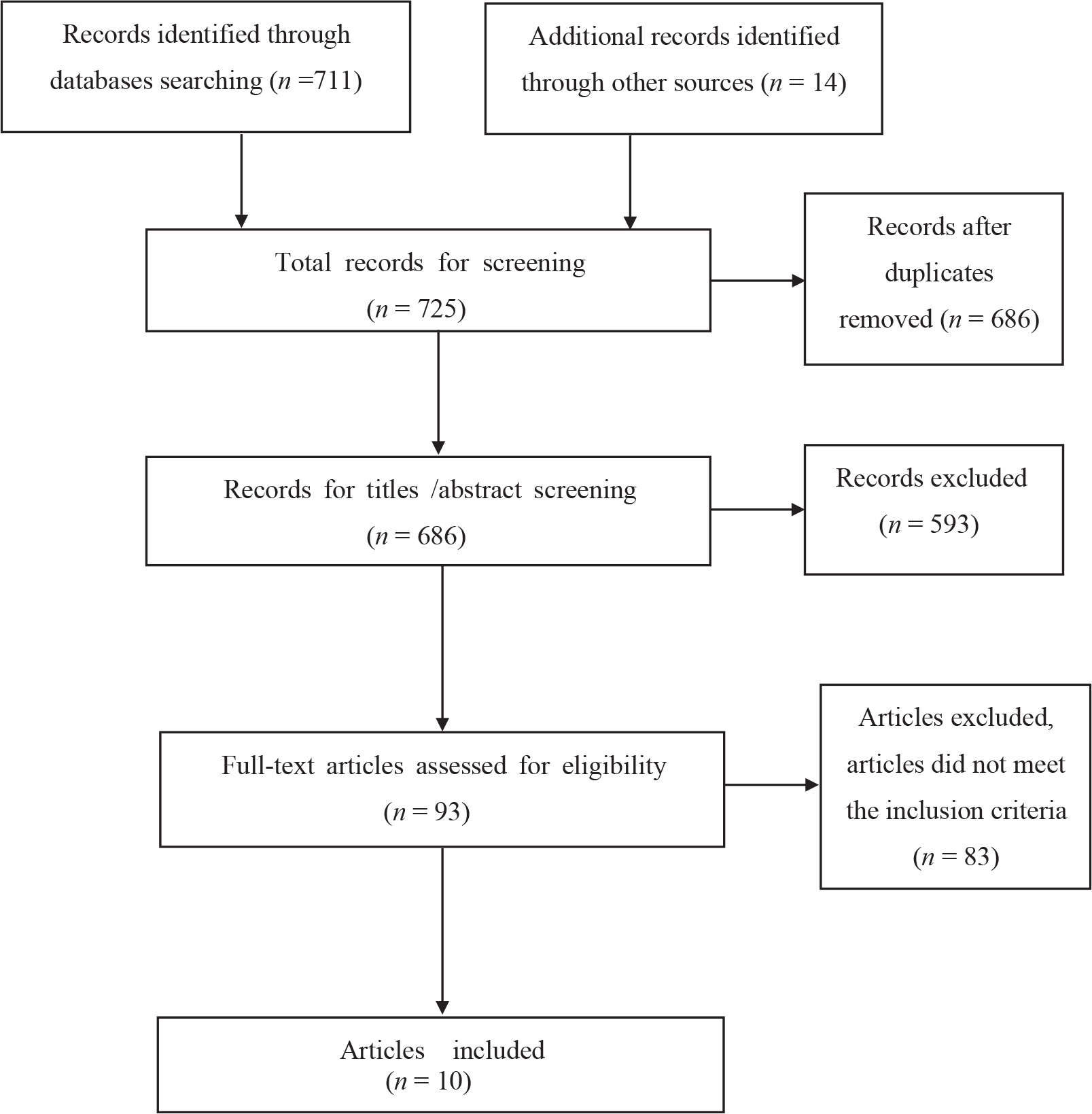
Figure 1.
PRISMA flowchart of search process.
Table 1.
Summary of included articles.
| Author(s), year, country | Study aim | Study design | Study characteristics | Study instruments | Key findings |
|---|---|---|---|---|---|
| Coyne et al. (2013)9, Ireland | Investigated pediatric nurses’ perceptions and practices toward FCC | Crosssectional design | 250 nurses working in pediatrics’ unit | FCC questionnaire-revised (Bruce and Ritchie, 1997) | Indicating the highest response perception than practices toward FCC. “Recognizing family individuality” was rated the highest score. “Parent-to-parent support” and “Design of healthcare system” were rated the lowest scores. |
| Gill et al. (2014)18, Australia | Examined perceptions of nurses regarding FCC | Crosssectional design | 519 nurses who are working in pediatric hospital | Perceptions of FCC-staff (Shields and Tanner, 2004) | Indicating a modest response to nurses’ perception of FCC. “Respect” was rated the highest score. “Support” was rated the lowest score. |
| Alabdulaziz et al. (2017)12, Saudi Arabia | Assessed nurses’ perceptions and practices regarding FCC | Mixed methods (quantitative and qualitative) | Quantitative phase: 219 nurses working in the pediatric units Qualitative phase: 14 nurses working in the pediatric units | FCC questionnaire-revised (Bruce and Ritchie, 1997) Semi-structured interviews | Scores for perception were significantly higher than their scores for practice regarding FCC. In addition, these results were supported by the observation data. “Recognition of family individuality” was rated highest in both perception and practice, while “Family as a constant” received the lowest rank on both perception and practice. |
| Okunola et al. (2017)8, Nigeria | Examined nurses’ perceptions of FCC | Crosssectional design | 176 nurses who have been working for more than 6 months in the pediatric units | Modified FCC scale (Curley, Hunsberger and Harris, 2013) | Indicating a most positive response perception toward FCC. “Parents are given detail explanations about changes they could be expected from their condition” was rated the highest score. Whereas “Parents are allowed to request how they want to participate in child care” was rated with the lowest scores. |
| Dall’Oglio et al. (2018)16, Italy | Assessed healthcare providers’ perceptions and practices regarding FCC | Crosssectional design | 455 healthcare providers working in inpatient clinical wards | FCC questionnaire-revised (Bruce and Ritchie, 1997) | Reported highest scores of perception than practices toward FCC. “Emotional support for staff” was rated the highest score. While, “Recognizing family individuality” was rated the lowest score. |
| Jung and Jung (2018)19, Korea | Explore and describe healthcare providers’ perceptions of the FCC | Qualitative descriptive method | 56 pediatric healthcare providers | Individual interviews using open-ended questions | The participants reported that the concept of FCC has been incompletely implemented. Furthermore, respecting a child’s family, taking care of a child with the child’s family, sharing information about children, supporting a child’s family, and a child’s family participating in child care were identified in the participants’ experiences with families. |
| Done et al. (2020)17, Sri Lanka | Investigated nurses’ perceptions toward FCC | Mixed-methods design | Quantitative phase: 157 nurses working in the pediatric hospital Qualitative phase: 18 nurses working in the pediatric hospital | Nurses’ perceptions and performance of FCC (developed by Done et al., 2020) | Quantitative phase: The mean score for overall perceptions of FCC was modest. “Family participation” was rated the highest score. “Collaboration” was rated the lowest score. Qualitative phase: Participants expected FCC to establish mutual trust between healthcare staff and parents, thereby ultimately contributing to better health outcomes for children. |
| Prasopkittikun et al. (2020)20, Thailand | Examined pediatric nurses’ practices and perceptions of FCC | Mixed-methods study | Quantitative phase: 142 pediatric nurses Qualitative phase: 16 pediatric nurses | FCC questionnaire-revised (Bruce, 2002) Qualitative interviews | Indicated the highest scores of perception than practices toward FCC. “Family strengths and individuality” were rated the highest. While “Parent/professional collaboration” was perceived as the least important element. Qualitative findings revealed that the major reasons for suboptimal implementation included a common perception that FCC is a Western concept, nurses’ weak attitudes toward their roles, and a shortage of nurses. |
| Razeq et al. (2021)21, Jordan | Investigated nurses’ perceptions of FCC | Crosssectional design | 246 nurses working in pediatric units | “Working with families” questionnaire (Aggarwal et al., 2009; Shields et al., 2014) | Indicated the modest perception of FCC. |
| Al-Oran et al. (2023)22, Jordan | Assessed the perceptions of nurses regarding FCC | Descriptive crosssectional study | 102 nurses working in pediatric settings | FCC questionnaire-revised (Bruce, 2002) | Revealed the modest perceptions and practices about FCC. |