
Table 1.
Sampleof a database search strategy using keyword combinations.
| Search keywords: “expectation”, “experiences”, “perception”, “health”, “care”, “system”, “service”, “hospital”, “setting”, “diabetes”, “diabetes mellitus” |
|---|
| (“patient expectation”[Title/Abstract] OR “patient experiences”[Title/Abstract] OR “patient perception “[Title/Abstract]) AND (“diabetes mellitus”[Title/Abstract] OR “diabetes”[Title/Abstract]) AND “setting”[Title/Abstract] OR “health”[Title/Abstract] OR “care”[Title/Abstract] OR “service”[Title/Abstract] OR “system”[Title/Abstract] OR “hospital”[Title/Abstract] |
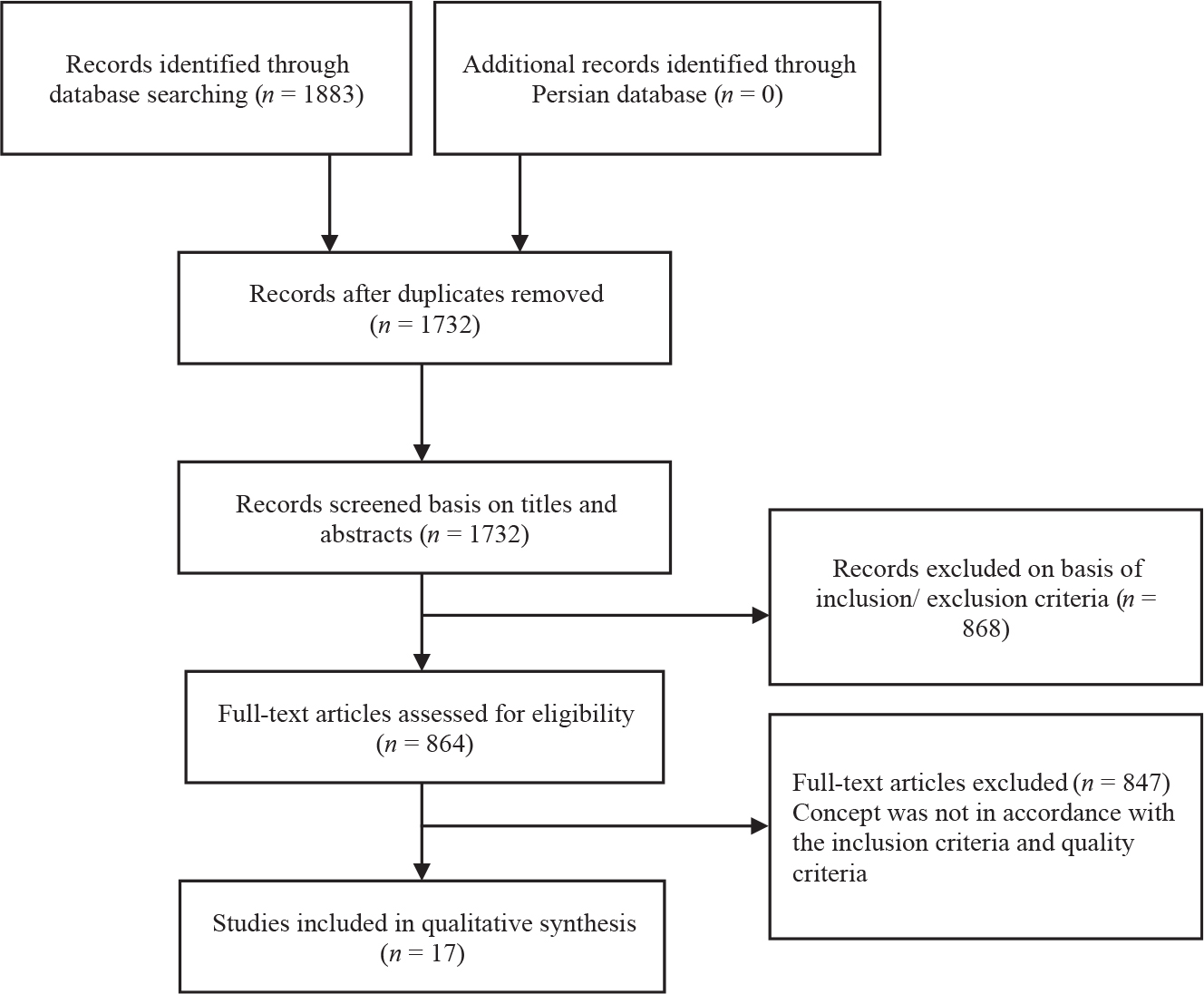
Figure 1.
PRISMA flow diagram of the present study.
Note: PRISMA, Preferred Reporting Items for Systematic Reviews and Meta-Analyses.
Table 2.
Details of literature reviewed in this study.
| Author (Publication year) | Design of study | Aims of study | HEs in patients with diabetes mellitus and factors affecting it |
|---|---|---|---|
| Atapour et al. (2023)29 | Qualitative study | Investigating the consequences of meeting the HEs of patients with diabetes-related visual impairment | Main category: improving access to comprehensive care, and four sub-categories: receiving preventive care, access to home care, safety promotion, and increasing health literacy |
| Yao et al. (2022)30 | Qualitative study | A review of the experiences of people with type 2 diabetes in relation to general practitioners in China | patients’ understanding, diabetes medication, communication with general practitioners, physician-patient relationships, and healthcare systems and context |
| Chan et al. (2020)31 | Qualitative study | To explore the barriers and recommendations regarding service delivery and research of IM service among diabetes patients and physicians | Seven subthemes regarding barriers towards IM (integrative medicine) service were identified including finance, service access, advice from medical professionals, uncertainty of service quality, uncertainty of CM effect, difficulty in understanding CM epistemology and access to medical records |
| Halperin et al. (2018)32 | Qualitative study | To gather patient perspectives on quality of care provided in diabetes clinics | Knowledgeable, caring, available, and communicative team that assists with self-management and overall control of diabetes (effective, patient-centered and timely), avoiding the complications of diabetes, participating in care planning and achieve patientcentered goals, financial support to cover medical and pharmaceutical expenses |
| da Silva et al. (2018)16 | Qualitative study | To identify the experiences, needs, and expectations of subjects with diabetes, for self-reliance for health promotion | Recognizing the rights and responsibilities, the capacity to decide, responsibly, protagonism of subjects, autonomy for them to have a better quality of life |
| Vachon et al. (2017)33 | Qualitative study | Investigating patients’ expectations and solutions for improving primary diabetes care | Follow-up by a family physician, continuous access to services adapted to evolving needs, motivation and maintenance of healthy behaviors, knowledge about diabetes, psychological support, financial constraints, and collaboration with secondary-level services, facilitating access to services, disseminating information about available services, centralizing diabetes information on the internet, offering personalized services and improving inter-professional collaboration |
| Jacklin et al. (2017)34 | Qualitative study | Reviewing the healthcare experiences of people with type 2 diabetes | The colonial legacy of healthcare, the perpetuation of inequalities, structural barriers to care, and the role of the healthcare relationship in mitigating harm |
| Gadsby et al. (2017)35 | Quantitative study | Measuring patient experience in diabetes care | More explanation and advice during appointments, listening to the patient, respecting the patient, increasing continuity of care, effective communication, screening services, ensuring regular foot, examinations and increasing access to foot care, easy access to Blood sugar control equipment and drugs, sufficient number of personnel, more support in early diagnosis, coordination in providing services, especially scheduling blood tests and multidisciplinary appointments in the clinic |
| Boyle et al. (2016)36 | Qualitative interpretive | Explaining the experiences of patients with type 2 diabetes from the care | Additional information and counseling |
| Oberg et al. (2012)37 | Qualitative study | Assessing the perception of people with type 2 diabetes from their first experiences with naturopathic care for diabetes | Health promotion, improving self-efficacy, pragmatic and practical self-care recommendations, novel treatment options, strengthening hope, improving patient education |
| Bowling et al. (2012)14 | Mixed-methods study | The concept of HE and develop scale | Personal experience of the patient and health staff, counseling, review of counseling outcomes, space and environment, time, Outcome, examinations and tests, treatment and medicine |
| Escudero-Carretero et al. (2007)11 | Qualitative study | To understand the expectations held by type 1 and 2 diabetes mellitus patients and their relatives regarding the healthcare provided to them | Expectations regarding healthcare professionals: understanding, treatment and communication capacity, providing information, recognition, perception of patients, respectful behavior, good communication skills, knowledge of patients’ knowledge and skills and providing transparent information, the ability to respond, have a normal life and no restrictions on work, education, social and family due to having diabetes and preventing complications expectations regarding healthcare centers: primary care consultation, specialized care consultation, necessary and sufficient equipment for treatment |
| Alazri et al. (2006)38 | Qualitative study | To evaluate the perceptions and experiences of patients with type 2 diabetes from continuing care, focusing on the advantages and disadvantages | Personal factors between themselves and the health care professional, their beliefs and behaviors, the presence of diabetes, and the systems and structures of general practices |
| Clementi (2006)39 | Dissertation (qualitative study) | Evaluation of experiences of patients during encounters with healthcare providers | Core category: respectful behavior other categories: appropriate body language, truth-telling, listening, problem-solving, effective communication, reassurance, outcome |
| Naithani et al. (2006)40 | Qualitative study | To identify patients experiences and values with respect to continuity in diabetes care | Regular clinical testing and provision of advice over time (longitudinal continuity) communication, understanding patients, concerned and interested in listening and explaining, and spending time communicating with the patient (relational continuity) flexibility of service provision in response to changing needs or situations (flexible continuity); and consistency and coordination between members of staff, and between hospital and general practice or community settings (team and cross-boundary continuity) |
| Lawton et al. (2005)41 | Qualitative study | To explore newly diagnosed Type 2 diabetes patients’ views about Scottish diabetes services | Information about self-management, the presence of a diabetes specialist and the availability of a specialist, specialist nurses, time |
| Hornsten et al. (2005)42 | Qualitative study | To report the findings of a study that elucidated the experiences and reflections of people with type 2diabetes about clinical encounters | Agreeing vs. in disagreement about the goals, autonomy, and equality vs. feeling forced into adaptation and submission, feeling worthy as a person vs. feeling worthless, being attended to and feeling welcome vs. ignored, and feeling safe and confident vs. feeling unsafe and lacking confidence |