
Table 1.
Steps involved in the study.
| Step | Nature of activity | Methods | Number of domains | Number of items | Addition or subtraction |
|---|---|---|---|---|---|
| 1 | Development of construct | Literature review Synthesize literature review | - | 60 | - |
| 2 | Item generation | Develop items | 04 | 55 | Subtraction of 05 overlapping items |
| 3 | Establishment of face validity and content validity | Expert review process | 04 | 51 | Subtraction of 05 items Addition of 01 item |
| 4 | Assessment of reliability | Test–Retest reliability | 03 | 51 | - |
| 5 | Assessment of stability | Internal consistency | 03 | 51 | - |
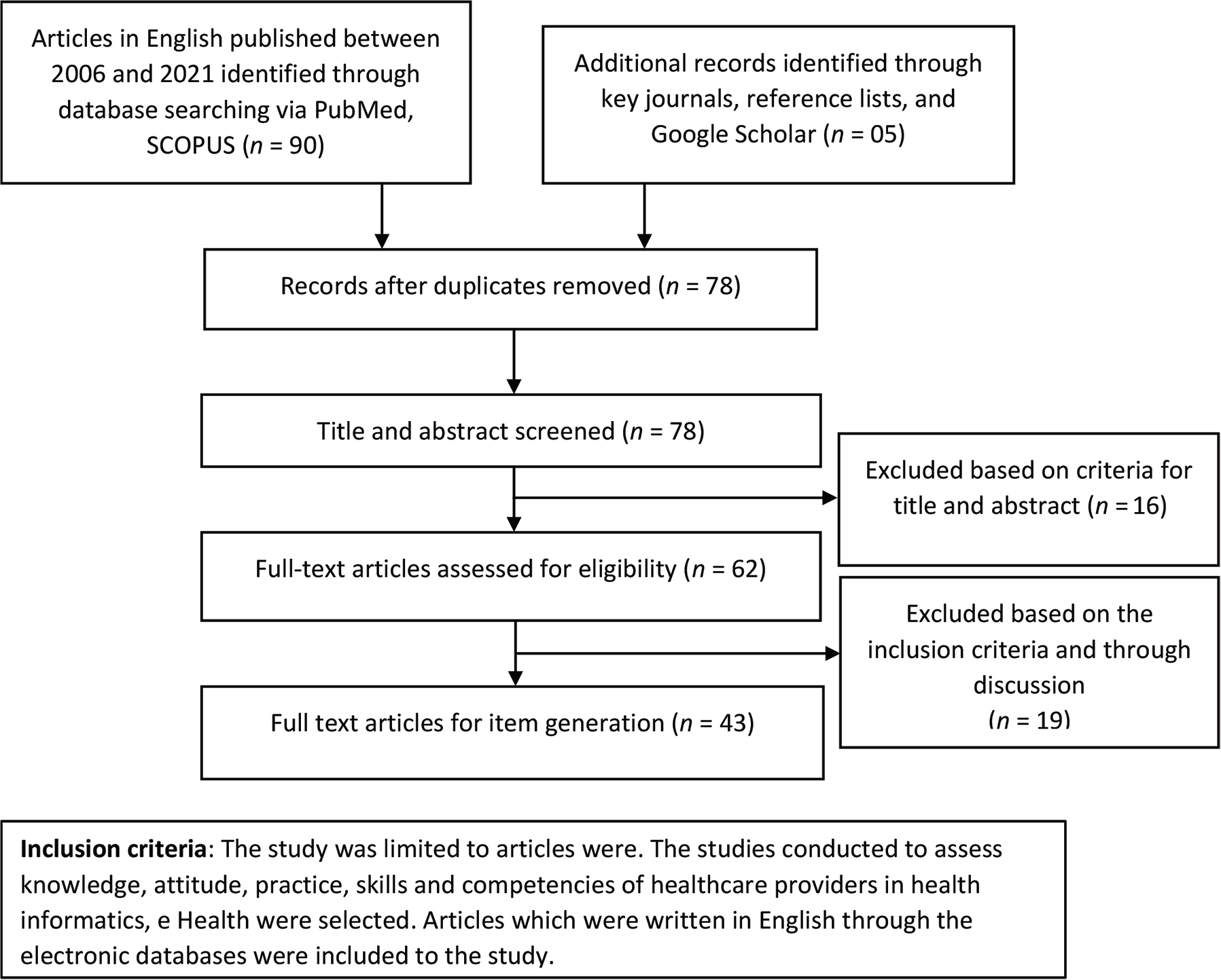
Figure 1.
Flow diagram of the inclusion of research articles to develop the instrument.
Table 2.
Scoring method.
| Items | Scoring |
|---|---|
| Relevancy | 1 = Not relevant |
| 2 = Item needs some revision | |
| 3 = Relevant but need minor revision | |
| 4 = Very relevant | |
| Clarity | 1 = Not clear |
| 2 = Item needs some revision | |
| 3 = Clear but need minor revision | |
| 4 = Very clear | |
| Simplicity | 1 = Not simple |
| 2 = Item needs some revision | |
| 3 = Simple but need minor revision | |
| 4 = very simple | |
| Ambiguity | 1 = Doubtful |
| 2 = Item needs some revision | |
| 3 = No doubt but need minor revision | |
| 4 = Meaning is clear |
Table 3.
Final version of the questions of the KAP domains.
| Domains | Items |
|---|---|
| Knowledge | |
| 1. Digital technologies (use of computers, mobile phones and other electronic tools and communication technologies) are used in many fields worldwide | a. The term “Digital Health” means the provision of healthcare via digital technologies. |
| b. Digital health has been used in all areas such as clinical, educational, managerial, administrative, training, and research. | |
| c. Digital health limits the access to healthcare for people in rural or remote areas. | |
| d. Digital health technologies are being used in both curative health and public health. | |
| e. Digital health facilitates managing data services such as data collection, management, use and exchange in health systems. | |
| 2. Your hospital is going to implement an eHIS. This implementation will facilitate | a. Direct access to all the information of patients through the computer. |
| b. Easy access to laboratory system through the computer at any time. | |
| c. The maintenance of paper-based medical records. | |
| d. The management of patients through decision support tools. | |
| e. To provide all nursing care through electronic devices. | |
| 3. Telemedicine | a. Telemedicine is the use of telecommunication to provide medical education and services at a distance. |
| b. Telemedicine needs sophisticated technologies. | |
| c. Patient management with prescribing drugs can be done through telemedicine. | |
| d. Follow-up of patients can be done through telemedicine. | |
| e. In telesurgery, a surgeon performs a surgical case without his/her being present in the operating room. | |
| 4. NI is an emerging specialty globally. | a. It is a combination of nursing science, computer science, information science, and cognitive science. |
| b. NI is applicable only in areas of clinical, education, and nursing research. | |
| c. NI roles require all nurses to be computer literate. | |
| d. NI is concerned with assisting and processing nursing data and information only. | |
| e. The goal of NI is to support decision-making only in specialized roles. | |
| 5. Suppose you are assigned to do a health education session for a group of patients under the digital health facilities. Do you have knowledge and skills on | a. Using basic components of the computer and its peripheral devices? (e.g., mouse, keyboard, multimedia, printer) |
| b. Using the Internet/search engines to gather information? | |
| c. Developing course materials using MS Word/MS PowerPoint/MS Excel? | |
| d. Sending a report of your teaching session via email? | |
| e. Using digital conference facilities such as Zoom/ Google Meet/Teams to conduct online sessions? | |
| Attitudes | |
| Relative advantages of digital health | 1. Reduce clinical errors made by nurses when providing patient care. |
| 2. Enable me to accomplish my tasks more quickly while performing duties in the workplace. | |
| 3. Makes my work easier due to the use of digital devices. | |
| 4. Improves the quality of nursing care provided by me to the patients. | |
| 5. Enables me to provide more comprehensive nursing care. | |
| Compatibility of digital health | 6. Compatible with all aspects of nursing activities that I conduct in the workplace during my duty hours. |
| 7. Fits well with the way I like to work in the workplace. | |
| 8. It is compatible with the current demand in health care. | |
| Acceptability of digital health | 9. Nurses should adjust to the digital health environment (NIs). |
| 10. I am interested in practicing digital health in my daily duties as a nurse. | |
| 11. I am interested in getting education/training on digital health. | |
| 12. I am seeking proper digital health education/ training. | |
| 13. Digital health reduces time spent with the patient. | |
| 14. A nurse should spend more time with the patients, not work with computers. | |
| 15. It negatively affects the nurse–-patient relationship in my workplace. | |
| Complexity of digital health | 16. Digital health technologies require large mental effort by nurses. |
| 17. It is difficult to adapt to digital health technologies in general. | |
| 18. Digital health creates new responsibilities for nursing staff. | |
| 19. The support from the other categories of healthcare staff to practice digital is not adequate. | |
| 20. I am not competent in using digital health. | |
| 21. I do not have facilities to adapt to/practice digital health. | |
| 22. I do not have adequate education/training to practice digital health. | |
| Observability of digital health | 23. I have observed how other health professionals utilize digital health technologies. |
| 24. I notice that digital health technologies are being used for a variety of tasks at the hospital. | |
| 25. In the hospital where I work, digital health is prominent. | |
| Practice | |
| 1. Do you have any digital health implementations (e.g., HIMS, EHR System, Telehealth) in your hospital? | a. Client identification through digital devices |
| 2. What are the digital health activities available in your hospital? (Select all that apply to you and put an [X] mark in the brackets given). | b. Client registration through digital devices |
| c. Trace laboratory investigations through digital devices | |
| d. Client discharge plan through digital devices | |
| e. Help to maintain clients’ medical records digitally (EMR/EHR/PHR) | |
| f. Use nurses’ decision support tools (checklists, alert systems, reminders) | |
| g. Provide nursing services through digital technologies whenever physical distance exists between client and nurses (telenursing practices) | |
| h. Communication through digital technologies | |
| (transmit routine news, workflow notifications, communication among staff) | |
| i. Referral coordination via digital technologies | |
| j. Activity planning and scheduling via digital devices (nurses notes) | |
| k. Nursing officer’s training (IT training, eLearning) | |
| l. Track client’s medication consumption and monitoring | |
| 3. How long (in months) you have been engaging in the above-mentioned digital health activities? | a. Client identification through digital devices |
| b. Client registration through digital devices | |
| c. Trace laboratory investigations through digital devices | |
| d. Client discharge plan through digital devices | |
| e. Help to maintain clients’ medical records digitally (EMR/EHR/PHR) | |
| f. Use nurses’ decision support tools (checklist, alert systems, reminders) | |
| g. Provide nursing services through digital technologies whenever physical distance exists between client and nurses (Telenursing practices) | |
| h. Communication via digital devices (transmit routine news, workflow notifications) | |
| i. Referral coordination via digital technologies | |
| j. Activity planning and scheduling via digital devices (nurses notes) | |
| k. Nursing officer’s training (IT training, eLearning) | |
| l. Track client’s medication consumption and monitoring | |
| 4. Which of the following digital devices do you use in your digital health practice in the workplace? (Select all that apply to you and put an [X] mark in the box given) | a. Desktop computer |
| b. Laptop/notebook computer | |
| c. Tablet computer (e.g., iPad, Galaxy) | |
| d. Smartphone | |
| e. Landline phone | |
| f. Fax machine | |
| 5. How often do you use above-mentioned digital devices in the workplace? | a. Desktop computer |
| b. Laptop/notebook computer | |
| c. Tablet computer (e.g., iPad, Galaxy) | |
| d. Smartphone | |
| e. Landline phone | |
| f. Fax machine | |
| 6. Which of the following digital devices do you use in your activities not related to work? (Select all that apply to you and put an [X] mark in the box given) | a. Desktop computer |
| b. Laptop/notebook computer | |
| c. Tablet computer (e.g., iPad, Galaxy) | |
| d. Smartphone | |
| e. Mobile phone (normal) | |
| f. Landline phone | |
| g. Fax machine | |
| h. Wearable devices | |
| 7. How often do you use the above-mentioned digital devices for activities not related to work? | a. Desktop computer |
| b. Laptop/notebook computer | |
| c. Tablet computer (e.g., iPad, Galaxy) | |
| d. Smartphone | |
| e. Mobile phone | |
| f. Landline phone | |
| g. Fax machine | |
| h. Wearable devices | |
| 8. What is your main purpose in using the above-mentioned digital devices in your daily life? | b. Find health information |
| c. Access to health care | |
| d. For health education | |
| e. Communication | |
| f. Digital health games | |