
Table 1.
Search strategies.
| #1 (Care Facility[MeSH Terms]) OR (Skilled Nursing Facility[MeSH Terms]) OR (Institutional Care[MeSH Terms]) OR (Homes for the Aged[MeSH Terms]) OR (Nursing Home[MeSH Terms]) OR (Old age home[MeSH Terms]) OR (Nursing Care[MeSH Terms]) OR (elderly care facility[MeSH Terms]) OR (long-term care facility[MeSH Terms]) OR (Nursing Care Management[MeSH Terms]) OR (Residential Facility[MeSH Terms]) |
| #2 (Elderly[MeSH Terms]) OR (Older people[MeSH Terms]) OR (aged[MeSH Terms]) OR (Older adults[MeSH Terms]) |
| #3 (horticulture therapy[MeSH Terms]) OR (horticultural therapy[MeSH Terms]) OR (gardening therapy[MeSH Terms]) OR (garden therapy[MeSH Terms]) OR (therapeutic horticulture[MeSH Terms]) OR (Horticulture Therapy[MeSH Terms]) |
| #1 AND #2 AND #3 |
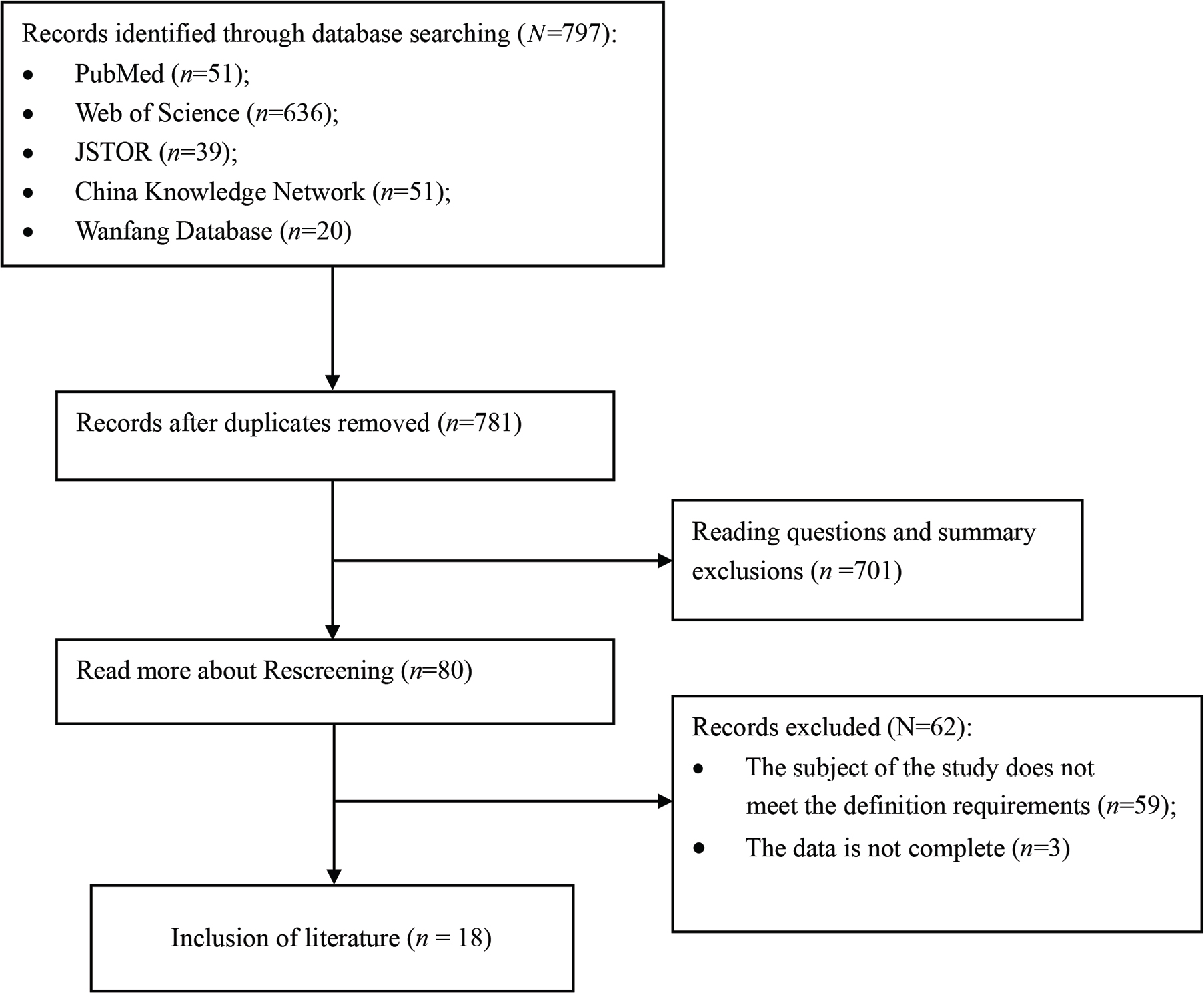
Figure 1.
Flow chart of the literature screening.
Table 2.
Summarised characteristics of eligible articles.
| Author | Years | Location | Study design | Participant | Intervention | Main findings | Outcome measures | ||
|---|---|---|---|---|---|---|---|---|---|
| Age (year) | Sample size (observation group/control group) | Measure | Duration and frequency | ||||||
| Chu et al.13 | 2019 | China | RCT | ≥65 | 75/75 | Intervention group performed planting and handicraft activities, and the rest were the same as the control group | 1–1.5 h per time/8 week | A reduction in depressive symptoms and improvement of the level of mental health | (21) (22) |
| Yao and Chen17 | 2017 | China (Taiwan) | Quasi-experimental study | ≥65 | 44/41 | Intervention group performed indoor planting activities, and the rest were the same as the control group | 1 h per week/8 weeks | Significant improvement in the activities of daily life, the sense of happiness, and interpersonal intimacy | (19)(25)(26)(27) |
| Mochizuki-Kawai et al.18 | 2021 | Japan | Quasi-experimental study | 90.3 ± 6.8 | 8/8 | Intervention group performed bedside structured floral arrangement program, and the rest were the same as the control group | 4 min/5 days | HT had a greater effect on QOL, and the depressive symptoms have reduced greatly | (3)(4)(5) |
| Yang et al.14 | 2021 | China | RCT | ≥60 | 8/8 | The intervention group performed outdoor planting, handicraft activities, and derivative activities, and the rest were the same as the control group | 1 h per week/10 weeks | A reduction of the apathy in dementia elderly and improvement in cognitive function | (6)(7)(8) |
| Jueng and Chen.19 | 2022 | China | Quasi-experimental study | 60–85 | 37/49 | Intervention group conducted indoor desktop gardening, and other measures were the same as the control group | 40 min per week/12 weeks | Significant benefits on SOC level of older LTCF residents | (9) |
| Park et al.20 | 2020 | Korea | Quasi-experimental study | ≥65 | 20/20 | Intervention groups were cultivated with low-intensity to moderate-intensity gardening activities, and the others were the same as the control group | 1 h per time/ twice per week/12 weeks | The ability of cognitive and BDNF levels in the gardening group was significantly improved | (10)(11)(12)(13) |
| Chen and Ji29 | 2015 | China | Mixed methods research | 60–85 | 5/5 | The intervention group performed indoor planting, handicraft, and cooking activities, and the rest were the same as the control group | 1.5 h per week/10 weeks | Significant improvement in the sense of achievement, happiness, and reduced loneliness | (14) (15) |
| Lai et al.15 | 2018 | China (Hong Kong) | RCT | ≥70 | 46/50 | The intervention group performed indoor and outdoor planting activities, and the rest were the same as the control group | 1 h per week/8 weeks | HT enhanced the sense of happiness greatly | (2)(15)(16)(17) (18)(24) |
| Lo et al.27 | 2019 | China (Hong Kong) | Qualitative research | ≥70 | 22 | Intervention group conducted horticultural courses, and the rest were the same as the control group | 1 h per week/8 weeks | A significant improvement was observed in well-being and quality of life | — |
| Bourdon and Belmin21 | 2021 | France | Quasi-experimental study | 81.0 + 3.5 | 3/3/3 | Group A were encouraged to invite enriched garden, group B were reminded to visit to invite conventional sensory garden, and ensure the elderly visited 4 times/ week | 10–20 min per time/4 times per week/24 weeks | Significant benefits on the level of cognition | (6)(19)(20) |
| Bassi et al.22 | 2018 | Italy | Quasi-experimental study | ≥65 | 6/7 | The first group took part in plant cultivation and handicraft activities, then took part in routine nursing home activities; the second group took part in routine activities and then took part in gardening activities | 1 h per week/6 weeks | HT had improved the quality of life, reduced stress, promoted happy mood, and enhanced mental health | (6) |
| Luk et al.23 | 2011 | USA | Quasi-experimental study | ≥65 | 7/7 | The intervention group performed outdoor planting and handicraft activities, and the rest were the same as the control group | 30 min per time/ twice per week/6 weeks | A reduction in the agitation in the elderly with dementia had been noticed | (6)(23) |
| Dahlkvist et al.26 | 2016 | Sweden | Mixed methods research | 84.8 | 290 | Encouraged to wander around in gardens and green spaces | Not mentioned | A significant improvement was observed in healthy self-perceived ability and level of health | (27)(28) |
| Edwards et al.28 | 2013 | Australia | Qualitative research | 79–90 | 12 | The intervention group visited the therapeutic garden, and the others were the same as the control group | 12 weeks, duration and frequency were not mentioned | Significant benefits in the quality of life and HT could reduce stress to a certain extent | (4)(6)(29) |
| Hassan et al.16 | 2018 | China | Randomised controlled cross-over study | 79.5 + 8.0 | 20/20 | First day, the first group conducted a transplanting activity using soil with plants; the second group conducted a transplanting activity using soil without plants, the next day, 2 groups exchanged activities | 15 min per day/2 days | HT reduced blood pressure and anxiety, persuade the elderly to relax | (1)(30)(31)(32) |
| Masuya et al.24 | 2014 | Japan | Quasi-experimental study | ≥65 | 9/9 | Intervention group performed planting and cooking activities, and the rest were the same as the control group | 30–40 min per week/6 weeks | A significant improvement was observed in short-term depression and life satisfaction | (6)(19)(21)(33) |
| Tse25 | 2010 | China (Hong Kong) | Quasi-experimental study | ≥60 | 27/26 | The intervention group did indoor plant planting, discussion, and diary writing activities, then the rest were the same as the control group | 8 weeks, duration and frequency were not mentioned | Significant improvement in physical activity level, the ability of moving, life satisfaction, and social level, then HT reduced loneliness | (34)(35)(36)(37) |
| Zushi30 | 2008 | Japan | Mixed methods research | 64–90 | 6/6/6 | Three groups of elderly people were conducted indoor and outdoor gardening activities. | 8 weeks, duration and frequency were not mentioned | Interest, motivation, communication skills, self-confidence, and self-achievement improved significantly | (38) |
1 Note: (1), Blood pressure; (2), GWB Schedule Scale; (3), EuroQoL; (4), CSDD; (5), AES-I; (6), MMSE; (7), QOL-AD; (8), BI; (9), SOC; (10), SFT; (11), Hand function ability (Digital grip dynamometer; Jamar hydraulic pinch gauge; Grooved pegboard); (12), MMSE; (13), Metabolic profiling techniques (ELISA); (14), UCLA Loneliness Scale version 3; (15), GDS-SF; (16), General Self-Efficacy Scale; (17), Social Engagement Scale; (18), SHS; (19), ADL; (20), TUG test; (21), GDS-15; (22), 20-item UCLA Loneliness Scale; version 3 (RULS-V3); (23), C-CMAI; (24), CHI; (25), MLS; (26), IIS; (27), PRS; (28), EQ-VAS; (29), DEMQOL; DEMQOLProxy; (30), EEG; (31), STAI; (32), Semantic differential scale; (33), VI, (34), Life Satisfaction-A Index Form; (35), UCLA Loneliness Scale (UCLA); (36), LSNS; (37), The MBI; (38), Evaluation form.
ADL, activities of daily living; AES-I, Apathy Evaluation Scale-informant version; BI, Barthel Index; LTCF, Long-term care facility; BDNF, brain-derived neurotrophic factor; C-CMAI, Chinese version of the Cohen–Mansfield Agitation Inventory; CHI, Chinese Happiness Inventory; CSDD, Cornell Scale for Depression in Dementia; EEG, electroencephalogram; EQ-VAS, Visual Analogue Scale; GDS-15, 15-item Geriatric Depression Scale; GDS-SF, Geriatric Drepression Scale-Short Form; GWB, General Wellbeing; HT, horticultural therapy; IIS, Interpersonal Intimacy Scale; LSNS, Lubben Social Network Scale; MBI, modified Barthel Index; MLS, Meaning of Life Scale; MMSE, Mini-Mental State Examination; PRS, Perceived Restorativeness Scale; QOL-AD, quality of life in Alzheimer’s disease; RCTs, randomised controlled trials; SFT, Senior Fitness Test; SHS, Subjective Happiness Scale; SOC, Sense of Coherence; STAI, State-Trait Anxiety Inventory; TUG, Timed Up and Go; VI, Vitality Index.