

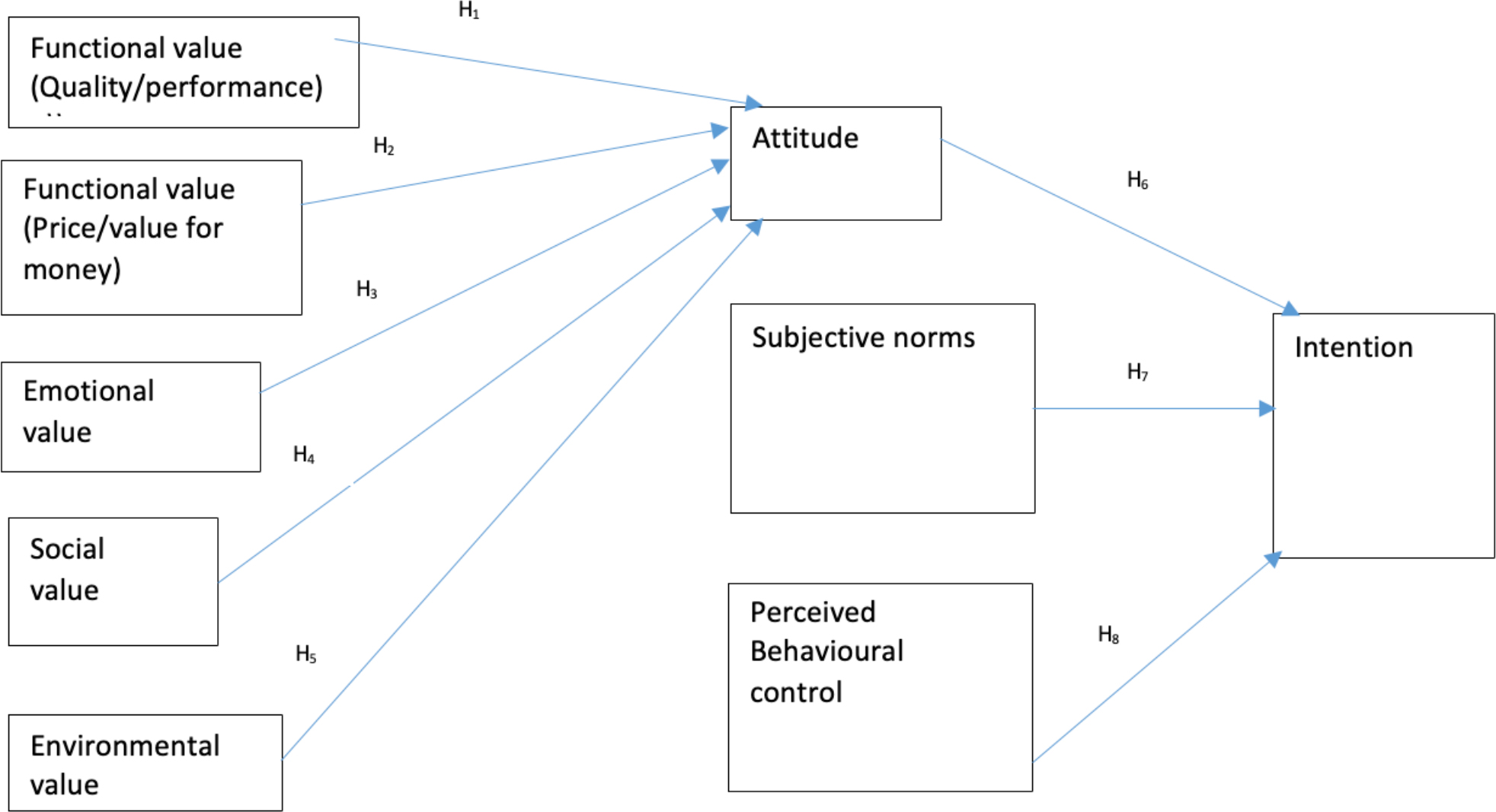
Figure 1.
Conceptual framework
(Source: Authors’ own research)
Table 1.
Measurement model (Source:
Authors’ own research)
| Construct (mean and SD) | Factor loading | CA | CR | AVE |
|---|---|---|---|---|
| Functional value (quality (4.50;1.01) | 0.752 0.816 0.777 0.804 | 0.822 | 0.867 | 0.619 |
| Functional value (price) (4.02, 1.05) | 0.836 0.772 0.768 0.801 - | 0.836 | 0.873 | 0.673 |
| Emotional value (3.90 0.99) | 0.808 0.852 0.820 | 0.900 | 0.866 | 0.684 |
| Social value (2.60 1.07) | 0.725 0.778 0.753 | 0.839 | 0.796 | 0.566 |
| Environmental value (3.92, 0.97) | 0.826 0.769 0.808 | 0.926 | 0.843 | 0.642 |
| Attitude (4.04; 1.03) | 0.826 0.749 0.765 0.723 | 0.864 | 0.851 | 0.588 |
| Subjective norms (2.64; 1.06) | 0.799 0.745 0.802 | - | 0.825 | 0.611 |
| Perceived behavioural control (4.15;1.11) | 0.796 0.802 0.815 | - | 0.846 | 0.647 |
| Intention (3.86, 1.02) | 0.838 0.865 0.752 | 0.788 | 0.860 | 0.672 |
Table 2.
Fornell and Larcker
(Source: Authors’ own research)
| Construct | FVQ | FVP | EV | SV | ENV | ATT | SN | PBC | INT |
|---|---|---|---|---|---|---|---|---|---|
| FVQ | 0.820 | - | - | - | - | - | - | - | - |
| FVP | 0.407 | 0.820 | - | - | - | - | - | - | - |
| EV | 0.361 | 0.429 | 0.827 | - | - | - | - | - | - |
| SV | 0.296 | 0.379 | 0.368 | 0.752 | - | - | - | - | - |
| ENV | 0.280 | 0.505 | 0.392 | 0.408 | 0.801 | - | - | - | - |
| ATT | 0.407 | 0.304 | 0.268 | 0.392 | 0.377 | 0.769 | - | - | - |
| SN | 0.373 | 0.361 | 0.408 | 0.399 | 0.507 | 0.462 | 0.782 | - | - |
| PBC | 0.401 | 0.328 | 0.526 | 0.557 | 0.407 | 0.380 | 0.437 | 0.804 | - |
| INT | 0.502 | 0.359 | 0.538 | 0.275 | 0.428 | 0.444 | 0.366 | 0.408 | 0.820 |
Table 3.
HTMT
(Source: Authors’ own research)
| Construct | FVQ | FVP | EV | SV | ENV | ATT | SN | PBC | INT |
|---|---|---|---|---|---|---|---|---|---|
| FVQ | - | - | - | - | - | - | - | - | - |
| FVP | 0.509 | - | - | - | - | - | - | - | - |
| EV | 0.369 | 0.307 | - | - | - | - | - | - | - |
| SV | 0.482 | 0.602 | 0.447 | - | - | - | - | - | - |
| ENV | 0.385 | 0.553 | 0.365 | 0.247 | - | - | - | - | - |
| ATT | 0.488 | 0.226 | 0.572 | 0.199 | 0.385 | - | - | - | - |
| SN | 0.385 | 0.469 | 0.472 | 0.538 | 0.473 | 0.477 | - | - | - |
| PBC | 0.529 | 0.365 | 0.521 | 0.488 | 0.465 | 0.366 | 0.406 | - | - |
| INT | 0.529 | 0.362 | 0.504 | 0.275 | 0.504 | 0.297 | 0.368 | 0.475 | - |
Table 4.
Structural model results
(Source: Authors’ own research)
| Hypothesised relationships | B | SE | T-value | Decision |
|---|---|---|---|---|
| H1: FVQ-ATT | 0.268 | 0.052 | 9.209* | Supported |
| H2: FVP-ATT | 0.306 | 0.047 | 6.673** | Supported |
| H3:EV-ATT | 0.511 | 0.072 | 4.747** | Supported |
| H4 SV-ATT | 0.031 | 0.045 | 0.122 | Not supported |
| H5 ENV-ESI | 0.248 | 0.039 | 5.548** | Supported |
| H6: ATT-INT | 0.402 | 0.055 | 7.407* | Supported |
| H7: SN-INT | 0.042 | 0.027 | 0.139 | Not supported |
| H8: PBC-INT | 0.268 | 0.049 | 3.278** | Supported |
| Construct | Items | Adopted from | Response category |
|---|---|---|---|
| Functional (quality/performance) | 1. EEAs have consistent quality 2. EEAs have an acceptable level of quality 3. EEAs have advanced technology 4. EEAs would last for a long time 5. EEAs have good functions | Sweeney and Soutar (1991); Zhang, et al. (2020) | Five-point Likert scale with 1 being ‘strongly disagree’ and 5 being ‘strongly agree’ |
| Functional (price/value for money) | 1. EEAs are reasonably priced 2. EEAs offer value for money 3. EEAs are in the longrun economical 4. EEAs are good products for the price that they are sold | Sweeney and Soutar (1991); Zhang, et al. (2020) | Five-point Likert scale with 1 being ‘strongly disagree’ and 5 being ‘strongly agree’ |
| Emotional value | 1. I enjoy using EEAs 2. I am relaxed about using EEAs 3. I feel good using EEAs 4. It gives me pleasure to use EEAs | Sweeney and Soutar (1991); Zhang, et al. (2020) | Five-point Likert scale with 1 being ‘strongly disagree’ and 5 being ‘strongly agree’ |
| Social value | 1. Using EEAs would make me feel acceptable 2. Using EEAs would improve the way that people perceive me 3. Using EEAs would enable me to make a good impression on other people 4. Using EEAs would give their owners social approval | Sweeney and Soutar (1991); Zhang, et al. (2020) | Five-point Likert scale with 1 being ‘strongly disagree’ and 5 being ‘strongly agree’ |
| Environmental value | 1. The use of EEAs would help to reduce environmental pollution 2. The use of EEAs would help to reduce global warming 3. EEAs are environmentally friendly | Sweeney and Soutar (1991); Zhang, et al. (2020) | Five-point Likert scale with 1 being ‘strongly disagree’ and 5 being ‘strongly agree’ |
| Attitude | I consider the purchase of energy-efficient appliances (EEAs) 1. unfavourable (1)/favourable 2. undesirable/desirable 3. unpleasant/pleasant 4. negative (1)/positive | Yadav and Pathak (2017) | Semantic differential scale |
| Subjective norms | 1. Most people who are important to me think I should buy EEAs when it comes to the choice of household appliances 2. If I buy EEAs, this can influence other people to buy them 3. People whose opinions I value would prefer that I purchase EEAs | Yadav and Pathak (2017) | Five-point Likert scale with 1 being ‘strongly disagree’ and 5 being ‘strongly agree’ |
| Perceived behavioural control | 1. I can largely decide whether or not to buy an EEAs 2. I will have the ability to buy EEAs in the future 3. I am confident that if I want to, I will definitely be able to choose EEAs in the near future | Yadav and Pathak (2017) | Five-point Likert scale with 1 being ‘strongly disagree’ and 5 being ‘strongly agree’ |
| Intention | 1. In the future, I am willing to buy EEAs if I need to have home appliances 2. In the future, I plan to buy EESs because they are appliances with better energy efficiency 3. In the future, I intend to buy EEAs because they are appliances with better energy efficiency | Yadav and Pathak (2017) | Five-point Likert scale with 1 being ‘strongly disagree’ and 5 being ‘strongly agree’ |