

1. Introduction
The Global Risks Report 2023 points out that one of the most significant risks faced by the world is climate change. The report describes climate change as swift, prevalent and increasing (World Economic Forum, 2023). According to the Secretary General of the United Nations, the world has moved from the era of global warming to global boiling as hot weather becomes more prevalent globally (United Nations, 2023). Therefore, to limit global warming, there is the need to reduce the emission of carbon dioxide and other greenhouse gases (World Economic Forum, 2023; United Nations, 2023). Although energy consumption has a positive effect on the economic growth of countries, it is one of the main factors contributing to climate change through the emission of carbon dioxide (Ritchie and Roser, 2020; Hossain, et al., 2022; Dia, et al., 2022). Energy consumption has increased rapidly in residences in the last few decades due to population growth (Wu and Lin, 2023). The percentage of consumption by electrified households in South Africa’s total grid electrical energy is approximately 17%. The residential sector can account for about 35% of national electricity demand during the peak hours (Hughes and Larmour, 2021). Apart from the negative environmental effects of energy consumption, there is an inadequacy of electricity supply in South Africa leading to regular load shedding (Ateba, et al., 2019). Furthermore, the prices of electricity for individuals and businesses have increased significantly in the last 10 years (Ismail and Wood, 2023). These issues make the reduction of energy consumption by individuals and businesses very important in South Africa.
Households can play a major role in environmental protection by using energy-saving products (Casado, et al., 2017). Improved efficiency and reduced energy demand are fast and economical ways to reduce energy use and ensure environmental sustainability (Sorrell, 2015). Energy efficiency focuses on the reduction of energy use through technological advancements, while energy conservation behavior involves changes in human behavior that lead to reduction in energy use (Moriaty and Honnery, 2019). Energy efficiency is at times preferred to energy conservation behavior because it is a one-time expenditure and does not require continuous effort by individuals (Ali, et al., 2021). Energy-efficient appliances (EEAs) use less electricity and still maintain good levels of comfort, convenience and performance (Li, et al., 2019). In South Africa, the energy efficiency of household appliances must be accurately shown on their labels (Department of Mineral Resources and Energy, 2018; Issock and Muphosi, 2023). However, there is a low level of awareness of EEAs in the country, and the estimated sale of energy-efficient appliances is less than 20% of the total market of appliances (Tholen, et al., 2015; Goldsein Market Intelligence Report, 2020; Issock and Muphosi, 2023). This makes it important to understand the factors that can improve the purchase of EEAs in South Africa.
The purchase of products such as EEAs can be affected by generational cohorts that comprise individuals born at a specific place within a certain time and normally go through similar experiences (Wahyuningsih, et al. 2022; Gomes, et al. 2023). Generational cohorts include Silent, Boomers, Generation X, Millennials and Generation Z (Pew Research Center, 2019). Generational cohorts are useful in consumer marketing and one of the ways of market segmentation and communication campaigns by firms (Kamenidou, et al., 2020). Although there are many studies on sustainable products, research studies that focus on generational cohorts are limited (Kamenidou, et al., 2020). The behavioral pattern of Generation Z especially in the context of the purchasing of green products has been insufficiently addressed by research (Dragolea, et al., 2023). This creates a significant gap in research on sustainable products such as EEAs. Generation Z represents of one third of the population of South Africa, and apart from being digital nomads, Generation Z consumers are also interested in activities that protect the environment (Pillay, 2021; Dragolea, et al., 2023). Actions taken by Generation Z to limit their environmental impact include the purchase of electric cars and energy efficiency at home (Deloitte, 2023). Generation Z are also willing to pay more for sustainable products but are struggling to afford them because of financial concerns (Deloitte, 2023). Therefore, it is important to understand the factors that can affect the purchase of EEAs by Generation Z.
The Theory of Planned Behavior (TPB) by Ajzen (1991) is the most widely used theory to understand individual intention and behavior. The TPB has been widely used as the theoretical basis to understand green consumption intention and behavior (Ruangkanjanases, et al., 2020; Ayar and Gürbüz, 2021). The TPB comprises three constructs, namely, attitude, subjective norms and perceived behavior control, as antecedents of intention. In addition, intention is expected to lead to behavior (Ajzen, 1991). According to the TPB, attitude, subjective norms and perceived behavioral control also have antecedents (Ajzen, 1991). The antecedents of attitude are behavioral beliefs, normative beliefs are the antecedents of subjective norms, and control beliefs are antecedents of perceived behavioral control. The examination of these antecedents can help in understanding the process that links these constructs to intention (Ajzen, 1991). According to Braimah, et al. (2023), there have been many attempts by empirical studies to examine the determinants of green attitude; however, several research gaps remain unexplored. Luo, et al. (2022) point out that although the TPB can be used to explain consumer intention and behavior, it does not take into consideration the effects of the perception of product value by consumers. Perceived value is a significant factor in the attitude and behavior of consumers (Sweeney and Soutar, 2001). Thus, how perceived value affects the purchase of EEAs should be explored (Zhang, et al., 2020). This study intends to use perceived value as the antecedent of attitude towards EEAs. Perceived value can be defined as the preference and evaluation of a product’s attributes and utility by customers (Woodruff, 1997; Luo, et al., 2022). The study is guided by the following objectives: (1) to determine the effect of perceived value dimensions on attitude towards EEAs by Gen Z consumers and (2) to examine the effects of attitude, subjective norms and perceived behavior control on intention to purchase EEAs by Gen Z consumers.
The study will be significant in the following ways. The study tests a new conceptual framework on how perceived value can affect attitude towards the purchase EEAs by generation Z consumers. Luo, et al. (2022) remark that perceived value is of significance in the purchase of energy-saving products by consumers; however, the findings of empirical studies are contradictory. In addition, the study focuses on Gen Z consumers. Exploring generational cohorts can lead to the understanding of the common characteristics of each generation, and this can influence the marketing strategy of firms that produce environmentally friendly products (Gomes, et al., 2023). The study is organized as follows. Section 2 focuses on the theoretical and empirical literature. The research methodology is presented in Section 3. Sections 4, 5 and 6 focus on the results, discussion and conclusion, respectively.
2. Literature review and development of hypotheses
2.1. Energy-efficient appliance (EEAs)
Energy-efficient appliances (EEAs) use less electricity and can achieve the same level of performance compared to conventional models of the same size or capacity (Agyarko, et al., 2020; Harun, et al., 2022; Aggarwal, et al., 2022). EEAs include light bulbs, hybrid electric vehicles, air conditioners, dishwashers, electric ovens, tumble dryers, water heaters, computers and servers (Department of Energy, 2019; Hossain, et al., 2022). EEAs are preferred to energy conservation behavior because they involve a one-time expenditure and do not require continuous effort by individuals (Li, et al., 2019).
2.2. Generation Z
Mannheim (1952) defines a generation as a group of people of similar ages and who have experienced an important historical event within a period. This forms the basis for the Generational Cohort Theory which argues that individuals born within the same generation tend to share similar economic, social and political events during the early stages of life and will develop a similar set of behavior, values and belief (Strauss and Howe, 1991; Padayachee, 2017). The theory has proved useful as a method of market segmentation and the development of effective market promotions (Thach, et al., 2020). Generations include Silent (1928–1945), Boomers (1946–1964), Generation X (1965–1980), Millenials (1981–1996) and Generation Z (1997–2012) (Pew Research Center, 2019). Le Rouz (2019) remarks that there are slight differences in the definitions of generations among countries due to the events that occurred at different times. In South Africa, there are slight differences in the period for Generation Z. Aina and Ezeuduji (2021) describe Generation Z as individuals born between 1995 and 2012. Axcell and Ellis (2023) define Generation Z is as individuals born between 1994 and 2010. This study defines Generation Z consumers as individuals born between 1997 and 2012.
2.3. Theoretical background
The study is guided by two theories namely the Theory of Planned Behavior (TPB) and the Perceived Value Theory. The TPB by Ajzen (1991) proposes that the intention to perform a behavior is shaped by three factors, namely, attitude, subjective norms and perceived behavioral control. In addition, intention is expected to lead to behavior (Ajzen, 1991). According to the TPB, attitude, subjective norms and perceived behavioral control also have antecedents (Ajzen, 1991). The TPB has been used as the theoretical basis for studies on green purchase behavior (Ruangkanjanases, et al., 2020; Ayar and Gürbüz, 2021). Misra, Pedada and Sinha (2022) point out that the concept of perceived value can be linked to the economic theory of the firm and consumer surplus. Perceived value is important to marketing practitioners, researchers and customers and is a significant determinant of consumer buying behavior (Demirgüneş, 2015). There is a lack of agreement among researchers on the definition of perceived value, and the differences in opinions can be linked to whether it should be seen as a unidimensional or multidimensional construct (Aulia, et al., 2016). However, there seems to be an agreement among most researchers that perceived value should be considered a multidimensional construct (Aulia, et al., 2016). Zeithaml (1988, p.14) defines perceived value as a ‘consumer’s overall assessment of the utility of a product (or service) based on perceptions of what is received and what is given’. Researchers have also not agreed on the dimensions of perceived value. Sheth, et al. (1991) in the theory of consumption value suggest five dimensions of value. These include functional, social, emotional, epistemic and conditional. Sweney and Soutar (2001) identify four distinct value dimensions, namely, emotional, social, quality/performance and price/value for money. Sweeney and Soutar (2001) argue that price and quality are two subfactors of the functional dimension. The two contribute separately to perceived value and should be separately measured. Luo, et al. (2022) argue that the dimensions of perceived value should include environmental or green value, which describes the perception of consumers about the environmental friendliness of products. This study uses five dimensions of perceived value, namely, functional (quality), functional (price) social, emotional and environmental.
2.4. Hypotheses
2.4.1. Functional value (quality and performance) and attitude
Sweeney and Soutar (2001, p.211) define quality/performance as a functional subfactor that explains ‘the utility derived from the perceived quality and expected performance of the product’. In the context of EEAs, this value relates to the quality and performance of the products (Luo, et al., 2022). The study by Luo, et al. (2022) finds that functional value (quality and performance) positively affects consumer satisfaction with energy-saving products. Zhang, et al. (2020) point out that quality value is a significant driver of product choice by consumers. Consumers consider quality and performance when evaluating household appliances. Quality focuses on issues such as the process of manufacturing and stable quality, while performance depicts working effects and advanced technology. The study by Zhang, et al. (2020) finds that quality positively impacts on attitude towards the purchase and use of energy-saving appliances. These findings are consistent with the results of Lin and Dong (2023) on the effects of functional value on attitude towards the purchase of EEAs. The positive perception of the functional value of EEAs by consumers in terms of quality and performance can affect attitude towards the purchase of the product. It is hypothesized that (H1): Functional value (quality and performance) is positively related to attitude towards the purchase of EEAs.
2.4.2. Functional value (price/value for money)
Sweeney and Soutar (2001, p.211) define functional value (price/value for money) as ‘the utility derived from the product due to the reduction of its perceived short term and longer-term costs’. Joshi, et al. (2021) find that consumers tend to assess the value for money of green products, and this enhances green buying. The study by Joshi, et al. (2021) finds that economic value positively affects attitude towards the green product purchase. Zhang, et al. (2020) remark that EEAs are energy efficient and can reduce electricity consumption and bills for consumers. The purchase and use of EEAs are economical in the long run, and the higher the perceived long-term cost, the higher the perceived price value. This can positively influence attitude towards the purchasing of EEAs. The study by Zhang, et al. (2020) finds a significant positive relationship between price and attitude towards the purchase of energy-saving appliances by consumers. Hassan and Aktar (2022) find that economic value is positively related to green consumption attitude of eco-bag by young consumers in Bangladesh. It is hypothesized that (H2): Functional value (price/value for money) is positively related to attitude towards the purchase of EEAs.
2.4.3. Emotional value and attitude
Emotional value can be defined as ‘the utility derived from the feelings or affective states that a product generates’ (Sweeney and Soutar, 2001, p. 211). In the context of energy-saving products, emotional value depicts the perceived utility of the product to give comfortable and pleasant feeling. This can affect the subconscious in the process of decision making (Luo, et al., 2022). The study by Luo, et al. (2022) finds that emotional value positively influences satisfaction with energy-saving products. Wang, et al. (2022) argue that emotion can affect the psychological or mental needs of a product by an individual. Emotional value is an important factor in behavioral intention. The buying process of a product can bring negative or positive affective feelings. Wang, et al. (2022) find a significant positive relationship between emotional value and green purchase attitude. Joshi, et al. (2021) find that emotional value positively influences attitude towards green product purchase. It is hypothesized that (H3): Emotional value is positively related to attitude towards the purchase of EEAs.
2.4.4. Social value and attitude
Social value can be defined as the ‘the utility derived from the product’s ability to enhance social self-concept’ (Sweeney and Soutar, 2001, p.211). Consumers take into consideration the opinion of other people when buying a product (Luo, et al., 2022). The findings of the study by Luo, et al. (2022) indicate that the effect of social value on satisfaction with energy-saving products is insignificant. Zhang, et al. (2020) remark that if consumers feel that purchasing and using energy-saving products will help them to win praise and show their image, the greater will be their perception of social value. The study by Zhang, et al. (2020) finds that the effect of social value on attitude towards the purchase of energy-saving products is insignificant. Wang, et al. (2022) remark that social value depicts the feeling of connectedness by consumers to others by using a product. Wang, et al. (2022) find that the effect of social value on green purchase attitude is significant. Hassan and Aktar (2022) find that social value is positively related to attitude to purchase green products in Bangladesh. It is hypothesized that (H4): Social value is positively related to attitude towards the purchase of EEAs.
2.4.5. Environmental (green) value and attitude
Environmental value can be described as the perceived utility derived from the consumption of products that reduces environmental degradation (Zhang, et al., 2020). In the context of EAAs, environmental value refers to the impact of such products on environmental protection (Luo, et al., 2022). Environmental value such as pollution reduction and managing resource depletion are considered by consumers when buying energy-saving products (Zhang, et al. 2022; Lin and Dong, 2023). Luo, et al. (2022) find a significant positive relationship between environmental value and customer satisfaction with energy-saving products. Hassan and Aktar (2022) find that environmental value is positively related to green consumption attitude of eco bags. Alagarsamy, et al. (2019) find that green consumption value positively affects the willingness attitude towards sustainable food logistics. The perception of consumers about environmental value can improve their attitude towards the purchase of EEAs. It is hypothesized that (H5): Environmental value is positively related to attitude towards the purchase of EEAs.
2.4.6. Attitude and intention
Ajzen (1991) describes attitude as the favorable or unfavorable evaluation of a particular behavior by an individual. According to the TPB by Ajzen (1991), attitude is one of the major predictors of intention. Attitude is one of the significant determinants of intention to purchase green products (Yen and Hoang, 2022). Hossain, et al. (2022) find that attitude is a significant predictor of intention to purchase EEAs. The findings of the study by Warid and Ahmed (2020) indicate a significant positive relationship between attitude and intention to purchase EEAs in Pakistan. The positive relationship between attitude and intention to purchase EEAs is further supported by Tan, et al. (2017), Li, et al. (2019) and Li, et al. (2021). The more favorable is the attitude of an individual towards the purchase of EEAs, the higher the intention to purchase them. It is hypothesized that (H6) attitude and intention to purchase EEAs are positively related.
2.4.7. Subjective norms and intention
Subjective norms can be described as the influence that other people have on a particular individual (Ajzen, 1991). The literature is inconclusive about the impact of subjective norms on the purchase intention of green product. Tan, et al. (2017) find that subjective norms do not significantly affect the intention to purchase EEAs in Malaysia. Ali, et al. (2021) find that the effect of subjective norms on the purchase of EEAs in Pakistan is insignificant. These findings are consistent with the results of Rezaei and Ghofranfarid (2018) on the effect of subjective norms on intention to use renewable energy by rural households in Iran. Hossain et al. (2022) find that subjective norms positively affect intention to purchase EEAs. The positive relationship between subjective norms and intention to purchase of EEAs is further supported by the findings of Yadav and Pathak (2017). It is hypothesized that (H7): Subjective norms and intention to purchase EEAs are positively related.
2.4.8. Perceived behavioral control and intention
Perceived behavior control as one of the constructs of the TPB depicts the judgement of an individual about their ability to perform a specific behavior (Ajzen, 1991). Zhuang, et al. (2021) in a meta-analytic review find that perceived behavioral control positively influences intention to purchase green products. The results of the study by Wang, et al. (2014) indicate that perceived behavioral control is positively related to energy-saving behavior. Bhutto, et al. (2021) find a positive relationship between perceived behavioral control and intention to purchase EEAs in Pakistan. The findings of the study by Hossain, et al. (2022) indicate that the relationship between perceived behavioral control and intention to purchase EEAs is positive. The positive relationship between perceived behavioral control and intention to purchase EEAs is further supported by the findings of Tan, et al. (2017), Li, et al. (2019), Li, et al. (2021) and Lin and Dong (2023). It is hypothesized that (H8): Perceived behavioral control and intention to purchase EEAs are positively related. Figure 1 depicts the conceptual framework of the study. Intention to purchase EEAs are positively related. Figure 1 depicts the conceptual framework of the study.
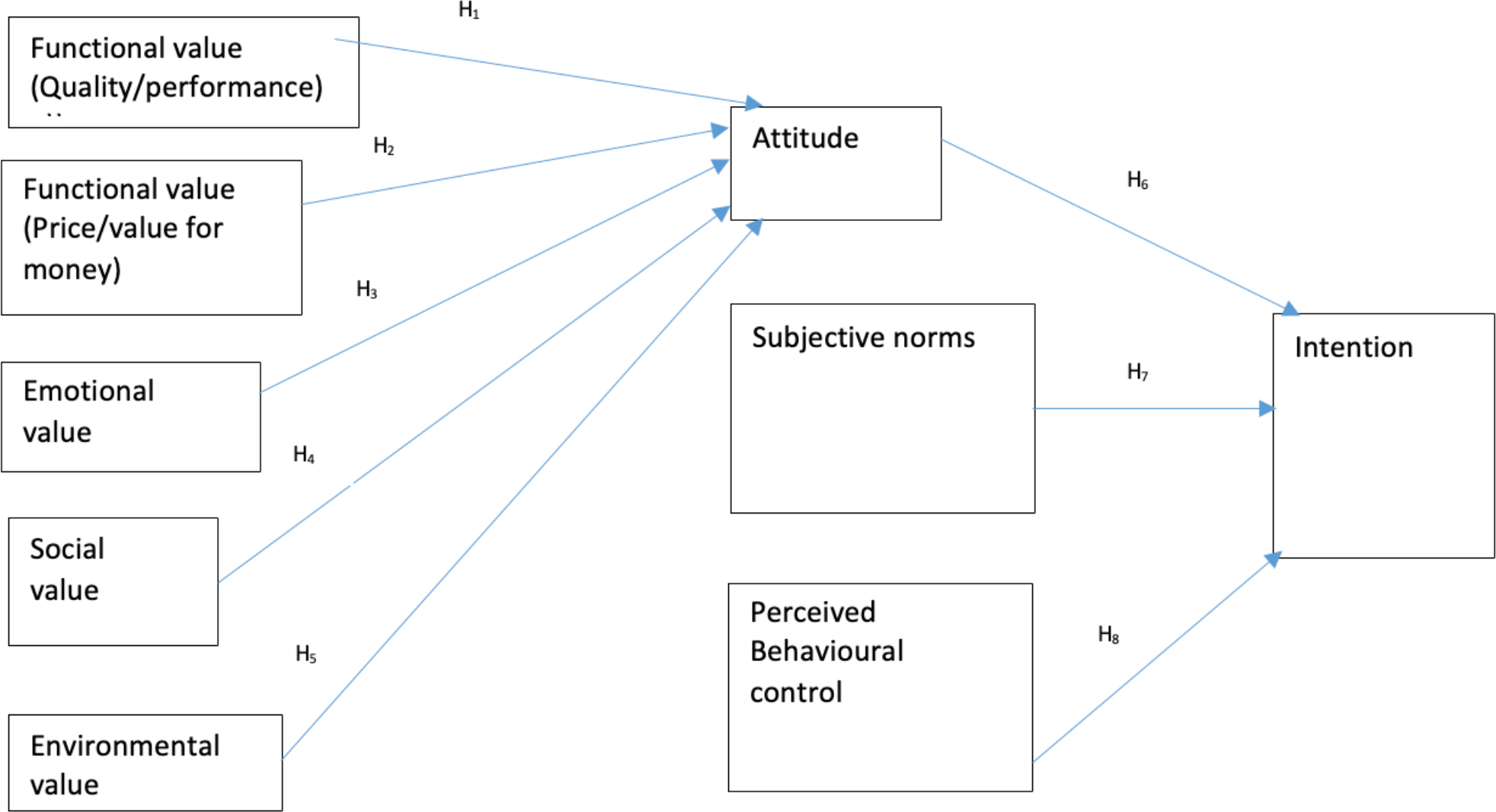
Figure 1.
Conceptual framework
(Source: Authors’ own research)
3. Research methodology
The quantitative research design was adopted, and a paper-based structured questionnaire was used to obtain data from Generation Z consumers. The survey questionnaire was distributed at four shopping malls in Mankweng and Polokwane in the Limpopo Province of South Africa using the mall intercept technique. The data collection process involved the researcher approaching young people and a screening question asked to determine their age and eligibility and their willingness to participate in the survey. If the age of the approached individual falls between 1997 and 2012 as per the definition of Generation Z used for the study, a questionnaire is given with a pen. Two field agents assisted in the data collection process. The study sample was selected using the non-probability purposive sampling method. The items used to measure the constructs of the study are depicted in Appendix 1. Two academic experts in the areas of sustainability and a pilot study that involved 30 Gen Z consumers helped to validate the questionnaire. Data collection took place between January and March 2023. The IBM SPSS AMOS 27 was used for data analysis. SPSS AMOS is specially used for performing Structural Equation Modelling (SEM) and confirmatory factor analysis (CFA) and testing and confirming relationships between observed and latent variables (Arbuckle, 2013).
4. Results
4.1. Response rate and biographical details
A total of 500 questionnaires were distributed to the individuals who were approached and agreed to participate in the survey. 482 questionnaires were found usable. Some questionnaires could not be used because the respondent did not complete some sections thereby leaving out vital information. The demographics of the respondents are as follows: Gender: 252 females and 230 males; Levels of education: Matric 88 and Post Matric 394.
4.2. Common method variance
To minimize common method variance (CMV), the questionnaire did not contain sensitive personal details, thus ensuring the anonymity of respondents and reducing responses that are socially responsible. In addition, the use of Likert scale question type helped to reduce method bias (Podsakoff, et al. 2003). Furthermore, the results of the Harman single factor test indicate that CMV is not a problem (Harman, 1976; Podsakoff, et al. 2003).
4.3. Structural equation modelling
The study used IBM AMOS 27 for data analysis. A two-stage approach (measurement model and structural model) was used. First, confirmatory factor analysis (CFA) was used to assess the quality of the measurement model using the maximum likelihood discrepancy estimation. In addition, the hypothesized relationships in the model were tested using the AMOS Covariance-based Structural Equation Modelling (CBSEM).
4.3.1. Measurement model
CFA was used to test the measurement model via Amos, and issues related to convergent and discriminant validity were discovered. There are some poorly loaded items in the initial CFA (less than 0.5). Also, some items cross-loaded with other items in the model. Based on this, three items with factor loading lower than 0.5 were removed. The model fit is acceptable (χ2 [640]=301.299; x2/df CFI =0.963, RMSEA =0.03, SRMR=0.036, NFI=0.799, GFI=0.936, AGFI=0.788) with the fit indices indicating that the measurement model is a good fit to the data.
Table 1 depicts the factor loading, the Cronbach’s alpha, composite reliability and average variance extracted (AVE) of each item used to measure each construct obtained from SEM. The Cronbach’s alpha and composite reliability of each construct are greater than 0.70 and 0.50, respectively, indicating a good internal consistency. The AVE >0.50 for each construct suggest an adequate convergent validity. To assess discriminant validity, the study used both the Fornell and Larcker and the Hetero-Trait-Mono-Trait (HTMT) as indicated in Tables 2 and 3. Table 2 depicts the results of the Fornell and Larcker obtained from SEM The results indicate that the square root of the AVE for each construct is greater than the correlation with all other constructs. Table 3 presents the results of the HTMT obtained from SEM. The results of the HTMT is lower than 0.95 for all the constructs.
Table 1.
Measurement model (Source:
Authors’ own research)
| Construct (mean and SD) | Factor loading | CA | CR | AVE |
|---|---|---|---|---|
| Functional value (quality (4.50;1.01) | 0.752 0.816 0.777 0.804 | 0.822 | 0.867 | 0.619 |
| Functional value (price) (4.02, 1.05) | 0.836 0.772 0.768 0.801 - | 0.836 | 0.873 | 0.673 |
| Emotional value (3.90 0.99) | 0.808 0.852 0.820 | 0.900 | 0.866 | 0.684 |
| Social value (2.60 1.07) | 0.725 0.778 0.753 | 0.839 | 0.796 | 0.566 |
| Environmental value (3.92, 0.97) | 0.826 0.769 0.808 | 0.926 | 0.843 | 0.642 |
| Attitude (4.04; 1.03) | 0.826 0.749 0.765 0.723 | 0.864 | 0.851 | 0.588 |
| Subjective norms (2.64; 1.06) | 0.799 0.745 0.802 | - | 0.825 | 0.611 |
| Perceived behavioural control (4.15;1.11) | 0.796 0.802 0.815 | - | 0.846 | 0.647 |
| Intention (3.86, 1.02) | 0.838 0.865 0.752 | 0.788 | 0.860 | 0.672 |
Table 2.
Fornell and Larcker
(Source: Authors’ own research)
| Construct | FVQ | FVP | EV | SV | ENV | ATT | SN | PBC | INT |
|---|---|---|---|---|---|---|---|---|---|
| FVQ | 0.820 | - | - | - | - | - | - | - | - |
| FVP | 0.407 | 0.820 | - | - | - | - | - | - | - |
| EV | 0.361 | 0.429 | 0.827 | - | - | - | - | - | - |
| SV | 0.296 | 0.379 | 0.368 | 0.752 | - | - | - | - | - |
| ENV | 0.280 | 0.505 | 0.392 | 0.408 | 0.801 | - | - | - | - |
| ATT | 0.407 | 0.304 | 0.268 | 0.392 | 0.377 | 0.769 | - | - | - |
| SN | 0.373 | 0.361 | 0.408 | 0.399 | 0.507 | 0.462 | 0.782 | - | - |
| PBC | 0.401 | 0.328 | 0.526 | 0.557 | 0.407 | 0.380 | 0.437 | 0.804 | - |
| INT | 0.502 | 0.359 | 0.538 | 0.275 | 0.428 | 0.444 | 0.366 | 0.408 | 0.820 |
Table 3.
HTMT
(Source: Authors’ own research)
| Construct | FVQ | FVP | EV | SV | ENV | ATT | SN | PBC | INT |
|---|---|---|---|---|---|---|---|---|---|
| FVQ | - | - | - | - | - | - | - | - | - |
| FVP | 0.509 | - | - | - | - | - | - | - | - |
| EV | 0.369 | 0.307 | - | - | - | - | - | - | - |
| SV | 0.482 | 0.602 | 0.447 | - | - | - | - | - | - |
| ENV | 0.385 | 0.553 | 0.365 | 0.247 | - | - | - | - | - |
| ATT | 0.488 | 0.226 | 0.572 | 0.199 | 0.385 | - | - | - | - |
| SN | 0.385 | 0.469 | 0.472 | 0.538 | 0.473 | 0.477 | - | - | - |
| PBC | 0.529 | 0.365 | 0.521 | 0.488 | 0.465 | 0.366 | 0.406 | - | - |
| INT | 0.529 | 0.362 | 0.504 | 0.275 | 0.504 | 0.297 | 0.368 | 0.475 | - |
4.3.2. Result of the structural model
The relationships between the constructs were tested through the use of latent SEM analysis with maximum likelihood analysis. The direct and indirect effects were tested. First, the structural model achieved an acceptable model fit (χ2 [528] = 1752.206; χ2/df = 3.208; CFI = 0.908 RMSEA = 0.048). The R2 of the TPB model is 0.464 and that of the extended model is 0.547. The results indicate the greater predictive power of the extended model.
The results of the structural model obtained from SEM for direct relationships are depicted in Table 4. The results indicate that the relationships between functional value (quality/performance), functional quality (price/value for money), emotional value and environmental value and attitude are significant positive. Therefore, Hypotheses 1, 2, 3 and 5 are supported. The results indicate that there are significant positive relationships between attitude and perceived behavioral control and intention. Hypotheses 6 and 8 are supported.
Table 4.
Structural model results
(Source: Authors’ own research)
| Hypothesised relationships | B | SE | T-value | Decision |
|---|---|---|---|---|
| H1: FVQ-ATT | 0.268 | 0.052 | 9.209* | Supported |
| H2: FVP-ATT | 0.306 | 0.047 | 6.673** | Supported |
| H3:EV-ATT | 0.511 | 0.072 | 4.747** | Supported |
| H4 SV-ATT | 0.031 | 0.045 | 0.122 | Not supported |
| H5 ENV-ESI | 0.248 | 0.039 | 5.548** | Supported |
| H6: ATT-INT | 0.402 | 0.055 | 7.407* | Supported |
| H7: SN-INT | 0.042 | 0.027 | 0.139 | Not supported |
| H8: PBC-INT | 0.268 | 0.049 | 3.278** | Supported |
5. Discussion
The study investigated the effects of perceived value dimensions on attitude towards EEAs by Gen Z consumers. In addition, the study examined the influence of attitude, subjective norms and perceived behavior control on intention to purchase EEAs by Gen Z consumers. The findings of the study indicated a significant positive relationship between functional value (quality/performance) and attitude towards the purchase of EEAs. The findings suggest that when Gen Z consumers perceive EEAs as having functional quality in the areas of quality and performance, they are likely to develop a positive attitude towards purchasing them. The findings of the study are supported by prior empirical studies by Zhang, et al. (2020), Luo, et al. (2022) and Lin and Dong (2023). The findings of the study indicated that the relationship between functional value (price/value for money) and attitude towards the purchase of EEAs is positive. The findings suggest that when Gen Z consumers perceive EEAs as having functional quality in the areas of price and value for money, they are likely to develop a positive attitude towards purchasing them. The findings of the study are supported by prior empirical studies by Zhang, et al. (2020) and Joshi, et al. (2021). The findings of the study indicated a significant positive relationship between emotional value and attitude towards the purchase of EEAs. The findings suggest that when Gen Z consumers perceive the utility of EEAs in the context of comfortability and pleasant feelings, they are likely to develop a positive attitude towards purchasing them. The findings of the study are supported by those of prior empirical studies by Joshi, et al. (2021), Luo, et al. (2022) and Wang, et al. (2022). The findings indicate an insignificant relationship between social value and attitude towards the purchase of EEAs. The findings suggest that the opinions of other people do not significantly affect the attitude towards the purchase of EEA by Gen Z consumers. The findings are consistent with the results of prior empirical studies by Zhang, et al. (2020) and Luo, et al. (2022). The findings of the study indicated a significant positive relationship between environmental value and attitude towards the purchase of EEAs. The findings suggest that when Gen Z consumers perceive EEAs as products that help to reduce pollution and manage resource depletion, they are likely to develop a positive attitude towards purchasing them. The findings of the study are supported by those of prior empirical studies by Alagarsamy, et al. (2019), Zhang, et al. (2020), Lou, et al. (2021) and Lin and Dong (2023). The findings indicated a significant positive relationship between attitude and intention to purchase EEAs. This suggests that the more favorable is the attitude of Gen Z consumers towards the purchase of EEAs, the higher the intention. The findings are consistent with the results of Tan, et al. (2017), Li, et al. (2019), Li, et al. (2021) and Hossain, et al. (2022). The findings indicate an insignificant relationship between subjective norms and intention to purchase EEAs. The findings suggest that the intention to purchase EEAs by Gen Z consumers is not influenced by the opinions of other people. The findings of studies by Tan, et al. (2017) and Ali, et al. (2021) also showed an insignificant relationship between subjective norms and intention to purchase EEAs. The findings indicate a significant positive relationship between perceived behavioral control and intention to purchase EEAs. This suggests that the judgement of Gen Z consumers about their ability to use EEAs can positively influence their intention to purchase them. The findings are supported by Wang, et al. (2014), Zhuang, et al. (2021), Bhutto, et al. (2021) and Hossain, et al. (2022).
6. Conclusion
6.1. Theoretical contribution
The study extended the TPB by using perceived value dimensions as antecedents of attitude towards the purchase of EEAs by Gen Z consumers. The study used functional value (quality/performance), functional value (price/value for money), emotional value, social value and environmental value as antecedents of attitude. In addition, the study examined the effects of attitude, subjective norms and perceived behavioral control on intention to purchase EEAs by generation Z consumers. The findings of the study indicated that the relationships between functional value (quality/performance), functional quality (price/value for money), emotional value and environmental value and attitude are significantly positive. In addition, the findings indicated that there are significant positive relationships between attitude and perceived behavioral control and intention. Research has primarily focused on using the TPB to explain the intention to purchase EEAs. However, perceived value is one of the factors that can influence the attitude and behavior of consumers as it focuses on their overall assessment of the utility of a product or service. This is important because while the three TPB constructs may provide the explanation of the variance in behavioral intention, it is by examining the antecedents of each TPB construct that the researcher can understand the process through which the constructs are linked to intention. The theoretical contribution of the study is the development and testing a new unique theoretical model that integrates the perceived value theory and the TPB in predicting attitude and intention to purchase EEAs by Gen Z consumers. The results of the new theoretical model confirmed the applicability of the integrated TPB and perceived value theory in explaining attitude and intention to purchase EEAs by Generation Z consumers.
6.2. Practical implications
The findings of the study offer practical implications for generation Z consumers, retailers and the management of firms that produce EEAs. There is the need to create awareness about the quality and performance EEAs. This can be done using the social media to create awareness about the attributes of EEAs and their positive effects on the environment in terms of energy consumption. In addition, firms that produce EEAs should give comprehensive information on energy efficiency labels and ratings to encourage consumers to make informed purchasing decisions. This can be done through an awareness campaign targeted at Generation Z consumers about the quality and performance of EEAs. Also, education materials, workshops and community events should be organized, and online content and brochures provided by retailers and manufacturers about the positive impact of EEAs should be made available. The websites of firms that produce EEAs should contain comprehensive information about the quality, price and environmental impact of EEAs. In addition, price/value for money is an important predictor of attitude towards EEAs. Firms that produce EEAs should ensure that they are not more expensive than conventional products as many generation Z consumers are price sensitive. This will help to improve affordability. To improve emotional value, simple, clear and well-communicated advice on energy saving can motivate Generation Z consumers to purchase EEAs. The significant benefits of EEAs through reduced electricity bills and lower environmental impact should be clearly communicated to Generation Z consumers. Government has a major role to play in improving attitude towards EEAs through policies that promote their widespread adoption and through financial and tax incentives. In addition, retailers have a major role to play in improving attitude towards EEAs by increasing their availability and visibility and enhancing the knowledge and communication of the benefits of EEAs to customers by employees. Generation Z consumers can improve behavioral control by obtaining information about the benefits of EEAs through the attendance of community events, workshops and seminars and reading about the products online.
6.3. Limitations and areas for future research
Data were collected from Gen Z consumers at only four shopping malls, and this may affect the generalizability of the findings. Therefore, other studies should include Gen Z consumers from other parts of South Africa to improve the generalizability of the empirical findings. The study used the cross-sectional survey method, and a longitudinal study can help to confirm cause and effect. The study did not include moderating and mediating variables. The moderating effect of gender and the mediating effect of attitude in the relationship between perceived value dimensions and intention to purchase EEAs can be explored. In addition, studies that focus on other generational cohorts such as millennials and purchase of EEAs can be explored.
Appendices
8
Appendix: Measures of construct
| Construct | Items | Adopted from | Response category |
|---|---|---|---|
| Functional (quality/performance) | 1. EEAs have consistent quality 2. EEAs have an acceptable level of quality 3. EEAs have advanced technology 4. EEAs would last for a long time 5. EEAs have good functions | Sweeney and Soutar (1991); Zhang, et al. (2020) | Five-point Likert scale with 1 being ‘strongly disagree’ and 5 being ‘strongly agree’ |
| Functional (price/value for money) | 1. EEAs are reasonably priced 2. EEAs offer value for money 3. EEAs are in the longrun economical 4. EEAs are good products for the price that they are sold | Sweeney and Soutar (1991); Zhang, et al. (2020) | Five-point Likert scale with 1 being ‘strongly disagree’ and 5 being ‘strongly agree’ |
| Emotional value | 1. I enjoy using EEAs 2. I am relaxed about using EEAs 3. I feel good using EEAs 4. It gives me pleasure to use EEAs | Sweeney and Soutar (1991); Zhang, et al. (2020) | Five-point Likert scale with 1 being ‘strongly disagree’ and 5 being ‘strongly agree’ |
| Social value | 1. Using EEAs would make me feel acceptable 2. Using EEAs would improve the way that people perceive me 3. Using EEAs would enable me to make a good impression on other people 4. Using EEAs would give their owners social approval | Sweeney and Soutar (1991); Zhang, et al. (2020) | Five-point Likert scale with 1 being ‘strongly disagree’ and 5 being ‘strongly agree’ |
| Environmental value | 1. The use of EEAs would help to reduce environmental pollution 2. The use of EEAs would help to reduce global warming 3. EEAs are environmentally friendly | Sweeney and Soutar (1991); Zhang, et al. (2020) | Five-point Likert scale with 1 being ‘strongly disagree’ and 5 being ‘strongly agree’ |
| Attitude | I consider the purchase of energy-efficient appliances (EEAs) 1. unfavourable (1)/favourable 2. undesirable/desirable 3. unpleasant/pleasant 4. negative (1)/positive | Yadav and Pathak (2017) | Semantic differential scale |
| Subjective norms | 1. Most people who are important to me think I should buy EEAs when it comes to the choice of household appliances 2. If I buy EEAs, this can influence other people to buy them 3. People whose opinions I value would prefer that I purchase EEAs | Yadav and Pathak (2017) | Five-point Likert scale with 1 being ‘strongly disagree’ and 5 being ‘strongly agree’ |
| Perceived behavioural control | 1. I can largely decide whether or not to buy an EEAs 2. I will have the ability to buy EEAs in the future 3. I am confident that if I want to, I will definitely be able to choose EEAs in the near future | Yadav and Pathak (2017) | Five-point Likert scale with 1 being ‘strongly disagree’ and 5 being ‘strongly agree’ |
| Intention | 1. In the future, I am willing to buy EEAs if I need to have home appliances 2. In the future, I plan to buy EESs because they are appliances with better energy efficiency 3. In the future, I intend to buy EEAs because they are appliances with better energy efficiency | Yadav and Pathak (2017) | Five-point Likert scale with 1 being ‘strongly disagree’ and 5 being ‘strongly agree’ |