

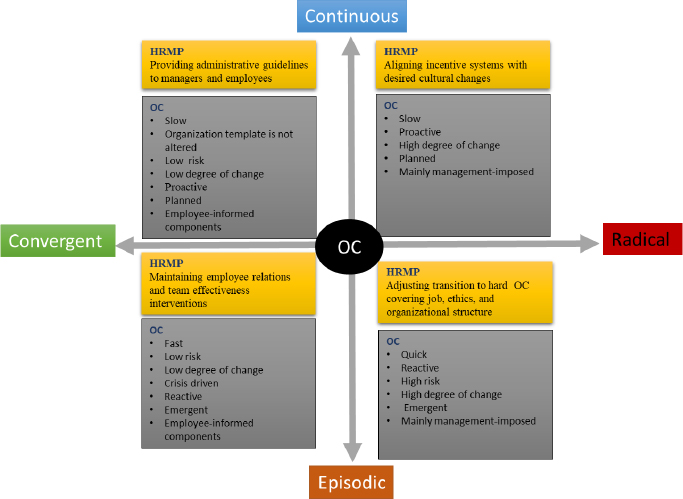
Figure 1.
Classification of OCs and examples of relevant HRMPs.
(Source: Authors’ own research)
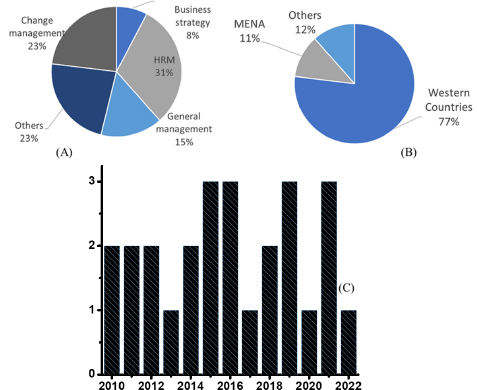
Figure 2.
Key features of the literature survey: (A) theme of journals publishing articles on HRMPs in the context of OC, (B) countries from which studies are reported, and (C) yearly publications on HRMPs in the context of OC.
(Source: Authors’ own research)
Table 1.
Summary of key findings on the role of HRMPs in OC (Source: Authors’ own research)
| References | Year | Country | Sector | Type of change | HRM role | Implications |
|---|---|---|---|---|---|---|
| Alfes et al., 2010 | 2010 | UK | Public | Content and process of change | Change driver, responsive, change focused, and HR focused | During OC, HRMPs must be proactive |
| Alfes et al., 2019 | 2019 | UK | Public | Content and process of change | Employee centric, responsive, and HR focused | HRMP can help the development of dynamic capabilities in employees to cope with OC |
| Alqudah et al., 2022 | 2022 | Jordan | Banking | Process of change | Employee centric, responsive, and HR focused | HRMPs can help employees' readiness for change |
| Bani, 2021 | 2021 | Ghana | Public | Process of change | Multifaceted | Effective HRMPs can reduce staff litigation |
| Baran, Filipkowski, and Stockwell, 2018 | 2019 | USA | Multiple | Content and process of change (perspectives of HR professionals) | “Change agent” and “consultant” | HR managers considered effective OC hierarchical |
| Barratt-Pugh and Bahn, 2015 | 2015 | Australia | Public | Cultural change during the merger | Develop a unified culture | During OC, HRMPs must consider mitigating efficiencies due to cultural differences |
| Barratt-Pugh, Schiavone, Bahn, and Gakere, 2013 | 2013 | Australia | Public | Cultural change program | Develop a unified culture | During OC, HRMPs must consider mitigating efficiencies due to cultural differences |
| Brown, Kulik, Cregan, and Metz, 2017 | 2017 | Australia | Multiple | Content and process of change | Strategic change agent | When HR assumes a strategic change agent role, OC is less likely to generate change cynicism |
| Cloutier and Robert-Huot, 2021 | 2021 | Canada | Multiple | Content and process of change | Depends on the dimension of change | HRMPs should vary according to the type of change, the objective of change, and the excepted outcome |
| D'Cruz, Noronha, and Beale, 2014 | 2014 | India | Private | OC as a predictor of workplace bullying | Employee centric and responsive | HRMPs should focus on addressing possible compounded bullying during OC |
| Faia Correia, Campos Cunha, and Scholten, 2011 | 2011 | Portugal | Multiple | Mergers and acquisitions | Strategic and responsive | HRM centrality has a moderating effect on OCs |
| Garavan, Shanahan, Carbery, and Watson, 2016 | 2016 | UK | Multiple | Process of change | Employee centric and responsive | HRMPs can help in the development of dynamic skills |
| Gollan, Kalfa, and Xu, 2015 | 2015 | Australia | Private | Content and process of change | Collaborative | HRMPs affect organizational performance indirectly |
| Huang, Zhang, Feng, and Seal, 2020 | 2020 | Canada | Multiple | Organizational innovation | Employee centric and responsive | HRMPs matter eventually |
| Lindorff, Worrall, and Cooper, 2011 | 2011 | UK and Australia | Multiple | Content and process of change | Employee centric and responsive | Hard change is the most detrimental |
| Sang Long and Khairuzzaman Wan Ismail, 2012 | 2012 | Malaysia | Multiple | Process of change | Change agent | HRMPs should be directed at a broader and cross-functional perspective |
| Lucia-Casademunt, Cuéllar-Molina, and García-Cabrera, 2018 | 2018 | Europe | Multiple | Process of change | Employee centric and responsive | HRMPs should be directed to enhance employees' well-being |
| Pellegrini, Rizzi, and Frey, 2018 | 2018 | Italy | Multiple | Change for sustainability | Employee centric and responsive | Effective HRMPs can enhance employees' commitment and behavior |
| Peters, Poutsma, Van der Heijden, Bakker, and Bruijn, 2014 | 2014 | The Netherlands | Multiple | New ways to work * (employee empowerment, home teleworking, and creating trust relationships) and work-related flow as experienced by employees (absorption, work enjoyment, and intrinsic work motivation) | Combined perspective integrating insights from the HRM-process model and the job demands-resources model | HRMPs should be aimed at improving employees' perception of job autonomy in the new working conditions |
| Pinzone, Guerci, Lettieri, and Redman, 2016 | 2016 | Italy | Multiple | Environmental management as an OC | Employee centric and responsive | HRMPs can improve collective engagement toward change objectives |
| Pluta and Rudawska, 2016 | 2016 | Poland | Multiple | Process of change | Employee centric and responsive | HR practices should apply the multidimensionality of individual resources and treat them holistically |
| Raeder, 2019 | 2019 | Norway | Multiple | Reorganization and downsizing | Broader scope of HRMPs | HRMPs should consider OC to be a factor of contingency |
| Rees, Rees, and Johari, 2010 | 2010 | Malaysia | Public/ banking | Strategic OC | Culture/employee sensitive | HRMPs should include ethics, spirituality, and regional contexts |
| Rubbers, 2020 | 2020 | Congo | Multiple | Multinational practices | Liaison, legal, and employee centric | HRMPs can help establish new contracts and recruitments to meet OC objectives |
| Shipton, Budhwar, and Crawshaw, 2012 | 2012 | UK | Multiple | Process of change | Employee centric and responsive | HRMPs can improve dynamic capabilities during OC |
| Tummers, Professor David Pick, Kruyen, Vijverberg, and Voesenek, 2015 | 2015 | The Netherlands | Public | Change management | Employee centric and responsive | HRMPS are particularly effective for improving the proactivity and vitality of employees |
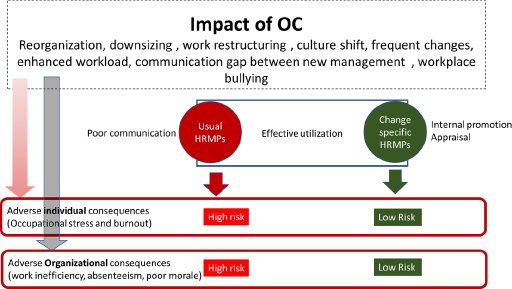
Figure 3.
Impact of OC on employees and effect of change-specific HRMPs on mitigating adverse individual and organizational consequences of OC.
(Source: Authors’ own research)