Have a personal or library account? Click to login
Innovation and Leadership: A Study of Organizations Based in the United Arab Emirates Cover

Innovation and Leadership: A Study of Organizations Based in the United Arab Emirates

By: Ruchi Agarwal and  Babeet Gupta  
Open Access
|Jun 2021

Figures & Tables

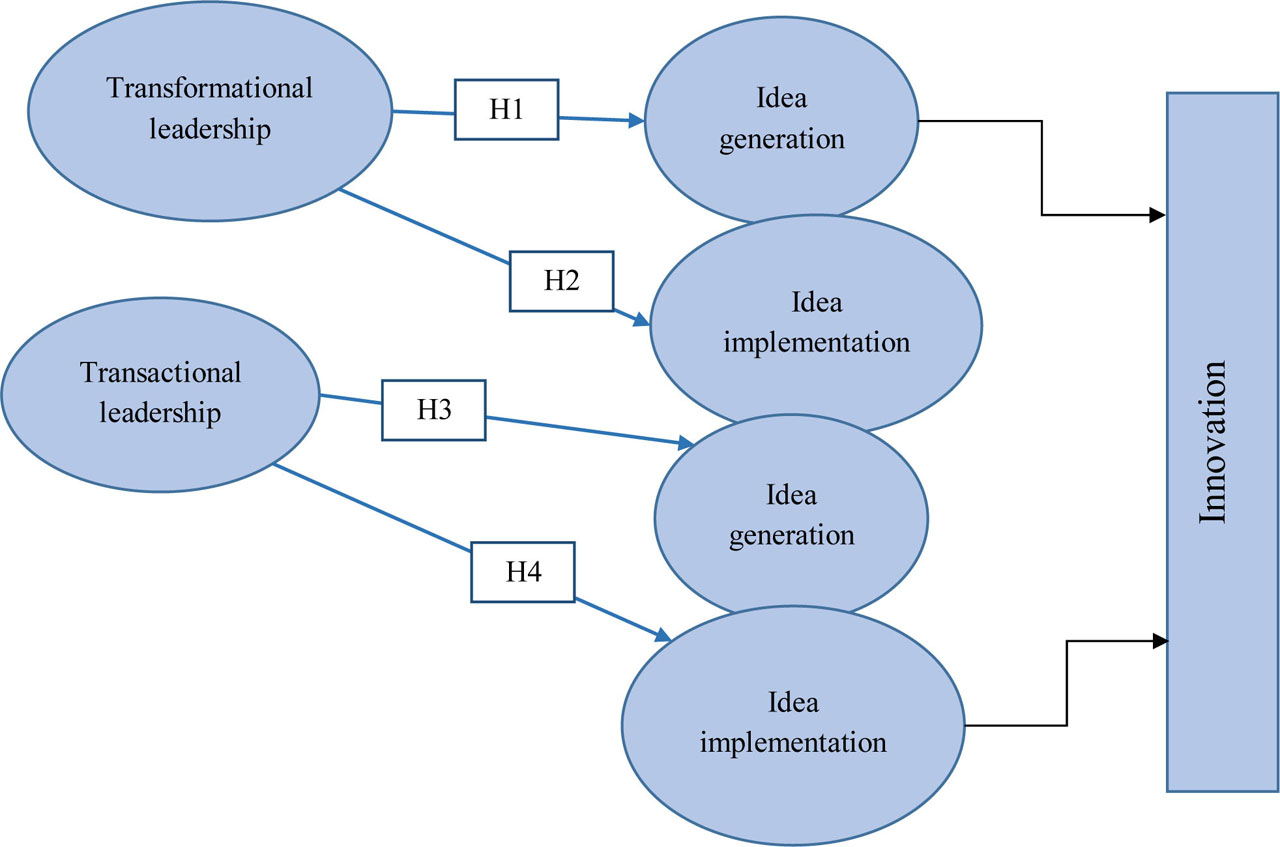
Figure 1

Framework of hypothesis (Source: Authors’ own research)

Results of the regression analysis* (Source: Authors’ own research)

PredictorsUnstandardized β coefficientStandardized β coefficienttSignificance (p-value)
Intercept0.810 1.5590.127
Transactional leadership−0.009−0.014−0.1340.893
Transformational leadership0.8040.7857.4930.000
R square0.616
F28.087

Key leadership and innovation dimensions (Source: Authors’ own research)

Leadership dimensionsInnovation dimensions

    Transactional leadership

  • Leaders show indifference toward the tasks that employees are handling

  • Leaders use punishment and discipline to change the behavior of employees

  • Leaders use power to ensure that the tasks given to the employees are completed

  • Employees are allowed to make their own decisions until they make a mistake

  • The absence of support and a positive working environment is prominently visible

  • Leaders focus on short-term, immediate solutions or objectives

  • Leaders focus on increasing efficiency in current practices

  • Leaders do not take employees’ needs and personal growth into consideration

    Idea generation

  • There is openness, strength, and supportiveness in the relationship between employees and supervisors

  • Information flow is open

  • New ideas are supported at all levels of the organization

  • Presence of freedom and autonomy

  • Resources (materials and information) are available

  • There are pressures of positive challenge and negative workload pressure

  • Organizational impediments to creativity (negative conservatism and internal strife)

  • There is clarity of goals

  • There is the freedom to make work-related decisions independently

  • There is a sense of control over one's job

    Transformational leadership

  • Leaders have inspirational motivation/charisma

  • Leaders are recognized as change agents

  • Leaders are guided by values

  • Leaders are oriented toward lifelong learning

  • Leaders are visionaries who trust people

  • Leaders motivate followers to improve their performance

  • Leaders can remove any obstacles and resistance toward changes

  • Leaders promote organizational members’ participation in collective decisions and activities

  • Leaders promote openness, which enhances the creation of structures and systems at all levels of the organization

  • Leaders can cope with complexity, ambiguity, and uncertainty

  • Leaders instill a new approach to the culture

  • Leaders create a climate of job satisfaction and commitment to quality service

    Idea implementation

  • Support for innovation is there

  • Collaboration outside the organization is encouraged

  • Decentralized decision-making is found

  • There is a clear status on resources (time, money, and tools)

  • The communication systems are clear

  • Consulting, mentoring, and coaching are embedded in organizational processes

  • Direct management and control are present

  • Recognition and economic incentives are a part of organizational processes

Descriptive statistics, reliability, and correlation matrix (Source: Authors’ own research)

VariablesNMSDαr
1234
1 Transactional leadership383.411.1090.914 −0.0010.138−0.015
2 Transformational leadership384.260.7080.957−0.001 0.785
3 Innovation – idea generation384.170.6970.8990.1380.902 0.779
4 Innovation – idea implementation384.210.7250.915−0.0150.7850.779

Sociodemographic variables (Source: Authors’ own research)

VariableCategoryNumber of respondentsPercentage of respondents
GenderMale1847.4
Female2052.6
Firm size<50 employees821.1
>50 but <150 employees821.1
>150 employees2463.2
Hierarchical levelLower management718.4
Middle management2976.3
Upper management37.9
DOI: https://doi.org/10.2478/fman-2021-0006 | Journal eISSN: 2300-5661 | Journal ISSN: 2080-7279
Language: English
Page range: 73 - 84
Published on: Jun 8, 2021
Published by: Warsaw University of Technology
In partnership with: Paradigm Publishing Services
Publication frequency: 1 issue per year

© 2021 Ruchi Agarwal, Babeet Gupta, published by Warsaw University of Technology
This work is licensed under the Creative Commons Attribution-NonCommercial-NoDerivatives 4.0 License.