
INTRODUCTION
Morel mushrooms (Morchella) are a rare edible and medicinal fungus (Liu et al., 2025). They have a delicious flavour and unique texture and are rich in various proteins, polyphenols, polysaccharides and other beneficial components for human health (Keskin et al., 2021; Yu et al., 2021). Research indicates that morel mushrooms (dry weight) can contain up to 35.8% protein (Li et al., 2023) and possess multiple effective functions, including lipid-lowering (Gao et al., 2025), antioxidant (Zhang et al., 2024), anticancer (Dairo et al., 2024), anti-obesity (Liu et al., 2023) and hypoglycemic effects (Turk et al., 2023), antibacterial effects (Khemiri et al., 2025), it can also efficiently convert inorganic substances into functional food mushroom products rich in selenium, germanium and high amino acids (Du et al., 2021). These products hold broad development prospects in food, medicine and health sectors, enjoying strong popularity among consumers worldwide (Zhu et al., 2024), with growing commercial demand in global markets (Tietel and Masaphy, 2018).
Due to natural constraints such as the short fruiting period and limited distribution of wild morel mushrooms, coupled with long-term intensive harvesting, wild resources have gradually disappeared (Li et al., 2020). Consequently, cultivating morel mushrooms has emerged as a viable solution (Pan et al., 2021; Qiao et al., 2023). Currently, reports of artificial cultivation exist in China, India, Pakistan, Turkey, western North America, Spain, France, Israel and Switzerland (Pilz et al., 2007; Richard et al., 2015; Tietel and Masaphy, 2018). Among these, China’s artificial morel cultivation has recently entered the commercialisation phase (Yang et al., 2022; Luo et al., 2023). Currently, the primary production areas for morels in China are concentrated in Sichuan, Yunnan, Guizhou and Shaanxi provinces, with an actual cultivation area ranging from 16000 ha to 20000 ha (Dong et al., 2024). Unlike other major edible fungi, morel mushrooms must be sown in soil and require meticulous artificial management to produce mushrooms (Gao et al., 2020), with high technical barriers.
This highlights the close relationship between soil and the growth and development of morel mushrooms. Its quality correlates with cultivation soil characteristics (Yin et al., 2023). Neutral to slightly alkaline pH (Yi et al., 2014), high total nitrogen content (He et al., 2009) and high organic matter content (Li, 2015) all promote morel mushroom growth and enhance quality. Concurrently, mineral elements serve as essential nutrients for morel mushroom growth and development. They function not only as cofactors or activators regulating extracellular enzyme activity (Huang et al., 2008; Hansch and Mendel, 2009) but also promote mycelium growth and development (Li et al., 2019). Moreover, they play an irreplaceable role in quality formation (Zhao et al., 2018). Specifically, nitrogen serves as a raw material for protein and nucleic acid synthesis, with an optimal carbon-to-nitrogen ratio enhancing morel mushroom growth rates (Carrara et al., 2018); phosphorus is rapidly absorbed during the mycelium stage, enhancing cell permeability and promoting lipid metabolism (Kalač, 2019); potassium accelerates enzymatic reactions and drives protein synthesis (Wang, 2013); selenium enhances stress resistance by regulating enzymatic and non-enzymatic detoxification systems (Jiang et al., 2022); iron significantly promotes sclerotium formation during the mycelium stage (Turkekul et al., 2004); magnesium and zinc participate in nucleoprotein and nucleic acid synthesis, maintaining stable cell membrane structure and function (Yang, 2021). Research indicates that shifts in microbial communities alter soil trace elements and soil enzyme activity, which in turn influence morel mushroom growth (Liu et al., 2017; Zhao et al., 2022). Additionally, biogeochemistry is the discipline studying the balance of multiple chemical elements (particularly C, N, P) in ecological interactions among organisms (Elser et al., 2000). The stoichiometric characteristics of soil C, N and P reflect the balance between nutrient mineralisation and retention during organic matter decomposition. These characteristics are crucial for revealing nutrient limitations and elucidating the mechanisms of C/N/P cycling and equilibrium. However, studies examining their coupling with morel mushroom growth remain scarce.
Given the specific soil requirements of morel mushrooms and the lack of systematic research on the relationship between cultivated morel soil and bioactive compounds, the impact of cultivation on soil factors remains unclear, representing a research gap both domestically and internationally. Therefore, this study focused on Morchella sextelata from different locations in Guizhou Province, as well as soil samples taken pre- and post-cultivation, analysing changes in the physical and chemical properties of the pre-planting and post-planting soils, as well as the stoichiometric characteristics of C, N and P. The study also explores the regional differences in the effective components of different parts of the morel mushroom, identifies the soil factors influencing these components and provides scientific basis for the scientific and efficient cultivation of morel mushrooms from different regions and the targeted development and utilisation of their different parts.
MATERIALS AND METHODS
Materials for testing
The morel mushroom variety used in the experiment was developed and bred independently by the Sichuan Academy of Forestry Sciences. It is a yellow morel mushroom variety called Liu Mei. The test soils were the pre-planting and post-planting soils from morel mushroom bases in two origins (Daozhen and Shuicheng).
Overview of the test area
The experimental sites were located in the cultivation bases of morel mushrooms in Luolong Town, Daozhen County, Zunyi City and Douqing Town, Shuicheng County, Liupanshui City, respectively. Luolong Town is located in Daozhen Gelao-Miao Autonomous County, with longitude and latitude of 107°71′E, 29°06′N, with an average elevation of 1600 m, average annual temperature of 22°C, frost-free period of 240 days, annual precipitation of 1170 mm and soil type of yellow loam. Douqing Town is located in Shuicheng County, between longitude 105°35′E and latitude 26°26′-26°29′N, with an average elevation of 1680 m, an average annual temperature of 11.1–14.3°C, an average annual precipitation of 1010–1360 mm and a soil type of yellow-brown loam. The specific location is shown in Figure 1.
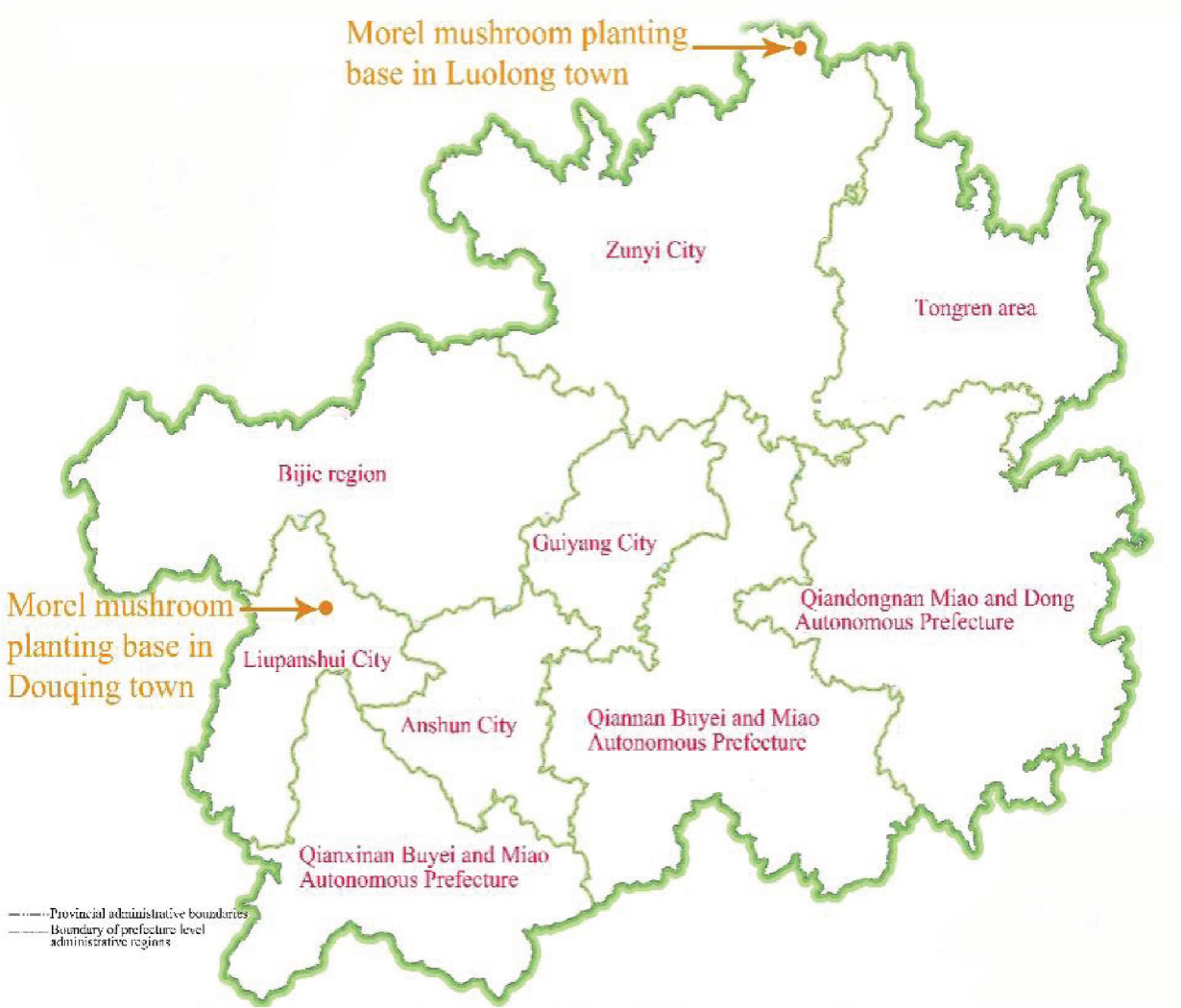
Figure 1.
Location map of morel mushroom planting bases (Guizhou Province).
Sample collection and preparation
Sample collection
This study adheres to the soil environment monitoring technical specification HJ/166-2004 standard for soil sample collection (HJ/T 166-2004, 2004). In March 2023, three biological replicate samples each were randomly collected from the topsoil layer (0–20 cm) at the morel mushroom cultivation bases in Luolong Town, Daozhen County, and Douqing Town, Shuicheng County, respectively, both pre-planting and post-planting. Mix the samples using the plum blossom sampling method, then reduce the sample size by quartering (after thoroughly mixing the collected samples, spread them into a square shape, divide them diagonally into four equal portions, retain the two diagonal portions and discard the remaining parts), and about 1 kg was taken as the mixed sample by the quadrature method. At the same time, around the corresponding soil sample points, six 10–12 cm tall mature morel mushrooms were collected and divided into cap and stalk samples. All soil, cap and stalk samples were put into clean self-sealing bags with numbers and brought back to the laboratory. The samples were designated as follows: Daozhen cap (D1), Daozhen stalk (D2), Shuicheng cap (S1) and Shuicheng stalk (S2).
Sample preparation
The samples of morel mushroom caps and stalks were initially rinsed with distilled water to eliminate surface soil, followed by three washes with ultrapure water (18.2 MΩ-cm). Subsequently, they were dried in a constant temperature blower-drying oven at 40°C, crushed and sealed for storage. Concurrently, collected soil samples were cleared of withered leaves, animal residues, stones and other extraneous materials. These soil samples were then air-dried in a ventilated area, ground using the tetrad method and sieved through meshes with pore sizes of 0.25 mm and 2.00 mm, respectively, before being stored for future use.
Sample determination
Determination of soil samples
The following chemical parameters were determined using currently valid methods: pH was determined using the glass electrode method (HJ 962-2018, 2018); soil organic matter (SOM) was measured by the potassium dichromate oxidation-external heating method (GB 9834-1988, 1988); total nitrogen (TA) was determined by the Kjeldahl method (HJ 717-2014, 2014); total phosphorus (TP) was measured by the molybdenum antimony colourimetric method (GB 9837-1988, 1988); total potassium (TK) was determined by the sodium hydroxide fusion-flame photometric method (GB 9836-1988, 1988); alkali diffusion method for alkali-hydrolysable nitrogen (AN)(LY/T 1229-1999, 1999); sodium bicarbonate extraction—molybdenum antimony colourimetric method for determining available phosphorus (AP) (HJ 704-2014, 2014); ammonium acetate extraction—flame photometric method for determining available potassium (AK) (NY/T 889-2022, 2022); water-soluble humic acid (WSH) determined by water-soluble acid precipitation gravimetric method and total humic acid (THA) determined by sodium pyrophosphate alkali-soluble gravimetric method (T/CHAIA 5-2018, 2018); soil mineral elements determined by inductively coupled plasma mass spectrometry (HJ 1315-2023, 2023).
Determination of morel mushroom samples
Method for determining the content of effective components in morel mushrooms: vanillin—perchloric acid colourimetric method for total saponins (Zhou et al., 2023), aluminium nitrate colourimetric method for total flavonoids (Shu et al., 2023), Folin-Ciocalteau colourimetric method for total phenols (Tan et al., 2021), anthrone-sulfuric acid colourimetric method for total polysaccharides (Tao et al., 2022), Kjeldahl method for protein determination (GB 5009.5-2016, 2016).
Methods of statistical analysis of data
Excel 2013 was used for data processing, statistical analysis and creating tables; SNK method in DPS (7.05) was used for significant difference analysis; Origin 2021 was used for plotting graphs, while Pearson-Listwise correlation analysis (p ≤ 0.05) was employed.
RESULTS
Characteristics of changes in soil nutrient content for morel mushroom cultivation
The results of the chemical analysis of the soil used for morel mushroom cultivation in the two regions are shown in Table 1. In both regions, the soil pH decreased post-planting compared to pre-cultivation. In Daozhen, the pH decreased by 0.17 units (from 7.04 to 6.87), a drop of 2.4%, shifting from slightly alkaline to neutral; in Shuicheng, the pH decreased by 0.28 units (from 6.11 to 5.83), a drop of 4.6%, shifting from slightly acidic to acidic, with a greater degree of acidification.
Table 1.
Soil nutrient content characteristics pre-planting and post-planting morel mushroom cultivation in different locations.
| Eigenvalue | Unit | Daozhen | Shuicheng | ||
|---|---|---|---|---|---|
| Pre-planting | Post-planting | Pre-planting | Post-planting | ||
| pH | 7.04 ± 0.41 a | 6.87 ± 0.37 a | 6.11 ± 0.34 a | 5.83 ± 0.30 a | |
| SOM | g · kg−1 | 55.63 ± 3.99 a | 55.22 ± 4.06 a | 42.83 ± 3.93 b | 58.09 ± 2.19 a |
| TN | 1.66 ± 0.24 a | 1.68 ± 0.22 a | 1.64 ± 0.11 b | 2.08 ± 0.06 a | |
| TP | 0.79 ± 0.12 a | 0.71 ± 0.15 a | 0.65 ± 0.06 a | 0.58 ± 0.04 a | |
| TK | 11.61 ± 1.06 a | 11.62 ± 1.18 a | 4.92 ± 0.09 a | 4.34 ± 0.26 b | |
| AN | mg · kg−1 | 115.93 ± 6.82 a | 125.75 ± 5.37 a | 149.92 ± 0.95 b | 222.03 ± 7.09 a |
| AK | 75.82 ± 5.69 a | 140.07 ± 9.55 a | 299.93 ± 6.08 b | 420.35 ± 3.93 a | |
| AP | 25.72 ± 2.65 a | 22.9 ± 1.83 a | 30.54 ± 2.79 b | 59.06 ± 3.22 a | |
| WSH | % | 1.14 ± 0.05 a | 0.89 ± 0.11 b | 0.74 ± 0.02 a | 0.71 ± 0.04 a |
| THA | 2.44 ± 0.16 b | 3.01 ± 0.09 a | 3.40 ± 0.06 b | 3.62 ± 0.04 a | |
In terms of fertility differences, Daozhen soil had higher initial fertility, with minimal fluctuations in overall indicators post-planting. TK remained largely unchanged, SOM decreased slightly by 0.7%, TN and AN increased by 1.2% and 8.5%, respectively, but AK surged by 84.7%, while AP and TP decreased by 10.9% and 10.1%, respectively. Shuicheng soil had lower initial fertility, soil fertility significantly improved after planting, with SOM, TN, AN and AK increasing significantly by 35.6%, 26.8%, 48.1% and 40.2%, respectively, and AP surging significantly by 93.4%, but TK and TP decreasing by 11.8% and 10.8%, respectively.
In terms of humic acid, Daozhen WSH and THA showed significant changes, with decreases of 21.9% and 23.4%, respectively; Shuicheng showed a slight decrease of 4.1% in WSH and a slight increase of 6.5% in THA.
Changes in the chemical stoichiometric ratio of soil for morel mushroom cultivation
As shown in Figure 2, there were no significant differences in the C/N ratio of soil pre- and post-cultivation between the two regions (p > 0.05). In Daozhen, the C/N ratio decreased by 1.9% (19.44 → 19.07) post-cultivation, which may be due to slight nitrogen accumulation or faster carbon decomposition; in Shuicheng, it increased by 6.9% (15.18 → 16.23), indicating more pronounced carbon accumulation or nitrogen consumption.
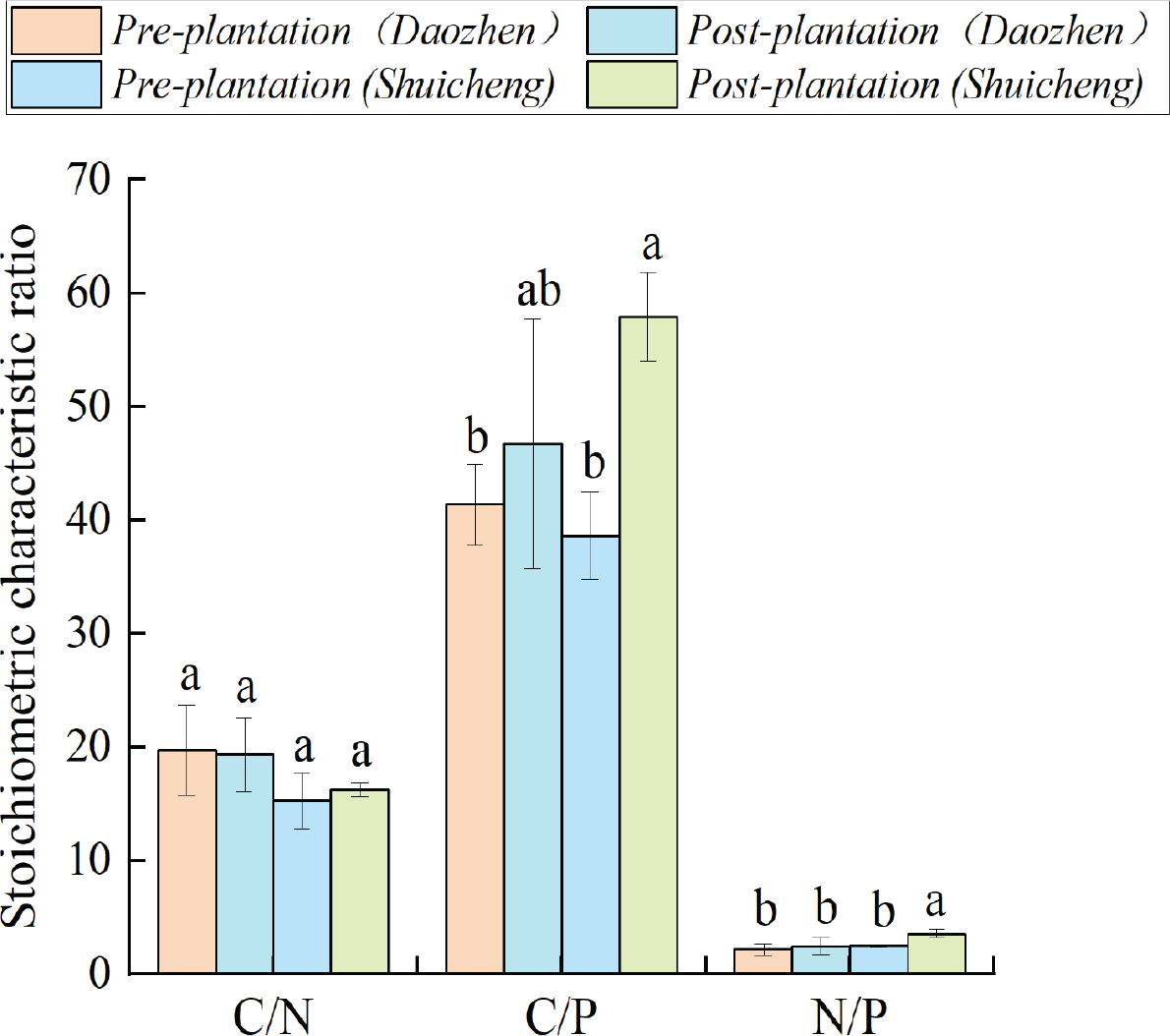
Figure 2.
Ratio of soil chemical characteristics pre-planting and post-planting morel mushroom cultivation in different locations. Lowercase letters in the figure indicate significant differences in the ratio of soil chemical characteristics pre-planting and post-planting in different locations at the 0.05 level.
Regarding the C/P ratio, except for the non-significant difference between the pre-cultivation soil of Daozhen and that of Shuicheng (p > 0.05), significant differences were observed between the remaining locations (p < 0.05). The C/P ratios in both regions increased significantly. In Daozhen, it increased significantly by 10.5% (41.02 → 45.33), with a relative decrease in phosphorus (TP decreased by 10.1%), possibly due to low phosphorus fertiliser utilisation or high phosphorus uptake by morel mushrooms; in Shuicheng, it increased significantly by 51.1% (38.22 → 57.76), P content significantly decreased (TP decreased by 10.8%), and carbon content significantly increased (SOM increased by 35.6%), reflecting the dual effects of soil carbon accumulation and phosphorus consumption.
The N/P ratio increased in both regions, with Daozhen showing an increase of 12.8% (2.11–2.38), possibly due to a slight increase in N content (TN increased by 1.2%) and a decrease in phosphorus (TP decreased by 10.1%), leading to an increase in the N/P ratio; in Shuicheng, the N/P ratio increased significantly by 41.3% (from 2.52 to 3.56), associated with a significant increase in nitrogen (TN increased by 26.8%) and a decrease in phosphorus (TP decreased by 10.8%), resulting in a more pronounced imbalance in the N/P ratio.
Changes in mineral element content in soil for morel mushroom cultivation
An analysis of 15 mineral elements in morel mushroom cultivation soil was conducted, with elements B and Mo either not detected or below the instrument detection limit. The specific results are shown in Table 2.
Table 2.
Changes in soil mineral element content pre-planting and post-planting morel mushroom cultivation.
| Element | Unit | Daozhen | Shuicheng | ||
|---|---|---|---|---|---|
| Pre-planting | Post-planting | Pre-planting | Post-planting | ||
| Ca | g · kg−1 | 3.06 ± 0.66 a | 2.73 ± 0.07 a | 0.80 ± 0.10 a | 1.33 ± 0.18 a |
| Mg | 3.91 ± 0.81 a | 3.88 ± 0.24 a | 1.73 ± 0.09 a | 1.88 ± 0.15 a | |
| Al | 29.60 ± 3.33 a | 27.11 ± 2.00 a | 21.46 ± 2.90 a | 23.70 ± 0.80 a | |
| Na | 1.72 ± 0.05 a | 1.71 ± 0.06 a | 0.55 ± 0.01 a | 0.52 ± 0.01 a | |
| Fe | mg · kg−1 | 32.36 ± 1.36 a | 32.15 ± 1.26 a | 18.63 ± 0.67 a | 17.71 ± 2.98 a |
| Cu | 31.34 ± 2.36 a | 29.95 ± 2.72 a | 11.16 ± 1.78 a | 11.32 ± 1.04 a | |
| Zn | 99.5 ± 5.59 a | 97.20 ± 4.31 a | 62.80 ± 3.24 a | 61.00 ± 3.92 a | |
| Mn | 904.99 ± 17.85 a | 857.35 ± 27.27 a | 496.21 ± 38.86 a | 392.16 ± 46.25 b | |
| Co | 29.69 ± 3.45 a | 29.71 ± 5.00 a | 9.85 ± 0.86 a | 9.58 ± 0.35 a | |
| Be | 6.94 ± 0.76 a | 6.61 ± 0.65 a | 3.26 ± 0.56 a | 3.30 ± 0.33 a | |
| Sr | 57.81 ± 1.82 a | 50.29 ± 7.39 a | 29.87 ± 2.32 a | 40.24 ± 9.01 a | |
| Se | 0.66 ± 0.02 a | 0.52 ± 0.06 b | 0.58 ± 0.05 a | 0.49 ± 0.03 b | |
| Ni | 29.02 ± 1.27 a | 28.45 ± 1.96 a | 13.76 ± 0.76 a | 14.92 ± 0.88 a | |
| B | ND | ND | ND | ND | |
| Mo | ND | ND | ND | ND | |
From a regional perspective, the initial mineral element content of Daozhen soil was approximately 1–4 times that of Shuicheng soil. Post-cultivation, the content of Ca, Al, Fe, Cu, Zn and other elements in Daozhen yellow soil generally showed a decreasing trend. Shuicheng yellow-brown soil combines the characteristics of yellow and brown soils, is slightly acidic, has a high cation exchange capacity, and exhibits strong retention capacity for elements such as Ca and Mg. Post-planting, Ca and Mg increased by 66.3% and 8.7%, respectively. The soil’s buffering capacity helps maintain the balance of alkaline metal elements; Ca and Sr elements showed enrichment, with Sr content increasing by 34.7%.
From the perspective of planting effects, in the Daozhen region, only Co showed an upward trend, while Ca, Mg, Al, Na, Fe, Cu, Zn, Mn, Be, Sr, Se and Ni showed a downward trend, with Se decreasing significantly by 21.2%. In the Shuicheng region, Na, Fe, Zn, Mn, Co and Se showed a downward trend, with Mn and Se decreasing significantly by 21.0% and 15.5%, respectively, while Ca, Mg, Al, Cu, Be, Sr and Ni showed an upward trend.
From the perspective of common changes, the content of Na, Fe, Zn, Mn and Se elements in the soils of both regions showed a consistent downward trend; the variation in Na, Fe and Zn content was relatively small, indicating that morel mushroom cultivation has a relatively minor impact on these three elements. The decreases in Mn and Se concentrations in the two regions show opposite trends, with Mn concentrations decreasing by 5.3% in Daozhen and 21.0% in Shuicheng, while Se concentrations decreased significantly by 21.2% in Daozhen and 15.5% in Shuicheng.
Characteristics of the content of effective ingredients in different parts of morel mushrooms
Testing and analysis of effective ingredients content in different parts of morel mushrooms from two different regions are presented in Figure 3. Except for Daozhen (total flavonoids, total saponins) and Shuicheng (total flavonoids, protein), significant differences (p < 0.05) were observed in all other indicators between the cap and stalk.
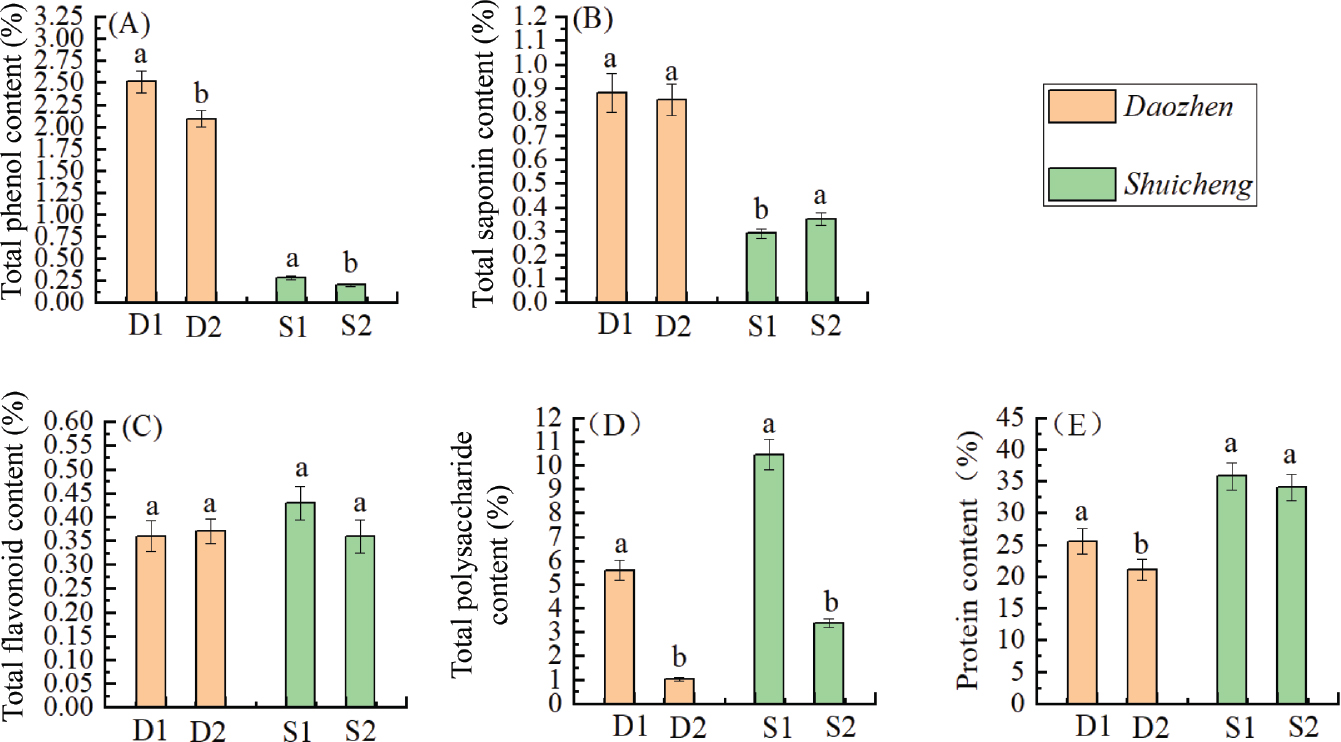
Figure 3.
Effective components of morel mushrooms of different origins. Daozhen cap (D1), Daozhen stalk (D2), Shuicheng cap (S1) and Shuicheng stalk (S2). Total phenol content (A), total saponin content (B), total flavonoid content (C), total polysaccharide content (D), protein content (E). Lowercase letters in the graphs indicate the significance of differences between the caps and stalks of morel mushrooms of the same origin (p < 0.05).
In terms of total phenols and total saponins, the Daozhen origin showed a significant advantage. The content of total phenols followed the trend of ‘“D1 (2.52%) > D2 (2.09%) > S1 (0.28%) > S2 (0.24%),”’ with the Daozhen origin being approximately 8.7~–10.5 times higher than that of Shuicheng. The trend in total saponins was similar to that of total phenols, with D1 and D2 reaching 0.88% and 0.85%, respectively, which were 3.0 times and 2.4 times higher than those of Shuicheng.
In terms of total flavonoids, total polysaccharides and total protein, the cap of the Shuicheng strain stands out. The total flavonoid content is highest in S1 (0.43%), followed by D2 (0.37%), while the stalk content of Daozhen and Shuicheng is similar (0.36%). Total polysaccharide content follows the order ‘S1 (10.45%) > D1 (5.59%) > S2 (3.37%) > D2 (1.02%),’ with Shuicheng cap and stalk content approximately 1.9 times and 3.3 times that of Daozhen, respectively; Shuicheng morel cap and stalk protein content reached 35.82% and 34.05%, which are 1.4 times and 1.6 times higher than those of Daozhen, respectively.
Overall, the effective components of morels exhibit certain regional differences. Daozhen morels have an advantage in the accumulation of phenolic and saponin secondary metabolites; Shuicheng morels, however, stand out in terms of polysaccharide and protein content. Within the same region, the total phenolic, total flavonoid and total saponin contents in the caps and stalks of morel mushrooms differ by <0.45%, while protein and polysaccharide contents vary by 1.7% to 5%, indicating that the stalks also possess significant utilisation value and can be scientifically and reasonably utilised.
Correlation analysis of soil factors on the effective components of morel mushrooms
After excluding the ineffective mineral elements B and Mo (not detected or below the detection limit), a correlation analysis was conducted between 26 soil factors and five effective components of morel mushrooms. In the figure, red indicates a positive correlation, blue indicates a negative correlation and the intensity of the colour reflects the strength of the correlation.
As shown in Figure 4, total phenols are negatively correlated with AK (p > 0.05) and positively correlated with total saponins, pH, TK, C/N, Ca, Mg, Na, Fe, Cu, Zn, Mn, Co, Be and Ni (p ≤ 0.05). Total flavonoids are negatively correlated with soil SOM (p > 0.05). Total saponins are negatively correlated with protein (p > 0.05) and positively correlated with pH, TK, C/N, Ca, Mg, Al, Na, Fe, Cu, Zn, Mn, Co, Be and Ni (p ≤ 0.05). Total polysaccharides are negatively correlated with TK, Mg, Na, Fe, Co and Ni (p > 0.05). Proteins are negatively correlated with AK (p > 0.05) and positively correlated with TP, TK, Mg, Na, Fe, Cu, Zn, Mn, Co, Be and Ni (p ≤ 0.05).
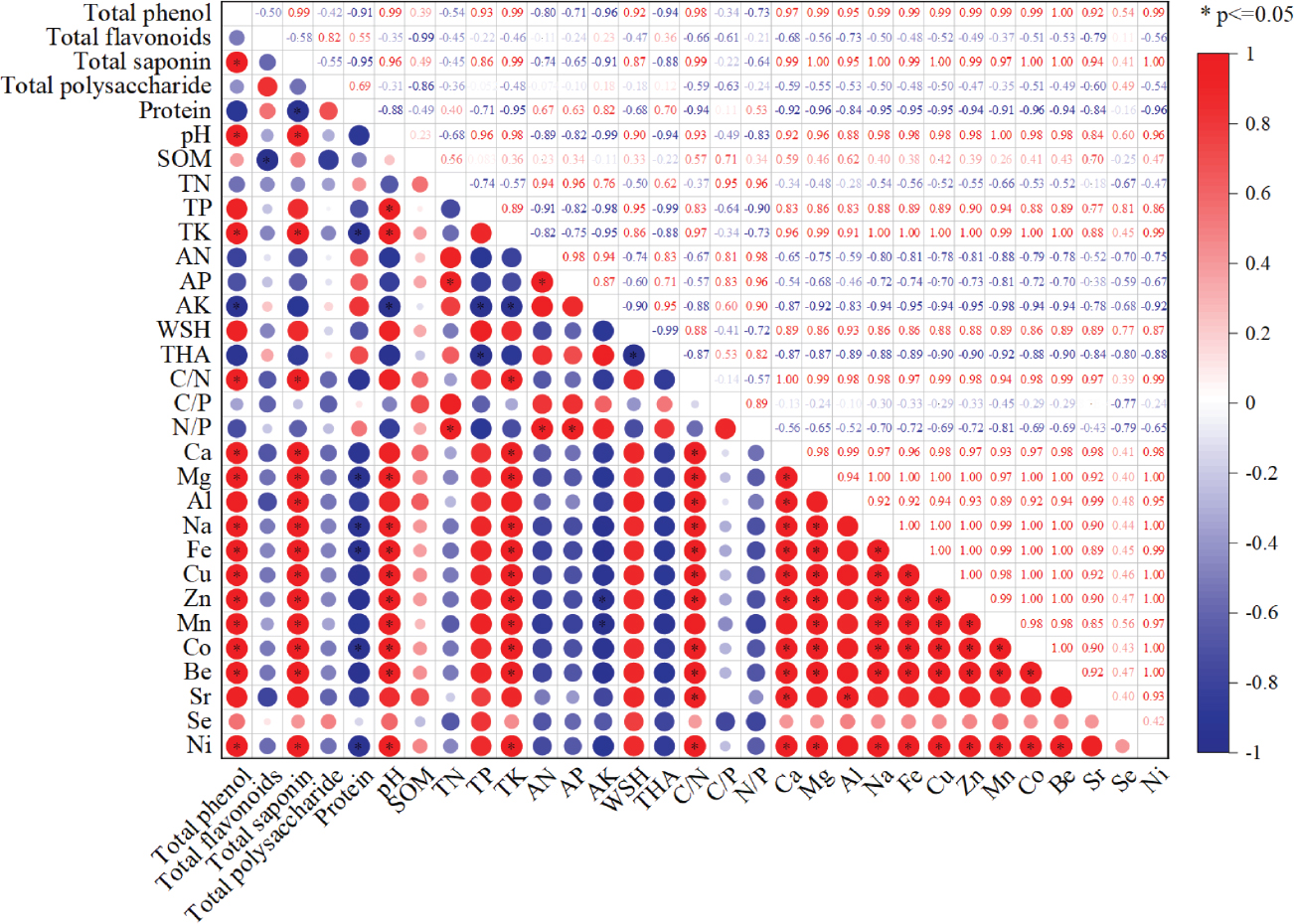
Figure 4.
Heat map showing the correlation analysis between soil factors and the effective components of morel mushrooms. AK, available potassium; AN, alkali-hydrolysable nitrogen; AP, available phosphorus; THA, total humic acid; TK, total potassium; TP, total phosphorus; WSH, water-soluble humic acid.
DISCUSSION
Post-cultivation of morel mushrooms, soil parameters such as TN, AN, AK, THA, C/P and N/P showed an upward trend in both regions, the mycelium of naturally grown morels may be more abundant and vigorous, thereby increasing nutrient content, particularly nitrogen (Zhu et al., 2017; Bai et al., 2021); meanwhile, pH, TP, WSH, Na, Fe, Zn, Mn and Se exhibited a downward trend. This is attributed to the acidification of soil by morel mushroom mycelium and microbial secretions, which promotes the leaching of metal ions, subsequently absorbed and consumed by various physiological metabolic processes of the mushrooms. Gao et al. (2025) reported that morel mushroom cultivation reduced soil Zn, Mn and Fe content, consistent with the results of this study; however, it increased soil pH, TN and AK, which contradicts the findings of this study. Zhang et al. (2020) pointed out that the soil pH of cultivated Morchella esculenta was significantly higher than that of uncultivated soil, which is also contrary to the results of this study. In this study, both regions tended towards acidification post-cultivation. This may be related to the synergistic acidification effect caused by the secretion of organic acids from morel mushroom mycelium metabolism, coupled with the release of H+ during microbial nitrification, breaking down soil organic matter (SOM), which further intensifies acidification and produces acidic substances. Caution is advised regarding the potential inhibitory effects of prolonged acidic conditions on soil microorganisms and nutrient availability. Following morel mushroom cultivation, Daozhen’s soil profile exhibited decreased TP and AP, increased AK and stable TK. This primarily stems from Daozhen’s neutral soil (pH 6.87), while morel fruiting bodies thrive optimally at pH 7.0 (Yang, 2023). Consequently, morels absorb substantial phosphorus for synthesising substances supporting mycelium growth (Zheng, 2022). Simultaneously, rhizosphere acidification causes AP to bind with metal ions, forming insoluble complexes that reduce overall phosphorus availability. In Daozhen’s yellow soil, TK exists predominantly in mineral form (over 90%), making it difficult to decompose and utilise, thus maintaining stable total TK levels. In the Shuicheng origin, TP and TK decreased while AP and AK increased. This was primarily due to Shuicheng’s acidic soil (pH 5.83), where the organic acids secreted by morels further intensify soil acidification. This process activates soil-bound phosphorus and releases potassium-bearing minerals through mineral decomposition. Combined with the activity of acidophilic microorganisms, it ultimately leads to an upward trend in both AP and AK. Meanwhile, a pH of 6.0 represents the optimal growth environment for morel mycelium (Zhang et al., 2002), resulting in a decrease in TP and TK due to their extensive uptake. After the cultivation of morel mushrooms, both WSH and THA levels decreased in both origins. This decrease in WSH is attributed to the acidified environment promoting the polymerisation of humic acid molecules into insoluble macromolecules, while microorganisms preferentially degraded smaller WSH molecules. However, the microbial decomposition of soil SOM into humic acid synthesis precursors, combined with the conversion of fungal mycelium residues, resulted in a net increase in humic acid synthesis exceeding degradation. Consequently, THA levels accumulated and increased. Additionally. The changes in WSH and THA showed a stronger trend in Daozhen than in Shuicheng, possibly due to the high-temperature climate in Daozhen accelerating microbial decomposition and conversion into stable humic acid. Additionally, Shuicheng had higher baseline values for WSH and THA, with a more stable humus structure, resulting in relatively smaller changes.
The content of 13 mineral elements in the soil pre-planting in Daozhen was approximately 1–4 times that of Shuicheng and post-planting, only one mineral element increased in Daozhen, while seven increased in Shuicheng. Additionally, SOM decreased by only 0.7% in Daozhen, whereas it significantly increased by 35.6% in Shuicheng. This is related to the strong organic matter decomposition ability of morel mushroom mycelium, which can also accumulate organic matter in the soil (Tan et al., 2021; Zhang et al., 2023), as well as the previous crop effects in both regions. The previous crops in Daozhen and Shuicheng were tobacco and corn, respectively. Post-planting, the application of organic fertiliser in tobacco fields was greater than in cornfields. After planting, the residual tobacco plant roots, stems and leaves contained special chemical components such as nicotine, which exerted inhibitory or selective effects on the structure of the soil microbial community. In contrast, the residual corn straw and other polysaccharide-rich materials provided abundant carbon sources and energy for soil microorganisms, promoting beneficial microbial activity and enhancing the conversion and release of organic matter, mineral elements in the soil, this has resulted in a greater variety of mineral elements being added to the Shuicheng origin. Additionally, the decline in Mn and Se content showed opposite trends between the two origin: the decline in Mn content was smaller in Daozhen than in Shuicheng, possibly due to greater soil acidification in Shuicheng, this may be attributed to the greater soil acidification in Shuicheng, where increased H+ displacement of soil colloid-adsorbed Mn2+, combined with the chelation of Mn by organic acids secreted by morel mycelium and microbial activity, collectively exacerbated manganese leaching. Studies indicate that temperature is a key controlling factor for Se volatilisation (Ye et al., 2021), while humidity also significantly promotes Se volatilisation (Pi et al., 2024); the decline in Se content was greater in Daozhen than in Shuicheng, which may be related to the faster reduction and volatilisation rate of selenium in Daozhen’s high-temperature, humid environment compared to Shuicheng’s low-temperature environment, as well as higher microbial metabolic activity and enzyme activity.
The soil C/N ratio reflects the efficiency of microbial utilisation of soil SOM. A lower C/N ratio indicates a faster rate of soil SOM mineralisation (Majdi and John, 2010). Studies have shown that a soil C/N ratio of 25 is most conducive to soil organic matter decomposition. When the C:N ratio is significantly below 25, it can be considered carbon-limited (Gu and Yang, 2023). In this study, the soil C/N ratios in both regions ranged from 15.29 to 19.79, both higher than the average soil C/N ratio for Chinese terrestrial soils (11.9) (State Forestry Administration of China, 1999) and within the global average range for soil C/N ratios (9.9–29.9) (Tian et al., 2010) indicating that carbon limitation is not significant in both regions, consistent with the results showing no correlation between C/N and soil SOM in this study. Additionally, the soil C/N ratio in the Daozhen region is higher than that in the Shuicheng region, indicating that soil C accumulation is occurring in the Daozhen region, while soil mineralisation is stronger in the Shuicheng region, with soil SOM decomposition rates exceeding accumulation rates.
The soil C/P ratio is used to measure the potential for releasing or retaining P during microbial mineralisation of soil organic matter, serving as an indicator of soil P mineralisation capacity (Zeng et al., 2015). In this study, the soil C/P ratio ranged from 38.61 to 57.92, both below the national average (61) (State Forestry Administration of China, 1999). Additionally, when the soil C/P ratio is <200, microbial carbon content significantly increases, and phosphorus undergoes net mineralisation (Wang and Yu, 2008), indicating that both sites experienced net phosphorus mineralisation. The C/P ratios in both regions significantly increased, with the increase in Shuicheng being far greater than that in Daozhen. This may be related to soil acidification in Shuicheng, which enhances the activity of aluminium and iron oxides, thereby exacerbating phosphorus fixation.
The N/P ratio is commonly used as a stable indicator for predicting nutrient availability. When the N/P ratio exceeds 14.5, nutrient availability is limited by phosphorus (P), and when it is below 14.5, it is limited by nitrogen (N) (Wu et al., 2010). In this study, the N/P ratios in both regions ranged from 2.11 to 3.56, both below the national average (5.2) (State Forestry Administration of China, 1999), indicating that the soils in both regions are primarily N-limited. This aligns with the study’s finding of a significant positive correlation between N/P and soil AN.
The total phenolic content and total saponin content in Daozhen were significantly higher than in Shuicheng, and the trend in total saponin content was similar to that of total phenolic content. This aligns with the positive correlation between total phenolic content and total saponin content, which is attributed to the generally higher soil physicochemical indicators in Daozhen compared to Shuicheng. The positive correlation between total phenols, total saponins and soil pH, TK, C/N ratio, Ca, Mg, Na, Fe, Cu, Zn, Mn, Co, Be, Ni, etc., further explains this phenomenon. Additionally, since total phenols are important antioxidant substances, they may be related to oxidative stress induced by the high-temperature, high-rainfall environment in Daozhen, where morels synthesise phenolic compounds to resist environmental stress. This may also be related to the lower enzyme reaction rates and the shift towards low-energy pathways in secondary metabolism under the low-temperature environment in Shuicheng. Studies indicate that as edible fungi fruiting bodies mature or undergo extended growth periods, protein and total polysaccharide content exhibit an upward trend (Barros et al., 2007; Cui et al., 2014; Zeng et al., 2022); however, antibacterial activity decreases (Barros et al., 2007), and antioxidant activity diminishes to varying degrees. This phenomenon is closely associated with the disruption of the balance between reactive oxygen species and antioxidants during the late maturation stage, as well as accelerated tissue senescence (Liu et al., 2013; Zeng et al., 2022; Li et al., 2024). Therefore, differentiated harvesting strategies can be adopted for morel mushrooms: to minimise degradation losses of antimicrobial and antioxidant compounds such as phenolic acids and saponins, harvest when fruiting bodies reach 70%–80% maturity; to maximise accumulation of polysaccharides and proteins, harvest after full fruiting body maturation.
The total flavonoid content was highest in the mushroom caps (S1) from the Shuicheng region, and total flavonoids showed a negative correlation with soil SOM, suggesting that the synthesis pathway of total flavonoids is more likely regulated by specific genes or environmental factors. Total polysaccharide and protein content showed a trend of being higher in Shuicheng than in Daozhen. This is because the cool environment (11–14°C) in Shuicheng extends the mycelium growth cycle, allowing carbon metabolic products more time to polymerise into polysaccharides. Additionally, the relatively stable nitrogen supply in the yellow-brown soil promotes amino acid synthesis and protein accumulation. Under relatively high temperatures (22°C), Daozhen exhibited enhanced respiration leading to accelerated carbon source consumption, restricted polysaccharide accumulation and potential protein loss due to elevated temperatures activating protease activity, accelerating proteolytic degradation. This loss resulted from high-temperature proteolytic action. (Brzostek and Finzi, 2011). This also correlates with Daozhen soil’s TK content being three times higher than ’Shuicheng’s, while protein content shows a negative correlation with soil TK. These dual factors contribute to lower protein content in Daozhen compared to Shuicheng. In this study, the total polysaccharide content exhibited a higher concentration in the cap than in the stalk, consistent with previous studies (He et al., 2017; Zhang et al., 2021), and the protein results align with those of He et al. (2017), indicating that the cap possesses higher medicinal and edible value.
The effective ingredient content of the caps of morel mushrooms from both regions is generally higher than that of the stalks, which is related to the fact that the caps are the main sites of photosynthesis and environmental response. The caps are directly exposed to the external environment and need to synthesise more protective substances (such as phenols and flavonoids) to resist stress, while the stalks mainly perform material transport functions and have relatively low metabolic activity. Therefore, the content of various effective ingredients in the stalks is generally lower.
CONCLUSIONS
After morel mushroom cultivation, the soil TN, AN, AK, THA, C/P and N/P levels in both areas showed an upward trend, while pH, TP and WSH levels showed a downward trend. The stoichiometric ratio characteristics indicated that both areas were not significantly limited by carbon, but primarily limited by nitrogen, and simultaneously experienced net mineralisation of phosphorus in the soil. The concentrations of Na, Fe, Zn, Mn and Se in the soil of both regions showed a consistent downward trend; the variations in Na, Fe and Zn concentrations were relatively small. Pre-cultivation soil in Daozhen contained approximately 1–4 times the concentrations of 13 mineral elements compared to Shuicheng. In Daozhen, only one element showed an upward trend, while 12 showed a downward trend, with Se showing a particularly significant decrease; in Shuicheng, seven elements showed an upward trend, while six showed a downward trend, with Mn and Se showing particularly large decreases. Therefore, it is recommended that the Daozhen production area prioritise supplementing Se, TP and humic acids (WSH, THA), while supplementing mineral elements such as Ca, Mg and Mn content decline. This can be achieved by increasing phosphorus fertiliser application, combining calcium-manganese fertilisers and incorporating organic fertilisers into the soil. Concurrently, potassium fertiliser application must be controlled to prevent nutrient imbalance. For the Shuicheng origin, prioritise supplementing Mn, Se and K. Take precautions against accelerated acidification and nutrient leaching, strictly control phosphorus fertiliser application, and monitor long-term accumulation risks of Al and Ni in the soil. Potassium balance can be achieved by increasing potassium sulfate application, while pH adjustment can be accomplished through lime application. Regularly test soil for available heavy metal concentrations.
The effective component content in the caps of morel mushrooms from the two regions is generally higher than that in the stalks. However, the content of five effective components in the caps and stalks of morel mushrooms from the same region differs by <5%. The stalks also have significant utilisation value and great development potential. Therefore, to reduce costs, mushroom caps and stalks need not be processed separately and can be utilised synergistically. The effective components of morel mushrooms exhibit certain regional differences. Daozhen morel mushrooms have an advantage in the accumulation of phenolic and saponin secondary metabolites. Harvesting at 70%–80% fruiting body maturity minimises degradation of these compounds, making them ideal for developing functional products targeting antioxidant and anti-inflammatory properties. Shuicheng morels exhibit notably higher levels of total polysaccharides and protein content. Harvesting after full fruiting body maturation enhances the accumulation of these effective components, making them particularly suitable for developing products such as immune modulators and nutritional supplements. Additionally, total phenols, total saponins, total polysaccharides and proteins in morels are significantly correlated with seven or more soil factors. Among these, soil factors TK, Mg, Na, Fe, Cu, Zn, Mn, Co, Be and Ni promote the accumulation of total phenols, total saponins and proteins, recommended to apply specialised fertilisers containing Ca, Mg, Mn, etc., in the Daozhen production area to enhance the content of these functional components. While TK, Mg, Na, Fe, Co and Ni inhibit the accumulation of total polysaccharides, we recommend controlling the application of TK in Shuicheng production areas to reduce the inhibition of polysaccharides; total flavonoids are negatively correlated with soil SOM and show no correlation with any of the 13 mineral elements. Therefore, it is recommended to focus on in-depth research into environmental conditions such as temperature, humidity and altitude. In future cultivation, both regions should integrate soil dynamic monitoring to develop precision fertilisation strategies, achieving synergistic development of higher morel mushroom yields and soil health.
ACKNOWLEDGEMENTS
The authors thank Guizhou Provincial Key Technology R&D Program for providing support and funding for this research.
Notes
[4] Contributed by AUTHOR CONTRIBUTIONS
L.X.L., D.T.F., C.P.X. and W.T. designed the experiments and analysed the data. L.X.L., W.F.X. and G.A.Q. drew the figures and wrote the manuscript. L.S.X. and W.D.P. revised and edited the manuscript. All authors read and approved the submitted version of the manuscript.
[5] Conflicts of interest CONFLICT OF INTEREST
No potential conflict of interest was reported by the authors.