
INTRODUCTION
Nowadays, plant micropropagation is a technique that is widely applied in research and commercially, as it has great potential in species for agricultural, ornamental and, to a lesser extent, forestry use. Optimising regeneration protocols has been necessary, which is why currently the use of new novel substances that can stimulate specific morphogenic responses has been resorted to, such as organogenesis and/or somatic in vitro embryogenesis. An alternative to this has been the implementation of nanotechnology.
Nanotechnology has allowed different materials to be used in different applications at a nanometric scale (0–100 nm). Such is the case with silver nanoparticles (AgNPs), whether of chemical or green origin. Among the different applications that have been reported for AgNPs, antimicrobial, fungicidal and termiticidal properties can be found, as well as mitigation of effects of ethylene in in vitro crops (Vázquez-Muñoz et al., 2014; Iqtedar et al., 2020; Crisan et al., 2021; Tung et al., 2021a). It has recently been reported that metal nanoparticles stimulate germination as well as the growth and development of plants (Hu and Xianyu, 2021; Reyes-Zambrano et al., 2024).
In in vitro systems, a hormetic effect has been observed when using AgNPs, meaning they stimulate the growth of plant cells at low concentrations and inhibit them at high ones, resulting in the induction of different morphogenic routes. These particles act synergically with growth regulators and components within the culture medium (Bello-Bello et al., 2017). This hormetic effect by AgNPs has been documented in species such as stevia (S. rebaudiana) and vanilla (V. planifolia), where it has been observed that, at low concentrations ranging from 25 mg · L−1 to 50 mg · L−1, AgNPs stimulate in vitro development. On the other hand, high AgNPs concentrations ranging from 100 mg · L−1 to 200 mg · L−1 inhibit the development of the crop (Spinoso-Castillo et al., 2017; Castro-González et al., 2019). Also, it has been reported that, for roses (Pink hybrida L.) var. Baby Love, succulents (Caralluma tuberculata R.Br.) and Chinese grass (Pennisetum alopecuroides L.), a concentration below 25 mg · L−1 will stimulate and increase in vitro growth and differentiation (Ali et al., 2019; Parzymies et al., 2019; Ngan et al., 2020).
AgNPs can also modify physiological and biochemical processes, such as the synthesis of chlorophyll and the production of secondary metabolites such as polyphenols (Shang et al., 2019). However, high doses and prolonged exposure to AgNPs can cause phytotoxicity, generating oxidative stress in the plant cell, in addition to alterations to development and growth of various cells. In turn, this damages tissues and/or delays the induction process of explants (Yan and Chen, 2019). Therefore, it is necessary to evaluate the concentrations and exposure time for each plant species. The present study evaluated the impact on the in vitro culture of AgNPs on Creole pineapple (A. comosus L.), which contributes to the understanding of its application in plant micropropagation protocols.
MATERIALS AND METHODS
Shoot induction
Meristems from Creole pineapple plantlets were used (A. comosus), which had previously been established in in vitro conditions at an age of 6 months. These were placed in MS medium (Murashige and Skoog, 1962) and supplemented with AgNPs (Bionag™ (Bionag SAPI the CV Co. Tijuana, México), previously known as ArGovit™, Juarez-Moreno et al., 2016) at concentrations of 0, 25, 50, 100 and 200 mg · L−1. Separately and based on what was reported by Torres-Ruiz et al. (2023), the effect of combining 1 mg · L−1 of 6-benzylaminopurine (BAP) with the same concentrations of AgNPs was tested. Both experiments were performed in triplicate, whereby three explants were placed in incubation per bottle. As for incubation conditions, the temperature was set at 25°C ± 2°C and photoperiods alternating between 16 hr light and 8 hr darkness was used. This was carried out for 8 weeks with reseeding every 30 days, whereby evaluations took place after 30 days and 60 days, in agreement with what was reported by Torres-Ruiz et al. (2023). In total, three independent experiments were carried out for all treatments with AgNPs alone and for AgNPs combined with BAP.
Chlorophyll determination
Leaves were collected from the shoots obtained (0.2 g) proceeding from the treatments with AgNPs and from those combining AgNPs with 1 mg · L−1 of BAP. Samples were macerated in a mortar with 85% acetone, then placed in a freezer at a temperature of −4°C for 24 hr, after which 6.25 mL of 85% acetone was added and centrifuged at 4500 rpm for 10 min. The supernatant was placed in falcon tubes. Chlorophyll determination was carried out at 663 nm and 645 nm for chlorophyll a and b, respectively. This was performed according to the methodology described by Castro-González et al. (2019). The following formula was used for the calculations:
Where:
A = Absorbance
C = Concentration (mg · g −1 fresh weight)
V = Volume (mg · L −1)
W = Sample weight (g) 1000 = conversion factor
Quantification of total phenols
Shoots obtained from treatments with AgNPs and from those combined with 1 mg · L−1 of BAP were lyophilised, where 0.5 g of dry weight (DW) per sample was macerated with 10 mL of 98% methanol and subjected to ultrasound (60 Hz, ULTRASONIC CLEANER CO-Z, Creworks Co.) for 2 hr at 25°C in darkness. Subsequently, the samples were centrifuged at 4000 rpm at 4°C for 10 min. Lastly, they were evaporated under vacuum at 40°C for 10 min and resuspended in 2 mL of methanol, and stored at −4°C. The methodology described by Santos-Espinoza et al. (2021) was performed, where gallic acid was used as the standard at a concentration of 1 mg · L−1. An aliquot of 0.1 mL was taken from the plant extract with methanol, which was diluted with 4.2 mL of distilled water, to which 0.5 mL of the Folin–Ciocalteu reagent were added. After stirring for 1 min, 1.0 mL of 20% Na2CO3 was amended. The reaction was allowed to incubate at room temperature for 2 hr in darkness, after which the absorbance was measured at 765 nm with a spectrophotometer UV/Vis DU730 (Beckman Coulter Life Sciences). The phenol concentration was determined with the previously obtained standard curve using gallic acid. The total phenol content was expressed as gallic acid equivalents (GAE mg · g−1 DW).
Determination of antioxidant capabilities
The antioxidant activity was determined via the 2,2-diphenyl-1-picrylhydrazyl (DPPH) radical, which was carried out as described by Santos-Espinoza et al. (2021). An aliquot of 0.3 mL of the sample was taken, to which 2.7 mL of a DPPH solution (0.190 mM) was added. After incubating the mixture for 30 min, the absorbance was measured at 517 nm with a Beckman Coulter spectrophotometer (DU 730).
Statistical analysis
To evaluate the effect of AgNP treatments, an analysis of variance (ANOVA) was performed with a significance level of 95%, and the mean comparisons were conducted by Media Significant Difference Test, using the Statgraphic centurion XV statistical package (StatPoint Tecnologies Inc. EE.UU.).
RESULTS AND DISCUSSION
Shoot induction
Shoot formation was observed after 30 days of culture for all treatments with AgNPs. This was also observed in combined treatments with 1 mg · L−1 BAP (Table 1). The best shoot induction response in AgNP only treatments was observed at concentrations of 50 mg · L−1 and 100 mg · L−1 after 60 days of induction, whereby 6.33 and 6.0 shoots/explant were obtained, respectively Figure 1H and Figure 1I. As for the treatments combining 1 mg · L−1 of BAP with AgNPs (Figure 2A-J), the most significant response was found at a concentration of 50 mg · L−1 of AgNPs at 60 days of induction, where up to 11.33 shoots per explant were found (Table 1, Figure 2H). This was the treatment where the greatest number of formed shoots per explant was achieved.
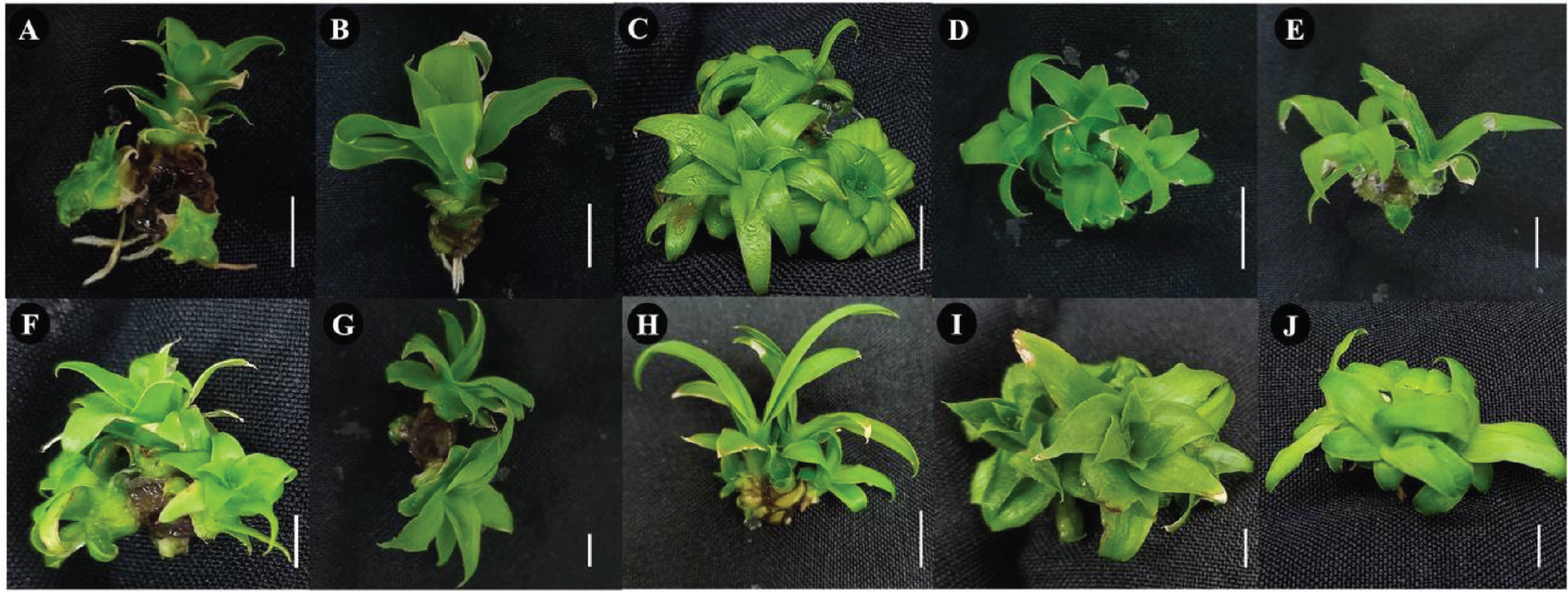
Figure 1.
Effect of AgNPs on the induction of Creole pineapple shoots. A) control treatment, B) shoots with 25 mg · L−1 of AgNPs, C) shoots with 50 mg · L−1 of AgNPs, D) shoots with 100 mg · L−1 of AgNPs, E) shoots with 200 mg · L−1 of AgNPs, 30 days of induction; F) control treatment, G) shoots with 25 mg · L−1 of AgNPs, H) shoots with 50 mg · L−1 of AgNPs, I) shoots with 100 mg · L−1 of AgNPs, J) shoots with 200 mg · L−1 of AgNPs, 60 days of induction. The bar is equivalent to 1 cm. AgNPs, silver nanoparticles.
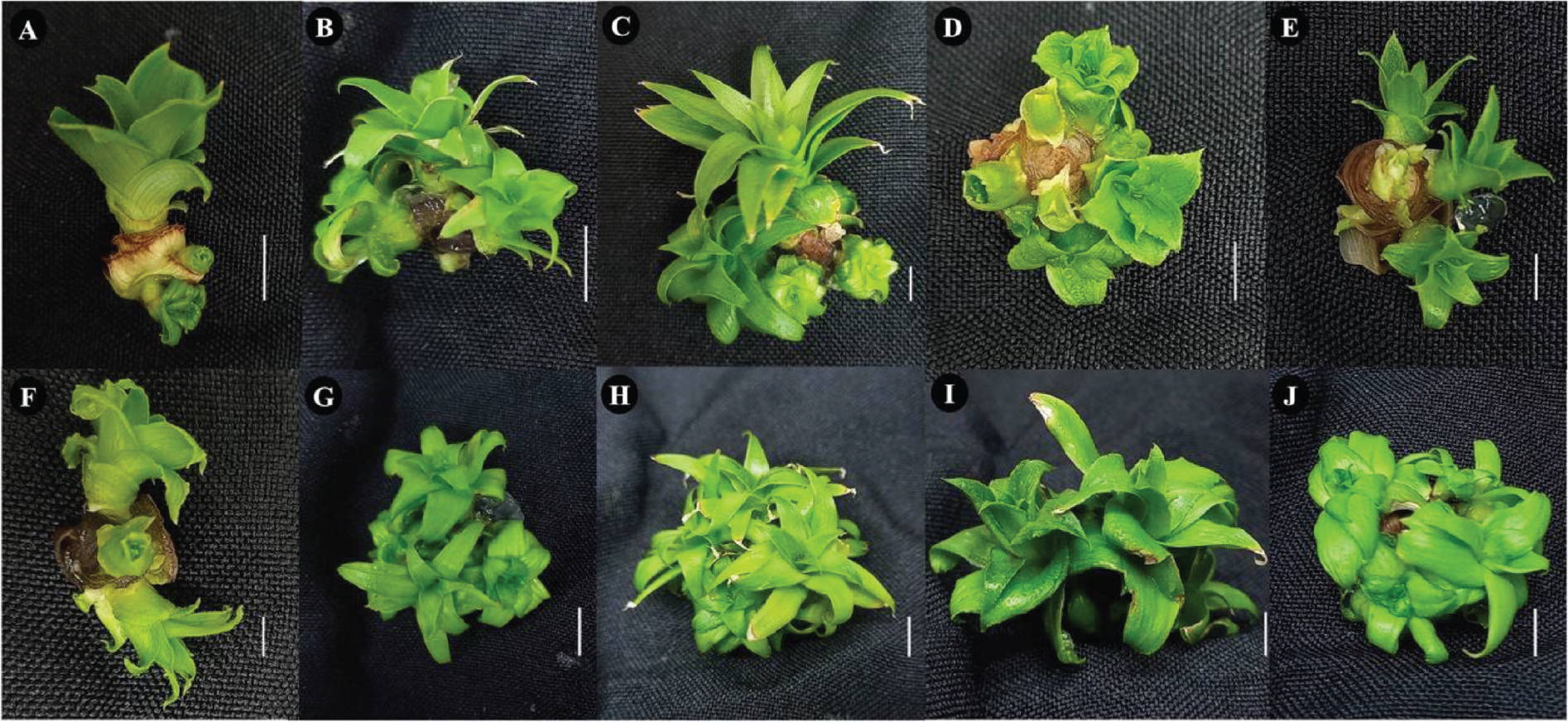
Figure 2.
Induction of Creole pineapple shoots with AgNPs + 1 mg · L−1 BAP. A) control treatment, B) shoots with 25 mg · L−1 of AgNPs, C) shoots with 50 mg · L−1 of AgNPs, D) shoots with 100 mg · L−1 of AgNPs, E) shoots with 200 mg · L−1 of AgNPs, 30 days of induction; F) control treatment, G) shoots with 25 mg · L−1 of AgNPs, H) shoots with 50 mg · L−1 of AgNPs, I) shoots with 100 mg · L−1 of AgNPs, J) shoots with 200 mg · L−1 of AgNPs, 60 days of induction. The bar is equivalent to 1 cm. AgNPs, silver nanoparticles; BAP, 6-benzylaminopurine.
Table 1.
Obtaining Creole pineapple shoots with AgNPs.
| Treatments | Number of shoots | ||
|---|---|---|---|
| AgNPs (mg · L−1) | BAP (mg · L−1) | 30 days | 60 days |
| 0 | 0 | 2.67 ± 0.88 if | 5.0 ± 0.0 c |
| 25 | 0 | 1.67 ± 0.66 f | 2.0 ± 1.0 d |
| 50 | 0 | 6.0 ± 0.57 bc | 6.33 ± 0.33 c |
| 100 | 0 | 6.0 ± 0.58 bc | 6.0 ± 0.0 c |
| 200 | 0 | 3.33 ± 1.20 def | 5.0 ± 0.57 c |
| 25 | 1 | 4.67 ± 0.67 cde | 8.57 ± 0.33 b |
| 50 | 1 | 9.33 ± 0.67 a | 11.33 ± 0.88 a |
| 100 | 1 | 5.0 ± 1.0 bcd | 10.33 ± 0.33 a |
| 200 | 1 | 7.0 ± 0.0 b | 8.67 ± 0.33 b |
| LSD | 2.26 | 1.36 | |
It has recently been shown that metal nanoparticles have a great influence on the germination, growth and development of plants (Hu and Xianyu, 2021; Tung et al., 2021b; Reyes-Zambrano et al., 2024). This stimulus on plant development depends on the physicochemical characteristics of the nanoparticles used, such as shape, size, coating (stabilising agent), concentration and type of metal (Agathokleous et al., 2020; Jalal et al., 2021). Hormesis, also known as the hormetic effect, is the ability of certain substances to positively stimulate the cell (or an organism) at low concentrations and inhibit it at high concentrations. Our results concur with this phenomenon, as the AgNPs stimulated the formation of the greatest number of shoots in Creole pineapple after 30 days and 60 days of induction when using concentrations of 50 mg · L−1 and 100 mg · L−1. Likewise, the same result was observed when combined with 1 mg · L−1 BAP. An opposite effect was noticed at high concentrations (200 mg · L−1), where a decrease in the number of shoots was observed (Figure 2I and Figure 2J).
Furthermore, it was observed that AgNPs alone can promote morphogenetics processes, such as direct organogenesis in Creole pineapple, stimulating shoot formation (Figure 1). To our knowledge, this phenomenon has not been reported in any study to date. The protocols regarding morphogenic responses are always carried out in combination with some type of growth regulator, such as auxin or 2,4-dichlorophenoxyacetic acid (2,4-D), naphthaleneacetic acid (NAA) or cytokines like BAP or benzyladenine (BA).
Castro-González et al. (2019) reported the effect of AgNPs on the proliferation of stevia shoots (S. rebaudiana) in MS liquid medium supplemented with 2 mg · L−1 of BAP and different concentrations of AgNPs (0, 12.5, 25, 50, 100 and 200 mg · L−1), where it was observed that the application of 12.5, 25 and 50 mg · L−1 of AgNPs promoted a high shoot production, as well as greater shoot length, but that 200 mg · L−1 inhibited both production and elongation of shoots. As for vanilla (V. planifolia), Spinoso-Castillo et al. (2017) reported that shoot multiplication is high when vanilla leaf segments are placed in liquid MS medium supplemented with 2 mg · L−1 of BA plus 25 or 50 mg · L−1 of AgNPs, where 14.3 and 14.89 shoots were obtained per explant respectively. On the other hand, a low number of shoots (4.55) is obtained when the medium is supplemented with 200 mg · L−1 of AgNPs. Ali et al. (2019) reported the proliferation of calluses in C. tuberculata, a succulent species, where a greater proliferation of biomass (callus) was observed when the MS culture medium was supplemented with 60 μl · L−1 de AgNPs + 0.5 mg · L−1 2,4-D + 3 mg · L−1 BA.
It has been shown that AgNPs have several applications in the culture of plant tissues, especially for large-scale micropropagation systems that use temporary immersion systems. In our research, a conventional micropropagation system was applied for the study model of Creole pineapples, where it was observed that the AgNP concentrations applied to the culture medium did not have a phytotoxic effect on the sprouts obtained. It was also found that the best concentration for chlorophyll responses, antioxidant capacity and sprout induction was 50 mg · L−1. Responses improved considerably when combined with 1 mg · L−1 BAP.
Recently, Torres-Ruiz et al. (2023) reported the regeneration of shoots via direct organogenesis in Creole pineapples, which is the only report regarding regeneration for this pineapple variety. The authors found that, after 30 days of culture, 1 mg · L−1 of BAP will induce the formation of 6.33 shoots per explant. Compared with our results, it was found that AgNPs in MS medium at a concentration of 50 mg · L−1 and 100 mg · L−1 induce the same number of shoots (6 shoots per explant) in the same timeframe. This type of response to AgNPs, whether chemical or green, has not been reported for any crop in vitro. Kaveh et al. (2013) carried out pioneering work, wherein they evaluated changes in gene expression in Arabidopsis thaliana in response to the exposure to AgNPs, resulting in differential expression of 375 genes. It was discovered that AgNPs are involved in plant response to various stresses. Positively regulated genes were found, which are associated with the response to metals and oxidative stress, whereas the negatively regulated genes were more associated with response to pathogens, including systemic acquired resistance (SAR) against fungi and bacteria, and hormonal stimuli (auxin or ethylene signalling pathways).
The fact that AgNPs negatively regulate genes involved in the auxin signalling pathway means that a cytokinin-type effect might be conferred by these particles, thus improving the organogenic response in various crops such as stevia, vanilla, sugarcane, rose and Chinese grass. This effect is enhanced when a combination with regulators occurs, such as BAP and/or BA. In most treatments, an AgNPs combination of 50 mg · L−1 results in high production and/or shoot formation (Bello-Bello et al., 2017; Spinoso-Castillo et al., 2017; Castro-González et al., 2019; Parzymies et al., 2019; Ngan et al., 2020).
This same response was observed in the induction of shoots in Creole pineapple when supplementing the culture medium with 1 mg · L−1 of BAP and 50 mg · L−1 of AgNPs. With this treatment, the number of shoots obtained after 60 days had doubled (11.33 shoots per explant). Although it was herein demonstrated that AgNPs can induce shoot formation via direct organogenesis in native pineapples, it is necessary to carry out more specific studies. Such studies could include differential expression of specific genes or morphogenetic process markers regarding organogenesis and/or somatic embryogenesis, whose expression could be regulated by AgNPs, either positively or negatively. Factors that need to be taken into account are genotype, phenotype, species to be studied, along with exposure time, type, size and nature (chemical or green) of the AgNPs that are used. Additional studies could confirm the application of AgNPs as a possible nano-regulator.
Chlorophyll quantification
Figure 3 and Figure 4 show the chlorophyll content in Creole pineapple shoots after 60 days of induction for treatments with AgNPs alone and in combination with BAP, respectively. Chlorophyll a, b and total contents showed a significant difference when AgNPs were used on their own and in combination with the BAP regulator. In general, an increase in chlorophyll was observed at concentrations of 100 mg · L−1 of AgNPs for all assessments (34.06 mg · g−1 fresh weight [FW] when used alone, 26.39 mg · g−1 FW in combination with BAP). The treatments with 25 mg · L−1 of AgNPs showed the lowest contents (17.51 mg · g−1 FW when used alone, 17.18 mg · g−1 FW in combination with BAP).
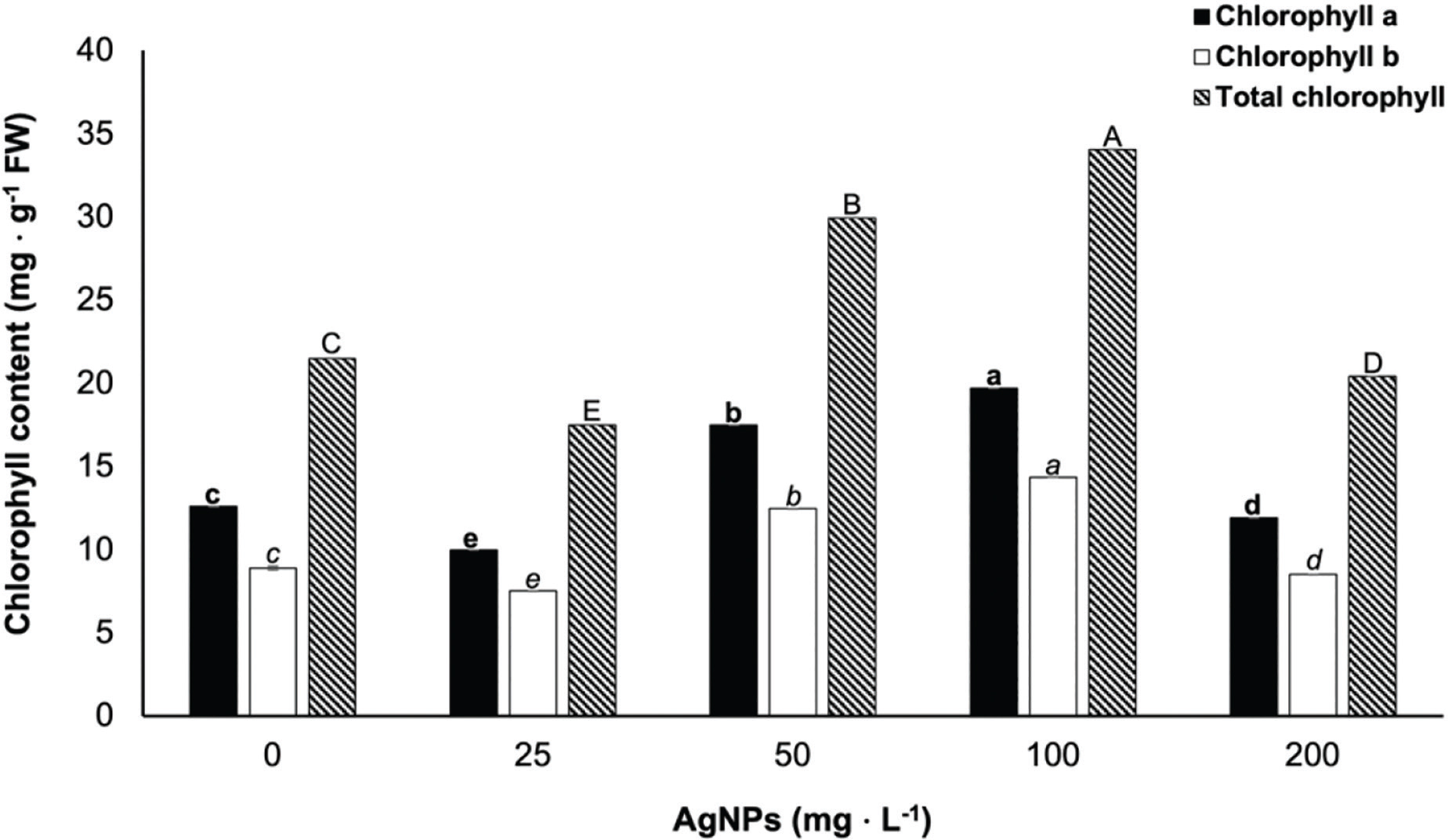
Figure 3.
Quantification of chlorophyll in pineapple shoots obtained from different treatments with AgNPs. Different letters indicate significant differences. Tukey p ≤ 0.05. AgNPs, silver nanoparticles.
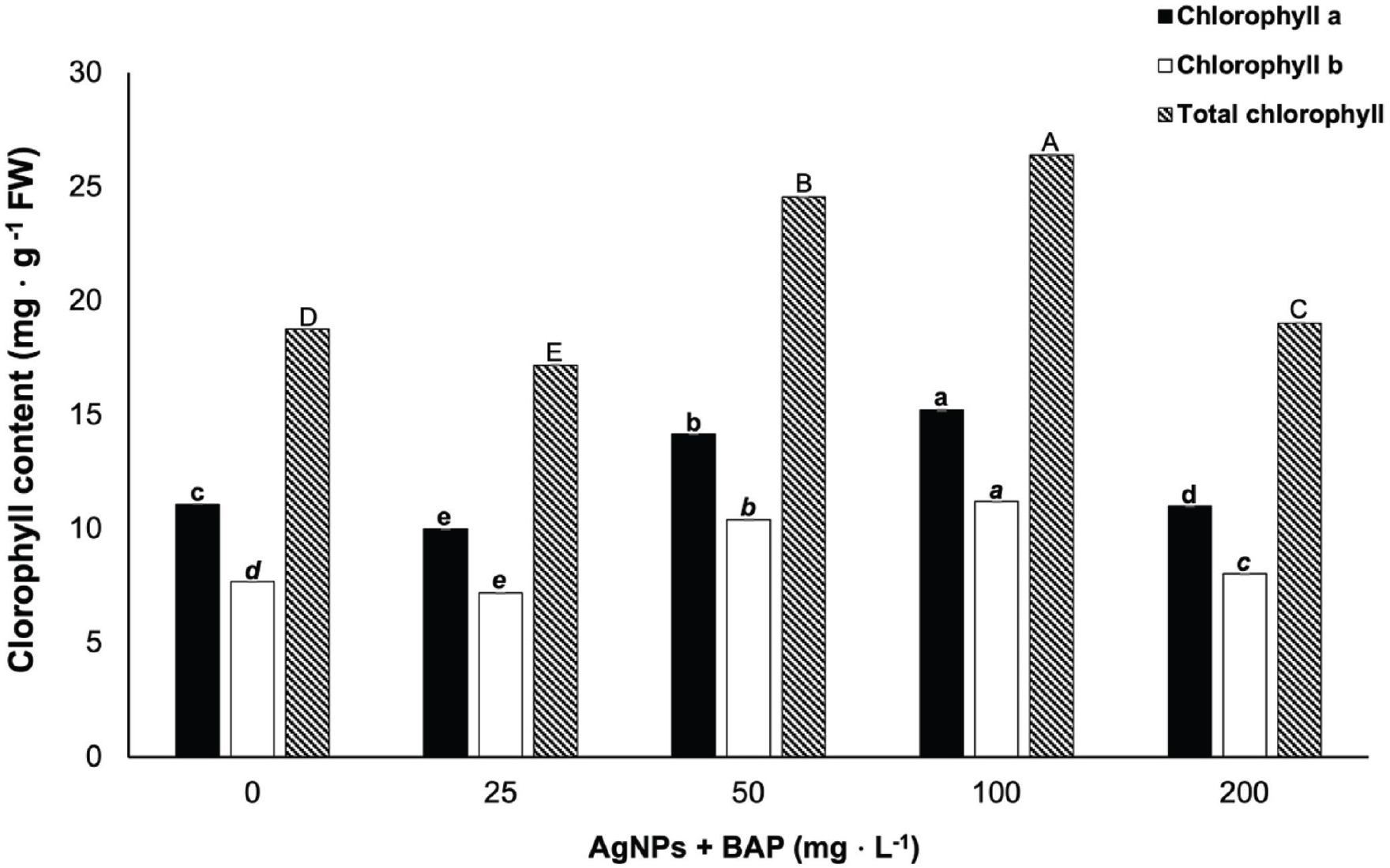
Figure 4.
Quantification of chlorophyll in pineapple shoots obtained from different treatments with AgNPs + 1 mg · L−1 BAP. Different letters indicate significant differences. Tukey p ≤ 0.05. AgNPs, silver nanoparticles; BAP, 6-benzylaminopurine.
A variation in chlorophyll content was found in all treatments with AgNPs, either alone or in combination with 1 mg · L−1 of BAP. The highest contents were found when AgNP concentrations of 50 mg · L−1 and 100 mg · L−1 were used, which agrees with reports by Razzaq et al. (2016), who found that the chlorophyll content increased with these same concentrations with in vitro cultures of wheat. Also, similar results were reported with in vitro cultures of Consecrated radiata (Saeideh and Rashid, 2014). On a similar note, Bello-Bello et al. (2017) and Spinoso-Castillo et al. (2017) reported an increase in the content of photosynthetic pigments in sugarcane and vanilla shoots treated with AgNPs. Reportedly, this response was explained by an increase in nutrients such as N, Mg and Fe in the explants exposed to AgNPs, as these elements are associated with various metabolic processes such as synthesis of chlorophyll, proteins, nucleic acids and are also related to reactions involving either adenosine triphosphate or the catalytic group of redox enzymes (Hopkins and Hüner, 2004; Rico et al., 2015).
Some authors have reported that AgNPs improve the quantum efficiency of photosystem I in Chlamydomonas reinhardtii (Matorin et al., 2013), and photosystem II in Brassica juncea (Sharma et al., 2012). In regard to chlorophyll content in creole pineapple shoots, AgNPs could be improving photosynthetic efficiency by stimulating photosystems I and II, which are in charge of completing the light reaction, along with electron transfer. At the same time, a combination of 1 mg · L−1 of BAP + 50 mg · L−1 of AgNPs increases the leaf area on the shoots, leading to a relative increase in the number of stomata, which, in turn, is related to a higher chlorophyll synthesis.
During unfavourable environments, reactive free radicals are produced in greater quantities, which form complex chain reactions, eventually affecting cells and tissues, as well as cellular processes (Sreelatha and Padma, 2009). Under these circumstances, plants activate their defence systems by producing polyphenolic compounds, namely phenols and flavonoids (Hong et al., 2008). Phenols and flavonoids are natural antioxidants which help reduce the free radical activity and can completely inhibit the formation of reactive oxygen species (ROS), which are known for altering the synthesis of lipids and proteins, as well as causing damage to the DNA molecule (Koşar et al., 2011).
Determination of total phenols
The results are shown in Table 2, where it can be seen that the total phenol content increased as the concentration of AgNPs increased, which was the case for all treatments. The highest contents were observed when 200 mg · L−1 of AgNPs were applied. Antioxidant capabilities were greater in treatments with 50 mg · L−1 of AgNPs, either alone or combined.
Table 2.
Quantification of total phenols and antioxidant capacity in Creole pineapple shoots that were obtained in treatments with AgNPs alone or in combination with BAP.
| AgNPs (mg · L−1) | Treatments | |||
|---|---|---|---|---|
| MS medium + AgNPs | Medium MS + AgNPs + 1 mg · L 1 BAP | |||
| Phenols (GAE mg · g−1 DW) | IC50 (mg · g−1 DW) | Phenols (GAE mg · g−1 DW) | IC50 (mg · g−1 DW) | |
| 0 | 20.81 ± 0.015 a–d | 35.45 | 18.74 ± 0.600 a–d | 4.98 |
| 25 | 25.85 ± 0.008 d | 25.45 | 18.16 ± 0.600 a–d | 4.64 |
| 50 | 32.44 ± 0.018 c | 8.60 | 21.35 ± 0.601 a | 2.96 |
| 100 | 36.58 ± 0.015 b | 15.82 | 20.19 ± 0.600 b | 3.82 |
| 200 | 42.02 ± 0.008 a | 26.68 | 19.52 ± 0.600 c | 4.39 |
| LSD | 0.041 | – | 0.037 | – |
In our results, we observed that the phenol concentration increased as the concentrations of AgNPs increased. However, the best response in regard to antioxidant capabilities was found at a concentration of 50 mg · L−1 of AgNPs, either when applied alone or in combination with BAP. Antioxidant potential in plant tissues is explained by the presence of phenolic compounds and flavonoids. It has been reported for micropropagation systems that the use of nanomaterials as inducing compounds in culture media can significantly improve antioxidant potential (Hong et al., 2008). AgNPs increase the production of ROS, whose production occurs due to the presence of silver ions in plant cells. Depending on the concentration of the absorbed nanoparticle, different concentrations of ROS are induced, with which different levels of oxidative stress are reached in the explants. Bello-Bello et al. (2017) reported that the application of 50 mg · L−1 of AgNPs to the culture medium when trying to obtain sugarcane shoots stimulates the production and accumulation of total phenolic compounds.
CONCLUSIONS
By using a conventional micropropagation system that used a Creole pineapple study model, a nanoregulatory effect by AgNPs was found in this study, as it favoured the induction, formation and development of shoots via direct organogenesis in this species. This response provides relevant data that should be studied at genetic, biochemical and physiological levels, opening new areas of research in regard to the effect of AgNPs on plant tissue culture systems. Possible studies could include marker genes of morphogenetic processes (organogenesis, embryogenesis and/or callogenesis), analysis of somaclonal variation in in vitro systems, studies of entry and transport mechanisms and, lastly, accumulation of AgNPs in cells and/or tissues.
ACKNOWLEDGEMENTS
The authors thank the TECNM Tuxtla Gutierrez campus for providing its facilities for this study.
Notes
[5] Contributed by AUTHOR CONTRIBUTIONS
C.A.L.G. did the study conception and design; J.R.T.R and S.J.R.Z. conducted the experiments and collected data; M.S.G., S.J.R.Z. and J.A.M.M. carried out analysis and interpretation of the results; C.A.L.G and A.R.M. undertook the draft of manuscript preparation and C.A.L.G and C.S.G. translated the manuscript.
[6] Conflicts of interest CONFLICT OF INTEREST
The authors declare no conflicts of interest.
Abbreviations
- AgNPs
silver nanoparticles
- BA
benzyladenine
- BAP
6-benzylaminopurine
- DPPH
2,2-diphenyl-1-picrylhydrazyl
- 2,4-D
2,4-dichlorophenoxyacetic acid
- DW
dry weight
- FW
fresh weight
- GAE
Gallic acid equivalents
- NAA
naphthaleneacetic acid