
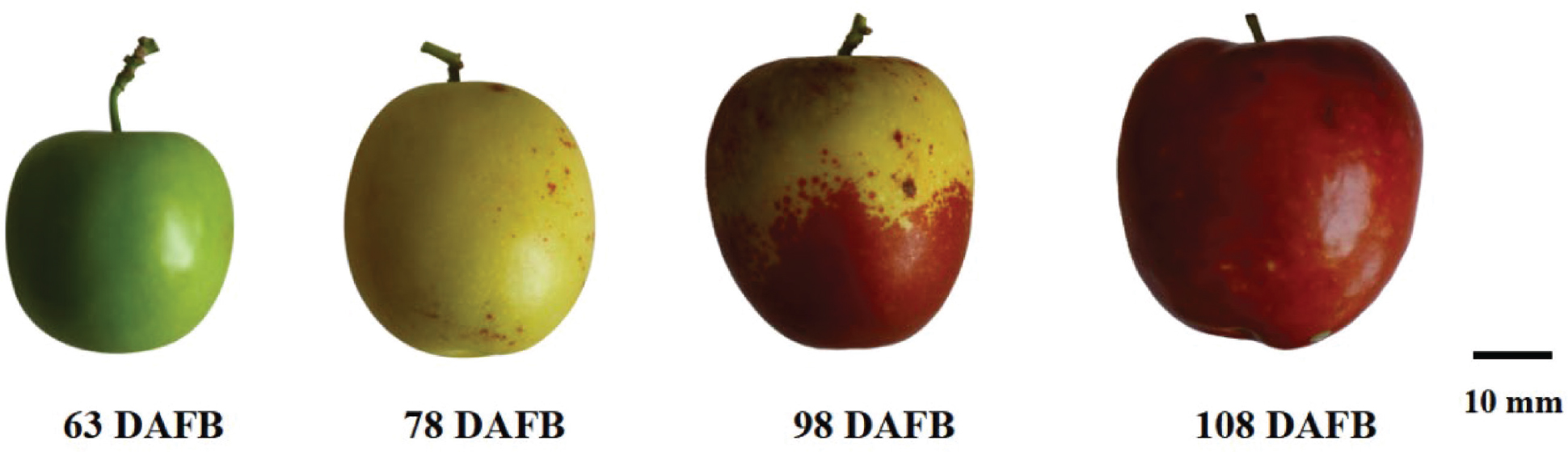
Figure 1.
Photographs of Z. jujuba cv. 'Dongzao' at four different stages of development (63 days, 78 days, 98 days, 108 days after flower blooming corresponding to the expansion stage, the FE stage, WM stage, ER stage, and FR stage, respectively). ER, early red; FE, fruit expanding; FR, full red; WM, white-mature.
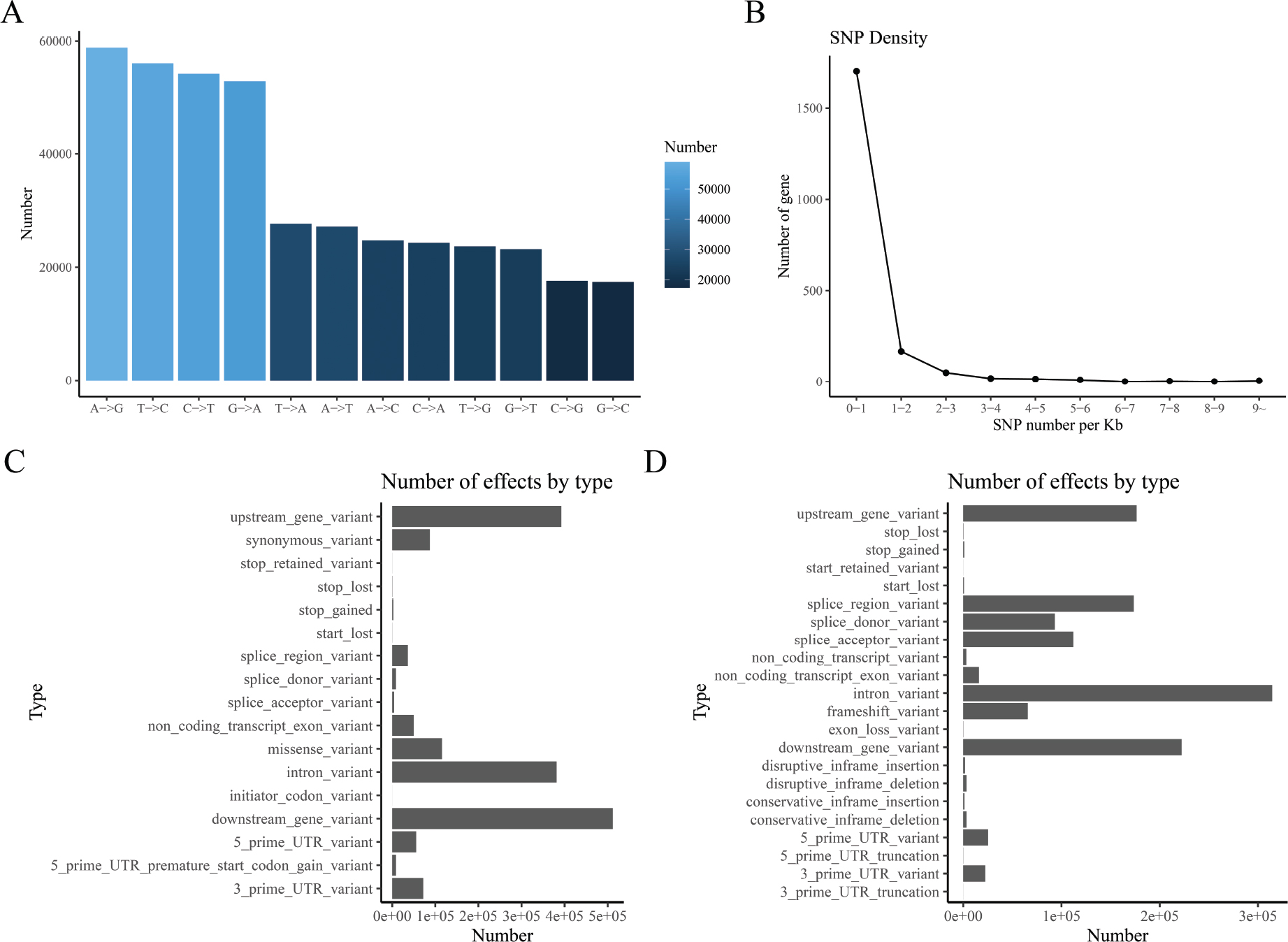
Figure 2.
Global assessment of transcriptome data. (A) Sequencing of single-base conversion types. (B) Distribution density of SNP counts, which shows the quality of transcriptome libraries. (C) SNP annotation categorisation. (D) INDEL-annotated classification. INDEL, insertion-deletion; SNP, single nucleotide polymorphism.
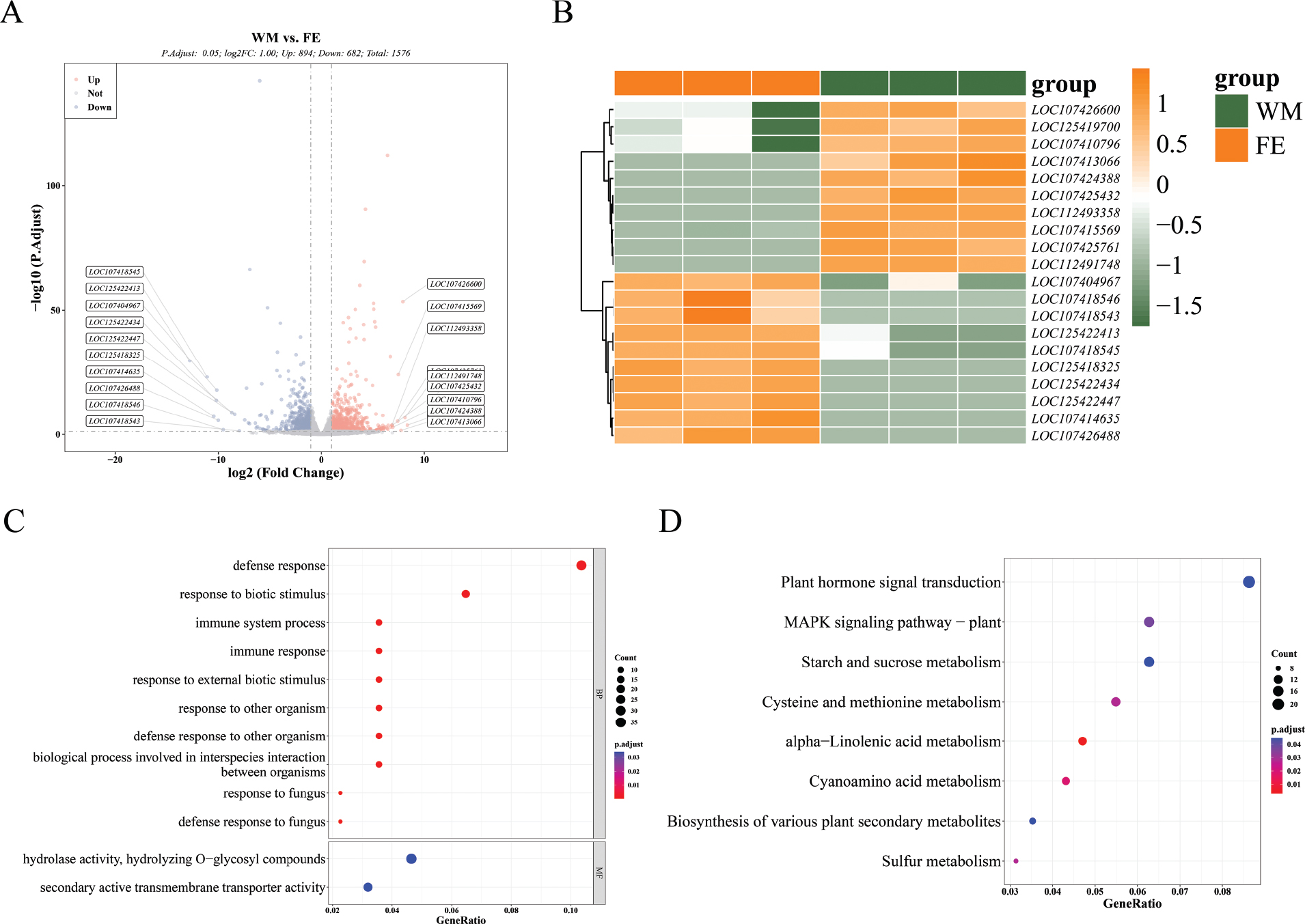
Figure 3.
Transcriptome analysis of fruit at the WM and FE stages. (A) Volcano plot showing the DEGs; the blue dots represent downregulated genes and the red dots represent upregulated genes. (B) Clustering heat maps of the top 10 DEGs, each row represents a gene and each column represents a sample, with the colour bands on the right indicating different gene expressions; the closer to yellow the higher the gene expression, the closer to green the lower the expression. (C) GO functional enrichment analysis of the genes in the FE and WM jujube groups. (D) KEGG functional enrichment analysis of the genes in the FE and WM jujube groups. DEGs, differentially expressed genes; FE, fruit expanding; GO, gene ontology; KEGG, Kyoto encyclopedia of genes and genomes; WM, white-mature.
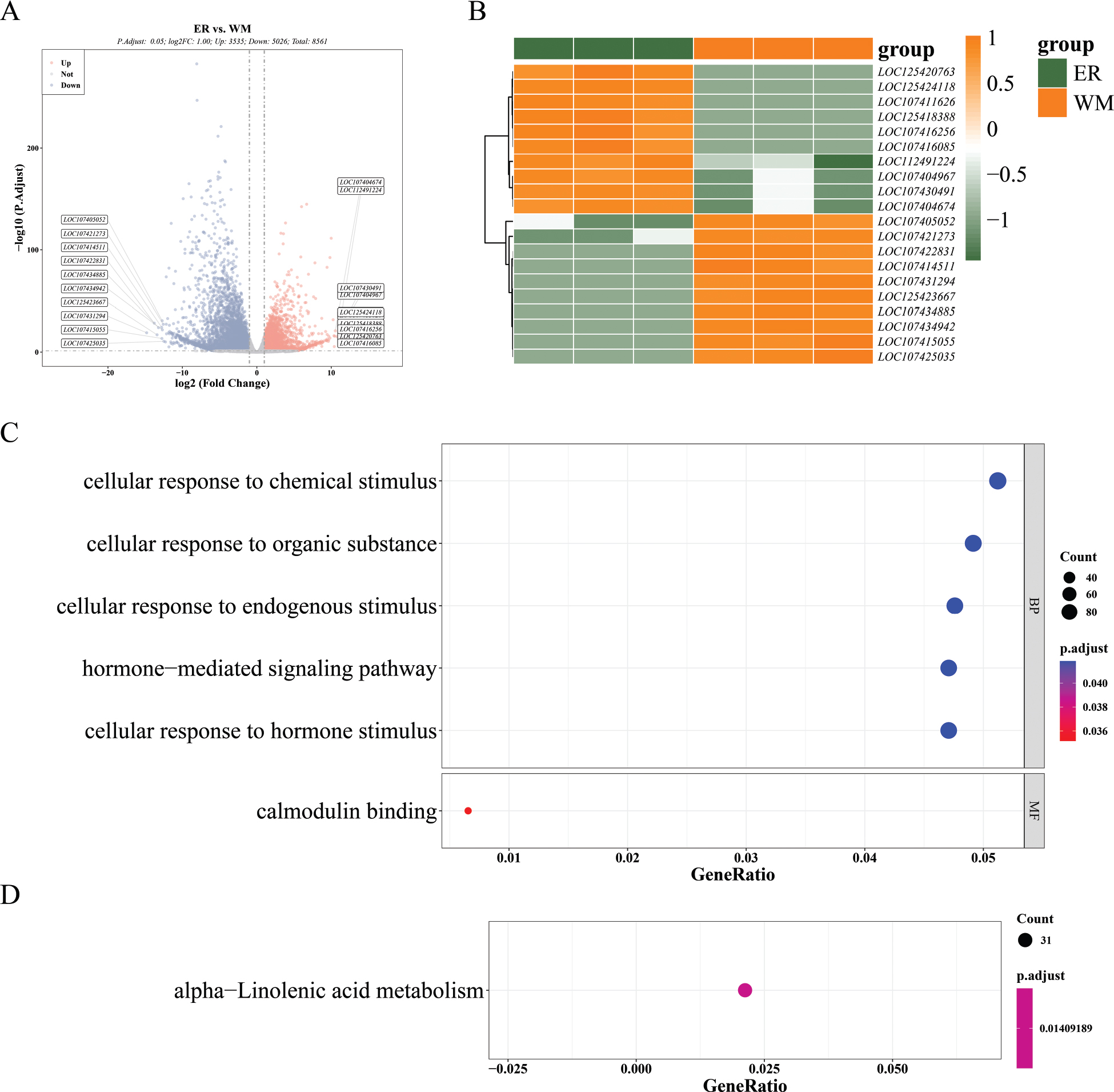
Figure 4.
Transcriptome analysis of fruit at the ER and WM stages. (A) Volcano plot demonstrating the DEGs; blue dots represent downregulated genes and the red dots represent upregulated genes. (B) Clustering heat maps of the top 10 DEGs, each row represents a gene and each column represents a sample, with the colour bands on the right indicating different gene expressions; the closer to the yellow the higher the gene expression, while the closer to the green the lower the expression. (C) GO functional enrichment analysis of genes in the WM and ER jujube groups. (D) KEGG functional enrichment analysis of genes in the WM and ER jujube groups. DEGs, differentially expressed genes; ER, early red; GO, gene ontology; KEGG, Kyoto encyclopedia of genes and genomes; WM, white-mature.
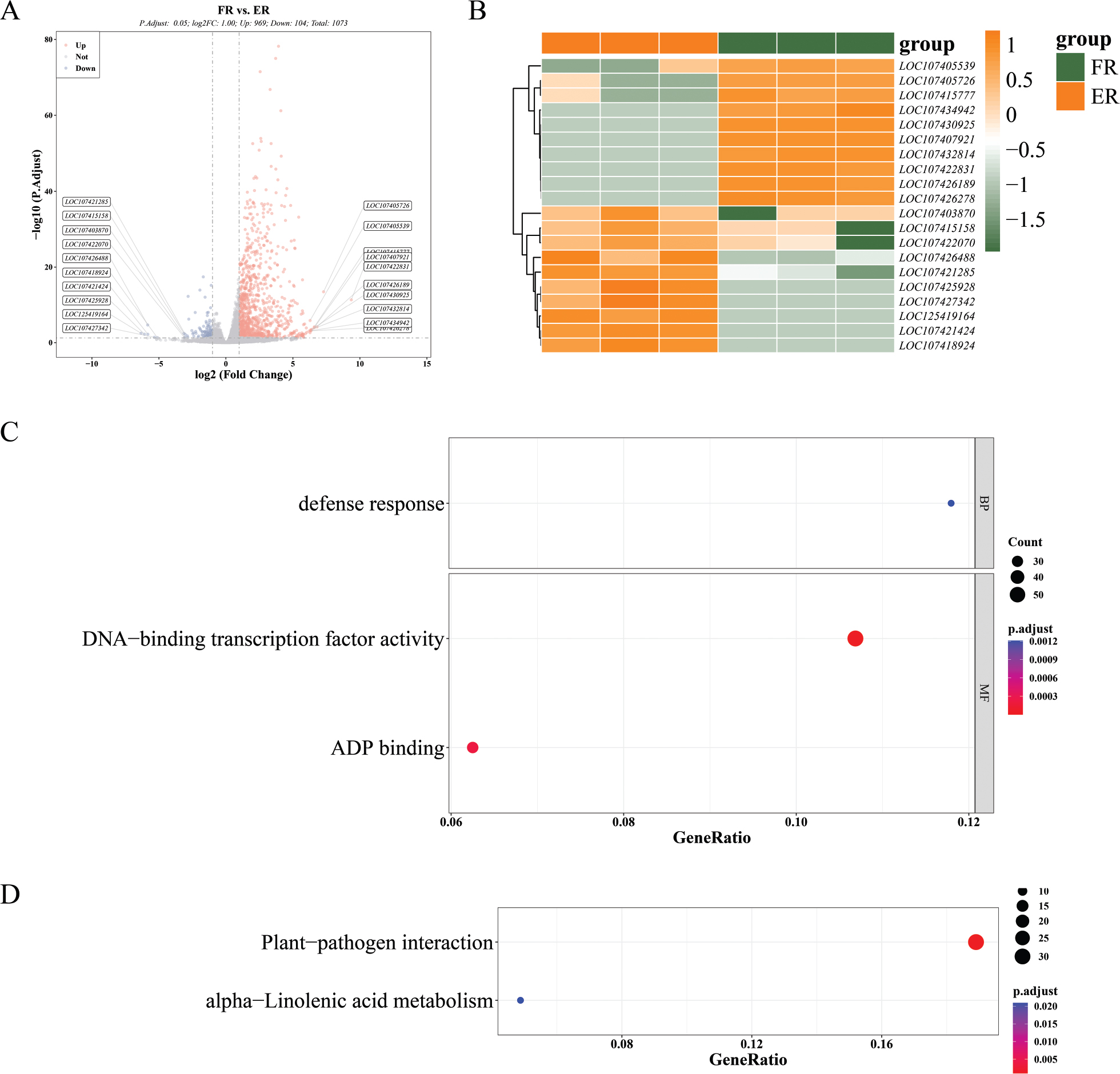
Figure 5.
Transcriptome analysis of fruit at the ER and FR stage. (A) Volcano plot showing the DEGs, the blue dots represent downregulated genes and the red dots represent upregulated genes. (B) Clustering heat maps of the top 10 DEGs, each row represents a gene and each column represents a sample, with the colour bands on the right indicating different gene expressions; the closer to the yellow the higher the gene expression, and the closer to the green the lower the expression. (C) GO functional enrichment analysis of genes in the ER and FR groups of jujuba. (D) KEGG functional enrichment analysis of genes in the ER and FR groups. DEGs, differentially expressed genes; ER, early red; FR, full red; GO, gene ontology; KEGG, Kyoto encyclopedia of genes and genomes.
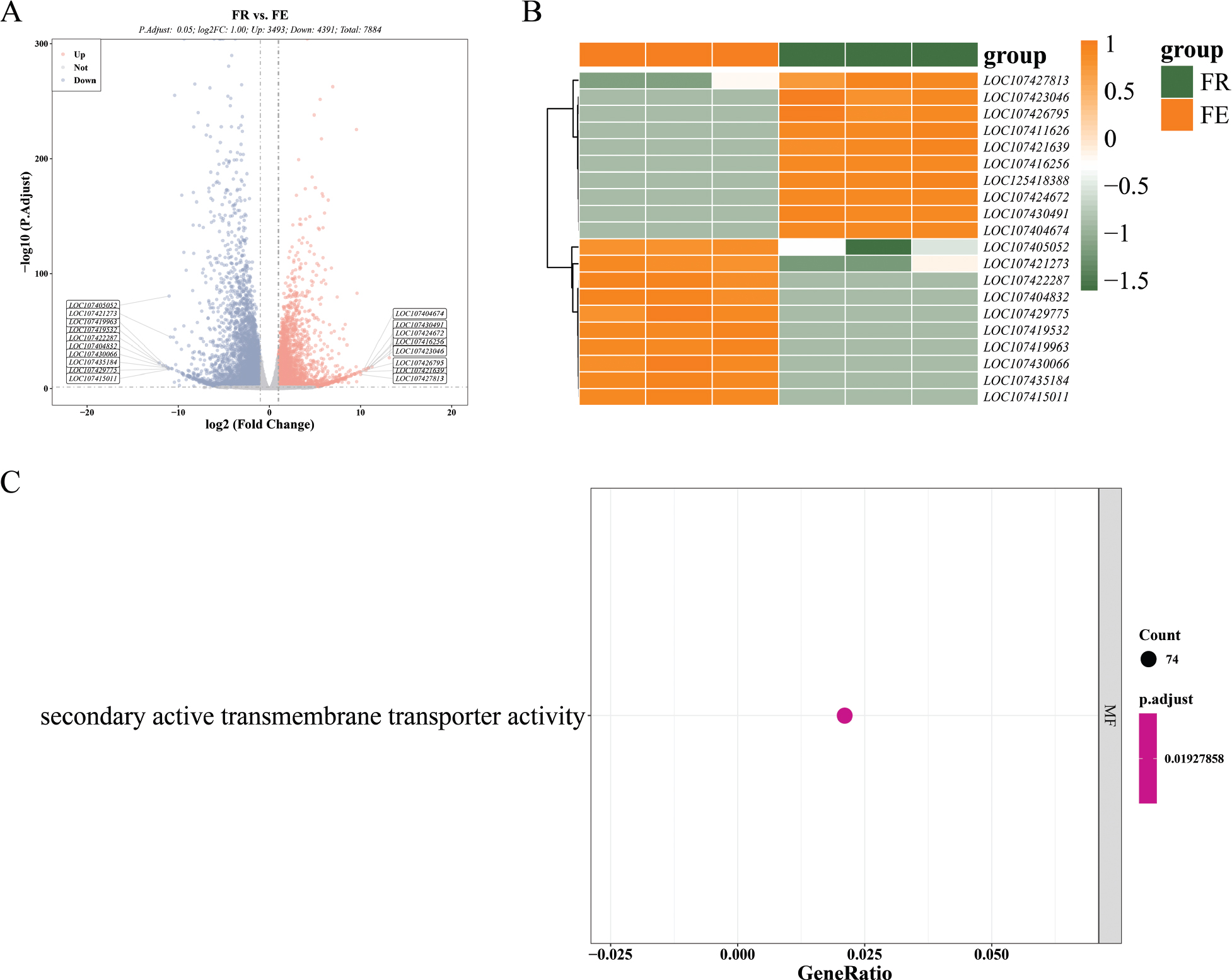
Figure 6.
Transcriptome analysis of fruit at the FE and WM stages. (A) Volcano plot indicating the DEGs; blue dots represent downregulated genes and the red dots represent upregulated genes. (B) Clustering heat maps of the top 10 DEGs, each row represents a gene and each column represents a sample, with the colour bands on the right indicating different gene expressions; the closer to the yellow the higher the gene expression, and the closer to the green the lower the expression. (C) GO functional enrichment analysis of the genes in the FE and WM jujube groups. DEGs, differentially expressed genes; FE, fruit expanding; GO, gene ontology; WM, white-mature.
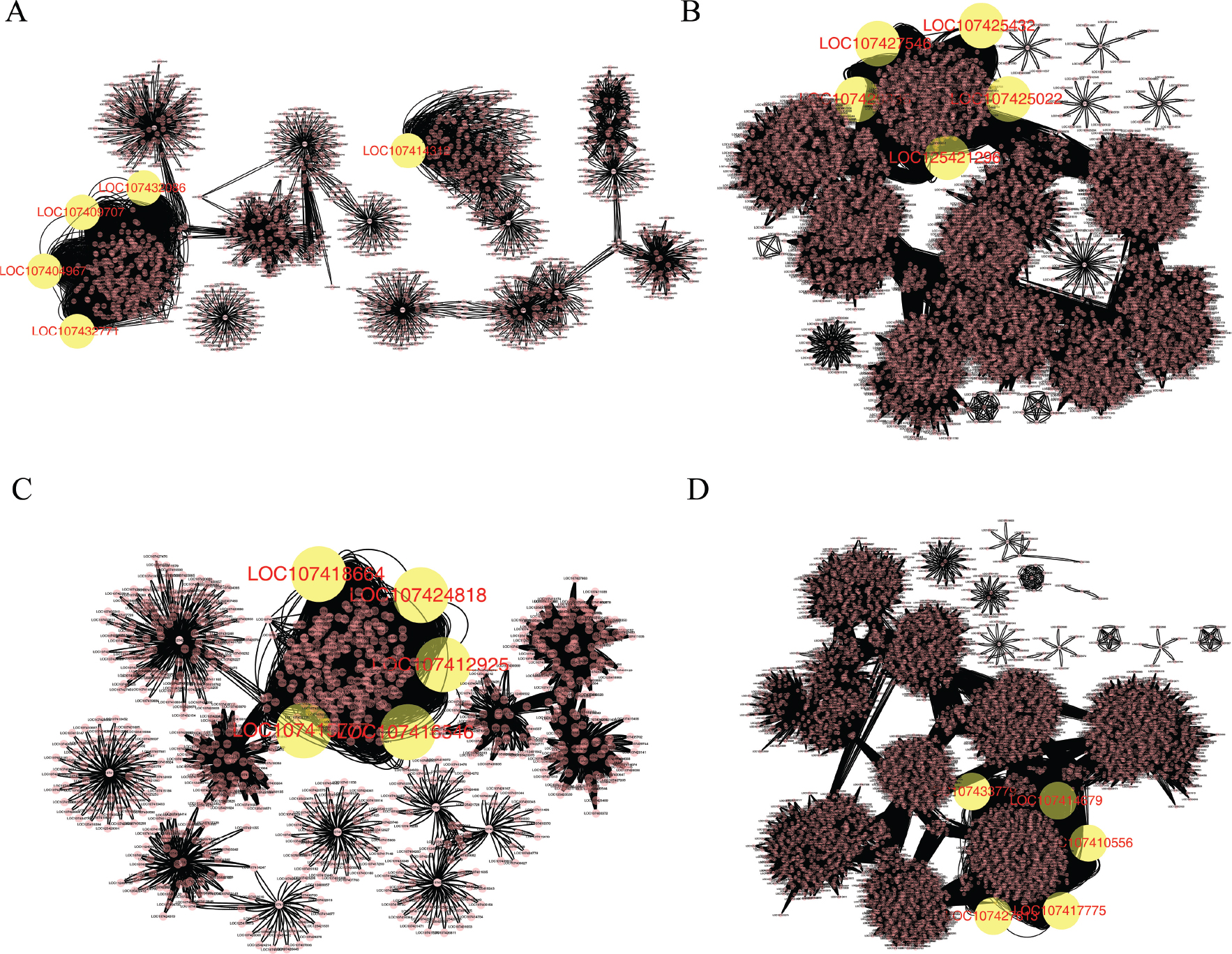
Figure 7.
Gene interaction network diagram. The pink nodes represent non-hub genes obtained, the yellow nodes represent hub genes after correlation coefficient screening and black lines indicate the presence of correlation between genes. The black line indicates the correlation between genes: (A) WM vs FE; (B) ER vs WM; (C) FR vs ER; (D) FR vs FE. ER, early red; FE, fruit expanding; FR, full red; WM, white-mature.
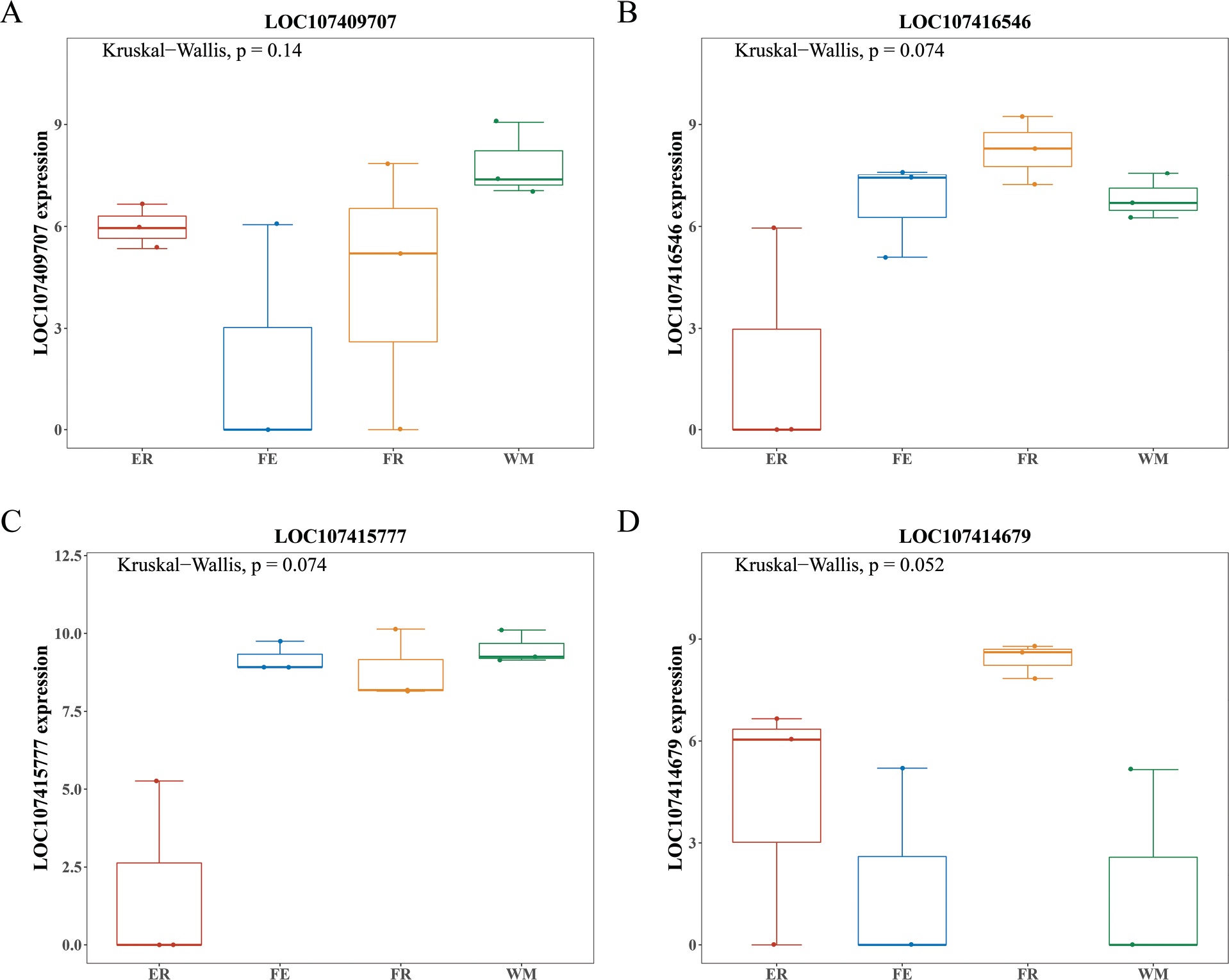
Figure 8.
Differential expression boxplot of the four hub genes. (A), LOC107409707; (B), LOC107416546; (C), LOC107415777; (D), LOC107414679.
Table S1.
The efficiency of the reads of each sample against the reference genome.
| Sample | Total Reads | Mapped Reads | Uniq Mapped Reads | Multiple Map Reads | Reads Map to ‘+’ | Reads Map to ‘-’ |
|---|---|---|---|---|---|---|
| ER1 | 34,967,790 | 28,610,083 (81.82%) | 27,551,138 (78.79%) | 1,058,945 (3.03%) | 14,885,522 (42.57%) | 15,022,253 (42.96%) |
| ER2 | 35,866,752 | 29,195,000 (81.40%) | 28,071,485 (78.27%) | 1,123,515 (3.13%) | 15,216,825 (42.43%) | 15,347,299 (42.79%) |
| ER3 | 33,722,952 | 27,256,909 (80.83%) | 26,159,026 (77.57%) | 1,097,883 (3.26%) | 14,276,092 (42.33%) | 14,408,408 (42.73%) |
| FE1 | 33,362,786 | 26,937,644 (80.74%) | 26,038,012 (78.05%) | 899,632 (2.70%) | 13,973,789 (41.88%) | 14,067,875 (42.17%) |
| FE2 | 31,701,814 | 25,501,408 (80.44%) | 24,663,212 (77.80%) | 838,196 (2.64%) | 13,186,007 (41.59%) | 13,325,312 (42.03%) |
| FE3 | 32,862,056 | 26,304,992 (80.05%) | 25,421,257 (77.36%) | 883,735 (2.69%) | 13,658,562 (41.56%) | 13,717,436 (41.74%) |
| FR1 | 36,467,944 | 29,673,467 (81.37%) | 28,546,895 (78.28%) | 1,126,572 (3.09%) | 15,467,804 (42.41%) | 15,596,106 (42.77%) |
| FR2 | 39,654,150 | 31,656,269 (79.83%) | 30,480,071 (76.86%) | 1,176,198 (2.97%) | 16,471,579 (41.54%) | 16,614,054 (41.90%) |
| FR3 | 33,872,164 | 27,548,123 (81.33%) | 26,547,492 (78.38%) | 1,000,631 (2.95%) | 14,325,410 (42.29%) | 14,444,203 (42.64%) |
| WM1 | 32,694,050 | 26,445,979 (80.89%) | 25,496,018 (77.98%) | 949,961 (2.91%) | 13,810,980 (42.24%) | 13,824,743 (42.29%) |
| WM2 | 32,516,758 | 26,331,369 (80.98%) | 25,402,482 (78.12%) | 928,887 (2.86%) | 13,708,981 (42.16%) | 13,780,517 (42.38%) |
| WM3 | 33,679,484 | 27,547,095 (81.79%) | 26,549,486 (78.83%) | 997,609 (2.96%) | 14,362,487 (42.64%) | 14,401,510 (42.76%) |
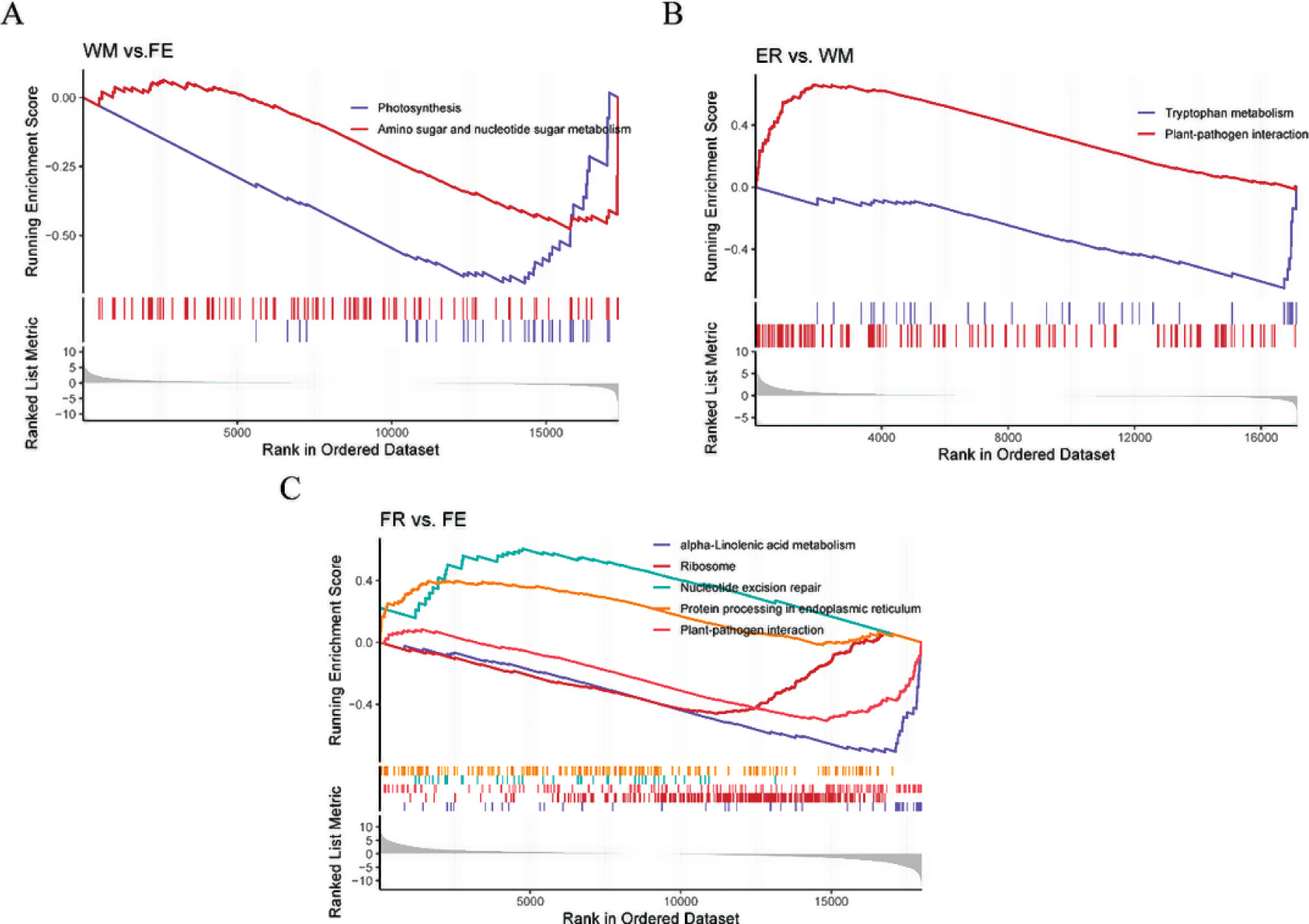
Figure S1.
GSEA functional enrichment analysis of genes. (A) the WM and FE jujube groups. (B) the ER and WM jujube groups. (C) the FR and FE jujube groups. ER, early red stage; FE, fruit expanding stage; FR, full red; WM, white-mature; GSEA, gene set enrichment analysis.