
INTRODUCTION
Among tropical fruit trees, papaya (Carica papaya L.) is a species with the greatest yield potential. Moreover, it is cultivated year-round due to the bioactive components present in its seeds, leaves and fruits, which contribute to its well-documented antioxidant, digestive and nutraceutical properties (Koul et al., 2022). The global record of 2021 reported 68 countries that produced papaya in 486161 ha, with eight countries having 74% of the cultivated area. India ranks as the first papaya producer with 146000 ha, followed by Nigeria 96038 ha, Bangladesh 34050 ha, Brazil 28495 ha, Mexico 19509 ha, Peru 13326 ha, the Democratic Republic of Congo 12454 ha and Indonesia 12279 ha. However, in total production, Mexico ranked 4th with 1134753 tons after India, Brazil and Indonesia, but with the highest unit yields than all mentioned countries (FAO, 2023). In Mexico, out of 32 states, 19 produce papaya (Siap-Sader, 2023).
Given the economic significance of papaya, the crop faces several challenges throughout its phenological stages, including various phytosanitary issues and complexities in floral biology. From an agronomic management perspective, the integration of irrigation and nutrient strategies often lacks clarity, complicating efforts to optimise production (Mahouachi and Marrero-Díaz, 2022). Moreover, planting seasons in certain regions are marked by environmental extremes (Salinas et al., 2022), further complicating the cultivation process and presenting significant challenges that must be addressed in each planting project.
To address these obstacles, research groups around the world have prioritised the development of technologies and innovations aimed at improving production efficiency and ensuring the sustainable growth of papaya. For example, identification of genes and its expression in selected transgenic papaya lines (Rogayah et al., 2014); improvement in seed production (Prakash, 2019); management practice related to papaya fruit production (Vos and Arancon, 2019); production of lateral shoots and its vegetative multiplication (Efendi and Putra, 2017); development of tissue culture protocols for in vitro propagation (Bindu and Podikunju, 2017; Ryavalad et al., 2019); plant sex identification by molecular PCR technique (Saalau et al., 2009); development of production systems of different varieties of papaya in greenhouse (Peres et al., 2011; Honoré et al., 2020a); and combination of early plant sexing by PCR discarding the initial female plants, but using them as rootstocks (Honoré et al., 2020b).
Thus, papaya grafting is helpful (Senthilkumar et al., 2016a,b). Grafting is a unique propagation technique, wherein reports indicate an increase in yield, and a reduction in tree height (Lange, 1969; Lima et al., 2010). In Malaysia, farmers replace female plants directly in the field with hermaphrodite plants, by grafting and obtaining more productive plants with low size and early harvest (Chong et al., 2008), and improvement in the absorption efficiency of nutrients P2O5 and K2O by the 'Tainung 2' genotype, grafted on wild rootstocks, favouring dry matter production (Li-Hung et al., 2004). From this perspective, papaya grafting is projected as an integrated crop management strategy. Based on the above, the objective was to evaluate the agronomic behaviour of grafted plants in two productive cycles.
MATERIALS AND METHODS
Experimental site
Two experiments were developed at the Experimental Field'Apatzingan Valley', located in Antunez, Michoacan, Mexico (19°00'31.52"N, 102°13'36.91"W), during two agricultural cycles. It is important to note that both experiments were evaluated at different times in order to address the integrated and derived matrices from the available germplasm. Additionally, the experiments were adjusted to the specific conditions of the fields where they were evaluated, particularly in terms of spacing and irrigation infrastructure, which explains their variations. During the study periods, climatic variation behaved as shown in Figure 1 and Figure 2.
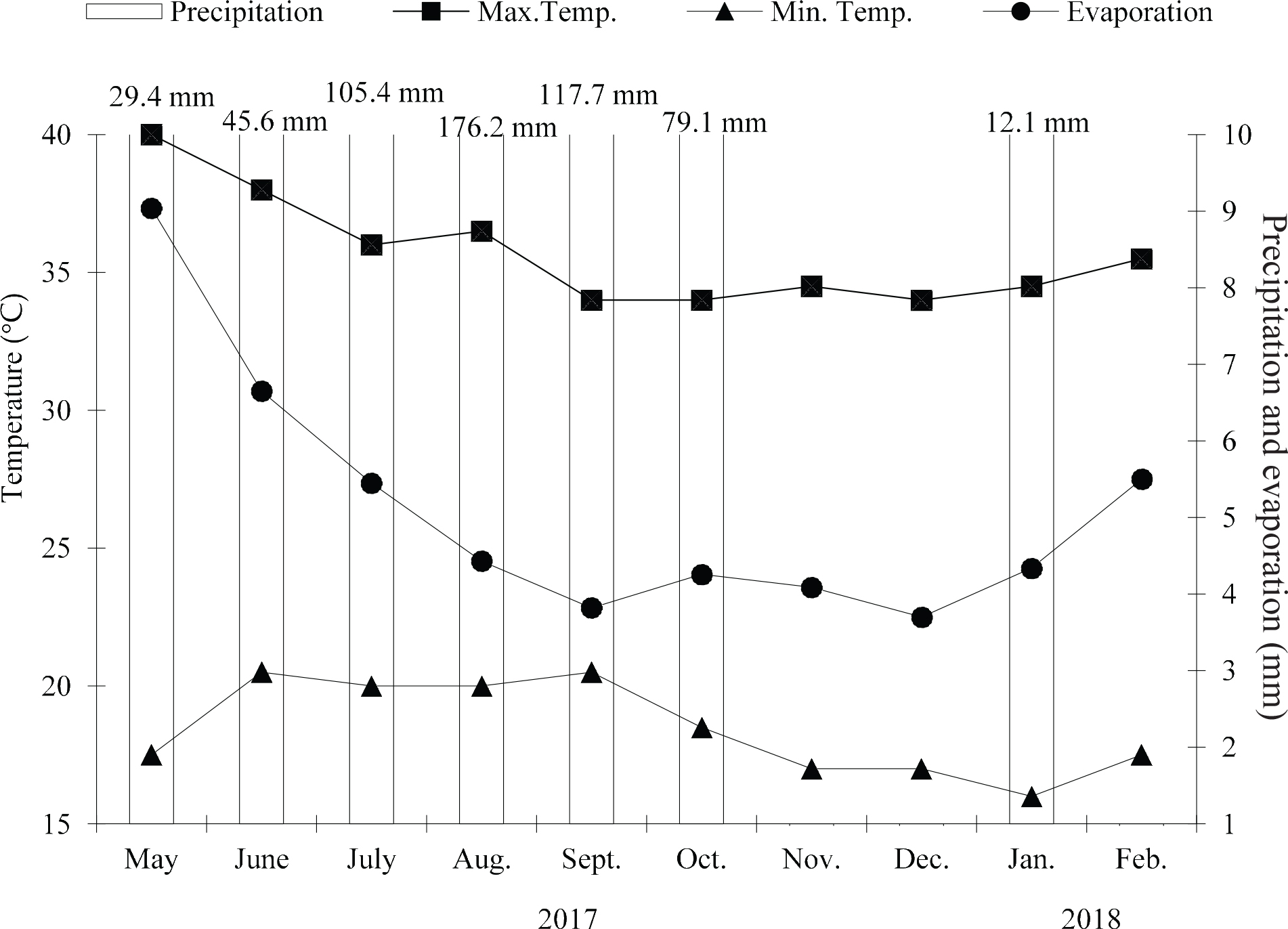
Figure 1.
Climatic variation during the 1st experiment.
Source: Department of Hydrometry. Irrigation District 097. CONAGUA. Mexico. Temperature range for papaya 21°C–33°C.
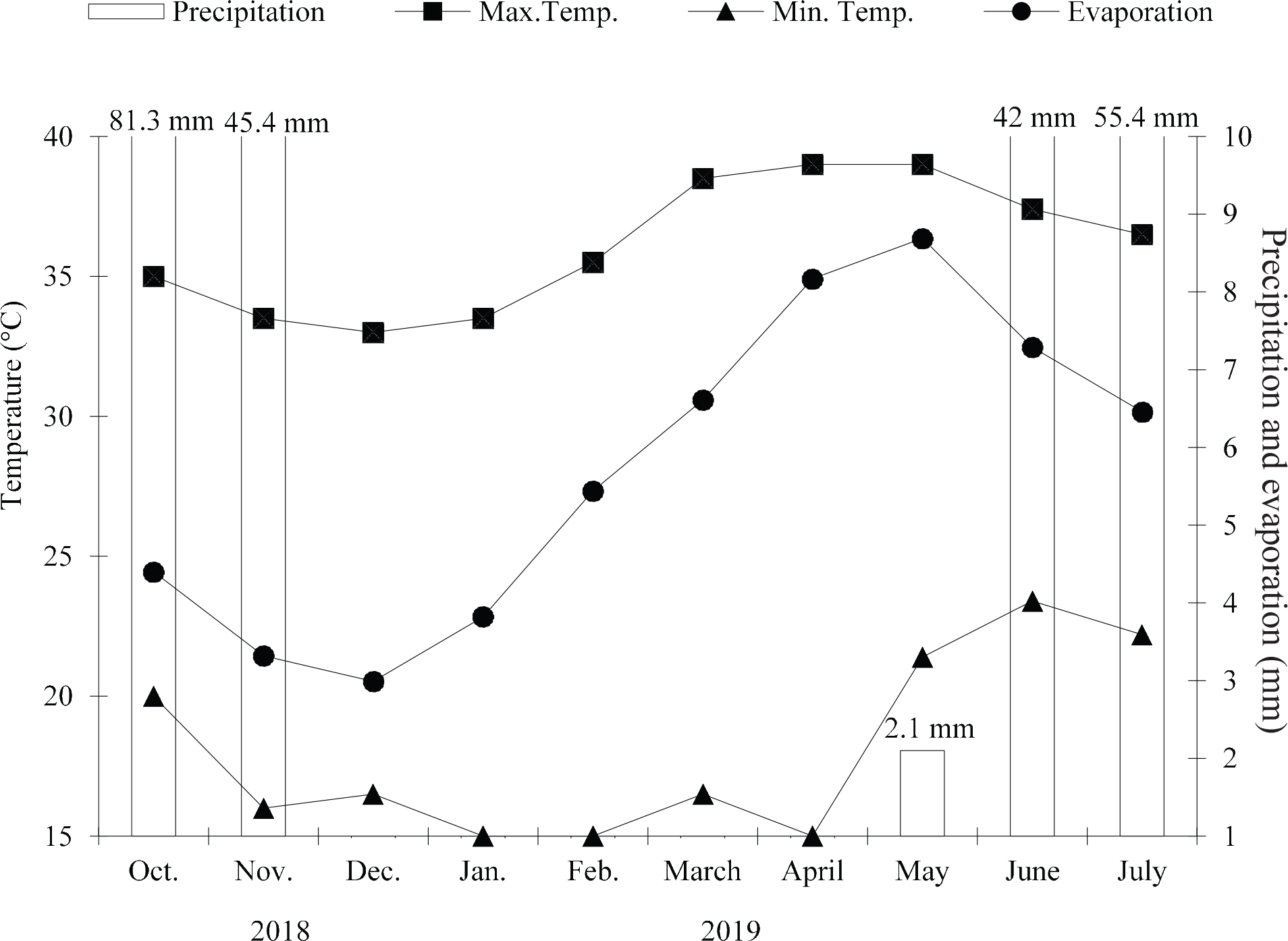
Figure 2.
Climatic variation during the 2nd experiment.
Source: Department of Hydrometry. Irrigation District 097. CONAGUA. Mexico. Temperature range for papaya 21°C–33°C.
Seedbed conditioning
In the nursery, papaya seeds for rootstocks and scions were sown in transparent plastic bags 7.8 × 12.4 cm, filled with Growing Mix IVM substrate (Canadian Sphagnum Peat Moss). Water was supplied daily. Ammonium sulphate fertiliser and carbendazim fungicide were added alternately every 3 days, both at a dose of 1% of the volume of water for up to 35 days. During this period, seedlings presented adequate size and stem diameter to perform the grafting operation. The method used was modified approach grafting (Alvarez-Hernandez et al., 2019). It is important to mention that the seedlings developed for both control and grafted treatments, and later transplanted to the field, were not differentiated by sex. As a result, their floral expression followed the natural sex ratio characteristic of this species, which was 66% hermaphrodite and 33% female. There were no males.
Plant materials and experimental design
Two experiments were performed in pelic vertisol soil (Table 1). For Experiment 1, genotypes of papaya 'Gibara' (G), BS (BS), 'Maradol' (M), 'MSXJ' (MS), 'Maradona' (Ma) and 'BS2' (BS2) served as Rootstocks (R) and Scion (S). Some genotypes were used as controls or non-grafted (Ng). In Experiment 2, four advanced lines or genotypes of papaya were used as rootstocks, named 'Robusta' with quality (RQ+), Robusta without quality (RQ-), Wild purple petiole (WPP) and Wild green petiole (WGP); and two genotypes were used as Scion (S), 'Tainung' (T) and 'Maradol' (M) and nongrafted as controls (Ng). The treatments were arranged in a randomised complete block experimental design. Each treatment consisted of 25 plants, of which, five replicates were taken for data recording and analysis.
Table 1.
Treatments evaluated in two grafted papaya field experiments.
| Experiment 1 | Experiment 2 | ||
|---|---|---|---|
| Rootstock × Scion | Abbreviation | Rootstock × Scion | Abbreviation |
| 1. 'Gibara' × 'BS' | RG × SBS | 1. 'Robusta' with quality × 'Tainung' | RRQ+ × ST |
| 2. 'BS' × 'Gibara' | RBS × SG | 2. 'Robusta' without quality × 'Tainung' | RRQ-× ST |
| 3. 'Maradol' × 'MSXJ' | RM × SMS | 3. WGP ×, Tainung' | RWGP × ST |
| 4. 'MSXJ' × 'Maradona' | RMS × SMa | 4. WPP × 'Tainung' | RWPP × ST |
| 5. 'BS2' × 'Maradol' | RBS2 × SM | 5. 'Robusta' with quality × 'Maradol' | RRQ+ × SM |
| 6. 'BS2' × 'Gibara' | RBS2 × SG | 6. 'Robusta' without quality × 'Maradol' | RRQ-× SM |
| 7. Non-grafted 'BS' | NgBS | 7. WGP × 'Maradol' | RWGP × SM |
| 8. Non-grafted 'Gibara' | NgG | 8. WPP × 'Maradol' | RWPP × SM |
| 9. Non-grafted 'Maradol' | NgM | 9. Non-grafted 'Tainung' | NgT |
| 10. Non-grafted 'Maradona' | NgMa | 10. Non-grafted 'Maradol' | NgM |
Field preparation
Soil was prepared by conventional tillage and formation of planting beds with expected distances of 2.8 m. The distance between plants was 1.6 m. At the bed centre, double drip lines were placed, with drippers spaced at 0.2 m and emitted flow of 0.7 L · h–1 per dripper. The density was 2232 plants · ha–1.
Experiments management
The agronomic management of the experiments was based on the recommended cultural practices of crop; irrigation was provided daily, according to the needs of the crop, but generally it was between 2 hr and 3 hr (Vazquez et al., 2010). Fertilisation was adjusted to the progress of each phenological stage, and the nutrients dosage was injected through the irrigation water flow weekly, varying the amounts in solution without >4% concentration. The total ratio was adjusted to 1.5:1:2 N:P2O5:K2O ratio, and foliar applications of microelements. A phytosanitary management programme for pests, diseases and weeds was implemented, based on weekly monitoring and preventive applications, mainly with chemical products.
Crop assessment and data analysis
The variables were recorded at 256 days and 242 days after transplanting in Experiments 1 and 2, respectively. A single measurement was recorded in the height to first fruit. In the heights in plant and first fruit, a flexometer from the ground was used for the stem girth, and the polar and equatorial circumference of fruits, encircling surfaces with a measuring tape. The leaves and fruits number, through visual counting; pulp width, with a graduated ruler recorded length at middle base of fruit; soluble solids of fruit with a manual refractometer (Hanna Model HI 96801, USA); fruit shape index was obtained by dividing fruit circumferences; fruit weight and yield were estimated with a digital scale (Denver Instrument Company Model AA-160, USA). Data obtained were analysed with statistical program SAS (2009), through analysis of variance using GLM procedure and means comparison by Tukey’s test (p = 0.05).
RESULTS
First experiment
The statistical analysis of the first experiment showed significant differences in plant height, the treatments with the greatest heights for NgBS and RM × SMS with heights >230 cm, while the smallest plant heights were found in RBS × SG and NgM with values slightly >200 cm. Although it is desirable that materials present low heights to facilitate harvesting, some treatments such as NgG and NgBS reduced their normal height when compared with grafted treatments. Some other non-grafted treatments had the opposite behaviour when compared with its grafted treatments; however, it is important to remark that a combination of rootstock and scion came from commercial materials (Table 2). In stem girth and the leaf number variables, it was observed that grafted treatments are thicker than nongrafted treatments, with the exception of NgBS and NgG treatments, but these two materials are usually of robust structure. The height at first fruit showed variation between grafted and non-grafted treatments, the latter being lower in height (Table 2).
Table 2.
Morphological variables of grafted and non-grafted papaya plants in 1st experiment.
| Treatments | Plant height (cm) | Stem girth (cm) | Leaves (No.) | Height at 1st fruit (cm) |
|---|---|---|---|---|
| RG × SBS | 213.40 cd | 49.50 ab | 38.00 ab | 73.80 a |
| RBS × SG | 200.60 d | 51.40 ab | 40.60 a | 69.80 ab |
| RM × SMS | 233.80 ab | 47.04 abc | 37.00 ab | 67.80 ab |
| RMS × SMa | 221.40 abc | 52.80 a | 40.00 ab | 69.20 ab |
| RBS2 × SM | 211.40 cd | 48.64 ab | 36.20 ab | 69.40 ab |
| RBS2 × SG | 223.00 abc | 45.38 bc | 35.60 ab | 72.40 a |
| NgBS | 236.40 a | 49.14 ab | 39.00 ab | 68.20 ab |
| NgG | 211.40 cd | 48.38 ab | 38.20 ab | 72.40 a |
| NgM | 204.40 cd | 41.32 c | 34.80 ab | 56.80 b |
| NgMa | 215.80 bcd | 41.20 c | 33.20 b | 65.40 ab |
| C.V. | 4.15 | 6.95 | 8.80 | 8.97 |
| p | ** | ** | ** | ** |
For the qualitative variables of fruits, in the first experiment, the statistical analyses showed no significant differences between treatments. This meant that fruits were not influenced by grafting effect when compared with non-grafted plants (Table 3). These values are considered as normal, due to the present characteristics of genotypes. Fruit size, referenced by the shape index, presented values between 1.42 and 1.62. Soluble solids were acceptable, indicating sweetness of the pulp (Table 3).
Table 3.
Qualitative variables in fruits of grafted and non-grafted papaya plants in 1st experiment.
| Treatments | Fruit circumference (cm) | Pulp width (cm) | Soluble solids (°Brix) | Fruit shape index | |
|---|---|---|---|---|---|
| Polar | Equatorial | ||||
| RG × SBS | 52.80 | 37.60 | 2.60 | 12.20 | 1.42 |
| RBS × SG | 54.40 | 36.40 | 2.72 | 11.60 | 1.51 |
| RM × SMS | 47.60 | 33.60 | 2.76 | 13.40 | 1.62 |
| RMS × SMa | 54.00 | 38.00 | 2.70 | 12.60 | 1.46 |
| RBS2 × SM | 54.00 | 36.80 | 2.62 | 13.60 | 1.43 |
| RBS2 × SG | 54.40 | 33.20 | 2.52 | 12.40 | 1.61 |
| NgBS | 52.60 | 35.00 | 2.60 | 12.60 | 1.51 |
| NgG | 54.20 | 35.20 | 2.60 | 12.60 | 1.56 |
| NgM | 52.60 | 34.40 | 2.66 | 12.60 | 1.53 |
| NgMa | 53.40 | 35.40 | 2.72 | 12.80 | 1.52 |
| C.V. | 12.91 | 12.27 | 11.64 | 12.66 | 18.02 |
| p | ns | ns | ns | ns | ns |
The variables related to productivity, except for fruit weight, showed significant statistical differences (Table 4). As shown in the fruit numbers variable, the treatments RM × SMS, RMS × SMa and RBS2 × SG produced a higher number of fruits per plant. Moreover, in yield per plant and yield per area variables, treatments RMS × SMa and RBS2 × SM yielded more, >40 kg · plant–1 and almost 9 kg · m–2, respectively. In addition, based on the general results, grafted plants showed higher fruit productivity than the non-grafted plants (Table 4).
Table 4.
Quantitative variables in fruits of grafted and non-grafted papaya plants in 1st experiment.
| Treatments | Fruits (No.) | Fruits weight (kg) | Yield (kg) | |
|---|---|---|---|---|
| Plant | Area (m2) | |||
| RG × SBS | 33.60 abc | 1.15 | 38.49 ab | 8.55 ab |
| RBS × SG | 34.20 ab | 1.18 | 39.67 ab | 8.81 ab |
| RM × SMS | 35.60 a | 1.10 | 39.44 ab | 8.76 ab |
| RMS × SMa | 35.40 a | 1.13 | 40.20 a | 8.93 a |
| RBS2 × SM | 33.60 abc | 1.17 | 40.01 ab | 8.89 a |
| RBS2 × SG | 36.80 a | 1.08 | 37.66 ab | 8.69 ab |
| NgBS | 28.80 abc | 1.09 | 31.38 ab | 6.96 ab |
| NgG | 27.00 bc | 1.11 | 30.12 ab | 6.69 ab |
| NgM | 25.60 c | 1.06 | 27.04 b | 6.01 b |
| NgMa | 25.60 c | 1.15 | 29.29 ab | 6.50 ab |
| C.V. | 12.45 | 12.44 | 19.05 | 18.53 |
| p | ** | ns | ** | ** |
Second experiment
In the second experiment, statistical analysis of the morphological variables showed significant differences (Table 5); like observed, the treatments that major development showed were mainly RWPP × ST and RRQ-× ST. By contrast, the treatments RRQ+ × SM and RSGP × SM were the lowest in plant height, although this condition is desirable. With respect to stem girth, the treatments RSPP × ST, RRQ-× ST and RWGP × SM presented the greatest stem thickness. The leaf number variable was similar to the stem girth variable; the treatments RWPP × ST, RRQ-× SM and RRQ-× ST had the highest leaf numbers per plant. In the height at first fruit variable, the treatment RRQ+ × SM had the lowest height, which is desirable. In fact, in this last variable the preference is that the fruits appear at the lowest possible height (Table 5).
Table 5.
Morphological variables of grafted and non-grafted papaya plants in 2nd experiment.
| Treatments | Plant height (cm) | Stem girth (cm) | Leaves (No.) | Height at 1st fruit (cm) |
|---|---|---|---|---|
| RRQ+ × ST | 247.40 abc | 48.72 ab | 39.60 bc | 91.20 ab |
| RRQ-× ST | 263.20 ab | 49.84 ab | 47.60 a | 95.20 ab |
| RWGP × ST | 231.00 bcd | 48.16 ab | 36.80 c | 96.20 ab |
| RWPP × ST | 283.40 a | 50.68 a | 43.20 abc | 104.00 a |
| RRQ+ × SM | 189.40 d | 45.24 ab | 37.20 c | 52.80 d |
| RRC-× SM | 231.20 bcd | 47.60 ab | 46.20 ab | 61.20 cd |
| RWGP × SM | 195.80 d | 43.96 ab | 37.80 c | 63.00 cd |
| RWGP × SM | 208.00 cd | 49.84 ab | 36.60 bc | 62.40 cd |
| NgT | 260.80 ab | 45.64 ab | 39.60 bc | 80.60 bc |
| NgM | 207.40 cd | 41.72 b | 38.40 c | 62.00 cd |
| C.V. | 8.79 | 8.37 | 9.00 | 13.77 |
| p | ** | ** | ** | ** |
Otherwise, in the statistical analysis of the qualitative variables of fruits in the second experiment, only the soluble solids variable showed significant differences. As seen, the fruits of grafted and non-grafted treatments were sweet. Although in some cases, the 'Robusta' rootstocks with and without quality were slightly superior in sweetness compared with the wild papaya rootstocks, but even so, all treatments were acceptable. In relation to the fruit size, the flesh width and the shape index variables, the values obtained were very stable, suggesting qualitative stability regardless of grafting (Table 6).
Table 6.
Qualitative variables in fruits of grafted and non-grafted papaya plants in 2nd experiment.
| Treatments | Fruit circumference (cm) | Pulp width (cm) | Soluble solids (°Brix) | Fruit shape index | |
|---|---|---|---|---|---|
| Polar | Equatorial | ||||
| RRQ+ × ST | 54.80 | 34.60 | 2.76 | 12.20 ab | 1.60 |
| RRQ– #x00D7; ST | 49.80 | 37.20 | 2.38 | 13.60 a | 1.35 |
| RWGP × ST | 48.00 | 37.60 | 2.60 | 12.00 ab | 1.28 |
| RWPP × ST | 53.80 | 36.40 | 2.80 | 11.80 ab | 1.49 |
| RRQ+ × SM | 50.80 | 38.00 | 2.58 | 13.20 ab | 1.24 |
| RRC– × SM | 49.80 | 35.40 | 2.62 | 13.80 a | 1.41 |
| RWGP × SM | 57.20 | 35.20 | 2.64 | 12.60 ab | 1.63 |
| RWGP × SM | 49.80 | 37.80 | 2.76 | 10.60 b | 1.32 |
| NgT | 53.60 | 36.20 | 2.66 | 12.20 ab | 1.52 |
| NgM | 54.60 | 34.60 | 2.68 | 13.20 ab | 1.60 |
| C.V. | 10.27 | 10.39 | 14.35 | 11.08 | 14.82 |
| p | ns | ns | ns | * | * |
In the productivity, the statistical analyses showed significant differences in fruits number per plant, yield per plant and yield per area variables (Table 7). The treatments RRQ-× ST and RRQ-× SM produced significantly more fruit per plant. The rest of grafted plant treatments also excelled, and overall surpassed NgT and NgM treatments. Moreover, in the yield per plant and the yield per area, the RRQ+ × SM treatment was superior to all treatments, with 38.39 kg · plant–1 and 8.53 kg · m–2, respectively. Similarly, the yield was lower in non-grafted plant treatments compared with grafted plant treatments (Table 7).
Table 7.
Qualitative variables in fruits of grafted and non-grafted papaya plants in 2nd experiment.
| Treatments | Fruits (No.) | Fruits weight (kg) | Yield (kg) | |
|---|---|---|---|---|
| Plant | Area (m2) | |||
| RRQ+ × ST | 28.80 abc | 1.21 | 34.45 abc | 7.65 abc |
| RRQ-× ST | 35.40 a | 1.03 | 35.63 ab | 7.91 ab |
| RWGP × ST | 34.40 ab | 1.04 | 35.54 ab | 7.89 ab |
| RWPP × ST | 27.80 abc | 1.23 | 33.70 abc | 7.48 abc |
| RRQ+ × SM | 34.40 ab | 1.13 | 38.39 a | 8.53 a |
| RRC-× SM | 37.60 a | 1.03 | 37.02 ab | 8.22 ab |
| RWGP × SM | 29.00 abc | 1.15 | 32.96 abc | 7.32 abc |
| RWGP × SM | 32.00 abc | 1.11 | 35.53 ab | 7.89 ab |
| NgT | 25.20 bc | 1.17 | 28.96 bc | 6.43 bc |
| NgM | 22.60 c | 1.18 | 26.36 c | 5.85 c |
| CV | 15.03 | 17.09 | 11.55 | 11.54 |
| p | ** | ns | ** | ** |
DISCUSSION
Globally, papaya production depends on sexual propagation (Efendi and Putra, 2017). However, constant exploitation of seeds used gradually lose their qualities and productive characteristics that are originally expressed (Bindu and Podikunju, 2017), this being due to phytosanitary pressure of producing areas, as well as nutritional, physiological problems and its complex floral biology. In view of this, grafting has been integrated into the papaya production system, since the results are encouraging (Honoré et al., 2020b). In addition to maintaining the characteristics of the mother plant, increase in fruit set, fruit emission at a lower height and longer production cycle are produced, compared with the traditional production system (Senthilkumar et al., 2016a,b). This behaviour was confirmed in the present study, as the treatments evaluated in both experiments showed improvement trends in morphological variables, stability in qualitative variables and increase in productive variables.
In relation to the morphological variables, in the first experiment, plant height and stem girth showed small variations, and grafted plants behaved similarly to non-grafted plants (Table 2 and Table 5). However, in the second experiment, these variations were more evident, due to a reduction of about 20 cm in plant height in grafted plants compared with non-grafted plants; and between 2 cm and 5 cm increases in stem girth in grafted plants compared with non-grafted plants. VanHong et al. (2018) reported similar behaviour in the genotype 'Tainung 2', whose grafted plants showed plant size reduction. In addition, Senthilkumar et al. (2016a,b) observed increases in stem girth at early developmental stages in grafted 'Co.2' and '9-1(D)' genotypes. It is important to note that the genotypes evaluated were low and high bearing, particularly bearing high materials; height was influenced by grafting, which in turn, also influenced the height to the first fruit. In fact, this effect has already been reported (Lima et al., 2010). Thus, the use of grafted plants tends to increase or reduce plant height and stem girth. Recently, Salinas et al. (2023), compared papaya plants of genotype 'Alicia', whose origin is from seed, grafted and in vitro propagated plants, where it was reflected that the environmental cycle influences the rate of development, that is, the winter period tended to decrease growth, compared with the autumn period. However, grafted plants exceeded by 15% the plant height at 14 months after planting in plants propagated by seed and in vitro propagated plants. This trend was reflected in the stem girth, which reflects a behaviour similar to that reported in the present study.
An important aspect to highlight is the plant canopy. Grafted treatments showed greater leaf count compared with non-grafted plants. Beyond the effects of grafting, other synchronised factors may also influence morphological traits such as stem and root thickness. According to Salinas et al. (2023), grafted 'Alicia' genotypes exhibited increased plant height from the ground to the head and from the ground to the top of the canopy compared with seedlings and in vitro papayas. Furthermore, grafted papayas had higher root density and dry weight. However, it is essential to consider that the rootstocks must possess adequate rusticity (Chong et al., 2008).
With respect to the qualitative fruit variables, results seem to support the fact that grafting does not have a decisive influence on the fruit size, flesh width and fruit shape index variables (Table 3 and Table 6). Meanwhile, the soluble solids presented variation, particularly in the second experiment. This condition was reported in 'Tainung', 'Golden' and 'Solo Sunrise' genotypes, evaluated in two cycles with different environmental conditions, where grafting did not interfere with fruit development (Lima et al., 2018). However, changes in the qualitative attributes of fruits such as the soluble solids, titratable acidity, vitamin C, among others, have been reported, when physicochemical changes occur in soils and weather conditions (Yamanishi et al., 2006). For its part, Salinas et al. (2023) report that in grafted plants 'Alicia' genotypes lower sweetness, even <10°Brix, which is the minimum value for the commercialisation of the fruit, on grafted, in vitro propagated plants and seedling plants.
In the productive variables, the fruit weight showed a behaviour similar to the qualitative variables, because grafting had no influence, so it remained the same in grafted and non-grafted treatments in both experiments. The average fruit weight was 1.12 kg, the average polar circumference was 52.61 cm and the average equatorial circumference was 35.93 cm. Some reports of genotypes evaluate, although non-grafting reflects heavier fruits. In 'Gibara' genotype, fruit weight is 2.9 kg, polar circumference 30.5 cm and equatorial circumference 17.5 cm; 'Maradol' genotype fruit weight is 2.9 kg, polar circumference 26.5 cm and equatorial circumference 13 cm; 'MSXJ' genotype fruit weight is 1.73 kg, polar circumference 26 cm and equatorial circumference 12.9 cm (Santamaría et al., 2015). On the contrary, Bibiano-Nava et al. (2021) report fruit weight for the 'Maradol' genotype at 0.748 kg and 1.44 kg for the 'Maradona' genotype, in non-grafting plants under organic management, which is similar to the result obtained at 1.06 kg · fruit–1 in the 'Maradol' genotype and 1.15 kg · fruit–1 in the 'Maradona' genotype. However, the fruit numbers per plant recorded 23%-26% in all treatments grafted over non-grafted treatments. This represented higher yields of 25% and 21% in two evaluations, respectively. Thus, it was possible to obtain 2 kg · m–2 more fruit yield over non-grafted plants; this makes it possible to increase the levels of productivity and competitiveness. According to Lima et al. (2010), when comparing three grafted and non-grafted papaya genotypes, the grafted plants recorded 47% higher fruit production per plant, which meant a substantial increase in yield. Salinas et al. (2023) reported similar results: in the 'Alicia' genotype, total and commercial yields were 28% and 25% higher, respectively, in plants grafted on in vitro plants; with respect to plants coming directly from seeds, they showed intermediate values. However, it is crucial to acknowledge that additional factors may influence yield, including plant sex differentiation. Growers of this fruit often favour hermaphroditic plants due to their production of elongated fruits, which are derived from elongata-type flowers. These flowers are typically associated with pear-shaped fruits containing seeds. Nonetheless, this aspect remains under further investigation (Barrantes-Santamaría et al., 2019). As could be seen, advantages of using grafted plants are much greater, since they are vigorised plants; although some studies suggest that in a controlled papaya cultivation environment, grafting could be beneficial in reducing plant vigour, thereby facilitating crop management and extending the cultivation cycle (Senthilkumar et al., 2016a,b; Salinas et al., 2023). Also, it is important to note that in this study, the selection of seedlings for grafting was indifferent between hermaphrodites and females. However, given the preference for hermaphroditic plants, further investigation is needed into the use of female plants as rootstocks, a practice employed by some research groups globally (Honoré et al., 2020a,b; Salinas et al., 2023). Therefore, this technique is projected as a strategy for the integral management of crop, productively enhancing yields per area.
CONCLUSIONS
Use of papaya grafting positively modified the morphological variables. Height was reduced in the short and tall genotypes, while stem circumference increased in most of treatments with grafted plants. The fruit quality remained similar in both grafted and nongrafted treatments. In the productive variables, although fruit weight was not influenced by the effect of grafted treatments, the fruit numbers per plant increased in grafted treatments; as well as the yield per area, which when compared with non-grafted plants, the latter exceeded in total production by 25% and 22% in both experiments, respectively.
ACKNOWLEDGEMENTS
The authors express their gratitude to the National Institute of Forestry, Agriculture and Live-stock Researches, for the facilities granted to carry out this investigation; and the National Technological of Mexico for the support granted for the development of this investigation (Project: 5841.16-P).
Notes
[17] Contributed by AUTHOR CONTRIBUTIONS
J.C.A.H., J.Z.C.R. and C.L.A.M. – designed experiments and performed analytical measurements. J.C.A.H. – performed statistical analysis. J.C.A.H., J.Z.C.R. and C.L.A.M. – equally contributed to manuscript writing.
[18] Conflicts of interest CONFLICT OF INTEREST
The authors declare that the research was conducted in the absence of any commercial or financial relationships that could be construed as a potential conflict of interest.
Abbreviations
- 2D
2 dimensional
- BS
BS
- BS2
'BS2'
- G
'Gibara'
- M
'Maradol'
- Ma
'Maradona'
- Ng
non-grafted
- MS
'MSXJ'
- R
Rootstocks
- RQ+
'Robusta' with quality
- RQ-
Robusta without quality
- S
Scion
- T
'Tainung'
- WGP
Wild green petiole
- WPP
Wild purple petiole