
INTRODUCTION
The most traded fruit in the world, bananas (Musa spp.), are an essential tropical crop with a global commerce volume of over 20 million tonnes and the world’s fifth most traded agricultural product; it is the main source of income in Asia, Latin America and Africa and a major export (Aurore et al., 2009). On the other hand, large-scale monoculture banana cropping methods combined with overuse of fertilisers can lead to nutrient imbalances, soil acidification and an increase in soil-borne diseases (Chen et al., 2018). The continuous use of monoculture and excessive fertiliser harm banana cultivation and soil quality (Fan et al., 2024).
The production of bananas and the health of the soil are negatively impacted by the prolonged usage of monoculture and the overuse of ammonium nitrogen fertiliser (Fan et al., 2024). The most serious disease that affects bananas, Fusarium oxysporum f. sp. cubense (Foc) Tropical Race 4, is the cause of Fusarium Wilt, which might be made worse by this (Gordon, 2017). The Food and Agriculture Organization of the United Nations projects that by 2028, this disease will have destroyed 160000 ha of banana crops globally, leading to a 2.8 million tonne decrease in production (Kema et al., 2021).
The banana crop is suitable for flat or slightly undulating land and deep soil, and soil conservation practices mainly require care in controlling erosion. The banana industry in Brazil thrives in sloping terrain with deep soils. In soil conservation, it is vital to implement efficient measures for controlling soil erosion (Borges and Da Silva Souza, 2004). The banana crop demands a significant amount of nutrients (NEPAR, 2019; Oliveira et al., 2022), which can have a profound impact on the soil’s edaphic microbial and invertebrate communities (Gizzi et al., 2009; Baretta et al., 2011; Cremonesi et al., 2021), as well as on nutrient and carbon cycling. In areas where bananas are cultivated near rivers, the soil’s physical properties reveal a substantial presence of clay particles that disperse readily upon contact with water. This high clay content leads to a decline in the soil’s overall quality, resulting in heightened resistance to penetration, reduced load-bearing capacity and increased susceptibility to erosion compared with forest and pasture areas (Iori et al., 2020).
Brazil’s traditional pattern of land use change begins with natural forest, progresses to pasture lands and concludes with cultivated soil. This pattern has been evaluated by its effects on soil health in different regions cultivated with sugarcane (Saccharum officinarum) (Cavalcanti et al., 2020; Cherubin et al., 2021; Bieluczyk et al., 2023). Most of the time, the results present a reduction of the soil structural quality, with adverse effects on the abundance of soil engineers (macrofauna) and a reduction in soil organic carbon (SOC) stocks (Panigrahi et al., 2021; Rondon et al., 2021; Gerke, 2022) and, consequently, in soil physical quality (Olivares et al., 2022; Silva et al., 2022; Bieluczyk et al., 2023).
Soil quality refers to the ability to function within the limits of the natural or managed system, aiming at sustaining productivity, maintaining and increasing air and water quality, and promoting the health of the animals, plants and humans (Doran and Parkin, 1994; Karlen et al., 1997). More recently, the soil quality concept has been associated with a dynamic condition to sustain life worldwide (Karlen et al., 2019), in which the soil’s health status reflects decisions related to land use and management practices adopted. According to Dias et al. (2016), land-use change (LUC) affects various global processes ranging from water energy balance to the modification of soil characteristics.
Assessing soil health must include examining its chemical, physical and biological properties and their interactions (Karlen et al., 2003). Furthermore, it is crucial to consider the influence of land use and management practices on soil health’s overall quality and sustainability when evaluating it. Understanding these factors is crucial for making informed soil conservation and agricultural production decisions. Bünemann et al. (2018) state that a fundamental part of soil health assessment is the choice of a dataset with sensitive attributes that can reflect the soil’s capability to function. For Cherubin et al. (2016a), indicators are an indirect way of assessing soil health, and they are characterised as measurable properties and processes that easily indicate variations in soil functions.
Therefore, soil quality indexes (SQIs) are essential decision tools for understanding complex information provided by various laboratory or field analyses of chemical, physical and biological indicators (Andrews et al., 2002). In this context, changes in land use and farming methods may or may not degrade the soil, and they can positively or negatively impact soil quality. Farmers are interested in cultivation methods that less impact the system’s sustainability and the environment. This study hypothesised that the LUC from secondary forest to banana crops could be sustainable, maintaining soil health, which different SQIs can verify. Thus, the aim was to determine the soil health in banana and forest systems, using indexes with distinct indexing strategies and variable datasets, and evaluate the impacts of banana crops on soil health.
MATERIAL AND METHODS
Study sites and land use systems
Three sites were chosen, located in the lower Ribeira River valley, state of São Paulo, comprising three counties: Eldorado, Registro and Sete Barras (Figure 1), and two land-use systems, banana and forest simply called banana and forest systems (Table 1). The forest is composed of the Atlantic Forest in the transitional regeneration stage, with major occurrence of Angiosperm families, such as Leguminosae, followed by Myrsinaceae, Myrtaceae, Annonaceae, Lauraceae, Rubiaceae, and Melastomataceae (Aidar et al., 2001). The soils are classified according to Food and Agriculture Organization (FAO) as Haplic Tb Eutrophic Cambisols (IUSS WORKING GROUP WRB, 2015) and as Cambissolos Háplicos Tb Eutróficos (Lepsch et al., 1999; Santos et al., 2018) with soil texture varying from clay loam to clay. Complementary information about sites, soil and banana management characteristics can be found in Cremonesi et al. (2021).
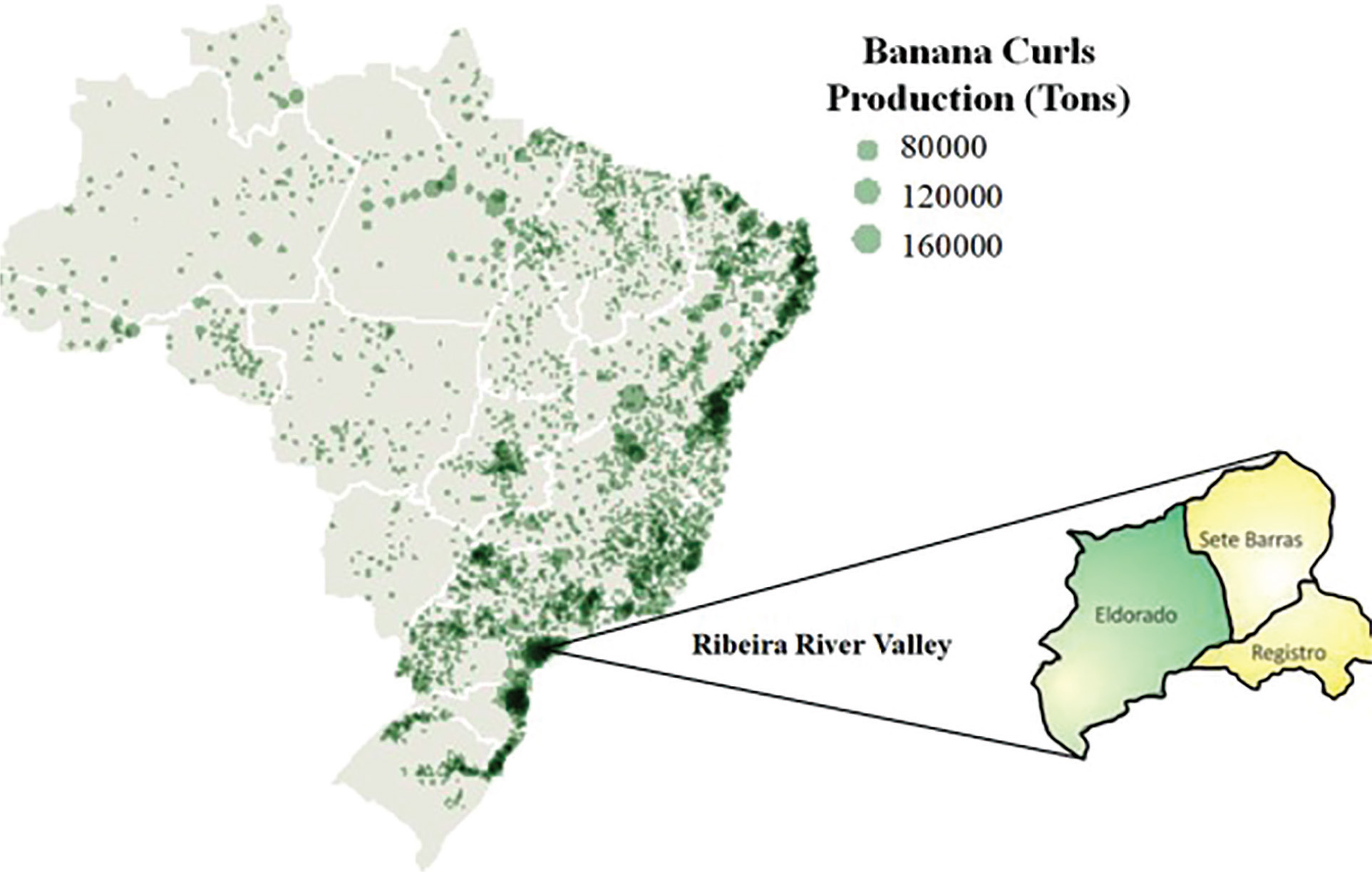
Figure 1.
Brazilian banana curls production and study sites in Ribeira River Valley, São Paulo state. Adapted from Almeida and Zanlorenssi (2018) and https://www.ovaledoribeira.com.br/2012/01/mapa-do-vale-do-ribeira-pelo-google.html.
Table 1.
Studied site characterisation at the Eldorado, Registro and Sete Barras counties.
| City | Eldorado | Registro | Sete-Barras | ||||
|---|---|---|---|---|---|---|---|
| System | Forest | Banana | Forest | Banana | Forest | Banana | |
| Age of system | 30 | 50 | 35 | 15 | 45 | 40 | |
| Latitude | 24°29′57″S | 24°23′34″S | 24°26′29″S | ||||
| Longitude | 48°02′48″O | 47°49′36″O | 47°53′22″O | ||||
| Climate Köppen* | Am | Af | Af | ||||
| Mean annual temperature (°C) | 23.9–24.3 (lowest 13°C) in July, and highest (34.2°C) in February | ||||||
| Mean annual rainfall (mm) | 1500–1600 | ||||||
| Soil texture | Clay Loam | Clay | Clay Loam | ||||
| Liming | 30 days before planting, based on raising BS to 70% and Mg content to 8 mmol · dm −3 | ||||||
| Fertilization | Potassium | 200 a 450 kg of K2O · ha−1 at formation stage and 100–750 kg of K2O · ha−1 at production stage | |||||
| Nitrogeneous | 200 kg of mineral N at formation stage and 160–400 kg N mineral · ha−1 · year−1 | ||||||
| Phosphate | 40–120 kg of P2O5 · ha−1 with annual repetitions according to soil analysis | ||||||
| Organic | Application in the pit (10–15 L of cattle manure) or chicken manure (3–5 L · pit−1) | ||||||
Soil sampling
The sampling was carried out at smaller watersheds in Ribeira River Valley, delimiting a sampling strip plot, 150 m long and 50 m wide, with banana crops on the high ground level, and other species for the forest system parallel to the river border, respecting a minimum distance of 10 m from the river bank. Ten sample points in banana and forest systems were defined aleatory. Then, disturbed soil samples were collected at the 0–0.20 m layer to determine the chemical indicators. For the physical indicators, undisturbed soil samples were collected using cylinders of approximately 128 cm3 (5 cm of height × 5.7 cm of diameter) at 0–0.05, 0.05–0.10 and 0.10–0.20 m of depth, at the same sample points, as well as monoliths at the same layers, to determine the macrofauna. The sampling of epiedaphic macrofauna was carried out throughout the seasons of the year, starting in the spring of 2018 and ending in the fall of 2019, using an adaptation of the standard sampling method proposed by the Tropical Soil Biology and Fertility (TSBF) Programme (Anderson and Ingram, 1993).
Soil quality indicators were arranged for 0–0.20 m depth, performing five pseudo-replicates in each land use system, at three counties. Thus, the split-plot design was adopted, considering each county as a block. The soil analyses (chemical, physical and biological) performed in this study and the methodologies used are described in detail in Cremonesi (2020).
SQIs
Soil health was evaluated through six SQIs developed using different strategies to define the minimum dataset (MDS), data interpretation (linear or non-linear scoring curves) and integration (additive or weighted), as presented in Table 2. In addition, we used the soil management assessment framework (SMAF), described in Andrews et al. (2004), and widely used to compare soil health in LUCs. A detailed description of each step of SQIs development is presented below:
Table 2.
Execution process of the SQIs and SMAF.
| SQI | Selection of indicators | Interpretation | Integration | Reference |
|---|---|---|---|---|
| SQI-1 | TDS | Non-Linear | Weighted | Cherubin et al. (2016a) |
| SQI-2 | Additive | |||
| SQI-3 | Linear | Weighted | Andrews et al. (2002) | |
| SQI-4 | Additive | |||
| SQI-5 | MDS | Non-Linear | Weighted | Cherubin et al. (2016a) adapted |
| SQI-6 | Additive | |||
| SMAF | Weighted | Andrews et al. (2004) |
Step 1—Selection of the indicators
Two processes were carried out to choose the indicators. The first was choosing the total dataset (TDS), with 30 indicators collected and evaluated. The second corresponded to using the MDS, with seven indicators, the same ones used in the SMAF (Table 3). The choice of the MDS took into account the ability of a smaller number of indicators to translate the soil health, to make it easier to obtain the data and to justify the comparison with the SMAF tool and the SQIs calculated from an MDS.
Table 3.
Soil indicators associated with soil functions and database.
| Soil function | Indicator | Unit | Dataset | ||
|---|---|---|---|---|---|
| Chemical | |||||
| f(i) Storage, availability and cycling of nutrients | P | mg · dm−3 | TDS | MDS | |
| K | mg · dm−3 | TDS | MDS | ||
| Ca | mmolc · dm−3 | TDS | - | ||
| Mg | mmolc · dm−3 | TDS | - | ||
| S | mmolc · dm−3 | TDS | - | ||
| B | mg · dm−3 | TDS | - | ||
| Cu | mg · dm−3 | TDS | - | ||
| Mn | mg · dm−3 | TDS | - | ||
| Fe | mg · dm−3 | TDS | - | ||
| Zn | mg · dm−3 | TDS | - | ||
| pH | - | TDS | MDS | ||
| H + Al | mmolc_ · dm−3 | TDS | - | ||
| BS | % | TDS | - | ||
| CEC | mmolc_ · dm−3 | TDS | - | ||
| Physical | |||||
| f(ii) Soil–water dynamic and soil aeration | BD | kg · m−3 | TDS | MDS | |
| f(iv) Sustain plant growth | |||||
| TP | m−3 · m−3 | TDS | - | ||
| f(ii) Soil–water dynamic and soil aeration | MaP | m−3 · m−3 | TDS | - | |
| MiP | m−3 · m−3 | TDS | - | ||
| SWSC | - | TDS | - | ||
| f(iv) Sustain plant growth | WFPS | - | TDS | MDS | |
| SAC | - | TDS | - | ||
| f(ii) Soil–water dynamic and soil aeration | Kfs | cm · h−1 | TDS | - | |
| f(v) Ability to resist degradation | |||||
| f(iv) Sustain plant growth | ASI | % | TDS | MDS | |
| f(v) Ability to resist degradation | |||||
| f(v) Ability to resist degradation | MWD | Mm | TDS | - | |
| SSI | % | TDS | - | ||
| Biological | |||||
| f(iii) Sustain biological activity | Mdens | Indiv · m −2 | TDS | - | |
| EWorm | Indiv · mC2 | TDS | - | ||
| Mrich | - | TDS | - | ||
| Mdiver | - | TDS | - | ||
| f(i, ii, iii, iv) | SOC | g · kg−1 | TDS | MDS | |
1 ASI, aggregate stability index; B, boron; BD, bulk density; BS, base saturation; Ca, calcium; CEC, electrical conductivity; Cu, copper; EWorm, oligochaetes; Fe, iron; H + Al, hydrogen + aluminium; K, potassium; Kfs, saturated hydraulic conductivity; Mdens-Density, Mrich, macrofauna richness; MDiver, Shannon’s diversity-index; MDS, minimum dataset.; Mg, magnesium; MiP, microporosity; Mn, manganese; MWD, weighted average diameter; P, phosphorus; pH, ionic hydrogen potential; S, sulphur; SAC, soil aeration capacity; SOC, soil organic carbon; SSI, structural quality index; SWSC, soil water storage capacity MaP, macroporosity; TDS, total dataset; TP, total porosity; WFPS, water filled pore space; Zn, zinc.
Step 2—Interpretation of indicators
The values of all determined indicators were transformed into scores ranging from 0 to 1 through the non-linear model (Cherubin et al., 2016a) and linear model (Andrews et al., 2002). For scoring indicators in the non-linear functions, thresholds were published in the literature and summarised in Cherubin et al. (2016a). The criteria adopted for non-linear curves were ‘more is better’ Eq. (1) and ‘less is better’ Eq. (2). For the ‘optimum mid-point’ curve, Eqs (1) and (2) were jointly used in the increasing and decreasing parts of the curve, respectively:
The score is the unitless value of the soil indicator, which ranges from 0 to 1. Where: a is the maximum score equal to 1 in this study; B is the baseline value (left side of the curve) of the soil indicator where the score equals 0.5; LT is the lower threshold, UT is the upper threshold, x is the measured soil indicator value and S is the slope of the equation set to –2.5.
Step 3—Integration of indicators into an index
For the TDS, the scores for each indicator were integrated into an overall index. Two integration methods were used (Table 2): a simple additive method in which the indicator scores were summed and then divided by the total number of indicators Eq. (3). The weighted method followed those presented in Cherubin et al. (2016a), where the indicators were weighted and integrated using Eq. (4):
Where: sa is simple additive SQI and wa is weighted additive SQI. Si is the indicator score, n refers to the number of indicators integrated into the index and Wi is the weighted value of the indicators.
However, the indicators used in each SQI with the TDS can compose distinct soil functions, then the score functions were summarised in (fi) storage, availability and cycling of nutrients; (fii) soil–water dynamic and soil aeration; (fiii) sustain biological activity; (fiv) sustain plant growth; and (fv) ability to resist degradation, in which the soil indicators were selected and grouped into each soil function and then reintegrated as an index.
For the MDS, the same indicators were used for SQI-5, SQI-6 and SMAF (Table 3), and the scores were interpreted and then integrated in a non-linear way, in which the SQI-6 was a simple additive, and others were weighted. For these SQIs, instead of using soil functions, we grouped them into soil sectors such as chemical, physical and biological. For weighted indexing applied, each sector’s average indicator was multiplied by ≈0.33. For simple additive, indexing performed the sum of indicators and/or soil sectors, and then they were divided by the total number of indicators and/or soil sectors, respectively. The exception was for the biological sector, where only one indicator was integrated SOC, which corresponded to the totality of the weight for the sector. The reliability was analysed by statistical parameters, such as coefficient of variation (CV), mean standard error (MSE), standard error mean and confidence intervals.
Statistical analysis
The SQI data were tested for normality using the Shapiro–Wilk test (p > 0.05), considered as a normal distribution. The analysis was performed in split plots, with the systems as the main factor and the SQI as the secondary factor. The scores of the SQI, and each function were compared according to the integration processes using the Tukey test (p < 0.05). All procedures were performed in the R software (R Core Team, 2023).
RESULTS
Soil quality indicators at studied systems
Soil quality indicators for both banana and forest systems are presented in Table 4, only for characterisation. In general, the banana system presented raised values for chemical indicators compared with the forest system, which is expected because of the fertilisation used in bananas to sustain the productive system. Observing the physical indicators, the mean values of the macroporosity (MaP) and saturated hydraulic conductivity (Ksat) (MaP = 0.09 m3 · m−3 and Ksat = 3.34 cm · h−1) in the banana system may present limitations to root growth. By contrast, for the forest system, they were kept adequate. Regarding biological indicators, the systems had similar results.
Table 4.
Mean values of the indicators of chemical, physical and biological sectors, to characterise each land use.
| Chemical | Forest | Banana | SD | Physical | Forest | Banana | SD | Biological | Forest | Banana | SD |
|---|---|---|---|---|---|---|---|---|---|---|---|
| BS% | 81 | 92 | 9.74 | Ksat (cm · h−1) | 39.82 | 3.34 | 25.79 | Mdiver | 1.5 | 1.4 | 0.09 |
| pH CaCl2 | 5.5 | 6.5 | 0.70 | WMD (mm) | 3.20 | 4.20 | 0.71 | ||||
| H + Al (mmolc · dm−3) | 18 | 13 | 5.82 | SSI (%) | 71.88 | 52.07 | 14.01 | Mrich | 2.0 | 1.8 | 0.17 |
| CEC (mmolc · dm−3) | 111 | 171 | 38.49 | ASI (%) | 11.76 | 14.67 | 2.06 | ||||
| Fe (mg · dm−3) | 81 | 72 | 32.92 | TP (m3 · nr−3) | 0.50 | 0.58 | 0.05 | Abundance (indv · m−2) | 28.1 | 32.7 | 0.28 |
| Cu (mg · dm−3) | 3 | 4 | 1.55 | SAC | 0.36 | 0.16 | 0.15 | ||||
| Zn (mg · dm−3) | 9 | 13 | 5.91 | MiP (m3 · m−3) | 0.32 | 0.48 | 0.11 | Eworm (indv · m−2) | 0.8 | 0.6 | 0.12 |
| Mn (mg · dm−3) | 50 | 26 | 17.49 | WFPS | 0.64 | 0.84 | 0.14 | ||||
| B (mg · dm−3) | 0.18 | 0.27 | 0.10 | SWSC | 0.63 | 0.84 | 0.15 | SOC (g · kg−1) | 24.75 | 30.81 | 6.93 |
| Mg (mmolc · dm−3) | 22 | 45 | 14.86 | BD (Mg · m−3) | 1.25 | 1.27 | 0.02 | ||||
| Ca (mmolc · dm−3) | 68 | 106 | 27.16 | ||||||||
| K (mmolc · dm−3) | 2 | 6 | 4.10 | MaP (m3 · m−3) | 0.18 | 0.09 | 0.06 | ||||
| P (mg · dm−3) | 16 | 125 | 65.88 | ||||||||
| S (mg · dm−3) | 12 | 12 | 2.35 |
1 SD is the standard deviation of all indicators. ASI, aggregate stability index; B, boron; BD, bulk density; BS, bases saturation; Ca, calcium; CEC, electrical conductivity; Cu, copper; EWorm, oligochaetes; Fe, iron; H + Al, hydrogen + aluminium; K, potassium; Ksat, saturated hydraulic conductivity; MaP, macroporosity; Mdiver, Shannon’s diversity-index; Mg, magnesium; MiP, microporosity; Mn, manganese; Mrich, Margallef’s wealth-index; P, phosphorus; pH, ionic hydrogen potential; S, sulphur; SAC, soil aeration capacity; SD, standard deviation; SOC, soil organic carbon; SSI, structural quality index; SWSC, soil water storage capacity; TP, 33; WFPS, water filled pore space; WMD, weighted mean diameter; Zn, zinc.
SQIs
The scores were obtained through evaluation of the soil functions–the availability and nutrient cycling (fi), the availability of water and soil aeration (fii), the support to biological activity (fiii), the sustaining plant growth (fiv) and the ability to resist degradation (fv)–which integrate the indicators linked to each function and after that integrated into the SQI.
In Figure 2, it can be observed that for both the SQI-1 and SQI-2, which took into account the TDS, interpreted in a non-linear way, there was no significant interaction between the systems and the soil functions (Figures 2A and 2B), demonstrating the similarity of both systems in these indexes. Nonetheless, for SQI-1, assessing the simple effects, fii had the lowest value followed by fiii and fiv, presenting 53, 65 and 70% of functioning for soil water dynamic and soil aeration, sustaining biological activity and sustaining plant growth, respectively. The functions fi and fv were the higher, with 93% and 77%, respectively, of functioning storage, availability, cycling of nutrients and ability to resist degradation. According to the SQI-2 (Figure 2B), which considered the TDS and was integrated in an additive way, the greatest contribution to the SQI was made by functions fi, fiv and fv for both systems.
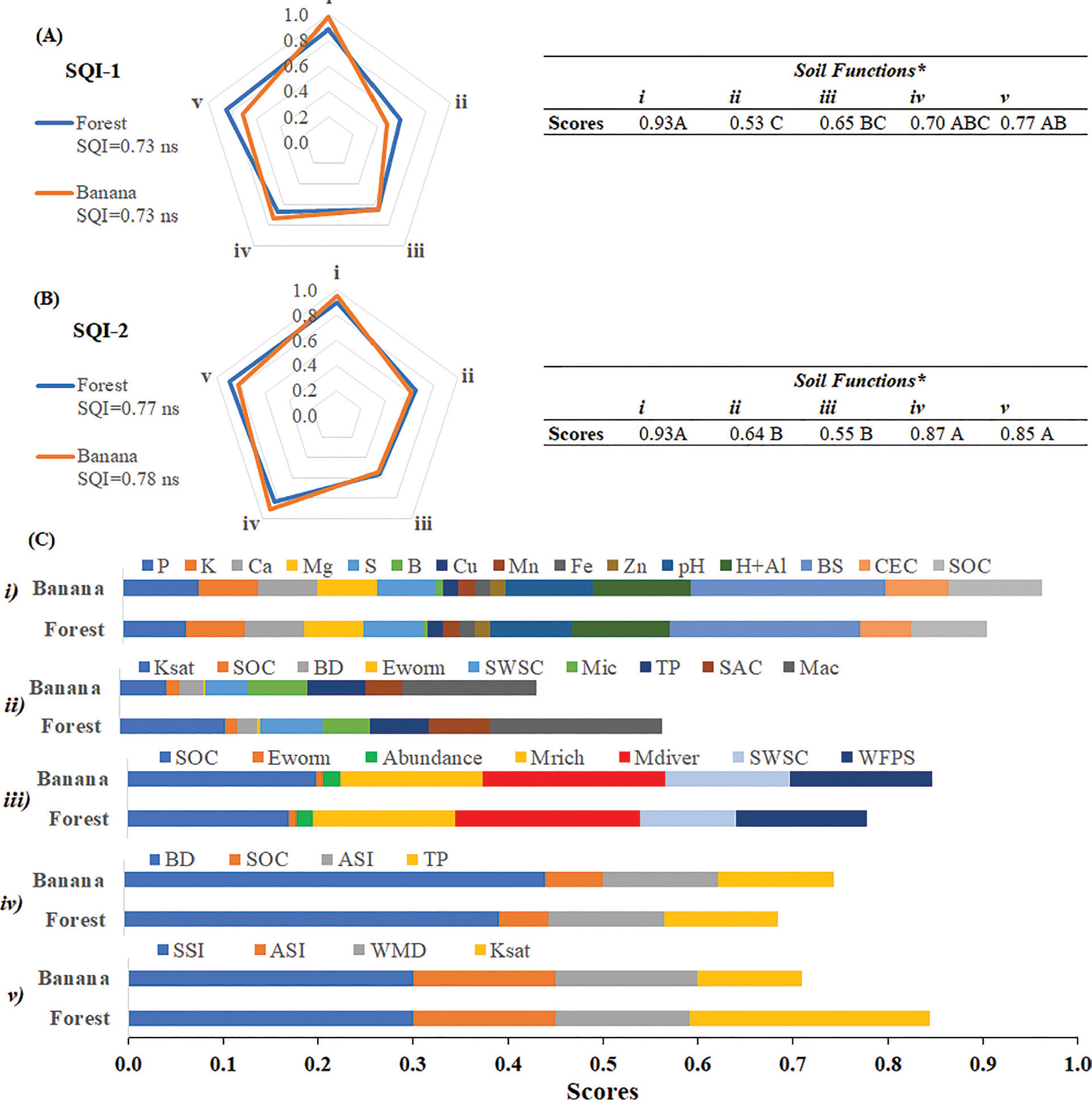
Figure 2.
Mean values of the Forest and Banana systems for SQIs, considering the TDS, non-linearly interpreted, with integration weighted and additive, respectively, for SQI-1 (A) and SQI-2 (B) and contribution of soil functions in each one. Contribution of the soil indicators§ in the respective score functions (C) non-linear. ns: non-significant; *non-significant interaction; simple effects evaluated; **significant interaction; means followed by the same uppercase letter between functions and lowercase between systems do not differ by Tukey’s test (p < 0.05); i–availability and nutrient cycling; ii–availability of water and soil aeration; iii–support to biological activity; iv-sustaining plant growth; v–ability to resist degradation. ASI, aggregate stability index; BD, bulk density; BS, base saturation; CEC, electrical conductivity; SOC, soil organic carbon; SQIs, soil quality indexes, SSI, structural quality index; SWSC, soil water storage capacity; TDS, total dataset; TP, total porosity; WFPS, water filled pore space; WMD, weighted mean diameter. §Abbreviations are the same as in Table 3.
Similar to SQI-1 but statistically less discriminant. Differences between the functions (p<0.05) in the SQI-1 demonstrated that the functions related to the availability of water and soil aeration (fii), the support to biological activity (fiii) and the sustaining plant growth (fiv) were lower than the functions linked to the availability and nutrient cycling (fi), and the ability to resist degradation (fv), supported mainly by base saturation (BS), SOC content, aggregate stability index (ASI) and Ksat (Figure 2C). However, the simple additive way makes the systems more similar among the functions, affecting the statistical results among them and increasing the fii. For the studied systems, the contribution of the indicators integrated into the functions (Figure 2C) suggests that for fi–storage, availability and cycling of nutrients, the indicators most important were the bases saturation (BS), hydrogen + aluminium (H + Al) SOC, pH, and the phosphorus (P) for both systems. For fii–availability of water and soil aeration were the MaP, soil Ksat and soil water storage capacity (SWSC), which were affected mainly in the forest system. In the fiii–support to biological activity, the SOC, Margallef’s Wealth Index (Mrich), Shannon’s diversity-index (Mdiver) and water-filled pore space (WFPS) contributed effectively to this function. Bulk density (BD), ASI and total porosity (TP) were those that raised the fiv–sustaining plant growth, and for fv, the ability to resist degradation, the structural quality index (SSI) and soil Ksat elevated the score, mainly in the forest. For function iv, the behaviour of some indicators was similar; however, the banana predominated over the forest. On the other hand, the lower soil Ksat in the banana system, while the others were similar, caused an impact on the score of fii and fv.
The linear integration strategy of SQI-3 and SQI-4 also did not detect significant differences between the systems (Figure 3A). However, in this integration strategy, interaction was significant within functions for both banana and forest systems (Figure 3B). The functions fi–storage, availability and cycling of nutrients and fiii–support to biological activity were higher by SQI-3. Otherwise, the SQI-4 obtained the best score for both systems in fiv, indicating better sustaining to plant growth. At the same time, all other functions were statistically equal for forest, and banana functions ii, iii and v had the lower scores. Besides, both SQIs-3 and 4 detected the nuances from indicators. The soil functions highlighted in each system were distinct, fiii and fiv, respectively. In Figure 3C, it is verified that the contribution of indicators to soil functions presented higher scores at fi in both SQIs-3 and 4 for the banana system, in which BS, pH and SOC stood out. By the way, SQI-3 presented lower soil–water dynamic and soil aeration (fii), mostly represented by MaP and SAC, and the ability to resist degradation (fv) by SSI, ASI and weighted mean diameter (WMD) for both systems.
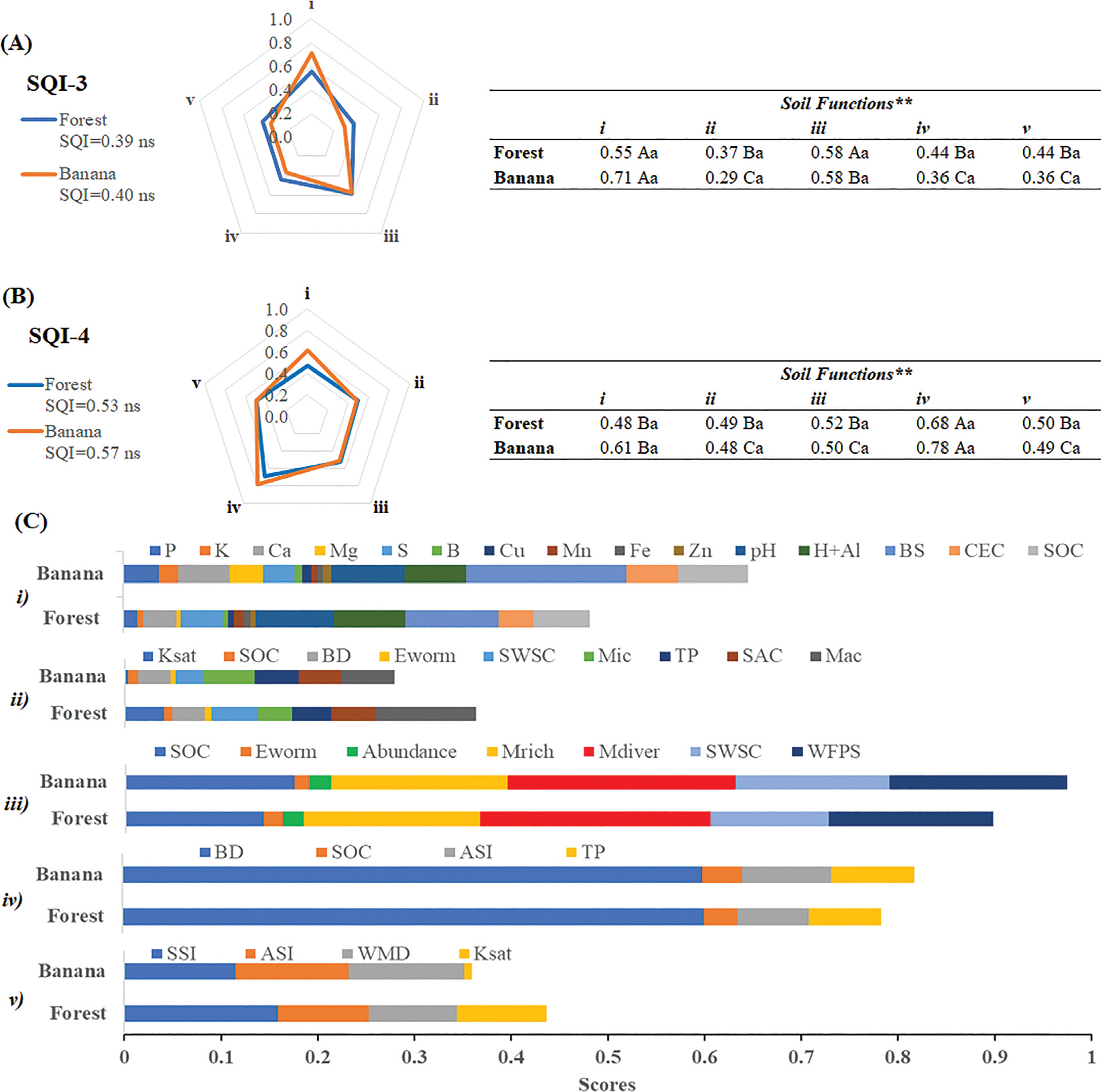
Figure 3.
Mean values of the Forest and Banana systems for SQIs, considering the TDS, linearly interpreted, with integration weighted and additive, respectively, for SQI-3 (A) and SQI-4 (B) and contribution of soil functions in each one. Contribution of the soil indicators§ in the respective score functions (C) linear. ns: non-significant; *non-significant interaction; simple effects evaluated; **significant interaction; means followed by the same uppercase letter between functions and lowercase between systems do not differ by Tukey’s test (p < 0.05); i–availability and nutrient cycling; ii–availability of water and soil aeration; iii–support to biological activity; iv-sustaining plant growth; v-ability to resist degradation. ASI, aggregate stability index; BD, bulk density; BS, base saturation; CEC, electrical conductivity; SAC, soil aeration capacity; SOC, soil organic carbon; SQIs, soil quality indexes, SSI, structural quality index; SWSC, soil water storage capacity; TDS, total dataset; TP, total porosity; WFPS, water filled pore space; WMD, weighted mean diameter.
§The full description of the indicators can be found in Table 3.
Figure 4 shows the comparisons between the SQI, based on an MDS, with only seven indicators chosen based on expert opinion and literature review. In the same way, no significant difference was found (p < 0.05) between the systems for these SQIs, and no significant interaction between the sectors and the studied systems.
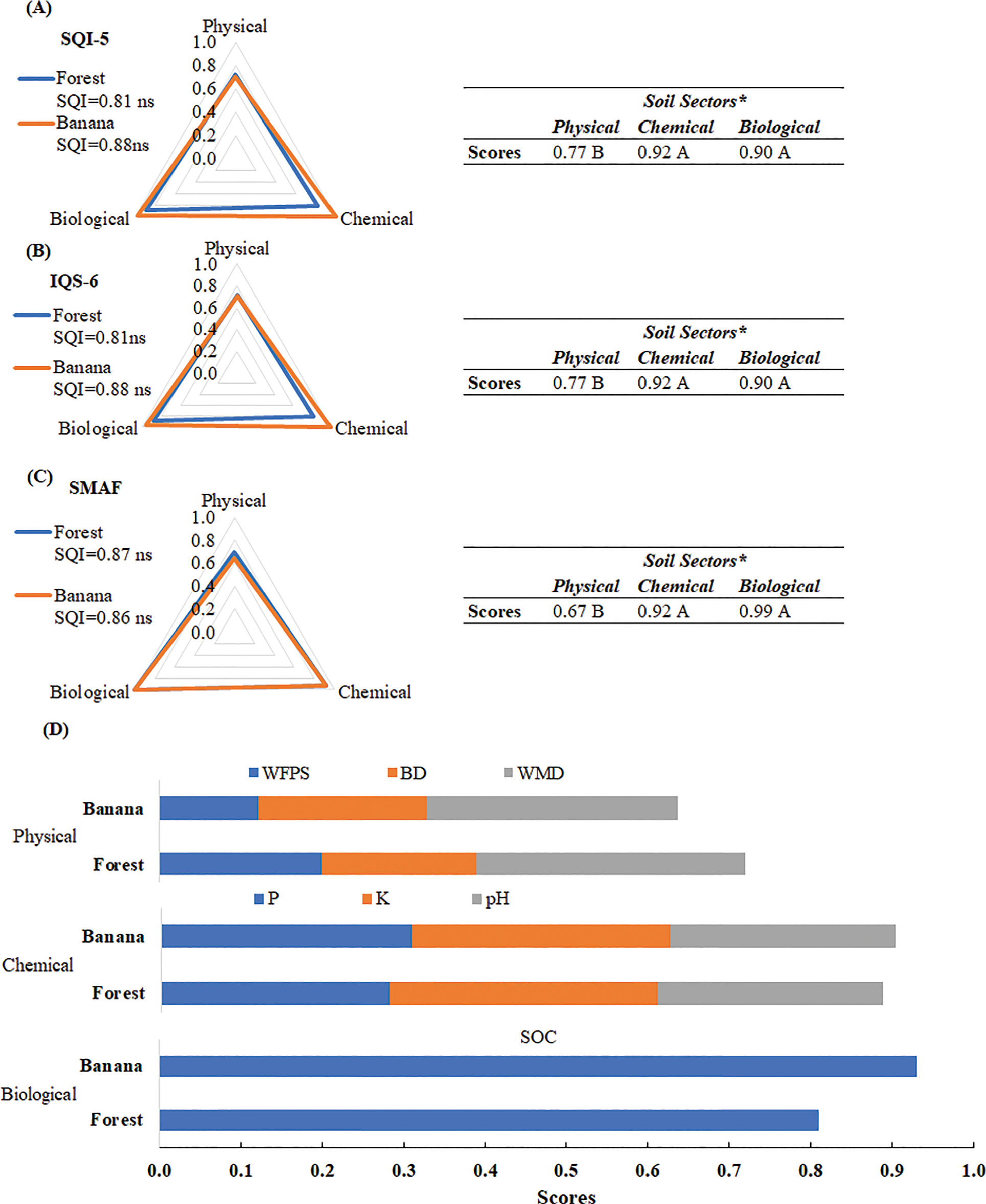
Figure 4.
Mean values of the Forest and Banana systems for SQIs, considering the MDS, non-linearly interpreted, with integration weighted, additive and additive, respectively, for SQI-5 (A) and SQI-6 (B) and SMAF (C) and contribution of soil sectors in each one. Contribution of the soil indicators§ in the respective score sector (D). ns: non-significant; *non-significant interaction; simple effects evaluated; **significant interaction; means followed by the same uppercase letter between functions and lowercase between systems do not differ by Tukey’s test (p < 0.05). BD, bulk density; MDS, minimum dataset; SOC, soil organic carbon; SMAF, Soil management assessment framework; SQIs, soil quality indexes; WFPS, water filled pore space; WMD, weighted mean diameter.
§The full description of the indicators can be found in Table 3.
Descriptive statistic of SQIs
The mean values of SQIs varied greatly, with the highest score for SMAF (87%) and the lowest in SQI-3 (40%). It is important to highlight that, independently of the mean value of SQIs, no significant differences between the forest and banana systems were detected. However, it is possible to indicate that SQIs can be more reliable based on some statistical parameters. Among SQIs, the lower CV found was in the SMAF and SQI-2, respectively, for the total and MDSs (Table 5).
Table 5.
Statistical parameters of the SQIs and SMAF for evaluating land use systems Forest and Banana.
| SQI | Mean | CV (%) | RMSE | Std. Error Mean | Confidence intervals | F test |
|---|---|---|---|---|---|---|
| SQI-1 | 0.73 c | 5.47 | 0.039 | 0.0150 | 0.126 | 0.40 ns |
| SQI-2 | 0.77 bc | 2.80 | 0.022 | 0.0079 | 0.069 | 0.00 ns |
| SQI-3 | 0.40 e | 9.44 | 0.037 | 0.0134 | 0.118 | 0.00 ns |
| SQI-4 | 0.55 d | 7.06 | 0.039 | 0.0172 | 0.126 | 1.80 ns |
| SQI-5 | 0.84 ab | 6.73 | 0.057 | 0.0263 | 0.182 | 2.46 ns |
| SQI-6 | 0.84 ab | 6.68 | 0.056 | 0.0261 | 0.180 | 2.48 ns |
| SMAF | 0.87 a | 1.92 | 0.017 | 0.0068 | 0.053 | 1.10 ns |
1 Means followed by the same letter in the columns do not differ by Tukey test (p < 0.05) between SQIs. ns: non-significant by F test (p < 0.05) between land use systems.
CV, coefficient of variation; RMSE, root mean square error; SMAF, soil management assessment framework; SQIs, soil quality indexes.
DISCUSSION
Soil quality indicators
According to the mean values of the determined indicators, it is possible to observe that all chemical indicators were considered adequate. Only boron presented a low value for the forest system (<0.20 mg · dm−3) (Van Raij et al., 1997), which can be plausible due to the lack of area fertilisation and to H3BO3 ion leaching behaviour under high precipitation conditions of the study areas. While physical indicators, the values of soil Ksat and MaP (Table 4) for the banana system presented limitations of soil functioning regarding the capacity to infiltrate water into the soil and the exchange of gases. According to Borges and Da Silva Souza (2004), banana cultivation requires well-drained soils that do not promote the accumulation of water in the soil. The greater MaP found in the forest system is responsible for the greater capacity of the soil to infiltrate water, which the greater soil Ksat confirms is found in the soils of the forest system. According to Soracco et al. (2019), the main influence on soil Ksat is exerted by MaP and not by the total pore volume, confirming that even with a higher TP, the banana areas had a lower capacity to conduct water through the soil profile. The indirect impact of this lower soil Ksat can be as in soil erosion, which may increase under high intensity of precipitations, as in soil aeration, under long periods of humid seasons.
Regarding chemical indicators, based on the recommendations for banana cultivation in the state of São Paulo, it is indicated that for fertilisation and liming, the levels of magnesium and BS are raised to 9 mmolc · dm−3 and 60%, respectively (Aguiar et al., 2014). Thus, the banana areas are within adequate limits for good development of the crop. Similarly, the biological indicators did not show restrictions to the banana crop.
SQIs
The absence of significant interaction (Figure 2) demonstrates that the forest and banana systems did not obtain statistical differences between them. Besides that, the function’s behaviour between indexes differed, suggesting some negative impacts on water availability and gas exchange. Besides, there was no significant difference between the banana and the forest, and it is possible to notice a decay in the banana system compared with the forest. However, the bananas had a slight improvement in fi and fiv, respectively, storage, availability, plus cycling of nutrients and sustain plant growth, leading to compensate the reduction of quality indicators observed in other functions.
By analysing the comparison of land use systems by TDS under non-linear interpretation and weighting strategy, slight variations among functions were observed. Then, there was no interaction between functions and systems, which did not differ between systems. However, this indicates a slight improvement (+1.3%) in soil health, from the point of view of the availability of water and soil aeration and the ability to resist degradation of the banana system. In a study developed by Cherubin et al. (2016a), where different SQI in traditional LUC were evaluated, the authors found a variation of 28% for native vegetation, 33% for pasture areas and 29% for sugarcane areas, considering the same indexes studied.
Using another interpretation, being linear but still with TDS, the systems had no difference (Figure 3). Moreover, it verified interaction between functions and systems suggesting that the same total database, scored linearly and integrated under a weighted way (SQI-3) and a simple additive way (SQI-4), can affect the results of soil functions, presenting different behaviours and increasing the percentage of those scores. In this case, the SQI-3 and SQI-4 indicated that the banana system had 2.5 and 7.0% improved the soil health, mainly because of soil fertilisation.
The interpretation by non-linear (Figure 4) and weighted and simple additive strategies, summarized in soil sectors instead of functions, respectively, for SQI-5, SQI-6, and SMAF, kept similar scores for the chemical and biological sectors. However, some harm can be noticed in the physical sector, which was significantly lower. The contribution of the indicators shows that WFPS was negatively affected by the banana system in the physical sector. By contrast, the banana system improved P and SOC indicators, for the chemical and biological sectors, respectively. Greater soil conditions for the plants enhance the accrual residuals to the soil over time, not only by plant growth but also banana management, which cuts the tree after harvesting the fruit, accelerating the decomposition of stems and leaves.
Considering SMAF as a tool widely used for evaluating soil health (Cherubin et al., 2017; Karlen et al., 2019; Matos et al., 2022; Gyawali et al., 2023), the sectors’ physical, chemical and biological can vary between land use systems, our results presented 67, 92 and 99%, respectively, of scoring. However, both systems, forest and banana, had no difference. Amorim et al. (2020), studying pasture management and conservation practices through the SMAF, also found variation in only one of the sectors. However, it was enough to attribute differences in soil health. Other researchers found differences between LUCs using SMAF, such as Cherubin et al. (2016b), who state that SMAF is efficient in detecting the effects of change of the use on the quality of tropical soils. Under constructed technosoils, the SMAF detected differences between the evaluated systems, similar among some (70, 67 and 69%) and 88% under pastures 20 years old (Ruiz et al., 2020).
Despite the effects of some indicators used in the evaluation of soil functions and/or sectors, within the SQIs with the TDS (Figures 2 and 3), the results showed that the land use systems, forest and banana, described in this study, are similar, contrasting studies that found soil quality superior in native systems. Da Luz et al. (2019) evaluated the effects of LUC (native vegetation, pasture, sugarcane, no-tillage and integrated crop-livestock systems) on soil quality. They found that some scores obtained by the SMAF were higher (88, 70 and 76%) for clayey and sandy loam Latosol and quartzarenic Neosol, respectively, compared with soils under native vegetation (69%). Valani et al. (2020) also found higher quality for native vegetation when compared with conventional and organic crops under Cambisols. It should be noted that the studied banana system is not subjected to heavy traffic from machines and implements and generally produces a high amount of residues on the soil surface, contributing to the soil’s quality or health. In addition, in the present study, the forest is in the transitional stages of regeneration; therefore, it may reflect past effects of anthropic actions.
Reliability of SQIs
The SQIs, independently of the method of interpreting the indicators (linear and non-linear) and the weighted and additive strategies, presented that both systems have similar soil health. On the other hand, when comparing these methods, Yu et al. (2018) concluded that indicators scored non-linearly presented better functions with greater differentiation capacity in calculating the SQIs. Besides that, according to the authors, scoring linearly does not require deep knowledge of the indicators’ behaviour, indicating greater variation between treatments. According to Andrews et al. (2002), the non-linear interpretation of indicators is considered the most adequate. In addition, the authors emphasise that combining an MDS with non-linear interpretation is an effective strategy for choosing the best management practices to be adopted.
The dataset is another point to be analysed because it can vary the final score and lead to distinct interpretations about the percentage of soil capacity functioning. Studies have demonstrated that the lower values correspond to the strategy adopted for an MDS, interpreted non-linearly and integrated in a weighted way. The higher values for those with the TDS are interpreted non-linearly and integrated in a simple additive way (Cherubin et al., 2016a). Moreover, Zhang et al. (2021) found that the SQIs, based on both TDS and MDS, could effectively and accurately assess the impact of vegetation succession on soil quality, indicating that our results are secure.
Regarding the feasibility and efficiency of the evaluated SQIs, we found no differences regarding the use of a TDS or an MDS. Nevertheless, searching for a representative MDS of indicators for soil health assessment has been a constant concern (Li et al., 2024; Macedo et al., 2024). Choosing indicators to compose an MDS is important, as according to Bünemann et al. (2018), the ease of sampling, reliability and costs is considered most important in choosing indicators. The authors also state that the number of indicators to compose an MDS varies from 6 to 8 indicators. Besides that, the comparison among SQIs indicates a great variation in the present study (Table 5), of above 50%; this can be attributed to indicators integration, as discussed before.
The statistical parameters used, such as CV, root mean square error (RMSE), standard deviation (SD) and confidence intervals, were better for soil quality index-2 and SMAF. However, all SQIs can be indicated as reliable, because less than 10% of CV was found. Therefore, although no significant difference is found between forest and banana systems by SQIs, some small variations in soil functions or sectors can alter soil health, which demands monitoring both areas.
CONCLUSIONS
The hypothesis of this study was proven independently of the dataset (TDS and MDS), interpretation, and integration strategies. Although there is no difference between bananas and forests, it was observed that fertilisation improved the soil health in the banana system directly by storage and the availability of nutrients, as indirectly by other functions, such as those related to the increasing of soil carbon content. On the other hand, some physical indicators, such as soil Ksat and MaP, caused some detriment in the availability of water and soil aeration but still provided adequate conditions for banana crops. Any SQIs could be used to verify soil health; however, we indicate SQI-2 for a TDS and SMAF for a MDS.
ACKNOWLEDGEMENTS
The National Council for Scientific and Technological Development–CNPq, is acknowledged for granting scholarship to SILVA, A. L. and to the Federal University of Paraná for making the laboratories available. Thanks are also given for the financial support provided from the Fundo Estadual de Recursos Hídricos (Proc. FEHIDRO 102/2016) and to the farmers for permission to take samples on their properties.
Notes
[6] Contributed by AUTHOR CONTRIBUTIONS
D.E.R, K.M.V.C.-P. and A.L.S. – conceptualization; M.V.C. and A.L.S. – field sample collection; M.V.C., A.L.S., D.E.R., J.D.L. and P.E.C. – laboratory analysis; K.M.V.C.-P., D.E.R. and M.R.C. – date curation; D.E.R., K.M.V.C.-P., A.L.S., J.D.L. and P.E.C. – writing of the original draft; D.E.R. and K.M.V.C.-P. – resources; D.E.R. and K.M.V.C.-P. – revision.
[7] Conflicts of interest CONFLICT OF INTEREST
The authors declare that they have no known competing financial interests or personal relationships that could have appeared to influence the work reported in this paper.