
Table 1.
The preliminary evaluation system for implementation of university horticultural therapy programmes.
| First-level indicator | Second-level indicator |
|---|---|
| B1. Horticultural therapy team | C1. Horticultural professional guidance team |
| C2. Horticultural volunteer team | |
| B2. Horticultural therapy plan | C3. Therapeutic schedule |
| C4. Horticultural activity | |
| C5. Treatment effectiveness evaluation | |
| B3. Natural healing environment | C6. Horticultural space |
| C7. Healing landscape | |
| C8. Horticultural facility | |
| B4. Post-maintenance management | C9. Landscape maintenance |
| C10. Horticultural resource management |
Table 2.
Experts’ demographic information.
| Demographic variables | Frequency | Percentage |
|---|---|---|
| Age (years) 30–40 | 4 | 40 |
| 41–50 | 5 | 50 |
| ≥51 | 1 | 10 |
| Sex | ||
| Female | 6 | 60 |
| Male | 4 | 40 |
| Research field | ||
| Landscape architecture | 5 | 50 |
| Medicine and psychology | 3 | 30 |
| Horticulture | 2 | 20 |
| Years of related experience | ||
| 11–20 | 4 | 40 |
| 21–30 | 4 | 40 |
| 31–40 | 2 | 20 |
| Professional title | ||
| Associate professor | 8 | 80 |
| Professor | 2 | 20 |
Table 3.
Quantitative criteria for the basis of expert judgement.
| Basis of judgement | Quantitative values for different levels of impact on experts | ||
|---|---|---|---|
| Large impact | General impact | Little impact | |
| Practical experience | 0.5 | 0.4 | 0.3 |
| Theoretical analysis | 0.3 | 0.2 | 0.1 |
| Understanding from peers | 0.1 | 0.1 | 0.1 |
| Intuition | 0.1 | 0.1 | 0.1 |
Table 4.
Quantitative criteria for expert familiarity.
| Degree of expert familiarity | Quantised value |
|---|---|
| Very familiar | 1.0 |
| Familiar | 0.8 |
| General familiar | 0.6 |
| Not familiar | 0.4 |
| Definitely not familiar | 0.2 |
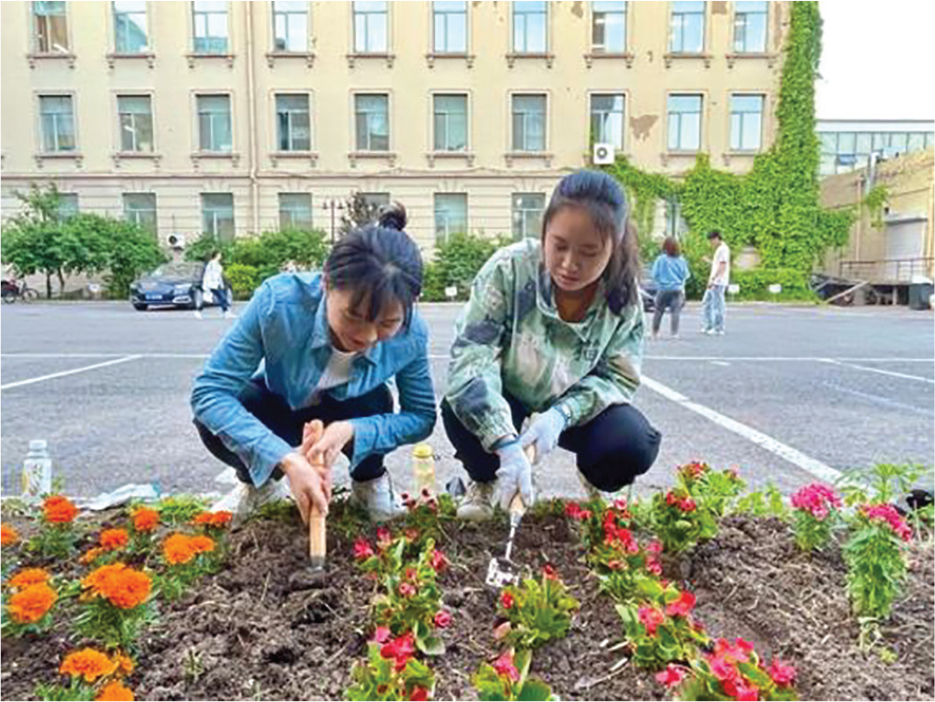
Figure 1.
College students engaged in horticultural planting activities.
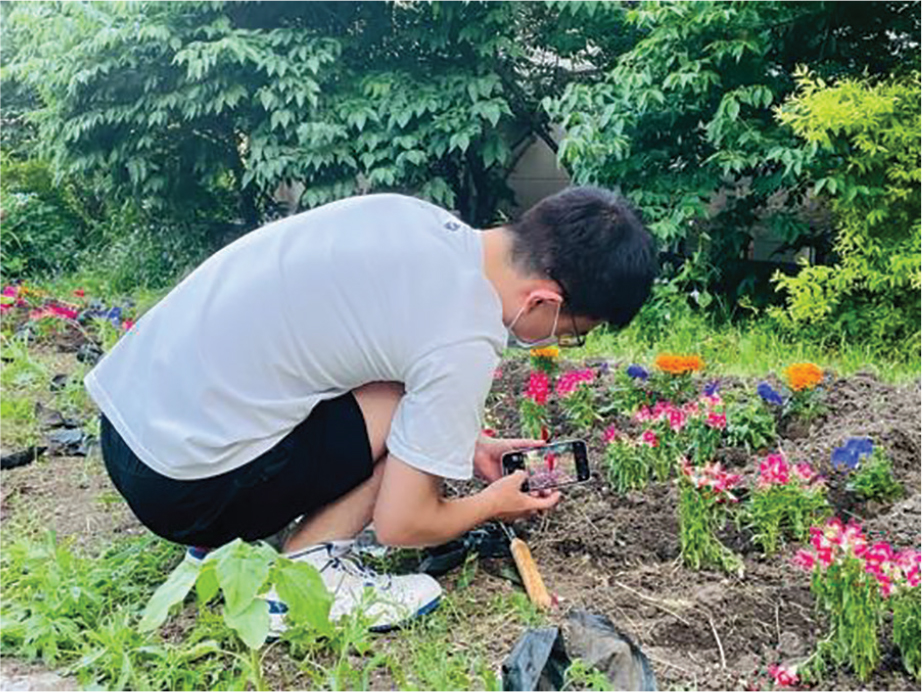
Figure 2.
College students taking photos of the plants they have planted.
Table 5.
Importance level and quantised value.
| Importance level | Quantised value |
|---|---|
| Equally important | 1 |
| Slightly more important | 3 |
| Significantly more important | 5 |
| Strongly more important | 7 |
| Absolutely more important | 9 |
| Intermediate value between two adjacent judgements | 2, 4, 6, and 8 |
Table 6.
Expert opinions’ authority degree.
| Indicator | Round 1 | Round 2 | ||||
|---|---|---|---|---|---|---|
| Ca | Cs | Cr | Ca | Cs | Cr | |
| B1. Horticultural therapy team | 0.770 | 0.820 | 0.795 | 0.830 | 0.880 | 0.855 |
| B2. Horticultural therapy plan | 0.770 | 0.820 | 0.795 | 0.880 | 0.840 | 0.860 |
| B3. Natural healing environment | 0.870 | 0.880 | 0.875 | 0.910 | 0.900 | 0.905 |
| B4. Post-maintenance management | 0.850 | 0.800 | 0.825 | 0.870 | 0.860 | 0.865 |
Table 7.
Expert opinions’ coordination degree.
| Experts (n) | Kendall’s W | χ2 | p-value | |
|---|---|---|---|---|
| Round 1 | 10 | 0.228 | 20.488 | <0.05 |
| Round 2 | 10 | 0.442 | 48.583 | <0.01 |
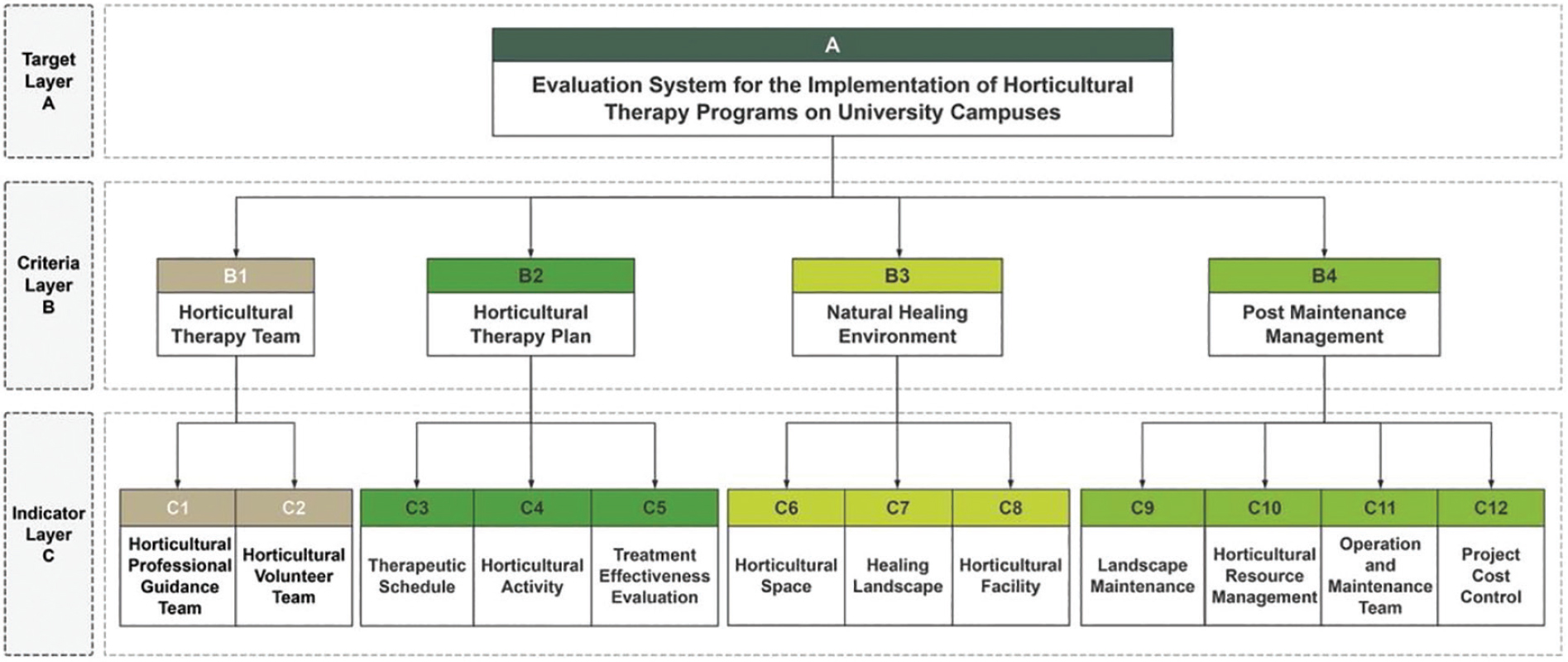
Figure 3.
Structure model of evaluation system.
Table 8.
Evaluation system for the implementation of horticultural therapy programmes on university campuses.
| Target layer | Criteria layer | Indicator layer | Interpretation of indicators |
|---|---|---|---|
| A. Evaluation system for implementation of horticultural therapy programmes on university campuses | B1. Horticultural therapy team | C1. Horticultural professional guidance team | A team led by horticultural therapists, with the participation of experts in medicine, psychology and landscape architecture, to provide professional guidance on the conduct of horticultural therapy programmes |
| C2. Horticultural volunteer team | The team, mainly composed of college students majoring in landscape architecture and other related disciplines, is responsible for the planning, publicity, organisation, operation and maintenance of the campus horticultural therapy programmes | ||
| B2. Horticultural therapy plan | C3. Therapeutic schedule | A therapeutic horticultural schedule determined by taking into account the programme participant’s spare time arrangement, health status, recovery goals and the healing techniques available on campus | |
| C4. Horticultural activity | Horticulture-related healing activities suitable for college campuses, including plant growing, landscaping, arts and crafts making, and other long-term and short-term activities | ||
| C5. Treatment effectiveness evaluation | Evaluating the effectiveness of horticultural treatment through the recording of personal physical and psychological health information and the recording of the treatment process | ||
| B3. Natural healing environment | C6. Horticultural space | Establishment of sites on university campuses dedicated to the implementation of horticultural therapy programmes | |
| C7. Healing landscape | A green space landscape that emphasises human–nature interaction and promotes the therapeutic effects of horticultural therapy | ||
| C8. Horticultural facility | Facilities that ensure the normal conduct of horticultural activities, such as raised planting beds, trellises, water supply and drainage facilities | ||
| B4. Post-maintenance management | C9. Landscape maintenance | Maintain the healing effect of the landscape by regularly cleaning the grounds, maintaining plants and updating facilities | |
| C10. Horticultural resource management | Regular management of horticultural resources ensures that horticultural therapy-related activities continue, such as managing pests and diseases, renovating soil and storing seeds | ||
| C11. Operation and maintenance team | A team led by a relevant school function (e.g. university logistics department) that ensures the continuity of the horticultural therapy programme | ||
| C12. Project cost control | Reasonable control of the costs of horticultural therapy programmes to facilitate sustainability |
Table 9.
Evaluation system indicator weights.
| Criteria layer | Weight coefficient | Rank | Indicator layer | Weight coefficient | Rank | Combination weights | Rank |
|---|---|---|---|---|---|---|---|
| B1. Horticultural therapy team | 0.190 | 3 | C1. Horticultural professional guidance team | 0.667 | 1 | 0.127 | 3 |
| C2. Horticultural volunteer team | 0.333 | 2 | 0.063 | 7 | |||
| B2. Horticultural therapy plan | 0.341 | 1 | C3. Therapeutic schedule | 0.387 | 2 | 0.132 | 2 |
| C4. Horticultural activity | 0.443 | 1 | 0.151 | 1 | |||
| C5. Treatment effectiveness evaluation | 0.170 | 3 | 0.058 | 9 | |||
| B3. Natural healing environment | 0.289 | 2 | C6. Horticultural space | 0.211 | 3 | 0.061 | 8 |
| C7. Healing landscape | 0.386 | 2 | 0.112 | 5 | |||
| C8. Horticultural facility | 0.403 | 1 | 0.116 | 4 | |||
| B4. Post-maintenance management | 0.180 | 4 | C9. Landscape maintenance | 0.155 | 4 | 0.028 | 12 |
| C10. Horticultural resource management | 0.242 | 2 | 0.043 | 10 | |||
| C11. Operation and maintenance team | 0.404 | 1 | 0.073 | 6 | |||
| C12. Project cost control | 0.199 | 3 | 0.036 | 11 |
Table 10.
Results of consistency test.
| Judgement matrix | λmax | CI | RI | CR | Criteria for CR |
|---|---|---|---|---|---|
| B1.B2.B3.B4. | 4.030 | 0.010 | 0.890 | 0.011 | <0.1 |
| C1.C2. | 2.000 | 0.000 | 0.000 | 0.000 | <0.1 |
| C3.C4.C5. | 3.018 | 0.009 | 0.520 | 0.017 | <0.1 |
| C6.C7.C8. | 3.002 | 0.001 | 0.520 | 0.002 | <0.1 |
| C9.C10.C11.C12. | 4.078 | 0.026 | 0.890 | 0.029 | <0.1 |
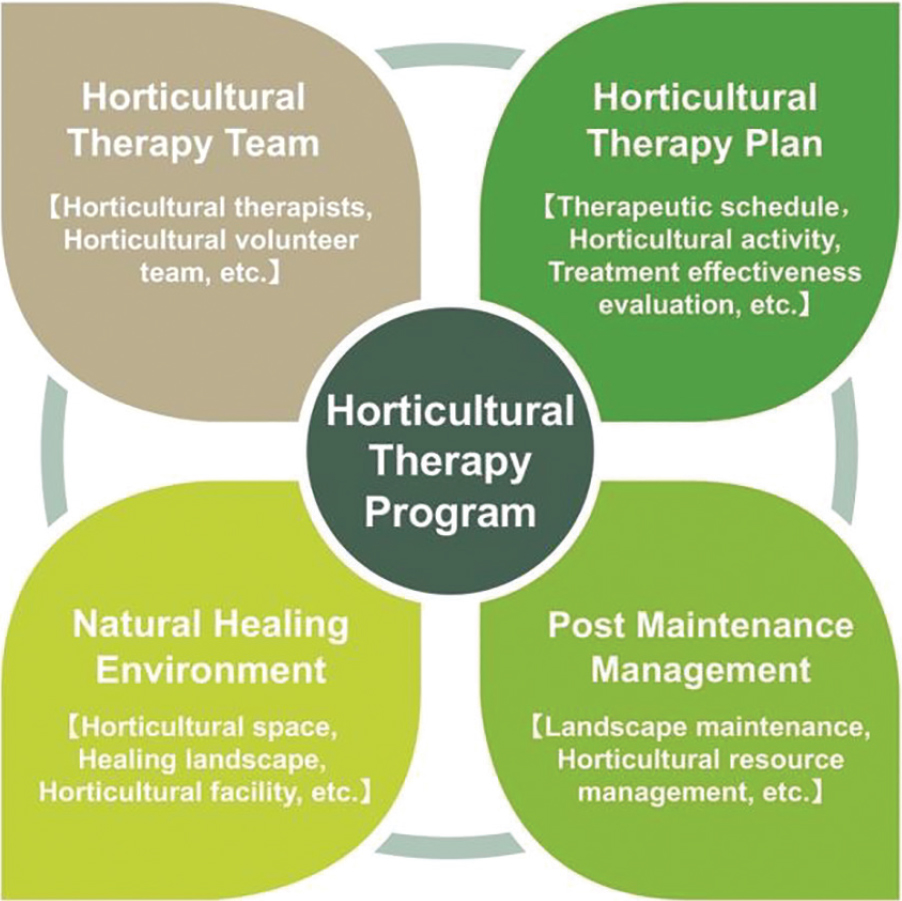
Figure 4.
Evaluation system construction based on the Delphi method.