
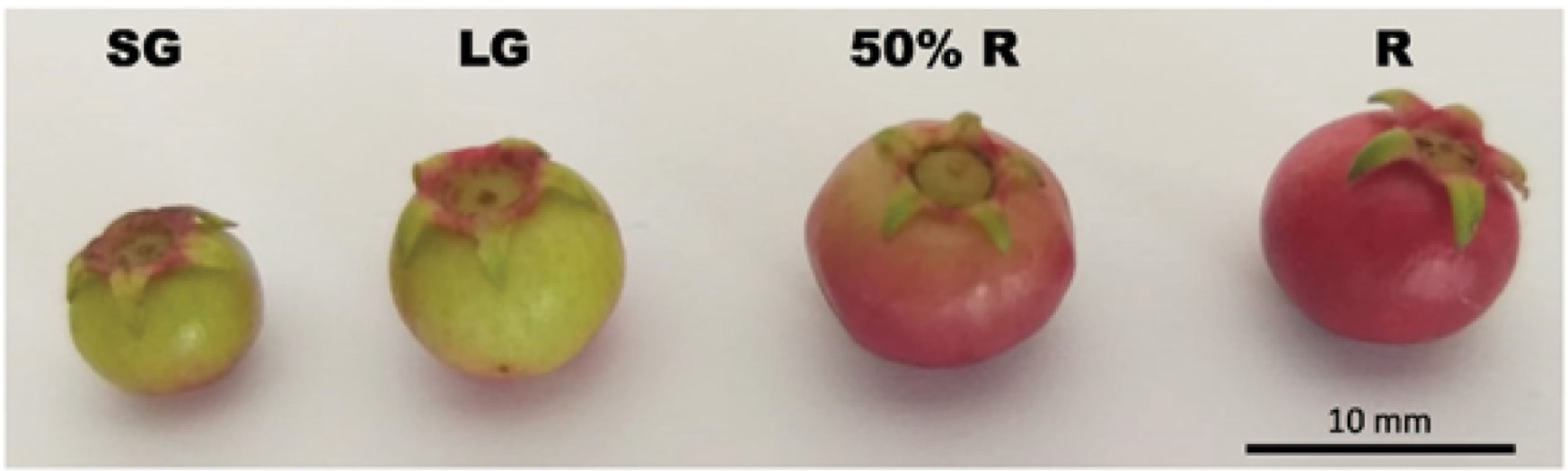
Figure 1:
Different ripening stages of Ugni molinae (murta) fruits: SG fruit; LG fruit; 50% R fruit; and ripe fruit (R). 50%R, 50% ripe; LG, large green; SG, small green.
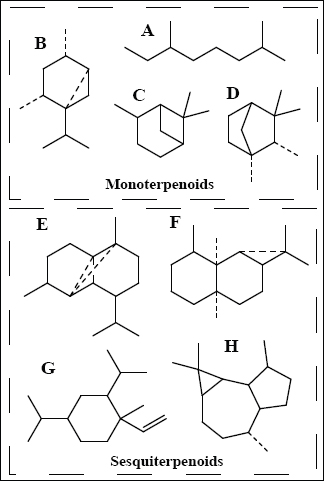
Figure 2.
Chemical structures of the terpenoid volatile compounds identified in murta fruits for all developmental stages. The letters correspond to the compounds whose concentrations are the ones described in Figure 7.
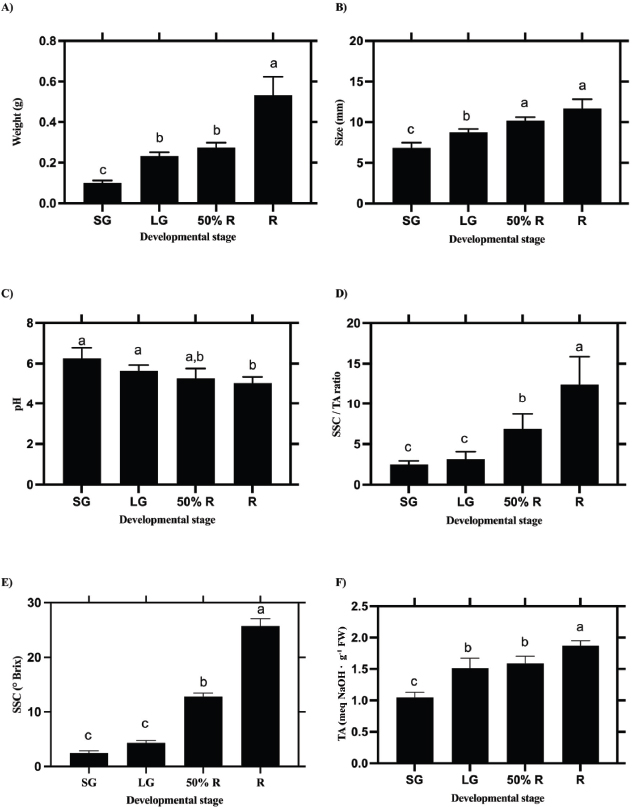
Figure 3.
Physiological parameters of murta fruits in the four developmental stages: (A) Weight; (B) Size; (C) pH; (D) SSC/TA ratio; (E) SSC and (F) TA. Different letters in a chart indicate statistical differences among samples. 50%R, 50% ripe; LG, large green; SG, small green; SSC, soluble solids concentration; TA, titratable acidity.
Table 1.
Colour readings of the four stage of murta fruit peel.
| Stage | L* | a* | b* | C* | h° | Color |
|---|---|---|---|---|---|---|
| SG | 43.75 ± 7.18 | –4.80 ± 1.60 | 27.80 ± 5.92 | 28.30 ± 5.63 | 280.42 ± 5.34 | |
| LG | 44.37 ± 10.19 | –5.74 ± 5.42 | 22.60 ± 4.58 | 23.98 ± 3.93 | 283.96 ± 14.63 | |
| 50%R | 42.70 ± 7.03 | 15.60 ± 10.56 | 25.97 ± 4.05 | 31.65 ± 5.96 | 60.95 ± 16.56 | |
| R | 33.49 ± 4.67 | 28.79 ± 6.63 | 18.02 ± 2.33 | 34.15 ± 5.94 | 32.77 ± 6.16 |
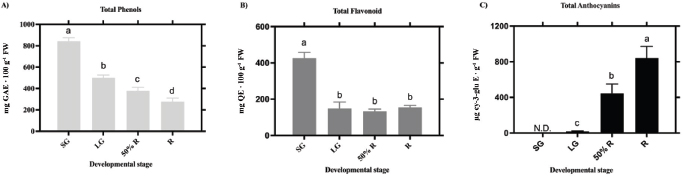
Figure 4.
Chemical analyses of fruit. (A) Total phenolics, (B) total flavonoids and (C) total anthocyanins contents were analysed at different developmental stages. Data correspond to mean ± SE of three biological replicates. Different letters indicate significant differences among samples (p ≤ 0.05; ANOVA). 50%R, 50% ripe; FW, fresh weight; GAE, gallic acid equivalents; LG, large green; SG, small green.
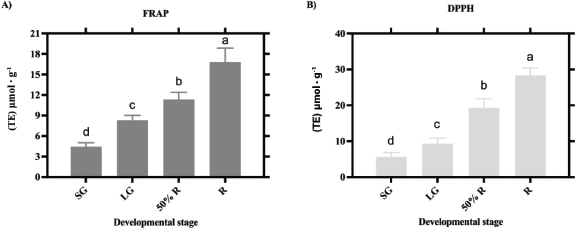
Figure 5.
Antioxidant capacity. Free radical scavenging activity by DPPH (A) and FRAP (B) were estimated in different developmental stage of fruit. Data correspond to mean ± SE of three biological replicates. Different letters indicate significant differences among developmental stages [p ≤ 0.05; ANOVA]. 50%R, 50% ripe; FRAP, ferric reducing antioxidant power; LG, large green; SG, small green.
Table 2.
Relative abundance of terpenoid volatile compounds in murta fruits according to their chemical structure, expressed as RA (RA · g–1 FW, and RA · berry–1).
| Developmental stage | RA · g–1 FW | RA · berry–1 | ||||
|---|---|---|---|---|---|---|
| G | 50%R | R | G | 50%R | R | |
| Acyclic monoterpenoids | 4.87 ± 0.26 ab | 3.63 ± 0.93 a | 6.76 ± 0.38 b | 1.05 ± 0.11 a | 1.07 ± 0.25 a | 1.94 ± 0.38 b |
| Monocyclic monoterpenoids | 16.46 ± 0.72 ab | 14.16 ± 2.99 a | 24.7 ± 2.80 b | 3.55 ± 0.36 a | 4.17 ± 0.78 ab | 7.19 ± 1.62 b |
| Bicyclic monoterpenoids | 17.11 ± 0.49 ab | 13.16 ± 2.58 a | 21.11 ± 0.76 b | 3.56 ± 0.53 a | 3.87 ± 0.67 a | 6.11 ± 1.22 a |
| Total monoterpenoids | 38.44 ± 0.5 ab | 30.95 ± 6.5 a | 52.57 ± 3.18 b | 8.16 ± 0.95 a | 9.11 ± 1.7 ab | 15.23 ± 3.16 b |
| Monocyclic sesquiterpenoids | 1.17 ± 0.24 a | 0.82 ± 0.36 a | 1.47 ± 0.39 a | 0.27 ± 0.03 a | 0.24 ± 0.10 a | 0.45 ± 0.12 a |
| Bicyclic sesquiterpenoids | 2.32 ± 0.30 a | 1.64 ± 1.30 a | 2.66 ± 1.05 a | 0.48 ± 0.07 a | 0.48 ± 0.37 a | 0.78 ± 0.22 a |
| Tricyclic sesquiterpenoids | 2.66 ± 0.55 a | 2.37 ± 1.59 a | 2.87 ± 0.20 a | 0.55 ± 0.11 a | 0.69 ± 0.45 a | 0.92 ± 0.09 a |
| Total sesquiterpenoids | 6.15 ± 1.09 a | 4.83 ± 3.25 a | 7.00 ± 0.46 a | 1.31 ± 0.19 a | 1.41 ± 0.92 a | 2.15 ± 0.14 a |
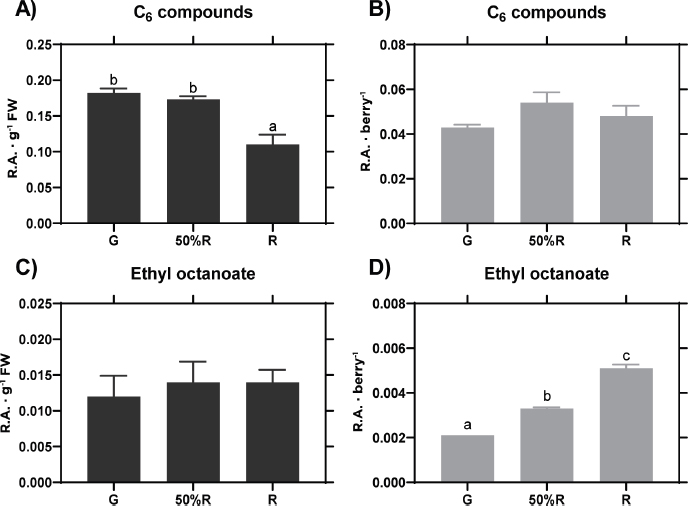
Figure 6.
Volatile organic compounds profile. Relative abundance of C6 compounds relative to FW (A) and per berry basis (B). Relative abundance of ethyl octanoate relative to FW (C) and per berry basis (D). Different letters indicate significant differences among samples (p ≤ 0.05; ANOVA). 50%R, 50% ripe; FW, fresh weight.
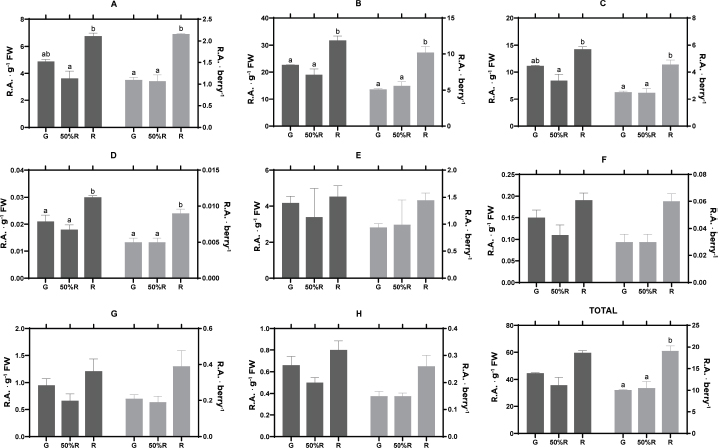
Figure 7.
Terpenoid volatile compounds profile. The relative abundance of terpenoids grouped by backbone (Figure 2). (A) Pinene type, (B) terpinene type, (C) camphene type, (D) ocimene type, (E) cymene type, (F) cardinene type, (G) maaliene type, (H) elemene type, and total terpenoids. Different letters indicate statistical differences among the development stages for each concentration unit, and the graphs without letters indicate that there are no statistical differences. Dark columns correspond to the RA per gram of FW, and light columns correspond to the RA per berry. 50%R, 50% ripe; FW, fresh weight; RA relative areas.