
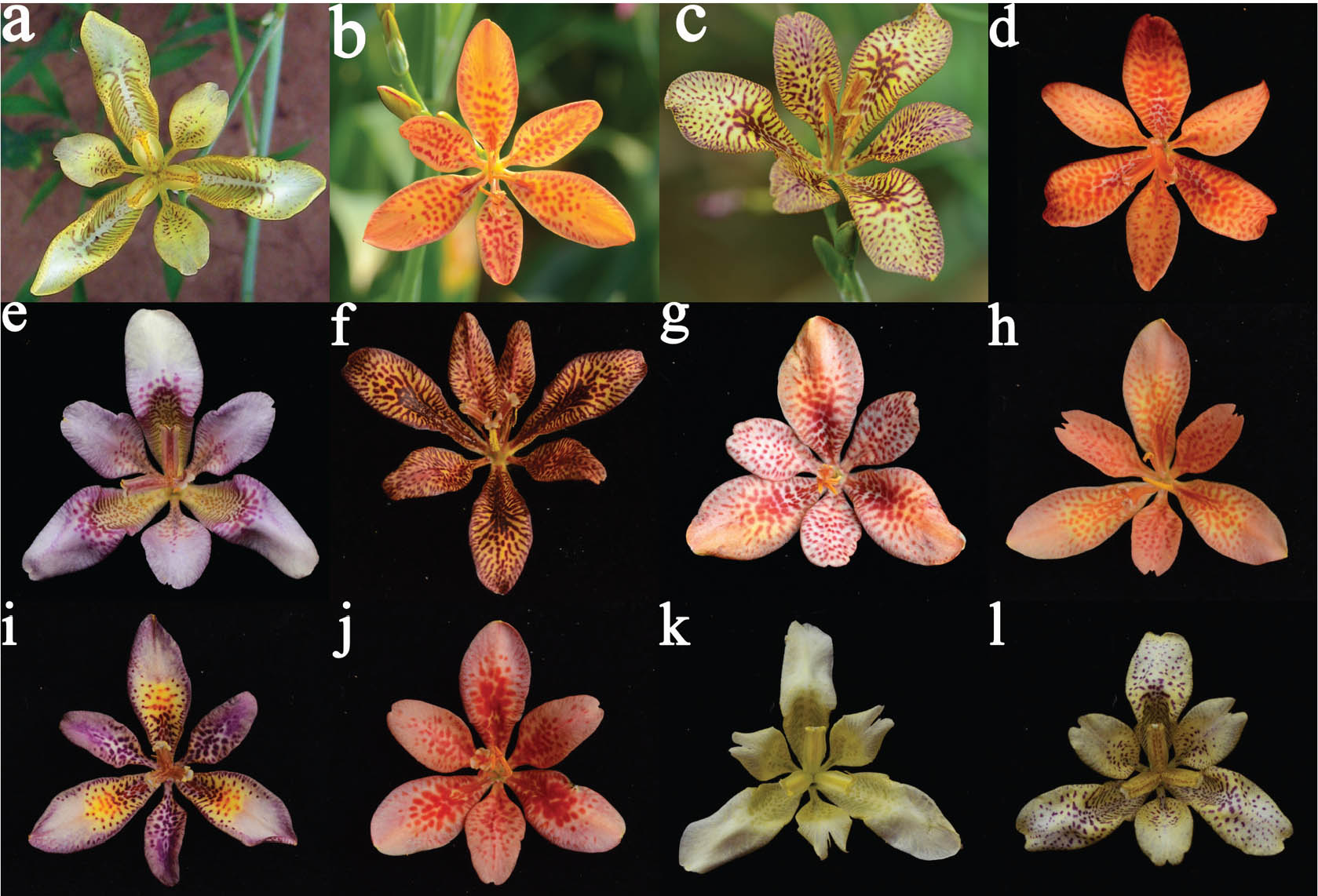
Figure 1
The flower of I. dichotoma (Y2), I. domestica (S3) and their hybrid progenies: A – I. dichotoma (Y2); B – I. domestica (S3); C – F1-5; D – F2-1; E – F2-2; F – F2-3; G – BC1-S-1; H – BC1-S-2; I – BC1-S-3; J–BC1-S-4; K – BC1-Y-1; l – BC1-Y-2.
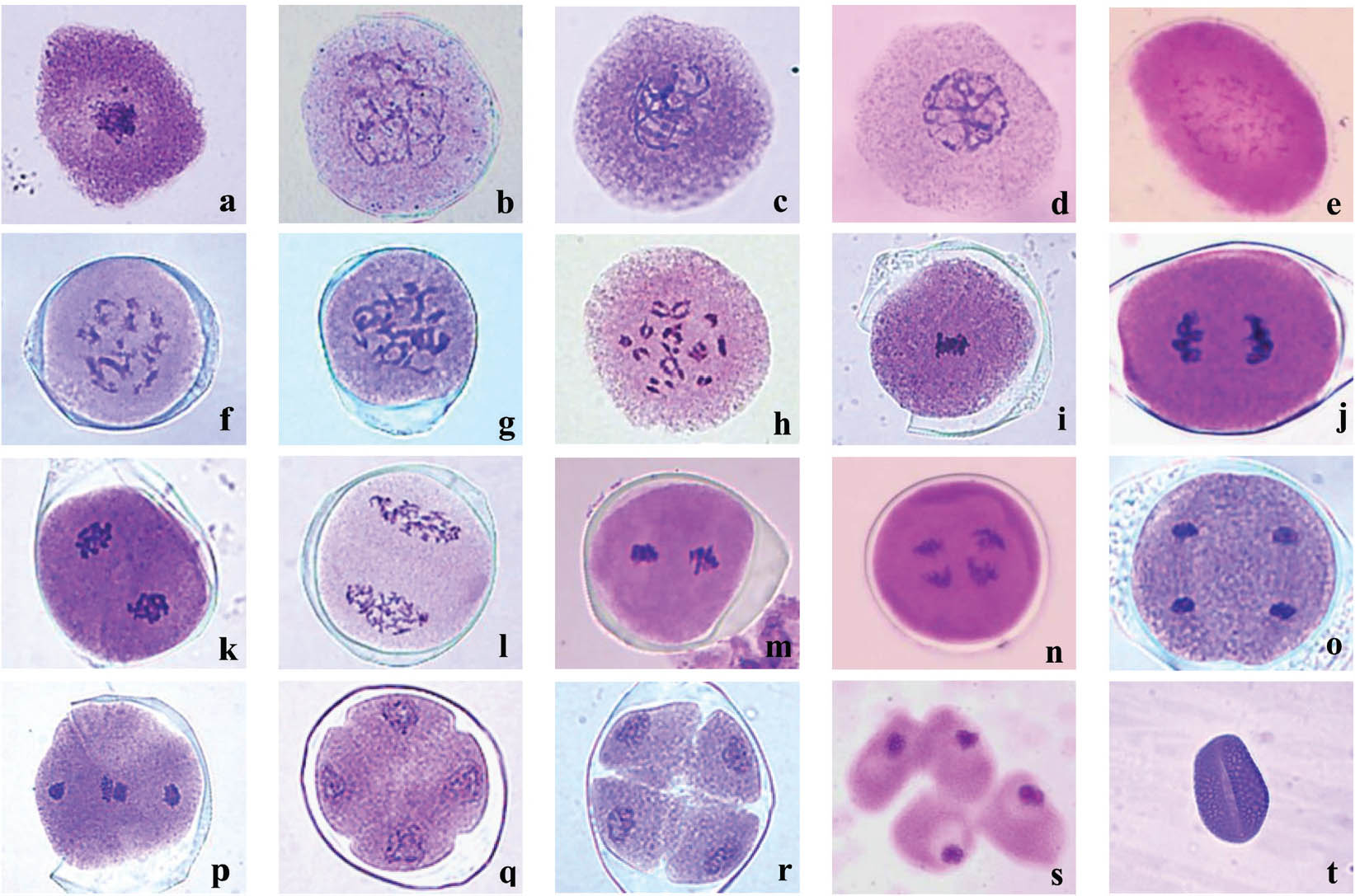
Figure 2
Normal meiosis process of pollen mother cells in I. dichotoma (Y2), I. domestica (S3) and their hybrid progenies: A – pollen mother cell (BC1-S-2); B – leptotene (BC1-S-2); C – zygotene (BC1-S-2); D – pachytene (BC1-S-4); E – the diffuse appearance of diplotene (F1-5); F – late diplotene (BC1-Y-1); G – late diplotene (F2-3); H – diakinesis (BC1-S-4); I – metaphase I (BC1-S-2); J – anaphase I (BC1-S-4); K – telophase I (BC1-S-2); L – prophase II (BC1-S-2); M – metaphase II (BC1-Y-2); N – anaphase II (F1-5); O – telophase II (BC1-S-4); P – telophase II (BC1-S-2); Q, R – tetrad (BC1-S-4); S – tetrad spores (BC1-S-4); T – pollen (Y2).
Table 1
The meiosis abnormalities rate (%) in I. dichotoma, I. domestica and their hybrid progenies.
| Y2 | S3 | F1-5 | F2-1 | F2-2 | F2-3 | BC1-S-1 | BC1-S-2 | BC1-S-3 | BC1-S-4 | BC1-Y-1 | BC1-Y-2 | |
|---|---|---|---|---|---|---|---|---|---|---|---|---|
| Metaphase I | 288 | 241 | 200 | 130 | 184 | 210 | 162 | 207 | 165 | 80 | 142 | 150 |
| Non-congression | 114 (39.6%) | 94 (39.0%) | 83 (41.5%) | 57 (43.8%) | 80 (43.5%) | 85 (40.5%) | 98 (60.5%) | 126 (60.9%) | 78 (42.3%) | 30 (37.5%) | 40 (28.2%) | 27 (18.0%) |
| Anaphase I | 216 | 170 | 156 | 104 | 155 | 140 | 113 | 120 | 150 | 126 | 115 | 143 |
| Lagging chromosomes | 82 (37.9%) | 35 (20.6%) | 53 (34.0%) | 11 (10.6%) | 42 (27.1%) | 31 (22.1%) | 46 (40.7%) | 50 (41.7%) | 60 (40.0%) | 41 (32.5%) | 24 (20.9%) | 14 (9.8%) |
| Bridge | 19 (8.7%) | 0 (0.0%) | 28 (17.9%) | 12 (11.5%) | 5 (3.2%) | 18 (12.9%) | 3 (2.7%) | 6 (5.0%) | 11 (7.3%) | 15 (11.9%) | 5 (4.3%) | 10 (7.0%) |
| Telophase I | 195 | 152 | 152 | 123 | 121 | 127 | 107 | 102 | 109 | 88 | 120 | 167 |
| Unequal separation | 22 (11.3%) | 8 (5.3%) | 35 (23.0%) | 64 (52.0%) | 13 (10.7%) | 9 (7.1%) | 47 (43.9%) | 24 (23.5%) | 0 (0.0%) | 25 (28.4%) | 27 (22.5%) | 45 (26.9%) |
| Micronuclei | 7 (3.6%) | 0 (0.0%) | 3 (2.0%) | 0 (0.0) | 9 (7.4%) | 12 (9.4%) | 10 (9.3%) | 4 (3.9%) | 19 (17.4%) | 5 (5.7%) | 3 (2.5%) | 0 (0.0%) |
| Metaphase II | 160 | 160 | 154 | 230 | 131 | 140 | 101 | 142 | 164 | 142 | 150 | 150 |
| Non-congression | 1 (0.6%) | 14 (8.8%) | 24 (15.6%) | 67 (29.1%) | 28 (21.4%) | 19 (13.6%) | 26 (25.7%) | 24 (16.9%) | 30 (18.3%) | 22 (15.5%) | 10 (6.7%) | 5 (3.33%) |
| Abnormal spindle | 3 (1.9) | 2 (1.3%) | 41 (26.6%) | 76 (33.0%) | 6 (4.6%) | 17 (12.1%) | 14 (13.9%) | 54 (38.0%) | 61 (37.2%) | 44 (31.0%) | 25 (16.7%) | 34 (22.7%) |
| Anaphase II | 220 | 188 | 202 | 221 | 194 | 200 | 214 | 281 | 310 | 235 | 250 | 269 |
| Lagging chromosomes | 31 (14.1%) | 26 (13.8%) | 12 (5.9%) | 42 (19.0%) | 51 (26.3%) | 26 (13.0%) | 14 (6.5%) | 51 (18.1%) | 43 (13.9%) | 54 (23.0%) | 22 (8.8%) | 46 (17.1%) |
| Bridge | 6 (2.7%) | 0 (0.0%) | 14 (6.9%) | 8 (3.6%) | 11 (5.7%) | 10 (5.0%) | 0 (0.0%) | 0 (0.0%) | 17 (5.5%) | 6 (2.6%) | 0 (0.0%) | 3 (1.1%) |
| Abnormal spindle | 5 (2.3%) | 6 (3.2%) | 17 (8.4%) | 46 (20.8%) | 27 (13.9%) | 11 (5.5%) | 64 (29.9%) | 30 (10.7%) | 71 (22.9%) | 16 (6.8%) | 6 (2.4%) | 2 (0.7%) |
| Not synchronous division | 14 (6.4%) | 11 (5.9%) | 33 (16.3%) | 74 (33.5%) | 39 (20.1%) | 23 (11.5%) | 70 (32.7%) | 90 (32.0%) | 65 (21.0%) | 75 (31.9%) | 29 (11.6%) | 14 (5.2%) |
| Telophase II | 223 | 172 | 200 | 150 | 125 | 183 | 151 | 138 | 152 | 295 | 166 | 121 |
| Unequal separation | 43 (19.3%) | 42 (24.4%) | 76 (38.0) | 91 (60.7%) | 62 (49.6%) | 67 (36.6%) | 82 (54.3%) | 72 (56.5%) | 96 (63.2%) | 98 (33.2%) | 33 (19.9%) | 21 (17.4%) |
| Micronuclei | 8 (3.6%) | 0 (0.0%) | 1 (4.5%) | 1 (0.7%) | 4 (3.2%) | 12 (6.6%) | 24 (15.9%) | 6 (4.3%) | 2 (1.3%) | 30 (10.2%) | 19 (11.4%) | 12 (9.9%) |
| Total | 1,302 | 1,083 | 1,064 | 958 | 910 | 1,000 | 848 | 990 | 1,050 | 966 | 943 | 1,000 |
| Abnormalities rate | 26.2% | 22.0% | 39.5% | 57.3% | 41.4% | 34.2% | 58.7% | 54.5% | 52.7% | 47.7% | 25.8% | 23.3% |
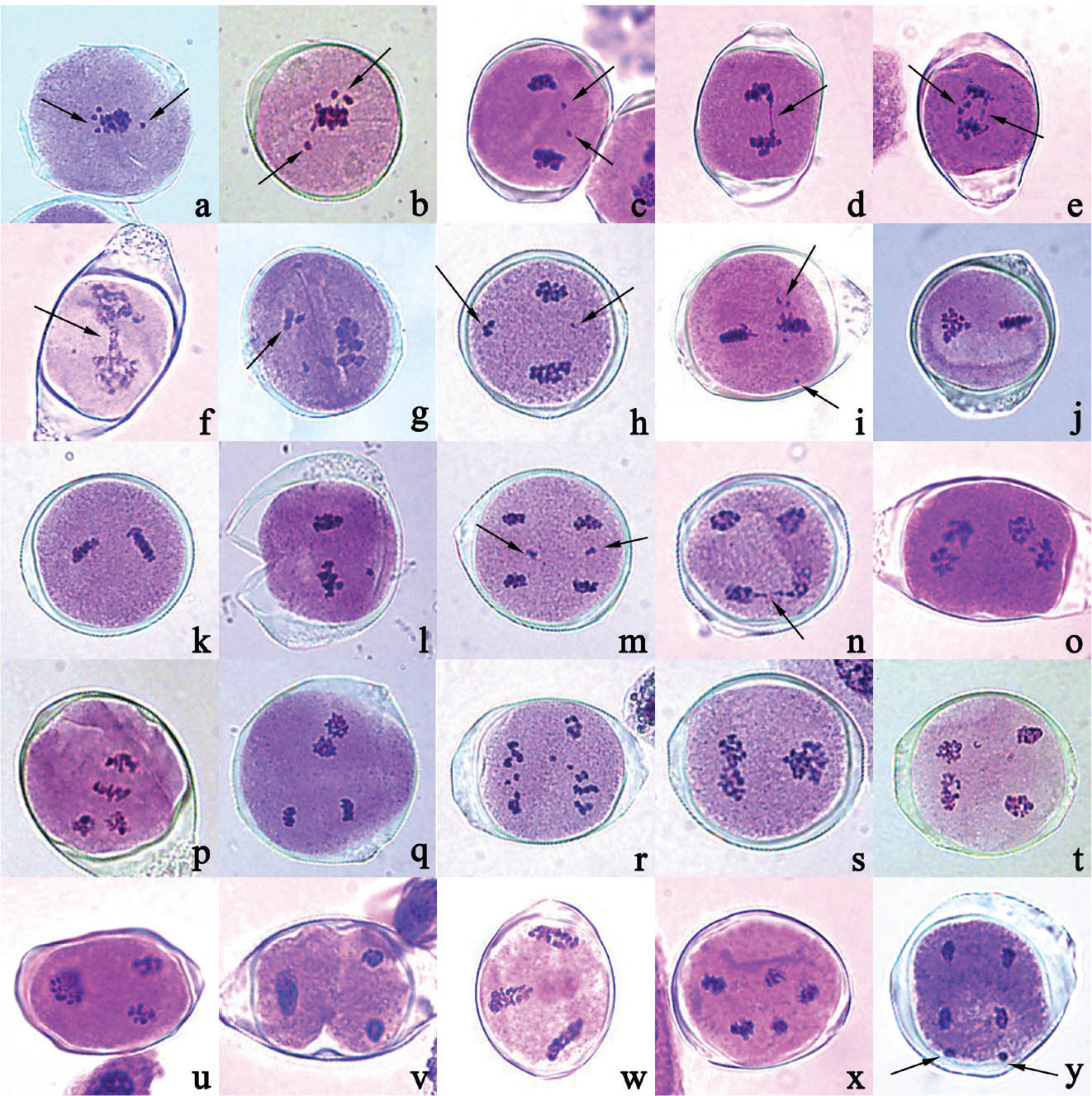
Figure 3
Abnormal meiosis phenomena in pollen mother cells of F1, F2 and BC1 plants from the cross I. dichotoma (Y2) × I. domestica (S3): A, B – non-congression in metaphase I of F2-2 and F1-5, respectively; C – laggard chromosomes in anaphase I of BC1-Y-1; D – bridge in anaphase I of BC1-S-2; E – double bridges in anaphase I of F2-3; F – thick bridge in anaphase I of BC1-S-1; G – unequal separation in telophase I of F2-1; H – micronuclei in telophase I of BC1-S-2; I – non-congression in metaphase II of BC1-S-3; J – early separation in metaphase II of BC1-S-1; K – tripolar spindle fibres in metaphase II of F2-1; L – perpendicular spindle fibres in metaphase II of BC1-S-1; M – laggard chromosomes in anaphase II of BC1-S-2; N – bridge in anaphase II of F2-3; O – tripolar spindle fibres in anaphase II of F2-1; P, Q – perpendicular spindle fibres in anaphase II of F1-5 and BC1-S-2, respectively; R – multiple spindle fibres of BC1-S-3; S, T – not synchronous division in anaphase II of F1-5 and F2-3, respectively; U, V – unequal separation in telophase II of BC1-S-4; W – unequal separation in telophase II of BC1-S-4; X – unequal separation in telophase II of BC1-S-2; Y – two micronuclei in telophase II of BC1-S-2.
Table 2
Distribution (%) of sporad configurations in I. dichotoma, I. domestica and their hybrid progenies.
| Materials | No. of cells studied | Monad Rate (%) | Dyad Rate (%) | Triad Rate (%) | Tetrad Rate (%) | Polyad Rate (%) |
|---|---|---|---|---|---|---|
| Y2 | 245 | 1.9 | 4.3 | 10.6 | 83.1 | 0.0 |
| S3 | 213 | 0.0 | 3.8 | 13.6 | 78.4 | 4.2 |
| F1-5 | 253 | 0.4 | 5.1 | 5.5 | 50.2 | 38.7 |
| F2-1 | 208 | 10.1 | 36.5 | 16.4 | 35.1 | 1.9 |
| F2-2 | 201 | 6.0 | 0.0 | 16.0 | 72.1 | 6.0 |
| F2-3 | 260 | 0.0 | 7.7 | 30.8 | 57.7 | 3.9 |
| BC1-S-1 | 432 | 2.3 | 14.6 | 33.8 | 45.4 | 3.9 |
| BC1-S-2 | 254 | 1.2 | 7.1 | 29.1 | 51.2 | 11.4 |
| BC1-S-3 | 271 | 5.5 | 11.1 | 33.2 | 46.1 | 4.1 |
| BC1-S-4 | 373 | 0.0 | 4.6 | 37.0 | 53.1 | 5.4 |
| BC1-Y-1 | 363 | 1.7 | 10.5 | 34.2 | 47.9 | 5.8 |
| BC1-Y-2 | 319 | 1.3 | 15.7 | 34.5 | 44.5 | 4.1 |
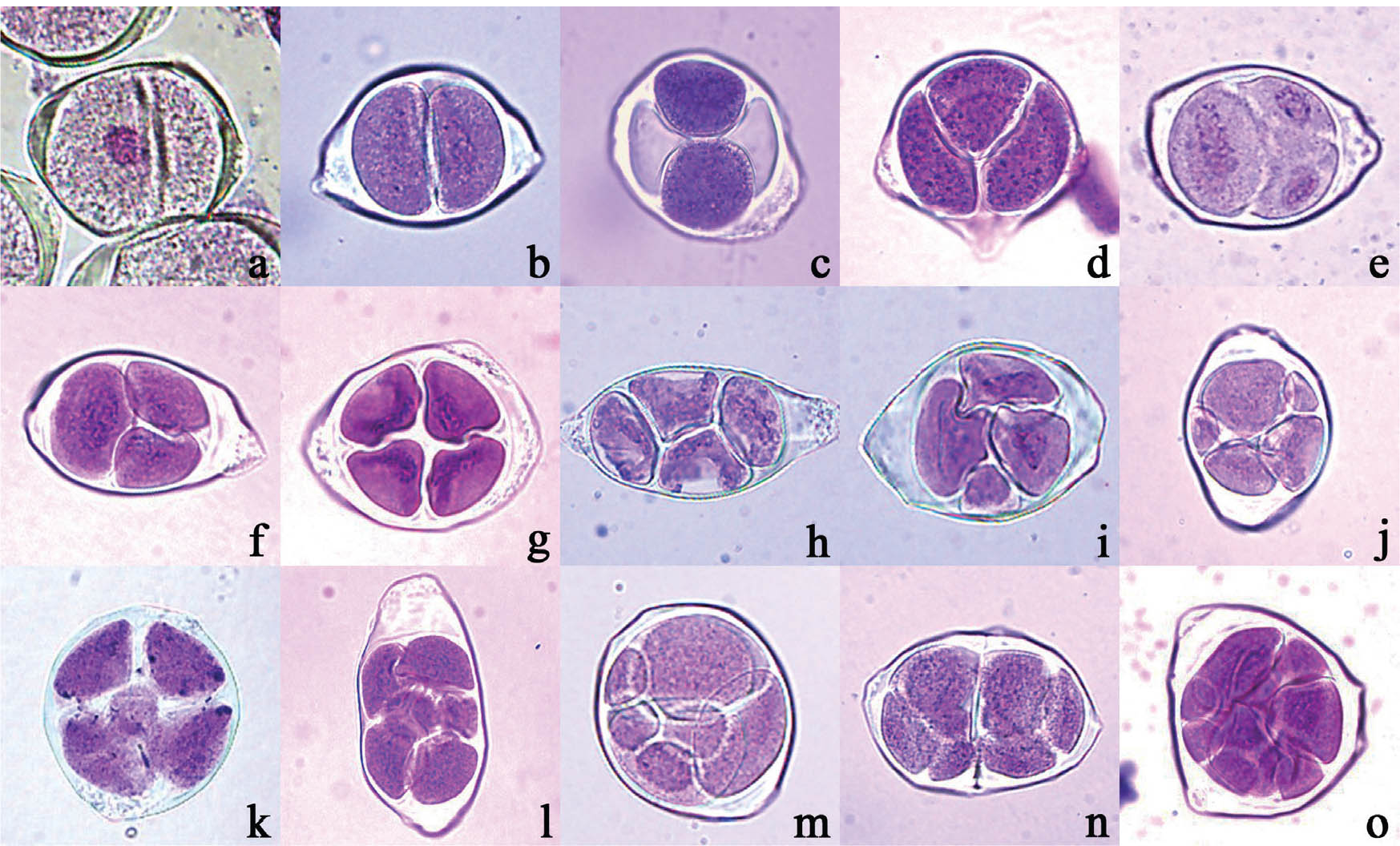
Figure 4
The meiosis sporad in I. dichotoma (Y2), I. domestica (S3) and their hybrid progenies: A – monad of F2-1; B – dyad of BC1-S-3; C – dyad of F2-2; D – triad of BC1-Y-1; E – triad of BC1-S-3; F – triad of F2-3; G – tetrad of F1-5; H – tetrad of BC1-S-2; I – tetrad of BC1-S-1; J – pentad of BC1-S-2; K – pentad of BC1-S-4; L – polyad of F2-3; M – polyad of BC1-S-3; N – polyad of BC1-S-1; O – polyad of BC1-S-2.
Table 3
Pollen germination rates of I. dichotoma (Y2), I. domestica (S3) and their hybrid progenies.
| Materials | Pollen in plant | Normal pollen size (μm) | Large pollen (%) | No. of pollens observed | No. of pollens germinated | No. of abort pollens | Abortion rate (%) | Germination rate (%) |
|---|---|---|---|---|---|---|---|---|
| Y2 | More | 65–75 | 0.5 | 1,713 | 447 | 33 | 1.9 | 26.1 |
| S3 | More | 60–70 | 0.2 | 2,706 | 951 | 392 | 14.5 | 35.1 |
| F1-5 | More | 60–70 | 0.8 | 2,039 | 205 | 738 | 36.2 | 10.1 |
| F2-1 | None | – | – | – | – | – | – | – |
| F2-2 | Little | 63–73 | 0.7 | 1,354 | 32 | 628 | 46.4 | 2.4 |
| F2-3 | More | 60–70 | 1.1 | 1,014 | 218 | 323 | 31.9 | 21.5 |
| BC1-S-1 | None | – | – | – | – | – | – | – |
| BC1-S-2 | Little | 61–71 | 1.7 | 582 | 9 | 311 | 53.4 | 1.6 |
| BC1-S-3 | Little | 62–72 | 1.7 | 673 | 32 | 334 | 49.6 | 4.8 |
| BC1-S-4 | More | 58–68 | 1.9 | 1,049 | 76 | 139 | 13.3 | 7.2 |
| BC1-Y-1 | More | 65–75 | 2.0 | 1,899 | 526 | 696 | 36.7 | 27.7 |
| BC1-Y-2 | More | 63–73 | 2.3 | 1,916 | 597 | 631 | 32.9 | 31.2 |
[i] Large pollen grains: >1.3× diameter of normal-sized pollen.
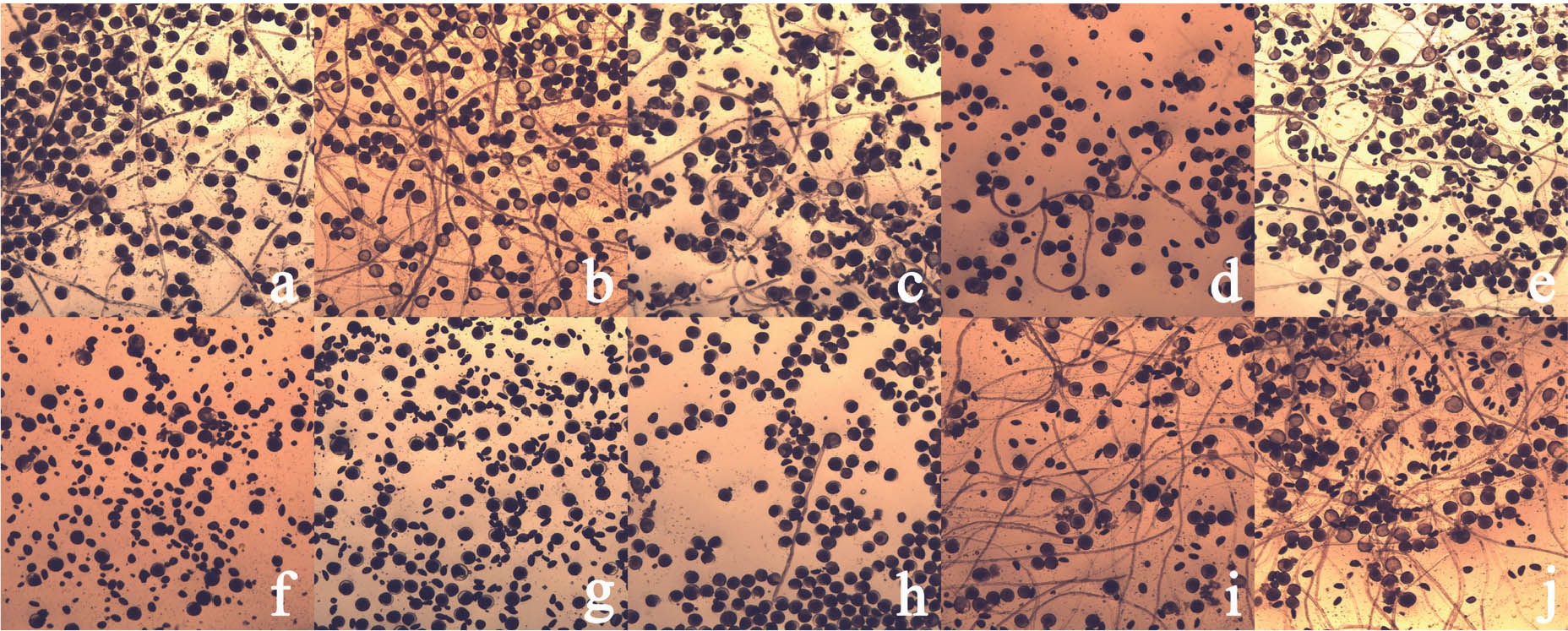
Figure 5
Pollen germination of I. dichotoma (Y2), I. domestica (S3) and their hybrid progenies: A – I. dichotoma (Y2); B – I. domestica (S3); C – F1-5; D – F2-2; E – F2-3; F – BC1-S-2; G – BC1-S-3; H – BC1-S-4; I – BC1-Y-1; J – BC1-Y-2.
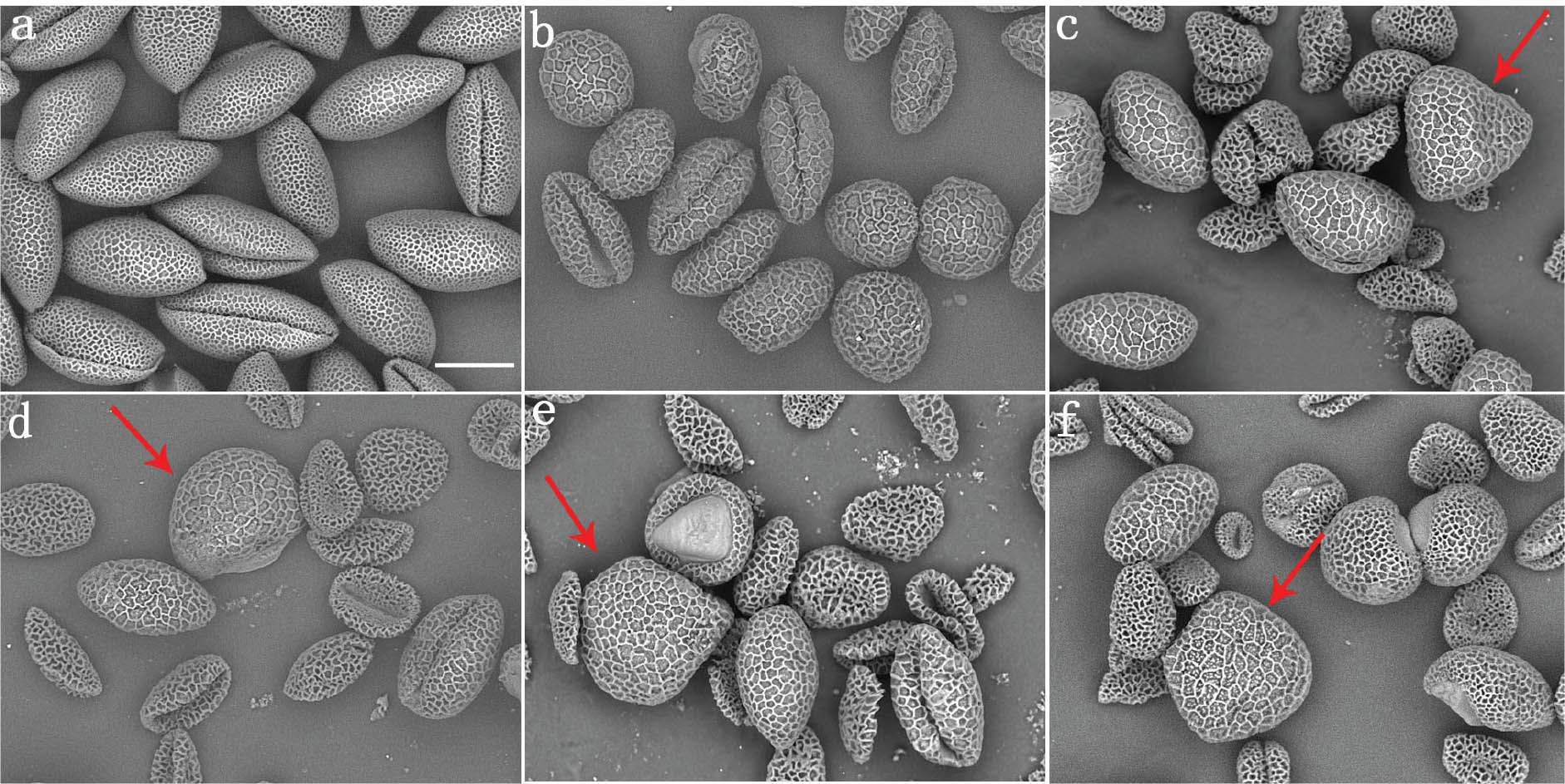
Figure 6
Scanning electron micrographs of different pollen grains: A – Y2; B – S3; C – F1-5; D – F2-3; E – BC1-S-3; F – BC1-S-4. C–F – occurrence of large pollen grains. Scale bar = 50 μm (magnification 500×).