
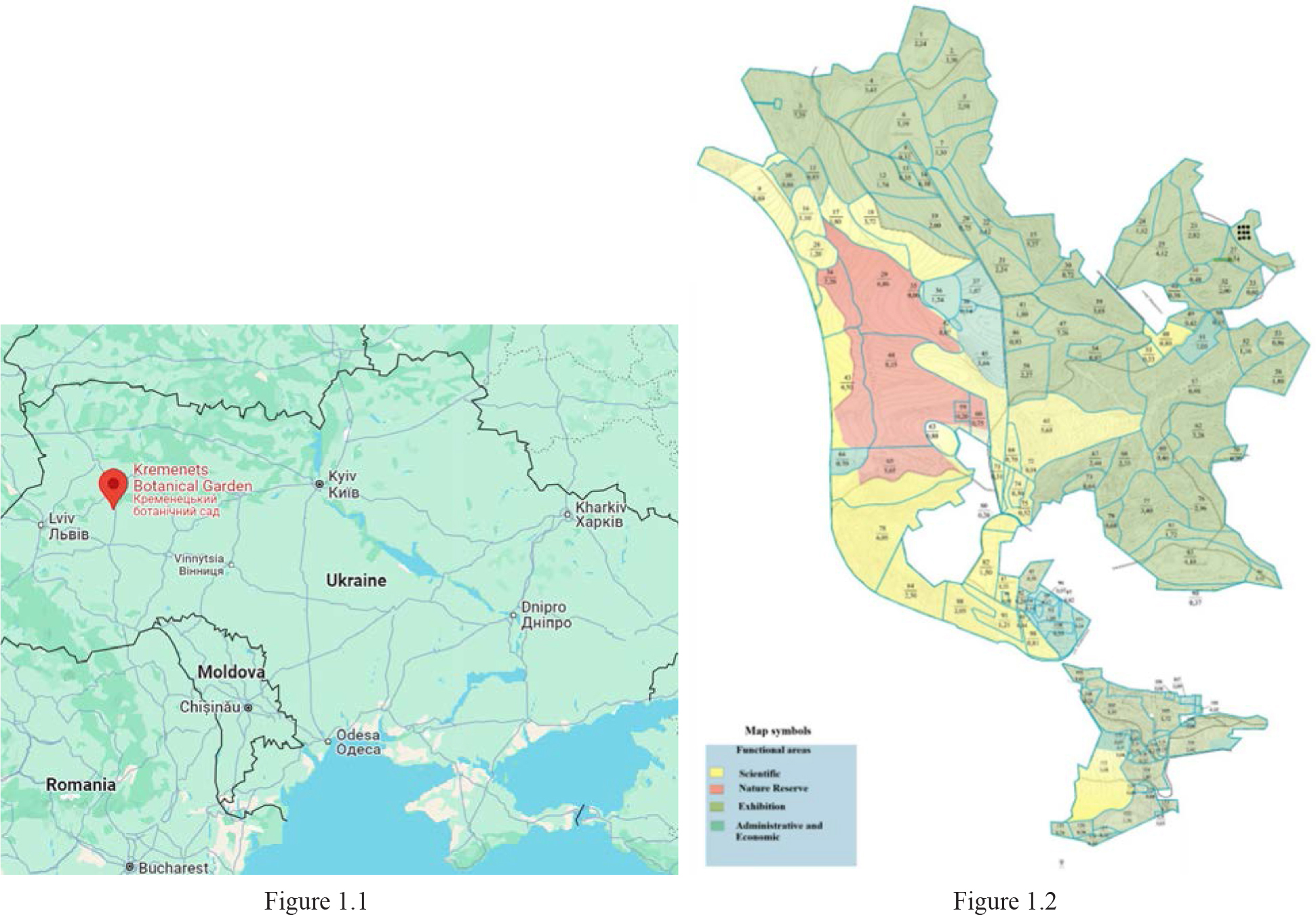
Figure 1.
Location (1.1) and zoning (1.2) of the Kremenets Botanical Garden with the arrangement of temporary experimental plots. Source.
Source 1.1: Compiled by the authors using Google maps online resource; Source 1.2: Data of the Kremenets Botanicatl Garden Territory Organisation Project 2019
Table 1.
Area distribution by the plot categories (in potential use), %
| Number | Plot categories in potential use | Area,% |
|---|---|---|
| 1 | Arboretum | 3.7 |
| 2 | Tree nursery | 1.4 |
| 3 | Fruit crop introduction plot | 1.3 |
| 4 | Landscaping plots | 1.0 |
| 5 | Area of natural flora | 38.5 |
| 6 | Protected zone | 10.6 |
| 7 | Podillia phytocoenosis sub-zone | 1.9 |
| 8 | Polissia phytocoenosis sub-zone | 9.7 |
| 9 | Recreational plot. Summer houses for holidaymakers | 1.2 |
| 10 | Old park | 1.0 |
| 11 | Monitoring and research area | 13.4 |
| 12 | Territory of special gardens | 1.5 |
| 13 | Power line route | 1.0 |
| 14 | Centre for breeding rare and endangered plants | 1.8 |
| 15 | Other | 12.0 |
| Total | 100.0 | |
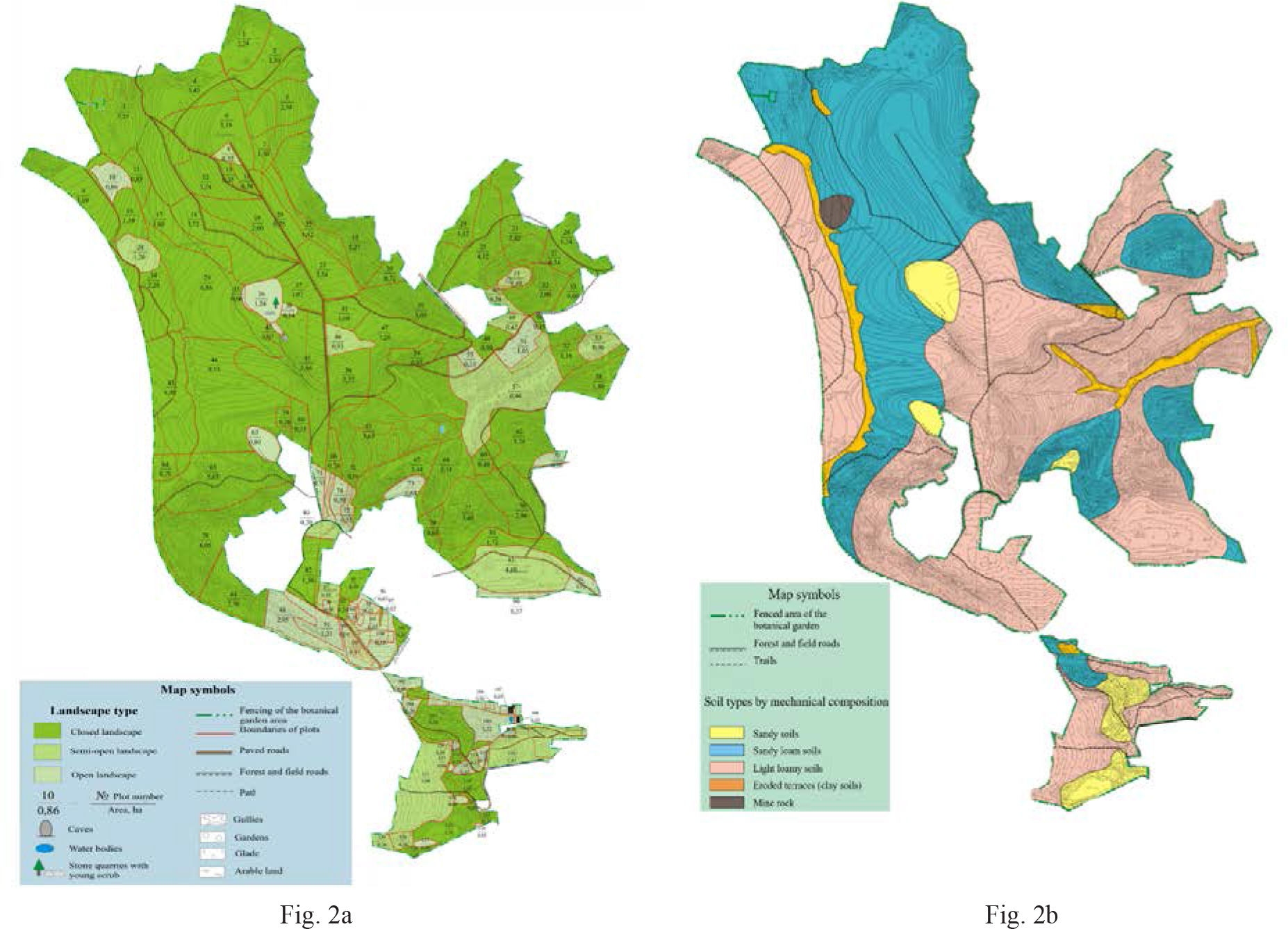
Figure 2.
Schematic map of the distribution of landscape types (a) and soils (b)
Source: Data of the Kremenets Botanicatl Garden Territory Organisation Project 2019
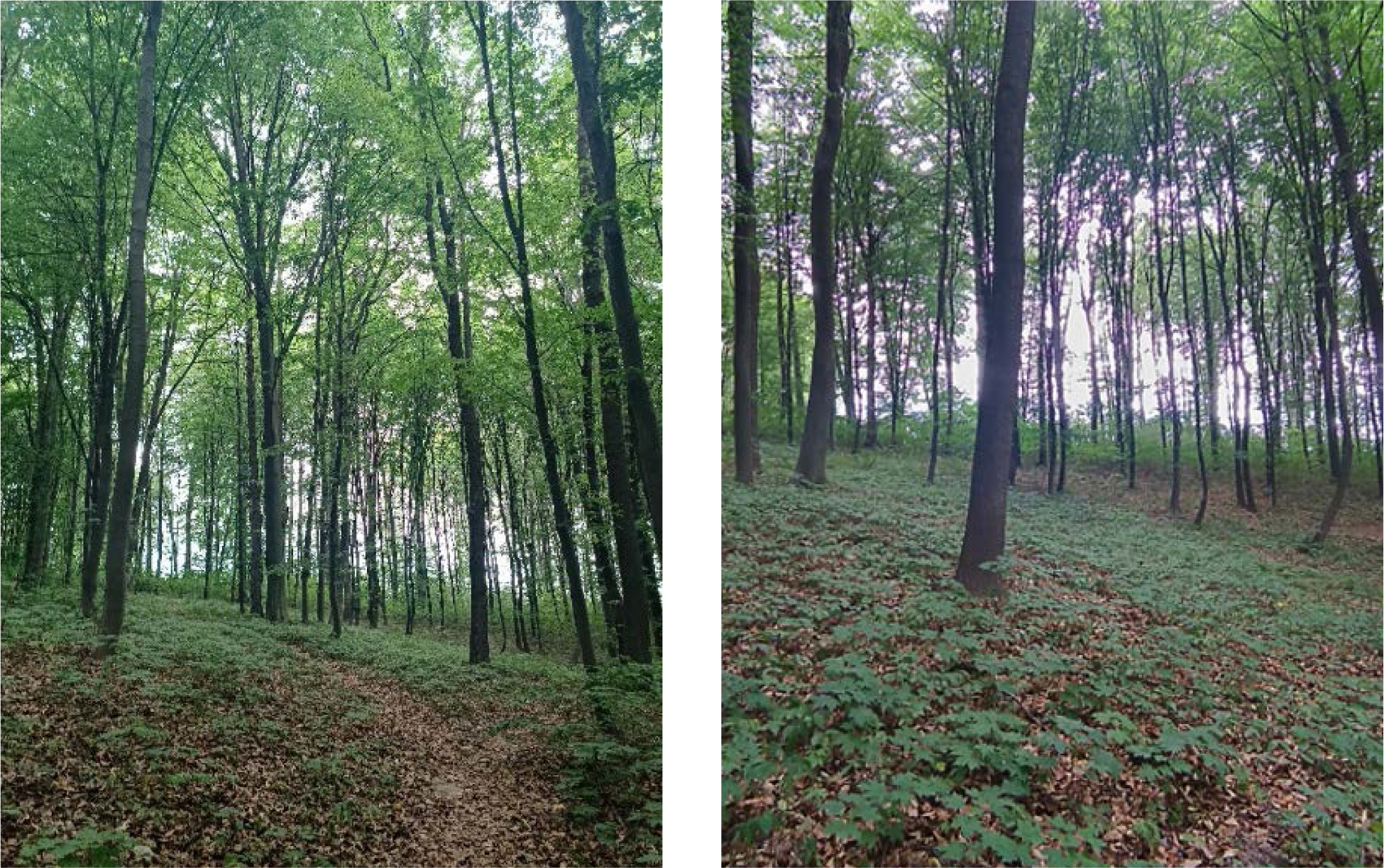
Figure 3.
Distribution of the European beech (Fagus sylvatica L.) in Section 26 of the Kremenets Botanical Garden as at 6 July 2026
Source: developed by the authors
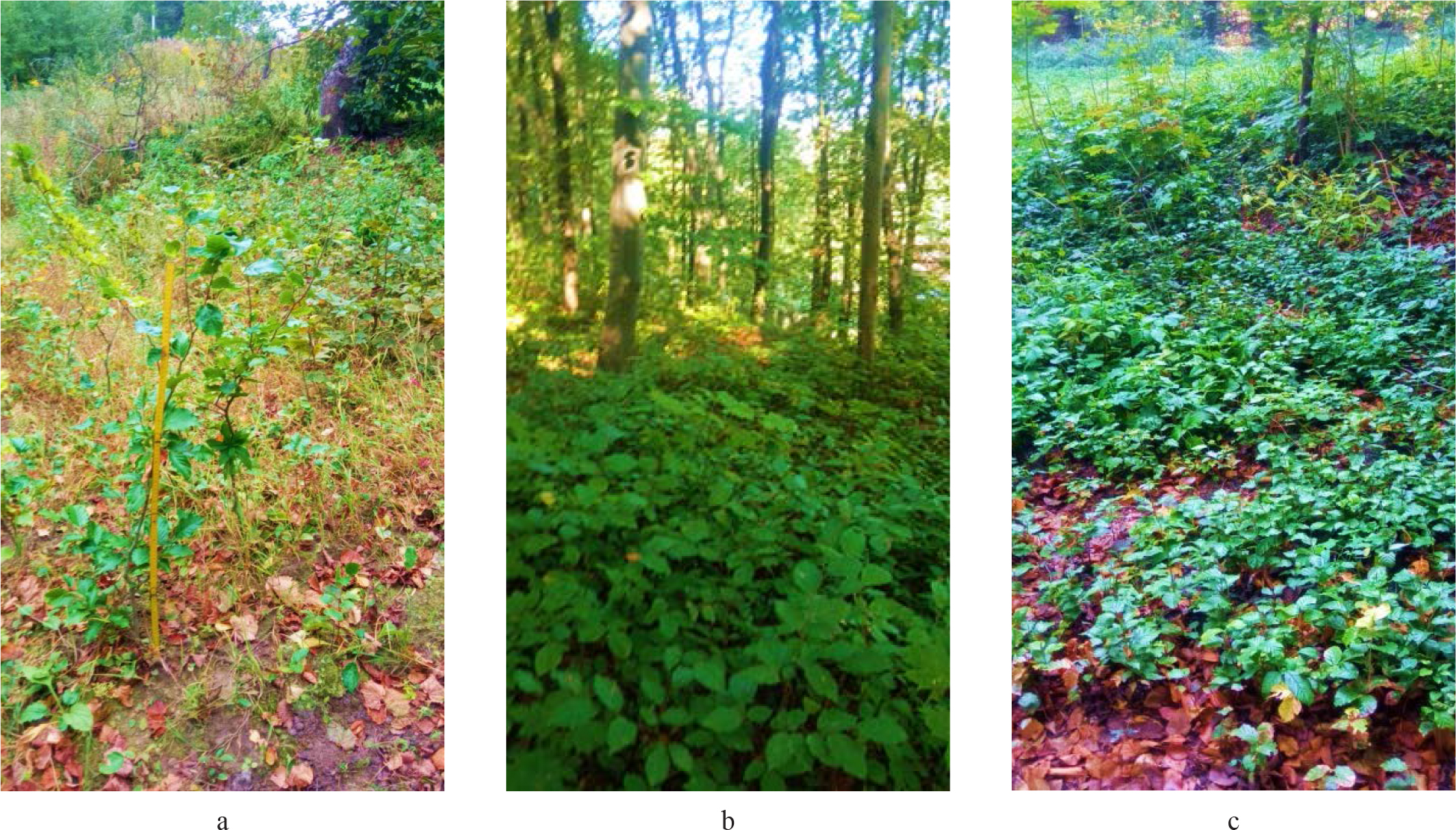
Figure 4.
Location of natural regeneration inventory plots (a – big advance regeneration with a height of up to 1.5 m; b – medium advance regeneration of up to 0.6 m height; c – small advance regeneration of up to 0.25 m height)
Source: developed by the authors
Table 2.
Characteristics of European beech natural regeneration on temporary sample plots
| Sample plot number | Age, years | Height of undergrowth, m | Viability category | Advance regeneration quantity, plant number | Density | Forest litter thickness, cm |
|---|---|---|---|---|---|---|
| 1 | 1 | Small up to 0.25 m | Normal viability | 460 | Very dense | 1–2 |
| 2 | 1 | 120 | Medium density | 1–2 | ||
| 3 | 1 | 26 | Sparse | 1–2 | ||
| 4 | 2–3 | Medium up to 0.5 m | Normal viability | 260 | Dense | 1–2 |
| 5 | 2–3 | 76 | Medium density | 1–2 | ||
| 6 | 2–3 | 19 | Sparse | 1–2 | ||
| 7 | 4–7 | Big up to 1.5 m | Normal viability | 19 | Sparse | 2–3 |
| 8 | 4–7 | 9 | Sparse | 2–3 | ||
| 9 | 4–7 | 5 | Sparse | 2–3 |
Table 3.
List of Red Data Book and regionally rare plant species
| Red Data Book species | Regionally rare species |
|---|---|
| Allium ursinum L. | Actea spicata |
| Botrychium lunaria (L | Alyssum gmelinii Jord |
| Cephalanthera damasonium (Mill.) Druce. | Anthyllis schiwereckii (DC) Blocki., |
| Dactylorhiza fuchsii (Druce) Soo, | Arum besseranum Schott |
| Dactylorhiza maculata (L.) Soo | Asplenium ruta-muraria L |
| Dactylorhiza majalis (Reichenb.) P.F. Hunt et Sammerhayes, | Asplenium trichomanes L. |
| Dactylorhiza. incarnata (L.) Soo | Carex humilis Leys. |
| Epipactis artrorubens Hoffm ex Bernb., | Convallaria majalis L. |
| Epipactis purpurata Swith. | Daphne mezereum L. |
| Galanthus nivalas L. | Filipendula vulgaris Moench. |
| Lilium martagon L | Geranium phaeum L. |
| Neottia nidus-avis L. | Helichrysum arenarium (L.) Moench. |
| Melittis sarmatica Klok., | |
| Minuartia aucta Klok. | |
| Parietaria officinalis L. | |
| Teucrium montanum L. | |
| Thymus podolicus Klok |