
Table 1.
Expected relationships between forest site condition, soil properties and humus forms used for rule-based ecological validation of NFI data
| Forest site type | Typical soils | Typical soil texture | Typical humus form | Typical tree species |
|---|---|---|---|---|
| A (poor sites) | Sod-podzolic soils | Sand | Moder (Mor) | Scots pine, birch |
| B (relatively poor sites) | Sod-podzolic soils | Sandy loams – light loams | Moder | Scots pine, oak |
| C (moderately fertile sites) | Grey forest soils | Sandy loams – light loams | Mull (Moder-Mull transitional forms) | Oak, hornbeam, maple, lime |
| D (fertile sites) | Dark grey forest soils, Chernozems, Brown forest soils | Medium to heavy loams and clays | Mull | Oak, ash, hornbeam, maple |
[i] Source: Compiled by the authors based on the Ukrainian forest typology (Pogrebnyak 1955, Ostapenko & Tkach 2002), forest soil fertility studies (Raspopina 2017, 2023) and forest floor classification (Zanella et al. 2011).
Table 2.
Results of the rule-based consistency check of edaphic records on subset of NFI plots (n=878)
| Indicator (logical check) | Number of plots with consistent records | Share of plots with consistent records (%) |
|---|---|---|
| Tree Species composition vs Forest site condition | 774 | 88.2 |
| Forest site condition vs Soil type | 671 | 76.4 |
| Forest site condition vs Soil texture* | 624 | 71.1 |
Table 3.
Agreement between original NFI field records and independent expert assessment for the subset of plots with available soil profile photographs (n = 120)
| Indicator | Number of plots with consistent records (n) | Share of plots with consistent records (%) |
|---|---|---|
| Forest site condition | 85 | 70.8 |
| Soil type | 88 | 73.1 |
| Humus form | 23 | 19.1 |
| Soil texture* | 83 | 68.9 |
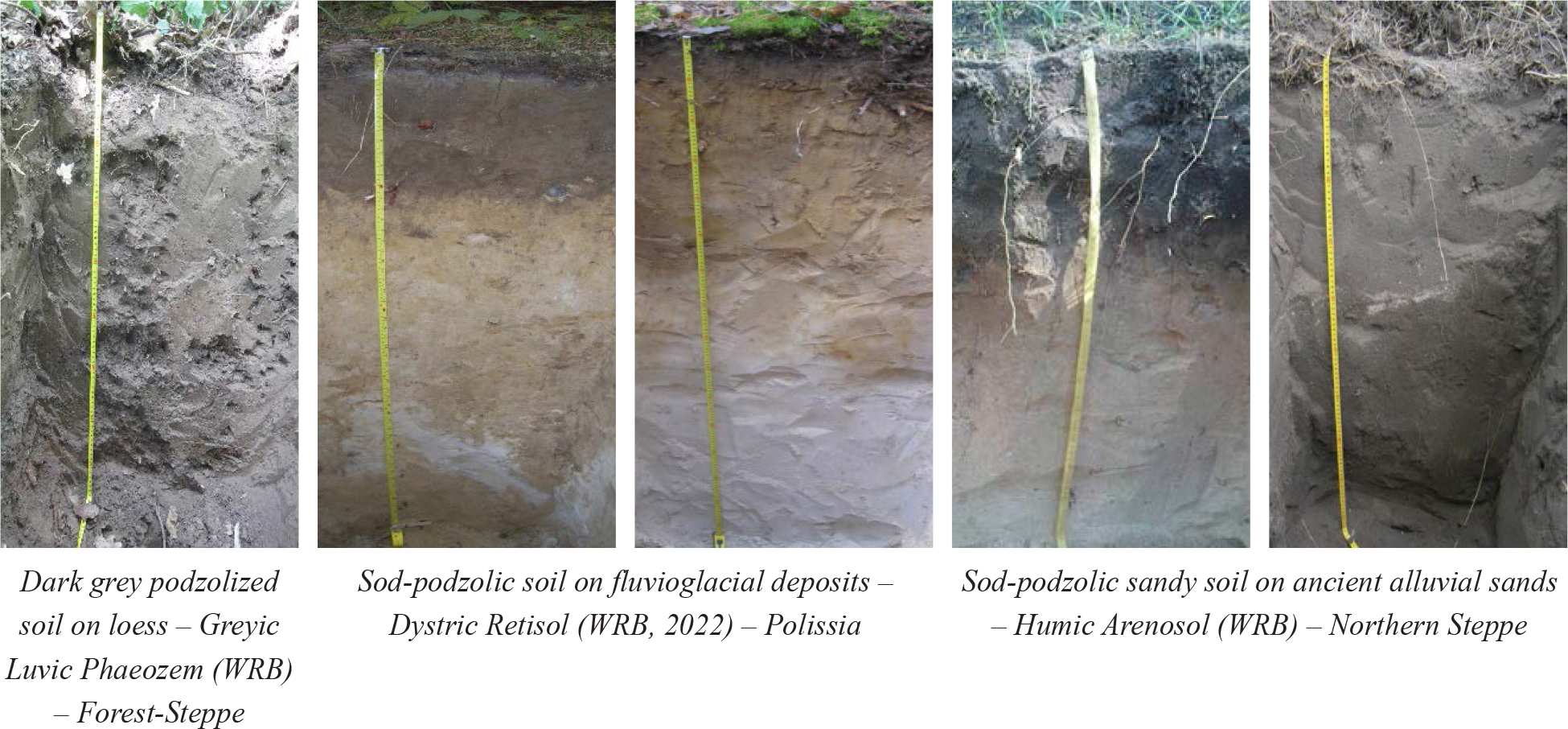
Figure 1.
Examples of soil profile morphology illustrating differences in humus horizon thickness among major ecological zones of Ukraine (photos by the authors)
Table 4.
Reference humus horizon depth thresholds for forest site fertility classes in Ukraine (adapted from Raspopina, 2017; 2023)
| Site fertility class | The humus horizon depth (thickness), cm | |
|---|---|---|
| Polissia Forest-Steppe, Northern Steppe | ||
| A | <10 (15) | <15 |
| AB | 10 | 15 |
| B | 15 | 15 |
| BC | 20 | 35 |
| C, D | 25 | 40 |