
Introduction
Silver fir (Abies alba Mill.) is a characteristic species of the mountainous forests of Central and Southern Europe (Bernadzki 2008). In Poland, its natural distribution is largely restricted to the southern regions, although several isolated lowland populations occur near the species’ northeastern range limit (Ilmurzyński and Włoczewski 2003; Puchniarski 2005). These enclaves (Jata, Jedlina, Topór, Rudka), represent the northeastern most occurrences of A. alba and include the only refugium of its autochthonous population in this region the “Tisovik” reserve in the Belarusian part of the Białowieża Forest (Gloger 1914; Szafer 1920; Jedliński 1922; Gunia and Kowalski 1968; Boratyński 1983; Korczyk 1999).
To date, 13 localities containing silver fir ranging from isolated individuals to small stands have been identified in the Polish part of the Białowieża Forest, including nine old-growth plots. The origins of most of these stands remain uncertain (Gunia and Kowalski 1968; Korczyk 2008; Barzdajn 2010; Marozau et al. 2026). Their ages vary widely, ranging from 19 to approximately 100 years, and all are believed to be of anthropogenic origin. The stand examined in this study is located in subcompartment 498 Ci. Historical sources disagree on its establishment: some report planting between 1928 and 1932 as a conservation measure (Korczyk 1995), while others suggest an earlier origin dating back to 1900–1910 (Korczyk 2008).
Stand growth and development are strongly influenced by age, making it one of the most important stand characteristics (Vangi et al. 2024). Accurate age determination is essential for understanding stand history, regeneration dynamics, and the onset of reproductive maturity—a key transition between the juvenile and mature ontogenetic stages (Chałupka 2006). Determining this threshold, which marks a fundamental transition in stand development, is an important prerequisite for establishing indicators used in forest management (Novák and Kacálek 2023). While these characteristics have long been well documented within the natural range of silver fir in Poland (Jaworski 2013; Załącznik … 2023), they remain poorly studied outside this range, particularly in the lowland conditions of the Białowieża Forest (Marozau et al. 2022).
Estimating tree age solely on the basis of size metrics (e.g., DBH and height) is unreliable, particularly in silver fir. The species can remain suppressed in deep shade for decades and then rapidly accelerate its growth following canopy release (Suchecki 1953; Gieruszyński 1961; Jaworski and Zarzycki 1983; Zasada 1998). This effort to determine true age conflicts with the commonly used forestry concept of “age class,” which groups coniferous stands into 20-year intervals (Szymkiewicz 2001; Instrukcja urządzania lasu 2012). While age classes are useful for general stand assessment, they are insufficient for identifying the subtle growth and developmental patterns (Rogozin and Razin 2015) investigated in this paper.
Therefore, this study addressed the following explicit research questions:
Can the true biological age of mature, shade-tolerant silver fir trees be reconstructed more accurately by integrating dendrochronological data with empirical corrections based on the height growth of juvenile plants?
At what biological age does silver fir reach reproductive maturity and initiate seed production under lowland conditions?
Material and Methods
The study was conducted in an old-growth population of silver fir growing outside its natural distribution range in the Polish part of the Białowieża Forest (52°67′ N, 23°81′ E) (Fig. 1). The forest type is mixed fresh forest, and the site is characterized by rusty proper soils (Klasyfikacja… 2000; Plan urządzenia lasu… 2011; FAO 2015). The groundwater level lies below 3 m. Lighting conditions vary significantly across a relatively small area. The light mosaic is formed by the interaction of dense silver fir canopies, with crown closure ranging from 0.7 to 0.9 in some groups, and open spaces left by the spruce’s demise, now overgrowing by natural deciduous trees. Diffuse light beneath mature tree crowns appears to promote the growth of young A. alba individuals more effectively than direct exposure near tree groups.
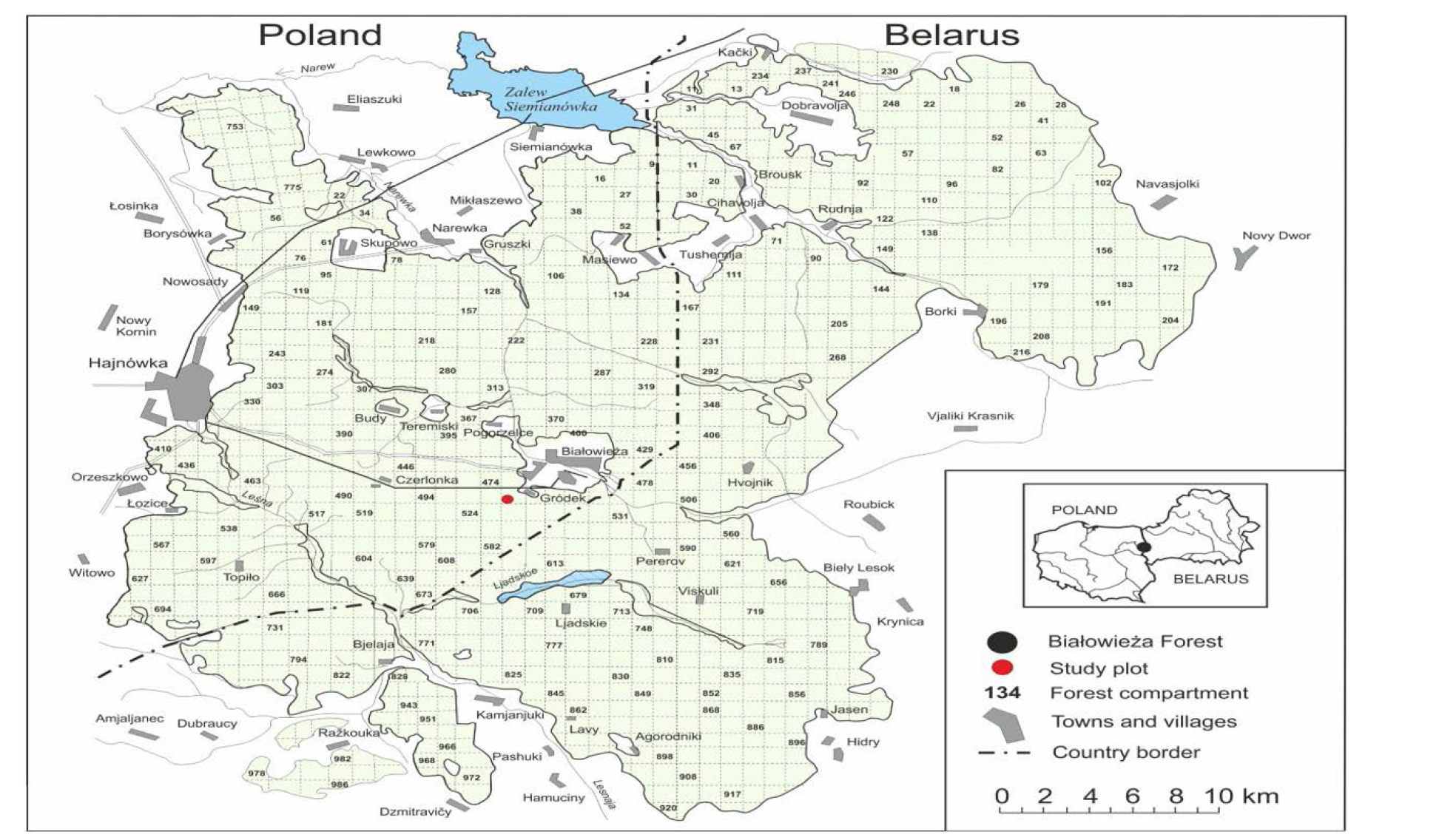
Figure 1.
Location of the study population in the Białowieża Forest (modified after Sokołowski 2004)
The population consists of 29 individuals distributed across a fenced 1.40 ha area, occurring either singly or in small clumps of up to five trees. The fencing prevents access by large herbivores. The mean diameter at breast height (DBH) of silver fir trees is 35.3 ± 16.2 cm (CV = 45.9%), and the mean height is 22.8 ± 7.9 m (CV = 34.8%). Norway spruce (Picea abies (L.) H. Karst.) was formerly the dominant species in the stand, with silver fir present as an admixture. However, most spruce died during 2012–2016 due to drought and outbreaks of the European spruce bark beetle (Ips typographus L.).
The current standing volume is 105 m3/ha, of which 60 m3 is pine and 45 m3 is oak. Following spruce mortality, an open gap formed, gradually becoming colonized by secondary-succession species whose canopy hinders silver fir regeneration. Nonetheless, its abundant and vigorous regeneration is present directly under mature fir crowns. The total density of A. alba regeneration is approximately 13,850 individuals per hectare.
In March 2021, increment cores were extracted from 29 mature silver fir trees using a Pressler borer. Cores were taken as close to the root collar as possible (8–52 cm aboveground), with one core collected per tree (Fig. 2). Boring holes were sealed with about 5 cm oak long cylinders coated with garden ointment and fitted flush with the bark surface to prevent infection.
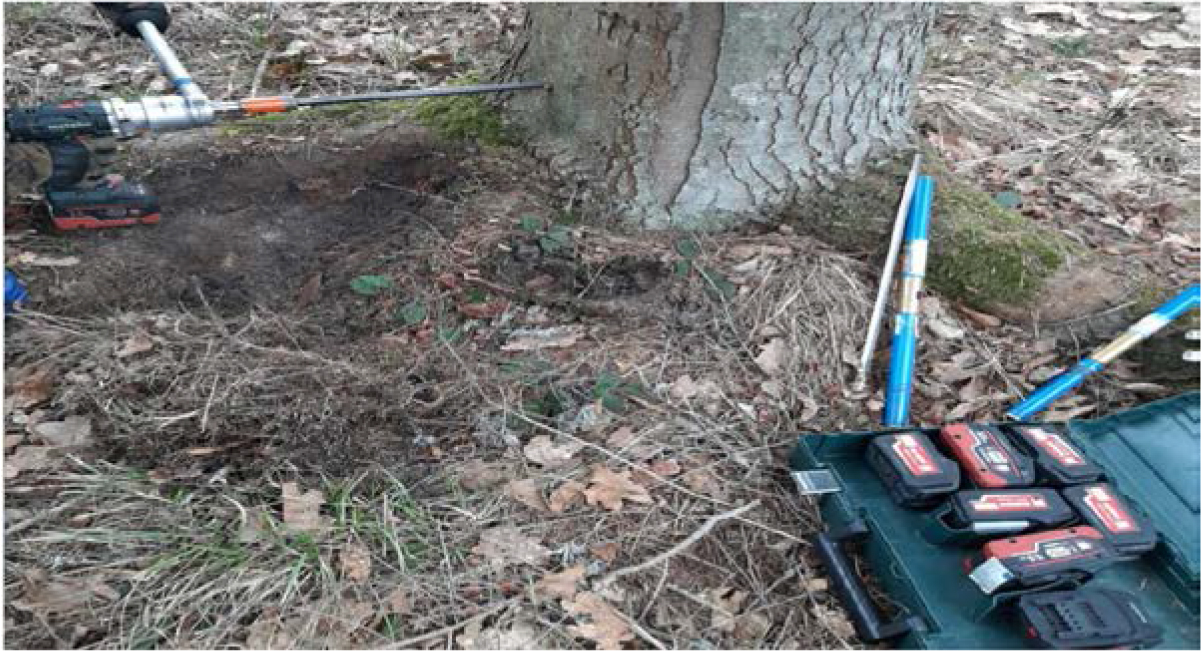
Figure 2.
Collecting an increment core with a Pressler borer at the tree base (photo by A. Marozau)
The decision to collect only one core from each tree was based on the following considerations: 1. To minimize injury and thereby reduce the risk of infection and weakening the tree. Silver fir is a rare species in the Białowieża Forest and occurs only in small numbers. 2. The overwhelming majority of cores passed through the center of the trunk, capturing all annual rings. 3. In the vast majority of cases, the cores contained intact wood, which facilitated an accurate count of annual rings. 4. No eccentric tree growth was observed.
Cores were glued to wooden mounts, sanded with progressively finer abrasives (250–1000 grit), scanned at 2400 dpi, and ring widths measured to a precision of 0.01 mm. The series were cross-dated using CooRecorder and CDendro (Larsson 2013; Maxwell and Larsson 2021), detrended using 30- year cubic smoothing splines with a 50% frequency cutoff (Cook and Peters 1981), and pre-whitened to remove autocorrelation (Cook and Kairiukstis 1990). A site chronology was then produced using bi-weighted robust means in the dplR package (Bunn 2008; Bunn et al. 2020; R Core Team 2020).
Key dendrochronological statistics included mean interseries correlation (Rbar), mean sensitivity (MS), first-order autocorrelation (AR1), expressed population signal (EPS), subsample signal strength (SSS), mean coherence (GLK), and signal-to-noise ratio (SNR) (Eckstein and Bauch 1969; Wigley et al. 1984; Cook and Kairiukstis 1990). Pith dates were either identified directly from ring curvature or estimated using early growth patterns and calculated pith offsets in CooRecorder when the pith was missing. Age at sampling height was then determined as: 2021 – pith year.
To estimate the number of years required for each tree to reach the coring height, age–height data obtained from natural regeneration within the study plot were used. As noted above, regeneration occurred in substantial quantities. This methodological approach is based on several assumptions, primarily that present-day regeneration patterns provide a reasonable approximation of juvenile growth conditions experienced by trees established approximately 80–100 years ago. In this regard, it should be noted that the main forest silvicultural parameters of the studied trees (Marozau et al. 2026) are comparable to those of trees growing under optimal conditions (Dobrowolska et al. 2015). This indirectly indicates that the influence of environmental factors on plants at all stages of ontogenesis was not negative in principle and did not exceed the genetically determined reaction norm. It is also important to emphasize that the light conditions of the juvenile stage were then and now similar (growth in shade) and corresponded to the biology of the species (Marozau et al. 2026). Therefore, the uncertainty associated with this reconstruction method is considered acceptable for approximating the early growth trajectories of trees established about a century ago. However, it cannot be ruled out that some trees were damaged by frost or animals during their juvenile stages, which may have reduced their early growth rates.
Silver fir seedlings and saplings growing beneath mature tree crowns i.e., under favorable light conditions, representing the full range of regeneration height classes were examined. In total, 92 individuals were analyzed, including only 30 saplings taller than 50 cm. This limited number of taller individuals reflects a well-known ecological pattern: under dense canopy conditions, relatively few regenerating silver firs surpass the critical “biological safety threshold,” typically defined at about 50 cm height, which separates self-sown seedlings from low undergrowth and indicates good future growth prospects (Dobrowolska 1998).
Each seedling or sapling stem was divided into 5 cm segments beginning at the root collar (Bruchwald 1999). Using an OPTA-TECH stereoscopic microscope, the number of annual rings was counted on transverse sections taken from the base of each segment, representing successive heights above the ground. In total, 640 stem sections were analyzed.
For each height (5, 10, 15 cm, and so on) the difference between the number of annual rings at the root collar and the number of rings at that height was calculated. This difference represented the number of years required for the regeneration to grow from the root collar to the given height. These values varied among the eight regeneration age groups, reflecting different establishment periods and light conditions (Tab. 1).
Table 1.
Parameters of age and growth of the new generation of A. alba
| Height, at which the number of annual rings in 2020 was counted (cm) | Average number of years required for regeneration to reach a certain height | ||||||||
|---|---|---|---|---|---|---|---|---|---|
| 5 | 2.7≈3 | ||||||||
| 10 | 5.4≈5 | ||||||||
| 15 | -* | 8.3≈8 | |||||||
| 20 | - | - | 11.0=11 | ||||||
| 25 | - | - | - | 13.4≈13 | |||||
| 30 | - | - | - | 15.3≈15 | |||||
| 35 | ** | - | - | - | 16.6≈17 | ||||
| 40 | - | - | - | - | 18.0=18 | ||||
| 45 | - | - | - | - | 18.6≈19 | ||||
| 50 | - | - | - | - | 19.0=19 | ||||
| 55 | - | - | - | - | 19.7≈20 | ||||
| 60 | - | - | - | - | 20.3≈20 | ||||
| 65 | ** | - | - | - | - | 20.8≈21 | |||
| 70 | ** | - | - | - | - | 21.0=21 | |||
| 75 | ** | - | - | - | - | - | 22.2≈22 | ||
| 80 | ** | - | - | - | - | - | 22.5≈23 | ||
| 85 | ** | - | - | - | - | 23.4≈23 | |||
| 90 | ** | ** | - | - | - | - | - | 23.5≈24 | |
| 95 | ** | ** | - | - | - | - | - | - | 26.0=26 |
| 100 | ** | - | - | - | - | - | - | - | 30 |
The biological age of mature trees was determined by combining their tree-ring ages at the sampling height with the height-growth data obtained from seedlings and saplings. Using the average number of years required for natural regeneration to reach specific height classes (5, 10, 15 cm, etc.) (Tab. 1), the average number of years required to grow one centimeter between consecutive height classes was calculated.
For each sampled mature tree, this per-centimeter value was multiplied by the number of centimeters between the actual coring height and the lower boundary of the corresponding height class. This product was then added to the baseline value shown in the rightmost column of Table 1 for that height class.
Thus, the actual total age of mature trees (D) was calculated using the formula:
where:A is the age obtained by counting tree rings at the sampling height using the CooRecorder program;
F is the approximate number of years required to reach the sampling height, obtained using a dataset of the ageheight relationship between the natural regeneration cohorts that emerged under the canopies of the studied trees;
6 is the number of years elapsed from the time of coring (spring 2021) to the year of age assessment (fall 2026).
Additionally, the age of the oldest regeneration cohort (Tab. 1) was used to determine the approximate onset of seed production. The difference between the actual age of the mature trees and the age of the oldest regeneration minus one year to account for the lag between seed production and seedling emergence was taken as the estimated age at which the trees first fruited. It should be emphasized that this indirect estimate of reproductive maturity is approximate, fruiting may have begun even earlier, since it cannot be ruled out that earlier regeneration cohorts could have been eliminated (e.g. zoogenic factor) before the start of the study or their representatives simply missed the experimental sample of 92 specimens.
All descriptive statistics, including means, medians, standard deviations, standard errors, minimum and maximum age values and coefficients of variation, were calculated using R software (R Core Team 2020). To account for potential outliers in tree age distribution, median values were prioritized. The uncertainty in reconstructed mature tree ages is expressed as a standard deviation and confidence interval.
Results
The time required for regeneration to attain heights between 5 and 100 cm ranged from 3 to 30 years (means) (Tab. 1). Some height classes had identical mean values (e.g., 19 years at 45 and 50 cm; 20 years at 55 and 60 cm; 21 years at 65 and 70 cm; and 23 years at 80 and 85 cm). This overlap likely reflects a combination of genetic variability and spatial diversity in light conditions. The calculated median time for plants to reach the core height was 14 years (Tab. 2).
Table 2.
The calculated real age of mature silver fir trees and their establishment years
| Tree ID | Tree age at sampling height in March 2021 based on the tree ring data | Tree ring sampling height (cm) | Calculated number of years required to reach the sampling height | Calculated real tree age in 2026 | Year of trees establishment |
|---|---|---|---|---|---|
| A | 75 | 40 | 18 | 99 | 1927 |
| B | 81 | 38 | 18 | 105 | 1921 |
| C | 78 | 22 | 12 | 96 | 1930 |
| D | 80 | 16 | 9 | 95 | 1931 |
| J | 64 | 15 | 8 | 78 | 1948 |
| E | 79 | 20 | 11 | 96 | 1930 |
| 1 | 83 | 52 | 19 | 108 | 1918 |
| 2 | 79 | 17 | 9 | 94 | 1932 |
| 3 | 76 | 29 | 15 | 97 | 1929 |
| 4 | 73 | 29 | 15 | 94 | 1932 |
| 5 | 73 | 30 | 15 | 94 | 1932 |
| 6 | 61 | 33 | 16 | 83 | 1943 |
| 8 | 78 | 29 | 15 | 99 | 1927 |
| 9 | 85 | 22 | 12 | 103 | 1923 |
| H | 76 | 12 | 7 | 89 | 1937 |
| G | 85 | 14 | 7 | 98 | 1928 |
| F | 79 | 29 | 15 | 100 | 1926 |
| 10 | 84 | 21 | 11 | 101 | 1925 |
| 20 | 75 | 8 | 4 | 85 | 1941 |
| 11 | 80 | 33 | 16 | 102 | 1924 |
| 12 | 76 | 47 | 19 | 101 | 1925 |
| 13 | 78 | 29 | 15 | 99 | 1927 |
| 14 | 74 | 27 | 14 | 94 | 1932 |
| 15 | 81 | 12 | 12 | 99 | 1927 |
| I | 78 | 10 | 5 | 89 | 1937 |
| 16 | 80 | 35 | 17 | 103 | 1923 |
| 19 | 75 | 35 | 17 | 98 | 1928 |
| 17 | 83 | 20 | 11 | 100 | 1926 |
| 18 | 79 | 23 | 12 | 97 | 1929 |
| Mean | 77.5 | - | 12.9 | 96.4 | 1930 |
| Standard deviation | 5.34 | 4.17 | 6.57 | 6.57 | |
| Standard error | 0.99 | 0.77 | 1.22 | 1.22 | |
| Coefficient of variation, % | 6.9 | 32.3 | 6.8 | 0.3 | |
| Median | 78 | 14.0 | 98 | 1928 | |
| Minimum | 61 | 8 | 4 | 78 | 1948 |
| Maximum | 85 | 52 | 19 | 108 | 1918 |
| Confidence intervals (confidence level 95%) | 75.6-79.4 | - | 11.4-14.4 | 94.0-98.8 | 1928-1932 |
Morphological examinations of first-year silver fir seedlings revealed simultaneous and undisturbed development of both below-ground and above-ground (hypocotyl and epicotyl) segments without abnormal bending below the root collar (Fig. 3). This normal development confirms the absence of severe site-induced physical stress (Niklasson 2002) and verifies that no additional age allowance was required to account for delayed subterranean growth.
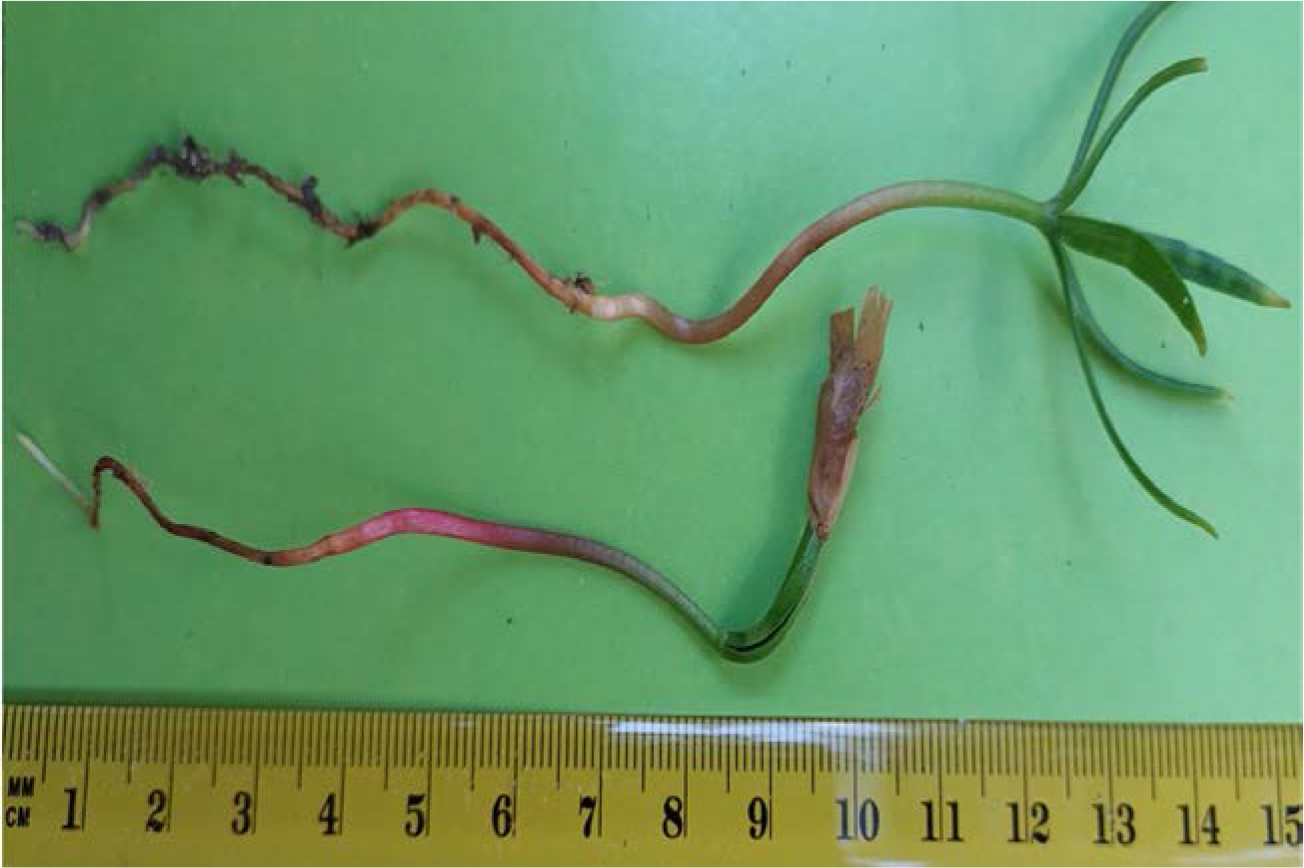
Figure 3.
Silver fir seedlings on 24 April 2024 at the study plot (photo by A. Marozau)
The ring-width chronology for the sampled mature trees covered the years 1936–2020. The chronology exhibited strong statistical quality, with the following parameters: GLK = 0.67, Rbar = 0.36, MS = 2.5, AR1 = 0.8, EPS = 0.94, SSS = 0.96, and SNR = 16.41 (Fig. 4).
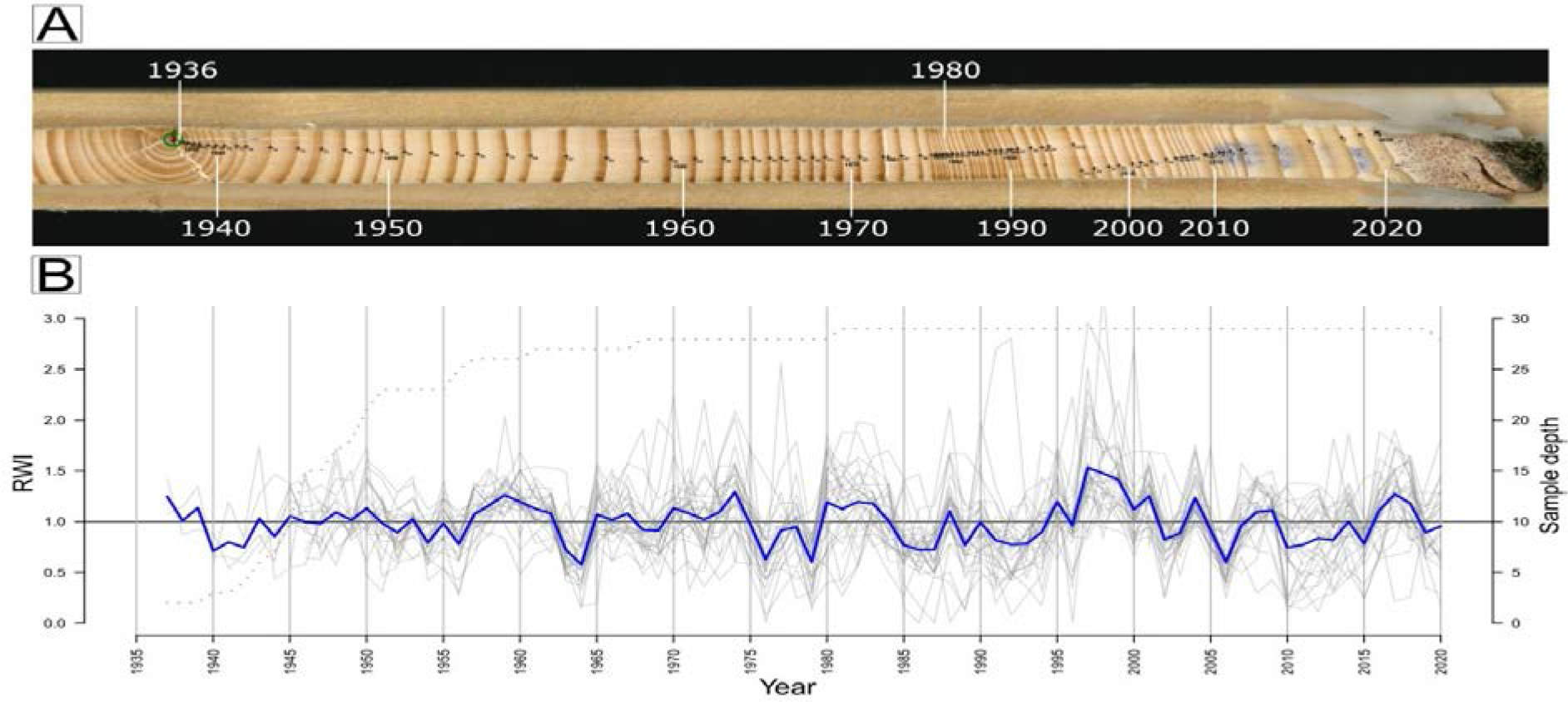
Figure 4.
(A) Example of an increment core from a mature silver fir tree (ID G, Tab. 2); (B) Silver fir site chronology (blue line), 1936–2020, derived from 29 mature trees sampled at 8–52 cm above ground level. Light gray lines represent individual series; dotted line shows sample depth. RWI = ring-width index (photo and graph by K. Pilch)
Sampling precision was high: only four trees had an estimated pith offset exceeding five years (7–8 years). Most mature trees (27 individuals, 93.1%) had pith years between 1936 and 1948, corresponding to ages of 73–85 years at sampling height in 2021 (Tab. 2).
The calculated age of sample trees of mature silver fir, taking into account the time required to reach the sampling height, ranged from 78 to 108 years in 2026. Most trees (23 individuals, 79.31%) were established during the period 1922–1932; however, the overall range of calculated years spanned 30 years, from 1918 to 1948. The 95% confidence interval for the reconstructed tree ages was 94.0–98.8 years (Tab. 2).
The median age is a more appropriate measure of stand age than the mean because it is less sensitive to outliers (Tab. 2). It therefore provides a more robust estimate of the central tendency of the age distribution of the studied trees.
The oldest silver fir regeneration individuals recorded in 2020 were 30 years old (Tab. 1). This means that it appeared in 1990, as a result of fruiting that took place in 1989 in trees established in 1928 (median value in Table 2). Thus, the first silver fir seeds in the study plot, which gave rise to the oldest of the present day existing regeneration, were most likely produced by parent trees approximately 61 years old, if not earlier.
Discussion
The regeneration cohorts (Tab. 1) exhibited clear differences in growth rates, reflecting variation in local stand and light conditions. For example, age group 8 established during the period of Norway spruce decline displayed faster height growth than groups (1–7). In general, growth rates increased as regeneration age decreased (Tab. 1). This pattern was most likely driven by improved light availability rather than by plant age itself. A clear example of this trend is shown in Figure 5. Regeneration established between 2001 and 2003 (group 4) reached a height of 50 cm approximately seven years earlier than regeneration established between 1990 and 1994 (group 1). Because the dataset includes regeneration cohorts established under a wide range of environmental conditions, the resulting growth estimates may have broader practical applicability. They reflect average growth responses across diverse environmental conditions rather than extreme ecological scenarios.
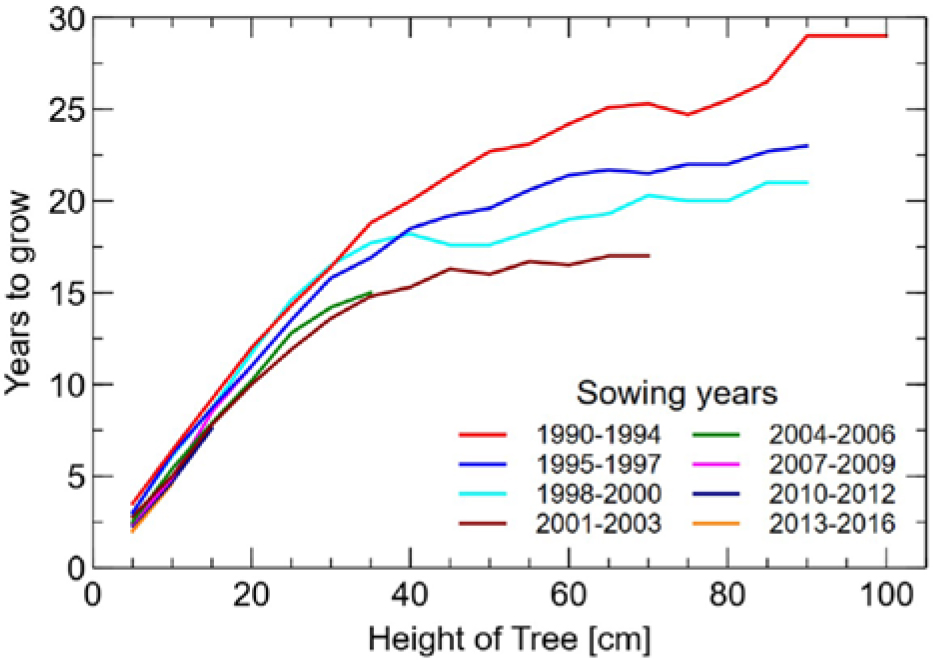
Figure 5.
Changes in the growth dynamics of silver fir regeneration depending on the time of its appearance
Previous studies in Poland often relied on generalized, simplified height-growth corrections when estimating silver fir age, that is, adding fixed constants such as 18 or 23 years to reach breast or sampling height (Gazda 1988; Korczyk et al. 1997; Bruchwald et al. 2015). However, the early growth rates vary substantially depending on light availability ranging from suppressed growth under dense canopy to rapid acceleration in canopy gaps (Dobrowolska 1999). Because applying a fixed correction factor across variable coring heights (8–52 cm) can introduce substantial estimation errors, our height-class-specific approach provides a more realistic reconstruction of tree age.
The confidence interval for the reconstructed ages, amounting to only 4.8 years (Tab. 2), indicates the accuracy of the result. However, in two cases, the differences in the calculated ages are quite substantial: 25 and 30 years (ID1 and ID6; ID1 and IDJ) and go far beyond the confidence interval (Tab. 2). Thanks to the empirical reconstruction of early height growth, the effect of different coring heights (8–52 cm) is approximated. Therefore, these age outliers are likely due to the multidirectional stress effects of abiotic factors (Speer 2010), for example, the influence of the severe winters of 1928–1929, 1939–1940, and 1955–1956 (Marozau et al. 2026). Silver fir is known to exhibit very narrow (false) or absent rings during periods of severe winter conditions, as well as severe droughts or high levels of SO2 pollution, affecting the accuracy of age identification (Vejpustková et al. 2023). Additional heterogeneity in the age distribution likely reflects environmental influences such as browsing, mechanical damage, or competition.
The large differences in estimated ages among some trees (Tab. 2) can not be explained from the point of view a single planting event. For example, according to calculations the oldest tree (ID 1) have become established in 1918, whereas the youngest tree (ID J) dates to 1948, representing a 30-year difference. Note, however, that no archival records were found documenting the introduction of silver fir into the study area during the immediate post-war period. Similarly, the large age difference between trees 1 and 2, located only 1.34 m apart (108 and 94 years, respectively can not to be explain under an artificial regeneration scenario. But this situation also can not to be explained that tree 2 origin from tree 1, as silver fir a priory impossible to begin seed production at the age of 14 years. Therefore, although CooRecorder is an advanced tool with high accuracy, errors may still occur due to the reasons mentioned above (Maxwell and Larsson 2021).
The median establishment year (1928) is in good agreement with historical data on intensive exploitation of the Białowieża Forest during the interwar period by the Century European Timber Corporation (Kosel et al. 2019, 2022) and with the simultaneous sowing of silver fir seeds under the canopy of secondary succession in a clear-cut area (Marozau et al. 2026).
Nevertheless, the observed age distribution more closely resembles gradual natural regeneration than a single introduction event. However, none of the previous studies conducted in the Białowieża Forest recorded a silver fir stand that could have served as a natural progenitor of the stand in subcompartment 498Ci (Antczak 1984). Brincken’s (2017, p. 34) information from 1826 that silver firs growing in the Hajnówka Forest District are 120 to 190 years old is questionable due to inaccuracies in the text.
Notably, mature trees of the same age exhibited up to twofold differences in DBH and height (e.g., trees ID 9 and ID G, both 85 years old at coring height) (Marozau et al. 2026, Tab. 2), illustrating that visual size-based age assessments can be highly misleading in shade-tolerant species. Such vertical hierarchy enhances stand structural diversity and resilience against abiotic stresses (Brang 2001; Bledý et al. 2024). It also influences reproductive success, as subdominant individuals contribute significantly less to the seed rain (Bernadzki 2008; Jaworski 2019).
Importantly, the estimated age of reproductive maturity (approximately 61 years) is in close agreement with published silvicultural studies stating that silver fir typically initiates seed production in closed forest stands between 60 and 70 years of age (Bronisz and Bijak 2012; Jaworski 2019). This strong convergence between indirectly reconstructed fruiting threshold and established empirical guidelines validates the accuracy of integrated age-reconstruction methodology. Furthermore, it confirms that silver fir growing outside its contiguous mountainous range in the lowland Białowieża Forest preserves its natural developmental timelines and reproductive capacity.
Conclusions
The combination of dendrochronological analysis with empirical reconstruction of early height growth showed that most mature individuals originated between 1922 and 1932, with a median establishment year of 1928 and the actual stand age in 2026 estimated at approximately 98 years.
The study further revealed substantial variability in the early growth dynamics of natural regeneration, with more recent cohorts experiencing significantly faster height increments due to increased light availability following the decline of Norway spruce.
The age of the oldest regeneration cohort (30 years old in 2020) indicated that seed production probably began when mother trees were approximately 61 years old, which is consistent with published data for silver fir growing in dense canopies.
The combined approach applied in this study provides a more accurate estimate of the biological age of slow-growing silver fir trees and may offer valuable insights for forest management, conservation planning, and understanding species performance beyond its natural distribution range.
Acknowledgements
The authors thank Ewa Zin for her substantive contribution to the initial stages of the manuscript. They also thank students Mirosław Skowroński, Gabriel Szymczyk and Rafał Karwowski for participation in fieldwork and primary data processing.