
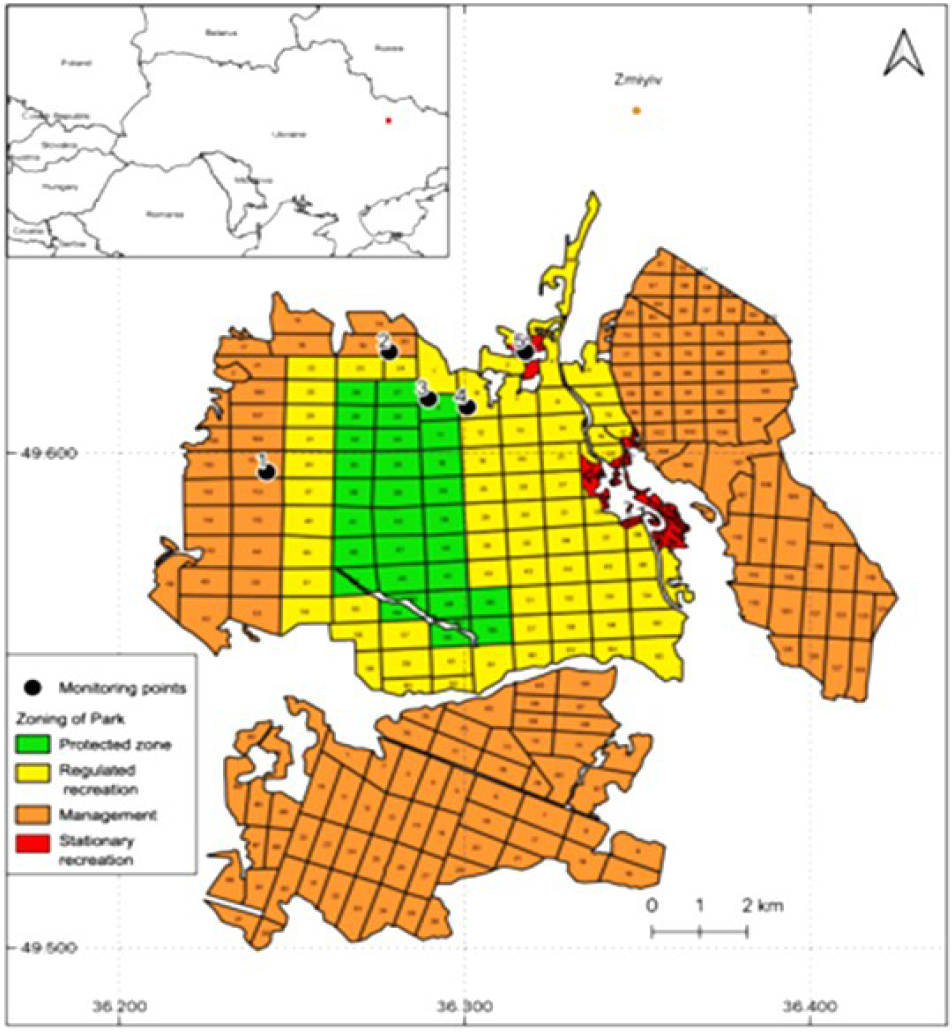
Figure 1.
Location of Gomilshanski lisy National Nature Park and sample plots (1 – plot of clear felling in the managed zone; 2 – plot of selective sanitary felling in the managed zone; 3 – protected zone; 4 – zone of regulated recreation; 5 – zone of stationary recreation) (Meshkova et al. 2022)
Table 1.
Taxonomy of Coleopterous predators in the sample plots of Gomilshanski Lisy NNP
| Family, Species | Family, Species |
|---|---|
| Family Histeridae | Family Cantharidae |
| 1. Acritus minutus (Herbst, 1792) | 22. Malthinus flaveolus (Herbst, 1786) |
| 2. Dendrophilus punctatus (Herbst, 1792) | Family Trogossitidae |
| 3. Paromalus flavicornis (Herbst, 1792) | 23. Nemozoma caucasicum Ménétriés, 1832 |
| 4. Paromalus parallelepipedus (Herbst, 1792) | 24. Nemozoma elongatum (Linnaeus, 1761) |
| 5. Platysoma compressum Herbst, 1783 | 25. Tenebroides fuscus (Goeze, 1777) |
| 6. Teretrius fabricii Mazur, 1972 | Family Cleridae |
| Family Staphylinidae | 26. Clerus mutillarius Fabricius, 1775 |
| 7. Thoracophorus corticinus Motschulsky, 1837 | 27. Thanasimus formicarius (Linnaeus, 1758) |
| 8. Bibloporus minutus Raffray, 1914 | 28. Korynetes caeruleus (De Geer, 1775) |
| 9. Bibloporus ultimus Guillebeau, 1892 | Family Rhadalidae |
| 10. Ctenistes palpalis (Reichenbach, 1816) | 29. Aplocnemus impressus (Marsham, 1802) |
| 11. Euplectus duponti Aubé, 1833 | Family Melyridae |
| 12. Euplectus karstenii (Reichenbach, 1816) | 30. Dasytes fusculus (Illiger, 1801) |
| 13. Euplectus mutator Fauvel, 1895 | 31. Dasytes niger (Linnaeus, 1761) |
| 14. Euplectus punctatus Mulsant et Rey, 1861 | 32. Dasytes plumbeus (Müller, 1776) |
| 15. Euplectus signatus (Reichenbach, 1816) | Family Salpingidae |
| 16. Lordithon lunulatus (Linnaeus, 1760) | 33. Salpingus planirostris (Fabricius, 1787) |
| 17. Sepedophilus bipustulatus (Gravenhorst, 1802) | 34. Salpingus ruficollis Linnaeus, 1761 |
| 18. Sepedophilus immaculatus (Stephens, 1832) | 35. Vincenzellus ruficollis (Panzer, 1794) |
| 19. Tachyporus corpulentus Sahlberg, 1876 | Family Tenebrionidae |
| 20. Tachyporus dispar (Paykull, 1789) | 36. Corticeus bicolor (Olivier, 1790) |
| Family Elateridae | |
| 21. Lacon lepidopterus (Panzer, 1800) |
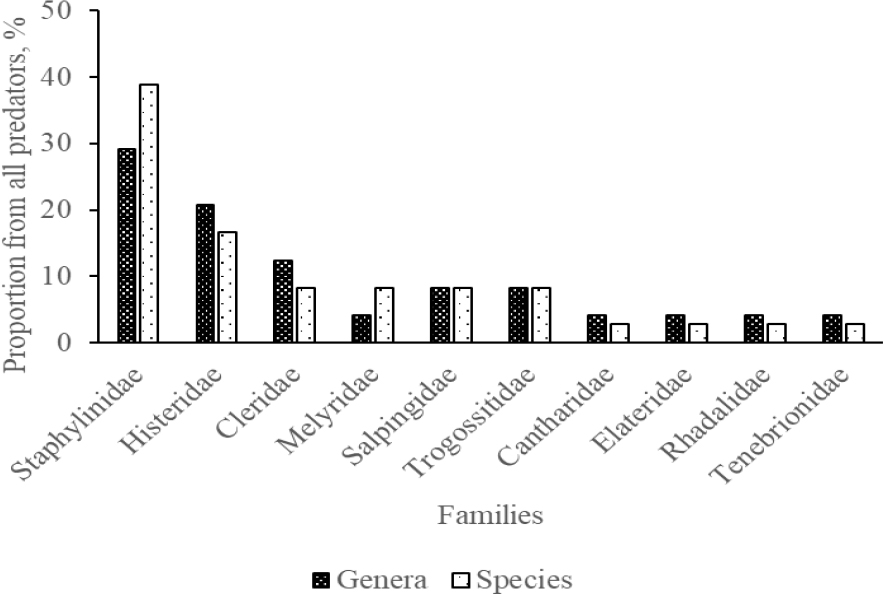
Figure 2.
The proportion of genera and species of individual families in the total number of trapped predators in Gomilshanski lisy NNP (pooled sample)
Table 2.
The two-proportion Z-test for pairwise comparison of predator species proportion among trapped Coleoptera across sample plots and zones in Gomilshanski lisy NNP (Clear fell. – clear felling in the managed zone; Sel. fell. – selective sanitary felling in the managed zone; Stat. recr. – zone of stationary recreation; Reg. recr. - zone of regulated recreation; Prot. – protected zone; Z0.05 = 1.96; Z0.01 = 3.96; bold Z shows the significant differences between sample plots; proportions in the parentheses)
| Sample plots | Sel. fell. (17.2 %) | Stat. recr. (15.5 %) | Reg. recr. (15.4 %) | Prot. (18.5 %) |
|---|---|---|---|---|
| Clear fell. (13.4 %) | -0.69 | -2.23 | -2.48 | -0.94 |
| Sel. fell. (17.2 %) | – | 0.31 | 0.32 | -0.23 |
| Stat. recr. (15.5 %) | – | – | 0.02 | -0.55 |
| Reg. recr. (15.4 %) | – | – | – | -0.56 |
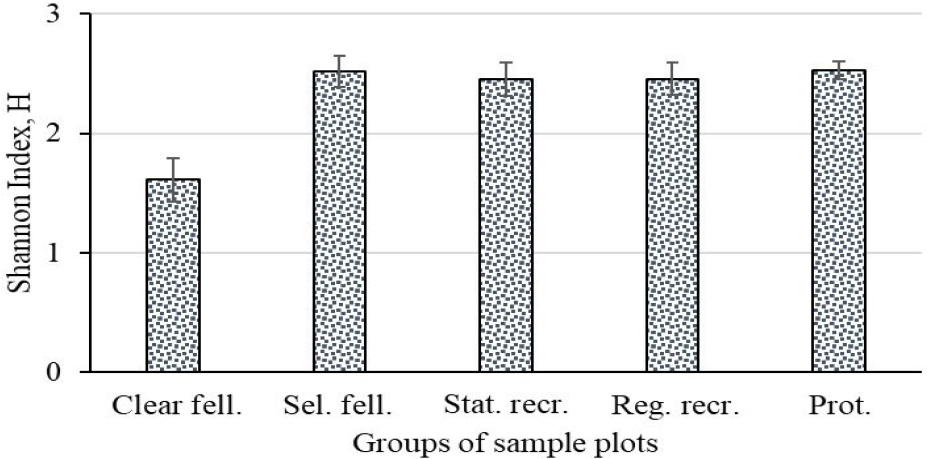
Figure 3.
Shannon Index (±standard deviation) in sample plots and zones in Gomilshanski lisy NNP (H – Shannon Index; Clear fell. – clear felling in the managed zone; Sel. fell. – selective sanitary felling in the managed zone; Stat. recr. – zone of stationary recreation; Reg. recr. – zone of regulated recreation; Prot. – protected zone)
Table 3.
The Hutcheson t-test for pairwise comparison of Shannon indices across sample plots and zones in Gomilshanski lisy NNP (Clear fell. – clear felling in the managed zone; Sel. fell. – selective sanitary felling in the managed zone; Stat. recr. – zone of stationary recreation; Reg. recr. – zone of regulated recreation; Prot. – protected zone; numerator – t, denominator – p; bold t shows the significant differences between sample plots; Shannon index H is in the parentheses)
| Sample plots | Sel. fell. (2.52) | Stat. recr. (2.45) | Reg. recr. (2.46) | Prot. (2.53) |
|---|---|---|---|---|
| Clear fell. (1.61) | -4.04 / 0.0001 | -3.63 / 0.0005 | -3.72 / 0.0003 | -4.61 / 1.56E-05 |
| Sel. fell. (2.52) | – | 0.38 / 0.71 | 0.35 / 0.72 | -0.03 / 0.98 |
| Stat. recr. (2.45) | – | – | -0.03 / 0.97 | -0.48 / 0.63 |
| Reg. recr. (2.46) | – | – | – | -0.46 / 0.65 |
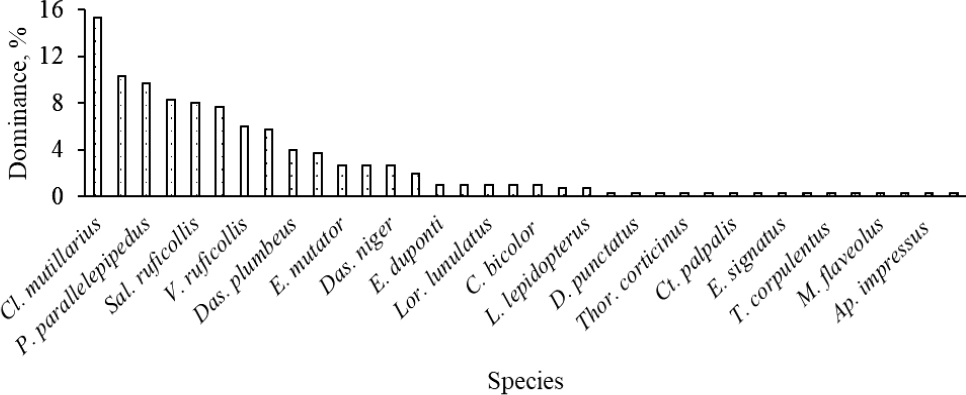
Figure 4.
Dominance of predatory beetle species in window traps in Gomilshanski lisy NNP (pooled sample)
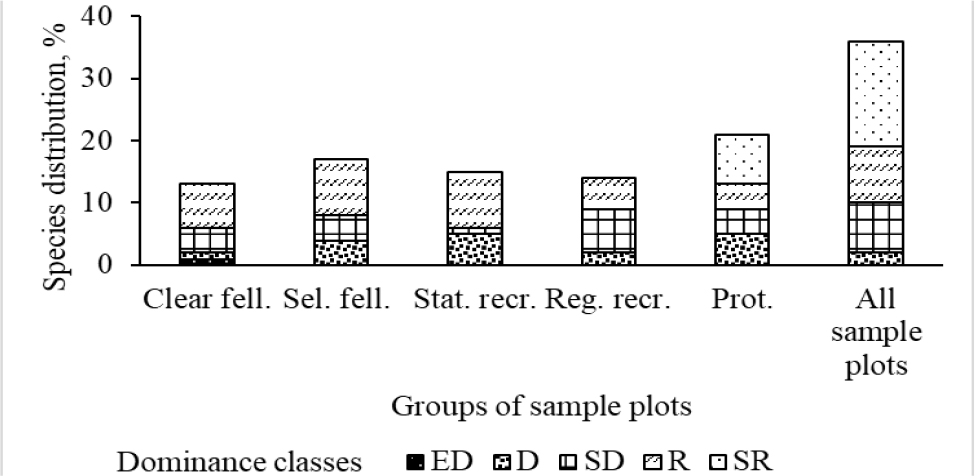
Figure 5.
Distribution of predatory beetles in Gomilshanski lisy NNP by Stöcker-Bergmann dominance classes (ED – eudominants; D – dominants; SD – subdominants; R – recedents; SR – subrecedents) in different groups of sample plots of Gomilshanski lisy National Nature Park. (Clear fell. – clear felling in the managed zone Sel. fell. – selective sanitary felling in the managed zone; Stat. recr. – zone of stationary recreation; Reg. recr. – zone of regulated recreation; Prot. – protected zone)
Table 4.
Dominance (D) and frequency of occurrence (F) of predatory beetle species in groups of sample plots and zones of Gomilshanski lisy NNP
| Predatory beetle species | Dominance, % (D) | Frequency of occurrence, % (F) | ||||||||
|---|---|---|---|---|---|---|---|---|---|---|
| Clear fell. | Sel. fell. | Stat. recr. | Reg. recr. | Prot. | Clear fell. | Sel. fell. | Stat. recr. | Reg. recr. | Prot. | |
| A. minutus | 0.00 | 0.00 | 2.94 | 0.00 | 0.00 | 0.00 | 0.00 | 3.13 | 0.00 | 0.00 |
| D. punctatus | 0.00 | 0.00 | 0.00 | 0.00 | 0.75 | 0.00 | 0.00 | 0.00 | 0.00 | 3.13 |
| P. flavicornis | 5.17 | 6.82 | 11.76 | 0.00 | 15.67 | 6.25 | 6.25 | 6.25 | 0.00 | 12.50 |
| P. parallelepipedus | 5.17 | 6.82 | 14.71 | 6.25 | 11.94 | 6.25 | 6.25 | 6.25 | 6.25 | 28.13 |
| Pl. compressum | 1.72 | 11.36 | 2.94 | 6.25 | 10.45 | 3.13 | 12.50 | 3.13 | 6.25 | 34.38 |
| Ter. fabricii | 0.00 | 0.00 | 2.94 | 0.00 | 0.00 | 0.00 | 0.00 | 3.13 | 0.00 | 0.00 |
| Thor. corticinus | 1.72 | 0.00 | 0.00 | 0.00 | 0.00 | 3.13 | 0.00 | 0.00 | 0.00 | 0.00 |
| B. minutus | 0.00 | 0.00 | 0.00 | 0.00 | 0.75 | 0.00 | 0.00 | 0.00 | 0.00 | 3.13 |
| B. ultimus | 0.00 | 0.00 | 0.00 | 0.00 | 1.49 | 0.00 | 0.00 | 0.00 | 0.00 | 6.25 |
| Ct. palpalis | 0.00 | 2.27 | 0.00 | 0.00 | 0.00 | 0.00 | 3.13 | 0.00 | 0.00 | 0.00 |
| E. duponti | 0.00 | 2.27 | 0.00 | 0.00 | 1.49 | 0.00 | 3.13 | 0.00 | 0.00 | 3.13 |
| E. karstenii | 0.00 | 0.00 | 0.00 | 0.00 | 2.24 | 0.00 | 0.00 | 0.00 | 0.00 | 9.38 |
| E. mutator | 0.00 | 2.27 | 0.00 | 6.25 | 3.73 | 0.00 | 3.13 | 0.00 | 6.25 | 6.25 |
| E. punctatus | 0.00 | 0.00 | 2.94 | 0.00 | 0.00 | 0.00 | 0.00 | 3.13 | 0.00 | 0.00 |
| E. signatus | 0.00 | 0.00 | 2.94 | 0.00 | 0.00 | 0.00 | 0.00 | 3.13 | 0.00 | 0.00 |
| Lor. lunulatus | 0.00 | 2.27 | 0.00 | 0.00 | 1.49 | 0.00 | 3.13 | 0.00 | 0.00 | 6.25 |
| Sep. bipustulatus | 0.00 | 2.27 | 0.00 | 3.13 | 4.48 | 0.00 | 3.13 | 0.00 | 3.13 | 15.63 |
| Sep. immaculatus | 0.00 | 0.00 | 0.00 | 0.00 | 0.75 | 0.00 | 0.00 | 0.00 | 0.00 | 3.13 |
| T. corpulentus | 0.00 | 2.27 | 0.00 | 0.00 | 0.00 | 0.00 | 3.13 | 0.00 | 0.00 | 0.00 |
| T. dispar | 0.00 | 2.27 | 0.00 | 0.00 | 0.00 | 0.00 | 3.13 | 0.00 | 0.00 | 0.00 |
| L. lepidopterus | 1.72 | 0.00 | 0.00 | 3.13 | 0.00 | 3.13 | 0.00 | 0.00 | 3.13 | 0.00 |
| M. flaveolus | 0.00 | 2.27 | 0.00 | 0.00 | 0.00 | 0.00 | 3.13 | 0.00 | 0.00 | 0.00 |
| N. caucasicum | 0.00 | 0.00 | 14.71 | 15.63 | 0.75 | 0.00 | 0.00 | 6.25 | 3.13 | 3.13 |
| N. elongatum | 0.00 | 0.00 | 14.71 | 9.38 | 0.00 | 0.00 | 0.00 | 6.25 | 9.38 | 0.00 |
| Ten. fuscus | 0.00 | 0.00 | 5.88 | 0.00 | 0.75 | 0.00 | 0.00 | 3.13 | 0.00 | 3.13 |
| Cl. mutillarius | 58.62 | 13.64 | 11.76 | 3.13 | 0.75 | 25.00 | 15.63 | 9.38 | 3.13 | 3.13 |
| Th. formicarius | 10.34 | 0.00 | 0.00 | 9.38 | 5.97 | 12.50 | 0.00 | 0.00 | 9.38 | 21.88 |
| K. caeruleus | 1.72 | 0.00 | 0.00 | 0.00 | 0.00 | 3.13 | 0.00 | 0.00 | 0.00 | 0.00 |
| Ap. impressus | 1.72 | 0.00 | 0.00 | 0.00 | 0.00 | 3.13 | 0.00 | 0.00 | 0.00 | 0.00 |
| Das. fusculus | 0.00 | 0.00 | 2.94 | 0.00 | 0.00 | 0.00 | 0.00 | 3.13 | 0.00 | 0.00 |
| Das. niger | 0.00 | 13.64 | 2.94 | 3.13 | 0.00 | 0.00 | 15.63 | 3.13 | 3.13 | 0.00 |
| Das. plumbeus | 3.45 | 18.18 | 0.00 | 3.13 | 0.75 | 6.25 | 6.25 | 0.00 | 3.13 | 3.13 |
| Sal. planirostris | 1.72 | 4.55 | 0.00 | 18.75 | 11.94 | 3.13 | 6.25 | 0.00 | 18.75 | 34.38 |
| Sal. ruficollis | 5.17 | 2.27 | 0.00 | 6.25 | 13.43 | 9.38 | 3.13 | 0.00 | 6.25 | 40.63 |
| V. ruficollis | 0.00 | 4.55 | 2.94 | 6.25 | 9.70 | 0.00 | 3.13 | 3.13 | 6.25 | 21.88 |
| C. bicolor | 1.72 | 0.00 | 2.94 | 0.00 | 0.75 | 3.13 | 0.00 | 3.13 | 0.00 | 3.13 |
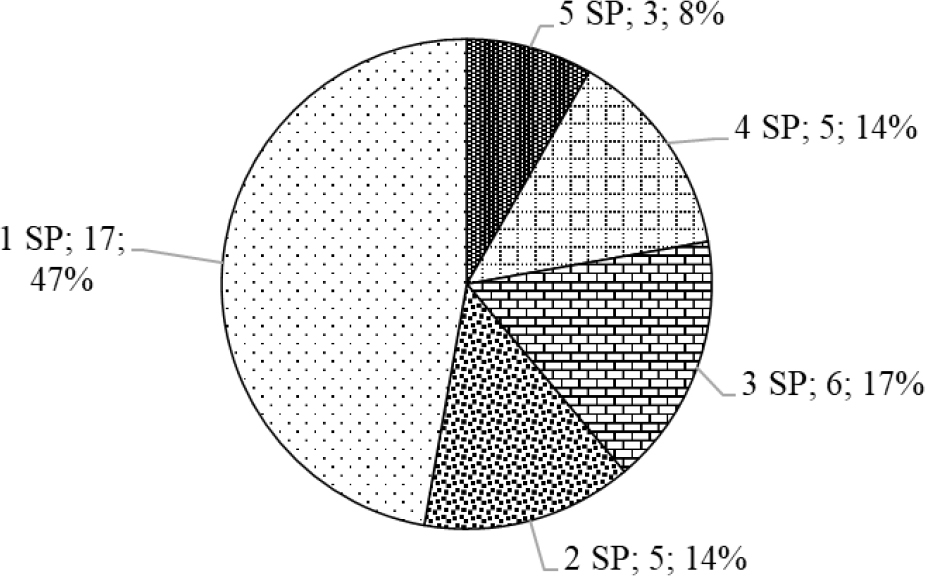
Figure 6.
Distribution of predatory beetle species by presence in sample plots (SP) of Gomilshanski lisy NNP (1 SP – 5 SP – number of sample plots with the presence of respective number of species; number of species; proportion of all species in the pooled sample)
Table 5.
Predatory beetle species in the top ten most frequently occurring (F) in window traps in groups of sample plots and zones of Gomilshanski lisy NNP
| Species | F | Species | F | Species | F | Species | F | Species | F |
|---|---|---|---|---|---|---|---|---|---|
| Protected zone | Clear felling | Selective sanitary felling | Zone of stationary recreation | Zone of regulated recreation | |||||
| Sal. ruficollis | 40.6 | Cl. mutillarius | 25.0 | Cl. mutillarius | 15.6 | Cl. mutillarius | 9.4 | Sal. planirostris | 18.8 |
| Pl. compressum | 34.4 | Th. formicarius | 12.5 | Das. niger | 15.6 | P. parallelepipedus | 6.3 | N. elongatum | 9.4 |
| Sal. planirostris | 34.4 | Sal. ruficollis | 9.4 | Pl. compressum | 12.5 | P. flavicornis | 6.3 | Th. formicarius | 9.4 |
| P. parallelepipedus | 28.1 | P. parallelepipedus | 6.3 | Sal. planirostris | 6.3 | N. elongatum | 6.3 | P. parallelepipedus | 6.3 |
| Th. formicarius | 21.9 | P. flavicornis | 6.3 | P. parallelepipedus | 6.3 | N. caucasicum | 6.3 | Pl. compressum | 6.3 |
| V. ruficollis | 21.9 | Das. plumbeus | 6.3 | Das. plumbeus | 6.3 | Das. niger | 3.1 | V. ruficollis | 6.3 |
| Sep. bipustulatus | 15.6 | Pl. compressum | 3.1 | P. flavicornis | 6.3 | Pl. compressum | 3.1 | Sal. ruficollis | 6.3 |
| P. flavicornis | 12.5 | Sal. planirostris | 3.1 | V. ruficollis | 3.1 | V. ruficollis | 3.1 | E. mutator | 6.3 |
| E. karstenii | 9.4 | C. bicolor | 3.1 | Sal. ruficollis | 3.1 | C. bicolor | 3.1 | Cl. mutillarius | 3.1 |
| B. ultimus | 6.3 | Thor corticinus | 3.1 | E. mutator | 3.1 | Ten. fuscus | 3.1 | N. caucasicum | 3.1 |
Table 6.
Predatory beetle species in the top ten by synthetic index Q for groups of sample plots and zones of Gomilshanski lisy NNP
| Species | Q | Species | Q | Species | Q | Species | Q | Species | Q |
|---|---|---|---|---|---|---|---|---|---|
| Protected zone | Clear felling | Selective sanitary felling | Zone of stationary recreation | Zone of regulated recreation | |||||
| Sal. ruficollis | 23.4 | Cl. mutillarius | 38.3 | Cl. mutillarius | 14.6 | Cl. mutillarius | 10.5 | Sal. planirostris | 18.8 |
| Sal. planirostris | 20.3 | Th. formicarius | 11.4 | Das. niger | 14.6 | P. parallelepipedus | 9.6 | N. elongatum | 9.4 |
| Pl. compressum | 19.0 | Sal. ruficollis | 7.0 | Pl. compressum | 11.9 | N. caucasicum | 9.6 | Th. formicarius | 9.4 |
| P. parallelepipedus | 18.3 | P. parallelepipedus | 5.7 | Das. plumbeus | 10.7 | N. elongatum | 9.6 | N. caucasicum | 7.0 |
| V. ruficollis | 14.6 | P. flaviciornis | 5.7 | P. parallelepipedus | 6.5 | P. flavicornis | 8.6 | P. parallelepipedus | 6.3 |
| P. flavicornis | 14.0 | Das. plumbeus | 4.6 | P. flavicornis | 6.5 | Ten. fuscus | 4.3 | Pl. compressum | 6.3 |
| Th. formicarius | 11.4 | Sal. planirostris | 2.3 | Sal. planirostris | 5.3 | Das. niger | 3.0 | V. ruficollis | 6.3 |
| Sep. bipustulatus | 8.4 | Pl. compressum | 2.3 | V. ruficollis | 3.8 | Pl. compressum | 3.0 | Sal. ruficollis | 6.3 |
| E. mutator | 4.8 | C. bicolor | 2.3 | Sal. ruficollis | 2.7 | V. ruficollis | 3.0 | E. mutator | 6.3 |
| E. karstenii | 4.6 | Thor, corticinus | 2.3 | Sep. bipustulatus | 2.7 | C. bicolor | 3.0 | Cl. mutillarius | 3.1 |
Table 7.
Similarity indices of predator complexes in groups of sample plots and zones in Gomilshanski lisy NNP
| Zone A | Zone B | Common species | Csc |
|---|---|---|---|
| Clear fell. | Sel. fell. | 7 (Sal. planirostris, Sal. ruficollis, P. flavicornis, P. parallelepipedus, Pl. compressum, Cl. mutillarius, Das. plumbeus) | 0.47 |
| Clear fell. | Stat. recr. | 5 (P. flavicornis, P. parallelepipedus, Pl. compressum, Cl. mutillarius, C. bicolor) | 0.36 |
| Clear fell. | Reg. recr. | 8 (Sal. planirostris, Sal. ruficollis, Th. formicarius, P. parallelepipedus, Pl. compressum, Cl. mutillarius, Das. plumbeus, L. lepidopterus) | 0.59 |
| Clear fell. | Prot. | 9 (Sal. planirostris, Sal. ruficollis, Th. formicarius, P. flavicornis, P. parallele-pipedus, Pl. compressum, Cl. mutillarius, Das. plumbeus, C. bicolor) | 0.53 |
| Sel. fell. | Stat. recr. | 6 (P. flavicornis, P. parallelepipedus, Pl. compressum, V. ruficollis, Cl. mutillarius, Das. niger) | 0.38 |
| Sel. fell. | Reg. recr. | 10 (Sal. planirostris, Sal. ruficollis, P. parallelepipedus, Pl. compressum, V. ruficollis, E. mutator, Cl. mutillarius, Das. niger, Das. plumbeus, Sep. bipustulatus) | 0.65 |
| Sel. fell. | Prot. | 12 (Sal. planirostris, Sal. ruficollis, P. flavicornis, P. parallelepipedus, Pl. compressum, V. ruficollis, E. mutator, Cl. mutillarius, Das. plumbeus, Sep. bipustulatus, E. duponti, Lor. lunulatus) | 0.63 |
| Stat. recr. | Reg. recr. | 7 (N. caucasicum, N. elongatum, P. parallelepipedus, Pl. compressum, V. ruficollis, Cl. mutillarius, Das. niger) | 0.48 |
| Stat. recr. | Prot. | 8 (N. caucasicum, P. flavicornis, P. parallelepipedus, Pl. compressum, V. ruficollis, Cl. mutillarius, Ten. fuscus, C. bicolor) | 0.44 |
| Reg. recr. | Prot. | 11 (Sal. planirostris, Sal. ruficollis, N. caucasicum, Th. formicarius, P. parallele-pipedus, Pl. compressum, V. ruficollis, E. mutator, Cl. mutillarius, Das. plumbeus, Sep. bipustulatus) | 0.63 |
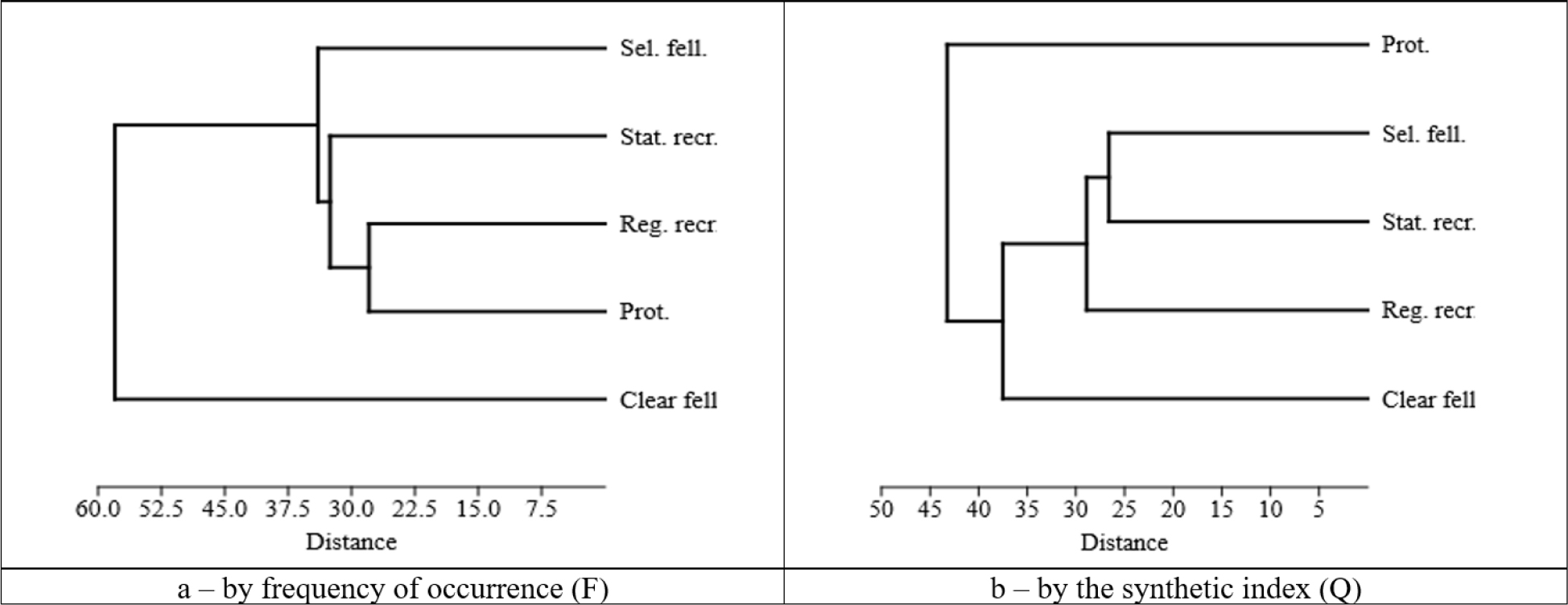
Figure 7.
Cluster analysis of predatory beetle complexes in sample plots and zones of the Gomilshanski lisy NNP (Clear fell. – clear felling in the managed zone Sel. fell. - selective sanitary felling in the managed zone; Stat. recr. – zone of stationary recreation; Reg. recr. – zone of regulated recreation; Prot. – protected zone)