
Introduction
Forest regeneration is carried out to achieve optimal forest cover, preserve biodiversity, improve the qualitative composition of forest stands, increase their biotic resistance, technical quality, and productivity, and enhance the protective and other beneficial properties of forests and protective forest plantations (Forest Code of Ukraine 2006). Forest regeneration includes reforestation, afforestation, forest plantation cultivation, and forest reclamation. In Ukraine, the most common methods of forest regeneration are reforestation and afforestation (Zhezhkun 2021). Reforestation is conducted on land previously covered by forest vegetation, while afforestation is applied to areas devoid of forest cover (nonforest lands). Reforestation can be natural, artificial (by planting or sowing), or combined. Afforestation can occur through natural forest encroachment or planting.
Since the introduction of martial law in 2022, forest regeneration in Ukraine has generally declined compared to previous years. However, the scale of afforestation activities has significantly increased within the framework of the President of Ukraine’s initiative “Large-Scale Afforestation of Ukraine” (Zhezhkun and Zhezhkun 2024).
Eastern Polissya of Ukraine is located on the left bank of the Dnipro River within the northern parts of Kyiv, Chernihiv, and Sumy administrative regions, covering an area of 2.55 million hectares. The actual forest cover in the region is 25.6% (Zhezhkun 2021), which is lower than the optimal level of 32% (Tkach 2012).
Before the introduction of forest regulation and systematic forest management in Eastern Polissya in 1842, forest regeneration occurred naturally. In the second half of the 19th century, excessive clear-cutting, stump removal, and plowing of sandy soils led to the formation of mobile sand dunes in the region. Since 1842, efforts have been made to stabilize and afforest these sands, and from 1844, artificial forest regeneration began on areas after clear cutting (Redko et al. 2005). Forest crops were irregularly established until 1857; from 1844 to 1857, state forestries in the Chernihiv region created 5.133 hectares of stands (48% on loose sands), though nearly 10% failed (Rusov 1899).
From 1858 to 1877, clear-cutting and natural regeneration were used, but the stands predominantly regenerated with softwood deciduous species (Redko et al. 2005). In 1878, artificial reforestation on areas after clear cutting resumed and became more widespread after 1899 with the introduction of forest-planting collateral systems (Vakulyuk 2000). However, the area of forest crops in state-owned forests remained relatively small compared to the extent of clear-cutting. In private forests, areas after clear cutting were generally left for natural regeneration, and artificial planting was carried out only sporadically. On dry sandy soils, the natural regeneration period for Scots pine (P. sylvestris L.) ranged from 10 to 20 years (Rusov 1899).
With the outbreak of World War I in 1914, forest cultivation activities in the region were nearly halted and were resumed in the 1920s. During that period, soil preparation for forest crops was carried out using horsedrawn plows, and up to 14.000 Scots pine seedlings per hectare were planted. In the 1930s, mechanization of forest planting operations began, which increased labor productivity and reduced the cost of establishing forest crops (Vakulyuk 2000).
After World War II, due to economic recovery, the volume of logging and reforestation increased. In 1950, for example, 6.3 thousand hectares of forest stands were established on areas after clear cutting and other lands not covered by forest vegetation, including 1.0 thousand hectares of sand dunes and 0.4 thousand hectares of ravines. In the 1960s, the main method of reforestation was the creation of forest crops after final clear cutting. With the creation of a forest seed base, forest restoration began to rely on planting material with improved genetic characteristics. For a long time, pure stands were created on areas after clear cutting, low-productive and degraded lands (such as quicksands, ravines and gullies). This led to a decrease in the resilience of stands, an increase in the number of outbreaks of pests and diseases, damage by May beetles (Melolontha hip-pocastani F., Melolontha melolontha L.) and wild animals. (Zhezhkun 2022).
Funding of forest regeneration was mainly provided from the internal budgets of forest enterprises. Due to differences in the forest resource potential of these enterprises, there was a variation in the intensity of forest regeneration, availability of equipment and machinery, number of workers, and so on.
The aim of this study is to determine the scope and examine the silvicultural and economic features of forest regeneration technologies in Eastern Polissya of Ukraine.
Material and methods
Data on the scale of reforestation and afforestation in Eastern Polissya were obtained from consolidated materials of forest enterprises in Chernihiv and Sumy regions. Forest crops and natural regeneration projects are reviewed and approved by the Silvicultural Council of the Northern Interregional Department of Forestry and Hunting (Chernihiv city).
The largest areas of forest regeneration discovered on clear-cuts following final fellings. After removing logging residues and reducing stump height, soil is prepared using PL-75-15 and PKL-70 plows pulled by MTZ 82 and MTZ 1221.2 tractors. Furrows 10–15 cm deep are formed to create planting spots. Planting material includes seedlings of tree species with open root systems (ORS) and container-grown stock (CRS), as well as saplings. ORS seedlings and saplings are planted using a Kolesov planting spade in spring or autumn. CRS planting is done with a motor auger during the growing season. To achieve standard survival rates of forest crops, supplementary planting is carried out during the first three years of cultivation. Until the moment of transferring crops to the category of forest-covered land, agrotechnical and silvicultural tending operations are performed.
In some cases, following clear cutting or on non-forested lands near forest tracts, measures to facilitate natural regeneration of valuable tree species were undertaken. Control plots without any regeneration-enhancing interventions were left nearby for comparison.
Permanent sample plots (PSPs) were established in the most representative areas within non-closed forest crops and in young stands of natural and artificial origin. Plots were rectangular or square in shape and designed to contain at least 200 trees of the main species. Research on sample plots was conducted using standardized methodologies (Vorobyev 1967; Gordienko et al. 2005; Instructions on design, technical acceptance, accounting, and quality assessment of forestry objects 2010). Forest site conditions were classified based on P.S. Pohrebnyak’s classification (Ostapenko and Tkach 2002), combining tro-photopes — A (bir – poor), B (subir – relatively poor), C (sugrud – fairly fertile), D (grud – fertile) — and hygrotopes: 0 – very dry, 1 – dry, 2 – fresh, 3 – moist, 4 – wet, 5 – swampy. For example: A0 – very dry bir, B2 – fresh subir, C3 – moist sugrud, D4 – wet grud, etc.
The vitality of young trees was assessed using five categories: I – no signs of weakening, II – weakened, III – severely weakened, IV – dying, V – dead. The height and height growth of young trees were determined with a measuring rod.
The quality of forest crops and natural regeneration sites was assessed according to regulatory standards (Instructions on design, technical acceptance, accounting, and quality assessment of forestry objects 2010), as presented in Table 1.
Table 1.
Regulatory criteria for evaluating the quality of forest crops and natural regeneration at the stage of classification as forested land (Instructions on design, technical acceptance, accounting and quality assessment of forestry objects, 2010)
| Main Tree Species | Type of Forest Site Conditions | Land Category | Quality Class | Polissya | ||
|---|---|---|---|---|---|---|
| age, years | density, thousand trees/ha | average height, m | ||||
| Forest Crops | ||||||
| Scots Pine (Pinus sylvestris L.) | A0, A1, B0, B1 | Glades, sands, agricultural lands | 1 | 7 | 6.5 | 1.3 |
| 2 | 5.6 | 1.2 | ||||
| 3 | 5.0 | 0.9 | ||||
| A2, A3 | Glades, burns, clear-cuts without natural regeneration | 1 | 6 | 6.0 | 1.4 | |
| 2 | 5.0 | 1.2 | ||||
| 3 | 4.2 | 1.0 | ||||
| B2, B3 | Glades, burns, clear-cuts without natural regeneration | 1 | 6 | 4.5 | 1.6 | |
| 2 | 4.2 | 1.5 | ||||
| 3 | 3.5 | 1.4 | ||||
| A2, A3, B2, B3 | Clear-cuts with sufficient natural regeneration | 1 | 6 | 5.0 | 1.7 | |
| 2 | 4.8 | 1.6 | ||||
| 3 | 4.3 | 1.4 | ||||
| C0, C1 | Glades, clearcuts, agricultural lands | 1 | 7 | 6.0 | 1.4 | |
| 2 | 5.5 | 1.3 | ||||
| 3 | 4.5 | 1.0 | ||||
| C2, C3 | Glades, clearcuts, agricultural lands | 1 | 6 | 4.7 | 1.8 | |
| 2 | 4.5 | 1.7 | ||||
| 3 | 4.0 | 1.5 | ||||
| A4, B4 | Waterlogged lands | 1 | 7 | 3.0 | 1.3 | |
| 2 | 2.8 | 1.1 | ||||
| 3 | 2.3 | 1.0 | ||||
| Natural Forest Regeneration | ||||||
| Scots pine (Pinus sylvestris L.) | A2, A3, B2, B3 | All categories | 1 | 6 | 5.0 | 1.5 |
| 2 | 4.0 | 1.3 | ||||
| 3 | 2.8 | 1.0 | ||||
| C2, C3 | All categories | 1 | 6 | 4.7 | 1.7 | |
| 2 | 4.0 | 1.6 | ||||
| 3 | 2.8 | 1.4 | ||||
| A4, B4 | All categories | 1 | 8 | 3.5 | 1.3 | |
| 2 | 3.0 | 1.1 | ||||
| 3 | 2.5 | 0.9 | ||||
Standards for assessing the quality of pedunculate oak (Quercus robur L.) crops established on clear cut areas without natural regeneration in forest site conditions C2, C3, D2, and D3 at the age of 7 years are as follows:
– Quality Class I – average height 1.5 m, density 2.7 thousand trees per hectare
– Quality Class II – average height 1.3 m, density 2.5 thousand trees per hectare
– Quality Class III – average height 1.0 m, density 2.0 thousand trees per hectare.
For natural regeneration of oak, the quality standards are:
– Quality Class I – 1.4 m height and 3.0 thousand trees per hectare
– Class II – 1.2 m and 2.5 thousand/ha
– Class III – 1.0 m and 2.0 thousand/ha (Instructions on design, technical acceptance, accounting and quality assessment of forestry objects 2010).
Initial planting density (thousand trees per hectare) of Scots pine was:
– in dry bir – 9.0
– in fresh and moist bir – 6.7
– in wet bir and subir – 3.0
– in dry subir – 6.1
– in fresh and moist subir – 4.3–5.5
– in fresh and moist sugrud – 4.8–6.7
– in wet sugrud – 3.4–5.0
For pedunculate oak:
– in fresh and moist sub-oak forests – 3.6–4.0
– in fresh and moist oak forests – 2.9–3.5
Inter-row spacing was:
– in site type A1 – 2.0 m
– in A2, A3, B2, B3 – 2.5 m
– in C2, C3 – 2.5 to 4.0 m
– in D2, D3 – 4.0 to 6.0 m
Over a period of 6–8 years, young forest stands of both artificial and natural origin were formed on areas after clear cutting (Tab. 2).
Table 2.
Silvicultural and mensurational indicators of artificial and naturally regenerated stands on permanent sample plots (PSP) in the Eastern Polissya
| No PSP | Type of regeneration | Species composition | Age [years] | Avg H [m] | Avg BH cm] | Density of stocking | Number [hss pcs · ha-1] | Stock [m3 · ha-1] | |
|---|---|---|---|---|---|---|---|---|---|
| Abs [m2 · ha-1] | relative | ||||||||
| 4-Brc | Forest crops Natural regener. | 10PiSy 7BePe3QuRo + PiSy, SaCa | 7 7 | 2.2 1.7 | 2.1 0.3 | 2.57 0.08 | 0.57 0.03 | 6000 7900 | 4.7 0.3 |
| 5-Krk | Forest crops Natural regener. | 10PiSy 6AlGl3BePe1PiSy + QuRo | 8 8 | 2.8 3.7 | 2.5 3.2 | 3.62 1.14 | 0.57 0.25 | 7200 7000 | 11.8 3.4 |
| 1-Nvk | Forest crops | 10PiSy +QuRo | 8 8 | 3.5 1.6 | 4.0 0.5 | 4.84 – | 0.48 – | 3906 208 | 13.9 – |
| 2-Krp | Forest crops Natural regener. | 10Pisy +QuRo 8PiSy1UlLa1AcPl + BePe, QuRo | 8 8 8 | 3.2 1.7 1.9 | 2.9 0.4 1.0 | 0.96 – 0.52 | 0.11 – 0.22 | 1457 257 7527 | 2.5 – 1.4 |
| 9-Uzr | Forest crops Natural regener. | 10PiSy +QuRo 4PiSy3BePe3QuRo + UlLa | 8 8 8 | 2.3 1.5 1.0 | 2.5 0.7 1.6 | 1.70 0.02 0.73 | 0.61 0.01 0.34 | 3425 725 3200 | 3.6 – 1.5 |
| 1-Irz | Forest crops Natural regener. | 10QuRo 5BePe3QuRu2FrEx + SaCa, AcPl | 8 8 | 2.1 2.9 | 1.2 1.9 | 0.44 1.53 | 0.24 0.45 | 4000 8650 | 1.4 4.0 |
| 2-Irz | Forest crops Natural regener. | 10QuRo 5QuRu3PoTr2BePe + FrEx, AcPl | 8 8 | 2.0 2.8 | 2.5 1.5 | 0.56 0.46 | 0.23 0.16 | 3175 3575 | 1.5 1.7 |
| 3-Irz | Forest crops Natural regener. | 10QuRo 4PiSy4QuRu2QuRo+ BePe, AcPl | 8 8 | 1.6 2.1 | 0.5 1.8 | 0.03 0.16 | 0.05 0.10 | 1455 3387 | 0.1 0.4 |
| 5-Oln | Natural regener. | 10PiSy + BePe, PoTr | 6 | 1.4 | 0.5 | 1.12 | 0.34 | 11440 | 0.3 |
| 4-Oln | Natural regener. | 7PiSy3QuRo + AcPl, BePe | 7 | 1.7 | 1.2 | 0.38 | 0.08 | 3493 | 0.2 |
| 3-Oln | Natural regener. | 7PiSy3BePe + AcPl, QuRo, TiCo | 7 | 1.5 | 0.8 | 0.35 | 0.23 | 7110 | 1.8 |
| 2-Oln | Natural regener. | 10PiSy + BePe | 7 | 1.6 | 1.0 | 0.32 | 0.20 | 4802 | 1.2 |
| 1-Oln | Natural regener. | 8PiSy2BePe + QuRo, UlLa, AcPl | 8 | 1.8 | 1.3 | 1.24 | 0.48 | 9421 | 5.3 |
| 1-Drz | Natural regener. | 3QuRo5AcPl1TiCo1PiSy+ BePe, SaCa | 7 | 1.3 | – | – | – | 23980 | – |
1 PiSy – Pinus sylvestriis, BePe – Betula pendula, QuRo – Quercus robur, SaCa – Salix caprea, AlGl –Alnus glutinosa, UlLa – Ulnus laevis, AcPl – Acer platanoides, FrEx – Fraxinus exelsior, PoTr – Populus tremula, QuRu – Quercus rubra, TiCo – Tilia cordata, Brc – Bretske Forestry, Krk – Koriukivske Forestry, Nvk – Nevklianske Forestry, Krp – Koropske Forestry, Uzr – Uzruivske Forestry, Irz – Irzhavetske Forestry, Oln – Olinske Forestry, Drz – Druzhbivske Forestry.
The data used to analyze the dynamics of reforestation and afforestation areas in Eastern Polissya of Ukraine for 2012, 2013, and 2019 were obtained from forestry enterprises. In 2023, the analysis relied on information available on the official websites of the Northern (Summary of forest crops projects, forest plantations and natural regeneration – Sumy and Chernihiv regions 2023) and Central Interregional Departments of Forestry and Hunting (Summary of forest crops projects of branches of the State Enterprise «Forests of Ukraine» 2023).
The assessment of the comparative economic efficiency of establishing and cultivating forest crops versus natural regeneration over a 3-year period was carried out by calculating direct production costs according to the required technological list of operations by year (Tab. 3), using actual prices of 2015 (To investigate the effectiveness of natural regeneration after final clear-cutting of pine stands of the Polissya zone of the Sumy Regional Department of Forestry and Hunting – SE «Sveske Forestry» 2017).
Table 3.
List of agrotechnical operations for natural regeneration and forest crops during the first three years
| Years | Measures to promote natural regeneration | Creation of a forest crops |
|---|---|---|
| First |
|
|
| Second |
|
|
| Third |
|
|
These costs were subsequently adjusted to the 2024 price level using the gross domestic product (GDP) deflator index (Tab. 4) (The change of gross domestic product deflator, 2022, 2023, 2024; Gross domestic product (2010–2021)).
Table 4.
Calculating the gross domestic product deflator by cumulative total in Ukraine (2015–2024)
| Indicator | 2016 | 2017 | 2018 | 2019 | 2020 | 2021 | 2022 | 2023 | 2024 |
|---|---|---|---|---|---|---|---|---|---|
| GDP deflator | 117.1 | 122.1 | 115.4 | 108.2 | 110.3 | 124.8 | 134.9 | 119.9 | 112.3 |
| GDP deflator by cumulative total | 117.1 | 142.9 | 164.9 | 178.4 | 196.8 | 245.6 | 331.3 | 397.2 | 446.1 |
According to the calculations (Tab. 4), the direct production costs for establishing forest crops or implementing measures to promote natural regeneration on areas after clear cutting in the Eastern Polissya Region of Ukraine increased by a factor of 4.46 in 2024 compared to 2015.
Results
The scale of forest regeneration depends on the availability of areas suitable for reforestation and afforestation (the creation of new forests). Between 2012 and 2023, the area of forest regeneration carried out by state forestry enterprises in the Eastern Polissya region ranged from 1.4 to 5.4 thousand hectares (Tab. 5). The predominant method of forest regeneration is reforestation, accounting for 78–98% of the total.
Table 5.
The volume of forest regeneration by state forestry enterprises
| Years | Area of reforestation, ha | Area of afforestation, ha | Total, ha | ||||
|---|---|---|---|---|---|---|---|
| forest crops | natural regeneration | total | forest crops | natural regeneration | total | ||
| 2012 | 3291 | 921 | 4212 | 1124 | 65 | 1189 | 5401 |
| 2013 | 2661 | 351 | 3012 | 289 | – | 289 | 3301 |
| 2019 | 2349 | 429 | 2778 | 90 | – | 90 | 2868 |
| 2023 | 1272 | 167 | 1439 | 35 | – | 35 | 1474 |
The largest areas of forest regeneration were observed in forest site condition type B2 (48.5%), while significantly lower volumes were recorded in types B3 (12.0%), C3 (11.9%), C2 (11.1%), and C4 (6.0%) (Fig. 1).
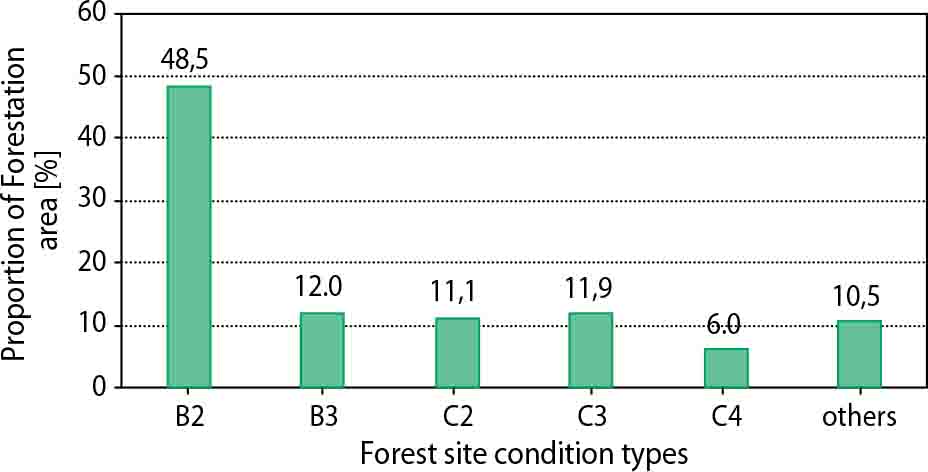
Figure 1.
Proportion of forest regeneration across forest site condition types, %
Forest regeneration is predominantly carried out using artificial methods: reforestation accounts for 78–88%, and afforestation for 94–100% of the total area of Eastern Polissya Region of Ukraine. In forest regeneration, Scots pine (P. sylvestris) dominates in terms of species composition: it accounts for 83–91% of reforested areas areas and 77–100% of afforested areas. Pedunculate oak (Q. robur) is also present, making up 7–10% of reforested areas and 0–11% of afforested areas (Tab. 6). Black alder (Alnus glutinosa Gaertn.) stands were established on moist and wet loamy soils, accounting for 1–8% of the total area.
Table 6.
Trends in forest crops areas by tree species composition
| Years | Area of artificial reforestation by dominant tree species, ha | Area of artificial afforestation by dominant tree species, ha | ||||||
|---|---|---|---|---|---|---|---|---|
| PiSy | QuRo | Algl | others | PiSy | QuRo | AlgI | Others | |
| 2012 | 2739.0 | 346.0 | 17.3 | 189.1 | 868.7 | 123.4 | 45.8 | 86.1 |
| 2013 | 2309.9 | 215.4 | 50.1 | 85.6 | 250.6 | – | 24.0 | 14.4 |
| 2019 | 2062.1 | 184.2 | 59.2 | 43.5 | 80.0 | – | – | 10.0 |
| 2023 | 1154.5 | 85.0 | 12.2 | 20.3 | 35.0 | – | – | 35.0 |
The share of other main forest-forming tree species in forest crops during the study period was: silver birch (Betula pendula Roth.) – 0–3%; black poplar (Populus nigra L.), eastern cottonwood (Populus deltoides Marsh.), Norway spruce (Picea abies (L.) Karst.), northern red oak (Quercus rubra L.), and Douglas fir (Pseudotsuga menziesii Franco) – 0–1%. Natural reforestation on areas after clear cutting occurs predominantly with silver birch (14–44%), black alder (A. glutinosa) (22–40%), and aspen (Populus tremula L.) (6–17%). The proportion of valuable species remains low: Scots pine (P. sylvestris) accounts for 11–23%, and pedunculate oak (Q. robur) for 2–4%.
In isolated plots (up to 1.0 ha in area), regeneration also includes black locust (Robinia pseudoacacia L.) (1.8%), European ash (Fraxinus excelsior L.) (0.5%), Norway maple (Acer platanoides L.) (0.3%), and smallleaved lime (Tilia cordata Mill.) (0.1%). Natural afforestation primarily occurs through black alder on waterlogged soils. In 2012, Scots pine accounted for 24%, and pedunculate oak for 6% of the total afforested area. The survival rate of forest crops at ages 1–3 years was 88–92% for reforestation areas and 84–90% for afforestation areas. In most cases, the quality of forest crops corresponds to quality classes 1 and 2 (see Tab. 2).
Scots pine crops established by direct seeding on fresh subir (B2) sites (PSP 4-Brc) showed lower average heights compared to those established by planting seedlings. In pure pine crops established by planting, tree spacing is often uneven (PSP 5-Krk). Local gaps caused by the damaging activity of Melolontha spp. and Hylobius abietis L. larvae have reduced the proportion of pine in the stand composition.
In forest site conditions B2 and B3, it is advisable to introduce pedunculate oak together with a mixture of fruit tree species Crab apple (Malus silvestris Mill.), Common pear (Pyrus communis L.). and shrubs Service-berry (Almelanchier ovalis Med.) to increase the stability of forest stands. Eight-year-old oak-pine crops with orderly mixing (PSP 1-Nvk, 2-Krp) demonstrate better growth of pine trees compared to stands where trees are mixed in clusters along the row (20 planting spots for Scots pine, 5 for pedunculate oak) at PSP 9-Uzr. At the age of eight, oak trees height are on average 0.8–1.9 meters (35–54%) shorter than pine trees, which can be attributed to the biological characteristics of the species as well as suppression by neighboring trees of other species. Therefore, appropriate tending is necessary to ensure the survival and improved growth of oak trees in pine-dominated crops.
Pedunculate oak (Q. robur) crops established on fresh and moist loamy soils and in oak forest types exhibit satisfactory quality, good survival rates, and successful growth. At the age of eight, the highest survival rate (80%) was recorded in experimental oak crops established using container-grown seedlings (PSP 1-Irz). Slightly lower survival was observed in crops established with three-year-old bare-root seedlings (63%) (PSP 2-Irz), and even lower in those established by direct acorn sowing (PSP 3-Irz). Oak stands created by sowing had an average tree height of 0.4–0.5 m (20–24%) lower compared to planted ones (see Tab. 2).
The average height increment of oaks varied significantly: the highest values were recorded in stands created using seedlings grown in containers, slightly lower – using direct sowing, and the lowest – using seedlings with an open root system. However, the current average annual height increment of oaks during 2017 (14.1 ± 0.84 sm – 15.4 ± 1.06 sm) did not show significant differences between the types of stands (Fig. 2).
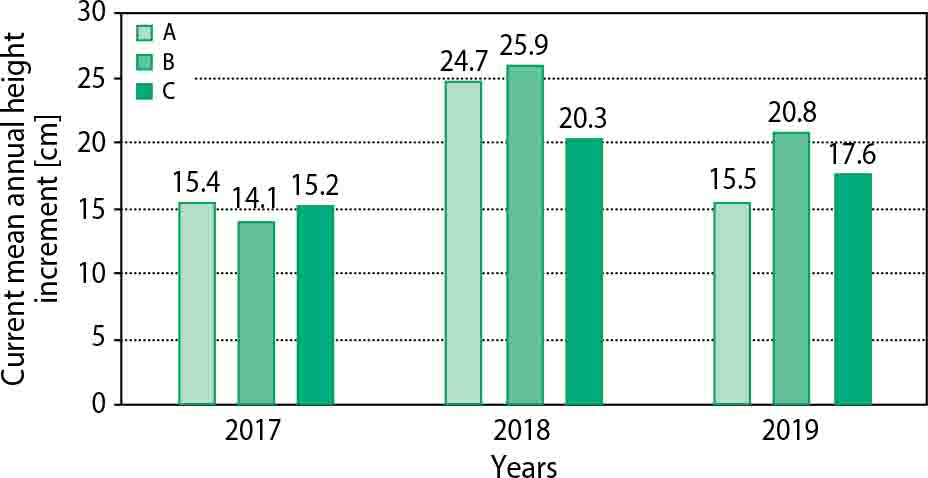
Figure 2.
Current mean annual height increment (cm) of pedunculate oak (Q. robur) trees in stands established in 2012 using container-grown seedlings (A), three-year-old bare-root seedlings (B), and direct acorn sowing (C)
In 2018, height growth for oak trees increased (20.3 ± 0.67 sm – 25.9 ± 0.98 sm), especially at PSP 2-Irz. In 2019, all variants showed a decline in current height increment, although the highest growth was still observed in the plot with crops established using three-year-old seedlings with an open root system (20.8 ± 1.22 sm).
In all experimental variants, crown closure occurred within the rows (crown projection ranged from 0.53 to 0.80 m). In the 4-meter-wide inter-rows, natural regeneration included silver birch, aspen, northern red oak, pedunculate oak, European ash, goat willow (Salix caprea L.), Norway maple, and Scots pine. In all experimental plots, broadleaf species and northern red oak exceeded pedunculate oak in average height. The most closed stand was the 8-year-old crops established using container-grown seedlings (relative density of stoking 0.69). Formation of mixed oak stands of combined origin should be managed through tending operations.
On areas after clear cutting, natural seed regeneration of main tree species occurs in varied patterns. Successful natural regeneration requires high-quality seed, favorable germination conditions, and adequate root-soil contact. The survival and growth of seedlings also depend on plant genetics, substrate moisture, light availability, and temperature extremes. In the first year, more than 112.000 Scots pine seedlings per hectare naturally regenerated on areas after clear cutting, natural seed regeneration of main tree species occurs in varied patterns. The most successful regeneration occurred on fresh and moist podzolized loam sites, 55–70 meters wide and up to 3.0 ha in area.
Satisfactory Scots pine regeneration was observed on areas after clear cutting surrounded on all sides or on two long and one short (northern or eastern) edge by reproductively mature pine stands. On areas after clear cutting 50–80 m wide in forest site conditions B2, B3, and C3, the proportion of one-year-old Scots pine seedlings reached 64–75% in the northern zone, 62–89% in the central zone, and 75–173% in the southern zone relative to the average. Most pine seedlings regenerated in furrows and other mineralized areas (60–99%). During the first growing season, Scots pine accounted for 83–98% of natural regeneration. Additional species included 0.02–1.67 thousand pedunculate oak seedlings, 0.06–7.28 thousand silver birch seedlings, and 0.34–3.6 thousand seedlings of other species per hectare. Shrub species and herbaceous ground vegetation gradually appeared on the clearcuts.
During the second year, 55–90% of the two-year-old pine seedlings survived, and 0.23 to 18.9 thousand one-year-old seedlings per hectare regenerated. By age 6–7, between 2.2 and 10.9 thousand viable Scots pine trees per hectare remained, with a stand density of 7–10 units (see Table 2). Natural regeneration was rated as quality classes 1–2.
On clearcuts without assisted regeneration, the share of Scots pine in the young stands decreased to 2–7 units, while the proportion of broadleaf species increased. Therefore, to support Scots pine regeneration and growth, site preparation and timely tending of valuable seed trees should be carried out before mast years.
On clearcuts of mature oak stands, over 20,000 pedunculate oak seedlings per hectare naturally regenerated in the year following acorn drop. However, in the second half of the growing season, oak seedlings were affected by powdery mildew (caused by Microsphaera alphitoides Griff. et Maubl.). Under drought conditions, premature leaf yellowing and drop were observed, and bud development was incomplete, leading to reduced seedling vitality the following year. In early growth stages, oak seedlings were suppressed by ground vegetation and shoots of secondary trees and shrubs. To ensure the survival and growth of oak regeneration, regular tending is required. Timely tending can result in 5–7-year-old mixed young stands with a pedunculate oak composition of 3 trees (PSP 1-Drz, Tab. 2). The number of oak trees ranged from 4.2 to 5.3 thousand per hectare, with a satisfactory regeneration success rating.
In recent years, spontaneous afforestation of abandoned arable lands, meadows, and pastures has been observed in Eastern Polissya. The highest density of natural regeneration occurred near existing forest stands. On former arable land in forest site condition B2, left without tillage, young stands formed over 10 years with a composition of 5PiSy4BeRe1SaCa+PoTr and a density of 12,880 trees per hectare. The proportion of young Scots pine trees at various distances from the forest edge (southwestern side) was: 24 m – 2.6%, 48 m – 15.5%, 72 m – 25.9%, 96 m – 21.5%, 120 m – 19.0%, 144 m – 14.6%, 168 m – 0.9%. By December 18, 2015, a dense birch-pine stand had developed with a growing stock of 133 m3 ha-1. The pine component was unevenaged (9–19 years), with an average height of 7.7 m and 5,300 trees/ha. As of September 24, 2020, the average pine height reached 11.3 m; the number of living trees per ha was 2,944 (55.5%), and dead trees – were 1,356 (44.6%). The stand’s growing stock reached 174 m3 ha-1, with a current increment of 14.1 m3 ha-1.
On weakly eroded slopes of ravine-gully systems with grey forest soils (site condition D2), formerly used as arable lands and meadows, natural regeneration occurred mainly with silver birch, provided seed sources were available. On former meadows with excessively moist soils (site conditions C4, D4), spontaneous afforestation featured dominance of black alder, white willow (Salix alba L.), and other species.
In most areas without nearby seed sources, afforestation is carried out artificially. Based on experience from forest crops establishment on former arable lands in the Chernihiv region, the following practices are recommended: deep soil ripping (to a depth of 40–60 cm), pre-plant treatment of seedling root systems with insecticides, establishment of mixed-species stands, and regular tending.
In most pure Scots pine crops established on former arable lands under forest site condition B2, decreased survival, reduced tree vitality (mean condition classes I.6–III.2), and tree mortality were observed, mainly due to damage from Melolontha spp. larvae (up to 8 individuals/m2 of third-instar larvae in some microsites). Some trees were also affected by large pine weevil (Hylobius abietis L.) and bark beetles (Hylastes sp.), requiring pest control measures. Following supplementary planting and timely tending, young pine stands are successfully formed in such areas. In the first two years, 1–2 manual within-row and 1–2 mechanized inter-row tending operations are performed. From the third year onward, only mechanized inter-row tending is applied (using brush cutters and disk cultivators).
The quality of forest crops at the time of their transfer to lands covered with forest vegetation over the past 12 years has been assessed as follows: in afforestation areas, the average quality class ranged from 1.65 to 1.83; in reforestation areas, from 1.39 to 1.69. In particular, in 2013, the total area of transferred forest crops in Chernihiv Oblast amounted to 1,778 ha, of which 42.8% were classified as quality class I, 49.3% as class II, and 7.9% as class III. Scots pine stands were evaluated with average quality classes of 1.65–1.87 in reforestation areas and 1.41–1.49 in afforestation areas, while pedunculate oak (Q. robur) stands received respective average scores of 1.78 and 2.02. The quality of natural regeneration was assessed at an average quality class of 1.72–1.88.
As of 2024, the average direct production costs per hectare over the first three years amounted to: UAH 31,914.40 for artificial reforestation; and 78.1% less (UAH 17,920.56) for assisted natural regeneration. The highest cost savings over the three-years were observed in the first year – a 2.5-fold difference (UAH 6,223.72 vs. UAH 15,609.00). In the second year, the costs of establishing crops exceeded those of assisted natural regeneration by 57.8% (UAH 9,229.10 vs. UAH 5,848.42), and in the third year – by 21.0% (UAH 7,076.30 vs. UAH 5,848.42).
Discussion
Forest regeneration areas in Eastern Polissya have declined over the past 12 years, due to reduced areas of clearcutting and afforestation potential. In 2013, forest regeneration declined by 1.100 ha (20.4%) compared to the previous year, and in 2019, by 2.515 ha (46.6%). Following the Russian invasion, forest regeneration in 2023 was nearly halved.
The highest regeneration areas were observed in fresh subir (B2 – 48.5%), reflecting the typological structure of the land base. The share of reforestation increased to 91.2% in 2013, 96.5% in 2019, and 97.6% in 2023, while afforestation declined due to reduced availability of lands designated for forest establishment.
However, it should be noted that pure Scots pine (P. sylvestris) crops exhibit low resistance by root rot (Heterobasidion annosum (Fr.) Bref.), particularly on former arable lands (Gordienko et al. 2005). Pure pine stands are also more susceptible to forest fires compared to mixed stands (Borisenko and Meshkova 2021). In response to a forest fire in 2008 that affected over 400 ha of pine stands, the state enterprise “Osterskyi Forestry” in Chernihiv Oblast implemented the establishment of mixed crops using nine species mixing schemes. Under fresh subir (B2) conditions, good growth of container-grown Scots pine seedlings was observed. In Eastern Polissya of Ukraine, forest fires affect not only forest crops but also naturally regenerated young stands that develop on abandoned agricultural lands (Zhezhkun 2021). These forests require fire prevention measures and the formation of mixed stands through tending operations.
In recent years, due to global climate change, the biotic resistance of forests, particularly pure stands, has declined (Brichta et al. 2023; Knutzen et al. 2025). Despite the dominance of artificial methods, mixed-species crops adapted to forest site conditions are being established in the region.
In oak-pine crops established with grouped planting in rows (PSP 9-Uzr), a greater number of pedunculate oak trees are retained, which improves conditions for the formation of a second canopy layer in fresh subir (B2). These mixed oak-pine stands have higher biotic resistance to adverse factors, in line with previous findings (Logginov 1968; Gordienko et al. 2005). Efforts to expand the participation of this valuable species are essential, given the constant reduction in the area of oak stands in Eastern Polissya using seedlings in containers, which agrees with the data (Danylenko et al. 2024).
Natural regeneration in fresh podzolized sandy loam sites occurs on only 20–30% of clearcuts, consistent with previous studies (Romashov 1972). Regardless of clearcut orientation, most Scots pine self-seeding occurs in mineralized parts of the site, consistent with findings by Fuchylo and Ryabukhin (2011), supporting the silvicultural and economic rationale for promoting natural regeneration. In subsequent years, the number of one-year-old Scots pine seedlings decreases – due to reduced soil mineralization and increased ground vegetation, in agreement with Maurer and Koren (2014). With timely tending, naturally regenerated young stands of Scots pine and other valuable species are successfully formed.
To maintain biodiversity, the use of natural regeneration should be promoted where it ensures preservation of main tree species and the formation of stable, high-yield stands adapted to forest types.
To increase forest cover and ensure landscape stability in the region, afforestation efforts should be expanded on both forest lands (e.g., glades) and non-forest lands (e.g., ravines, gullies, wastelands, steep slopes, and reclaimed lands). This would enhance the protective, water-regulating, and other ecological functions of forests.
Spontaneous afforestation of unused, low-productivity, and degraded agricultural lands has mixed economic implications. On one hand, natural overgrowth of abandoned lands with forest vegetation increases carbon sequestration and eventually raises land productivity, producing marketable timber and improving eco-economic land use parameters. On the other hand, direct economic losses may occur when landowners or users (e.g., lessees) of reforested agricultural land attempt to clear young stands to restore farming. This results in losses for both the landholders and society, which forfeits the future benefits of those developing forest ecosystems. Legal frameworks regulating land use relationships should be improved to prevent ecological, economic, and social losses.
The quality of forest regeneration projects has improved steadily in recent years. The share of crops rated as quality class III decreased from 15.7% in 2012 to 11.7% in 2019 and to 7.9% in 2023. However, due to the ongoing armed aggression against Ukraine, many forest crops sites on mined areas remain unaccounted for and unassessed.
According to a three-year comparative economic analysis, direct production costs for assisted natural regeneration of clearcuts were 78.1% lower than those for planting and subsequent tending. These efficiency figures slightly exceed estimates from South Korea, where natural regeneration costs were 55% lower than those of forest crops (Joung et al. 2020). Our findings also confirm the conclusions of Długosiewicz et al. (2019), which highlighted that the most significant factor in the economic performance of young stand establishment and maintenance is the cost of site preparation, particularly furrow cutting or plowing. Over time, the cost difference between artificial and natural regeneration has narrowed due to the similarity of tending operations applied in both systems.
Conclusions
Annual forest regeneration areas in Eastern Polissya, Ukraine, during 2012–2023 ranged from 1.4 to 5.4 thousand hectares. Reforestation accounted for 78–98% of the total forest regeneration area. In recent years, afforestation volumes have declined due to a reduction in the area allocated for forest establishment.
Reforestation and afforestation are predominantly carried out using artificial methods. In reforestation areas Scots pine (Pinus sylvestris L.) (83–91%) and pedunculate oak (Quercus robur L.) (7–10%) dominated. Natural regeneration occurs under specific forest site conditions, primarily with Scots pine, black alder, aspen, and silver birch.
Afforestation is conducted on degraded and low-value lands. New forest crops are predominantly composed of Scots pine (77–100%), pedunculate oak (0–11%), and black alder (0–8%). Natural afforestation occurs mainly through black alder and Scots pine.
Based on the analysis of growth indicators in experimental forest crops established with different species mixing schemes and technologies, including direct sowing and planting with open-root seedlings and growing in containers, classification indicators for forest crops types were developed. These include main and accompanying tree species, mixing schemes, initial stand density, establishment technology and maintenance frequency.
During the first 1–3 years of growth, stands in the reforestation fund demonstrated slightly higher-survival rates (88–92%) compared to stands in the afforestation fund (84–90%). Over the past 12 years, the average quality class of stands at the time of transfer to forest-covered lands was 1.65–1.83 in afforestation areas and 1.39–1.69 in reforestation areas. The quality of natural regeneration was estimated at an average class of 1.72–1.88. According to a comparative analysis, promoting natural regeneration in areas after clear cutting turned out to be 1.8 times more economically profitable than creating forest crops.