
Introduction
Natural oak forests are a source of preservation of landscape and biological (especially genetic) diversity. Intensive forest use leads to a significant reduction in the area of forests of natural origin. The lack of reliable natural renewal, especially of the forests of the plain part of Ukraine, led to a significant reduction of oak forests of natural origin at the expense of artificially created ones. The periodicity of mass fruiting is 5–7 years, which significantly affects the lack of natural seed renewal, and its unsatisfactory growth is the main reason for interrupting the genesis of forest stands. Natural oak forests, which are the main formations in the research region, are characterized by particularly unsatisfactory natural regeneration (Chernevyy et al. 2024; Maliuha et al. 2024).
During the past three decades, the total area of forests in the Kyiv region has significantly decreased, which, in turn, has led to significant changes in the composition of forests. During the last century, natural development was disrupted due to the negative impact of abiotic, biotic and anthropogenic factors, which resulted in the activation of processes of drying and degradation of oak forests and the impoverishment of their biological diversity (Tkach 2009). The process of reproduction of forests of natural origin in Ukraine plays a key role in the implementation of the biodiversity conservation strategy. Particularly important objects for the preservation and restoration of the biodiversity of the plant world in current conditions are the ancient natural indigenous forests, in particular, the old age oak forests of natural origin. They are important centres of conservation of the gene pool in the condition of deterioration or lack of practical renewal in the study region (Matusiak et al. 2019).
The relevance of the topic of scientific research is due to the clarification of the characteristics of the growth and development of old oak forests of natural origin in order to substantiate their current status. A feature of old forests is the full-fledged formation of the natural forest environment, which is represented by all components: tree stand, undergrowth, underbrush, living and dead aboveground covers and root-containing soil layer.
Common oak (Quercus robur L.) is one of the main forest-forming tree species in Ukraine. Approximately 28% of the forest areas of the country covered with forest vegetation are occupied by stands of this species. Oak forests perform various ecological functions and meet the needs of the national economy in valuable wood (Vasylevskyi et al. 2021).
Oak woodlands play a critical role in protecting soils from erosion and landsliding, regulating water flow in watersheds and maintaining water quality in streams and rivers. The main ecological functions of oak forests are the following (Dalponte et al. 2019).
Conservation of soil. Oak forests contribute to soil formation, preservation of soil cover and prevention of erosion processes. Their root system is able to firmly hold the soil, which makes it difficult for it to be washed away due to the concentration of surface runoff and prevents erosion.
Preservation of biodiversity. Oak forests form important ecosystems that provide habitat for numerous species of plants and animals.
Air purification. Forest ecosystems, particularly oak forests, are able to absorb carbon dioxide and other pollutants, helping to clean the air.
Climate regulation. Forests influence the climate by reducing greenhouse gas emissions and providing regulation of air temperature and humidity.
Protection against natural disasters. Oak forests act as a natural barrier, protecting the area from extreme weather conditions, such as strong winds, showers and snowfalls.
Forests play a decisive role in maintaining the stability of the biosphere due to their global influence on the planet’s climate. Forests perform an important ecological function at the regional and local levels as key elements of landscape stabilization.
Among natural oak forests, wood stands of seed origin are of special importance for forestry, as they are more stable and longer lasting than seedlings, and are also centres of gene pool preservation. Each subsequent coppice generation (tree stands of the second and subsequent coppice generations) of the same tree will be characterized by deterioration, a decrease in growth energy, stability and longevity (Tkach 2009; Chernevyy et al. 2024).
Centuries-old trees are unique biological objects: they are important for preserving biodiversity (Onyshchenko 2015), maintaining the natural structure of forests (Tkach 2009) and supporting climatological and dendrochronological studies on the growth and development of stands (Dalponte et al. 2019). A significant part of the centuries-old trees of Ukraine are registered and have a protective status. However, these trees are insufficiently researched from the point of view of forestry and forest management. A large number of old trees, despite their unique silvicultural and historical-cultural importance, are little known and often not directly protected by law. Dzyba (2022) systematized the taxonomic and ecological structures, as well as the frequency of occurrence of potentially old, centuries-old and ancient trees in natural and man-made protected areas and sites of the Ukrainian Polissia. Only on the territory of Kyiv, there are several hundreds of age-old trees from 100 to 900 years old, which represent ecological, cultural-historical and aesthetic value (Onyshchenko 2015).
Old stands are being actively researched abroad. Among the studies in the southern Appalachians of the Eastern region, the main focus is on the dynamics and conservation of old-growth forests (White et al. 2020). Scientists of European forest institute (O’Brien et al. 2021) observed protecting old-growth forests in Europe as a scientific evidence to inform policy implementation. Wallenius et al. (2002) investigated the spatial structure of tree age and fire history in two old-growth forests in eastern Finnish Scandinavia. Stewart et al. (2003) provided findings on particularly valuable old-growth forests in Nova Scotia, covering aspects of age, ecology, structure and condition assessment. Researchers have also compared growth dynamics and biodiversity change in ancient boreal forests to changes in climate temperature (Schulze et al. 2009). Special attention is currently being paid to the study of ancient forests and the problems that can be caused to them by various factors affecting the wood structure (Pesklevits et al. 2011). A quantitative assessment of the regeneration features of old-growth forests in France is described in a manuscript (Paillet et al. 2015), and the authors (Nagel et al. 2017) assess the impact on the landscape structure of old-growth habitats in a temperate climate region.
Leaf-gnawing and trunk pests and pathogens were important factors contributing to the weakening of old oak stands. Insects play an important role in the spread of trunk rots, in particular, through the passages made by oak galls: peak oak borer (Agrilus angustulus (Illiger, 1803)), two-spotted oak borer (Agrilus biguttatus (Fabricius, 1776)), mustaches: small oak (Serambyx scopolii (Fussly, 1775)), variegated oak (Plagionotus arcuatus (Linnaeus,1758)) and oak sapwood (Scolitus intricatus (Ratzeburg, 1837)), which carries the causative agent of oak vascular disease, necrotizing mycoses (Macháčová et al. 2022).
An infection that gets into these passages can not only penetrate but also spread more intensively along the trunk. The productivity of plantations is directly dependent on their biological stability, and one of the ways to increase the productivity of forests is to grow healthy stands (Moore and Conroy 2006; Mölder et al. 2019).
The consequences of long-term anthropogenic intervention in the integrity of the old-growth forest of the Oleksandria Park in Ukraine were revealed, the role of anthropogenic factors in its spatial differentiation was determined, and the patterns of oak weakening and decline were considered (Dragan 2013).
The purpose of the work was to study the current status, health condition, growth and development of natural age-old common oak stands, which are important foci of biotic and genetic diversity in the study region and require conservation and environmental protection measures.
Material and methods
The study of the health condition and growth of old oak stands of natural origin was carried out in the ‘Koshyk’ tract of the educational and research farm of the Bila Tserkva National Agrarian University. The research was conducted in September–December 2023 in forest stands of the same composition, almost the same age, quality and site index. Trial plots (TP) were laid according to generally accepted methods (Trial plots…2006).
Remote sensing on the experimental sites was carried out with the aim of determining the coordinates of the trial plots on the Koshyk tract (Fig. 1), which was carried out using the Google Maps web mapping service (Dalponte et al. 2019).
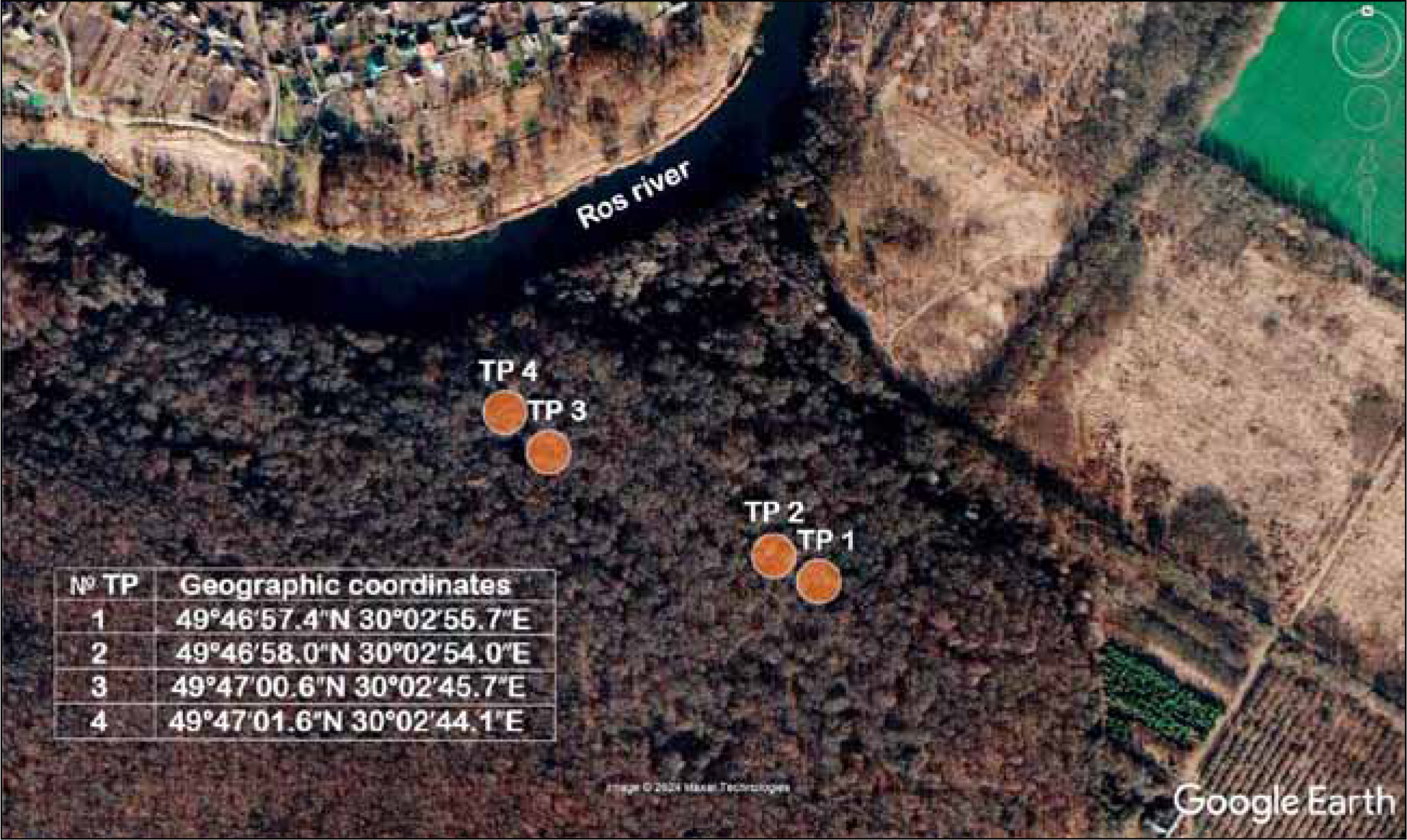
Figure 1.
Location of trial plots with the corresponding coordinates
The health condition of oak trees was determined in accordance with the current Sanitary rules in the forests of Ukraine (Sanitary…2016). Age-old trees affected by diseases were determined visually. The presence of fruiting bodies, cancerous diseases, hollows and dry upper branches was noted.
Droughts, climate changes, the hydrological regime of the Ros river, invasions of leaf-gnawing pests and pathogens, powdery mildew, etc. contributed to the weakening of old trees in different periods. Powdery mildew (Microsphaera alalphitoides Griff. et Maubl.) is one of the main and common oak diseases (Juzwik et al. 2011; Copolovici et al. 2014). During its significant spread in the crown of the tree, the process of preparing the shoots for winter slows down, growth decreases and there is a significant decrease in the reserves of nutrients in the tree. The weakening of trees led to a decrease in fruiting in plantations, an increase in the interval between seed years, which significantly reduced the possibilities of natural regeneration.
On all trial plots, a continuous list of trees was carried out with a simultaneous distribution by classes of growth and development of age-old oak stands of natural origin. The research was carried out by route surveys of old trees during the growing season, and the age of each tree was determined using biometric parameters (Shlapak et al. 2010). The researchers identified the places of the largest concentration of centuries-old trees, which is important for the development of measures for their protection, taking into account the conditions of significant recreational impact.
The classification by growth and development of age-old oak stands of natural origin is schematically presented in Figure 2.
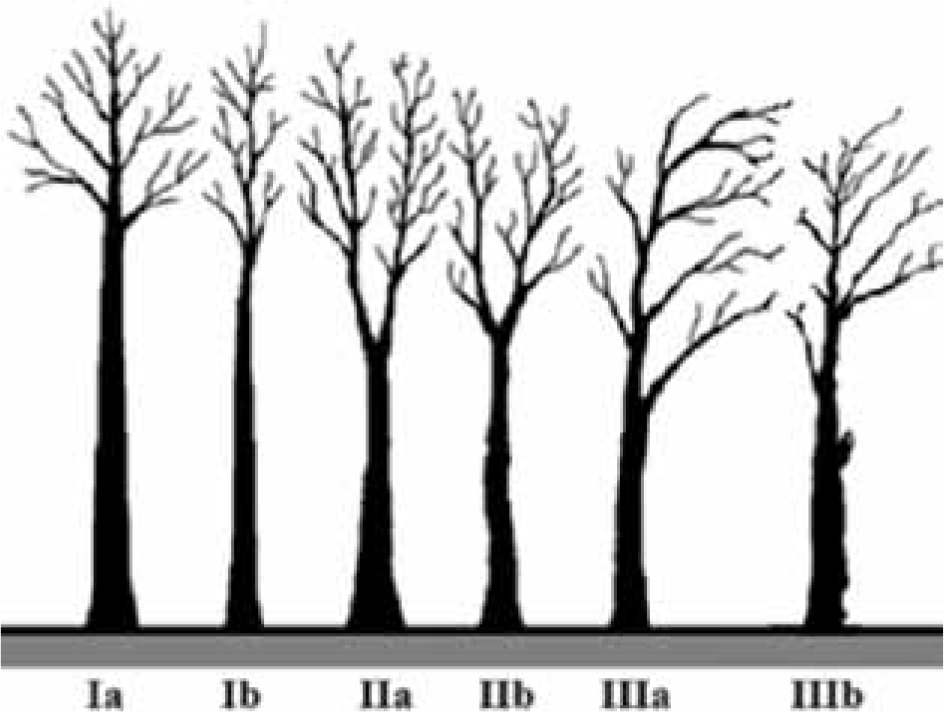
Figure 2.
Classification by growth and development of age-old oak stands of natural origin
Source: developed by the authors
Ia class: healthy trees with a slender, slightly tapered trunk, a high-placed tent-shaped symmetrical crown, which make up the upper canopy of stands.
Ib class: healthy trees of the upper tier with a symmetrical but compacted crown, a straight trunk with a smaller diameter than the previous ones.
IIa class: healthy trees with a tapered branched trunk, on which a generally high tent-shaped crown is formed.
IIb class: weakly weakened trees with a tapered branched trunk, but a narrowed crown, a smaller trunk diameter than the previous ones, sometimes have the presence of phytopathological signs up to 10% of the total number of trees.
IIIa class: moderately weakened trees that have an asymmetric, often flag-like shape of the crown due to its spread in the windows of the space or toward the edges of the wood, with placement down the trunk, which can have various types of branching and, not infrequently, phytopathological signs from 11% to 30% of the total number of trees.
IIIb class: very weakened trees, which are often affected by various phytopathological signs, more than 30% of the total number of trees, having an uneven, rather curved and branched trunk with a low-hanging asymmetrical crown, which contains many dry branches. Completely dried-out trees are also assigned to this class.
The method of assessing the health condition of old oak stands using an integral indicator that takes into account biometric, meliorative and sanitary characteristics of stands, as well as agrochemical indicators of the soil, is described in Maliuha et al. (2024).
On the four trial plots with an area of 3.0, 2.2, 1.3 and 1.0 ha, the girths of 794 common oak trees were continuously measured at a height of 1.3 m with a measuring tape, followed by age determination according to formula 1 (Hrynyk et al. 2024).
where:A – the age of the tree, years;
K – the coefficient (1.0 for common oak);
C – the length of the circle (girth) of the tree trunk, cm (O’Brien et al. 2021; Hrynyk et al. 2024).
A significant advantage of forests of natural origin, even when they are pure in composition, lies in their multi-age structure, which provides them with sufficient stability. The formation of studied oak stands took place in the interval from 116 to 351 years at the control site (TP 4) and from 131 to 410 years at TP 1. The calculated average values of the age of stands from 200 to 214 years are presented in Table 1.
Table 1.
Stands of common oak of different ages of natural origin
| Number TP | Composition | Area of TP, ha | Trees number, pc. | Age, years | |||
|---|---|---|---|---|---|---|---|
| at plot | per ha | average | min | max | |||
| 1 | 10Qr | 3.0 | 321 | 107 | 214 | 131 | 410 |
| 2 | 10Qr | 2.2 | 236 | 107 | 204 | 124 | 331 |
| 3 | 10Qr | 1.3 | 135 | 104 | 200 | 118 | 363 |
| 4 | 10Qr | 1.0 | 102 | 102 | 204 | 116 | 351 |
Trial plots were laid in the most typical parts of oak stands with undergrowth of the main forest-forming tree species. At each trial plot undergrowth, understorey, herbaceous vegetation, and forest litter were characterized as the main components of forest stands by general scientific and special research methods (Neyko 2002; Hrynyk et al. 2024).
Living overground cover was described using an atlas (Yukhnovskyi et al. 2013). Litter accumulation was studied after leaf fall by collecting it on 10 evenly spaced 1.0 × 1.0 m counting sites. The thickness of the forest litter was measured using the wooden template with an internal area of 1 m2, divided into squares every 20 cm with nylon hair and measuring the litter thickness with a millimetre ruler at 16 intersections of this hair.
The assessment of the state of a stand was given through the tree health condition index, which was calculated as a weighted average value based on the results of the list of trees in the stand. The agrochemical properties of the soil were evaluated based on the results of laboratory analyses of soil samples. Ammonium nitrogen (N-NH4+) was determined using the Nessler reagent method; nitrate nitrogen (N–NO3) by the method with the Griess reagent; mobile phosphorus (P2O5) according to Chyrikov (State standard 4115-2002); mobile potassium (K2O) by the method of flame-photometric analysis; pHKCL (State standard 26483-85) and hummus according to Tiurin.
The general view of the control area is presented in Figure 3a. All trees on the trial plots are numbered (Fig. 3B).
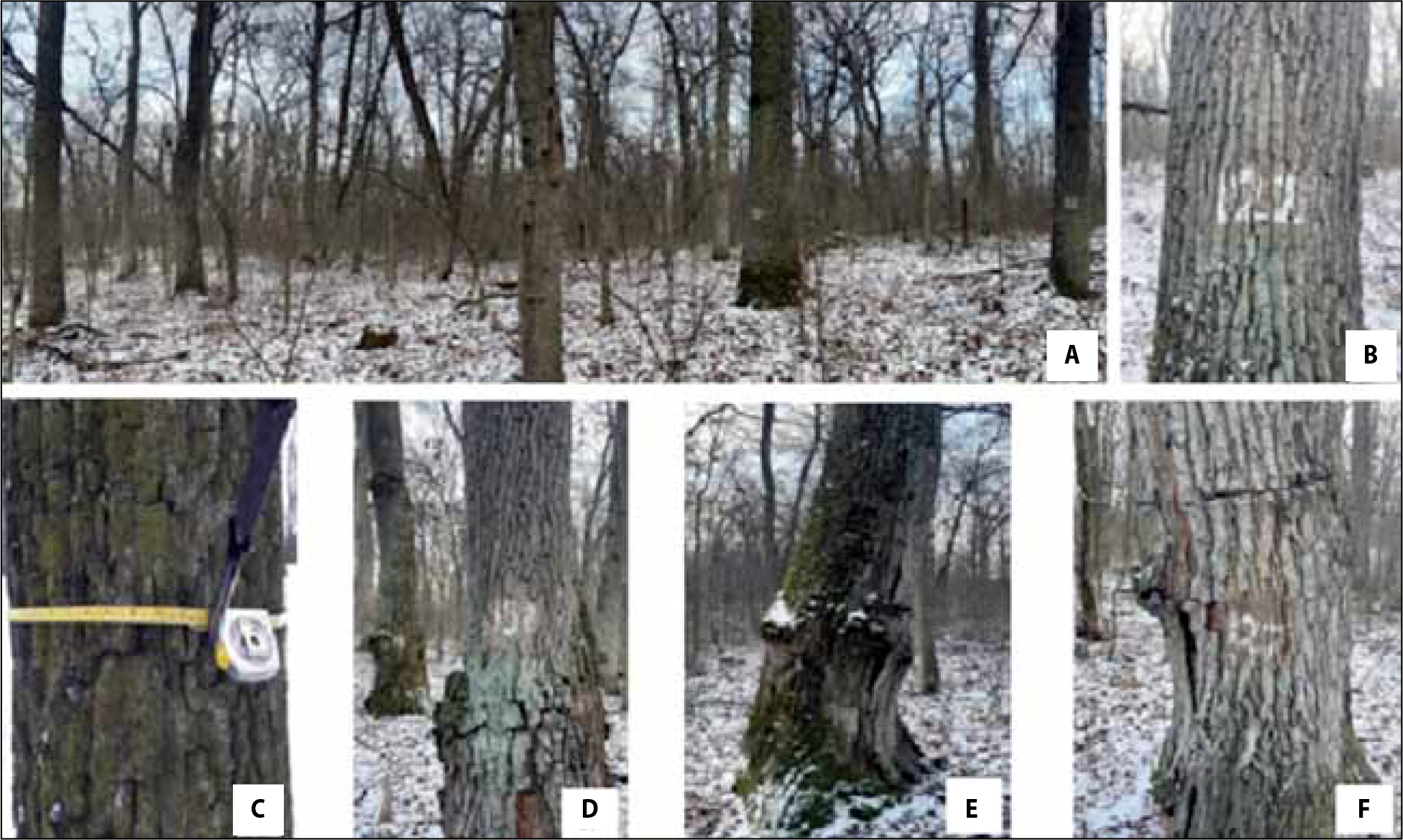
Figure 3.
Pictures of field studies: A –general view of the trial plot; B –numbered tree; C –measurements of tree girth; D –root rot, E –growths (inflows), and F –trunk cavity
The diameter of each tree is determined by formula (2):
where:D –the diameter, cm;
C –the girth, cm;
π –3.1416.
Next, a list was formed in 4-centimetre steps of thickness. Tree heights were measured with a PM-5 altimeter-eclimeter (Suunto Finland) for each degree of thickness with subsequent plotting of height curve graphs.
Results
The forestry and biometric characteristics of old age oak forests of natural origin are given in Table 2. All stands are pure in composition, aged from 200 to 214 years with average diameters from 63.5 to 67.8 cm. Trial plot 1 has a difference in average diameter, and the rest do not have a reliably significant difference. The statistical evaluation of the diameters is given in Tables 3 and 4. The average heights do not have a significant difference and are within the class II of productivity, which is a fairly high-quality indicator of the productivity of aged stands.
Table 2.
Forestry and biometric indicators of old age stands by data of trial plots
| Number TP | Composition | Age, years | Average | Trees number, pc. | Area of site, ha | Stock, m3 | |||
|---|---|---|---|---|---|---|---|---|---|
| diameter, cm | height, m | per 1 ha | per area | per 1 ha | total | ||||
| 1 | 10Qr | 214 | 67.8±0.75 | 29.3±3.1 | 107 | 321 | 3.0 | 510 | 1,530 |
| 2 | 10Qr | 204 | 64.7±0.75 | 29.1±2.6 | 107 | 236 | 2.2 | 465 | 1,023 |
| 3 | 10Qr | 200 | 63.5±1.06 | 28.9±3.0 | 104 | 135 | 1.3 | 451 | 586 |
| 4 | 10Qr | 204 | 64.6±1.41 | 29.2±2.5 | 102 | 102 | 1.0 | 429 | 429 |
Table 3.
Statistics of average diameters of experimental sites, cm
| Number TP | N | M | m | σ | u | p | A | E |
|---|---|---|---|---|---|---|---|---|
| 1 | 321 | 67.8 | 0.75 | 13.5 | 19.9 | 1.11 | 0.916 | 1.673 |
| 2 | 236 | 64.7 | 0.75 | 11.5 | 17.8 | 1.16 | 0.602 | 0.428 |
| 3 | 135 | 63.5 | 1.06 | 12.3 | 19.4 | 1.66 | 1.087 | 2.400 |
| 4 (C) | 102 | 64.6 | 1.41 | 14.2 | 22.0 | 2.17 | 0.314 | 0.011 |
Table 4.
Difference between the average values of the diameters of trial plots
| The difference between the values on the TP | Number of degrees of freedom | Student’s criterion t0.05 | The difference between the values on the TP | Number of degrees of freedom | Student’s criterion t0.05 |
|---|---|---|---|---|---|
| 1–2* | 553 | 2.92 | 2–3 | 367 | 0.92 |
| 1–3* | 452 | 3.31 | 2–4 (C) | 334 | 0.06 |
| 1–4 (C)* | 419 | 2.01 | 3–4 (C) | 233 | 0.62 |
The total number of trees on the experimental sites is from 102 to 321, which is due to the different size of the areas. However, if converted the number of trees to 1 ha, their number does not have a significant difference. Quantitative indicators of the productivity of forest stands are represented by the stock of trunk wood. The total stock is in the range of 429–1530 m3 and from 429–510 m3/ha. Trial plot 1 has the advantage in stock of stem wood (510 m3), and TP 4 has the lowest value (429 m3). The diameters of oak trees aged 200–214 years are 63.5–67.8 cm, which is consistent with research data of other scientists (Shlapak et al. 2010; Matiashuk et al. 2014). Statistics of the average diameters of experimental stands are given in Table 3.
An estimate of the significance of the difference between the average indicators of the diameters of the experimental stands is given in Table 4.
As evidenced by the data in Tables 3 and 4, a significant difference between the average indicators occurs only at TP 1. The characteristics of the remaining components of forest stands are given in Table 5.
Table 5.
Characteristics of the components of the stands
| Number TP | Undergrowth | Understorey | Living aboveground cover | Forest litter | |||||
|---|---|---|---|---|---|---|---|---|---|
| composition | height, m | number, pieces/ha | number, pieces/ha | cover, % | number, pieces/ha | cover, % | thickness, cm | stock, kg/ha | |
| 1 | 8Um1Ap1Ac single Qr,Apl | 0.5–7.0 | 8,000 | 85,000 | 5 | 110,000 | 10 | 2.0 | 7,101 |
| 2 | 8Um1Ap1Fe single Qr,Ac,Apl | 0.5–5.0 | 5,500 | 70,000 | 3 | 95,000 | 10 | 1.5 | 6,873 |
| 3 | 10Um+Qr,Ac,Ap | 0.5–7.0 | 12,000 | 80,000 | 6 | 100,000 | 8 | 2.5 | 7,459 |
| 4 | 10Um+Qr,Ap,Fe,Ac | 0.5–8.0 | 20,000 | 120,000 | 6 | 130,000 | 9 | 3.5 | 7,984 |
Undergrowth is presented with a preference for little elm. It numbers eight units in the composition with an admixture of sharp-leaved maple at TP 1 and TP 2, field maple at TP 1 and common ash at TP 2. The presence of little elm on TP 3 and 4 reaches ten units. The participation of common oak in the first two trial plots is represented single, and in the others, it reaches 3–5% in the composition with the participation of other accompanying species. The height of undergrowth ranges from 0.5 to 8.0 m, quantitatively from 5.5 (TP 2) to 20 thousand units/ha (TP 4).
The understorey on TP 1 consists of common hazel (Corylus avellana L.), European barberry (Euonymus europaeus L.), warty rowan (Euonymus verrucosus) and black elder (Sambucus nigra L.). Its coverage reaches 5% at a quantitative representation of 85,000 pieces/ha.
The living aboveground cover on TP 1 includes a list of the following herbaceous plants: Viola reichenbachiana Jprd ex Boreau, Brachypųdium sylvaticum H., Pulmonaria officinalis L., Geum urbanum L., Vinca L., Aegopodium podagraria L., Impatiens L., Urtica dioica L., Chelidonium majus L., Chaerophllum L., Lamium L. and Athyrium filix-femina L. Its coverage reaches 10% with a quantitative representation of 110,000 pieces/ha. The thickness of the forest litter reaches 2 cm with a stock of 7,101 kg/ha.
The understorey on TP 2 consists of European barberry, black elderberry (Sambucus nigra L.) and warty barberry (Euonymus verrucosus Scop.). Its coverage reaches 3% at a quantitative representation of 70,000 pieces/ha.
The living aboveground cover on TP 2 includes a list of the following herbaceous plants: Pulmonaria L., Aegopodium podagraria L., Urtica dioica L., Viola odorata L., Brachypschdium sylvaticum H., Chaerophullum L., Athyrium filix-femina L., Lamium maculatum L., Chelidonium majus L. Its coverage reaches 10% with a quantitative representation of 95,000 pieces/ha. The thickness of the forest litter reaches 1.5 cm with a stock of 6,873 kg/ha.
The understorey on TP 3 consists of common hazel, European barberry and black elderberry. Its coverage reaches 6% at a quantitative representation of 80,000 pieces/ha.
The living aboveground cover on TP 3 includes a list of the following herbaceous plants: Athyrium filix-femina L., Pulmonaria L., Viola odorata L., Chelidonium majus L., Urtica dioica L. and Aegopodium podagraria L. Its coverage reaches up to 8% at a quantitative representation of 100,000 pieces/ha. The thickness of the forest litter reaches 2.5 cm with a stock of 7,459 kg/ha.
The understorey on TP 4 consists of common hazel, hawthorn single-stamen (Crataegus monogyna Jacq.) and black elder. Its coverage reaches 6% at a quantitative representation of 120,000 pieces/ha.
The living aboveground cover on TP 4 includes a list of the following herbaceous plants: Urtica dioica L., Athyrium filix-femina L., Geum urbanum L., Aegopodium podagraria L. and Pulmonaria L. Its coverage reaches 9% with a quantitative representation of 130,000 pieces/ha. The thickness of the forest litter reaches 3.5 cm with a stock of 7,984 kg/ha.
The results of agrochemical analyses of the soils of the trial plots are given in Table 6.
Table 6.
The content of the main elements of mineral nutrition in the upper 50-centimeter layer of the studied soils
| Number TP | Horizon | Mineral nitrogen (N–NH4+) + (N-NO3) | Mobile phosphorus (P2O5) | Mobile potassium (K2O) | ||||||
|---|---|---|---|---|---|---|---|---|---|---|
| mg/1000 g | regarding control | mg/1000 g | regarding control | mg/1000 g | regarding control | |||||
| % | t | % | t | % | t | |||||
| 4 | 0–10 | 28.3±0.53 | 100.0 | – | 179.7±2.55 | 100.0 | – | 186.7±1.65 | 100.0 | – |
| 10–20 | 16.7±0.39 | 100.0 | – | 151.3±1.95 | 100.0 | – | 134.5±1.41 | 100.0 | – | |
| 20–30 | 15.8±0.43 | 100.0 | – | 98.6±1.24 | 100.0 | – | 97.4±1.39 | 100.0 | – | |
| 30–40 | 13.2±0.47 | 100.0 | – | 54.9±0.74 | 100.0 | – | 81.8±1.21 | 100.0 | – | |
| 40–50 | 13.1±0.21 | 100.0 | – | 48.8±1.40 | 100.0 | – | 75.4±1,19 | 100.0 | – | |
| 1 | 0–10 | 21.1±0.37 | 74.6 | 11.15 | 116.7±2.06 | 64.9 | 19.22 | 148.3±1.57 | 79.4 | 16.86 |
| 10–20 | 18.4±0.40 | 110.2 | 3.04 | 94.8±1.72 | 62.6 | 21.73 | 133.6±1.50 | 99.3 | 0.44 | |
| 20–30 | 12.2±0.33 | 77.2 | 4.89 | 59.4±1.57 | 60.2 | 14.82 | 92.9±1.34 | 95.4 | 2.33 | |
| 30–40 | 13.1±0.41 | 99.2 | 0.26 | 35.5±1.36 | 64.7 | 12.53 | 78.5±1.28 | 96.0 | 1.87 | |
| 40–50 | 10.6±0.36 | 80.9 | 14.39 | 36.6±1.21 | 75.0 | 6.86 | 59.9±1.15 | 79.4 | 9.36 | |
| 2 | 0–10 | 20.2±0.46 | 71.4 | 16.45 | 112.7±0.71 | 62.7 | 25.31 | 144.1±1.49 | 77.2 | 19.16 |
| 10–20 | 18.5±0.51 | 110.8 | 4.37 | 95.2±1.51 | 62.9 | 22.75 | 127.8±1.40 | 95.0 | 3.37 | |
| 20–30 | 16.8±0.49 | 106.3 | 2.35 | 55.7±1.30 | 56.5 | 23.87 | 82.6±1.32 | 84.8 | 10.68 | |
| 30–40 | 13.8±0.41 | 104.4 | 0.80 | 40.4±1.15 | 73.6 | 10.60 | 61.9±1.20 | 75.7 | 11.67 | |
| 40–50 | 13.0±0.48 | 99.2 | 0.19 | 38.8±1.02 | 79.5 | 5.77 | 55.2±1.05 | 73.2 | 12.73 | |
| 3 | 0–10 | 27.2±0.51 | 96.1 | 1.28 | 135.7±1.75 | 75.5 | 14.23 | 153.3±1.42 | 82.1 | 22.58 |
| 10–20 | 17.9±0.64 | 107.2 | 1.60 | 120.2±1.61 | 79.4 | 22.18 | 128.6±1.30 | 95.6 | 4.26 | |
| 20–30 | 14.5±0.45 | 91.8 | 1.65 | 74.4±1.32 | 75.4 | 13.36 | 87.4±1.18 | 89.7 | 7.41 | |
| 30–40 | 13.1±0.38 | 99.2 | 0.17 | 45.5±1.14 | 82.9 | 6.92 | 77.5±1,10 | 94.7 | 2.63 | |
| 40–50 | 13.2±0.23 | 100.8 | 0.32 | 36.9±0.99 | 75.6 | 6.94 | 65.3±1.03 | 86.6 | 6.42 | |
As can be seen from Table 6, the best agrochemical indicators were found at TP 4 due to the grounding role of undergrowth, which was improved to 20,000 pieces/ha and litter stock of 7,984 kg/ha. They are inferior to indicators at TP 3, where growth reaches 12,000 pieces/ha and litter stock is 7,459 kg/ha. The age difference between these stands is 4 years. The oldest plantation (214 years old), TP 1, ranks third with undergrowth of up to 8,000 pieces/ha and litter stock of 7,101 kg/ha. The weakest soil-improving properties were found on TP 2. Although it is the same age as TP 4 (204 years), it has a growth rate of 5,500 pieces/ha and a litter stock of 6,873 kg/ha, which affected the result.
The distribution of age-old oak trees according to the presented classification by their growth and development (Fig. 2) is given in Table 7.
Table 7.
Distribution of age-old oak trees according to their growth and development
| Number TP | Number of trees, pc. | Classes according to growth and development, % | ||||||
|---|---|---|---|---|---|---|---|---|
| Ia | Ib | IIa | IIb | IIIa | IIIb | total | ||
| 1 | 321 | 24 | 22 | 16 | 11 | 13 | 14 | 100 |
| 2 | 236 | 32 | 23 | 12 | 14 | 10 | 9 | 100 |
| 3 | 135 | 0 | 4 | 19 | 30 | 20 | 27 | 100 |
| 4 | 102 | 0 | 17 | 12 | 27 | 22 | 22 | 100 |
The data given in Table 7 on the age distribution of common oak trees as a percentage of the total number on the experimental sites indicate that the number of healthy trees (Ia, Ib, IIa) is different on TP 1, 2, 3, and 4, which is, respectively, 62%, 67%, 23% and 29%. Weakened and affected by various phytopathological signs stands are represented by the following distribution, respectively: TP 1 – 38; TP 2 – 33%; TP 3 – 73% and TP 4 – 71%.
The distribution of indices of the condition of trees and the number of affected trees is given in Table 8.
Table 8.
Indices of tree health condition and number of affected trees
| Number TP | Stand composition | Age, years | Number of trees, pieces | Index | Number of affected trees, % | |||
|---|---|---|---|---|---|---|---|---|
| per area | per 1 ha | health condition | drying branches, % | weakened, % | ||||
| 1 | 10Qr | 214 | 321 | 107 | 1.96 | up to 30 | 38 | 46.4 |
| 2 | 10Qr | 204 | 236 | 107 | 1.49 | up to 30 | 33 | 44.9 |
| 3 | 10Qr | 200 | 135 | 104 | 2.48 | up to 30 | 77 | 48.5 |
| 4 | 10Qr | 204 | 102 | 102 | 2.58 | over 30 | 71 | 55.9 |
The obtained health condition index shows that the stands were divided into healthy TP 2, weakened TP 1 and 3, and very weakened TP 4. The branch drying index is almost the same on TP 1–3 and is up to 30%, slightly higher on TP 4.
The percentage of weakened trees (by the sum of classes IIb, IIia and IIIb) does not correspond to the number of affected trees due to the fact that the appearance of any phytopathological signs is not mandatory on weakly and moderately weakened trees, and on the contrary, there were several of them on very weakened trees. The distribution of the number of affected trees according to phytopathological signs is given in Table 9.
Table 9.
Distribution of the number of affected trees by phytopathological signs, %
| Number TP | Number of trees, pieces | Phytopathological characteristics, % of the number of trees | ||||||||
|---|---|---|---|---|---|---|---|---|---|---|
| visible rotten | hollows | wooddestroying fungi | wood exposure | growths, inflows | transverse oak cancer | frostbite | ||||
| root, lump | trunk | root, lump | trunk | |||||||
| 1 | 321 | 1.3 | 27.0 | – | 11.0 | 13.0 | 2.7 | 11.0 | 33.0 | 1.0 |
| 2 | 236 | – | 15.1 | – | 10.0 | 14.5 | 15.1 | 6.6 | 38.7 | – |
| 3 | 135 | 12.3 | 12.3 | – | 13.2 | 16.0 | 1.0 | 12.3 | 25.5 | 7.4 |
| 4 | 102 | 7.0 | 3.5 | 15.9 | – | 15.9 | 1.7 | 17.5 | 35.0 | 3.5 |
Therefore, when looking at visible rot, the problem is observed in all groups of trees, but its distribution varies significantly from 2.3% to 27.0%, also a common problem in the trial plots is hollows in the trunk, which are observed in all groups, but the level of damage varies from 10.0% to 13.2%. In addition, wood-destroying fungi are observed, affecting from 13.0% to 16.0% of trees. Among the special diseases of old trees are transverse oak cancer and frostbite. Transverse canker is observed in all trial plots with the percentage of affected trees ranging from 25.5% to 38.7%. Frostbite is also not a very common problem, but the absence of this lesion on TR 2 and its presence on TR 1, 3 and 4 may indicate certain climatic factors or environmental conditions.
Discussion
The discussion of the data of forestry and biometric characteristics of old oak forests provides important information about the state and development of natural ecosystems in such aspects.
First, it is important to note that the average diameters and heights of trees in forest stands indicate a fairly high productivity of these ecosystems, especially considering the class productivity II, which is considered a fairly high-quality indicator.
Second, the distribution of trees by classes of growth and development and health condition makes it possible to understand which factors affect the health condition of oak stands. For example, a high proportion of weakened and damaged trees in TR 3 and 4 may indicate environmental problems or other stressors affecting forest development.
Third, the analysis of the distribution of affected trees by phytopathological features allows identifying specific problems that may arise in forests. For example, the spread of wood-destroying fungi or transverse canker may indicate potential problems with the health condition of old oak forests of natural origin, which require attention and possible measures to prevent the spread of diseases (Rumyantsev et al. 2016; Vasylevskyi et al. 2018).
In general, these data can be used for the development of forest resource management strategies, in particular, for the implementation of measures to protect forests and support their productivity. In addition, they can serve as a basis for research and further monitoring of the state of forest ecosystems in order to ensure their sustainable management and biodiversity conservation (Bilous 2009).
Slusar and Kushnir (2015) highlight the need for a comprehensive methodology for researching centuries-old trees, taking into account the current aspects of anthropogenic transformation of the environment. The authors propose to analyse old trees in biological, social and biosocial directions. According to the findings of Onyshchenko (2015) about centuries-old oak trees in the southern part of Kyiv, 50 specimens with a trunk girth at a height of 1.3 m at least 450 cm were registered, among which 14 trees have a girth of 500 cm or more; the largest recorded girth was 708 cm. During the research, the geographical coordinates of the old trees were recorded, and a map of their spatial location was created (Onyshchenko 2015; Matiashuk et al. 2014).
Age-old natural oak stands are an important source of preservation of landscape and biological (especially genetic) diversity. However, unfavourable factors, such as intensive forest use, lead to a significant decrease in their area. The lack of effective natural regeneration, especially in the plain regions of Ukraine, has led to a decrease in forests of natural origin, which is compensated by artificially created forests (Bilous 2009). The main reason for the disruption of the genesis of forest stands in old natural oak stands is unsatisfactory fruiting and lack of sufficient natural seed renewal, as well as a lack of its effective growth. This threatens the conservation of these unique ecosystems (Hayda 2014).
Particularly important is the problem of insufficient natural reproduction of oak forests, which are the main formations in many regions. In this regard, the assessment of reforestation processes and the implementation of measures to stimulate seeding and felling aimed at the natural reproduction of forest stands are becoming priority tasks of forest resource management in these regions (Neyko et al. 2012).
The common oak has a wide ecological amplitude in relation to the development and distribution of root systems as one of the main factors of counteracting the occurrence and manifestation of erosion processes. The tendency of the spread of the root mass is observed, which coincides with the direction of development of the crown projection, as well as the decrease of the total root mass with distance from the trunk. The surface area of the roots is also an important indicator of the remedial role of the root system. The surfaces of active roots are predominant in most pits and make up 70–90% of the total volume (Minder 2015).
Matiastchuk et al. (2014) as a result of route surveys of old oaks in park ‘Feofania’ found that patriarch trees are characterized by unique biometric parameters, in particular, the trunk diameter of trees aged 100–150 years was 36–60 cm (1103 specimens, or 23.9% of total number of trees) and that of trees aged 151–200 years was 61–90 cm (1,614 specimens, or 35%). The largest number (40%) was found of trees aged 201–300 years (trunk diameter 91–100 cm), and the oldest trees over 300 years old (trunk diameter over 100 cm, in some 135–171 cm) were found on the territory of 47 specimens (1,1%).
It is also worth noting that with an increase in the number of large ancient trees in stands, it is possible to increase their productivity and material and energy impact on the natural environment by 20–40% (Tkach 2009; Dragan 2013; Hrynyk et al. 2024).
According to researchers O’Brien et al. (2021), old-growth forests in the EU are extremely rare and endangered, yet they play an indispensable role in maintaining biodiversity and providing other ecosystem services such as carbon storage. In recognition of this, the EU’s 2030 Biodiversity Strategy sets a target to strictly protect all remaining primary and old-growth forests. This target is part of a wider target to protect 30% of EU land and to set aside 10% of EU land for strict protection. Strict protection of the remaining primary and old-growth forests of the EU is the first and decisive step to ensure their long-term conservation.
Conclusions
The average age of the old oak stands was determined to be within 200–214 years. The diameters of mature oaks are in the range of 63.5–67.8 cm, but a significant difference between the averages occurs only at TP 1. To assess the health condition, a classification was developed based on the growth and development of age-old oak stands of natural origin.
The studied age-old oak stands of natural origin are distinguished by high indicators: they grow according to the class II of productivity and have a quantitative productivity of 429–510 m3/ha. Having a powerful rod root system, they show a fairly high resistance to negative environmental conditions and are characterized by longevity and a significant meliorative effect.
According to the results of agrochemical analyses, the best agrochemical indicators were found on TP 4 due to the soil-improving role of undergrowth, which is up to 20,000 pieces/ha and litter stock of 7,984 kg/ha. They are inferior to the indicators on TP 3, where the growth reaches 12,000 pieces/ha and the litter stock is 7,459 kg/ha. The third place is for TP 1, where it will grow up to 8,000 pieces/ha and the litter stock is 7,101 kg/ha. Trial plot 2 has an undergrowth of up to 5,500 pieces/ha with a litter stock of 6,873 kg/ha.
The stands have different levels of resistance to the effects of harmful factors, such as rot, hollows in the trunk, wood-destroying fungi, transverse oak cancer and frostbite. It has been established that tree stands vary in degree of damage. Weakened and affected by various phytopathological signs, stands are represented by the following distribution: TP 1 –38%, TP 2 –33%, TP 3 –73% and TP 4 –71%. The obtained health condition index shows that the stands are divided into healthy TP 2, weakened TP 1 and 3, and very weakened TP 4.
On the basis of the conducted studies of stands with the participation of common oak, it can be concluded that, in general, the health condition is assessed as satisfactory. The most valuable are seed forests 200 years old and more, which occupy an area of 7.5 hectares. Studies have confirmed that the natural resilience of native oak stands over many decades provides confidence in their stability and relatively low vulnerability to pests and diseases.
The obtained data are important for further monitoring of the health state of oak stands, biomonitoring of the natural environment and assessment of its condition.