
Introduction
The forest dacha Bilohrudivsky Forest is an educational and scientific production department of the Uman National University of Horticulture. The dacha is located in the Uman District of Cherkasy Region in the Central Forest-Steppe Zone of Ukraine, near the northeastern outskirts of Uman.
One of the main forest-forming species on the territory of Right-Bank Ukraine is the pedunculate oak (Quercus robur L.) (Kashpor and Strochynskyi 2013). It is a mighty tree (20–40 m tall) of Fagaceae family with a tent-like or broadly pyramidal crown, strong branches and a thick trunk (1–1.5 m in diameter). The bark is dark grey and thick with longitudinal cracks. Young oaks have grey, smooth bark. Young shoots are glabrous, olive-brown, ribbed, with oval buds. Leaves are short-petiolate, elongate-obovate, narrowed downwards and pinnately lobed (7–40 cm long). The blades are blunt, and rounded, with shallow cutouts between them. Young leaves are pubescent, while old leaves are pubescent only on the veins. The leaf placement is regular. The flowers are unisexual. The plant is monoecious. The fruit is a glabrous, brownish-brown nut (acorn) (1.5–3.5 cm long) on a long (3–8 cm long) stalk. The acorn is located in a saucer- or bowl-shaped bowl (0.5–1 cm long) (Barbarych 1977).
Pedunculate oak is widely used in silviculture for forest creation, field protection and erosion control. Forests with oak participation play multifaceted ecological functions and meet the needs of the national economy for valuable wood (Nikitin and Shvydenko 1978).
Problem statement
Studying the ceenotic structure, Y. R. Sheliag-Sosonko (1974) found that within the Cherkasy Region, there is a two-tiered stand with crown closure of 0.8–0.9 and productivity of the I–II growth classes. The first tier is formed by the unifier – pedunculate oak (Quercus robur L.), which at the age of 100–120 years is 26–28 m high, and European ash (Fraxinus excelsior L.) grows here. The second tier (18–22 m) is created by common hornbeam (Carpinus betulus L.) and heart-leaved linden (Tilia cordata Mill.). There are also some sharp-leaved maple (Acer platanoides L.), common pear (Pyrus communis L.) and wych elm (Ulmus glabra Huds.). The shrub layer is not pronounced, with single growths of common hazel (Corylus avellana L.), euonymus (Euonymus verrucosa L.) and European euonymus (Euonymus europaea L.). The grass cover has a projective coverage of 30%–60%, and the floristic core consists of typical non-moral species – greater stitchwort (Stellaria holostea L.), ground elder (Aegopodium podagraria L.), Solomon’s seal (Polygonatum multiflorum (L.) All.), unspotted lungwort (Pulmonaria obscura Dumort.), spring pea (Lathyrus vernus L.), dog’s mercury (Mercurialis perennis L.), ground-ivy (Glechoma hirsuta Waldst. & Kit.), hazelwort (Asarum europaeum L.), sweet woodruff (Galium odoratum (L.) Scop.), the yellow archangel (Galeobdolon luteum L.), etc. Undergrowth is not always clearly visible; its coverage often depends on the age of the stand and the maintenance felling (Hensiruk 2002). The average abundance is 15–20%, with fluctuations from 5 to 70, rarely 80–100%. The most common shrubs are euonymus, which often covers 70% of the allotment, while European euonymus occupies up to 10% and blood-red dogwoods (Cornus sanguinea L.) and wayfaring trees (Viburnum lantana L.) occur in 5% of the area. Common hazel (Corylus avellana L.), hawthorn (Crataegus monogyna Jacq.), dog rose (Rosa canina L.), black elderberry (Sambucus nigra L.) and wild privet (Ligustrum vulgare L.) are found in single occurrences.
According to the research by Shlapak and Mostoviak (2021), in the Bilohrudivsky Forest, the first tier is occupied by the following species: common oak (Quercus robur L.), common ash (Fraxinus excelsior L.), red oak (Quercus rubra L.), common aspen (Populus tremula L.) and bird cherry (Prunus avium (L.) Moench). The second tier consists of common hornbeam (Carpinus betulus L.), sharp-leaved maple (Acer platanoides L.), small-leaved linden (Tilia cordata Mill.) and hanging birch (Betula pendula Roth.).
The temporal change of species and dendroecology of an old oak forest in Virginia was studied by Abrams and Copenheaver (1999). The formation of oak stands in an old-growth forest in Indiana over 75 years was studied by Aldrich et al. (2005). They also studied the influence of tree size on the decline in forest productivity. They conducted an analysis combining inventory data for 10 European species. Bourdier et al. (2016) found that structural diversity contributes to the productivity of mixed-aged forests in southwestern Germany. Danescu et al. (2016) determined the amount and dynamics of dead wood in oak forests of the Hungarian Carpathians. Bölöni et al. (2017) analysed the long-term dynamics of the development of oak crowns at the stand level. Longuetaud et al. (2008) highlighted the first signs of the old structure and composition of the oak forest after four decades of mismanagement. Aszalós et al. (2017) revealed the influence of forest structure on the productivity of plantations in Central European forests depending on the stage of development and diversity of tree species.
At present, the agrotechnological methods of creating and growing medieval stands in the Bilohrudivsky Forest remain insufficiently studied.
The study aims to establish the peculiarities of the formation of mixed medieval oak stands in the conditions of the Bilohrudivsky Forest, which will allow them to achieve their maximum productivity with the predominance of pedunculate oak and can be further used to model the growth dynamics and forecast by the main taxonomic indicators.
The objectives of the study are to analyse the literature, present the methodology, main material and results of the study, analyse the results of the study and draw appropriate conclusions.
The object of the study is the formation of mixed medieval oak stands of the V age class in the Bilohrudivsky Forest.
The subject of the study is the method of forming mixed medieval oak plantations in the Bilohrudivsky Forest on the established experimental plots, where the creation and cultivation of pedunculate oak crops was carried out according to the agricultural technologies adopted by forestry enterprises at that time.
Material and methods
Bilohrudivsky Forest’s plantations are divided into 16 quarters. The boundaries of the quarters are established along roads and natural boundaries (Project for the organization¼ 2015). The basis for the calculations was the materials of forest management of the State Enterprise ‘Ukrderzhlisproekt’ and own field research on nine trial areas aged 41–50 years. Nine taxonomic allocations of medieval oak cultures were analysed under three methods of soil cultivation on an area of 27.0 ha.
To determine the current state, we analysed the distribution of forestry lands by species, age groups, growth classes, fullness and stocks of stem wood.
Based on the list of trees in the experimental plots, the main silvicultural and taxation indicators of medieval stands were calculated. The information basis is a list of the number of trees by thickness and forest elements. At the same time, the following taxonomic characteristics of the studied crops were analysed: plot area, stand age, diameter, height, relative fullness, stem wood stock per 1 ha, growth class, type of forest vegetation conditions and stand composition. To analyse the data, we used the general principles of mathematical statistics and methods used in forest inventory (Nikitin 1978). The grade of the dominant tree species (pedunculate oak) was determined by the average age and average height according to the Unified Forest Standards for the Unified Forest Stand Grade System. A modelling system for assessing and predicting the growth of artificial mixed oak stands in the forest-steppe zone of Ukraine was developed (Shlapak 2021b).
Results
The distribution of land covered with forest vegetation by age groups in the forest dacha Bilohrudivskyi Forest allows us to identify trends and changes in the forest fund (Fig. 1).
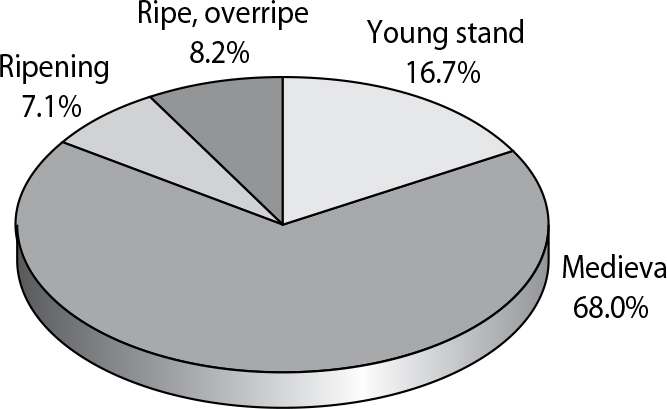
Figure 1.
Distribution of land covered with forest vegetation by age groups in the forest dacha Bilohrudivsky Forest, %
As can be seen from Figure 1, the area of young trees within the forest dacha is 16.7% of the total area, that is, plantations under 20 years old. The largest share, 68.0% of the total area, is occupied by medieval plantations. The smallest share is occupied by ripening (7.1%) and ripe and overripe (8.2%) plantations. If the unbalanced age structure of the forest fund is maintained, in 30–40 years, a significant share of medieval plantations will be transferred to the group of mature ones. This will lead to an increase in the volume of clear-cutting, sanitary and reforestation felling.
In the second half of the 20th century, agrotechnological methods of creating pedunculate oak cultures were mainly reduced to three variants (Tab. 1), namely:
– The first option – Soil cultivation was carried out by cutting furrows to a depth of 30 cm using a mechanised method with a PKL-70 plough, followed by two-fold loosening of the furrow ridges with a KLB-1.7 disc harrow into a plough ridge and breakdown in an aggregate with an MTZ-80 tractor. The peculiarity of furrow tillage was that the furrows were laid bypassing stumps, which in turn worsened mechanised care of forest cultures during their cultivation before they closed.
– The second option – Soil cultivation was carried out by cutting furrows using a mechanised method with a PKL-70 plough to a depth of 30 cm. The peculiarity of this variant was that the furrows were not even due to the bypassing of stumps, and the soil that was turned upside down during furrowing did not return to the furrow.
– The third option was performed by an agrotechnological technique in the form of lowering stumps to ground level in a strip 2–2.5 m wide, and then tillage for forest crops on the logs was carried out by cutting furrows to a depth of 30 cm using a mechanised forest plough PKL-70 and two to three times passing with a KLB-1.7 cultivator in combination with an MTZ-80 tractor-80. The peculiarity of such tillage is that the lowering of stumps made it possible to lay straight furrows without going around stumps, which facilitated mechanised care of forest cultures before they were transferred to forested land.
Table 1.
Productivity of medieval artificial oak stands
| Quarter | Allotment | Area, ha | Age, years | Composition of the plantation | Medium | Growth class | Fullness | Stock of stemwood, m3·ha−1 | Stock of stemwood, m3·ha−1 resulted in fullness of 0.7 | Stock of stemof wood, at a fullness of 0.7 resulted to 45 years of age, m3·ha−1 | ||
|---|---|---|---|---|---|---|---|---|---|---|---|---|
| N, m | D1,3, cm | |||||||||||
| 41–50 years | ||||||||||||
| Cultivations of common oak created using the first agrotechnological method | ||||||||||||
| 2 | 4 | 1.5 | 45 | 4Co2Cash2Ro1Chor1Norm + Pr | 16 | 16 | I | 0.8 | 170 | 148.75 | 148.75 | |
| 2 | 6 | 1.6 | 45 | 3Co2Cash3Ro2 Norm + Chor + Pr | 17 | 20 | I | 0.9 | 200 | 155.56 | 155.56 | |
| 6 | 2 | 5.9 | 49 | 8Co1Sll1Norm + Chor | 17 | 20 | I | 0.9 | 220 | 171.11 | 157.14 | |
| 10 | 10 | 6.2 | 46 | 5Co2Cash1Sll1Norm1Chor | 16 | 16 | I | 0.8 | 170 | 148.75 | 145.52 | |
| LSD0.5 | 2.12 | 1.82 | 2.15 | 2.04 | ||||||||
| Cultivations of common oak using the second agrotechnological method | ||||||||||||
| 11 | 4 | 2.7 | 46 | 4Co3Chor2Cash1Norm + Pr + Sb | 17 | 14 | I | 0.9 | 170 | 132.22 | 129.35 | |
| 15 | 3 | 3.2 | 48 | 3Co4 Chor1Sll1Norm1Cash + Pr + As | 19 | 20 | Ia | 0.9 | 200 | 155.56 | 145.84 | |
| 15 | 15 | 1.4 | 48 | 3Co4 Chor1Sll1Norm1Cash + Pr + As | 19 | 20 | Ia | 0.9 | 200 | 155.56 | 145.84 | |
| Cultivations of common oak using the third agrotechnological method | ||||||||||||
| 16 | 1 | 2.8 | 42 | 3Co1Ro3 Chor 2As1Cash + Norm + Sll + Pr | 12 | 12 | II | 0.8 | 90 | 78.75 | 84.38 | |
| 16 | 10 | 1.7 | 42 | 3Co1Ro3 Chor2As1Cash + Norm + Sll + Hs | 12 | 12 | II | 0.8 | 90 | 78.75 | 84.38 | |
| LSD0.5 | 2.03 | 1.91 | 2.14 | 2.14 | ||||||||
| Σ | 27.0 | |||||||||||
In the Bilohrudivsky Forest, we studied medieval plantations of the V age class (41–50 years old) of Table 1, namely:
– Pedunculate oak cultures (quarter 2, allotment 4, area 1.5 ha; quarter 2, allotment 6, area 1.6 ha; quarter 10, allotment 10, area 6.2 ha; quarter 11, allotment 4, area 2.7 ha) were created by planting standard seedlings in spring (according to the first variant). Forest cultures were planted manually using Kolesov’s planting iron. The distance between the rows was 4.0 m. The planting pitch in the row was 0.5 m. Mixing scheme: (PP 1) 6pCo4pRo, (PP 2) 5pCo5pRo, (PP 4) 10pCo, (PP 5) 10pCo. Agrotechnological soil care consisted of weeding and loosening the soil with hoes for 5 years.
– Cultures of pedunculate oak (quarter 6, allotment 2, area 5.9 ha; quarter 15, allotment 3, area 3.2 ha; quarter 15, allotment 15, area 1.4 ha) were created by planting standard seedlings in spring (according to the second variant). The cultures were planted manually using Kolesov’s planting iron. The distance between the rows was 4 m. The planting pitch in the row was 0.6 m. Mixing scheme: (PP 3) 8Co2Sll, (PP 6) 10pCo, (PP 7) 10pCo. Agronomic soil care consisted of weeding and loosening the soil with hoes for 5 years.
– The pedunculate oak cultures (quarter 16, allotment 1, area 2.8 ha; quarter 16, allotment 10, area 1.7 ha) were created by planting standard seedlings in spring on a timber blocking (according to the third variant). Forest cultures were planted manually using Kolesov’s planting iron. The distance between the rows was 4.0 m. The planting pitch in the row was 0.6 m. Mixing scheme: (PP 8) 5Co5Ro, (PP 9) 5Co5Ro. Agronomic soil care consisted of weeding and loosening the soil with hoes for 5 years.
According to the results of the study (the first variant), cultures were studied by the mixing schemes 6rCo4rRo (PP 1), 5rCo5rRo (PP 2), 10rCo (PP 4) and 10rCo (PP 5).
Forest crops in quarter 2, allotment 4 (PP 1) were created according to the planting scheme 5rCo5rRo. At the age of 45, the plantations are represented by pedunculate oak and red oak with an admixture of European ash and wild cherry, which grow in the first tier of the first class of growth. In the second tier, there are common hornbeam and sharp-leaved maple. The plantation has the following average taxonomic indicators: stand composition: 4Co2Cash2Ro1Norm1Chor + Pr; height: pedunculate oak 16 m, red oak 16 m, European ash 17 m, maple 12 m, hornbeam 10 m; trunk diameter: pedunculate oak 16 cm, red oak 20 cm, ash 20 cm, maple 10 cm, hornbeam 10 cm; fullness: 0.90 units; stem wood reserve: 170 m3·ha−1. Common hornbeam and sharpleaved maple are of vegetative origin.
The forest crops of common oak in quarter 2, allotment 6 (PP 2) were created according to the planting scheme 5rCo5rRo. At the age of 45, the plantation has the following average taxonomic indicators: stand composition: 3Co2Cash3Ro2Norm + Chor + Pr; height: pedunculate oak 17 m, red oak 18 m; height: European ash 17 m, maple 12 m, hornbeam 12 m; trunk diameter: pedunculate oak 20 cm, red oak 22 cm, ash 22 cm, maple 12 cm, hornbeam 12 cm; fullness: 0.90 units, stem wood reserve: 200 m3·ha−1. Common ash, bird cherry, hornbeam and sharp-leaved maple occur naturally.
The forest cultures of pedunculate oak in quarter 10, allotment 10 (PP 4) were created according to the planting scheme 10pCo. In 46-year-old cultures, the plantations are represented by pedunculate oak with an admixture of common ash, which grows in the first tier according to the first class of growth. In the second tier, there are common hornbeam, small-leaved linden and sharp-leaved maple. The plantation has the following average taxonomic indicators: stand composition: 5Co2Cash1S111Norm1Chor; height: oak 16 m, linden 12 m, maple 12 m, hornbeam 12 m; trunk diameter: oak 16 cm, linden 14 cm, maple 12 cm, hornbeam 12 cm; fullness: 0.80 units; stem wood reserve: 170 m3 ha−1. Common ash, bird cherry, hornbeam and sharp-leaved maple occur naturally.
The forest crops of common oak in quarter 11, allotment 4 (PP 5) were created according to the planting scheme 10pCo. The 46-year-old crops are represented by pedunculate oak and European ash, which grow in the first tier of the first class of growth. In the second tier, there are common hornbeam, small-leaved linden and sharp-leaved maple, with an admixture of up to 5% wild cherry and silver birch. The plantation is characterised by the following average taxonomic indicators: stand composition: 4Co3Chor2Cash1Norm + Pr + Bp; height: oak 17 m, ash 17 cm, linden 12 m, maple 12 m, hornbeam 12 m; trunk diameter: oak 14 cm, ash 16 cm, linden 14 cm, maple 12 cm, hornbeam 12 cm; fullness: 0.90 units; stock of stem wood: 170 m3·ha−1. Common ash, bird cherry, hornbeam, sharp-leaved maple and hanging birch occur naturally.
According to the results of the research and the second variant, we studied the cultures of pedunculate oak, which were created by tillage by cutting furrows to a depth of 30 cm using a mechanised method with a PCL-70 plough and according to the mixing schemes 8Co2Sll(PP 3), 10pCo (PP 6), 10pCo (PP 7).
The forest cultures of pedunculate oak in quarter 6, allotment 2 (PP 3) were created according to the planting scheme 8Co2Sll At the age of 49, the cultures are represented by pedunculate oak, which grows in the first tier according to the first class of growth. In the second tier, small-leaved linden, sharp-leaved maple and common hornbeam grow. The plantation has the following average taxonomic indicators: stand composition: 8Co1Sll1Norm + Chor; height: oak 17 m, linden 12 m, maple 12 m, hornbeam 12 m; trunk diameter: oak 20 cm, linden 14 cm, maple 12 cm, hornbeam 12 cm; fullness: 0.90 units; stem wood reserve: 220 m3·ha−1. Small-leaved linden, sharp-leaved maple and common hornbeam occur naturally.
The forest cultures of pedunculate oak in quarter 15, allotment 3 (PP 6) were created according to the 10Co planting scheme. At 48 years of age, the cultures are represented by pedunculate oak and European ash, which grow in the first tier of the Ia class of growth. In the second tier, there are common hornbeam, small-leaved linden, sharp-leaved maple, wild cherry and aspen. The plantation has the following average taxonomic indicators: stand composition: 3Co4Chor1Sll1Norm1Cash + Pr + As; height: oak 19 m, ash 19 m, linden 12 m, maple 12 m, hornbeam 12 m; trunk diameter: oak 20 cm, ash 20 cm, linden 14 cm, maple 12 cm, hornbeam 12 cm; fullness: 0.90 units; stock of stem wood: 200 m3·ha−1. Common ash, small-leaved linden, bird cherry, common hornbeam, sharp-leaved maple and aspen occur naturally.
The forest crops of common oak in quarter 15, allotment 15 (PP 7) were created according to the planting scheme 10pCo. At 48 years of age, the cultures are represented by pedunculate oak and European ash, which grow in the first tier of the Ia class of growth. In the second tier, there are common hornbeam, small-leaved linden, sharp-leaved maple, wild cherry and aspen. The plantation has the following average taxonomic indicators: stand composition: 3Co4Chor1Sll1Norm1Cash + Pr + As; height: oak 19 m, ash 19 m, linden 12 m, maple 12 m, hornbeam 12 m; trunk diameter: oak 20 cm, ash 20 cm, linden 14 cm, maple 12 cm, hornbeam 12 cm; fullness: 0.90 units; stock of stem wood: 200 m3·ha−1. Common ash, small-leaved linden, bird cherry, common hornbeam, sharp-leaved maple and aspen occur naturally.
According to the results of research on the third variant, we studied cultures of pedunculate oak, which were created by planting standard seedlings in the spring on a timber blocking with the subsequent agrotechnological technique of lowering stumps to ground level in a strip 2–2.5 m wide. Pre-planting soil cultivation for forest crops on the timber blockings was carried out by cutting furrows mechanised with a forest plough PKL-70 to a depth of 30 cm and two to three with a KLB-1.7 cultivator in combination with an MTZ-80 tractor to return the fertile soil layer to the furrow and according to the mixing schemes 5Co5Ro (PP 8) and 5Co5Ro (PP 9).
The forest crops of pedunculate oak in quarter 16, allotment 1 (PP 8) were created according to the planting scheme 5Co5Ro. At the age of 42, the cultures are represented by pedunculate oak, red oak, European ash, aspen and sweet cherry, which grow in the first tier of the second class of growth. In the second tier, there are common hornbeam, small-leaved linden and sharpleaved maple. The plantation has the following average taxonomic indicators: stand composition: 3Co1Ro3Chor2As1Cash + Sll + Pr; height: pedunculate oak 12 m, red oak 12 m, European ash 12 m, aspen 12 m, sweet cherry 12 m, small-leaved linden 9 m, sharp-leaved maple 9 m, hornbeam 9 m; trunk diameter: pedunculate oak 12 cm, red oak 12 m, European ash 12 m, aspen 12 cm, cherry 12 cm, linden 10, cm, maple 10 cm, hornbeam 10 cm; fullness: 0.80 units; stock of stem wood: 90 m3·ha−1. Common ash, small-leaved linden, bird cherry, common hornbeam, sharp-leaved maple and aspen occur naturally.
The forest cultures of pedunculate oak in quarter 16, plot 10 (PP 9) were created according to the planting scheme 5Co5Ro. At the age of 42, the cultures are represented by pedunculate oak, red oak, European ash, aspen and sweet cherry, which grow in the first tier of the second class of growth. In the second tier, there are common hornbeam, small-leaved linden and sharpleaved maple. The plantation has the following average taxonomic indicators: stand composition: 3Co1Ro3Chor2As1Cash + Norm + Sll + Pr; height: pedunculate oak 12 m, red oak 12 m, European ash 12 m, aspen 12 m, sweet cherry 12 m, small-leaved linden 9 m, sharpleaved maple 9 m, hornbeam 9 m; trunk diameter: pedunculate oak 12 cm, red oak 12 m, European ash 12 m, aspen 12 cm, cherry 12 cm, linden 10, cm, maple 10 cm, hornbeam 10 cm; fullness 0.80 units; stock of stem wood: 90 m3·ha−1. Common ash, small-leaved linden, bird cherry, common hornbeam, sharp-leaved maple and aspen occur naturally.
Analysing the data in Tab. 1 shows that the medieval plantations of Bilohrudivsky Forest in the age range from 41 to 50 years (PP 1–PP 9) are represented by a stand of pedunculate oak, European ash and red oak and less frequently by wild cherry and aspen, which grow on PP 6 and PP 7 in the Ia class of growth, on PP 1–PP 5 in the I class of growth and on PP 8 and PP 9 in the II class of growth mainly in the first tier of the plantation. In the second tier, all the sample areas are covered with common hornbeam, small-leaved linden, sharp-leaved maple, occasionally hanging birch of the III class of growth and rarely birch.
Investigating the cultures of common oak in quarter 2, allotment 4, area of 1.5 ha (PP 1), quarter 10, allotment 10, area of 6.2 ha (PP 4) and quarter 11, allotment 4, area of 2.7 ha (PP 5), it was found that the cultures were created by planting standard seedlings in the spring. Soil cultivation was carried out by cutting furrows in a mechanised way with a PKL-70 plough, followed by two-fold loosening of the furrow ridges with a KLB-1.7 disc harrow into a plough ridge and a breakdown in an aggregate with an MTZ-80 tractor. Forest cultures were planted manually using Kolesov’s planting iron. The distance between the rows was 4.0 m. The planting pitch in the row was 0.5 m.
Cultures of common oak in quarter 2, allotment 4 on the area of 1.5 ha (PP 1), which were created according to the planting scheme 6rDz4rDchr, at the age of 45 years had the composition 4Co2Cash2Ro1Chor1Norm + Pr; in quarter 10, allotment 10 on the area of 6.2 ha (4), which were created with the composition 10rDz, at the age of 46 years had the composition 5Co2Cash1Sll1Norm1 Chor; and in quarter 11, allotment 4, on an area of 2.7 (PP 5) ha, which were created with the composition 10rDz, at the age of 46 years had the composition 4Co3Chor2Cash1Norm+Sll+ Pr +Bp. A characteristic feature of these crops is that they were all created in the type of habitat conditions of a fresh hornbeam oak forest (D2-gD) under the same method of soil cultivation. According to the taxation characteristics, the average heights, diameters, plantation bonuses, completeness and stock of stem wood are almost identical, which is confirmed by the stock of stem wood reduced to completeness 0.7, which is in the range of 132.22–155.56 m3·ha−1 with a difference of 23.34 m3·ha−1, and on PP 1 and PP 4, this difference was only 6.81 m3·ha−1 compared to PP 2.
Cultures of common oak in quarter 15, allotment 3 on the area of 3.2 ha (PP 6) and quarter 15, allotment 15 on the area of 1.4 ha (PP 7) were created by tillage by cutting furrows by a mechanised method with a PKL-70 plough to a depth of 30 cm with a mixing scheme of 10pCo., At 48 years of age, the cultures are represented by common oak and common ash, which-grow according to the Ia class of growth, with a fullness of 0.9 units of plantation having a stock of stem wood of 200 m3·ha−1. In both plantations, the effect of tillage on the productivity of 48-year-old plantations was not found. When studying the composition of the plantation 3Co4Chor1Sll1Norm1Cash + Pr + As, it is necessary to pay attention to the low share of common oak (3Co). This situation can be explained by a set of measures, namely, partly by the untimely implementation of the first stage of oak trees’ clearing before the transfer of crops to forested land and by the late clearing and insufficient selection of related tree species during thinning.
In the study of 42-year-old stands in quarter 16, allotment 1, on an area of 2.8 ha (PP 8) and quarter 16, allotment 10, on an area of 1.7 ha (PP 9), cultures of pedunculate oak were established by planting standard seedlings in spring on a timber blocking with subsequent agronomic technique of lowering stumps on timber blocking in a strip 2–2.5 m wide. Soil cultivation for forest cultures was carried out by cutting furrows mechanically with a forest plough PKL-70 and for two to three times with a cultivator KLB-1.7 in the plough ridge in combination with a tractor MTZ-80 to return the fertile soil layer to the furrow. The mixing scheme on both experimental plots was 5pCo5pRo. At the age of 42, the plantations were formed with the composition 3Co1Ro3Chor2As1Cash + Norm + Sll + Pr and had an average height of 12 m, average diameter of 12 cm, grew according to the II class of growth, with a fullness of 0.8 units and a stem wood reserve of 90 m3·ha−1. The peculiarity of the plantation is the presence of red oak, which negatively affected the growth and development of pedunculate oak and its accompanying species of European ash, aspen, hornbeam, sharp-leaved maple, small-leaved linden and wild cherry, which are of natural origin.
At the same time, there are no low-completeness plantations, which indicates proper forest management in the studied stands.
The Least Significant Difference in the experimental medieval plantations of the V age class is in the range of 1.11–2.18, which indicates the reliability of the research.
Discussion
We selected model trees of oak, ash and hornbeam to analyse the growth in height (Fig. 2) and diameter (Fig. 3).
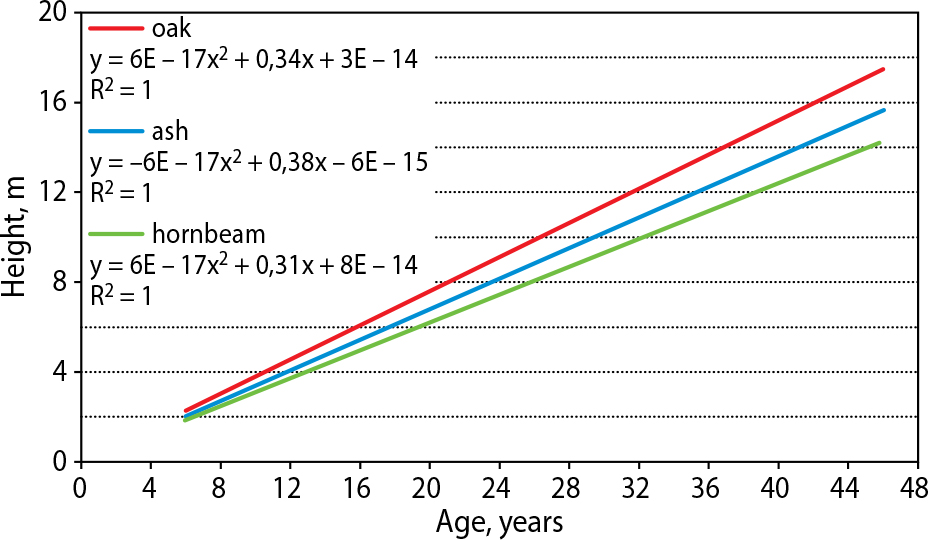
Figure 2.
Growth progress in height of 46-year-old stands (PP 5)
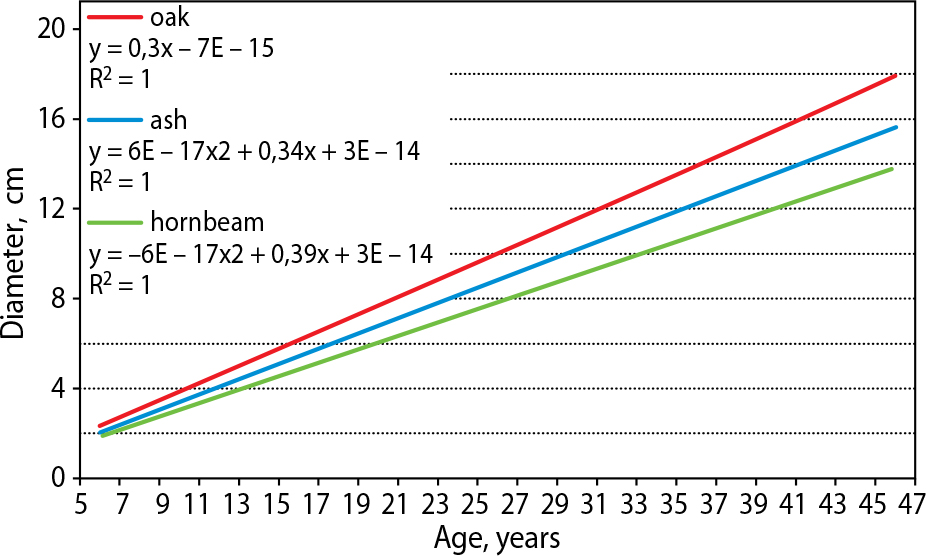
Figure 3.
Growth progress by diameter of 46-year-old stands (PP 5)
As can be seen from the graph (Fig. 2), the growth progress in height at the age of 46 years of oak, ash and hornbeam under soil cultivation by furrowing with a PKL-70 plough to a depth of 30 cm with two-fold loosening of the furrow ridges with a KLB-1.7 cultivator in the swath and the breakdown has a significant difference, where ash has the highest height and oak occupies an intermediate value between ash and hornbeam (the first variant). They have a significant difference, with ash having the highest height. Thus, at the age of 20 years, it is 9.2 m, at 30, it is 12.0 m and at 45, it is 15.2 m, while oak is intermediate between ash and hornbeam. At the age of 20 years, its height is 8.2 m, at 30, it is 10.9 m and at 45, it is 13.8 m. The height of the common ash exceeds the height of the common oak by 1.0 m at 20 years, 1.1 m at 30 years and 1.4 m at 45 years. At the age of 45 years, the height of the common hornbeam is 1.6 m less than that of the common oak and 3.0 m less than that of the common ash.
At the same time, it should be noted that our research differs from normative and reference materials. Thus, according to the tabulated data, the height of an ash tree at the age of 20 exceeds the actual height by 1.1 m. At the age of 30, this difference was already 0.4 m, and at the age of 45, it was 2.6 m in favor of the tabulated data. In the course of growth in height of the common oak, a difference can be observed starting from the age of 20 years in favour of the tabular data.
As can be seen from the graph in Fig. 3, the growth of a 46-year-old plantation in diameter has the same trend as in height (Fig. 2). Ash and oak form the largest diameters. The difference is observed from the age of 7 years. Thus, if at the age of 7 years the diameters of common oak and common ash did not differ and were 1.9 cm each, then at the age of 45 years, this difference reached 2 cm in favour of common ash.
In terms of diameters of both common oak and common ash, the tabular materials have an advantage, except for 30-year-old stands of common ash, where the difference was 4.6 cm in favour of our research.
We selected model trees of oak, hornbeam and maple to analyse the growth in height (Fig. 4) and diameter (Fig. 5).
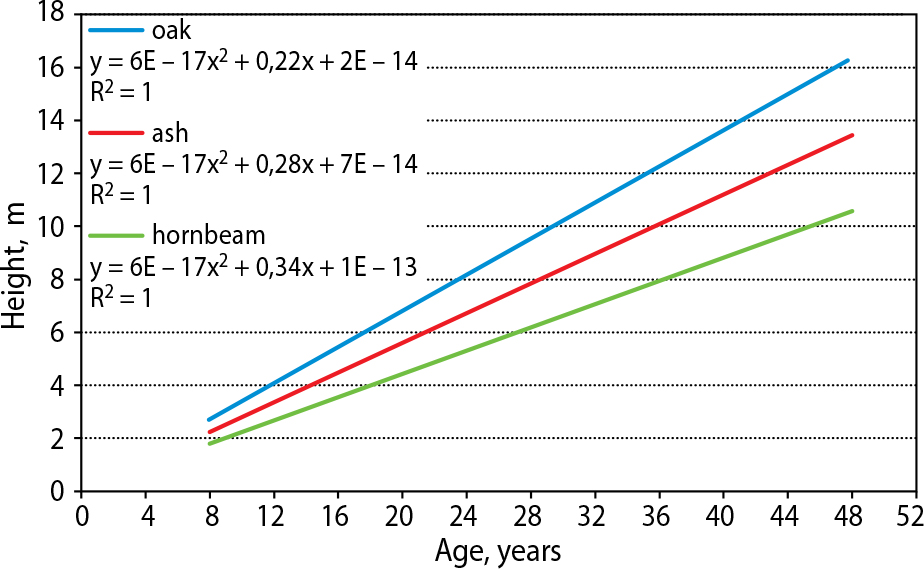
Figure 4.
Growth progress in height of 48-year-old stands (PP 6)
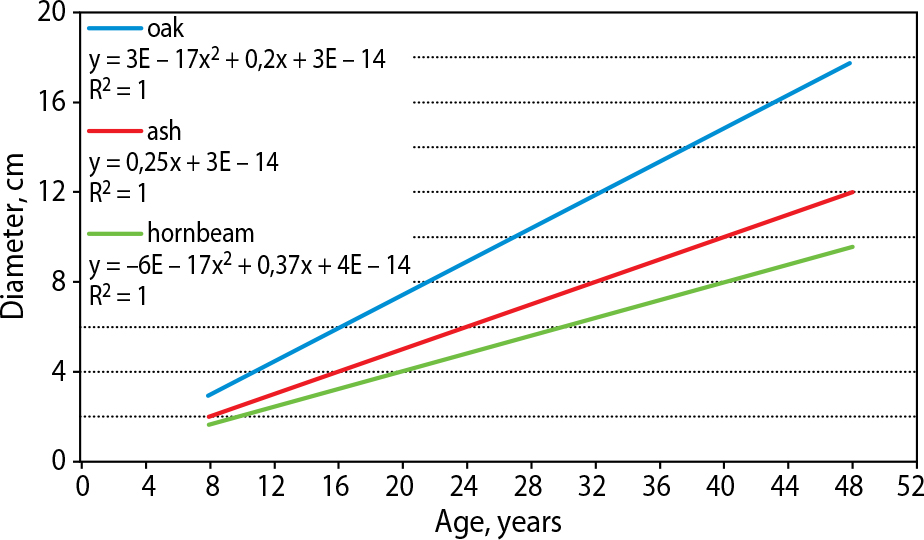
Figure 5.
Growth progress by diameter of 48-year-old stands (PP 6)
As can be seen from the graph in Fig. 4, the growth of oak, hornbeam and maple trees is observed during tillage by furrowing with the PKL-70 plough to a depth of 30 cm (the second variant).
The highest growth was achieved by the common oak. Thus, at 10 years of age, its height was 2.6 m, at 20 years of age, it was 8.0 m, at 30 years of age, it was 11.0 m and at 47 years of age, it was 14.3 m. The height of the common ash was 2.0 m at 10 years, 6.8 m at 20 years, 9.0 m at 30 years and 12.0 m at 47 years, that is, common oak was 2.3 m higher than common ash and 5.0 m higher than hornbeam. The common hornbeam has clearly formed the second tier. In the course of growth in height, a difference between common oak and common ash can be traced from the age of 8 years (Bala 2004).
Studying the growth of 48-year-old plantations by diameter, as can be seen from the graph in Fig. 5, common ash and common oak have the largest diameters. At the same time, the largest diameter was reached by common oak; at 10 years of age, its diameter was 3 cm, at 20 years of age, it was 9.2 cm, at 30 years of age, it was 12 cm and at 47 years of age, it was 15.9 cm. The diameter of common ash at 20 years of age was 6 cm, which is 3.2 cm less than the diameter of the common oak. At 47 years of age, the diameter of common ash was 10.8 cm and the diameter of common oak was 15.9 cm. The diameter of the common hornbeam at 47 years was 8.3 cm, which is 52.2% of the diameter of the common oak.
According to the results of the research (third variant), we studied the cultures of common oak, according to the next mixing schemes: 5Co5Ro (PP 8) and 5Co5Ro (PP 9) (Zeller and Pretzsch, 2019).
We have selected model trees of oak, ash, hornbeam and maple, on which we analysed the growth course in height (Fig. 6) and diameter (Fig. 7).
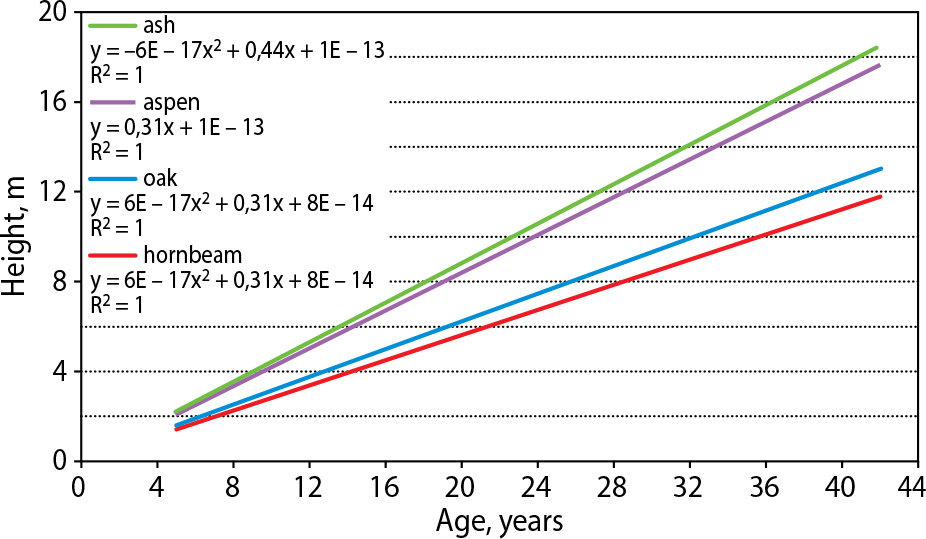
Figure 6.
Growth progress in height of 42-year-old stands (PP 9)
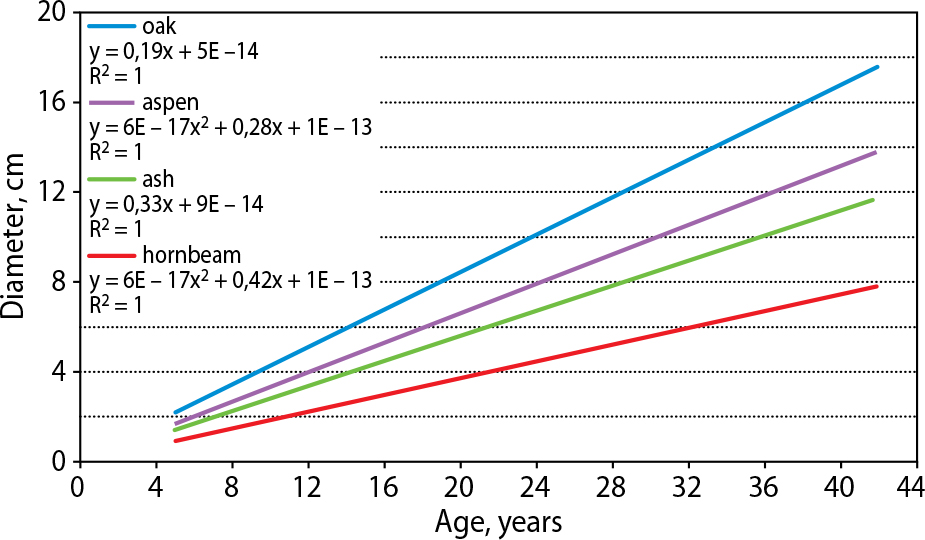
Figure 7.
Growth progress in diameter of 42-year-old stands (PP 9)
As can be seen from the graph (Fig. 6), at 42 years of age, the height was 16 m for common ash and 15.2 m for aspen. The difference is 0.8 m or 5%. The height of the common oak at 42 years was 11.3 m, and the height of the common hornbeam was 10.1 m. The difference in height between the trees was 1.2 m or 10.6%. The difference in height between the main forest-forming species of the Ukrainian forest-steppe, common oak and common ash, is noteworthy (Lukianets 2023). At 42 years of age, it is 11.3 m for common oak and 16 m for common ash. The 29.3% growth lag of common oak compared to common ash is due to untimely felling, which resulted in the predominance of three units of common hornbeam and two units of aspen in the plantations.
As can be seen from the graph (Fig. 7), the diameter of the forest-forming species of the 42-year-old common oak is 15.3 cm, aspen 12.0 cm, common ash 10.2 cm and common hornbeam 6.8 cm. The peculiarity of the plantation is that the common oak, common ash and aspen form the first tier.
Conclusions
One of the most valuable in the forest fund of Bilohrudivsky Forest is oak plantations growing in forest conditions – fresh hornbeam groves (D2-fD), the current state of which needs to be improved in most forestry allotments.
An imbalance in the age structure of oak plantations was found, with a significant predominance of middle-aged (68%) and young trees (16.7%) and a small proportion of mature, ripe and overstocked plantations (7.1% and 8.2%, respectively). The distribution of the age structure of pedunculate oak is far from optimal. This feature is an important reason for taking forest management measures aimed at optimising the age structure.
In oak plantations of the V age class, the influence of soil cultivation methods during the creation of forest crops on their productivity can be traced. The largest stock of stem wood (155.56 m3·ha−1) was obtained by tillage by making furrows with a PKL-70 plough to a depth of 30 cm with two-fold loosening of the furrow ridges with a KLB-1.7 cultivator and the smallest -84.38 m3·ha−1 for soil cultivation by lowering stumps to ground level, plowiing furrows with a PKL-70 plough to a depth of 30 cm with 2–3 times disking with a KLB-1.7 cultivator into the plough ridge.
The vast majority of forest crops were created with a composition of 10pCo, but in 40–50-year-old plantations, 10 to 3 units of Co were found, with three units of oak predominating in the composition of plantations and rarely four. Increasing the proportion of oak in plantations will support the gradual transformation of even-aged stands into multi-aged, mixed, multi-tiered plantations. This shift in composition and structure will align the forest characteristics more closely with those found in natural ecosystems. The assignment of each individual forest plot of oak plantations to a certain category of forests determines the establishment of an appropriate forest management regime.
It was found that the composition of the plantation in the vast majority of 40–50-year-old cultures is 3Co4Chor1Lpd1Klg1Yaz+Chsh+Os, where European ash, hornbeam, maple, small-leaved linden, white acacia, aspen, birch and wild cherry are in all experimental plots of natural origin.
The forest plantations of Bilohrudivsky Forest are concentrated in the recreational, healthy and protective forests of Uman and therefore perform important water protection, soil protection, recreational, sanitary, hygienic and aesthetic and other environmental functions.
List of abbreviations
- Co
Common oak (Quercus robur L.)
- Cash
Common ash (Fraxinus excelsior L.)
- Ro
Red oak (Quercus rubra L.)
- Chor
Common hornbeam (Carpinus betulus L.)
- Norm
Norway maple (Acer platanoides L.)
- Pr
Prunus (Prunus avium L.)
- As
Aspen (Populus tremula L.)
- Sll
Small-leaved linden (Tilia cordata Mill.)
- Sb
Silver birch (Betula pendula Roth.)
- PP
trial area