Have a personal or library account? Click to login
Do private forest owners in Poland recognise Natura 2000 areas? Cover

Do private forest owners in Poland recognise Natura 2000 areas?

Open Access
|Dec 2025

Figures & Tables

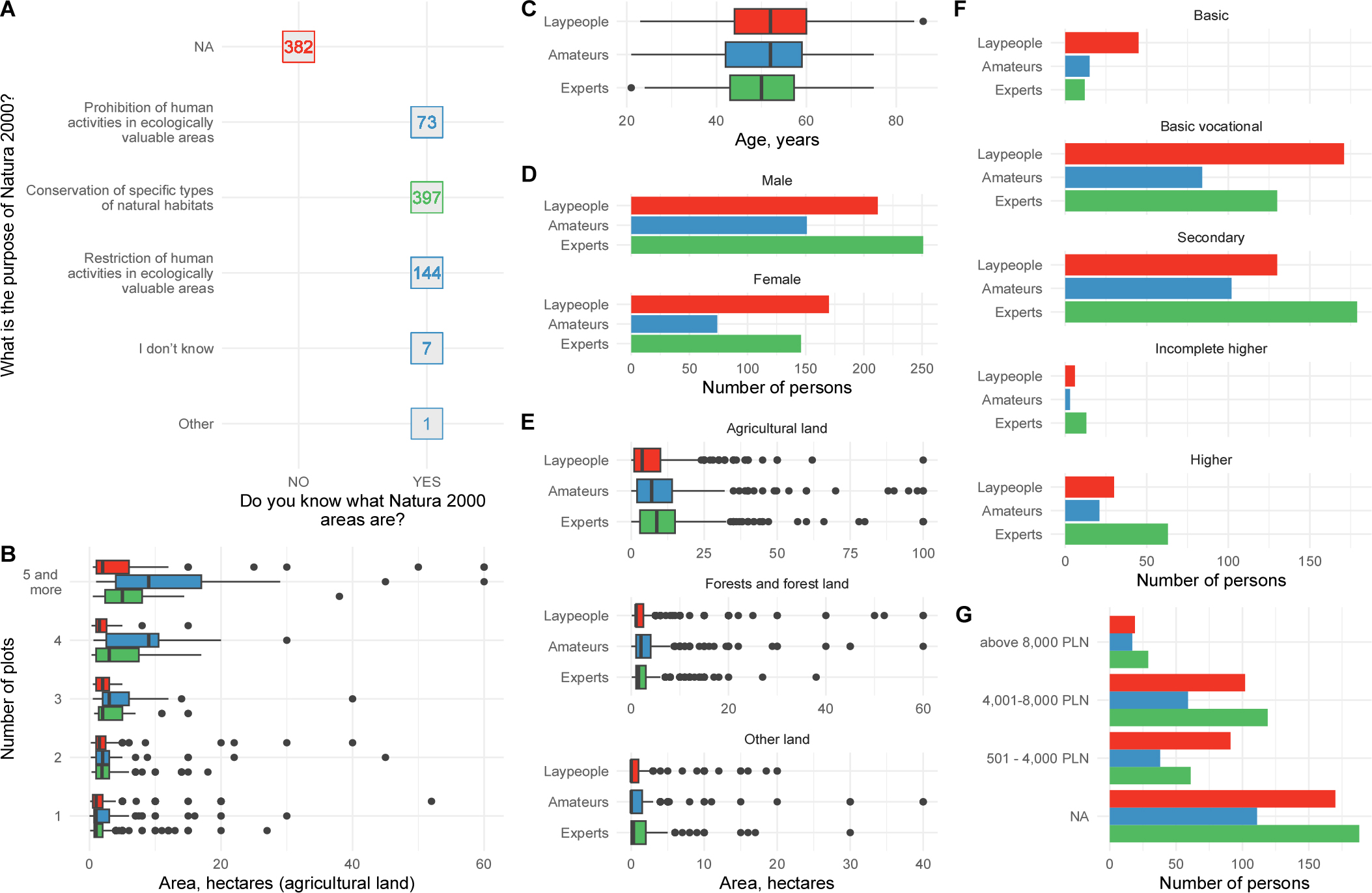
Figure 1.

Demographic characteristics of respondents and their comprehension of the definition of Natura 2000 sites. Panel A shows the distribution of respondents into groups (‘experts’, ‘amateurs’ and ‘laypeople’ denoted by green, blue and red colours, respectively) according to their answers to the two given questions. The number of respondents who chose the corresponding answer is indicated in the squares. Respondents who answered ‘NO’ on the horizontal axis (first question) were not asked on the vertical axis (second question) and were labelled NA. The other fields show the socioeconomic profiles of the respondents according to the groups. Panels B and E indicate the number and area of lands owned by the respondents, respectively. Panels C, D and F describe the age, gender and level of education of the respondents, respectively. Panel G indicates the average monthly income of all members of the respondents’ households (NA means that the person does not know or has not answered)
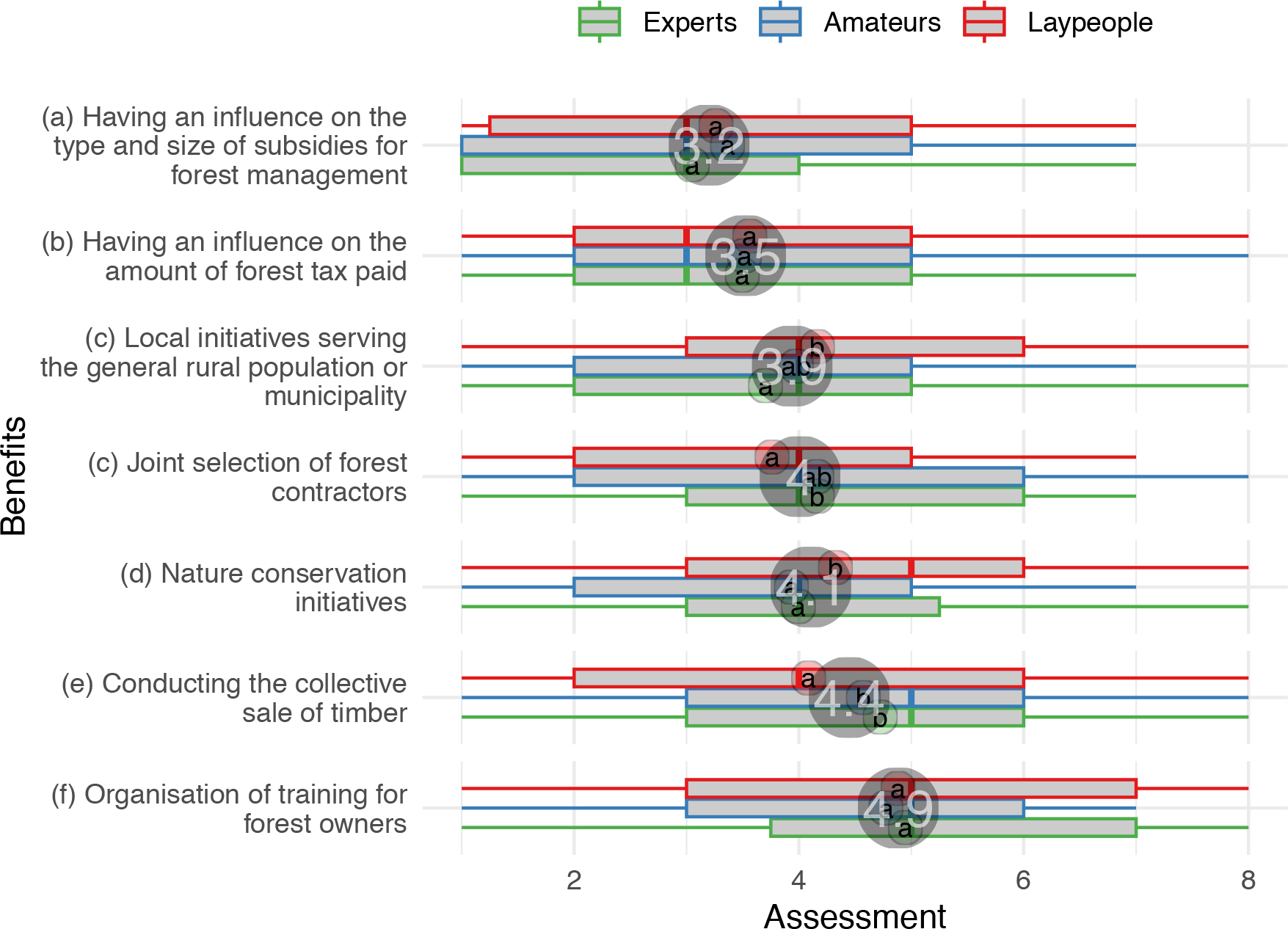

Figure 2.

The ranking of the proposed types of benefits was based on the three groups of respondents: ‘experts’, ‘amateurs’ and ‘laypeople’ (represented by green, blue and red colours, respectively). The transparent, filled circles with the numbers inside indicate the average rating of all respondents. The same letters in the benefits’ names mean no significant differences in the rating between them (p < 0.05). The answers of the different groups of respondents were compared for each type of benefit. The same letters in the circles within each benefit mean that there are no statistically significant differences between the answers of respondents from different groups (p < 0.05)
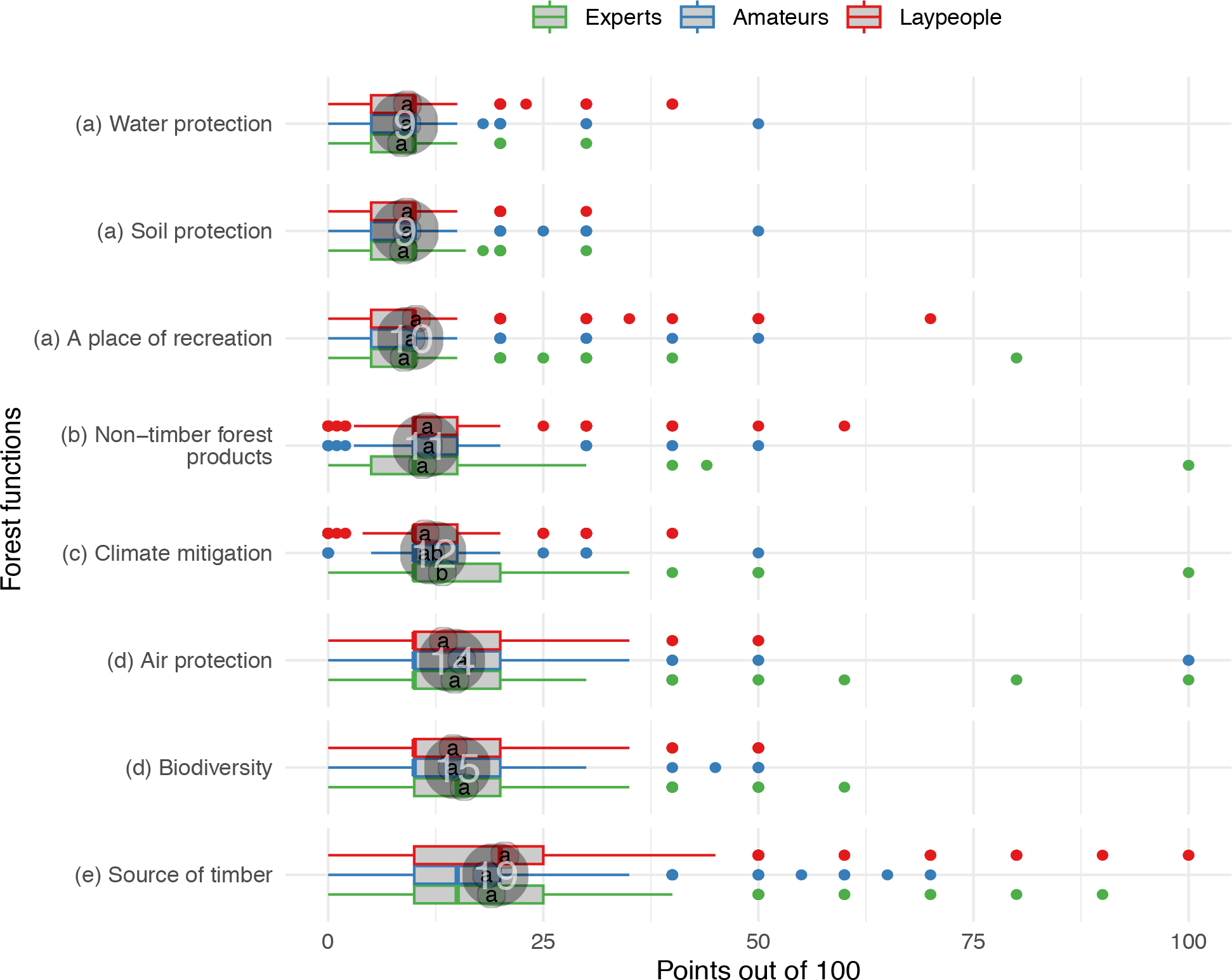

Figure 3.

This figure shows the distribution of 100 points on the forest functions by the respondents of the three groups: ‘experts’, ‘amateurs’ and ‘laypeople’ (represented by green, blue and red colours, respectively). The transparent, filled circles with the numbers inside indicate the average points. The same letters in front of the names of the forest functions suggest that there are no significant differences in the points awarded for the forest functions by all respondents (p < 0.05). The points awarded by the different groups of respondents were compared for each forest function. The same letters on the circles within each forest function indicate that there are no significant differences between the points awarded by respondents from different groups (p < 0.05)
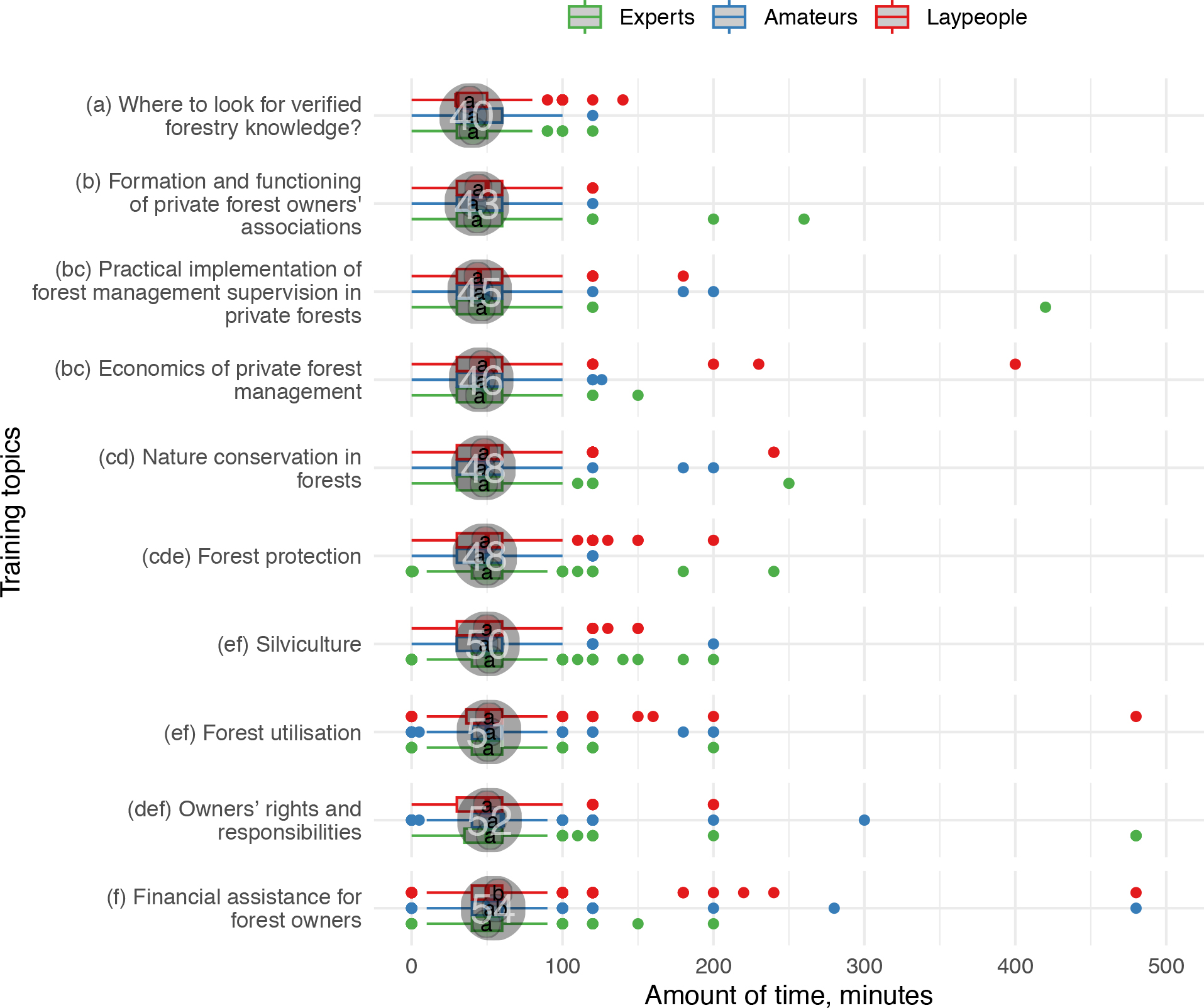

Figure 4.

The figure shows the distribution of time, depending on the training topics, among the respondents of the three groups: ‘experts’, ‘amateurs’ and ‘laypeople’ (represented by green, blue and red colours, respectively). The transparent, filled circles with the numbers inside indicate the average time spent. The same letters in the variant names mean that there are no significant differences between the training topics (p < 0.05). In addition, the answers of the different respondent groups were compared for each training topic. The same letters in the items within each topic mean that there are no significant differences between the respondent groups (p < 0.05)
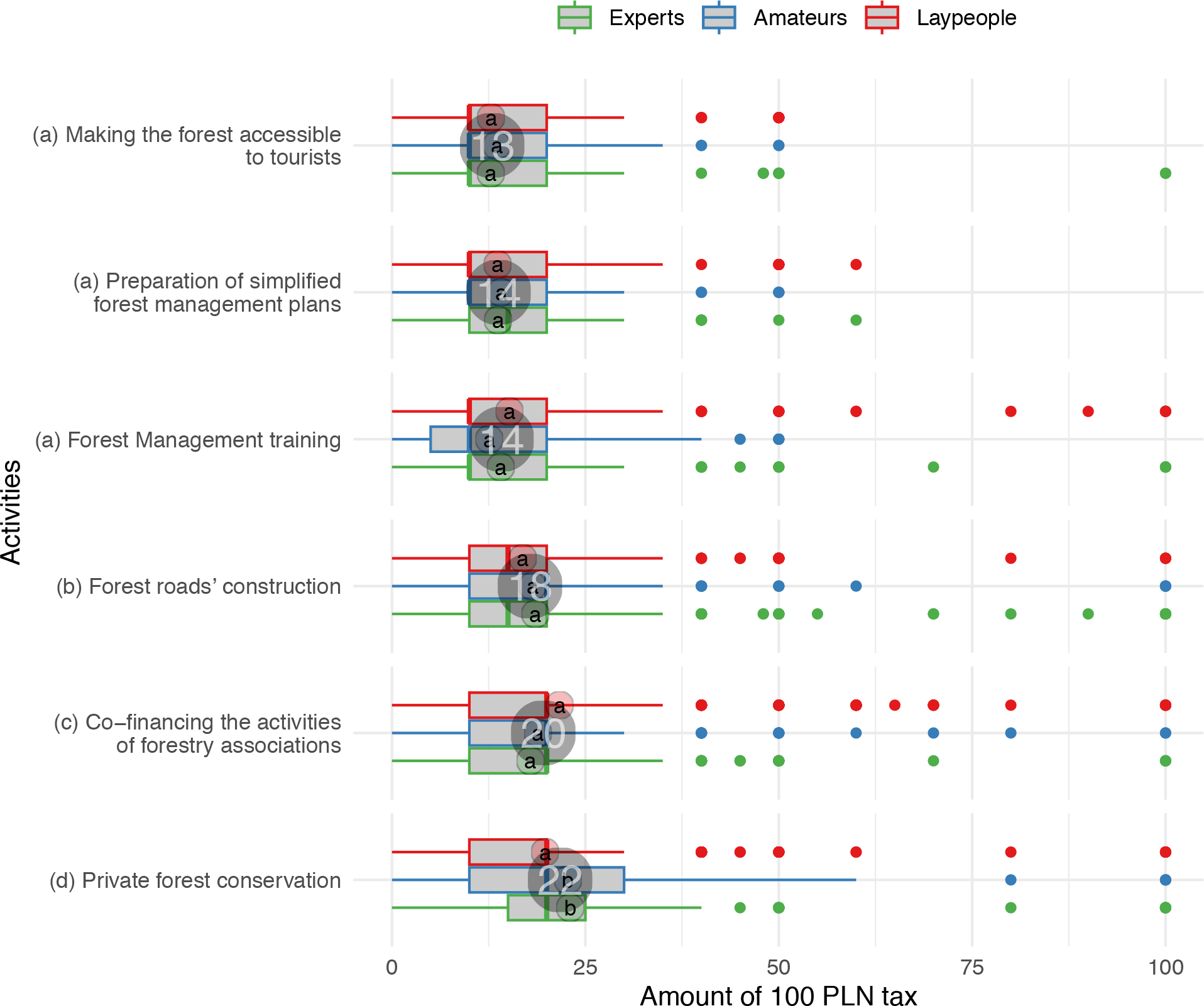

Figure 5.

Distribution of the tax amounts assigned to the purposes by the respondents in the three groups: ‘experts’, ‘amateurs’ and ‘laypeople’ (represented by green, blue and red colours, respectively). The transparent, filled circles with the numbers inside indicate the average amount of tax. The same letters in the names mean that there are no significant differences between the purposes (p < 0.05). In addition, the answers of the different respondent groups were compared for each purpose. The same letters in the points within each purpose mean that there are no significant differences between the respondent groups (p < 0.05)
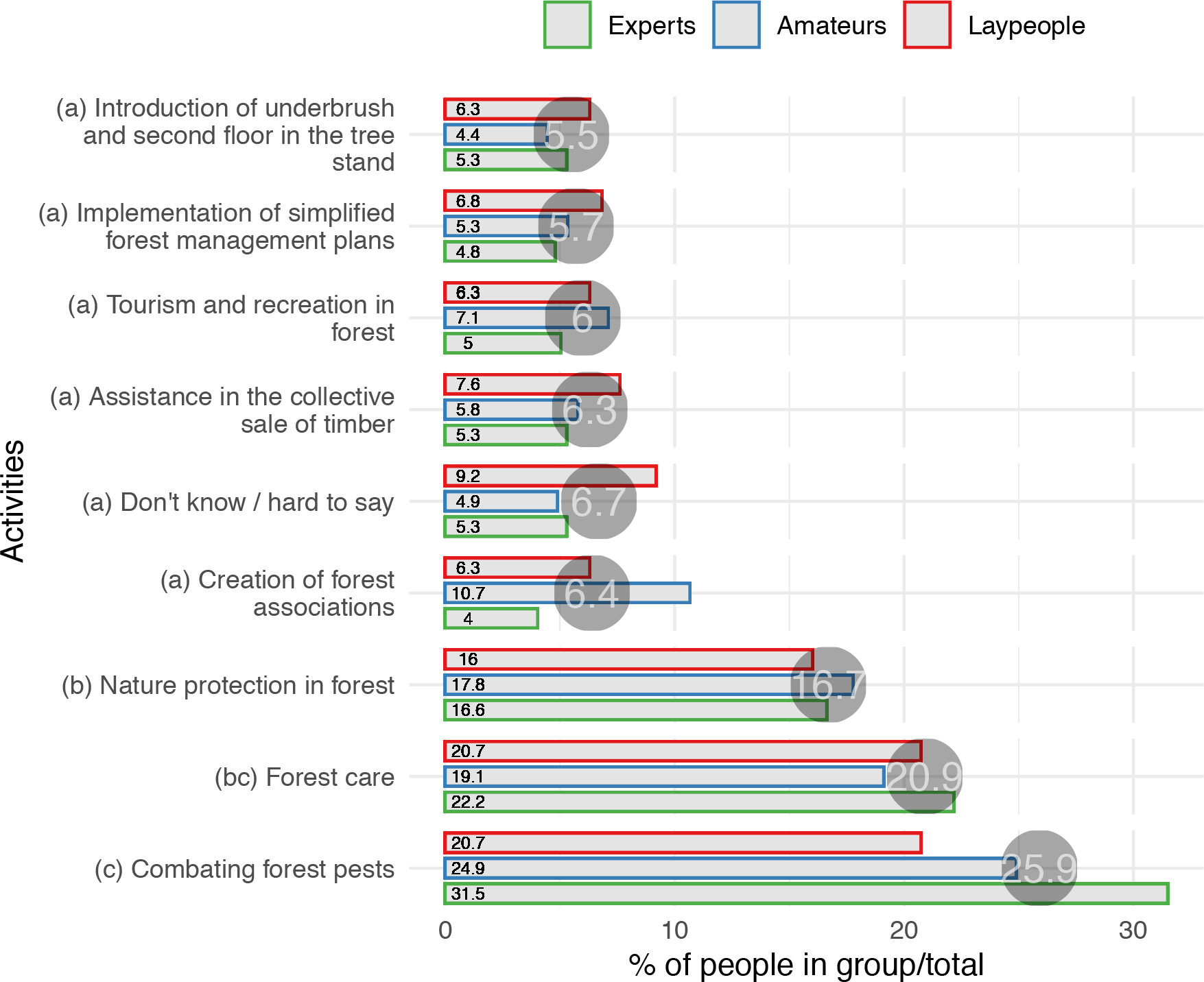

Figure 6.

The figure illustrates answers to the question, Which forestry activities in private forests should be financed first? The results of the respondents in the three groups are shown: ‘experts’, ‘amateurs’ and ‘laypeople’ (represented by green, blue and red colours, respectively). The transparent, filled circles with numbers inside indicate the percentage of respondents who think that a particular activity should be prioritised for funding. The same letters in the names mean that there are no significant differences between them (p < 0.05). The number on each bar indicates the percentage of respondents, broken down by group, who considered that activity to be the highest funding priority
DOI: https://doi.org/10.2478/ffp-2025-0019 | Journal eISSN: 2199-5907 | Journal ISSN: 0071-6677
Language: English
Page range: 240 - 253
Submitted on: Aug 12, 2025
Accepted on: Sep 30, 2025
Published on: Dec 12, 2025
Published by: Forest Research Institute
In partnership with: Paradigm Publishing Services
Publication frequency: 4 issues per year

© 2025 Emilia Wysocka-Fijorek, Vasyl Mohytych, Piotr Gołos, Zbigniew Karaszewski, Wojciech Gil, published by Forest Research Institute
This work is licensed under the Creative Commons Attribution-NonCommercial-NoDerivatives 4.0 License.