
Introduction
The basis of the creation of anti-erosion systems is the prevention of erosion processes, restoration of soil fertility, and its protection from washing away (Oblasov and Balyk 2009). One of the factors in the selection of the assortment for the creation of regional protective forest plantations is considering the zoning of forest growth conditions (Liulchyk et al. 2020).
Introduced species are often used in phytoremediation practice. At the same time, their ecological properties, such as drought resistance and heat resistance, are of particular importance in the steppe zone of Ukraine. On the contrary, Pinus pallasiana D. Don is rarely used in anti-erosion plantations. Nevertheless, it may be promising for the afforestation of ravines in the steppe regions of Ukraine. For example, on the slopes of the ravines (in the Upper Dnieper region), Pinus pallasiana under the age of 25 years forms a stand that belongs to the first class of the growth class of tree stands. For a wider usage of this species, it is necessary to study the peculiarities of its biology in the harsh conditions of the slopes of the ravines, especially the southern exposure (Goreyko 1996).
In recent years, the threat to forests caused by water stress due to climate warming combined with droughts has attracted increased attention (Grant et al. 2013). Global climate change is projected to increase the intensity, duration, and frequency of droughts in many regions (Parry et al. 2007; Seager et al. 2009). Droughts in the early 2000s led to the death of 40%–80% of Pinus edulis trees (Breshears et al. 2005; Kleinman et al. 2012), as well as an increased level of death of deciduous and coniferous species and a decrease in their productivity in Europe (Ciais et al. 2005; Carnicer et al. 2011). Therefore, the study of the features of water exchange of woody plants in drought conditions from the point of view of their adaptation is relevant.
Important indicators characterizing the water status of plants are transpiration, leaf moisture, their water deficit, and water-holding capacity.
The purpose of this study is to compare the indicators of water exchange of Pinus pallasiana needles under the conditions of different supply of moisture to plants in an anti-erosion plantation using the example of the Viyskovyi ravine in the Dnipropetrovsk region.
Material and methods
The research was conducted at the anti-erosion plantation of Crimean pine (Pinus pallasiana D. Don) in the Viyskovyi ravine in the Dnipropetrovsk region in the steppe zone of Ukraine. The plantation is located on the terraces of the southern exposure slope. The age of the trees is 28–30 years. A characteristic feature of the steppe climate is the periodic occurrence of droughts, that is, periods of prolonged rainlessness. The study area is characterized by a small amount of precipitation (420–450 mm) and a low humidity coefficient (0.67) (Tsvetkova 2013).
Experiments on the study of water regime were carried out on three test sites, differing in the level of soil moisture. The first section is located in the thalweg, the second in the middle part of the slope, and the third on its upper part. The thalweg of the ravine is characterized by fresh loamy black earth soils, and the soil moisture is ground and atmospheric. The hygrotop is mesophilic (fresh, CL2). In the areas of the middle and upper parts of the slope, the soil is weakly leached dry loamy chernozem. Forest growth conditions are mesoxerophilic (semi-arid, CL1) and xerophilic (dry, CL0–1) (Tab. 1). Humidification in both areas is atmospheric-transit. The slope of the southern exposure of the ravine is characterized by greater insolation compared to other parts of the ravine and, as a result, more intensive warming and drying of the soil (Belgard 1971).
Table 1.
Soil moisture on test sites in the Viyskovyi ravine (%)
| Month | Depth, cm | Thalweg, CL2 | Middle part of the slope, CL1 | Upper part of the slope, CL0–1 |
|---|---|---|---|---|
| May | 10 | 19.21±0.18 | 17.32±0.15 | 17.24±0.14 |
| 40 | 23.42±0.20 | 20.45±0.23 | 20.31±0.22 | |
| June | 10 | 22.42±0.29 | 15.31±0.17 | 12.08±0.14 |
| 40 | 23.50±0.33 | 18.79±0.19 | 17.14±0.20 | |
| July | 10 | 18.36±0.12 | 10.13±0.16 | 9.26±0.13 |
| 40 | 21.63±0.28 | 13.77±0.18 | 11.51±0.15 | |
| August | 10 | 13.43±0.13 | 7.28±0.15 | 5.72±0.12 |
| 40 | 19.65±0.17 | 12.69±0.17 | 8.31±0.16 |
Coordinates of the trial areas (TAs):
– TA 1 (CL2) 48°10′52.3»N 35°08′55.4»E,
– TA 2 (CL1) 48°10′53.1″N 35°08′54.9″E, and
– TA 3 (CL0–1) 48°10′53.4″N 35°08′54.4″E.
Needles for the analysis were collected at a height of 2 m from the southeastern side of the crown under the same lighting conditions. Temperature and air humidity were monitored, and soil moisture was determined.
The indicators of the water regime were studied in seasonal dynamics from May to September. The intensity of transpiration was determined by the weight method according to L.A. Ivanov. Needles were weighed on electronic scales TVE-0.21–0.001; reweighing was carried out after 5 min. The amount of evaporated water was calculated for 1 g of raw mass per 1 h. The total water content was determined by the difference between the initial mass of fresh needles and their mass after drying at a temperature of 105°C and was expressed as a percentage of the raw mass. The water-holding capacity of needles was determined according to A.A. Arland by the wilting method based on water loss after certain time intervals and was expressed as a percentage of the initial water content in the needles (Bessonova 2006). Water deficit in needles was determined by increase in the mass of needle segments after their saturation with water and was expressed as a percentage of the total water content at full saturation (Voitsekhivska et al. 2010). In parallel with sampling, air temperature and humidity were measured with a Flus ET-951 electronic thermohygrometer. Soil samples were taken at depths of 10 and 40 cm. Their moisture content was determined by the thermogravimetric method (DSTU ISO 11465:2001), and measurements were performed in triplicate (Kucerik et al. 2013).
The content of soluble protein in needles was determined according to M. M. Bradford (1976) using Coomassie Brilliant Blue G-250 dye. The optical density of the colored solution was measured on a KFK-3-01-ZOMZ photometer at a wavelength of 595 nm. The protein content was found according to the calibration graph.
The results of the experiment were processed statistically using the standard software package Statistical Package for the Social Sciences (SPSS) Statistics 22 (IBM, Armonk city, USA; 2013). Data are presented as a mean with standard error (SE), that is, x ± SE. A value of P ˂ 0.05 was considered statistically significant. Tukey’s criterion of significant difference of group average (with Bonferroni correction) was applied.
Results
The course of the daily intensity of transpiration of needles of Pinus pallasiana differed in different months of the research. In May, the curve expressing the daytime activity of this process in thalweg plants was characterized by a gradual rise with a maximum at 12:00 p.m. followed by a slight drop (Fig. 1A). From 2:00 p.m. to 4:00 p.m., the indicators remained at the same level with a further decrease. The maximum transpiration in mesoxerophilic (CL1) and xerophilic (CL0–1) conditions was observed earlier (at 11:00 a.m.) with a gradual decrease until 2:00 p.m., which was more significant than in the needles of thalweg plants. The second maximum of water evaporation by needles occurred at 4:00 p.m. in the area with CL1 hygrotop and at 5:00 p.m. in the area with CL0–1. The needles of thalweg plants had the highest intensity of transpiration, and the lowest intensity was of plants with xerophilic growth conditions. The biggest difference in the value of indicators was found from 12:00 p.m. to 4:00 p.m. At 8:00 a.m., the values of moisture evaporation in all variants were almost the same and at 10:00 a.m., they were identical in the areas with CL1 and CL0–1 forest growth conditions (Fig. 1A).
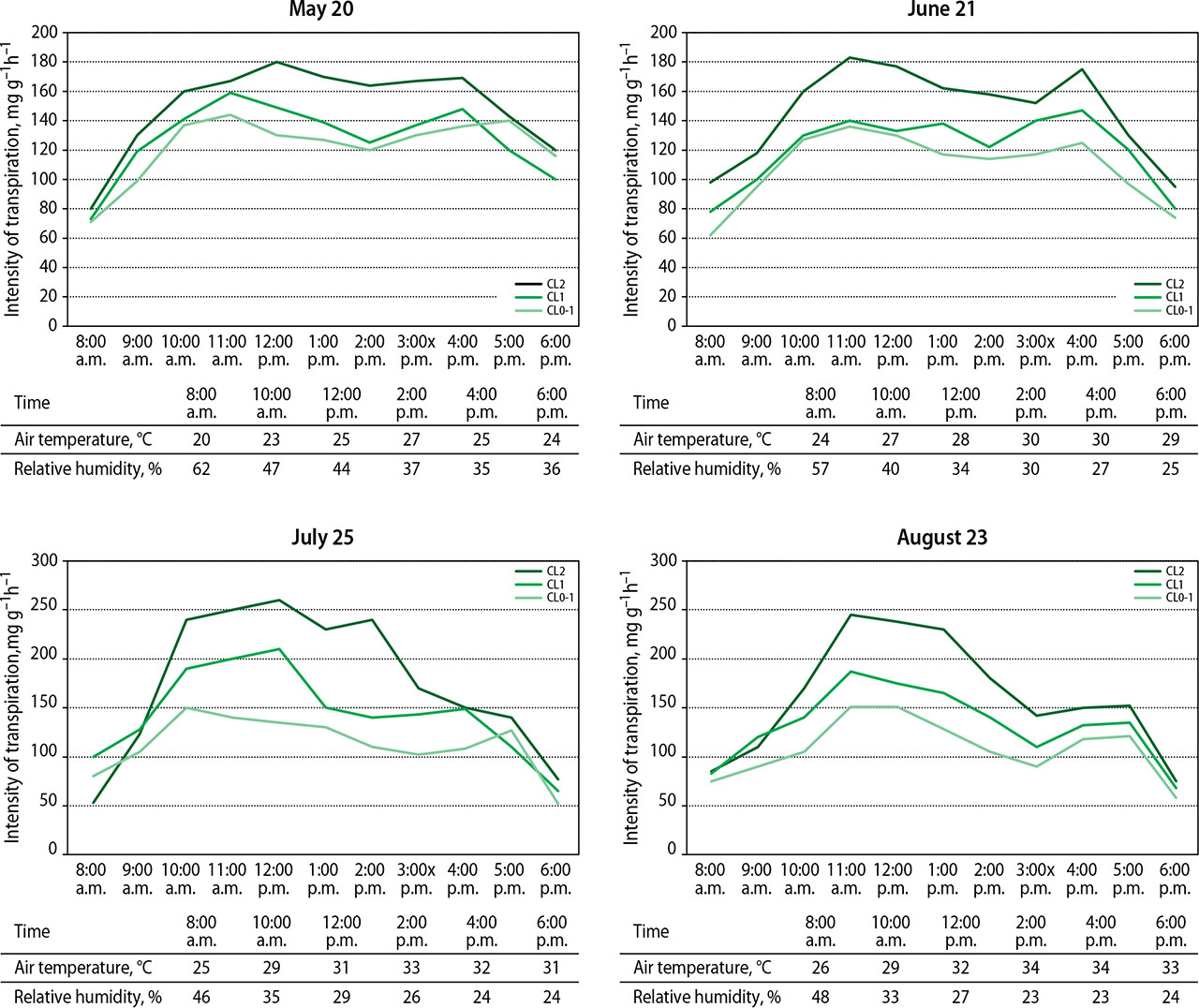
Figure 1.
The course of the daily intensity of transpiration in different months of the study (mg g−1 h−1)
In June, the quantitative indices of transpiration of needles of Pinus pallasiana had the same numerical limits as in May (Fig. 1B). However, the difference in values between the variant with sufficient moisture supply of plants (CL2) and insufficient (CL1, CL0–1) moisture supply was increasing. Before 10:00 a.m., the indicators of water evaporation by the needles of plants in mesoxerophilic and xerophilic growth conditions were very close, but then the difference between them increased. In mesophilic (CL2) forest growth conditions, evaporation of water by needles had two maxima – at 11:00 a.m. and 4:00 p.m. In CL1 variant (mesoxerophilic conditions), under insufficient water supply, the transpiration activity increased until 11:00 a.m. and then practically did not change until 2:00 p.m.; the peak of activity was observed at 4:00 p.m. In the needles of trees of the xerophilic conditions (CL0–1), after the rise in moisture evaporation before 11:00 a.m., the curve gradually decreased with a maximum at 4:00 p.m., as in the first two variants. The needles of Pinus pallasiana trees growing in the thalweg evaporated the most water during transpiration. From 8:00 a.m. till 11:00 a.m., the indicators of this process in plants of mesoxerophilic and xerophilic conditions did not differ statistically. The biggest differences between these variants in the values of water evaporation were found in the period from 12:00 p.m. till 4:00 p.m.
The transpiration values in mesophilic (CL2) and mesoxerophilic (CL1) forest growth conditions were higher in July than in previous months (Fig. 1C). Thus, its maximum daily value in the needles of thalweg trees was 260 mg g−1 h−1, in mesoxerophilic condition was 213 mg g−1 h−1, in xerophilic condition was 154 mg g−1 h−1. While in June – 181 mg g−1 h−1, 145 mg g−1 h−1 and 135 mg g−1 h−1, respectively. The daily course of transpiration in thalweg plants is expressed by a two-peaked curve with maxima at 12:00 p.m. and 2:00 p.m. Then the intensity of this process gradually decreased. In mesoxerophilic conditions, two maxima were also present. The first, as under the conditions of sufficient moisture supply, was at 12:00 p.m., and the second was shifted to 4:00 p.m., while also being much smaller, that is, in the hottest period of the day, the intensity of transpiration dropped. In xerophilic forest growth conditions, the first peak of transpiration activity occurred earlier (at 10:00 a.m.), and the second occurred later at 5:00 p.m., compared to the results obtained on the CL2 and CL1 sites. The minimum of the process was found at 3:00 p.m. Such features of the course of transpiration in dry forest growth conditions are associated with adaptive reactions to reduce water loss during the period with the highest temperature and lowest air humidity. Between the variants of the experiment, a significant difference in transpiration rates was found between 10:00 a.m. and 3:00 p.m.
Therefore, in the curve in July, as well as in other periods, the daily course of transpiration in Pinus pallasiana needles in different variants of the experiment indicated the highest intensity of this process under the conditions of sufficient moisture supply of plants, while the lowest intensity was observed under xerophilic (dry) forest growth conditions.
In August, in all the variants of the experiment, the daytime intensity of needle transpiration had two peaks – at 11:00 a.m. and 5:00 p.m. (Fig. 1D). The first maximum in mesophilic and mesoxerophilic growth conditions of Pinus pallasiana was significantly higher than the second by 64.2% and 38.5%, respectively. In plants of xerophilic forest growth conditions, the values differed by 23.7%. The highest intensity of transpiration, as well as in other periods, was on site CL2. The lowest intensity was in the needles of plants growing under dry growth conditions (CL0–1). The difference between the indicators of all experimental variants was statistically reliable within the period from 11:00 a.m. to 4 p.m. In the morning and early evening hours, no significant differences were found in the indicators of this process at different experimental sites.
Thus, the nature of the daily transpiration curves of Pinus pallasiana on the dates of the studies was different. They were the least broken in May. In July and August, daily fluctuations of values were more pronounced and their indicators were higher than in May and June. The most significant difference between the options in the values of water evaporation in all periods of the study was found during the midday hours, when the air temperature is the highest and its humidity is the lowest. In the morning and early evening hours, the changes in transpiration values were small or statistically unreliable.
Figure 2 shows the average daily values of transpiration on the dates of the research. In mesophilic (CL2) and mesoxerophilic (CL1) growth conditions of Pinus pallasiana, the highest rates of moisture evaporation by needles were observed in July, followed by a decline. Coniferous plants in xerophilic (CL0–1) forest growth conditions had the largest value of average daily transpiration in May; in other months, the deviations in the obtained data were small.
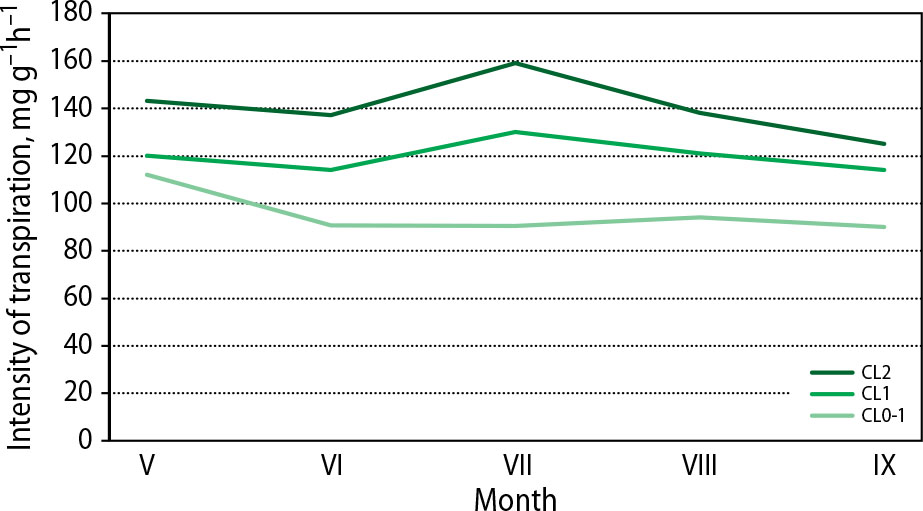
Figure 2.
Monthly average daily values of transpiration intensity (mg×g−1 h−1)
Many researchers consider leaf tissues’ hydration to be an important indicator of water exchange, on which physiological and biochemical processes in plant cells depend (Gieger and Thomas 2002; Sikuku et al. 2010; Zaitseva and Povorotnaya 2015). The hydration of Pinus pallasiana needles was changing during the growing season on all sites. It was highest in May and lowest in August (Tab. 2).
Table 2.
Moisture content of Pinus pallasiana needles during the growing season under different soil moisture conditions (% of raw mass)
| Site | Month | ||||
|---|---|---|---|---|---|
| V | VI | VII | VIII | IX | |
| CL2 | 60.21±0.51 | 58.21±0.47 | 57.40±0.32 | 55.42±0.53 | 58.77±0.60 |
| CL1 | 57.36±0.48a | 54.11±0.68a | 51.74±0.34a | 50.11±0.40a | 52.30±0.52a |
| CL0–1 | 54.02±0.62a.b | 51.24±0.39a.b | 49.39±0.42a.b | 47.14±0.85a.b | 49.18±0.48a.b |
Forest growth conditions also affect this indicator. The water content in needles was the highest in thalweg plants during all periods of the study. Its quantity was less when the soil moisture was deteriorating, especially in xerophilic forest growth conditions. As can be seen from Table 1, the water content in the soil decreases during the summer period. The minimum values of this indicator are identified in August. Consequently, as soil drought increases, the water content of Pinus pallasiana needles decreases, despite lower transpiration rates under these conditions.
The water deficit of the leaves is an indicator of the intensity of the water regime. Although the midday water deficit in the needles of thalweg plants increased in the summer months compared to May, it was relatively small (Tab. 3). Lyr et al. (1967) indicated that a water deficit in plant leaves ranging from 3% to 14% can be considered relatively small with the physiological processes proceeding without noticeable disturbances. The lower water content in the soil on CL1 and CL0–1 sites and more intense microclimatic conditions lead to excesses of these water deficit values. This indicator was the highest in August (23.56% and 29.31%, respectively) (Tab. 3). In the following month, its decrease was observed. Therefore, despite the decrease in the intensity of needle transpiration under more severe hydrothermal conditions compared to the site with normal water supply, the midday water deficit still showed larger numbers.
Table 3.
Midday water deficit of Pinus pallasiana needles under different forest growth conditions from mass at full saturation (%)
| Month | Site | Percentage of the results from CL2 | |||
|---|---|---|---|---|---|
| CL2 | CL1 | CL0–1 | CL1 | CL0–1 | |
| V | 4.23±0.51 | 7.46±0.47a | 9.21±0.60a | 176.36 | 217.73 |
| VI | 7.21±0.64 | 11.12±1.12a | 16.32±0.84a.b | 154.23 | 226.35 |
| VII | 10.12±0.85 | 17.23±0.90a | 23.24±1.30a.b | 170.25 | 229.64 |
| VIII | 13.21±1.12 | 23.56±0.68a | 29.31±1.17a.b | 178.35 | 221.87 |
| IX | 9.14±1.03 | 15.30±1.20a | 21.16±0.89a.b | 167.40 | 231.50 |
Water retention forces play an important role in regulating the water exchange of plants. Pinus pallasiana needles are characterized by high water-holding capacity (Fig. 3). Even after 24 h, the water loss was low. It was lower than that observed for some conifers, in particular Thuja plicata (Ivashchenko 2014), Thuja occidentalis and its cultivars (Kovalevskii and Kryvokhatko 2018), and especially in deciduous species (Bessonova et al. 2016; Ponomareva and Bessonova 2019; Brovko and Brovko 2014).
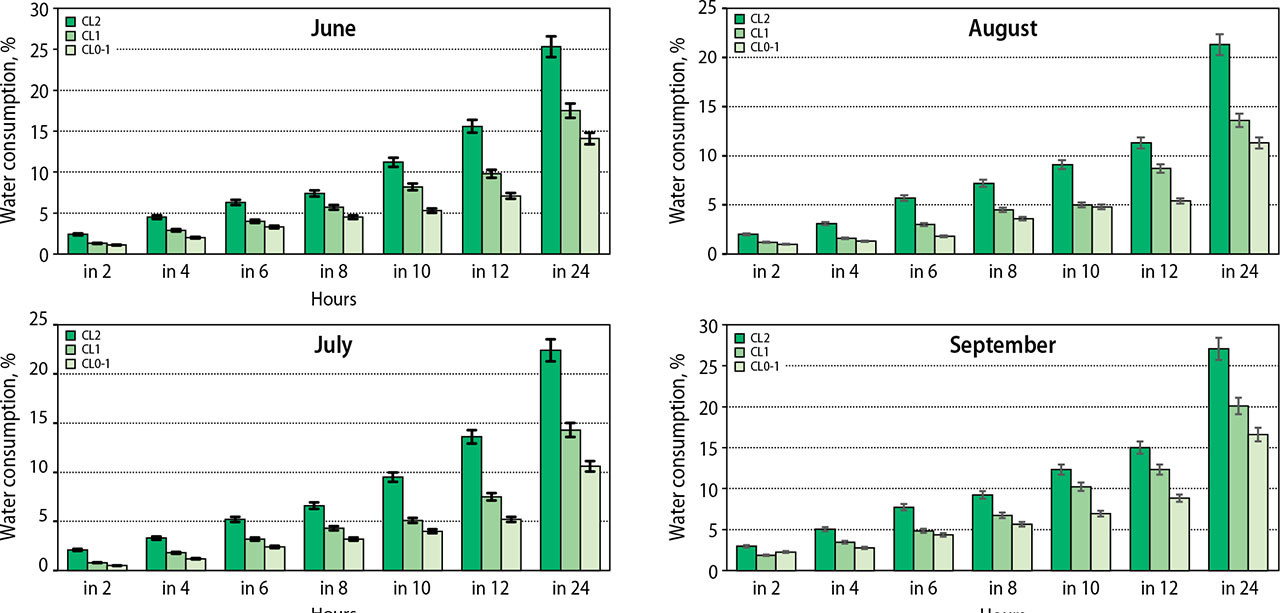
Figure 3.
Water-holding capacity of Pinus pallasiana needles, % water loss from the initial mass
Results showed that Pinus pallasiana needles had the highest water-holding capacity (less water loss) in July and August. Thus, with exposure of 24 h, this indicator in the needles of thalweg trees in July was 22.2% lower than in June, on the sites CL1 (by 26.7%) and CL0–1 (by 29.1%). In September, compared to previous months, the water-holding capacity decreased in all variants.
A comparison of the water-holding capacity of tree needles under different forest growth conditions showed that this indicator was the highest under arid growth conditions. The loss of water by needles was the greatest for thalweg plants, that is, with good water supply. After 24 h of exposure, plants of mesoxerophilic and xerophilic forest growth conditions showed 1.57 and 2.11 times lower results, respectively.
High water-holding capacity indicates the stability of water balance of plants under hydrothermal stress and characterizes the degree of endurance and response of plants to climatic factors (Kushnirenko et al. 1970; Goncharova 2005). According to many authors, this indicator is a diagnostic value for the degree of plants’ drought resistance (Ishmuratova et al. 2013; Wu et al. 2017).
The amount of soluble protein in Pinus pallasiana needles in the driest and hottest months was determined. As can be seen from Figure 4, it was significantly larger in the needles of plants that grew in mesoxerophilic and xerophilic conditions. However, there was practically no difference between the indicators of one and the same option during the studied months.
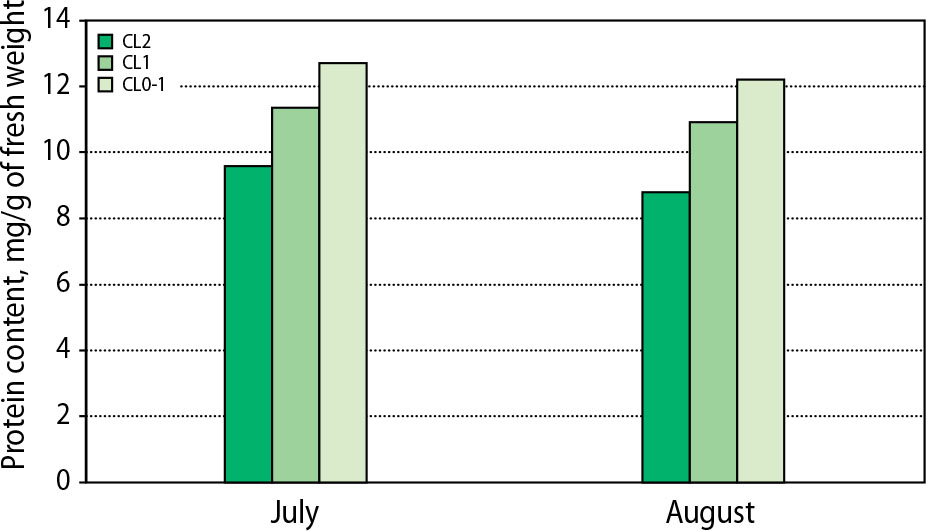
Figure 4.
Protein content in Pinus pallasiana needles under different growth conditions
Discussion
As our research has shown, the water supply of Pinus pallasiana plants during the growing season deteriorates due to a decrease in soil moisture, especially in the upper part of the slope of the ravine (Tab. 1). This is accompanied by high temperatures in the summer months. Williams et al. (2013) noted that high temperatures can increase the severity of drought stress.
Analysis of indicators of water exchange showed that Pinus pallasiana is characterized by a number of adaptations to unfavorable hydrothermal growth conditions. Under water scarcity (CL1 and CL0–1), the intensity of transpiration in the needles of Pinus pallasiana decreases compared to plants of mesophilic growth conditions, with the exception in the evening and morning hours. A shift of the transpiration maximum in plants of dry (xerophilic, CL0–1) growth conditions to earlier and later hours compared to the variant with sufficient moisture supply (mesophilic, CL2) was also revealed, which is a manifestation of an adaptive reaction to a lack of moisture.
The intensity of needle transpiration is significantly lower in trees growing under mesoxerophilic and, especially, xerophilic forest growth conditions, during the hours of high air temperature and low humidity, compared to the plants from the areas with sufficient water supply. The needles of plants under arid conditions are characterized by a higher water-holding capacity. These adaptations contribute to maintaining the relative stability of the water balance under adverse hydrothermal conditions and are a manifestation of physiological adaptations to drought.
Changes in the anatomical structure of the needles (Bessonova and Jusypiva 2018) and a significant increase in the concentration of soluble osmoprotective sugars (Bessonova and Yakovlieva-Nosar 2022) may be the factors stabilizing the water regime of Pinus pallasiana, as shown in the same model of trees on which we studied water metabolism. Of significant importance is the increase in the content of hydrophilic colloids in leaf tissues, which bind water and prevent its loss (Bessonova et al. 2016). This is caused by the accumulation of water-soluble proteins. As can be seen from Figure 4, the amount of water-soluble proteins is greater in Pinus pallasiana needles under arid conditions (mesoxerophilic and xerophilic) compared to the needles of plants growing under better moisture supply. Other authors (Mayne et al. 1994; Kosakivska and Golovynko 2006; Zaitseva 2017) also noted an increase in the content of water-soluble proteins in plants adapted to arid growing conditions.
However, it should be noted that despite the more economical consumption of water and the higher water-holding capacity of needles under mesoxerophilic and, especially, xerophilic growth conditions, the midday water deficit is more significant in these variants, although it does not reach critical values. The highest value of this indicator was found under xerophilic forest growth (29.31%), which is significantly lower than the sublethal deficit of water saturation for the needles of Pinus sylvestris L. and somewhat less than for Picea abies L. (Karst.) (Lyr et al. 1967). We have not found such data on Pinus pallasiana.
Therefore, the analysis of changes in the water exchange characteristics of Pinus pallasiana indicates a number of adaptations due to which smaller moisture losses are observed. It contributes to the successful growth of this plant under the complex hydrothermal conditions on the slope of the southern exposure. This indicates the possibility of using the introduced species for anti-erosion plantations under the arid conditions of the steppe zone of Ukraine.
Conclusion
In the anti-erosion man-made plantations of the Viyskovyi ravine, differences in the daily intensity of transpiration of Pinus pallasiana needles were observed in different months of the research. In May, the curves of this process had a more smoothed character. The intensity of transpiration and its daily amplitude were the highest for all variants of the experiment in July and August.
On all dates of the study, needles of thalweg plants evaporated water most intensively, while the plants of xerophilic growth conditions showed the lowest result. During the midday hours, when the air temperature is the highest and its humidity is the lowest, there was a significant difference between the variants in the values of water evaporation in all periods of the study. In the morning and early evening hours, the differences in transpiration values between the variants were small or statistically unreliable.
Both the decrease in the intensity of the transpiration process and the shift of its maxima during the day to earlier and later periods in plants from xerophilic growth sites compared to plants with better moisture supply conditions are associated with adaptive reactions to reducing water loss in the period with the highest temperature and lower air humidity.
The analysis of monthly average daily values of transpiration intensity showed the maximum evaporation of moisture by the needles of plants from mesophilic and mesoxerophilic sites in July, with a subsequent decline of the process, and of xerophilic plants in May. During the other months of the study, this indicator practically did not change.
The moisture content of Pinus pallasiana needles on all sites was maximum in May and minimum in August, which is consistent with increasing soil drought. This indicator was minimal in plants of xerophilic forest growth conditions.
The lowest midday water deficit in the needles of Pinus pallasiana in thalweg was observed in May, and it slightly increased during summer months. This indicator for the plants growing in areas with a lack of moisture was significantly more pronounced than for the plants with better moisture supply (CL2), despite the decrease in the intensity of transpiration. In all variants of the study, the water deficit reached its peak values in August.
The high water-holding capacity of Pinus pallasiana needles was established throughout the study, especially in July and August. Water loss was the largest for thalweg plants and the lowest under xerophilic forest growth conditions. This is one of the indicators of plant endurance to harsh hydrothermal conditions.
Such adaptive changes in the water exchange of Pinus pallasiana needles in arid places of growth, which are decrease in the intensity of transpiration in hot hours, a shift of the maxima in its daily course to the morning and later periods, and an increase in the water-holding capacity of the needles, compared to plants in normally watered areas indicate the possibility of successful creation of anti-erosion forest plantations with the use of this species on the slopes of the southern exposure of the ravines, where there are harsh hydrothermal conditions in summer.