
Introduction
The increased risk of forest fires in recent years is a problem that is increasingly recognised in social and academic life, not only in the situation of increasingly frequent large fires, but above all in the context of advancing climate change. To minimise the damage caused by forest fires, many countries around the world have forest fire protection systems in place, including observation towers, fire escapes and water intake points. However, to maximise fire safety, it is important to predict and designate areas of increased fire risk. For this purpose, fuel models are used in some countries (Daymond et al. 2004; Matthews et al. 2019; Hurzhii et al. 2023), which help predict the spread of fire and can form the basis for optimising the fire protection infrastructure that has been created.
According to the definition of the ‘Glossary of Forest Fire Management Terms’ (www.frames.gov…), a fuel model is ‘an identified combination of fuel elements of characteristic species that are similar in shape, size arrangement and continuity and show a typical course of the combustion process under certain environmental conditions’. According to the ‘European Glossary for Wildfires and Forest Fires’ (www.ctif.org…), a fuel model is ‘a mathematical representation of the characteristics of combustible material at a particular location, often used to predict and determine the likely spread of a fire and its intensity’.
The basic features that characterise the type of fuel (=fuel model), according to most researchers, are fuel load, moisture, bulk density, often referred to as the spatial structure of the combustible material, expressed by the packing coefficient (Fuller 1991; Chandler et al. 1983), and the thermal content of the material (Scott and Burgan 2005). Some also emphasise the importance of the chemical composition of the fuel for its properties (Johnson and Miyanishi 2001). Of the above characteristics, fuel load is considered important, that is, the amount of living and dead phytomass calculated per unit area over the soil, taking into account its size.
A separate model describing combustible plant materials (e.g. litter, grass, heather cover) that are similar in terms of characteristic species, shape, quantity and structure (Phelps and Beverly 2022) determines the typical course of the combustion process. The purpose of fuel classification is to enable area managers to make the right decisions by identifying the forest fire hazard and predicting the spread of fires.
The greatest achievements in the development of fuel models have been in the USA and Canada. In the model of the spread of soil cover fires developed by Rothermel (1972), the fuel type was the input data. The author defined it as a complete set of parameters characteristic of a particular plant formation. In his research, he distinguished 11 fuel models for which fire spread calculations could be performed. The model was modified by Albini (1976), who added two new models. The amended categorisation became the binding set of 13 fuel models in the USA. The difference between the models concerned the material moisture limit. In the earlier models, it was constant regardless of the type of fuel, whereas in the modified versions, it was assigned to each type of material. Anderson (1982), in turn, described the 13 models distinguished by Albini in detail and pointed out that the parameters of the fuel model should be fuel load, layer depth and limiting moisture content of the combustible material. Later modifications by Scott and Burgan (2005) concerned improving the accuracy of predicting the spread of fires outside the main fire season.
In Canada, 16 fuel models are used to simulate the spread of fire (The Canadian Forest Fire Behaviour Prediction System), which are divided into five fuel groups: coniferous, deciduous, mixed hardwood forests, clearcuttings and grasses (De Groot 1993). The speed and intensity of the fire, the amount of mass burnt and the vertical extent of the flames are calculated.
In Europe, the forest fire classification system ‘Prometheus’ was developed, which applies to Mediterranean ecosystems and distinguishes seven vegetation models based on remote sensing techniques (Domingo et al. 2020). Other studies confirm the validity of using satellite data and scaling it according to specific needs. Depending on the methodology adopted using Support Vector Machine (SVM) and Object-Based Image Analysis (OBIA) methods, this makes it possible to develop terrain maps for the Iberian Peninsula and Balearic Islands that identify between 19 and 45 fuel types (Aragoneses et al. 2021). Mapping fuel models using satellite data, machine learning and artificial intelligence is also possible on a continental scale. The solution developed within the FIRE-RES project allowed the creation of a fuel map for Europe, at all Nomenclature of Territorial Units for Statistics (NUTS) scales, from the country level (NUTS0) to the provincial level (NUTS3). The resolution of the fuel map the size of a 100 m × 100 m square (Kutchartt et al. 2024).
When analysing existing systems for classifying fuel models of forest plant material, it should be noted that they are structurally complex and differ greatly in terms of both physical properties and fire behaviour. In addition, there are significant limitations to their use, mainly because the fuel models are tailored to a specific geographical location. Adapting fuel models to other climate zones leads to incorrect simulation results of forest fire development.
To create optimal fuel models, the Laboratory of Forest Fire Protection (LFFP) of the Forest Research Institute (IBL) worked on the development of fuel models for plant materials of soil cover characteristic of various forest habitats in Poland on behalf of the Directorate General of State Forests (DGLP) in the years 2014–2017. The article presents the development of forest fuel models, which have not yet been described in detail in the literature.
Methodology
Analysis of the occurrence of fires
In the first phase of the development of fuel models, an analysis of the occurrence of forest fires in the period 2007–2013 was carried out on the basis of data from the National Forest Fire Information System (NFFIS). This system enables the synthesis of information on forest fires from three sources: the Information Technology system of State Forests, the decision support system of the State Fire Service and reports from national parks.
The analyses took into account the number of fires and the area burnt. The percentage of fires was assessed for the locations where they broke out according to the following criteria: forest habitat types, soil cover type, stand age class and predominant species. The descriptions of the stands required for the assessment were taken from the forest database of The Bureau for Forest Management and Geodesy State Enterprise.
For the analyses, the flammability index was used as a descriptive characteristic, which represents the quotient of the number and area of fires according to the evaluated characteristic to the proportion of the area of all stands according to this characteristic. The analysis conducted to determine which types of forest stands are most vulnerable to fires based on selected taxing characteristics allowed for the selection of study sites where field measurements were conducted to develop fuel models of forest plant materials of the soil cover.
Fuel load
The field measurements were carried out at research sites, the location of which is shown in Figure 1, with particular attention being paid to areas at risk of forest fires, as determined by analysing the occurrence of fires.
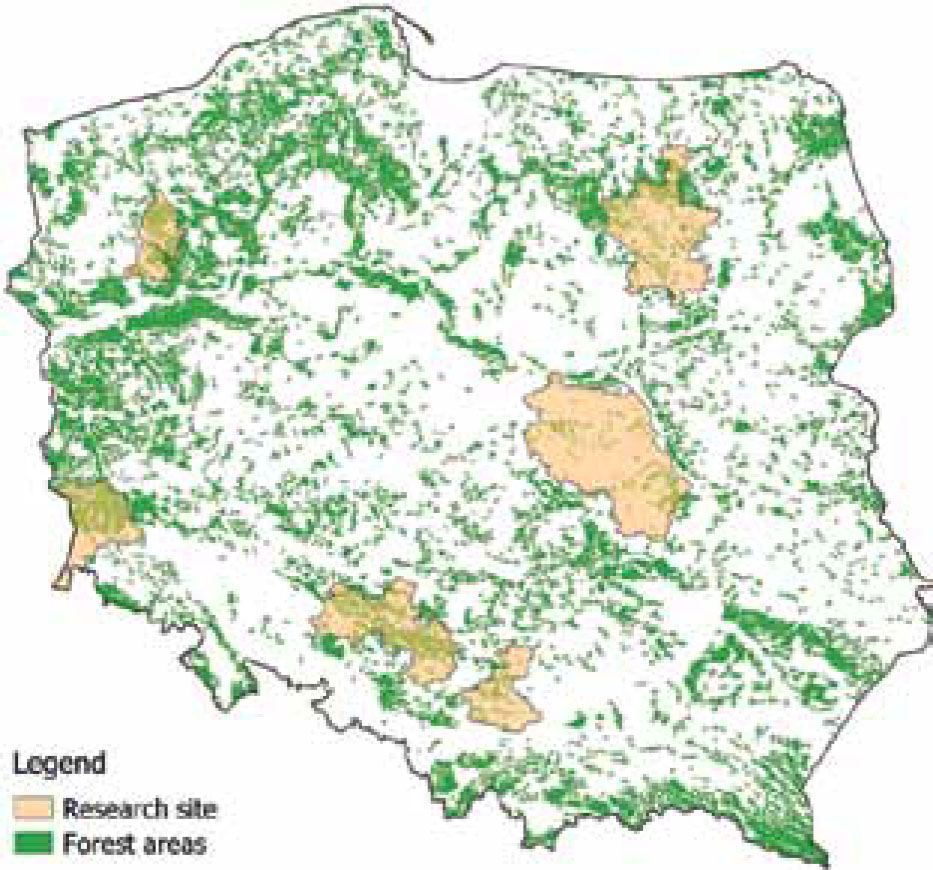
Figure 1.
Location of research sites where soil cover fuel load measurements were carried out
Measurements of the fuel load were taken in stands in which no maintenance treatments were carried out. To conduct the study properly, all measurements were carried out before the maintenance treatments were carried out to avoid disturbances related to the amount of flammable material in the soil cover.
To avoid the influence of stands adjacent to the study area, the measurements were taken in sections with an area of more than 1 ha and the measurement areas were at least 10 m away from the boundary.
A basic description of the ground cover was drawn up for each stand studied, and the biomass (fuel load) was measured on 10 plots with an area of 1 m2. When selecting the locations where plant material from the ground cover was collected, the degree of surface cover by vegetation species characteristic of the forest stands in which the measurements were carried out was taken into account. The biomass of the undergrowth components was determined if the proportion of their cover was greater than 10%. In individual plots, the vertical cross section of the main layers of combustible material components to the mineral soil layer was measured. Samples of the individual materials were also taken to determine their moisture content. Determining the moisture content of the individual combustible materials was necessary to determine the actual fuel load, expressed in kg/m2.
Analysis of variations in flammable material moisture content
Due to the large differences in the composition of the soil cover, especially in the area of undergrowth vegetation, it was necessary to analyse the variability of the moisture content of the individual components of the soil cover biomass.
An assessment of the variability of the moisture content of the individual materials was carried out, and the variability of the moisture content of the upper litter was compared with the moisture content of the litter obtained from empirical data to determine the forest fire risk in the years 2014–2017. As different biomass components were present in the different measurement plots, it was difficult to analyse the correlation of the moisture content of the individual materials. At the same time, it should be noted that the only component of the soil cover biomass whose moisture was regularly monitored was the upper litter. Therefore, the moisture variability was analysed by comparing the moisture of the litter with the moisture of the individual components of the soil cover biomass. This analysis was performed using the backward multiple stepwise regression method, where the dependent variable was the moisture of the individual components of the soil cover biomass and the independent variables were litter moisture, the natural logarithm of litter moisture, the number of days without precipitation, the number of days with less than 1 mm of precipitation and the number of days with less than 5 mm of precipitation. These analyses allowed the grouping of materials that are similar in terms of moisture properties, which enabled the development of models by limiting the number of variables. This made it possible to assess the moisture content of individual combustible materials and to determine periods when individual materials are particularly susceptible to fire. This was possible thanks to the development of equations for each group of materials that determine their moisture content as a function of the moisture content of the upper litter.
Development of fuel models
The next step was to develop equations to calculate the amount of soil cover biomass depending on forest habitat types, soil cover type, species composition and stand age. Since only the variable describing age could be represented on a nominal scale, it was decided to form homogeneous groups for forest habitat type, cover type and species composition by using the Kruskal–Wallis rank test, which allows the median value of a given trait to be compared for many independent groups. The advantage of this test over the significant extension of the measurements to many forest habitat type groups, cover type and species composition of the stands was the possibility to perform analyses independent of the distribution of the dependent variable. In the first phase, analyses were carried out for three groups of decay materials and dead and living components of soil cover biomass, separated by forest habitat type, cover type and stand species composition. Subsequently, analyses were carried out for classes, grouped by characteristics for which there were no significant differences in the distribution of the average weight of certain types of soil cover materials, with the aim of isolating a maximum of several groups for each of them. For these groups, the correlation between the mass of each soil cover material and the age of the tree stand was determined and equations were developed to calculate the fuel load for a given type of fuel.
The study assumed that fire models would be developed for land cover based on the results of analysing the occurrence of fires:
– six forest habitat types most affected by fires (dry coniferous forest, moist mixed coniferous forest, fresh mixed coniferous forest, mixed hardwood forest, moist coniferous forest and riparian forest);
– types of soil cover – layer without litter; moss layer – mosses cover over 50% of the surface; moss–blackberry layer – moss with blueberry patches; sodded layer – with blueberries or with blueberries and grasses; layer heavily sodded – dense grass vegetation covering over 50% of the surface; layer heavily infested with weeds – undergrowth vegetation is dense and consists of plants with strong and deep roots or with rhizomes or stolons, which makes forest regeneration or afforestation impossible without agrotechnical measures (Encyklopedia… 2023);
– the predominant tree species, including Scots pine (Pinus sylvestris) and oaks (Quercus spp.) and
– age classes of tree stands from 10 to 80 years.
The following characteristics were taken into account when developing fuel models for forest stands:
– fuel load, that is, the amount of biomass expressed in kg/m2 or t/ha, and in firefighting defined as fuel load density expressed in MJ/m2, according to the Polish standard: PN-70-02852:2001;
– moisture content of combustible material (%), taking into account the moisture range during the fire hazard season and the area where it is particularly susceptible to fire;
– heat of combustion and calorific value, expressed in kJ/kg and
– the volumetric density of the fuel, expressed in kg/m3, which is an indicator of the spatial structure or so-called ‘packing’ of the fuel.
The basis for the development of bulk density, understood as the ratio of the mass of the material to its volume, including the pores filled with air (socalled apparent fuel density), was an analysis of the correlation between the mass of the individual biomass groups of the soil cover and the thickness of their layer. For decay and other dead components of the soil cover, it was performed for all groups together. For living soil cover components, it was performed separately for individual groups, depending on the forest habitat type and type of soil cover.
For a given fuel model, the range of its moisture under natural conditions and its particular susceptibility to the occurrence and spread of fire were determined. The thermal values of the fuel models were calculated on the basis of the dry fuel load for the averaged heat of combustion of typical soil cover materials, using the results of earlier work (Szczygieł et al. 1985) of the Forest Fire Protection Laboratory of the Forest Research Institute. The basis for calculating the bulk density of fuels was the field measurements of their mass (in dry mass) in relation to the volume of the combustible material deposit.
In addition, a list of all combinations of forest habitat types, cover type and species composition for which specific types of fuels should be used was compiled.
Results
Analysis of the occurrence of fires
Between 2007 and 2013, 19,264 forest fires occurred on lands managed by the State Forests. The data comes from NFFIS. Most fires occurred in stands growing in fresh mixed coniferous forest (33.0%) and fresh coniferous forest (28.9%) habitats.
The most flammable of all forest habitat types are dry coniferous forest, moist mixed coniferous forest, fresh mixed coniferous forest, fresh coniferous forest and moist coniferous forest. The exclusion of upland mixed coniferous forest from the group of most flammable habitats results from a significant difference in the values of flammability indicators when the number of fires and the burnt area are taken into account. Based on the number of fires and the burnt area, the mixed hardwood forest habitat should be considered fire prone, although the flammability indices for both the number of fires and the burnt area were below 1 (Tab. 1).
Table 1.
The occurrence of forest fires by forest habitat type, expressed by the flammability index and the proportion of the area of forest stands growing in specific habitats
| Forest habitat type | Flammability index for | Share of tree stand area growing in this habitat | |
|---|---|---|---|
| number of fires | burnt surface | ||
| Dry coniferous forest | 2.18 | 3.70 | 3.7 |
| Upland mixed coniferous forest | 1.99 | 0.48 | 0.5 |
| Fresh mixed coniferous forest | 1.47 | 1.37 | 1.4 |
| Fresh coniferous forest | 1.47 | 1.06 | 1.1 |
| Moist mixed coniferous forest | 1.42 | 2.60 | 2.6 |
| Mixed upland hardwood forest | 1.34 | 0.69 | 0.7 |
| Moist coniferous forest | 1.07 | 0.90 | 0.9 |
| Mixed hardwood forest | 0.85 | 0.84 | 0.8 |
| Moist mixed hardwood forest | 0.85 | 1.27 | 1.3 |
| Mixed mountain hardwood forest | 0.62 | 1.14 | 1.1 |
| Riparian forest | 0.61 | 1.10 | 1.1 |
| Mixed mountain coniferous forest | 0.60 | 0.74 | 0.7 |
| Boggy mixed coniferous forest | 0.52 | 1.04 | 1.0 |
| Fresh hardwood forest | 0.40 | 0.70 | 0.7 |
| Moist hardwood forest | 0.27 | 0.24 | 0.2 |
| Upland hardwood forest | 0.19 | 0.18 | 0.2 |
| Boggy mixed hardwood forest | 0.15 | 0.18 | 0.2 |
| Alder forest | 0.15 | 0.04 | 0.0 |
| Ash–alder swamp forest | 0.12 | 0.25 | 0.3 |
| Mountain hardwood forest | 0.07 | 0.31 | 0.3 |
Table 1 does not include the habitats boggy coniferous forest, mountain coniferous forest, high-mountain coniferous forest, upland riparian forest, mountain ash–alder swamp forest, upland ash–alder swamp forest, which cover a total of 0.3% of the area and where 0.1% of all fires occurred.
Most fires occurred in stands of age class I (23.7%) and age class III (21.7%). Detailed data on the occurrence of fires depending on the age of the stand are presented in Table 2.
Table 2.
The occurrence of forest fires according to the age class of the tree stand, expressed by the flammability index and the proportion of the area covered by these stands
| Age class | Flammability index for | Share of tree stand area in a given age class | |
|---|---|---|---|
| number of fires | burnt surface | ||
| I (up to 20 years) | 2.21 | 6.94 | 10.7 |
| II (21–40 years) | 1.19 | 0.70 | 13.7 |
| III (41–60 years) | 0.92 | 0.21 | 23.7 |
| IV (61–80 years) | 0.68 | 0.07 | 20.2 |
| V (81–100 years) | 0.71 | 0.07 | 14.7 |
| VI (101–120 years) | 0.95 | 0.10 | 5.9 |
| VII (over 120 years old) | 0.77 | 0.05 | 3.0 |
| Other | 0.76 | 0.96 | 8.0 |
On analysing forest flammability depending on age, a clear decrease in flammability was observed with increasing age of the forest stands. By comparing the values of the flammability indices for the number of fires and the area burnt, it can be concluded that fires in stands of younger age classes pose the greatest risk due to the much larger areas they cover. The flammability of stands older than 61 years was low, although these age classes accounted for a significant proportion of the number of fires. The flammability of stands in the regeneration class and the class to be regenerated is slightly higher, but this could be related to considerable thinning of the canopy layer of these stands and the occupation of part of their area by young plantations.
Most fires occurred in stands where Scots pine was the predominant tree species (84.3%), followed by stands where oak (Quercus spp.) was the predominant tree species (4.6%). Detailed data on the occurrence of fires depending on the dominant species can be found in Table 3.
Table 3.
The occurrence of forest fires according to the predominant species expressed by the flammability index and the share of the area covered by these stands (the table contains the species present in the stands, which covered 99.2% of the area of all stands)
| Dominant species | Flammability index for | Share of tree stand area with a given species in the dominant age class | |
|---|---|---|---|
| number of fires | burnt surface | ||
| Scots pine (Pinus sylvestris) | 1.25 | 1.14 | 67.4 |
| Birch (Betula spp.) | 0.68 | 0.39 | 5.1 |
| Oak (Quercus spp.) | 0.60 | 1.11 | 7.6 |
| Spruce (Picea abies) | 0.49 | 0.81 | 5.4 |
| Beech (Fagus sylvatica) | 0.25 | 0.72 | 6.1 |
| Alder (Alnus spp.) | 0.17 | 0.20 | 4.6 |
| Fir (Abies alba) | 0.20 | 0.05 | 3.0 |
When assessing the flammability of forests depending on the tree species composition, the dominance of those forests in which Scots pine was the dominant species was recognisable. Attention was also paid to tree stands in which birch and oak were the dominant species. In stands dominated by birch, the number of fires was slightly lower than the average for all forests (flammability index 0.68 for the site of origin and 0.74 for all compartments) and the size of the burnt area was significantly smaller (flammability index 0.39 for the site of origin and 0.65 for all compartments). In oak stands, the flammability index considering the burnt area is similar to that in pine stands, which is due to the larger amount of biomass.
On analysing the occurrence of fires depending on the type of soil cover, it was found that most fires (48.3%) occurred in stands with sodded layer (Fig. 2).
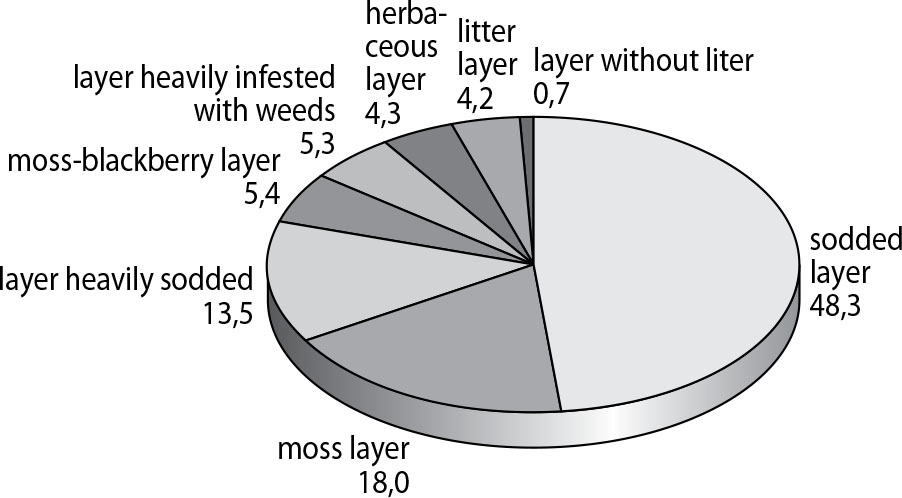
Figure 2.
Fire occurrence depending on the type of soil cover (%)
Analysis of the occurrence of fires in relation to the forest habitat types, the type of soil cover and the dominant species, in relation to the area of forest stands occupied by these stands, is shown in Tables 1–3. It enabled the selection of the forest stands in which the field research was carried out. For these studies, tree stands were selected in six age groups: 10, 20, 30, 40, 60 and 80 years old. For the first four groups of younger stands, it was assumed that the age difference to the given stands could be 2 years. For the last two groups of stocks, this difference was 5 years. In total, field tests were carried out in 512 tree stands, each with 10 replicates covering an area of 1 m2.
Analysis of variations in flammable material moisture content
Based on the field measurements were used to analyse the variability of the upper litter moisture, the average value of which was 37.52% with a standard deviation of 18.81. Based on the distribution of litter moisture values obtained from the forest fire risk prediction network (mean 28.9%, standard deviation 15.6), it was assumed that litter moisture is similar.
Analysis of the dependence of moisture content of down litter and decay on the moisture content of upper litter and length of the rain-free period showed that this dependence is average (the coefficient of determination for this dependence is 0.3). The moisture content of the bottom litter and decay is described by Equation 1 based on the results of the predicted and observed values together with the confidence interval (Fig. 3):
where:Wd-m – the moisture content of down litter and decay (%),
Ws – the moisture content of upper litter (%),
d<1 – the number of days with precipitation less than 1 mm.
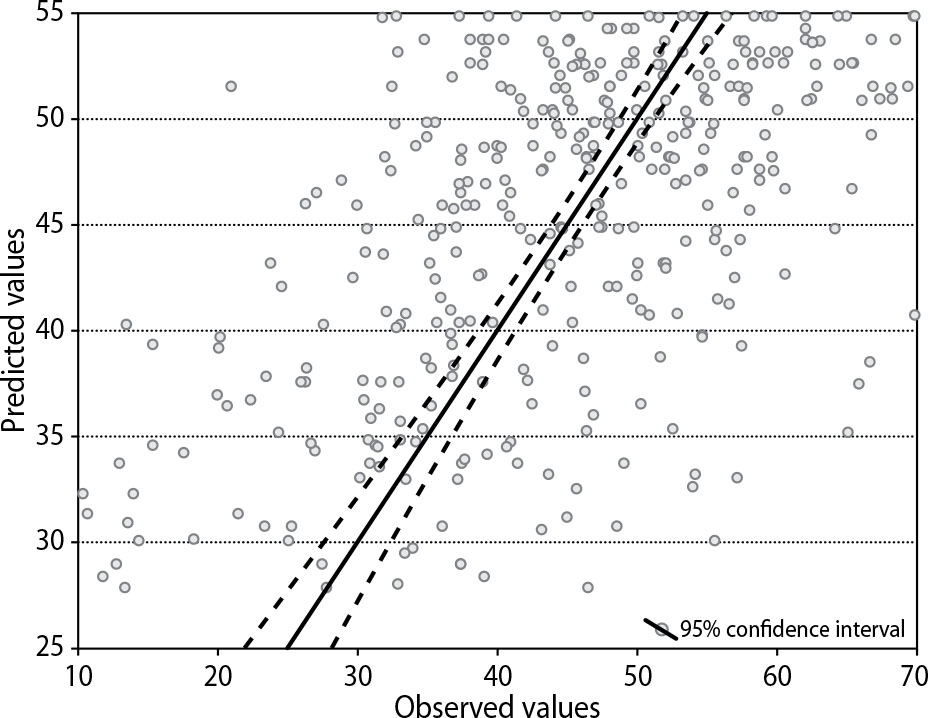
Figure 3.
Observed and predicted moisture content of down litter and decay values
For dead wood moisture, this relationship was high with a coefficient of determination of 0.6. The expected moisture content of dead wood is described by Equation 2:
where:Wl – the moisture content of dead wood (%),
Ws – the moisture content of upper litter (%),
d<5 – the number of days with precipitation less than 5 mm.
For moss moisture, it was found that dependence of moss moisture on the moisture of the upper litter and length of the rain-free periods was the highest among all the materials tested (the coefficient of determination was 0.7). This relationship is described by Equation 3:
where:Wm – the moss moisture (%),
Ws – the moisture content of upper litter (%),
d<5 – the number of days with precipitation less than 5 mm.
Dependence of the moisture content of the other living components of the soil cover on the moisture content of the litter and length of the rain-free periods is not as strong as with moss and dead wood. For heather and grasses, it is similar to the relationship for down litter and decay, and for the other components tested, it is even lower. The equations are presented below (4–9).
where:aking into account the contribution of the individual components of the soil cover to the fuel load and a similar range of variation in the moisture content of the live fuel of soil cover, it was possible to conduct joint statistical analyses for these parameters and develop fuel models.
The average total fuel load of the field trials was 4.4 kg/m2. The average amounts of the individual components of the soil cover were: for the lower litter and decay 3.9 kg/m2, for dead components (upper litter, dead wood) 0.3 kg/m2 and for living components of the cover 0.5 kg/m2. The average values were calculated only for the areas where materials of certain groups were present. When dependence of the average moisture of the living components of the soil cover on the litter moisture and the length of the rain-free periods was evaluated, a very high dependence was found. The coefficient of determination for the multiple regression taking into account the litter moisture transformed by a logarithmic equation and the number of days with less than 5 mm of precipitation was 0.5. Equation 10 describes this relationship as follows:
where:Wzielna – the moisture content of herbaceous vegetation (%),
Ws – the moisture content of the upper litter (%),
d<5 – the number of days with precipitation less than 5 mm.
On analysing the average moisture of the dead biomass components of the soil cover depending on the moisture of the upper litter and length of the periods without precipitation, a relationship was found – the value of the coefficient of determination of the multiple regression taking into account the litter moisture and the number of days with less than 1 mm and less than 5 mm of precipitation was 0.95. This relationship is described by Equation 11:
where:Ws – the moisture content of the upper litter (%),
Wmr – the moisture of dead biomass of the soil cover (%),
d<1 – the number of days with precipitation less than 1 mm,
d<5 – the number of days with precipitation less than 5 mm.
Development of fuel models
Homogeneous groups were formed for selected components of the soil cover biomass in relation to their mass. Table 4 contains exemplary results of multiple comparisons of decay mass by the forest habitat type. These comparisons were performed using the Kruskal–Wallis test. The cases marked in bold are those where the value of the ‘p’ statistic is below the significance level for a given sample size, indicating that the null hypothesis that there are no differences between the groups must be rejected.
Table 4.
The p-value of the Kruskal–Wallis test for multiple comparisons of boggy soil according to forest habitat types
| Forest habitat type | Moist mixed coniferous forest | Fresh mixed coniferous forest | Fresh coniferous forest | Mixed hardwood forest | Moist coniferous forest | Riparian forest | Dry coniferous forest |
|---|---|---|---|---|---|---|---|
| Moist mixed coniferous forest | – | 0.00 | 0.00 | 0.00 | 0.00 | 0.01 | 1.00 |
| Fresh mixed coniferous forest | 0.00 | – | 0.07 | 0.00 | 0.00 | 1.00 | 0.00 |
| Fresh coniferous forest | 0.00 | 0.07 | – | 0.00 | 0.00 | 1.00 | 0.00 |
| Mixed hardwood forest | 0.00 | 0.00 | 0.00 | – | 0.00 | 0.02 | 0.00 |
| Moist coniferous forest | 0.00 | 0.00 | 0.00 | 0.00 | – | 0.00 | 0.08 |
| Riparian forest | 0.01 | 1.00 | 1.00 | 0.02 | 0.00 | – | 0.01 |
| Dry coniferous forest | 1.00 | 0.00 | 0.00 | 0.00 | 0.08 | 0.01 | – |
The stages of comparison of groups separated on the basis of forest habitat type, species composition and stand age in terms of decay biomass, dead components of soil cover (other than decay) and living components of soil cover allowed the separation of three groups for decay biomass and living components of soil cover and two for dead components of soil cover (upper litter and dead wood). For these groups, based on the Kruskal–Wallis test, it was not possible to reject the null hypothesis that there are no significant differences between them. These groups are:
1) for decay:
– stands growing in dry coniferous forest, moist coniferous forest, moist mixed coniferous forest habitats;
– stands growing in fresh coniferous forest, fresh mixed coniferous forest, riparian forest habitats;
– tree stands growing in mixed hardwood forest habitats;
2) for dead components of the soil cover:
– tree stands growing in fresh coniferous forest and fresh mixed coniferous forest habitats;
– tree stands growing in other habitats;
3) for living components of the soil cover:
– tree stands growing in dry coniferous forest, moist coniferous forest, moist mixed coniferous forest and other habitats with litter cover;
– stands growing in fresh coniferous forest, fresh mixed coniferous forest, mixed hardwood forest and riparian forest with moss cover;
– other stands growing in fresh coniferous forest, fresh mixed coniferous forest, mixed hardwood forest and riparian forest habitats.
Development of correlation equations for soil cover mass and stand age
On analysing the relationship between decay mass and stand age, a clear, statistically significant relationship was found for the group with fresh coniferous forest, fresh mixed coniferous forest and riparian forest. For this group, the correlation coefficient was 0.22. For the group comprising stands in dry coniferous forest, moist coniferous forest and moist mixed coniferous forest habitats, the correlation coefficient was 0.06, while it was 0.01 for mixed hardwood forest. For stands growing in dry coniferous forest, moist coniferous forest and moist mixed coniferous forest habitats, the decay mass varied between 5.730 and 6.900 kg/m2 in the age range of the stands from 10 to 80 years, according to the equation describing this relationship. Equation 12 describes this correlation:
where:Mmu-1 – the mass of decay in stands growing in the habitats dry coniferous forest, moist coniferous forest and moist mixed coniferous forest (kg),
W – the age of the tree stand.
The decay mass correlation Equation 13 for the fresh coniferous forest, fresh mixed coniferous forest and riparian forest groups is:
where:Mmu-2 – the mass of decay in stands in the fresh coniferous forest, fresh mixed coniferous forest and riparian forest habitats (kg),
W – the age of the tree stand.
In the stands growing in a mixed hardwood forest habitat in the age range of 10–80 years, the difference in decay mass was 0.045 kg and this relationship was not statistically significant, so an age-independent decay mass of 1.760 kg should be assumed for stands growing in this habitat.
For the components of dead soil cover, with the exception of decay, a statistically significant relationship between the amount of biomass and the age of the stand was found only for the group of stands growing in the fresh coniferous forest and fresh mixed coniferous forest habitats. This correlation was negative and amounted to −0.07. For the other stands, the correlation coefficient was 0.01. The amount of biomass of dead soil cover in stands growing in the fresh coniferous forest and fresh mixed coniferous forest habitats is described by Equation 14:
where:Mma-1 – the mass of dead biomass in tree stands (litter, fine wood debris, coarse wood debris) in the fresh coniferous forest and fresh mixed coniferous forest habitats (kg),
W – the age of the tree stand.
In the remaining stands, the amount of dead soil cover biomass changed by 0.005 kg within the age range of the stand, so it was assumed that this mass was independent of age and amounted to 0.368 kg.
For the live fuel of the soil cover, the dependence of its amount on the age of the stand was statistically significant for groups comprising stands in dry coniferous forest, moist coniferous forest, moist mixed coniferous forest and other habitats with litter cover, and stands growing in the following habitats: fresh coniferous forest, fresh mixed coniferous forest, fixed forest and riparian forest with nonmoss cover. For the first of these groups, the correlation coefficient was 0.14. The distribution of the amount of living biomass of the soil cover is described by Equation 15:
where:Mż-1 – the mass of living biomass in stands in the dry coniferous forest, moist coniferous forest and moist mixed coniferous forest habitats and others with litter cover (kg),
W – the age of the tree stand.
In stands with moss cover growing in other habitats, where no statistically significant relationship was found between the living biomass of the soil cover, its amount changed by 0.070 kg in the age range from 10 to 80 years. It was therefore assumed that it was 0.663 kg regardless of the age of the tree stand. For the remaining stands growing in the fresh coniferous forest, fresh mixed coniferous forest, mixed hardwood forest and riparian forest habitats, the correlation coefficient of the equation describing the dependence of the amount of living biomass of the soil cover on the age of the stand was 0.27. The distribution of these values is described by Equation 16:
where:Mż-3 – the mass of living biomass in stands in the habitat fresh coniferous forest, fresh mixed coniferous forest, mixed hardwood forest and riparian forest with non-moss forest (kg),
W – the age of the tree stand.
The results of the analysis of the dependence of quantities of the individual components of the biomass of the soil cover on their thickness showed a high correlation in the case of decay, for which the correlation coefficient was 0.73. The thickness of the duff layer is described by Equation 17:
where:Hmu – the decay layer thickness (cm),
Mmu – the mass decay (kg).
The average weight of 1 m3 of decay in the dry state was 125.5 kg. For dead soil cover components, this relationship was smaller and the correlation was weak. The thickness of the layer of dead soil cover components, the average value of the mass of 1 m3 was 19.3 kg, was described by the Equation 18:
where:Hma – thickness of the layer of dead components of the soil cover (cm),
Mma – the mass of dead components of the soil cover (kg).
In the analyses carried out, there was no correlation between the thickness of the layer of living components of the soil cover and its mass. There was no statistically significant correlation for stands growing in the fresh coniferous forest, fresh mixed coniferous forest, mixed hardwood forest and riparian forest habitats with moss cover. The average volume weights of 1 m3 of the living components of the soil cover for the individual groups of stands are presented in Table 5.
Table 5.
Average volume weights of living components of the soil cover
| Type of tree stand | Average volumetric weight 1 m3 (kg) |
|---|---|
| In dry coniferous forest, moist coniferous forest, moist mixed coniferous forest habitats as well as in other habitats with litter cover | 5.03 |
| In fresh coniferous forest, fresh mixed coniferous forest, mixed hardwood forest and riparian forest habitats with moss cover | 17.80 |
| Others growing in the habitats fresh coniferous forest, fresh mixed coniferous forest, mixed hardwood forest and riparian forest | 9.55 |
Heat of combustion and calorific value of plant materials of the soil cover
The research results from the study by Szczygieł (1989) were used for the thermal properties of the fuel models. Table 6 contains data on the heat of combustion and calorific value of the most important soil cover materials. The average dry calorific value of soil cover materials is 18,920 kJ/kg. This value was included in Equation 19 for calorific value because the fuel model describes many plant materials:
where:Wop – the calorific value in a dry state (kJ),
Qd – the fuel load (kg).
Table 6.
Heat of combustion and calorific value of forest materials (Szczygieł 1989)
| Type of material | Heat of combustion (kJ/kg) | Calorific value (kJ/kg) | |||||
|---|---|---|---|---|---|---|---|
| Moisture content of material (%) | |||||||
| 0 | 10 | 20 | 30 | 40 | 50 | ||
| Pine litter | 22,069 | 20,938 | 18,640 | 16,387 | 14,181 | 12,020 | 9,902 |
| Pine bark | 20,494 | 19,364 | 17,224 | 15,131 | 13,080 | 11,074 | 9119 |
| Pine cones | 20,335 | 19,205 | 17,078 | 15,001 | 12,967 | 10,978 | 9,035 |
| Small reed | 18,850 | 17,719 | 15,742 | 13,812 | 11,920 | 10,086 | 8,294 |
| Fescue | 18,217 | 17,086 | 15,173 | 13,306 | 11,484 | 9,709 | 7,980 |
| Heather | 20,733 | 19,603 | 17,438 | 15,319 | 13,247 | 11,216 | 9,236 |
| Blueberry | 20,909 | 19,778 | 17,597 | 15,462 | 13,368 | 11,325 | 9,324 |
| Moss | 18,799 | 17,668 | 15,696 | 13,770 | 11,895 | 10,057 | 8,261 |
| Average calorific value | 18,920 | 16,824 | 14,774 | 12,768 | 10,808 | 8,894 | |
Development of soil cover fuel models
To analyse the quantities of the individual components of soil cover biomass, five fuel models were distinguished: decay, litter, moss, green layer coniferous forest and forest herbaceous. The following abbreviations are used for the models:
– W – age of the tree stand;
– Ws – moisture content of litter;
– d<0.1 – number of days with precipitation less than 0.1 mm;
– d<1 – number of days with precipitation less than 1 mm and
– d<5 – number of days with precipitation less than 5 mm.
Decay fuel’ model (DFM)
The fuel load model applies to stands that occur in dry coniferous forest, moist coniferous forest and moist mixed coniferous forest habitats. The calculation equations for this model were developed on the basis of field measurements in a group of tree stands representing about 5% of the forest area managed by the State Forests. Due to the similar type of fuel and flammability index, this model can also be used for tree stands growing in the boggy coniferous forest and boggy mixed coniferous forest habitat.
Weight of decay (kg/m2)
Weight of aboveground part (kg/m2)
Fuel load (kg/m2)
Calorific value (kJ/kg)
Moisture content of decay (%)
Moisture content of aboveground part (%)
Average moisture content (%)
Moisture content range (%)
Thickness of the decay layer (cm)
Thickness of the aboveground layer (cm)
Volume density (kg/m3)
‘Litter fuel’ model (LFM)
The fuel load model for this type of fuel was developed on the basis of measurements in tree stands growing in fresh coniferous forest and fresh mixed coniferous forest habitats with litter cover. These stands, categorised as the highest flammability class, account for less than 1% of the forest area of the State Forests; however, due to the significant discrepancy in the amount of soil cover biomass, it is not possible to combine them with other types of stands. This model can be applied to all other stands with litter cover, with the exception of dry coniferous forest, moist coniferous forest, moist mixed coniferous forest, boggy coniferous forest and boggy mixed coniferous forest. In total, such stands account for 3.07% of the area.
Weight of decay (kg/m2)
Weight of aboveground part (kg/m2)
Fuel load (kg/m2)
Calorific value (kJ/kg)
Moisture content of decay (%)
Moisture content of aboveground part (%)
Average moisture content (%)
Moisture content range (%)
Thickness of the decay layer (cm)
Thickness of the aboveground layer (cm)
Volume density (kg/m3)
‘Moss fuel’ model (MFM)
The fuel load model for this type of fuel was developed on the basis of measurements in tree stands growing in fresh coniferous forest and fresh mixed coniferous forest habitats with moss cover. This model can be applied to all other stands with moss cover, with the exception of the stands mentioned in the ‘decay fuel’ section, that is, dry coniferous forest, moist coniferous forest and moist mixed coniferous forest. In total, such stands account for 12.09% of the area managed by the State Forests.
Weight of decay (kg/m2)
Weight of aboveground part (kg/m2)
Fuel load (kg/m2)
Calorific value (kJ/kg)
Moisture content of decay (%)
Moisture content of aboveground part (%)
Average moisture content (%)
Moisture content range (%)
Thickness of the decay layer (cm)
Thickness of the aboveground layer (cm)
Volume density (kg/m3)
‘Green layer coniferous forest fuel’ model (GCFM)
This model was developed on the basis of measurements in stands growing in fresh coniferous forest and fresh mixed coniferous forest habitats with other types of vegetation. This model can be used for all coniferous forest stands with a herbaceous layer typical of coniferous habitats. In total, these stands cover 31.89% of the forest area managed by the State Forests.
Weight of decay (kg/m2)
Weight of aboveground part (kg/m2)
Fuel load (kg/m2)
Calorific value (kJ/kg)
Moisture content of decay (%)
Moisture content of aboveground part (%)
Average moisture content (%)
Moisture content range (%)
Thickness of the decay layer (cm)
Thickness of the aboveground layer (cm)
Volume density (kg/m3)
‘Herbaceous layer hardwood forest fuel’ model (HHFM)
This model was developed on the basis of measurements in stands growing in mixed hardwood forest and riparian forest habitats. This model can also be used for other hardwood forest stands, with the exception of stands with litter or moss cover. These tree stands account for a total of 46.94% of the forest area managed by the State Forests.
Weight of decay (kg/m2)
Weight of aboveground part (kg/m2)
Fuel load (kg/m2)
Calorific value (kJ/kg)
Moisture content of decay (%)
Moisture content of aboveground part (%)
Average moisture content (%)
Moisture content range (%)
Thickness of the decay layer (cm)
Thickness of the aboveground layer (cm)
Volume density (kg/m3)
Table 7 lists the forest habitat types, soil cover types and the fuel models described above, using the names adopted for them. This list facilitates the practical application of the fuel models.
Table 7.
Types of fuel models depending on the type of forest habitat and type of soil cover
| Forest habitat type | Type of soil cover | |||||||
|---|---|---|---|---|---|---|---|---|
| Moss | Moss–blackberry | Without litter | Heavily sodded | Heavily infested with weeds | Litter | Sodded | Herbaceous | |
| Dry coniferous forest | DFM | DFM | DFM | DFM | DFM | DFM | DFM | DFM |
| Moist coniferous forest | DFM | DFM | DFM | DFM | DFM | DFM | DFM | DFM |
| Boggy coniferous forest | DFM | DFM | DFM | DFM | DFM | DFM | DFM | DFM |
| Moist mixed coniferous forest | DFM | DFM | DFM | DFM | DFM | DFM | DFM | DFM |
| Boggy mixed coniferous forest | DFM | DFM | DFM | DFM | DFM | DFM | DFM | DFM |
| Boggy mountain coniferous forest | MFM | GCGM | GCGM | GCGM | GCGM | LFM | GCGM | GCGM |
| Mountain fresh coniferous forest | MFM | GCGM | GCGM | GCGM | GCGM | LFM | GCGM | GCGM |
| Mountain moist coniferous forest | MFM | GCGM | GCGM | GCGM | GCGM | LFM | GCGM | GCGM |
| Boggy mixed mountain coniferous forest | MFM | GCGM | GCGM | GCGM | GCGM | LFM | GCGM | GCGM |
| Fresh mixed mountain coniferous forest | MFM | GCGM | GCGM | GCGM | GCGM | LFM | GCGM | GCGM |
| Moist mixed mountain coniferous forest | MFM | GCGM | GCGM | GCGM | GCGM | LFM | GCGM | GCGM |
| Fresh mixed coniferous forest | MFM | GCGM | GCGM | GCGM | GCGM | LFM | GCGM | GCGM |
| Fresh upland mixed coniferous forest | MFM | GCGM | GCGM | GCGM | GCGM | LFM | GCGM | GCGM |
| Moist upland mixed coniferous forest | MFM | GCGM | GCGM | GCGM | GCGM | LFM | GCGM | GCGM |
| Fresh coniferous forest | MFM | GCGM | GCGM | GCGM | GCGM | LFM | GCGM | GCGM |
| High-mountain coniferous forest | MFM | GCGM | GCGM | GCGM | GCGM | LFM | GCGM | GCGM |
| Fresh mountain hardwood forest | MFM | HHFM | HHFM | HHFM | HHFM | LFM | HHFM | HHFM |
| Moist mountain hardwood forest | MFM | HHFM | HHFM | HHFM | HHFM | LFM | HHFM | HHFM |
| Riparian forest | MFM | HHFM | HHFM | HHFM | HHFM | LFM | HHFM | HHFM |
| Mountain riparian forest | MFM | HHFM | HHFM | HHFM | HHFM | LFM | HHFM | HHFM |
| Upland riparian forest | MFM | HHFM | HHFM | HHFM | HHFM | LFM | HHFM | HHFM |
| Boggy mixed hardwood forest | MFM | HHFM | HHFM | HHFM | HHFM | LFM | HHFM | HHFM |
| Fresh mixed mountain hardwood forest | MFM | HHFM | HHFM | HHFM | HHFM | LFM | HHFM | HHFM |
| Moist mixed mountain hardwood forest | MFM | HHFM | HHFM | HHFM | HHFM | LFM | HHFM | HHFM |
| Mixed hardwood forest | MFM | HHFM | HHFM | HHFM | HHFM | LFM | HHFM | HHFM |
| Moist mixed hardwood forest | MFM | HHFM | HHFM | HHFM | HHFM | LFM | HHFM | HHFM |
| Fresh upland mixed hardwood forest | MFM | HHFM | HHFM | HHFM | HHFM | LFM | HHFM | HHFM |
| Moist upland mixed hardwood forest | MFM | HHFM | HHFM | HHFM | HHFM | LFM | HHFM | HHFM |
| Fresh hardwood forest | MFM | HHFM | HHFM | HHFM | HHFM | LFM | HHFM | HHFM |
| Moist hardwood forest | MFM | HHFM | HHFM | HHFM | HHFM | LFM | HHFM | HHFM |
| Fresh upland hardwood forest | MFM | HHFM | HHFM | HHFM | HHFM | LFM | HHFM | HHFM |
| Moist upland hardwood forest | MFM | HHFM | HHFM | HHFM | HHFM | LFM | HHFM | HHFM |
| Alder forest | MFM | HHFM | HHFM | HHFM | HHFM | LFM | HHFM | HHFM |
| Ash–alder swamp forest | MFM | HHFM | HHFM | HHFM | HHFM | LFM | HHFM | HHFM |
| Mountain ash–alder swamp forest | MFM | HHFM | HHFM | HHFM | HHFM | LFM | HHFM | HHFM |
| Upland ash–alder swamp forest | MFM | HHFM | HHFM | HHFM | HHFM | LFM | HHFM | HHFM |
Conclusion
Fuel models can be used, among other things, for the following:
– Mapping the amounts of individual components of the soil cover biomass by fuel type. The type of fuel is determined on the basis of the predominant forest types of soil cover. Mapping using the models presented enables the identification of areas exposed to the spread of high-intensity fires.
– Modelling based on the current moisture content of individual soil cover components depending on the moisture content of the litter and the length of periods without precipitation. For the amount and moisture content of the individual components of the soil cover biomass, the result is the average, taking into account the percentage of the area.
The use of forest fuel models enables the creation of fire hazard maps. Their level of detail depends on local needs and can be created for compartments or sub-compartments. Such materials can be used when planning a system for securing forest areas in the event of a fire, for example, by optimising the location of fire roads or water intake points.
Modelling allows you to create maps that are useful in carrying out rescue and firefighting operations in the event of large fires. This type of solution should use weather data from the nearest meteorological monitoring station managed by the State Forestry Administration. Based on the collected data, the fire hazard situation can be mapped spatially, for example, the moisture content of combustible material. Mapping makes it possible to visualise the moisture status of the dead components of the soil cover and the current moisture content of the soil biomass.
Previously, it was possible to accurately determine the fire risk in forest areas of the country for the area of a forest district or a national park. The described method of the fuel model made it possible to carry out this assessment down to the level of sub-compartments.