
Introduction
If we look at the ecology of fire, fire is a natural process that has always existed. Natural ecosystems, particularly forests, have always been subject to fire ever since plants first colonized the land over 400 million years ago (Keeley and Pausas 2022). In recent years, catastrophic wildfires have broken out on every continent around the world, successively breaking sad records for surface area, damage, and casualties (Rigolot et al. 2020). The biggest enemies of the forests are fires, diseases, pollutions, and phenomena mainly localized in developed countries (Lavieille 2004). This figure is tending to increase in many parts of the world, particularly around the Mediterranean basin.
Mediterranean forests are affected by fires every year, and mountain and temperate forests are also affected at a more local level (Curt et al. 2020). These forests were subject to fires, which are caused by lightning or poorly extinguished embers carelessness. However, fires could rarely spread over large areas in an uncontrolled way, given the lack of continuity between forest patches or the low density of trees and undergrowth (Plana et al. 2016).
In 2000, Africa lost more than 230 million acres due to fire, i.e., 7.7% of the continent total surface and 64% of the devastated surface worldwide (Belkaid 2016). The global annual burnt area has been estimated at 350 Mha per year, 72% of which has been in Africa in recent decades (Wu et al. 2022).
Algeria’s forest cover has declined since 1990. Algeria is a very vulnerable country when it comes to fires, which are mainly man-made, given that the forests are public property and freely accessible. Managing and protecting Algeria’s forests is currently a priority. In Algeria, it is estimated that more than 37,000 acres of the woody surfaces have been ravaged from 1979 till 1985 (Madaoui 2000): an average of 8,750 ha or 0.52% per year has been lost. Algeria has lost 10.5% of its forest cover or 175,000 ha, mainly through forest fires. Although the government has launched major reforestation programs, the forest area in Algeria is decreasing from 0.8% of the forest area (17,898 ha) in 1990 to 0.6% in 2010 (Merdas et al. 2017).
It is the biggest victim of fires in North Africa as it witnessed yearly from 378 to 1,388 fire incidents, which led to a loss between 34,596 and 41,258 acres during the periods from 1876 to 1962 and 1963 to 2007 (Meddour-Sahar et al. 2008). Two periods characterize this region: a cold season from November to April, with minimum temperatures recorded at around 2°C, and a hot season from May to October, with maximum temperatures of 35°C. Maximum heat stress is accentuated by a hot southerly wind, the sirocco, which occurs mainly in summer and increases evapotranspiration. Rainfall is concentrated during the cold season. Average annual rainfall is between 300 and 500 mm (ONM, 2013).
Fires are generally caused by anthropogenic activities as the case in Algeria (Souidi and Benbakar 2017; Souidi et al. 2015), where 86% of the incidents between 1985 and 2006 were reported as man-made (Arfa et al. 2009). The absence of an appropriate management contributes to the current delicate state of the forest that hinders the conservation and sustainability of this Algerian patrimony (MATE 2003).
Numerous analyses have been carried out on forest fires to determine their causes, such as modeling the socio-economic factors behind fires (Vilar et al. 2016; Wang et al. 2023; de Diego et al. 2023; Canepa 2024). In Algeria, we can mention the work by Souidi et al. (2017) in the western region and Arfa et al. (2018 and 2019), which analyzed and tried to model and map all the fires in the forests of the Wilaya of Tarf in the east region between 1985 and 2012 to understand and follow their spatiotemporal evolution. Furthermore, Belkaid (2016) carried out an analysis on the spatial variability of fires putting in evidence main human factors that determine the distribution of fires in three villages of the Wilaya of Tizi-Ouzou in the center region. The combination of different data should provide an overall picture of the decline in forest heritage (Souza et al. 2024).
Policies of forest-fire management include three phases: The 1st is setting the regulations (establishing committees and enacting laws), the 2nd is the prevention phase (equipment and infrastructure), and the 3rd is the extinction (intervention of the forest agents and the fire brigades).
This study focuses on the second and third phases, analyzing available equipment and infrastructure to guide managers toward a more effective fire prevention system. The realization of a base map is a reliable step to detect and point out the insufficient measures taken against forest fires.
We will try through a descriptive statistical approach to analyze the temporal progression of fires in 40 Wilayas in North Algeria during 2003–2017. The distribution of fires in the north of the country, according to the three main regions, is fairly identical, with 29% in the east, 41% in the center, and 30% in the west (Souidi and Benbakar 2017). The conditions under which fires break out are practically the same throughout the country. The aim of such data analysis is to uncover the general tendencies in fires’ behavior. We, therefore, opted for the Wilaya of Mascara as a semi-arid region in the West of Algeria, which offers the same conditions as Algeria’s other wilaya and is a good case study given the availability of data.
The climatic study includes 4 parameters that have an impact on the outbreak and spread of fire: the monthly average temperature, the monthly average precipitations, humidity, and wind speed. According to many authors, such as Abatzoglou and Williams (2016), Brown et al. (2021), and Jay et al. (2018), the frequency and size of forest fires are expected to increase in the future due to climate change. Consequently, forest management with adequate infrastructure and equipment for better fire control and management will become more important.
One of the main objectives of the fight against forest fires is to prevent the potential risk of fire (danger) so that managers can take the necessary decisions to limit the start and spread of fire. In this study, we used human activities as the main basis for estimating fire risk using a fire danger index (FDI). It include the major factors that play a part in forest fire spread (Hardy and Hardy 2007). The results obtained will enable us to better understand the surrounding factors and improve forest fire management.
Material and Methods
Study zone
Algeria has a surface of 2,381,741 km2 and is divided into 58 Wilayas (provinces) and 1541 municipalities. It has 2 important mountain ranges: the Tellian Atlas (from “Tell” a region in Algeria) in the North and the Saharian Atlas in the South. They divide the country into 3 types of environments characterized with their relief and morphology; from north to south, we find the Tellian system, the steppic high plains, and the Sahara (Fig. 1).
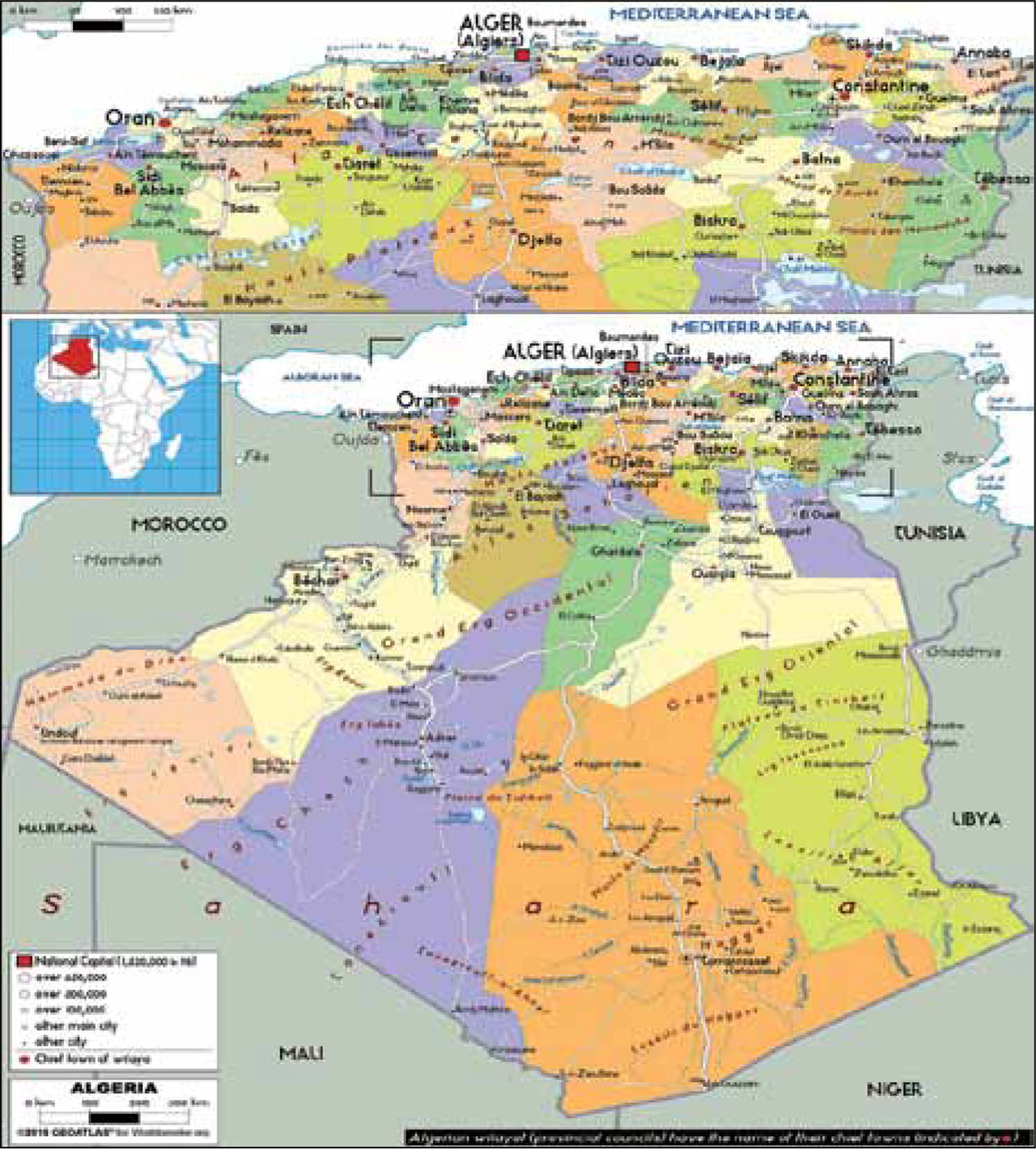
Figure 1.
Localization of the north zone in Algeria
The relief is divided into 2 rainfall gradients: a North–South decreasing gradient and a West–East increasing gradient (Tabet 2008).
Forest lands occupy 4,115,908 acres, i.e., 16.7% of North Algeria. They are made up of 58% scrubland and woody scrubland. However, natural forests and reforested sites cover only 42% of the total forest formations.
The Wilaya of Mascara, located in the West, is an adequate case study as it covers a surface of 513,000 acres with 47 municipalities (Fig. 2). Its topographic space may be classified into 5 relatively distinct homogenous zones with 504 douars (Algerian countryside). It is a semi-arid region with an average altitude of 600 m, ranked as a middle mountains area.
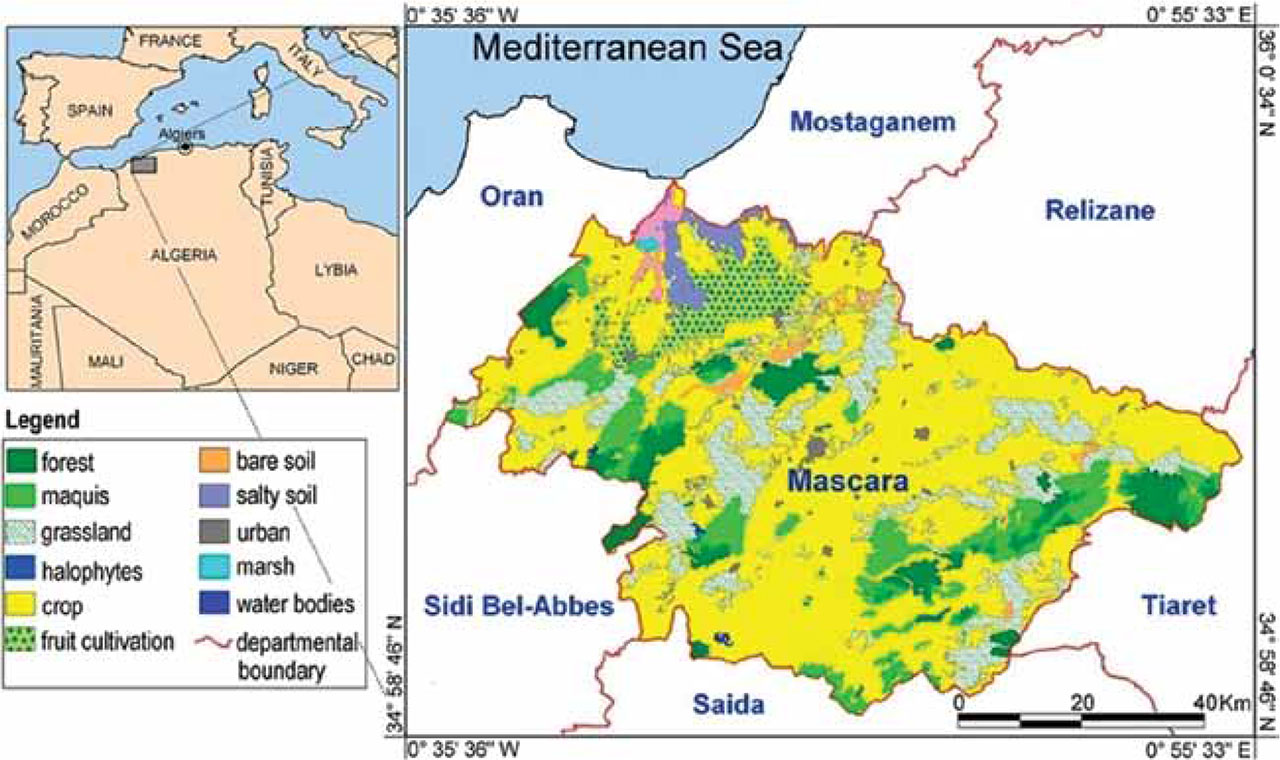
Figure 2.
Location of the study zone
The territories of the Wilaya of Mascara are made up of 5 individualized morphologic unities (Fig. 3) that are all oriented South-West/North-East.
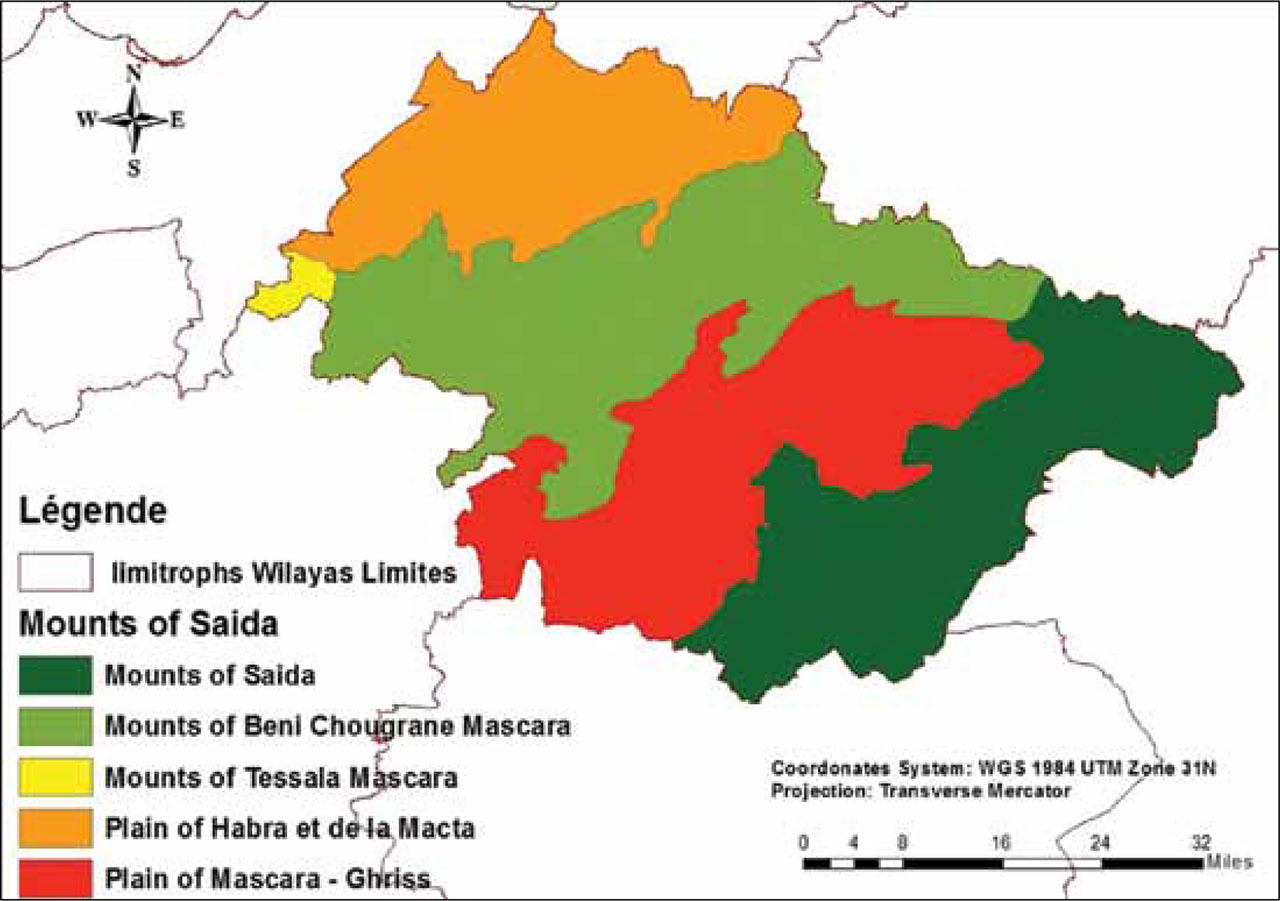
Figure 3.
Homogenous zones of Mascara
The 5 zones are as follows:
Habra-Sig plain
Beni Chougrane mounts
Mascara-Ghriss plain
Said (Aoufs) mounts
Tessala Mascara mounts
The two important zones in the forested development and valorization of the mountain lands are the mounts of Beni Chougrane and the mounts of Saida (Aoufs) which represent 51% of the total surface. The forest surface of Mascara is 90,223 acres, i.e., a level of forestation of 17.57% of which 37,470 acres are forests, 52,571 acres are scrubland, and 182 acres are arable spaces.
Methodological approach
A data analysis on the burned surfaces and the fire zones has been carried out from the internal archives and documents of the General Directorate of Forests which is part of the Ministry of Agriculture, Rural Development and Fishing. These data are available in the form of annual records of fires. Collected forest fires data (number of fires, damaged surface, and year of record) are saved in the form of Excel sheets, allowing all kinds of data manipulation and visual interpretations.
The methodological approach is based on the study of two parameters: the burned surface and the number of fires during 15 years (2003–2017) in 40 Wilayas of the North and Mascara.
The realization of the infrastructure map and that of forest fire dangers required the use of the Geographic Information System “ArcGIS 10.3” in order to integrate the collected data on the field (GPS points) in a digitalized database.
We studied three types of infrastructure proposed in Algeria’s forest fire-fighting plan, DFCI plan “Defense Forests Fire,” which are the fire break trenches, the tracks, and the lookout point. The aim of the firebreak trenches is to create a discontinuity of forestation in order to reduce the intensity of fires. They must be established perpendicularly to the winds’ orientation (Arbonnier and Faye 1988).
The rapid and guaranteed arrival to the incident can be guaranteed only through a sufficient number of the tracks that are well maintained.
Surveillance generally relies on lookout points located in high spots. Operators observe big parts of the territory with 360° coverage in order to make alerts when they suspect fires and precisely localize their occurrences.
The climatic study of Matmore station in Mascara for the period of 2007–2017 (474 m altitude, municipality n°14) (Fig. 3) contains the following 5 parameters: average annual and monthly temperature, average annual and monthly precipitations, humidity, evaporation, and wind speed. This climatic study enables us to make the relation between the climate and fire occurrence and spread. Indeed, assessing the impact of climate change on the future size of fires is important. Regional climate model simulations in the United States predict an overall increase in fire potential and an extension of the forest fire season in the future climate (Yu et al. 2023).
A number of dynamical methods have been developed in order to produce short-term hazard indices, such as the Fire Probability Index and the Fire Weather Index (Laneve et al. 2020; Vitolo et al. 2020). Multiple fire danger indices (FDIs) that incorporate weather and fuel conditions have been developed and utilized to support wildfire predictions and risk assessment (Tores et al. 2017; Hadisuwito and Hassan 2020; Yu et al. 2023; Atalay et al. 2024). In this paper, we have integrated different human activities in the realization of a map indicating fire-prone zones. The aim is to answer this question: Which areas present a high risk of fire starting?
To model fire danger, we opted for the Fire Danger Index (FDI) developed by Arfa et al. (2019) in Algeria, which is expressed with the following relationship (eqn. 1):
were:D – the danger level related to the approximation of the following elements:
farms that indicate cattle ranching activities (Dfarm);
rural houses indicate the human presence (DRH)
agricultural lands (DAgri);
forest tracksthat allow the access to the forest massifs (DTrack).
For each of these criteria, the values of danger level D range from 1 (low danger) to 5 (very high danger). These danger levels are determined according to the rate of the declared fire numbers between 1985 and 2012 and the distance that separates them of each criterion. The hazard levels retained are as follows:
D = 1: Low danger with a fire number rate equal to 5%
D = 2: Moderate danger with a fire number rate equal to 10%
D = 3: Average danger with a fire number rate equal to 20%
D = 4: High danger with a fire number rate equal to 30%
D = 5: very high danger with a fire number rate equal to 35%
The values of FDI are between 4 and 16. There are 5 classes code:
Low: FDI =4
Moderate: 4 <FDI ≤ 8
Average: 8 <FDI≤ 12
High: 12 <FDI ≤ 16
Very high: FDI> 16
Results and Discussion
Record of the fires of 40 Wilayas in the North of Algeria
The global burned surface between 2003 and 2017 in North Algeria (Tellian Atlas) was 482,000 acres for 40,000 fires with an average of 32,133 acres per year. In the years 2007, 2012, 2014, and 2017, the burned surface exceeded 40,000 acres for each year with a total of 42% of the global burned surface with a peak in 2012 which witnessed 99,000 acres burned. They are subject to seasonal variability due to meteorological factors (precipitation, temperature, wind) or biotic factors (fuel type and structure). The North-Eastern region of Algeria (Skikda, Annaba, and Tarf) is the mostly damaged (Arfa et al. 2018). Table 1 shows that the burned surface in these three Wilayas during 2015–2018 was 31,333 acres, which represented 45% of the total burned surface (68,993 acres).
Table 1.
Record of the fires per Wilaya during 2015–2018
| WILAYA | 2015 | 2016 | 2017 | 2018 | Number of fires | Burned surface |
|---|---|---|---|---|---|---|
| 1 | 2 | 3 | 4 | 5 | 6 | 7 |
| Chlef | 88 | 74 | 90 | 46 | 298 | 673 |
| Oum El Bouaghi | 7 | 24 | 22 | 4 | 57 | 123 |
| Batna | 11 | 12 | 34 | 10 | 67 | 481 |
| Bejaia | 70 | 193 | 181 | 24 | 468 | 9,286 |
| Blida | 272 | 245 | 185 | 77 | 779 | 1,862 |
| Bouira | 87 | 79 | 92 | 11 | 269 | 385 |
| Tebessa | 4 | 6 | 20 | 10 | 40 | 78 |
| Tlemcen | 101 | 42 | 31 | 20 | 194 | 4,945 |
| Tiaret | 39 | 55 | 30 | 5 | 129 | 920 |
| TiziOuzou | 125 | 269 | 392 | 67 | 853 | 6,847 |
| Alger | 128 | 160 | 99 | 58 | 445 | 57 |
| Djelfa | 10 | 8 | 28 | 25 | 71 | 27 |
| Jijel | 174 | 287 | 135 | 2 | 598 | 2,463 |
| Setif | 13 | 26 | 27 | 13 | 79 | 964 |
| Saida | 24 | 36 | 16 | 16 | 92 | 2,041 |
| Skikda | 23 | 64 | 198 | 15 | 300 | 8,134 |
| S.B.Abbes | 314 | 296 | 94 | 21 | 725 | 8,616 |
| Annaba | 30 | 108 | 38 | 8 | 184 | 3,020 |
| Guelma | 9 | 29 | 55 | 12 | 105 | 6,090 |
| Constantine | 12 | 14 | 23 | 10 | 59 | 591 |
| Medea | 84 | 133 | 183 | 70 | 470 | 2,967 |
| Mostaganem | 56 | 86 | 49 | 32 | 223 | 311 |
| Mascara | 32 | 15 | 11 | 2 | 60 | 846 |
| Oran | 76 | 56 | 38 | 14 | 184 | 504 |
| B.B.Arreridj | 39 | 32 | 49 | 12 | 132 | 255 |
| Boumerdes | 104 | 123 | 109 | 23 | 359 | 1,299 |
| El Tarf | 49 | 169 | 203 | 0 | 421 | 20,179 |
| Tissemsilt | 74 | 57 | 52 | 7 | 190 | 664 |
| Khenchela | 11 | 41 | 52 | 28 | 132 | 437 |
| Souk Ahras | 54 | 90 | 98 | 2 | 244 | 1,244 |
| Tipasa | 134 | 183 | 196 | 48 | 561 | 1,196 |
| Mila | 4 | 15 | 22 | 16 | 57 | 501 |
| Ain Defla | 81 | 92 | 91 | 24 | 288 | 1,486 |
| Ain Temouchent | 36 | 13 | 21 | 24 | 94 | 151 |
| Relizane | 6 | 6 | 17 | 2 | 31 | 144 |
| TOTAL | 2,381 | 3,138 | 2,981 | 758 | 9 258 | 89,787 |
Analysis of fire data of the Northern region of Algeria (Fig. 4) shows a good correlation (R2= 0.69) between the number of fires and the burned surface during 2003–2017. The two indexes are well related.
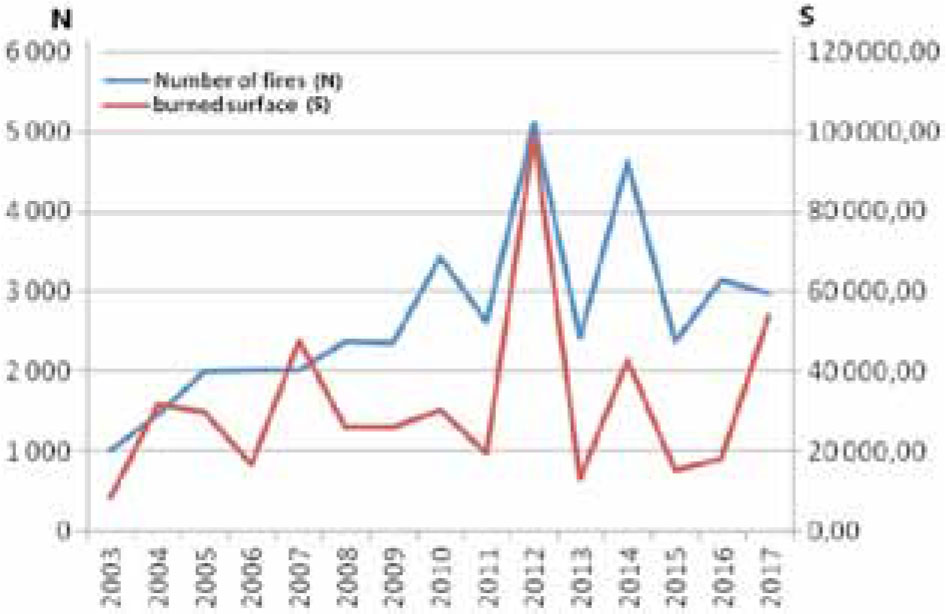
Figure 4.
Annual distribution of fires in the Northern region of Algeria (2003–2017)
Figure 4 shows a stability in the period of 2003–2011 and a peak in 2012 which was marked with hot waves making the whole Northern region of Algeria witness significant temperature rise (Boudjemline et al. 2016).
Zeineddine (2011) confirms the return of rains during the last years of the period between 2002 and 2006. The rain which falls on the Algerian territory became more intense in 2007, 2008, 2009, 2010, and 2011, which explains the low number of fires during those years.
Record of fires in Mascara
The global burned surface during the period from 2003 until 2017 in Mascara (Fig. 5) is 6,721 acres in 286 fires, with an average of 448 acres per year. In 2005 and 2014, the burned surface exceeded 1,000 acres with a rate of 47% of the global burned surface. In 2005, there was a peak with a surface of 2,042 acres. The correlation coefficient is equal to 0.71, which means that the number of fires and the burned surface of Mascara during 2003–2017 are well correlated.
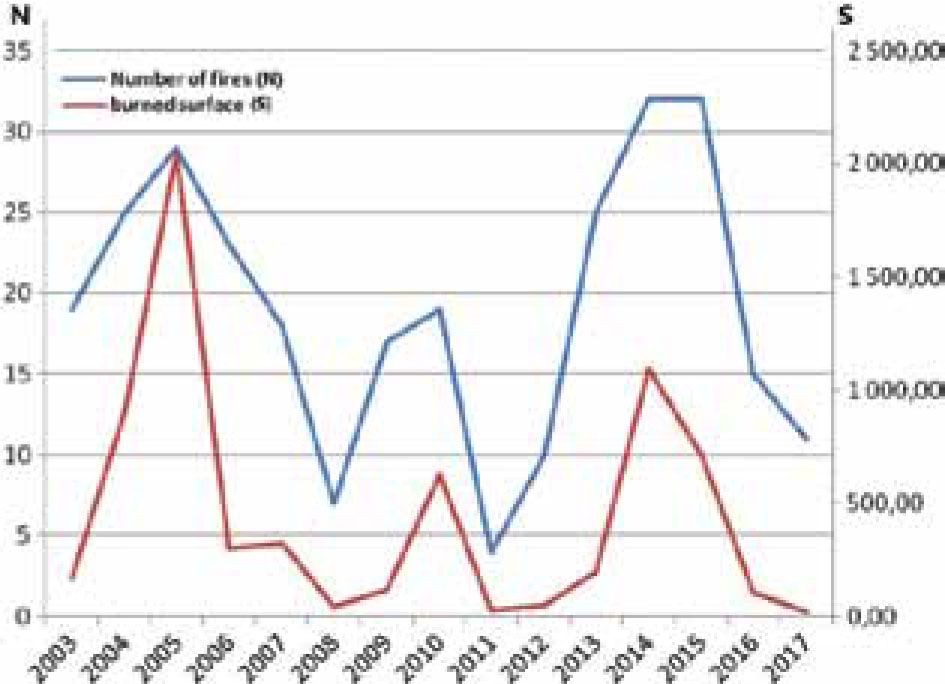
Figure 5.
Annual distribution of fires in Mascara during 2003–2017
The total burned surface depends on the meteorological conditions. The number of fire occurrences related to imprudence is correlated with the density of the population in the natural space which depends on the meteorological conditions. In relatively “wet” years, there has been little human presence in the natural area, resulting in fewer incidents, small fires that can be easily fought, and, consequently, a low surface area burnt.
Distribution of forest fires per type of formation
We clearly see that the scrubland of Mascara (53% of the forest massifs) is the formation that is most subject to forest fires with a rate of 61.12% during this decade. The forests witnessed fires with a percentage of 21.43%–14.36% for the scrub (Fig. 6). According to Belgherbi et al. (2018), the matorral is vulnerable to the fires more than the other forest formations.
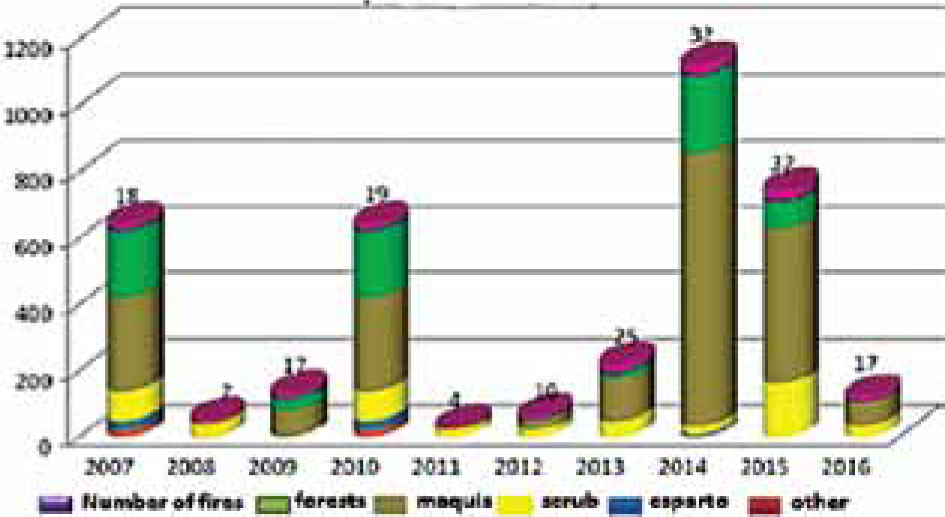
Figure 6.
Distribution of fires in Mascara per type of formation (2007–2016)
Distribution of forest fires per hours of the day
The most sensitive part of the day subject to fires is between midday and 4 pm where the temperature reaches its peak. 50% of the fire incidents have been registered during this period of the day.
The number of fire occurrences depends on the ignition of the combustibility and the water state of the vegetation determined by the dryness and humidity of the ground and the air (Chevrou 1998; Souidi et al. 2009). According to Souidi (2010), the water stress concords with the hottest and most humid hours of the day (maximal temperature, maximal humidity).
Climatic study of Mascara
The climate of Mascara belongs to the tempered Mediterranean type characterized with two seasons. The humid season starts from October till May, while the dry season starts from June to September. The very rough terrain complexity contributes to the creation of various micro-climates in the region.
The Ombrothermic diagrams of Gaussen (Fig. 8) that are traced with data of the rains and average temperature of the period 2003–2017 show a dry period that lasts from April to October (i.e., 6 months) with the variations of the climate from one year to another. This period tends to become longer.
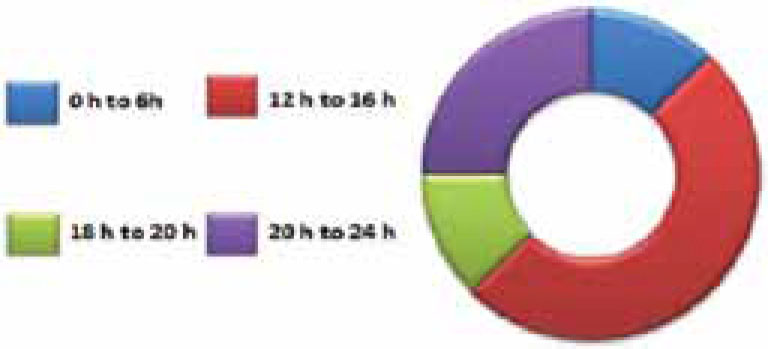
Figure 7.
Distribution of fires according to the hours of the day (2003–2017)
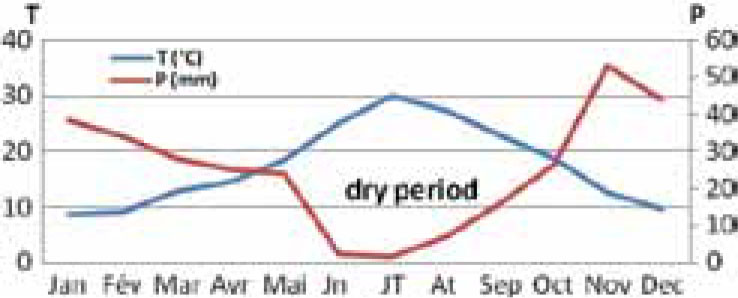
Figure 8.
Ombrothermic diagrams of Bagouls and Gaussen
Relation between the annual averages of the climatic parameters and the fires
The meteorological conditions are the major factor on which the burned surfaces depend and their number decreases in an important way according to the quantity of the precipitations (Yu et al. 2023; Turco et al. 2023).
The monthly annual averages vary between 28°C and 32°C due to the geographic situation of the study zone which is mountainous and its semi-arid region. According to Figure 9, the number of fires generally increases as the temperature rises, which influences fire ignition by drying out vegetation, making it sensitive and flammable. The increase in the area burnt and the intensity and severity of fires, which will have a significant impact on forest ecosystems, is the consequence of the impact of climate change on the fire regime (Flannigan et al. 2000; Yu et al. 2023).
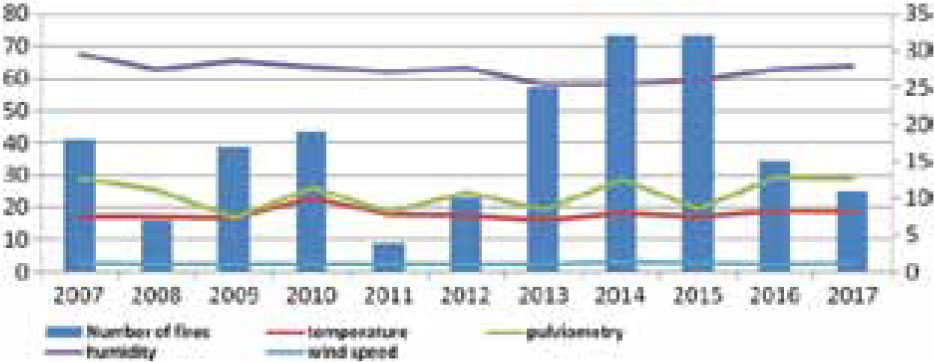
Figure 9.
Relation between the annual averages of the climatic parameters and the number of fires in Mascara (2007–2017)
The annual average precipitations vary between 20 and 30 mm, which are quite little for the prosperity of the vegetation in the best conditions.
The number of fires increases generally with the increase of the wind speed, which has an influence on fire ignitions by drying the vegetation making it vulnerable and leading to the spread of the fire and to the creation of new fires from the transported flames.
Analysis of the annual averages of the climatic parameters does not show clearly their relation with the fire occurrences. This requires an in-depth study of the monthly averages of the climatic parameters.
Relation between the monthly averages of the climatic parameters and the fires
Monthly average temperatures
The monthly average temperatures of Mascara are high, but they vary a bit during the year. We notice that it is hot throughout the Wilaya. Figure 10 shows that the hottest months are July and August of every year which is the period that witnesses a high number of fires.
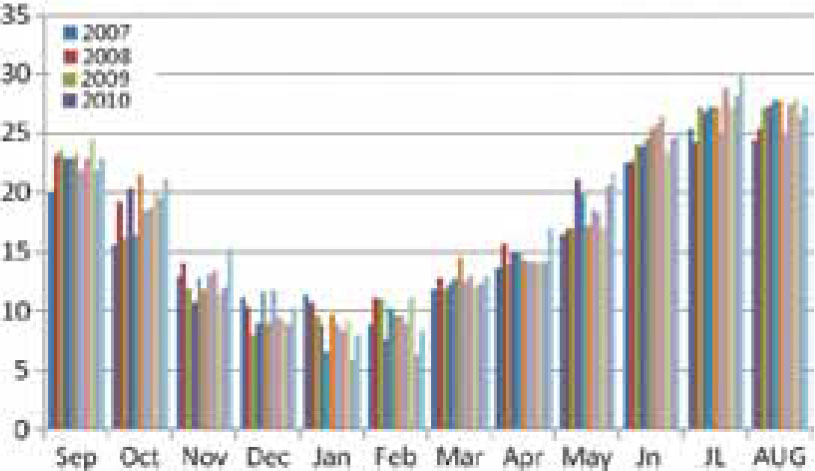
Figure 10.
The monthly average temperatures of Mascara (2007–2017)
The number of fires is superior to the average in 2013, 2014, and 2015. The registered temperatures during June and July are the highest with values that respectively are 25.70°C, 28.80°C, and 27.80°C.
The hottest month in the studied period is August of 2017. However, its number of fires is inferior to the average because 2017 was a rainy year with 420 mm; January was the rainiest month with 114 mm.
Figure 11 shows a heterogeneous distribution of the rainfall intensity in Mascara. The climatic variability noticed in the Wilaya is related to the low frequency of the rainy days in general and the daily rains.
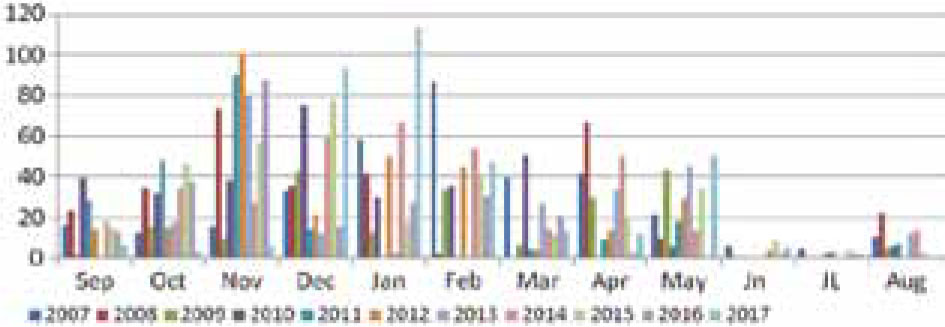
Figure 11.
The monthly average precipitations of Mascara (2007–2017)
The modification noticed on the cumulus of the rainfall height is accompanied with a modification of the length of the rainy season.
The monthly average rainfall of Mascara is less high and does not exceed 114 mm, but they vary a bit during the year. We notice that it is hot in Mascara. Figure 11 shows that the rainiest months are November, December, and January of each year; it is the period where the fires are almost absent.
The number of fires is superior to the average in 2013, 2014, and 2015, and the registered temperatures during June, July, and August are the highest with values that are 25.70°C, 28.80°C, and 27.80°C, respectively.
The least rainy months are those of the dry season (Fig. 8) which is the period where forest fires are abundant. According to Turco et al. (2023), forest fire regimes have been linked in some cases to climate change, such as warmer summer temperatures, below-average precipitation, and fewer rainy days during the fire season in the western United States.
The rainiest month of the period of study is November of 2013, but with a number of fires superior to the average. According to the Forests Conservation Department of Mascara, this increase was due to the carbonization activities that represent the only income of the Southern region of the Wilaya.
Figure 12 shows that the monthly average humidity (2007–2017) in Mascara varies between 35.5% (July) and 81.9% (January). The monthly average humidity is generally superior to 50% and relatively varies during the year. However, higher values are registered in November, December and January, which correspond to the humid period.
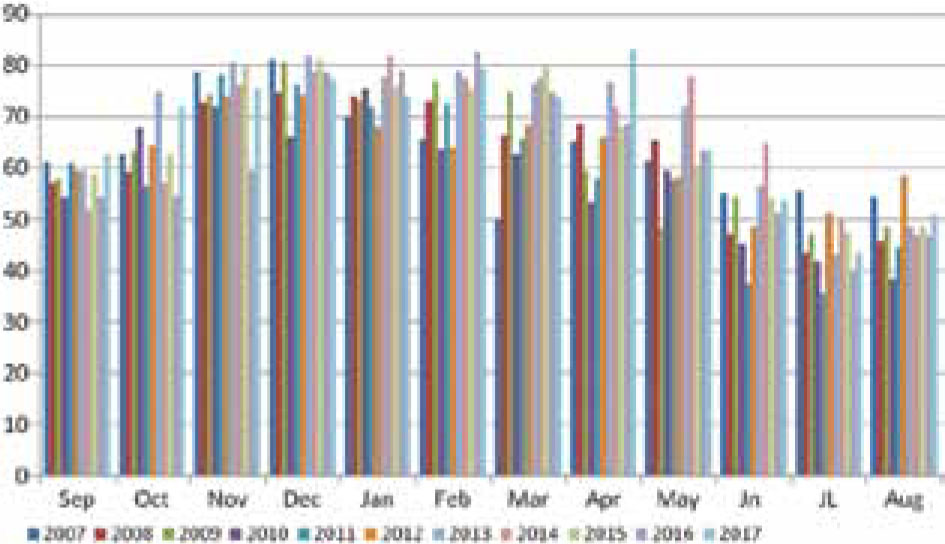
Figure 12.
The monthly average humidity in Mascara (2007–2017)
Despite the high values of humidity, the number of fires registered was superior to the average in 2013, 2014, and 2015. According to the Forest Conservation Department of Mascara, this increase is due to the carbonization activities that represent the only income of the Southern region of the Wilaya.
In 2014 and 2015, the biggest burned surface was in the forest of Guetarnia, Canton Boumidouna, and it was a voluntary fire by those who looked for honey.
Figure 13 shows stability in the wind speed during the dry season. In 2013, 2014, and 2015, when the number of the fires was superior to the average, the wind speed exceeded 3 m/s in June and 2.7 m/s in July and August. According to the Forest Conservation Department in Mascara, the burned surface during these years was the most important exceeding 1,000 acres in 2014 and 711 acres in 2015.
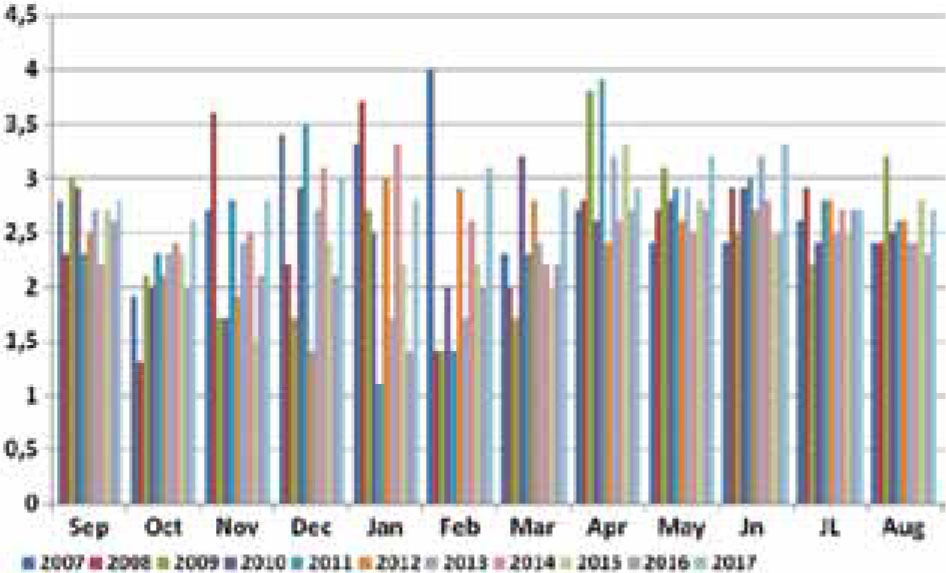
Figure 13.
The monthly average wind speed in Mascara (2007–20017)
The burned surface reflects the efficiency of the fight against the fire dangers. It depends on meteorological conditions with a higher surface when the air and vegetation are very dry and the wind is strong. This creates numerous strong fires that are difficult to fight (Benoit De Coignac 1996).
The wind accelerates the drying of the plants and the grounds. It brings the heat to the combustibles and increases the speed of the fire spread making it difficult to control.
The dominating winds are those of the West and North-West during the four seasons (Fig. 14). In summer, the air masses of the Sahara arrive through the Atlas Mountain range and spread toward the Tell. The circulation of the sirocco, a hot and dry wind, leads to the drainage of the vegetation and increases the combustibility and inflammability of the vegetation.
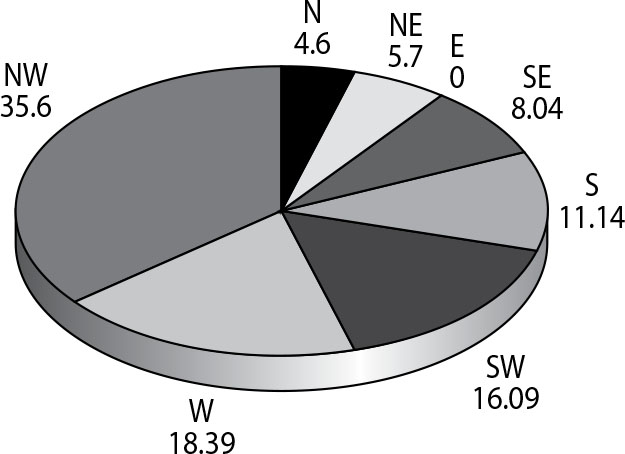
Figure 14.
The wind orientation in Mascara (2007–2017)
Equipment and forest infrastructure of Mascara
Table 2 indicates the existing infrastructure in linear kilometers of tracks and in surface of firebreak trenches throughout Mascara (Fig. 2).
Table 2.
Forest surface and infrastructure of Mascara (BNEDER 2008)
| No.of municipalities | Name of municipalities | Forest surface (acre) | Lookout points | Firebreak trenches | Pointsof water | Tracks(km) | Number of households from 2008 to 2017 | Burned surface (acres) 2008–2017 |
|---|---|---|---|---|---|---|---|---|
| 1 | 2 | 3 | 4 | 5 | 6 | 7 | 8 | 9 |
| 09 | Zelamta | 12,412.05 | 00 | 00 | 00 | 25 | 00 | 155.5 |
| 37 | Bou Henni | 7,511.77 | 00 | 00 | 00 | 15 | 00 | 00 |
| 11 | Ain Ferrah | 6,751.50 | 01 | 01 | 10 | 45 | 08 | 130.5 |
| 45 | Nesmoth | 6,495.36 | 00 | 00 | 00 | 25 | 04 | 265.5 |
| 43 | Chorfa | 5,357.77 | 00 | 00 | 00 | 20 | 08 | 65 |
| 07 | Hachem | 4,586.2 | 00 | 00 | 00 | 20 | 33 | 387 |
| 04 | Hacine | 3,472.37 | 1 | 18 | 4 | 30.70 | 00 | 00 |
| 38 | El Gueithna | 1,979.2 | 1 | 115 | 3 | 20.90 | 00 | 00 |
| 41 | Gharrous | 3,950 | 00 | 00 | 00 | 10 | 25 | 16 |
| 33 | Ferraguig | 1,822.89 | 3 | 51 | 00 | 36 | 00 | 00 |
| 19 | Beniane | 2,900 | 00 | 00 | 00 | 10 | 03 | 17 |
| 31 | Mohamadia | 705.4 | 1 | 00 | 1 | 19 | 05 | 10.25 |
| 26 | Sig | 1,700 | 1 | 70 | 2 | 39 | 10 | 120 |
| 39 | Mamounia | 630 | 1 | 00 | 00 | 12 | 00 | 00 |
| 21 | El Menaouer | 580 | 1 | 123 | 00 | 81.50 | 00 | 00 |
| 23 | Aouf | 1,550 | 00 | 50 | 3 | 93.50 | 12 | 26.6 |
| 27 | Oggaz | 6 506 | 00 | 00 | 00 | 60.70 | 01 | 01 |
| 03 | Tizi | 500 | 00 | 00 | 00 | 00 | 00 | 00 |
| 02 | Bouhanifia | 6,457 | 5 | 137 | 9 | 87.60 | 07 | 482 |
| 18 | Ain Fekan | 4,458 | 00 | 00 | 02 | 30 | 04 | 24.9 |
| 35 | Sedjerara | 420.42 | 00 | 00 | 00 | 00 | 00 | 00 |
| 12 | Ghriss | 450 | 00 | 00 | 00 | 00 | 00 | 00 |
| 22 | Oued Taria | 3,400 | 00 | 00 | 00 | 00 | 00 | 00 |
| 24 | Ain Fares | 400 | 2 | 3 | 00 | 1.20 | 00 | 00 |
| 34 | El Ghomri | 350 | 00 | 00 | 00 | 00 | 00 | 00 |
| 14 | Matemore | 350 | 00 | 00 | 00 | 00 | 00 | 00 |
| 30 | Zahana | 350 | 00 | 12 | 00 | 31 | 06 | 54.3 |
| 46 | S.A.Eldjebar | 334 | 00 | 00 | 00 | 00 | 00 | 00 |
| 16 | S.Boussaid | 1,251 | 00 | 00 | 1 | 2 | 00 | 00 |
| 40 | El Keurt | 250 | 00 | 00 | 00 | 00 | 00 | 00 |
| 10 | Oued El Abtal | 3,237 | 1 | 51 | 00 | 44.50 | 12 | 57 |
| 29 | El Gaada | 150 | 00 | 21 | 00 | 15 | 00 | 00 |
| 15 | Makdha | 150 | 3 | 13 | 2 | 13 | 00 | 00 |
| 28 | Alaimia | 106.5 | 00 | 00 | 00 | 00 | 00 | 00 |
| 13 | Froha | 46.57 | 00 | 00 | 00 | 00 | 00 | 00 |
| 47 | Sehailia | 100 | 00 | 00 | 00 | 00 | 00 | 00 |
| 42 | Guerdjoum | 60 | 00 | 00 | 00 | 00 | 00 | 00 |
| 01 | Mascara | 26.30 | 00 | 00 | 00 | 1.25 | 00 | 00 |
| 44 | R.A.Amirouche | 50 | 00 | 00 | 00 | 00 | 00 | 00 |
| 20 | Khalouia | 34.4 | 00 | 17 | 1 | 55.50 | 00 | 00 |
| 06 | Tighennif | 3.5 | 00 | 00 | 00 | 00 | 00 | 00 |
| Total | 133,121.33 | 21 | 682 | 38 | 844.35 | 138 | 1,145 | |
According to BNEDER (2008), the generally accepted norms for the intensive management of the forests require 2 km of tracks for 100 acres of forest and 2.5 acres of firebreak trenches for 100 acres of forest.
Table 2 shows clearly the relation between the networks of tracks and the burned surface. In the forests that have an important surface and a low number of tracks, the burned surface is big, and vice versa. In the municipality of Hachem which has a forest surface of 4,586.2 acres and a track volume of 20 km, the burned surface is 387 acres; in the municipality of Nesmoth which has a forest surface of 6,495.36 acres and a track volume of 25 km, the burned surface is 265.5; in the municipality of Ain Fekan which has a forest surface of 4,458 acres and a track volume of 30 km, the burned surface is 24.9 km; while in the municipality of Ferraguig with a 1,822.89 acres of forests and a track length of 36 km, there were no fires.
In Mascara, the forest tracks are 1,059.35 km long, i.e., a density of 1.4 km for each 100 acres of forest (Fig. 15). This is insufficient regarding the norm that recommends 2 km of track for each 100 acres of forest (BNEDER 2008). The total number of tracks to be considered in the development program for the Wilaya of Mascara, to meet the standard, would be 786 km. These needs are relatively high at the level of the forests of Zelmata municipality (143 km), Nesmoth municipality (89.5 km), and Cheurfa municipality (354 km). Furthermore, the existing tracks are not very efficient and do not meet the requirements (insufficient width and absent or insufficient lateral protection) and need maintenance. The existing tracks will be progressively adapted to the norms which may be the opportunity to get rid of the inefficient ones.
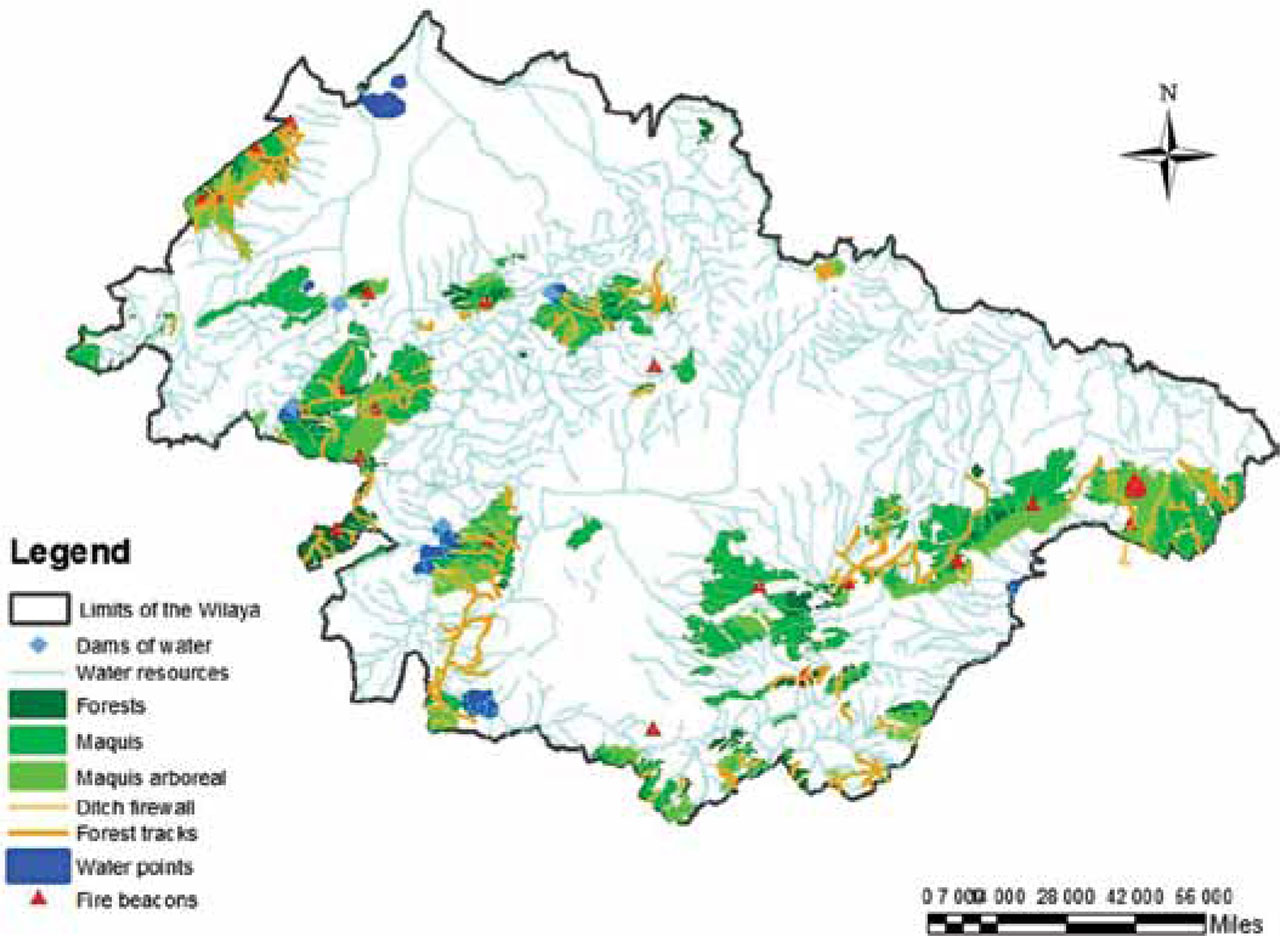
Figure 15.
Map of the forest infrastructure in Mascara
As for the firebreak trenches, the forests of the Wilaya have 936 acres of trenches. However, they need 1,035 acres. The needs are important for the forests of Zelmata (193.5 acres), Nesmoth (111.5 acres), Sdamas Guerbi (153 acres), and Cheurfa (529.5 acres).
The number of forest houses is superior to the norm that states1forest house for each 10,000 acres. Under the general rules, Mascara is allowed to have 8 houses instead of its usual 12, and the same applies to most of the forests, with the exception of Cheurfa, where the number of forest houses is low. The equipment with lookout points is sufficient as there are 28 points in total, while 11 points are required according to the norms.
Activities in the forests
Activities in the national forest are restricted for the people living inside or near those forests, and these activities usually include collecting products for the domestic needs and the enhancement of the life conditions.
The empty spaces inside the forest are meant to valorize the lands for the plantation of fruits (Tab. 3) for the inhabitants who will protect the forest against the fires by being the first to detect fires and fight against their spread.
Table 3.
Activities in the forest
| Wilaya | Municipality | Perimeter | Surface (acres) | Activity |
|---|---|---|---|---|
| Mascara | Zahana | Djeniene Meskine | 4 | Fruit arboriculture (plantation of olives and almonds) |
| Chorfa | Anantra | 2 | ||
| Haoudh Kouabi | 7 | |||
| Djelaba | 2 | |||
| Menaouer | Temaznia | 4 | ||
| Makhda | Djebel Timatmart | 4.57 | ||
| Djebel Bourdim | 6.25 | |||
| Aouf | Sidi Reffas | 4 | ||
| Djebel Zerakine | 3 | |||
| Nesmoth | Gorot El Bordji | 3 | ||
| Ain Sidi Dahou | 6 | |||
| Zelamta | Khanafou | 3 | ||
| Bled Hayoum | 11.5 | |||
| Guergour | 2.50 | |||
| TOTAL | 7 | 14 | 62.82 |
Table 4.
Classes of Fire Danger Index (FDI)
| FDI | Signification | Percentage (%) | Surface (acre) |
|---|---|---|---|
| FDI = 4. | Low danger | 0.16 | 144.35 |
| 4 < FDI ≤ 8 | Moderate danger | 8.26 | 7,452.41 |
| 12 < FDI ≤ 16 | High danger | 74,97 | 67,640.18 |
Map representing the classification of Mascara forests according to their vulnerability to forest fires.
Figure 10 shows the spatial variability of the fire dangers in the forests of Mascara. Findings show that the most endangered class, which is the most represented, covers more than 74% of the forests. Only 0.16% of the forests are at low danger class.
The study of the fire records of Mascara shows that the most damaged forest massifs are located in the South and East of the Wilaya, where the scrubland occupies the 1st place among forest formations (Meddour-Sahar et al. 2013).
Firefighters signaled a lack in their infrastructure especially in the regions at high risk and where the forest massifs are not accessible.
The forest zones belonging to two classes of “moderate” and “low danger” (Fig. 16) are the smallest forests with surfaces of 30 acres to 100 acres, and they are accessible and easy to manage concerning prevention and fight.
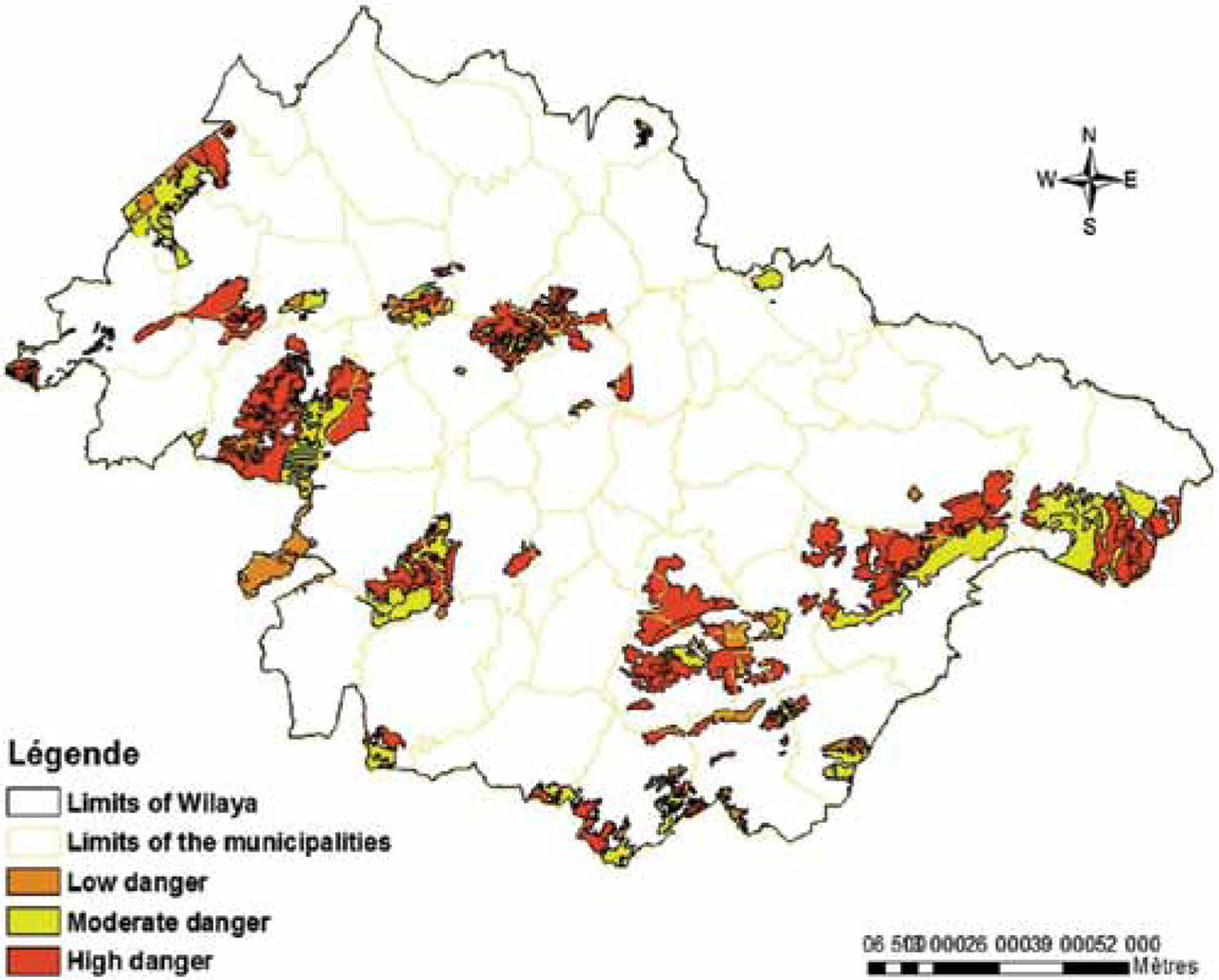
Figure 16.
Map representing the fire-endangered zones of Mascara
Conclusions
This study using the statistical analysis and the FDI show that the fire played a primordial role in the current state of the Algerian forest ecosystem.
The fire frequency is only increasing with time, with a high number of fires in the last 15 years showing the inefficiency of the fire-fighting systems in the forests of 40 Wilayas.
Acquiring the needed information on the cartography, meteorological conditions, and available prevention tools was necessary for statistical studies to allow more trustworthy previsions and enhancement management tools against fires.
Finally, the map of the zones under investigation shows clearly the high fire vulnerability of the forest massifs of Mascara.
Many measures need to be taken in the sake of prevention (raising awareness, information) and prediction (infrastructure of the fight and field equipment) and in the speed and efficiency of fire fights.
The policy of the Algerian government that dates back to 2007 with the proximity program of integrated rural development must take into consideration the socio-economic side through integrating the countryside’s in a well-designed participative approach.
The map of the forest infrastructure and the map of the fire-prone zones are important tools that should help managers set a good firefighting system protecting the natural resources of the country.