
The European beech (Fagus sylvatica L.) is an important tree species in European forests that offers numerous benefits (Durrant et al. 2016; von Wühlisch 2008). Its wood is valued for its strength, and its fine grain has great economic importance. Moreover, beech serves as an important carbon sink, contributes to the reduction of greenhouse gas emissions, and increases the productivity of forest ecosystems through nutrient cycling and soil fertility. As the dominant species in many forest ecosystems, beech forests play a crucial role in maintaining biodiversity by providing a habitat for diverse flora and fauna. In addition, these forests provide recreational opportunities and are of cultural and historical importance, often as protected landscapes. Ensuring the protection and sustainable management of beech forests is essential for the promotion of resilient forest ecosystems and the well-being of people and the environment (Frýdl et al. 2011; Mühlethaler et al. 2011; Skrzyszewski 2012).
Dealing with the effects of climate change on tree species, including European beech, remains a major challenge for forest science (Alia et al. 2021; Mátyás et al. 2010). Common garden tests provide valuable insights into their adaptability to different climatic conditions (Robson et al. 2018). The broad ecological amplitude of beech makes it a valuable reference species for large-scale studies on plastic and adaptive responses in fitness-related traits to climate change.
Numerous provenance trials for European beech have been carried out throughout Europe (Muhs and von Wuehlisch 1993; von Wuehlisch 2004). These trials usually involve progenies from different populations (provenances, i.e., natural beech stands) at different experimental sites, where researchers carefully observe their growth, survival, and adaptability over time. Such experiments are important to understand how the species adapts to different climates and soil conditions. The most extensive is the International Beech Provenance Trial 1993/95, which was established in 1995 (von Wuehlisch 2004). The aim of this experiment is to evaluate different geographical provenances of European beech in the gradient of climate conditions across Europe. The planning of the International Beech Provenance Trial 1993/95 was coordinated by researchers from the Institute for Forest Genetics and Forest Tree Breeding (Großhansdorf, Germany) in collaboration with the international trial site holders. All trials were conducted according to a standardized methodology. A total of 23 provenance trials were conducted in 18 countries (Tab. 1, Fig. 1). One such experiment, named Bu19_19 (Roztochja), was established in the western part of Ukraine, at coordinates 49°54′36″ N, 23°38′20″ E.
Table 1.
General description of the international beech provenance tests of the 1993/95 series (adapted from information provided by the Institute for Forest Genetics and Forest Tree Breeding, Großhansdorf, Germany). ID – trial designation according to Figure 1, VersNr – official designation of the provenance trial, Ort – official name of the provenance test trial, LAT – latitude (degrees and minutes), LON – longitude (degrees and minutes), ALT – altitude (meters above sea level).
| ID | VersNr | Ort | Country | LAT | LON | ALT |
|---|---|---|---|---|---|---|
| 01 | Bu19_01 | Schädtbek | Germany | 54° 18′ N | 10° 18′ E | 40 |
| 02 | Bu19_02 | Wesel | Germany | 51° 39′ N | 6° 23′ E | 40 |
| 03 | Bu19_03 | Malter | Germany | 50° 56′ N | 13° 40′ E | 360 |
| 04 | Bu19_04 | Navarra | Spain | 43° 0′ N | 1° 20′ W | 910 |
| 05 | Bu19_05 | Vrchdobroc | Slovakia | 48° 36′ N | 19° 38′ E | 840 |
| 06 | Bu19_06 | Bilogora | Croatia | 45° 55′ N | 16° 58′ E | 220 |
| 07 | Bu19_07 | Gablitz | Austria | 48° 15′ N | 16° 7′ E | 350 |
| 80 | Bu19_08 | Otterup | Denmark | 55° 31′ N | 10° 25′ E | 5 |
| 09 | Bu19_09 | FD de Lyons | France | 49° 29′ N | 1° 36′ E | 190 |
| 10 | Bu19_10 | Bologna | Italy | 44° 6′ N | 11° 6′ E | 930 |
| 11 | Bu19_11 | Rathdnum | Ireland | 52° 30′ N | 6° 10′ W | 106 |
| 12 | Bu19_12 | Chilterns FD | United Kingdom | 51° 37′ N | 0° 57′ E | 180 |
| 13 | Bu19_13 | Loehlitz | Germany | 49° 53′ N | 11° 24′ E | 430 |
| 14 | Bu19_14 | Benesov | Czech Republic | 49° 21′ N | 15° 1′ E | 630 |
| 15 | Bu19_15 | Oleszyce | Poland | 50° 10′ N | 22° 55′ E | 200 |
| 16 | Bu19_16 | Nedlitz | Germany | 51° 59′ N | 12° 19′ E | 120 |
| 17 | Bu19_17 | Brasov | Romania | 45° 33′ N | 25° 45′ E | 800 |
| 18 | Bu19_18 | Livadkite | Bulgaria | 42° 40′ N | 26° 50′ E | 1150 |
| 19 | Bu19_19 | Roztochja | Ukraine | 49° 55′ N | 23° 42′ E | 330 |
| 20 | Bu19_20 | Laski | Poland | 51° 11′ N | 18° 2′ E | 234 |
| 21 | Bu19_21 | Ranna | Sweden | 58° 27′ N | 13° 50′ E | 160 |
| 22 | Bu19_22 | Louschelt | Luxembourg | 49° 53′ N | 5° 47′ E | 425 |
| 23 | Bu19_23 | Baia Mare | Romania | 47° 35′ N | 24° 4′ E | 640 |
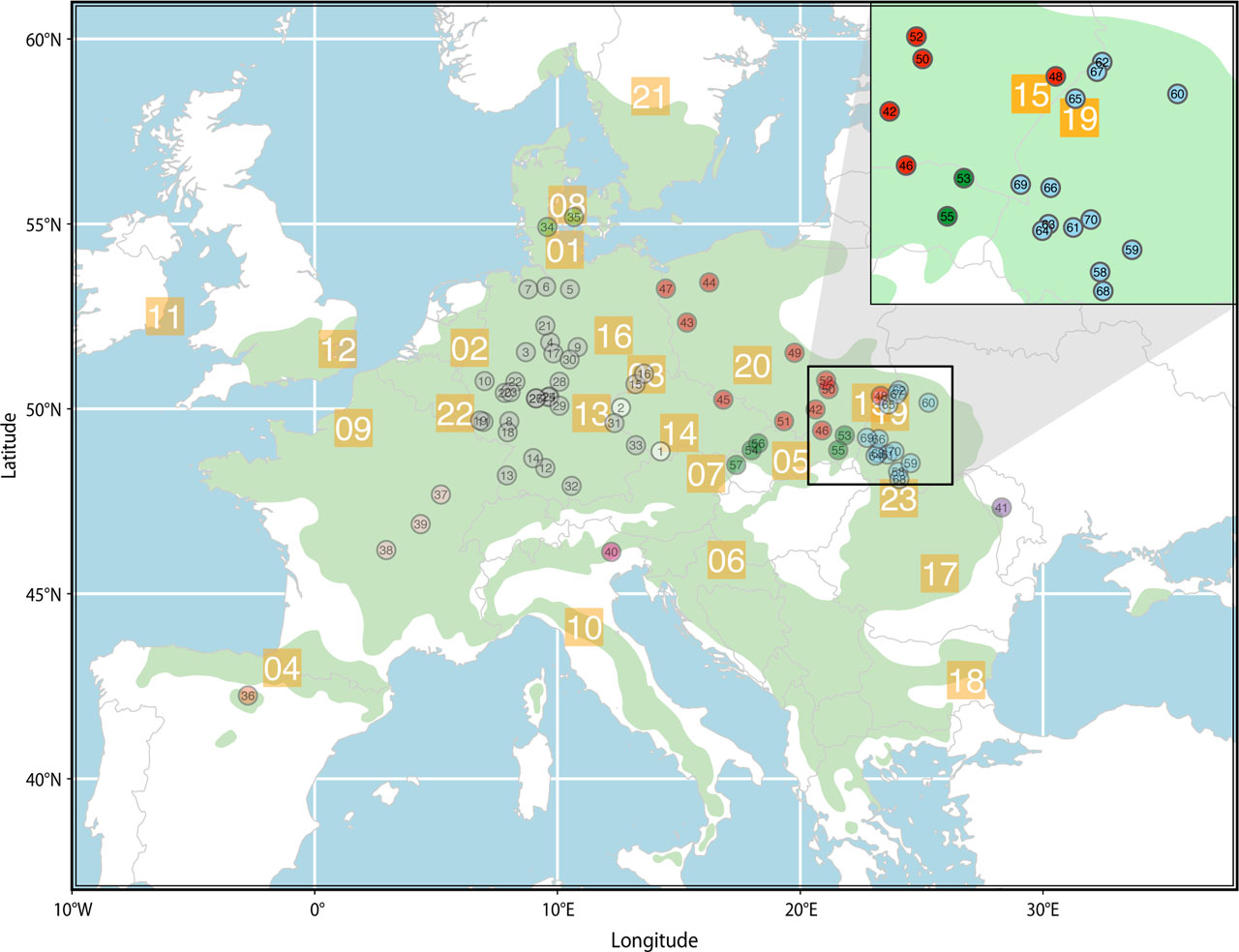
Figure 1.
Map of provenance trials (orange squares) from the 1993/95 series. The numbers in the orange squares correspond to the ID column in Table 1, indicating that the provenance trial Bu19_19 is marked as 19 on the map. Circles on the map represent the provenances used for the Bu19_19 provenance trial, with numbers in the circles corresponding to the ID column in Table 2. The transparent green area denotes the natural distribution area of Fagus sylvatica L. in Europe (source: https://www.euforgen.org)
Table 2.
General description of provenances used at Bu19_19 provenance trial (adapted from information provided by the Institute for Forest Genetics and Forest Tree Breeding, Großhansdorf, Germany). CO – Country of origin (CZ – Czech Republic, DE – Germany, DK – Denmark, ES – Spain, FR – France, IT – Italy, MD – Moldova, PL – Poland, UA – Ukraine), ID – provenance designation according to Figure 1, Ort – Provenance (ecotype), VersNr – provenance designation according to documentation, LAT – Latitude (degrees and minutes), LON – Longitude (degrees and minutes), ALT – Altitude (meters above sea level).
| CO | ID | Ort | VersNr | LAT | LON | ALT | CO | ID | Ort | VersNr | LAT | LON | ALT |
|---|---|---|---|---|---|---|---|---|---|---|---|---|---|
| 1 | 2 | 3 | 4 | 5 | 6 | 7 | 8 | 9 | 10 | 11 | 12 | 13 | 14 |
| CZ | 1 | Cesky serumlov | 9001 | 48°51′N | 14°15′E | 750 | ES | 36 | Anguiano | 8984 | 42°15′N | 2°45′W | 950 |
| 2 | Kladska | 9007 | 50°2′N | 12°37′E | 690 | FR | 37 | Val desmons | 9018 | 47°41′N | 5°12′E | 440 | |
| DE | 3 | Glashutte | 8771 | 51°32′N | 8°42′E | 440 | 38 | Colettes | 9020 | 46°11′N | 2°57′E | 575 | |
| 4 | Seelzerthurm | 8786 | 51°48′N | 9°42′E | 360 | 39 | Planoise | 9021 | 46°53′N | 4°22′E | 535 | ||
| 5 | Busschewald | 8938 | 53°14′N | 10°31′E | 75 | IT | 40 | Vallorch | 9049 | 46°8′N | 12°13′E | 1150 | |
| 6 | Harsefeld | 8939 | 53°18′N | 9°32′E | 43 | MD | 41 | Ungeny MLD | M1 | 47°20′N | 27°78′E | 36 | |
| 7 | Ostenholz-Scharmbeck | 8940 | 53°14′N | 8°48′E | 25 | PL | 42 | Brzesko, Tymowa | 161 | 49°59′N | 20°38′E | 350 | |
| 8 | Kirchheimbolanden | 8941 | 49°40′N | 8°1′E | 400 | 43 | Swiebodzin PL-1 | 9051 | 52°20′N | 15°20′E | 170 | ||
| 9 | Oderhaus | 8942 | 51°40′N | 10°50′E | 710 | 44 | Swierczyna PL-9 | 9052 | 53°25′N | 16°15′E | 180 | ||
| 10 | Morbach | 8951 | 50°45′N | 7°0′E | 660 | 45 | Ladek Zdroj PL3/PL2 | 9053 | 50°15′N | 16°50′E | 965 | ||
| 11 | Hermeskeil | 8952 | 49°39′N | 6°57′E | 650 | 46 | Krynica | 9054 | 49°25′N | 20°54′E | 850 | ||
| 12 | Ehingen | 8953 | 48°24′N | 9°30′E | 620 | 47 | Gryfino | P2 | 53°15′N | 14°28′E | 37 | ||
| 13 | Ettenheim | 8954 | 48°12′N | 7°55′E | 445 | 48 | Narol | P4 | 50°21′N | 23°19′E | 273 | ||
| 14 | Herrenberg | 8955 | 48°40′N | 9°0′E | 500 | 49 | Mlynary | P5 | 51°31′N | 19°46′E | 183 | ||
| 15 | Heinzebank | 8956 | 50°40′N | 13°13′E | 540 | 50 | Staszow | P6 | 50°32′N | 21°10′E | 176 | ||
| 16 | Tharandt | 8957 | 50°57′N | 13°34′E | 365 | 51 | Sucha | P7 | 49°40′N | 19°20′E | 400 | ||
| 17 | Bovenden | 8958 | 51°30′N | 9°50′E | 375 | 52 | Lagow | P8 | 50°46′N | 21°4′E | 295 | ||
| 18 | Elmstein-Sud, Appenthal | 8959 | 49°22′N | 7°57′E | 405 | SK | 53 | Medzilaborce-kos | 8943 | 49°17′N | 21°50′E | 426 | |
| 19 | Osburg | 8960 | 49°41′N | 6°49′E | 540 | 54 | Trenk In | 8945 | 48°53′N | 18°0′E | 144 | ||
| 20 | Montabaur | 8961 | 50°26′N | 7°50′E | 313 | 55 | Zamutov | 8946 | 48°53′N | 21°34′E | 259 | ||
| 21 | Deister | 8962 | 52°15′N | 9°30′E | 175 | 56 | Lednike Rovne | 8947 | 49°4′N | 18°16′E | 257 | ||
| 22 | Dillenburg | 8963 | 50°44′N | 8°16′E | 500 | 57 | Smolenice | 8948 | 48°29′N | 17°22′E | 192 | ||
| DE | 23 | Hadamar | 8964 | 50°27′N | 8°4′E | 218 | UA | 58 | Uholka | U1 | 48°18′N | 23°62′E | 353 |
| 24 | Schluchtern | 8966 | 50°20′N | 9°40′E | 490 | 59 | Ust-Chorna | U2 | 48°32′N | 23°93′E | 686 | ||
| 25 | Sinntal | 8968 | 50°19′N | 9°38′E | 430 | 60 | Brody | U3 | 50°10′N | 25°17′E | 253 | ||
| 26 | Budingen | 8970 | 50°17′N | 9°7′E | 198 | 61 | Svaliava – 1 | U4 | 48°46′N | 22°96′E | 678 | ||
| 27 | Budingen | 8971 | 50°17′N | 9°7′E | 225 | 62 | Roztochchia | U5 | 49°90′N | 23°64′E | 330 | ||
| 28 | Bad Salzungen | 8994 | 50°44′N | 10°5′E | 555 | 63 | Mukachevo | U6 | 48°48′N | 22°72′E | 356 | ||
| 29 | Eisenach | 8995 | 50°5′N | 10°5′E | 615 | 64 | Svaliava – 2 | U7 | 48°44′N | 23°6′E | 949 | ||
| 30 | Ebeleben | 8996 | 51°20′N | 10°30′E | 315 | 65 | Zavadiv | U8 | 50°7′N | 23°38′E | 245 | ||
| 31 | Vohenstrauss | 8997 | 49°37′N | 12°21′E | 660 | 66 | Volovets | U9 | 48°71′N | 23°14′E | 717 | ||
| 32 | Kaufbeuren | 8998 | 47°55′N | 10°35′E | 700 | 67 | Rava-Ruska | U10 | 50°24′N | 23°59′E | 260 | ||
| 33 | Zwiesel | 8999 | 49°1′N | 13°14′E | 755 | 68 | Kobyletska Poliana | U11 | 48°6′N | 24°5′E | 587 | ||
| DK | 34 | Grasten, Buskmose | 8974 | 54°55′N | 9°35′E | 50 | 69 | Perechyn | U12 | 48°73′N | 22°45′E | 235 | |
| 35 | Glorup | 8975 | 55°11′N | 10°41′E | 70 | 70 | Mizhhiria | U13 | 48°51′N | 23°53′E | 627 |
The provenance trial Bu19_19 comprised a total of 70 provenances from 10 European countries and is one of the largest trials of the 1993/95 series. While five larger trials with more than 100 provenances each were carried out in Germany (Bu19_01, Bu19_02, and Bu19_03), Spain (Bu19_04), and Slovakia (Bu19_05), a similar trial (Bu19_20) in Poland comprised 71 provenances. All other trials included 49 provenances or less (von Wühlisch 2004).
The provenances represented in the Bu19_19 trial cover a large part of the natural distribution area of beech, extending north-south from Italy to Denmark and east-west from Moldova to Spain (Fig. 1, Tab. 2). These provenances also have a wide range of altitudes, ranging from 25 m above sea level (Osterholz-Scharmbeck, Germany) to 1150 m above sea level (Vallorch, Italy). However, the areas outside Central Europe are rather underrepresented. Most provenances come from Germany (31), followed by Ukraine (13), Poland (11), and Slovakia (5). The remaining provenances come from France (3), Denmark (2), the Czech Republic (2), Italy (1), Spain (1), and Moldova (1).
The plants of this series were sown in the spring of 1993, undercut during the first growing season for easier lifting, and lifted in the autumn of 1994 at two years of age (Von Wuehlisch G. et al. 1998; von Wuehlisch 2004). The establishment of the Ukrainian part of the trial was coordinated by I. Shvadchak and H.T. Krynytskii from the Institute of Forestry and Wood Technology in Lviv (now UNFU – Ukrainian National Forestry University). The provenance trial was established on the territory of the Stradch Educational-Industrial Forestry Complex of UNFU, which is located in Roztochchia (sometimes transliterated as Roztochia or Roztocja), a region in western Ukraine known for its high biodiversity.
European beech is a species that requires medium-fertile soils (Sułkowska et al. 2011). The site for the provenance trial was selected on a plateau 330 m above sea level within the 4-square of the Velykopilske forestry. In the winter of 1994/95, a monospecific beech forest (Carpineto-Fageta) was cleared at this site. The topography of the site is heterogeneous, with a surface slope of about 4–6° (Delehan 2005). The soils were originally characterized as turf podzolic soils of medium thickness, although studies by Grechanyk et al. (2004) describe them as gray forest podzolic soils. The plant cover includes species such as Rubus caesius L., Rubus idaeus, Hypericum perforatum L., Pteridium aquilinum L. Kuhn, Chamaenerion angustifolium Scop, and Calamagrostis epigejos L. The natural regeneration of Betula pendula Roth, Carpinus betulus L., Salix caprea L., Populus tremula L., Acer pseudoplatanus L., and Frangula alnus Mill. was observed at this site (Delehan 2005).
The seedlings were planted in spring 1995 with a spacing of 2 × 1 m, resulting in a density of 5000 seedlings per hectare. The experimental design is a randomized complete block with three replicates, which was used for all trials in this series (Fig. 2). One replicate of each provenance consisted of 50 plants planted in five rows of 10 planting sites (10 × 10 m plot; Fig. 2). Dead seedlings were not replaced in subsequent years. According to von Wuehlisch (2004), the plots are large enough to maintain the trials for 60 years.
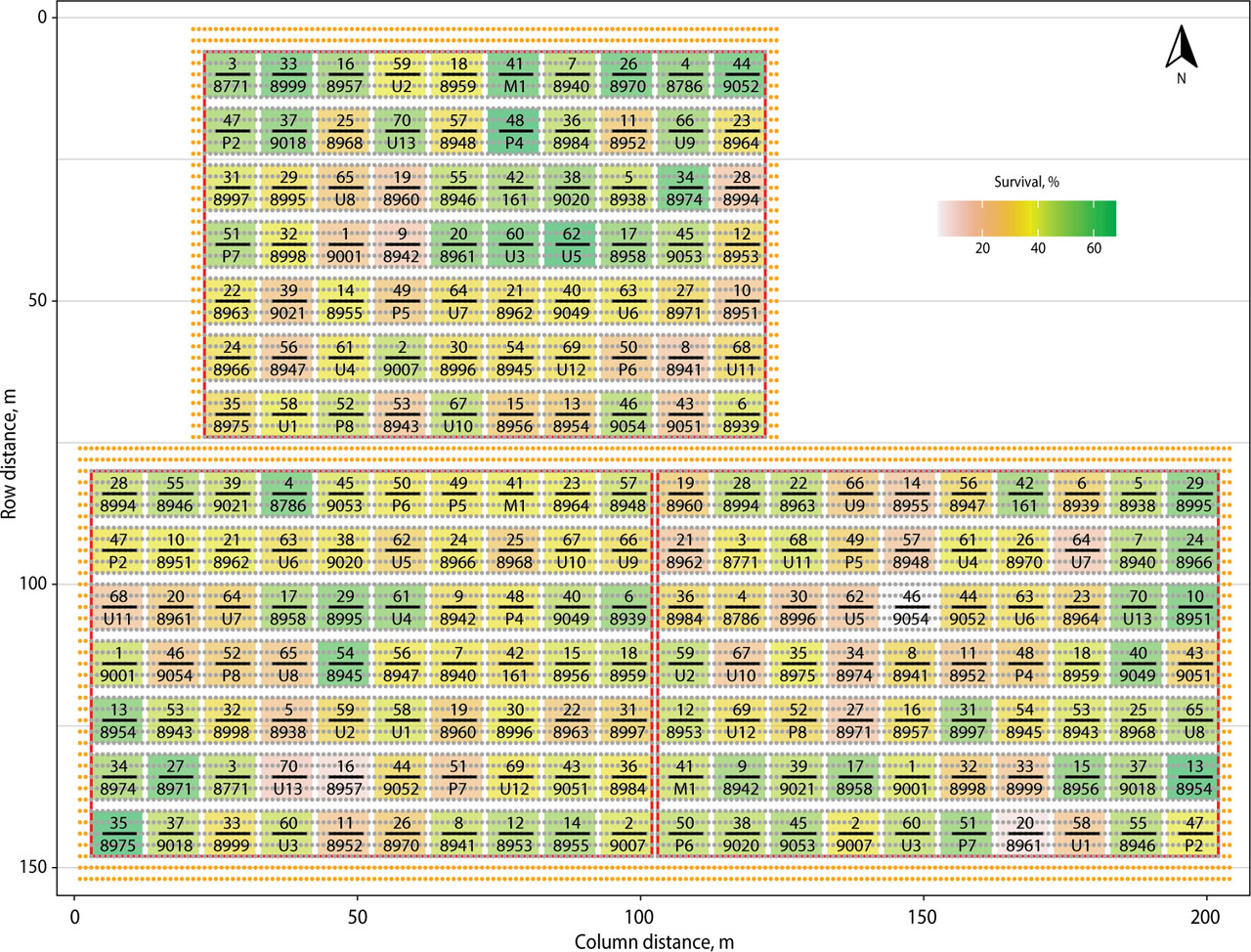
Figure 2.
Plan of the provenance trial Bu19_19 established in 1995 in Stradch Educational-Industrial Forestry Complex. Fill color, according to the scale, denotes the survival rate of provenances after 28 years of growth. The numerator and denominator of each plot denote the provenances according to the columns ID and VersNr in Table 2. The red line denotes the borders of complete randomized blocks, and gray dots denote planting sites (orange dots around blocks denote bordering rows). Block one is on top, blocks two and three are bottom left and right, respectively.
After the establishment of the experiment, the investigations of the provenance test Bu19_19 were carried out by I.I. Delehan (Delegan and Skobalo 2010; Delehan 2005), who concluded that most of the provenances showed good adaptability. The five-year phenological observations from 2006 to 2010 (Delegan and Skobalo 2010) show that the provenances from Gryfino (Poland), Kaufbeuren (Germany), and Planoise (France) are the earliest to initiate budburst. The Polish provenance from Gryfino is the first to complete leaf senescence, while the provenance from Swierczyna (Poland) is the last to complete this phase.
The trial Bu19_19 has not been thinned since it was established. From May 22 to May 30, 2023, we measured the DBH of all alive trees at each plot of this site (Ivaniuk and Zaitsev 2024; Zaitsev and Ivaniuk 2023). The effects of the microenvironment on the survival of the population in each block are clearly visible (Fig. 2). Thus, the number of alive trees per plot varies a lot (Fig. 3) due to both genetic and microenvironmental variability. Twenty-eight years after the trial was established, 3961 of the 10,500 trees planted are still present. The average survival rate is 38% or 57 trees per provenance (Fig. 4A). The number of surviving trees per provenance ranges from 37 (provenances 8952 and 9054 from Germany and Poland, respectively) to 76 (provenance 8958 from Germany). The average DBH of the trees at this site is 11.2 centimeters, while some provenances have trees with a DBH of more than 30 centimeters (Fig. 4B).
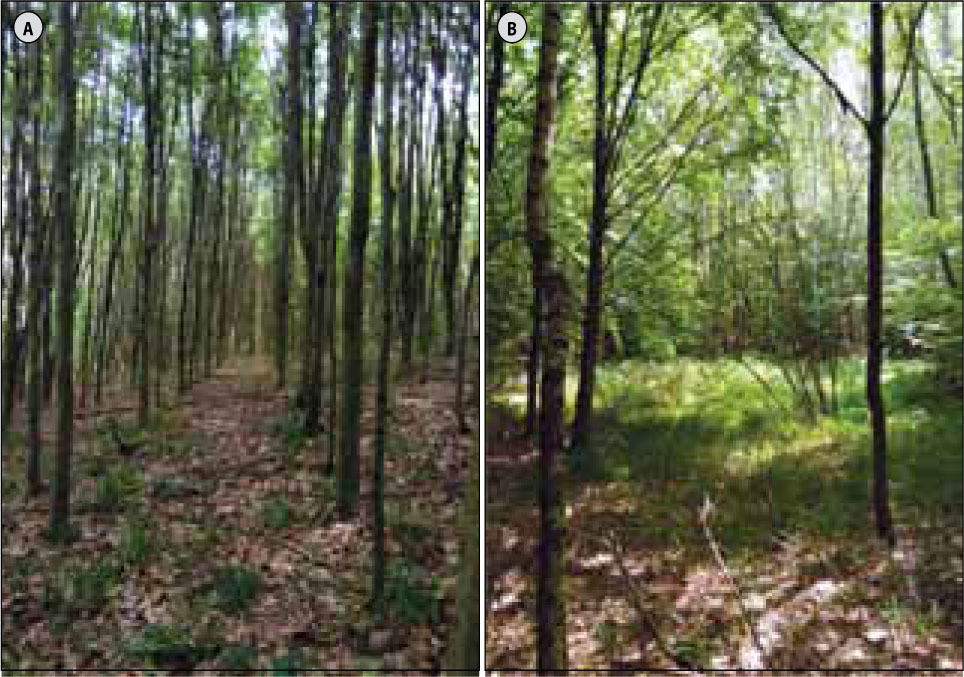
Figure 3.
Plots with high (A) and low (B) survival rate at the Bu19_19 provenance test trial in Ukrainian Roztochchia
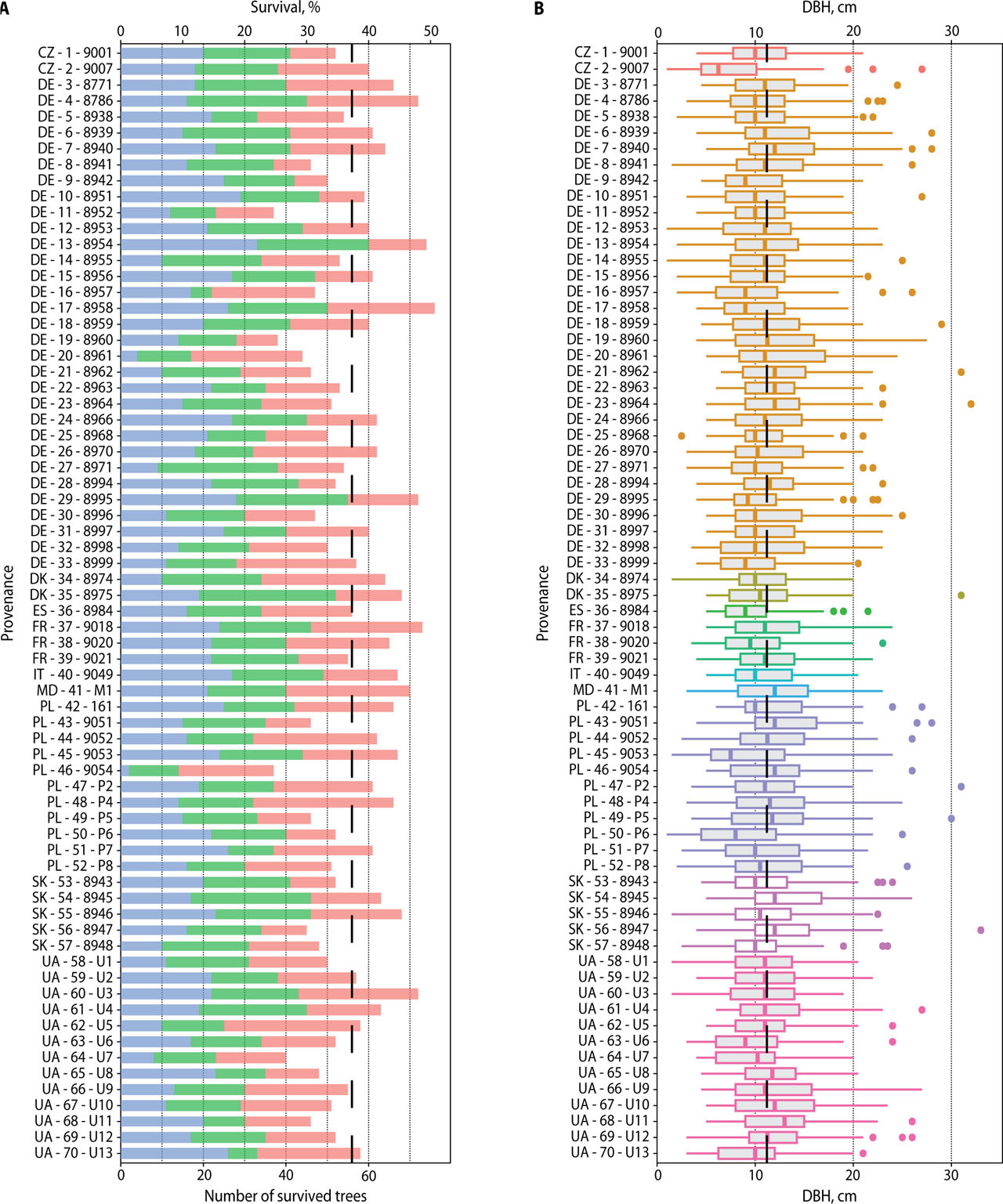
Figure 4.
Survival rate (A) and DBH (B) at the Bu19_19 provenance trial 28 years after planting. Provenances are labeled according to columns CO, ID, and VersNr in Table 2. Vertical dashed lines indicate grand mean values. In panel A, the colors red, green and blue represent blocks 1, 2 and 3 respectively.
In conclusion, after almost three decades, the Bu19_19 provenance trial in Roztochchia demonstrates significant variability in survival and growth among European beech provenances. With a survival rate of 38%, the trial remains a valuable resource for investigating the performance of European beech populations and can provide crucial insights into their resilience and adaptation.