
Introduction
Maintaining the ability to provide various ecosystem services (ESs) in forest areas under changing social, economic and climatic conditions is a key task for the institutions that manage forest areas. This is all the more true as society’s changing demand for forest ecosystem services brings with it the need to optimise their provision. The EU Forest Strategy (EP 2022) underlines this by “striking a balance between the different forest functions, meeting needs and providing important ES”. This document emphasises the need to support conservation and management measures that “maintain, enhance and restore the resilience and multifunctionality of forest ecosystems as an important part of the EU’s green infrastructure, providing key environmental services and raw materials” to urban and rural areas (Orsi et al. 2020).
Mapping and Assessment of Ecosystems and their Services (MAES) (Maes et al. 2020) based on the Common International Classification of Ecosystem Services (CICES) (Haines-Young and Potschin-Young 2017) indicates that forests have the potential to provide over 100 ES (Haines-Young and Potschin-Young 2013). These services can be categorised into three main groups: provisioning services, whose role is to provide timber and non-timber products (berries, mushrooms, medicinal plants, meat from wild animals) (Gamfeldt et al. 2013); regulating services, which influence climate at global and local scales (carbon storage and sequestration, regulation of local climate (temperature), absorption of pollutants, regulation of the water cycle, protection of biodiversity, etc.) (Scheidl et al. 2020; Piaggio and Siikamaeki 2021); cultural services, which are intangible benefits of forest areas, such as the possibility of rest and recreation, cultural, religious and spiritual values, inspiration and positive effects on health and well-being (Azzopardi et al. 2022).
The concept of ES also includes issues of assessing their potential (available volume of the service), the demand for them. The number and diversity of services means that not every forest area has the same potential to provide the selected service. This is due, among other things, to the geographical location and the characteristic features of the forest (e.g., age, species composition, forest habitat type) (Krajter Ostoić et al. 2020; Hochmalová et al. 2022). Due to the variability of the service potential as well as the reported demand for these services and their actual use, the basis for intentional forest management using the concept of ES is their identification and subsequent mapping.
ESs are usually interlinked, so that a change in the level of provision of one service can have an impact on others (Biber et al. 2015, 2020). Such interdependencies mean that rational, sustainable forest management should be based on recognising the relationships between ES. There are two main types of relationships that can occur between services: trade-offs (i.e., timber production and non-timber forest products (Gamfeldt et al. 2013)) and synergies (i.e., sometimes between timber harvesting and recreation (Gundersen and Frivold 2008)). Although there is no universally recognised definition, increasing the provision of one service while decreasing the provision of other services should be considered a trade-off between two services. Synergy, on the other hand, means that one service has a positive impact on the provision of another service or has no impact at all. The relationships between services may change over time and depend on the location of the area (Simons et al. 2021), the forest management method applied and the scope of the analyses (Blatertt et al. 2020; Teben’kova et al. 2020).
All this makes it very difficult to find an answer to the question of how forests can be managed in such a way that they are still able to provide the expected level of ES. The question of the extent to which the provision of ES depends on the type of forest management and the extent to which different ESs support each other and which require trade-offs is still open (Biber et al. 2015; Eyvindson et al. 2018). Regardless of the outcome of such considerations, it should be assumed that multifunctional forest areas offer many benefits for different stakeholders and therefore enable a higher level of human well-being. At the European level, Orsi et al. (2020) present a classification of forest areas in Europe according to the bundles of ES provided.
The aim of the systematic literature review is to determine the current state of knowledge on the relationships between different forest ESs in Europe and North America. The review focussed on a detailed analysis of the relationships between provisioning and regulating services, provisioning and cultural services, regulating and cultural services, and within specific service groups. The study aims to provide answers to the following questions:
– Which relationships between the analysed services were found most frequently?
– What factors influence the emergence and maintenance of relationships between ES?
– Are there trade-offs or synergies between the wood provisioning service and the other services analysed?
– Can the type of forest management influence the type of the relationship?
– Which relationships between the services should be the subject of future research?
Material and methods
A systematic review of the literature was conducted using the methodology proposed by Pullin and Stewart (2006) (Fig. 1). Articles were found in the largest database of scientific publications SCOPUS, using the following terms: “ecosystem services” AND “forest” AND “bundle”; “ecosystem services” AND “forest” AND “synergy”; “ecosystem services” AND “forest” AND “trade-off”. Terms were searched in the title, abstract, and keywords in articles published from 2005 to December 2023. The records returned in the queries (n = 825; after removing duplicates 609 left) were analysed to leave only those items that fit the purpose of research. Based on the content of the abstracts of the individual articles, they were included in detailed analyses when:
1) an article published in the English language,
2) the research was carried out in Europe or in North America,
3) the main focus of the study was on the relationship between ES in forest areas.
In the second stage, based on a detailed content analysis of 137 articles, only those articles that met the criteria of the first stage and were made available on an open-access basis were selected for review. From the pool of 137 articles, 80 were finally rejected due to thematic inconsistency and 2 articles due to lack of access. Based on the content of the 55 remaining articles, a database was created with the following information:
1) bibliography,
2) main information about the study area: location, spatial scale, time scale, description of the forest (species composition, age)
3) relationship between ES
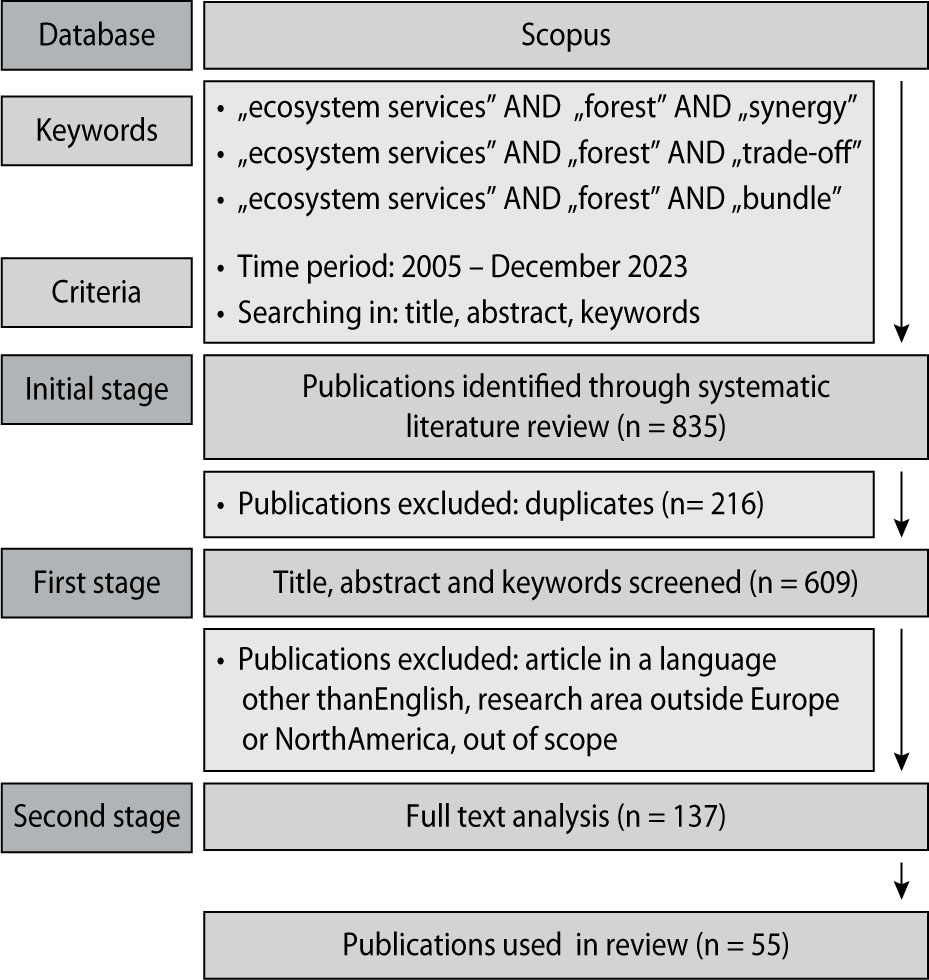
Figure 1.
Scheme for a systematic literature review
The diversity of terms related to ES led to the need to standardise the terminology and classify the indicators into three groups of ES: provisioning, regulating and cultural services. Figure 2 shows a summary of the indicators by group.
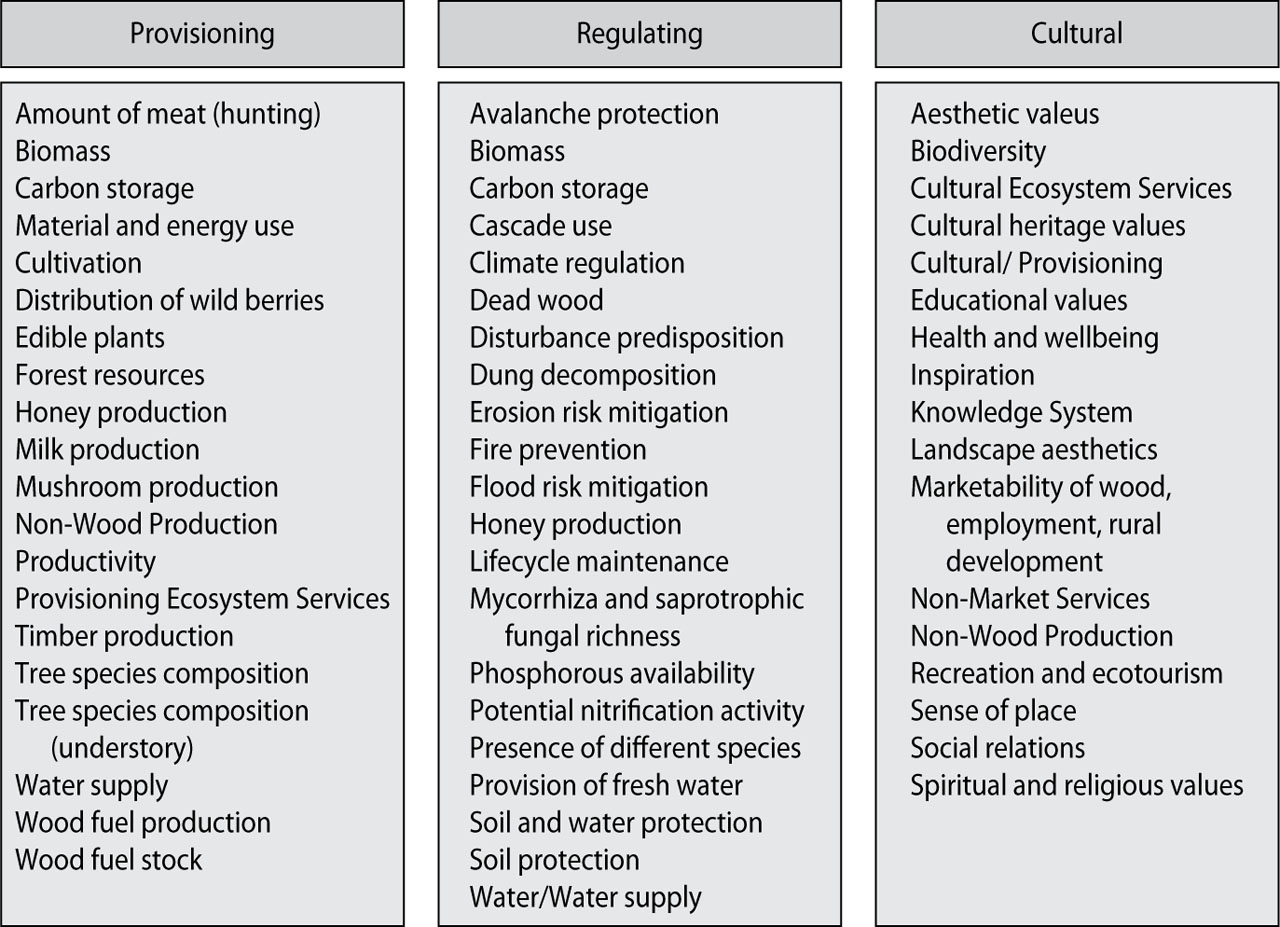
Figure 2.
Classification of the ecosystem services mentioned in the articles into the three groups of provisioning, regulating and cultural services
Results
Relationships between ES in forests – a general view
A detailed content analysis of 55 scientific articles revealed that in 39 publications, the authors examined the relationships between more than one pair of ES. Taking into account the subdivision into the area in which the pairs of services were examined (in some articles, there were several areas), they were the subject of the analyses in 290 cases. The most frequently addressed topic was the relationship between provisioning and regulating services (n = 72). Researchers were interested in the relationship between provisioning services related to timber harvesting, including energy wood, and regulating services such as biodiversity (n = 22), carbon storage/sequestration (n = 18) and water erosion (n = 6). Subsequently, the relationship between the services of the group of regulating services (n = 45) and provisioning services (n = 27) (mainly logging/energy wood and non-timber products) was examined. The topic of Cultural Ecosystem Services (CES) was discussed the least frequently (Tab. 1).
Table 1.
Summary of research between the groups of ecosystem services identified in the publications analysed
| Ecosystem services | Cultural | Provisioning | Regulating |
|---|---|---|---|
| Cultural | 1 | 2 | 13 |
| Provisioning | 12 | 27 | 72 |
| Regulating | 7 | 24 | 45 |
| Sum | 20 | 53 | 130 |
In the analysed papers, the researchers determined the type of relationship between the services. Table 2 shows the number of relationships identified and divided into service groups and the type of relationship: trade-off (including exclusion) and synergy. Due to the analysis of different areas and the use of simulations that consider many forest management methods, the number of trade-offs and synergies identified is greater than the number of relationships examined. Provisioning services are in most cases in trade-off with cultural (n = 11) and regulating (n = 106) services. They occur 53 times in synergy with these groups. Regulating services mainly occur in synergy with cultural services (n = 19).
Factors influencing the relationship between ES
In the literature analysed, relationships between groups of services or individual ES were mostly determined using models and simulations at different spatial (mostly landscape) and temporal scales (i.e., projection of changes even concerned the year 2100). The studies presented took into account climate change scenarios, the development of European Union directives in the area of forest management and the regulations of the countries in which the studies were carried out (principles or changes in forest management principles). Numerous simulations were carried out taking into account different forest management scenarios, particularly with regard to the intensity of timber harvesting. A synthesised picture of the results discussed is presented in Tables 1 and 2 showing the frequency of occurrence of the different relationships. The relationship between services can be influenced by the simulation timing (Holland et al. 2011), the spatial scale of the simulation (Obiang Ndong et al. 2020), the forest management strategy (Seidl et al. 2007; Eyvindson et al. 2018), the species composition (Schwaiger et al. 2019; Gamfeldt et al. 2013) and the distribution of age classes (Akujärvi et al. 2021) or, more generally, the stand structure (Roces-Díaz et al. 2018; Schwaiger et al. 2019). The simulations also take into account the effects of various climate change scenarios (Hengevleid et al. 2015). The relationships between the services also result from the history of the study area and its location, but they are less important for the differences in the level of potential ES provision than the species composition of the forest stands (Simons et al. 2021). Lee and Lautenbach (2016) showed that trade-offs between regulating and provisioning services prevail, while synergies were mainly observed between regulating and cultural services. Turner et al. (2014) confirm the trade-offs that exist between provisioning services (mainly timber) and other forest ES. Morán-Ordóñez et al. (2020) point out that trade-offs and synergies in ES depend on habitat productivity. At the same time, they emphasise that no forest management policy can maximise the provision of all services and that climate change affects the provision of services to a lesser extent than forest management. This is confirmed by Felipe-Lucia et al. (2018), who find that forest attributes are good predictors of forest supply as well as synergies and trade-offs between these services.
Time plays a dominant role in the growing number of trade-offs between ES (Roces-Díaz et al. 2018). The nature of the relationship between ecosystem services (trade-off, synergy, neutrality) can strongly depend on the time scale at which the interaction is analysed (Holland et al. 2011). Anderson et al. (2009), Holt et al. (2015) and Roces-Díaz et al. (2018) point out that the interactions between ES also depend on the scale of the analysis. It is possible that different relationships can be observed at the sub-area level and at the landscape level. According to Pohjanmies et al. (2017), the consequences of trade-offs between the selected provisioning and regulating services appear to be less severe for larger areas. The authors argue that trade-offs between services can be effectively mitigated at a scale of around 200 ha.
An important factor taken into account in research on the relationships between ES is the forest management strategy (Seidl et al. 2007). Several different strategies are listed in the work of Gutsch et al. (2018), Morán-Ordóñez et al. (2020), Blattert et al. (2020) and Simons et al. (2021). As the terminology varies in terms of describing the extent of timber harvesting, it is difficult to compare them in detail. Akujärvi et al. (2021) state that an important factor influencing the indicators of simulated ES is the distribution of stand age classes. This is confirmed by the results of studies in Sweden, which point to the importance of forest age for increasing the multifunctionality of ES in forests with low productivity (Jönsson and Snäll 2020). The state of the forest structure at the beginning of the simulation and the species composition have a significant influence on the long-term provision of ES (Schwaiger et al. 2019). Simons et al. (2021) found that environmental conditions such as geomorphology, climate and landscape history are less important for the differences in the level of potential ES provision than the species composition of forest stands.
The combination of tree stand characteristics with the level of services provided and the relationships between services means that climate change has a significant impact on the long-term view of forest ES. The ability of forests to continue to provide ecosystem services is also threatened by rapid changes in climate and disturbance conditions and impacts. Therefore, efforts to limit the effects of climate change on the forest ecosystem may affect the occurrence and durability of various ES relationships. According to Hengevleid et al. (2015), severe climate change may affect the relationships between services, especially at the landscape level. According to Biber et al. (2015), for simulations longer than 30 years, different climate scenarios should be included in the modelling. For simulations up to 30 years, the climate should not have a major influence on the simulations. Simons et al. (2021) state that no single forest type was able to provide all ESs studied at a high level and that the specific combination of services that can be provided depends on the forest type. In order to create multifunctional forest landscapes that provide ES where they are needed, taking into account both managers and users of ES, long-term and spatial planning of forest management on large areas is required. These changes represent a major challenge for forest managers.
The time factor is important for maximising the level of ES provision, especially when longer periods of time are involved (i.e., cutting ages over 100 years). This is particularly true for provisioning services (forest resources for industry) or regulation measures, including protection from natural hazards. It should be kept in mind that attempts to maximise the level of ES supply may increase its variability over time and thus jeopardise the continuity of ES supply (Albrich et al. 2018).
The research findings suggest that trade-offs allow many different ESs to be maintained, including in commercial stands, and to some extent, they allow timber production to be balanced with other ES. It will be helpful to identify relationships by establishing quantitative indicators that allow the extent of potential trade-offs between market services and other services to be assessed (Stokely et al. 2021).
Relationships between wood production and other ES
According to studies by Duncker et al. (2012) and Schwenk et al. (2012), there can be significant trade-offs between timber production and other ES. This type of relationship is confirmed by studies in southern Sweden in a spruce stand (Zanchi and Brady 2019). The content analysis of the publications revealed that the most frequently identified trade-offs are between timber production and non-timber forest products (Gamfeldt et al. 2013), biodiversity (e.g., Blattert et al. 2020; Sacchelli et al. 2013), carbon storage (Pohjanmies et al. al. 2017) and soil protection from erosion (Selkimäki et al. 2020) as well as recreation and relaxation (Triviño et al. 2017). Orsi et al. (2020) also identified various synergies between timber provision, erosion control, climate regulation and recreation.
Relationships between timber production and non-timber forest products
Knowledge about synergies and trade-offs between timber production and various non-timber forest products is limited (Kurttila et al. 2018) (Tab. 3). The relationships between services related to non-timber forest products and other types of ES, including primarily timber production, depend not only on the intensity of forest management but also on the characteristics of forest stands (Biber et al. 2015). Kurttila et al. (2018) emphasise that the correlations between timber harvest and yields of non-timber forest products are predominantly negative. This is confirmed by the trade-off between Vaccinium myrtillus L. production and total woody biomass production and by the synergy in the analysis of pine biomass production. There are also synergies between the production of deer and Vaccinium myrtillus L. and the abundance of understory plant species. Trade-offs concern the potential for wildlife production and the production of woody biomass and deadwood (Gamfeldt et al. 2013). Blueberry yields are highest in mature stands (Miina et al. 2009) and are also sensitive to clear-cutting and soil preparation (Hedwall et al. 2013). However, it should be emphasised that overly dense forests can reduce Vaccinium myrtillus L. production because they do not receive enough light and moisture (precipitation) (Gamfeldt et al. 2013). In this case, thinning can lead to an increase in Vaccinium myrtillus L. yields. There is a slight conflict between Vaccinium vitis-idaea L. production and timber production. According to Turtiainen et al. (2013), lingonberry is not as sensitive to forestry practice as Vaccinium myrtillus L. According to research by Kurttila et al. (2018), increasing timber harvesting led to a reduction in the possibility of pine resin extraction, although this resulted in synergies between mushroom yields and Vaccinium myrtillus L. shoot extraction efficiency, as well as an increase in Vaccinium myrtillus L. and Vaccinium vitis-idaea L. yields. The highest Vaccinium vitis-idaea L. yields are achieved in stands with intensive thinning to allow more light to reach the understory layer (Turtiainen et al. 2013).
Table 3.
Summary of the relationship between non-timber products and timber production in the publications analysed
| ES „A: | ES „B” | Study area | Age of stand | Species composition | Time scale | Spatial scale | Relationship between ecosystem services | Source | |
|---|---|---|---|---|---|---|---|---|---|
| trade off | synergy | ||||||||
| Timber production | Vaccinium vitis-idaea L. | Finland | different | Pinus L., Picea A. Dietr. | 2001–2012 | whole country | x | x | Turtiainen et al. 2013 |
| Biomass (Pinus L.) | Vaccinium myrtillus L. | Sweden | different | Picea A. Dietr., Pinus L., Betula L., Fagus sylvatica L. | 400,000 km2 | x | Gamfeldt et al. 2013 | ||
| Amount of game meat (humting) | Vaccinium myrtillus L. | x | |||||||
| Biomass | Vaccinium myrtillus L. | x | |||||||
| Potential amount of game meat | biomass | x | |||||||
| Timber production | beekeeping | Spain | n/d | mediterranean shrubs and trees species andalmonds | n/d | 1 km × 1 km | bundle | García-Nieto et al. 2013 | |
| Production of feed for wild ungulates | timber production | USA | Pinus L. | x | Stokely’ego et al. 2021 | ||||
| Biodiversity and non-wood production | timber production | Finland | n/d | different stands | n/d | 48,770 ha | Eyvindsona et al. 2018 | ||
| Timber production | Vaccinium myrtillus L. | x | |||||||
| Timber production | milk production | Germany/Netherlands | 241/219 km2 | x | Hölting et al. 2020 | ||||
| Timber production | Resin | x | |||||||
| Timber production | Vaccinium myrtillus L., Vaccinium vitis-idaea L. | x | Kurttila et al. 2018 | ||||||
| Thinning | lichens, Vaccinium myrtillus L. | Sweden | n/d | Pinus L. | n/d | 117 field plots | x | Strengbom 2017 | |
| Timber production | Vaccinium vitis-idaea L. | Finland | 18 forest stands (app. 3 ha each) | x | Granata et al. 2018 | ||||
| Timber production | Vaccinium myrtillus L. | x | |||||||
There is also a slight conflict between the yield of porcini mushrooms and the value of the harvested wood. Miina et al. (2013) point out that porcini yields were highest in 20- to 40-year-old spruce-dominated forests. Egli et al. (2010) showed that the production of mushroom fruiting bodies correlates positively with the growth stage of the trees (the host). Therefore, a properly conducted thinning that accelerates tree growth can influence the intensity of fungal occurrence. Peura et al. (2016) point out that high yields of forest by-products (Boletus edulis Bull., Vaccinium myrtillus L., Vaccinium vitis-idaea L.) in combination with high revenues from timber are possible when alternative management scenarios are applied at the landscape scale. The economic potential of by-products can account for up to 25% of the income from timber sales depending on the area analysed.
Relationships between timber production and biodiversity
A large number of works have noted a trade-off between timber production and biodiversity (Verkerk et al. 2014; Schwaiger et al. 2019; Sedmák et al. 2020) (Tab. 4). This also applies to the extraction of energy wood (resulted in carbon loss in litter and soil) (Akujärvi et al. 2021). There are also cases of synergies between the above services that may arise from the biodiversity indicators used for the analysis and the area where research was conducted (Biber et al. 2015, 2020). The aim of the work by Duncker et al. (2012) was to investigate synergies and trade-offs between different forest ESs depending on the type of forest management. The authors chose 5 variants of the analysis. The results suggest that it is necessary to exclude certain areas for conservation purposes if the goal is to create conditions for the survival of all species in a given landscape. In their opinion, larger and contiguous areas are generally better than small, isolated areas. The close-to-nature forestry scenario showed that it is possible to combine biodiversity conservation with a positive economic outcome. Similar conclusions were drawn for boreal (Hynynen et al. 2005) and temperate forests (Seidl et al. 2007). Duncker et al. (2012) point out that in scenarios based on high development intensity, there are trade-offs between maximising timber production and maintaining biodiversity at the stand level. This has been confirmed in the work of Boscolo and Vincent (2003), Gamborg and Larsen (2003), Hunter (1999) and Seymour and Hunter (1992, 1999).
Table 4.
Summary of the relationship between biodiversity and timber production in the publications analysed
| ES „A” | ES „B” | Study area | Age of stand | Species composition | Time scale | Spatial scale | Relationship between ecosystem services | Source | |
|---|---|---|---|---|---|---|---|---|---|
| trade off | synergy | ||||||||
| 1 | 2 | 3 | 4 | 5 | 6 | 7 | 8 | 9 | 10 |
| Timber production | biodiversity | Czech Republic (simulation) | 30 years | Quercus L., beech | 60 years | 332 ha | x | Sedmák et al. 2020 | |
| Europe (Spain, France, Belgium, Germany, Sweden, Finland) | different | different | n/d | NFI plots – extrapolating | x | van der Plas et al. 2017 | |||
| Central Europe | 0 | beech, Picea A. Dietr. | 120 years | stands | x | Duncker et al. 2012 | |||
| USA | different | Acer saccharum, Fagus grandifolia | 100 years | 533 randomly located site | x | x | Schwenk et al. 2012 | ||
| Tsuga canadensis, Betula alleghaniensis | |||||||||
| Norway | n/d | coniferous and boreal deciduous forest | n/d | landscape level | x | Schroter et al., 2014 | |||
| Austria | n/d | Picea abies, Pinus sylvestris | 100 | private forests, 248.7 ha | x | x | Seidl et al. 2007 | ||
| Europe | n/d | n/d | 2010–2030 | n/d | x | Verkerk et al. 2014 | |||
| Europe (20 case studies located in Bulgaria, France, Germany, Ireland, Italy, Lithuania, Netherlands, Portugal, Slovakia, Sweden) | n/d | depends on country | 30 years | 600–1,000,000 ha | x | x | Biber et al. 2015 | ||
| Lithuania, Ireland, Netherlands, Germany, Slovakia, Italy, Portugal | n/d | different stands | 2050 or 2100 | 15–3734 ha | Biber et al. 2020 | ||||
| Sweden, Portugal | n/d | x | Biber et al. 2020 | ||||||
| Turkey | n/d | x | Biber et al. 2020 | ||||||
| Timber production | biodiversity | Spain | n/d | Pinus nigra Arn. subsp. Salzman-nii, Pinus sylvestris L. | 2001–2100 | ca. 40000 ha | x | Morán-Ordóñez et al. 2020 | |
| Switzerland | n/d | Different stands | 2013–2106 | NFI plots | x | Blatertt et al. 2020 | |||
| Finland | n/d | Pinus L., Picea A. Dietr., Betula L. | 50 years | 68700 ha | x | Triviño et al. 2016 | |||
| Finland | n/d | different stands | n/d | 48,770 ha | x | Eyvindson et al. 2018 | |||
| Sweden | n/d | Pinus L. | n/d | 117 field plots | x | Strengbom 2017 | |||
| Switzerland | mature stand | Fagus sylvatica L., Picea A. Dietr. | 2016–2101 | Forest subcompartment | x | Mey et al. 2022 | |||
| Biodiversity | timber production (expected) | USA | Pinus L. | x | Stokely’ego et al. 2021 | ||||
| Fuelwood production | biodiversity | Sweden | n/d | Pinus sylvestris, Picea abies, Betula spp. | 2106 | NFI plots | x | Blatertt et al. 2020 | |
| Finland, Slovenia | n/d | n/d | n/d | Survey | x | Peters et al. 2015 | |||
| Germany, Norway, Spain | n/d | n/d | n/d | Survey | x | x | Peters et al. 2015 | ||
| Fuelwood production | dead wood | Sweden | different | Picea A. Dietr., Pinus L., Betula L., Fagus sylvatica L. | 400 000 km2 | x | Gamfeldt et al. 2013 | ||
In boreal forests, it was not possible to achieve a high level of biodiversity when the goal of forest management was to maximise revenue from timber harvesting. However, with a slight decrease in timber revenues, it was possible to significantly increase the multifunctionality of the landscape, especially biodiversity indicators (Triviño et al. 2017). Similarly, in Italy, the greatest conflict between timber production and biodiversity conservation was observed in the maximisation of profit from timber sales (Sacchelli 2018). Jopke et al. (2015) emphasised that synergies between timber supply and regulation services are more common in unmanaged forests than those in managed forests (in managed forests, timber supply is usually inversely related to other services). The trade-off or synergy between forest biodiversity and almost all other categories of ES, with the exception of non-timber market production, depends on the region and economic history (Biber et al. 2015). According to Seidl et al. (2007), it should be taken into account that changing management methods may improve some important biodiversity parameters, while others require additional measures to meet the requirements of sustainable forest management. Blattert et al. (2020) and Thom et al. (2017) point out that more conservative timber harvesting strategies in the context of biodiversity should, however, take into account the balance between the occurrence of stands in different age classes. According to the authors, a greater age diversity of tree stands has a positive effect on increasing biodiversity.
Bieber et al. (2015) found that the relationships between timber harvesting and biodiversity may depend on the area studied. They also confirmed that the higher the level of timber harvesting, the more pronounced the decline in biodiversity. This trend was observed in southern, western and eastern Europe. In central-western and north-western Europe, on the other hand, no changes in biodiversity were observed with the increasing level of logging.
The type of the relationship between timber harvesting and biodiversity can also be influenced by the size and homogeneity of the forest area. For bird species that occur in or use areas with early successional stages, timber harvesting can have positive effects. These species are provided with a new habitat. The fragmentation of forests can have a negative impact on species in late successional stages due to the increased risk of predation (Schwenk et al. 2012).
Biodiversity is influenced by wood harvesting for bioenergy production (Bouget et al. 2012; Huston and Marland 2003; Pedroli et al. 2013; Verkerk et al. 2011). Peters et al. (2015) conducted research in Finland, Germany, Norway, Slovenia and Spain on the perception of a wide range of stakeholders of energy wood production and its use. Qualitative analysis among stakeholders addressed current and future trade-offs and synergies between energy wood production and use and other ES. The trade-off between the production and use of energy wood and other forest ES is related to the protection of biodiversity in the perception of stakeholders. The main biodiversity concerns the use of logging waste for energy purposes and the preservation of dead wood. Increased forest exploitation for wood and fuel may translate into lower provision of other services or reduction of ecosystem functions (Kraxner et al. 2013; Sacchelli et al. 2013). For example, if wood is harvested in quantities corresponding to annual growth, increased use of biomass for energy purposes, including stumps and residues, may threaten biodiversity and the food cycle. On the other hand, the use of wood chips can reduce the consumption of fossil fuels in local power plants and thus improve the environmental indicators of energy production (Häyhä et al. 2011; Sacchelli et al. 2014). Analyses at the landscape level indicate that the collection of logging waste resulted in the loss of carbon in the litter and soil and limited the litter regeneration process, showing a negative impact on the amount of deadwood and, consequently, on the biodiversity of forests, especially those species whose biology depends on the presence of deadwood (Akujärvi et al. 2021).
Pohjanmies et al. (2017) observed that the greatest and most difficult conflicts to resolve occur between timber production and other management objectives. Forest management aimed at increasing timber harvest to the maximum economically sustainable utilisation size negatively affects the habitat suitability index, non-timber product yield, biodiversity and carbon storage. This can result in landscapes losing variability in their ability to protect and provide ES. The combination of different forest management systems should mitigate the negative impacts of increasing timber harvesting on biodiversity and non-timber ES (Eyvindson et al. 2018; Granath et al. 2018).
Precise planning of forest management at the landscape level is crucial to minimise the ecological costs of increasing timber harvesting (Eyvindson et al. 2018). Differentiated forest management planning at the landscape level can reduce trade-offs (Triviño et al. 2017). It is also necessary to identify the exact mechanisms that can lead to a reduction in ES in order to refine forest management systems in such a way that a balance between different services is possible (Bennett et al. 2009). In terms of biodiversity conservation, one option could be to designate strict nature reserves. To achieve this without reducing timber harvesting, a compensatory increase in harvesting elsewhere is required. Where such intensification of forest management is possible, lost timber can be replaced by timber from a small area designated for intensive production (Seymour and Hunter 1992). This view makes it clear that there is no single best solution to combine all services. Schröter et al. (2014) point out the financial aspect of designing areas to protect biodiversity. The authors emphasise the need to create legal and financial instruments that compensate owners of private forests for losses caused by the conversion of forest areas into protected areas. The solution to cover losses is the establishment of so-called ecological fiscal transfers and adequate promotion of tourism and recreation in protected areas (Ring et al. 2011). As generalised in MEA (2005), intensive management aimed at maximising a single provisioning service alters the ecosystem and causes losses in other ES.
Relationships between timber production and carbon storage
A strong intensification of forest management can reduce an important service for society, namely the storage of carbon dioxide (Tab. 5). Sacchelli (2018) observed that the value of sequestered carbon decreases significantly with an increase in timber production (reduction of 33%). This thesis was not confirmed by the results of Schwaiger et al. (2019), who pointed to the synergy between productivity and carbon sequestration. The results of Duncker et al. (2012) indicate that preparing the soil for new plantings has a significant impact on the increase in the amount of carbon dioxide released into the atmosphere. Pohjanmies et al. (2017) found that the extent of the trade-off between timber harvesting and carbon storage is highly dependent on the scale of analyses. The negative relationships between these services can be effectively mitigated on larger areas.
Table 5.
Summary of the relationship between carbon storage and timber production in the publications analysed
| ES „A” | ES „B” | Study area | Age of stand | Species composition | Time scale | Spatial scale | Relationship between ecosystem services | Source | |
|---|---|---|---|---|---|---|---|---|---|
| trade off | synergy | ||||||||
| 1 | 2 | 3 | 4 | 5 | 6 | 7 | 8 | 9 | 10 |
| Carbon storage | fuelwood production | Finland | n/d | Picea A. Dietr. | 2012–2100 | 1425 km2 | x | Akujärvi et al. 2021. | |
| Finland, Germany, Norway, Slovenia, Spain | n/d | n/d | n/d | survey | x | x | Peters et al. 2015 | ||
| Carbon storage | timber production | Sweden | 70 | Picea A. Dietr. | 2100 | virtual forest stand | x | Zanchi, Brady 2019 | |
| Sweden | n/d | Pinus sylvestris, Picea abies, Betula spp. | 2106 | NFI plots | x | Blatertt et al. 2020 | |||
| Germany | n/d | Picea A. Dietr., Pine, Beech, Quercus L., Betula L., Pseudotsuga menziesii (Mirb.) Franco | 14 simulations of future climate (2011–2045) plus five simulations of historical climate (1971–2005) | 10.37 million hectares | x | Gutsch et al. 2018 | |||
| Central Europe | n/d | Fagus sylvatica L., Picea A. Dietr. | 120 years | Stands | x | Duncker et al. 2012 | |||
| USA | different | Acer saccharum, Fagus grandifolia, Tsuga canadensis, Betula alleghaniensis | 100 years | 533 randomly located site | x | Schwenk et al. 2012 | |||
| Austria | n/d | Picea abies, Pinus sylvestris | 100 | Private forests, 248.7 ha | x | Seidl et al. 2007 | |||
| Europe (exc. North Europe) | n/d | n/d | 2010–2030 | n/d | x | Verkerk et al. 2014 | |||
| Germany | n/d | Pinus L., Picea A. Dietr. | 100 years | 2 study areas: 78,000ha, 53,000 ha | x | Schwaiger et al.. 2019. | |||
| Lithuania, Ireland, Netherlands, Germany, Slovakia, Italy, Portugal, Sweden, Portugal, Turkey | n/d | different stands | 2050 or 2100 | 15–3734 ha | x | Biber et al. 2020 | |||
| Spain | n/d | Pinus L. | 2016–2100 climate model | 40,000 | x | Morán-OrdóĖez et al. 2020 | |||
| Carbon storage | timber production | Sweden | n/d | Pinus sylvestris, Picea abies, Betula spp. | n/d | NFI plots | x | Blatertt et al. 2020 | |
| Finland | n/d | different stands | n/d | 48770 ha | x | Eyvindson et al. 2018 | |||
| Switzerland | Pole or Mature stands | Fagus sylvatica L., Picea A. Dietr. | 2016–2101 | forest subcompartment | x | Mey et al. 2022 | |||
| Italy | 50 | conifer stand | 210 years | subcompartment | x | Sacchelli 2018 | |||
| Fuelwood production | carbon sequestration in soil | Sweden | different | Picea A. Dietr., Pinus L., Betula L., Fagus sylvatica L. | 400 000 km2 | x | Gamfeldt et al. 2013 | ||
| Carbon storage | timber production | USA | Pinus L. | x | Stokely’ego et al. 2021 | ||||
Triviño et al. (2015) investigated the relationship between revenues from timber sales and the storage/sequestration of carbon dioxide in alternative forest management methods. The simulation carried out over a 50-year period made it possible to identify conflicts between these ES. Proper forest management can lead to a win-win situation for these ES. At a relatively low economic cost (5% decrease in revenue from timber harvesting), a significant increase in services associated with charcoal can be observed (9% increase in storage and 15–23% increase in uptake). Akujärvi et al. (2021) simulated changes in the resources of accumulated carbon in the tree population and in the soil taking into account timber harvesting. The authors pointed out that cyclic timber harvesting, which affects the distribution of stand age classes, is a key factor determining changes in the amount of accumulated carbon at the landscape level. However, the removal of post-harvesting residues, such as stumps, has a negative impact on the carbon content in the litter and soil.
Gutsch et al. (2018) have shown the trade-off between the accumulated amount of carbon and timber harvesting in two different management models, taking into account three climate scenarios. However, Schwaiger et al. (2019) emphasised that when modelling the effects of management methods on carbon sequestration, all carbon fluxes and resources in the study area must be considered. Seidl et al. (2017) investigated the extent of carbon sequestration (wood products and bioenergy production) under different alternative management strategies of spruce forests using the example of a private forestry operation in Austria. The authors considered three forest management scenarios. The fourth variant of so-called unmanagement was the control variant. The results showed that in situ carbon storage is sensitive to forest management, with the largest amount of stored carbon occurring in the unmanaged variant, followed by the variant with continuous use. All three management strategies allow the storage of significant amounts of carbon in the pool of wood products.
When considering alternative uses of biomass that focus on energy production, significant carbon offsets could be achieved through the potential substitution of fossil fuels. Estimates of the opportunity cost of carbon sequestration indicate that this can be a cost-effective way to reduce atmospheric CO2 through forest management, but achievable quantities are limited by biological conditions and social constraints. In Zanchi, Brady (2019), Peura et al. (2018) and Schwenk et al. (2012), it was also shown that avoiding clear-cutting and applying the Continuous Cover Forestry (CCF) management model allow for an increase in the amount of carbon in the forest stand. One of the forest management scenarios at European Union level assumes that climate change can be mitigated by storing carbon dioxide in forests. This model promotes the implementation of initiatives related to so-called carbon farming. According to Morán-Ordóñez et al. (2020), it is not possible to implement this model in the short term without significant changes in the valuation of services and products other than wood.
Relationships between timber production and erosion control
Most studies point to a conflict of objectives between timber harvesting and erosion control (Duncker et al. 2012). However, as the studies by Selkimäki et al. (2020) and García-Nieto et al. (2013) show, the slope of terrain as well as the type of soil influence the occurrence of the trade-off and its magnitude. Selkimäki et al. (2020) pointed out that the strength of the trade-offs between timber production and erosion control depends also on length of the cutting cycle. At a slope of 10% (50-year cycle), the trade-offs were small, and at a slope of 80% (10-year cycle), they were large. These results indicate that trade-offs occur especially in mountainous areas where forest cover prevents erosion and landslides. The authors also pointed out the trade-offs between timber production and erosion control. Garcia-Nieto et al. (2013) found spatial discrepancies in erosion control between the supply of this service at the local level and the demand at the regional and national levels, suggesting that this service should be managed in the public interest at the regional and national levels, and therefore, the decision-making process should involve different spatial scales. The results of this work are consistent with similar studies in Spain (García-Llorente et al. 2011; Martín-López et al. 2012). These studies show the impact of scale on the occurrence of tradeoffs and the need for multi-spatial level analysis. The work of Gundersen et al. (2010) in buffer riparian forests, mainly involving clear-cutting in upland forest areas, showed a trade-off in terms of immediate economic loss for the forest owner if the buffer was left without logging. However, careful planning of economic measures and adherence to recommendations to reduce the risk of erosion when implementing these measures can further reduce the impact of upland forest management and improve the effectiveness of buffer zones.
Relationships between cultural ecosystem services and other ecosystem services
The relationship between timber harvesting and recreation in forest areas can be described as a conflict in most cases (Lee and Lautenbach 2016; Triviño et al. 2017). The occurrence of conflicts and their intensity are influenced by the extent of timber harvesting and the type of forest management. In a study on forest functions, Tahvanainen et al. (2001) determined the influence of the extent of forest treatment on the attractiveness of tree stands. According to the authors, clear-cutting on small areas and pre-commercial cutting have no influence on the recreational value. However, large-scale clear-cutting and the removal of undergrowth have a negative effect, although the undergrowth must not be too dense according to the respondents. At the same time, some studies point to the possibility of synergies between timber harvesting and recreation. This means that there are cases where people prefer to spend their leisure time in managed forests rather than in natural forests (Gundersen and Frivold 2008). The improvement of visual attractiveness (synergy) between timber harvesting and the recreational offer of mountain forests in Switzerland emerges from the analyses of Thrippleton et al. (2023). The main factors for increasing visual attractiveness are the optimisation of tree density and the increase in tree species diversity. Cultural ES depends, among other things, on the biodiversity of fungi, plants and microorganisms associated with the soil (synergy). The impact of soil microbial biodiversity on recreation and tourism can be direct or indirect. Indirectly, it affects vegetation, which can also be used as a tool to monitor the condition of habitats, especially in areas intensively used for recreation (Blasi et al. 2013) (Tab. 6). A direct benefit arises from mycorrhizal relationships with the roots of tree species, which enable the collection of fungi – a popular activity in many countries. The biological richness of the soil provides the opportunity to obtain bait for fishing (Ulicsni et al. 2016). They are also important as food for selected wildlife species (Decaëns et al. 2006), which increases the attractiveness of forests from the point of view of nature observation and nature photography (MacMillan and Phillip 2008). Niemi et al. (2014) showed a case in which forest soil and the fungi it contains helped to transform degraded areas into urban green spaces more quickly. There is a link between the occurrence of fungi and various plants and cultural ES mainly because they are mainly used by the local community and less by tourists (Motiejūnaitė et al. 2019).
Table 6.
Summary of the relationship between regulating and cultural ecosystem services in the publications analysed
| ES „A” | ES „B” | Study area | Age of stand | Species composition | Time scale | Spatial scale | Relationship between ecosystem services | Source | |
|---|---|---|---|---|---|---|---|---|---|
| trade off | synergy | ||||||||
| Spiritual and religious values | biodiversity | Europe | n/d | n/d | n/d | n/d | x | Motiejūnaitė et al. 2019 | |
| Socioeconomic functions | biodiversity | Europe (20 case studies located in Bulgaria, France, Germany, Ireland, Italy, Lithuania, the Netherlands, Portugal, Slovakiaand Sweden) | n/d | depends on country | 30 years | 600–1,000,000 ha | weak (region-specific) | weak (region-specific) | Biber et al. 2015 |
| Culturally interesting plants | temperature regulation, carbon storage, nitrification potential | Germany | 53 forest type | dominating forest types in Central Europe | n/d | 150 forest plots of 100 m × 100 m / NFI to predict | x | Simons et al. 2021 | |
| Recreation | carbon sequestration | Italy (mountain forests) | n/d | Picea abies, Larix decidua Mill, Pinus sylvestris L., Fagus sylvatica L. | n/d | n/d | x | Häyhä et al. 2015 | |
| Biodiversity | recreation | Europe (exc. North Europe) | n/d | n/d | 2010–2030 | n/d | x | Verkerk et al. 2014 | |
| Regulating ES | recreation | Europe (exc. North Europe) | n/d | n/d | 2010–2030 | n/d | x | Verkerk et al. 2014 | |
| Recreation/aestheti values | carbon storage/biodiversity | Denmark | n/d | n/d | n/d | n/d | x | Sántha, Bentsen, 2020 | |
The rootedness of these traditions in culture is reflected in the linguistic richness of the names, idioms and linguistic forms of mushrooms and plants. The linguistic diversity associated with mushrooms was mainly described in sources from Eastern and Southern Europe, which can be attributed to the traditions of mushroom picking and the knowledge of the species and different varieties (Casebeer 2002). Cultural identity (sense of relationship to place) is usually associated with landscapes in the literature on CES (e.g., Dominati 2013), but in the case of mushrooms, the benefits of mushroom picking shape cultural heritage, identity and social life. The influence of soil flora and fauna on the spiritual and religious aspects of human life dates back to the ancient world tree (Motiejūnaitė et al. 2019). Roots (especially trees), mammals and earthworms are attributed to the chthonic world, which is reflected in various manifestations of spirituality (e.g., superstition) (Referowska-Chodak 2015).
Sántha and Bentsen (2020) investigated the relationships between services depending on the tree species used for bioenergy production. They demonstrated synergies between recreation and landscape attractiveness as well as carbon storage and biodiversity. The study also showed that species such as Miscanthus x giganteus and Salix Tordis do not provide benefits for cultural ecosystem services. Of the species studied, Quercus robur had the highest cultural ES values. Fagus sylvatica and Populus “OP42” also provided the highest value for aesthetic services. In a study conducted in Italian mountain areas, Häyhä et al. (2015) pointed out that the lower the annual amount of CO2 absorption, the greater the rec-reational potential (landscape value). This result is to be expected, as carbon sequestration is lower in older stands, which are preferred for recreational purposes, than that in stands of earlier age classes. These stands are carbon reservoirs, not carbon sinks. Using data from a large-scale forest inventory, Simons et al. (2021) showed synergistic effects between services related to the occurrence of culturally interesting plants and regulating services such as temperature regulation, carbon storage in trees and nitrification potential. In a Europe-wide study, Biber et al. (2015) indicated a weak synergy between biodiversity and socioeconomic function.
However, research on forest functions has shown that the presence of lying and standing deadwood in the ecosystem generally has a negative impact on the attractiveness of the tree population (Nielsen et al. 2012). However, as noted by Tyrväinen et al. (2001), the presence of deadwood was found to be accepted or did not reduce the recreational value if the interviewees had a higher level of ecological literacy or were made aware of the role of deadwood in the ecosystem by the interviewers. Deadwood in the ecosystem can also be accepted if it is identified with a more natural stand (Nielsen et al. 2007).
In Hölting et al. (2020) analyses of suburban areas with a significant proportion of forest, most trade-offs were found between utilities and other ES categories, while there were fewer trade-offs between regulatory services and cultural ES. However, in the experience of Sántha and Bentsen (2020) in different forest production systems and for different species, the most synergies were found between regulating, cultural services, and support, cultural services indicators – 67 and 33% of the relationships were labelled as strong, respectively. The research study shows that a diversity of ES needs to be maintained in order to preserve the values that cultural landscapes provide for a wide range of people. At the same time, solutions to local conflicts regarding the land use and the use of ecosystem services should be sought. The results indicate that multifunctionality can be seen as a common goal (Hölting et al. 2020).
Relationships within individual ES groups
Relationships between ES can occur not only between groups of services but also within them. Verkerk et al. (2014), using the European Forest Information SCENario model, pointed out that increased biodiversity conservation can lead to a net economic gain, largely due to increased carbon sequestration in woody biomass. Bieber et al. (2020) found in a pan-European study that there is no clear relationship between carbon balance and biodiversity. Depending on the study area, there was no correlation in 6 out of 9 cases, and the only correlations found were negative (trade-off) (Portugal, Turkey, Sweden). In the study by Pohjanmies et al. (2017), the authors pointed out the synergy between carbon storage and habitat availability for the selected species, the three-toed woodpecker. The amount of deadwood was found to correlate strongly with the occurrence of endangered species: birds, insects and fungi (Virkalla 2016; Penttilä et al. 2006), making it a good indicator of biodiversity.
A link between carbon storage and the retention properties of forests has also been established in the literature. Several studies suggest that, in most cases, forest restoration involves making difficult choices between the ES of carbon storage and water supply (Temperton et al. 2019). A similar relationship was noted by Dymond et al. (2012), who suggested that fast-growing tree species may have an impact on increased water use in catchments. The effects of afforestation on regulating ES have also been studied in Saxony. Although afforestation had an overall positive effect on plant species richness and carbon storage, a number of sites were identified where afforestation leads to a reduction in plant species richness (Lautenbach et al. 2017). This shows that humans require many ES, but it is largely unknown whether trade-offs between ecosystem functions prevent the achievement of high ecosystem multifunctionality at the spatial scale (van der Plas et al. 2018). Schwaiger et al. (2019) point to synergies between groundwater recharge and biodiversity.
Lee and Lautenbach (2016) pointed out that pollination is positively (synergy) related to erosion control but negatively (or unrelated) to other services. This statement seems to be correct, as pollination is promoted at the boundary between forests and croplands, i.e., in the parts of forest areas where the supply of other forest ES (especially wood supply and carbon storage) is usually lower. In addition, other studies have found that tradeoffs between crop production and regulating services (soil formation) have a synergistic relationship with water supply (Jopke et al. 2015), but are negatively associated or not associated with other services. This can be explained by the fact that soil organic carbon content is very high in northern forests, where the difference between precipitation and evapotranspiration is also very large (and therefore, there is significant water productivity) (Orsi et al. 2020).
Conclusion
The insights gained from the results of the content analysis represent an important contribution to the necessary definition of current research directions, which will make it possible to define the concept of multifunctional sustainable forest management from a new perspective. The results also indicate how diverse and varied research in the field of ES is. They concern forest areas with different characteristics, located in different climatic zones and managed in different ways, with different and often contradictory expectations from society, the environment and the economy. The results represent an important contribution to the attempt to systematise knowledge about the ES provided by forests and the relationships between them.
This literature review suggests that the concept of ES can be a tool for future management decisions in forests. However, this requires the development of indicators, models and scenarios that can be used to examine the level of ES and the relationships between them at different –local, regional and national – management levels.
The content analysis allows us to formulate several general observations that synthesise the analysis carried out:
Most of the studies analysed the relationships between provisioning services (timber harvesting) and regulating services such as biodiversity, carbon storage/sequestration or water erosion. Cultural ESs were only examined in a few studies.
In most cases, provisioning services (especially timber harvesting) are in trade off with cultural and regulating services. Synergy effects between them, which characterise the relationship between regulating and cultural services, are far less common.
Among the various factors responsible for the provision of services and influencing the relationships between them, the authors of the publication have paid attention to climate change, forest management scenarios, the temporal and spatial scale of the simulation, the species composition and age class distribution of the studied forest stand or, more generally, the structure of the forest stand, the history of the study area, its location, habitat productivity and geomorphology.
Forest attributes (age, species composition, habitat) are good predictors of the supply of ecosystem services and the relationships between these services. This means that forest management at various stages of forest and the occurrence of disturbances may affect the amount of ecosystem services provided.
Notes
[1] Financial disclosure Funding
The research was funded within the project ‘Services provided by main types of ecosystems in Poland – an applied approach’, under the EEA Financial Mechanism 2014−2021 (project number 510401). Funded by the National Science Centre, Poland under the OPUS call in the Weave programme (project No. 2021/43/I/HS4/01451).