
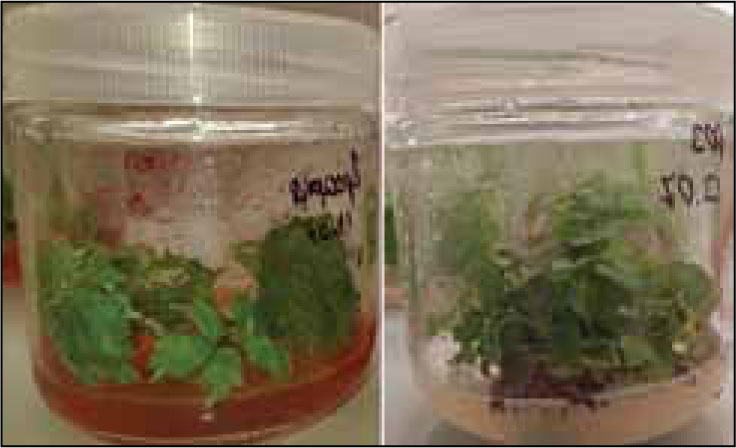
Figure 1.
Cultivation of raspberry in vitro in containers with a volume of 200 ml
Table 1.
The composition of nutrient media
| Component | Quantity, mg/l | ||
|---|---|---|---|
| MS | M1 | MK | |
| NH4NO3 | 1650.00 | 1250 | 417.00 |
| KNO3 | 1900.00 | 1100 | 367.00 |
| MgSO4 × 7H2O | 370.00 | 770 | 257.00 |
| KH2PO4 | 170.00 | 970 | 324.00 |
| Ca(NO3)2 × 4H2O | – | 440 | 293.00 |
| CaCl2 × 2H2O | 440.00 | – | – |
| FeSO4 × 7H2O | 27.80 | – | 18.54 |
| Na2MoO4 × 2H2O | 37.30 | – | 24.70 |
| Ferrilene 4.8 Orto–Orto | – | 183.4 | – |
| H3BO3 | 6.2 | ||
| MnSO4 × H2O | 22.3 | ||
| CoCl2 × 6H2O | 0.025 | ||
| CuSO4 × H2O | 0.025 | ||
| ZnSO4 × 7H2O | 8.6 | ||
| Na2MoO4 × 2H2O | 0.25 | ||
| KJ | 0.83 | ||
| Thiamine-HCl | 1.6 | ||
| Pyridoxine-HCl | 0.5 | ||
| Vitamin C | 2.0 | ||
| Nicotinic acid | 1.0 | ||
| Mesoinosit | 100 | ||
| Glycine | 0.5 | ||
| Adenine | 0.2 | ||
| Saccharose | 30,000 | ||
| Agar | 7,000 | ||
| pH 5.6 | |||
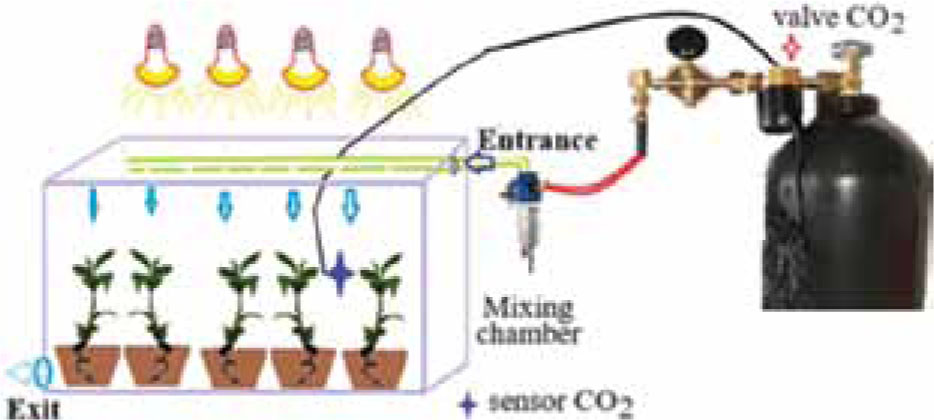
Figure 2.
Microclimate maintenance scheme for photoautotrophic nutrition
Table 2.
Duration of plant regeneration in vitro from different types of primary explants, days
| Type of explant | Medium | ||
|---|---|---|---|
| MS | M1 | MK | |
| Meristem | 63 ± 7.2 | 57 ± 8.1 | 61 ± 7.0 |
| Bud | 39 ± 3.9 | 33 ± 4.8 | 30 ± 4.1 |
| Shoot stem | 34 ± 4.7 | 32 ± 4.2 | 30 ± 3.8 |
Table 3.
The influence of the type of primary explants on the number of transfers and the yield of regenerants in vitro, medium M1
| Type of explant | Number of transfers, pieces | Yield of regenerants from primary explants, % |
|---|---|---|
| Meristem | 2.7±0.4 | 2.3±1.1 |
| Bud | 1.9±0.3 | 18.4±3.6 |
| Shoot stem | 1.5±0.3 | 54.3±4.1 |
Table 4.
The influence of the nutrient medium on the rate of raspberry multiplication in vitro (BAP 1.0 mg/l, fifth passage)
| Indicator | Medium | ||
|---|---|---|---|
| MS | MK | M1 | |
| Multiplication coefficient | 4.7 ± 0.3 | 2.1 ± 0.3 | 5.6 ± 0.3 |
| Regeneration period, days | 32.0 ± 4.4 | 49.0 ± 4.9 | 24.0 ± 3.2 |
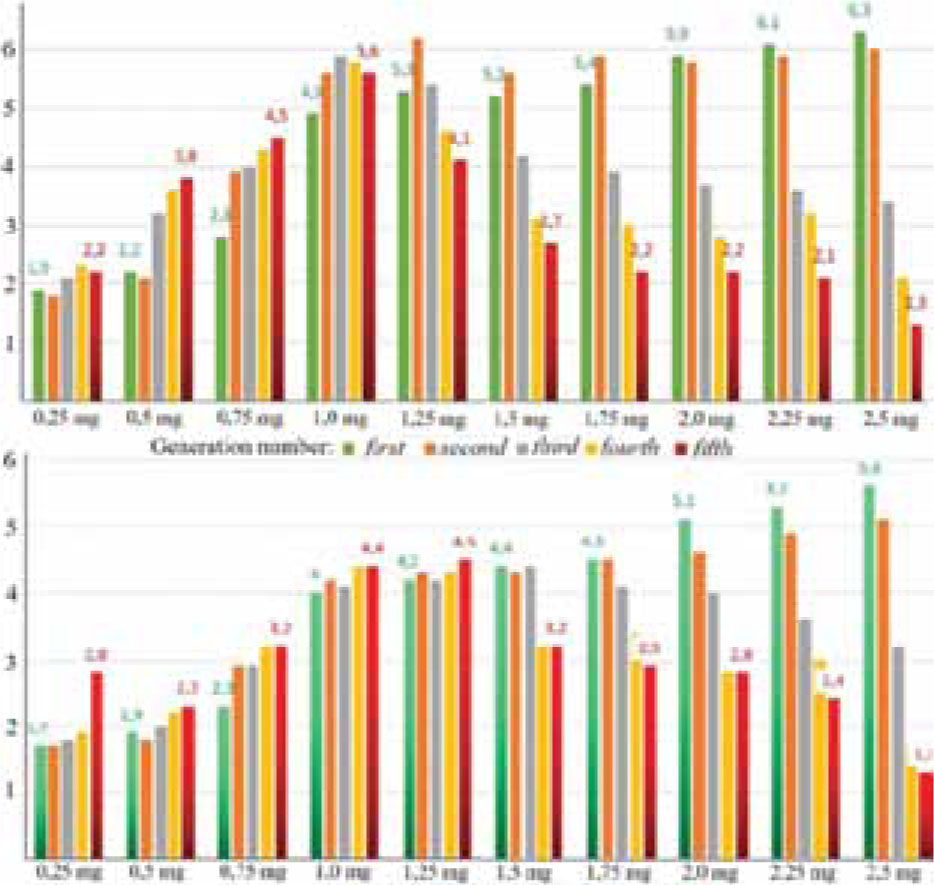
Figure 3.
The influence of different concentrations of 6-benzylaminopurine (a) and kinetin (b) on the coefficient of multiplication of raspberries in vitro
Table 5.
The influence of cultivation of donor plants during five passages on media with different concentrations of cytokinins on the rhizogenesis of regenerants
| Indicator | Cytokinin, mg/l | |||
|---|---|---|---|---|
| BAP 0.25 | BAP 1.0 | Kinetin 0.25 | Kinetin 1.0 | |
| Beginning of root formation, days | 19.0 ± 3.2 | 24.0 ± 3.7 | 13.0 ± 2.4 | 16.0 ± 2.9 |
| The length of the root system on the 30th day of cultivation, mm | 9.3 ± 3.0 | 4.2 ± 0.9 | 16.4 ± 3.1 | 14.1 ± 3.9 |
| The number of roots on the 30th day of cultivation | 9.2 ± 2.8 | 7.4 ± 2.2 | 7.3 ± 2.4 | 5.1 ± 1.8 |
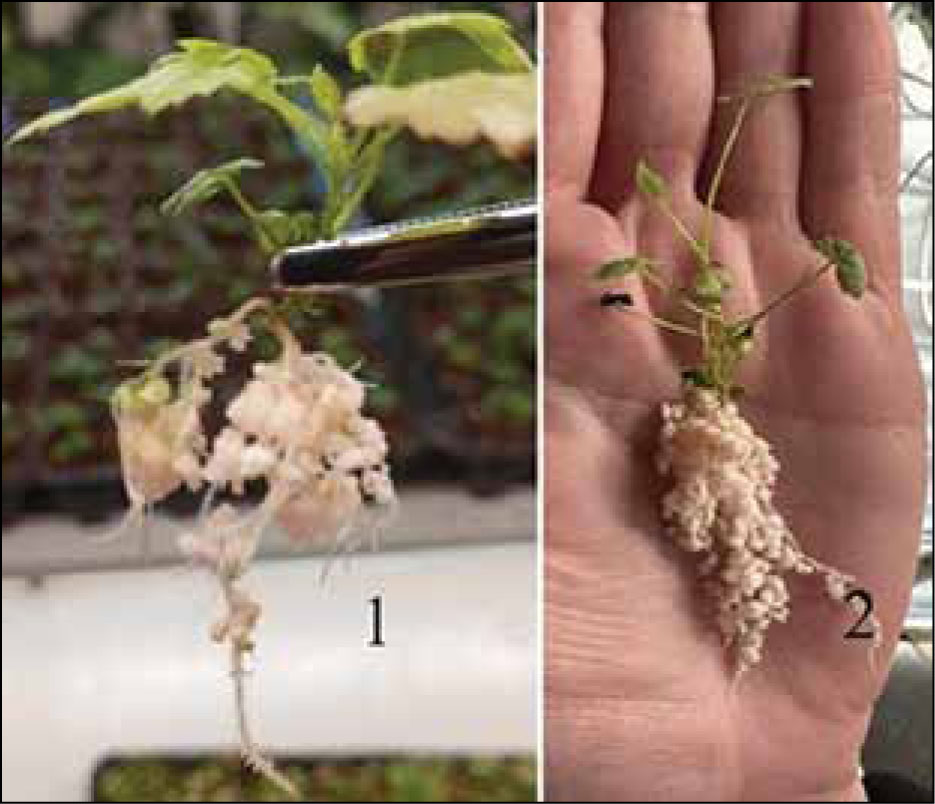
Figure 4.
The determining effect of cytokinins on the offspring of donors raised on substances with cytokinin activity in quantities of 1 mg/l, where 1 – kinetin; 2 – BAP
Table 6.
Peculiarities of adaptation of regenerants depending on the basis of the substrate
| Indicator | The basis of the substrate | |
|---|---|---|
| Peat | Perlite | |
| Survival, % | 73.3 ± 6.0 | 89.3 ± 6.3 |
| Height of regenerants on the 30th day, mm | 76.5 ± 6.0 | 67.1 ± 5.3 |
| Inhabitation by insects, pieces/container | 23.1 ± 6.4 | 4.0 ± 1.7 |
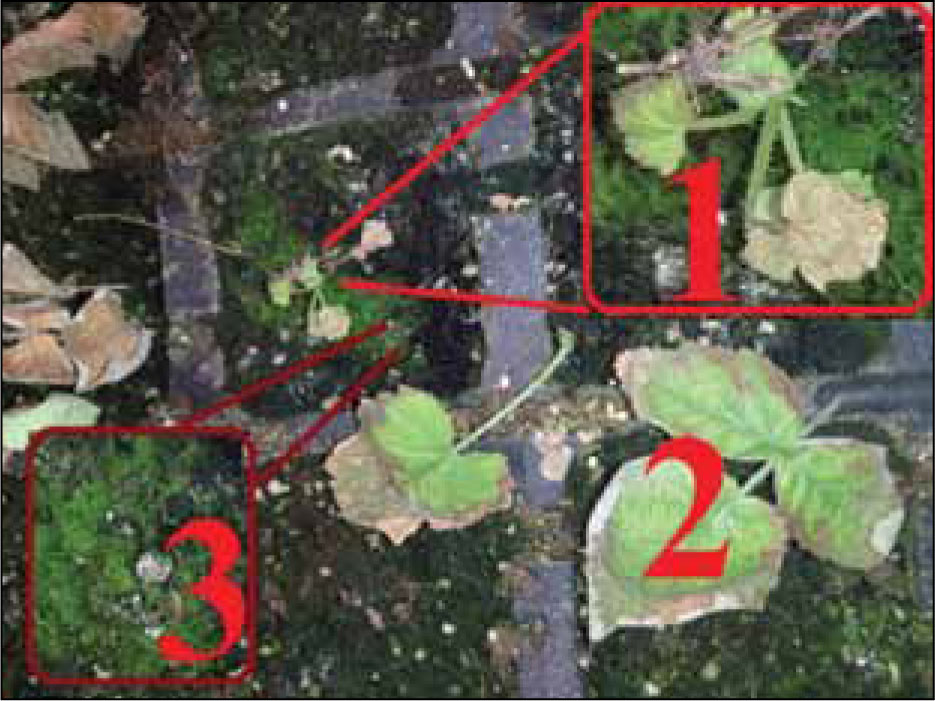
Figure 5.
Negative consequences of excessive watering on peat substrates
Table 7.
Effectiveness of controlling the quantity of insects in humid chambers
| Number of insects | Control | Standard | Insectivorous plants | ||
|---|---|---|---|---|---|
| Drosera | Dionaea | Nepenthes | |||
| Peat substrate | |||||
| Beginning | 9±3.2 | 10±3.0 | 9±2.9 | 11±4.2 | 8±2.8 |
| End | 27±4.9 | 7±1.8 | 3±0.9 | 19±4.0 | 23±5.7 |
| Perlite substrate | |||||
| Beginning | 3±0.9 | 3±0.6 | 4±0.6 | 3±0.4 | 4±1.1 |
| End | 11±2.8 | 5±1.2 | 1±0.2 | 9±1.9 | 8±2.9 |
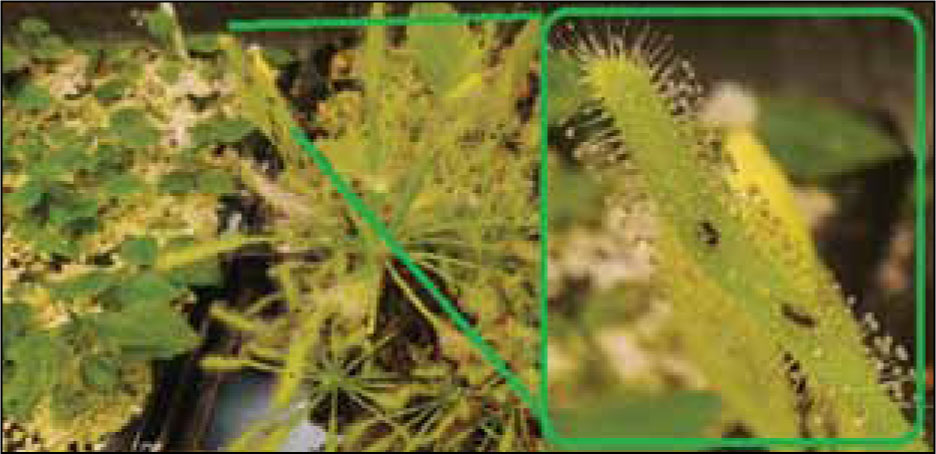
Figure 6.
Use of Drosera to control insect population in bioreactors of photoautotrophic microclonal propagation
Table 8.
The length of the raspberry root system ex vitro, mm
| Conditions | Cultivation day | |||
|---|---|---|---|---|
| 7 | 14 | 21 | 30 | |
| Wet chamber | – | 3±1.2 | 11±5.4 | 59±8.8 |
| Bioreactor | 27±3.2 | 68±7.0 | 103±9.1 | 124±11.0 |
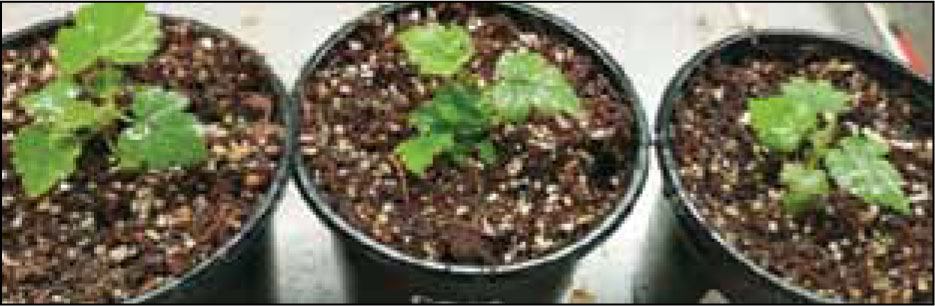
Figure 7.
The second generation of cuttings by photoautotrophic microclonal reproduction
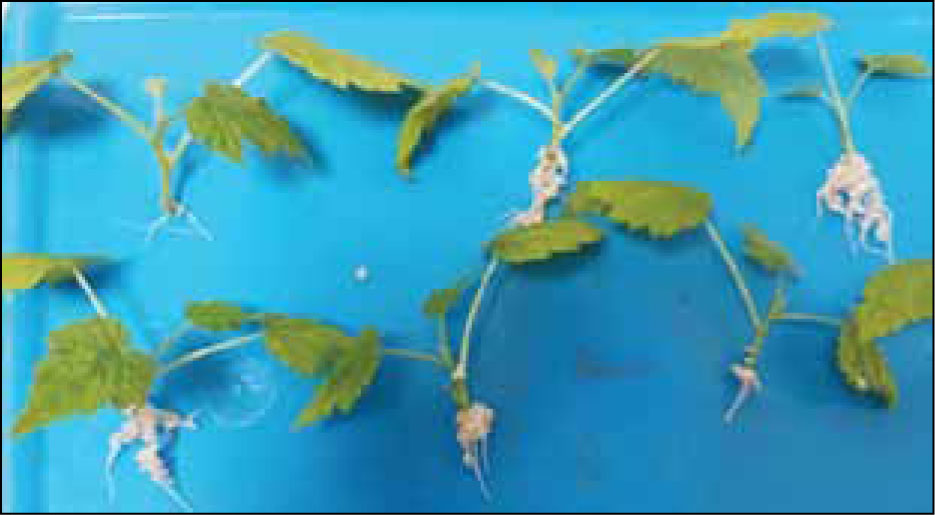
Figure 8.
State of the regenerants on the 21st day after leaving from the bioreactor

Figure 9.
Raspberry leaf polymorphism due to the loss of juvenility: 1 – adapted plants in vitro (the first generation, grown ex vitro); 2 – second generation ex vitro; 3 – third generation ex vitro
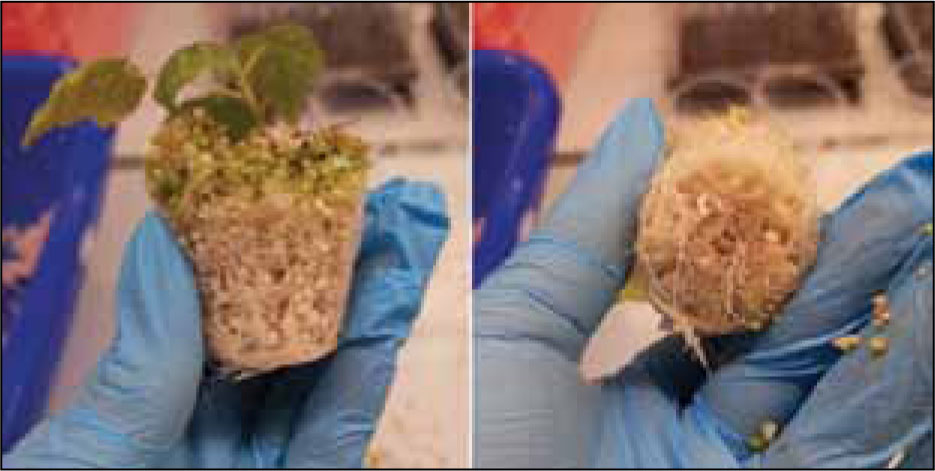
Figure 10.
The state of the root system in donors of apical cuttings
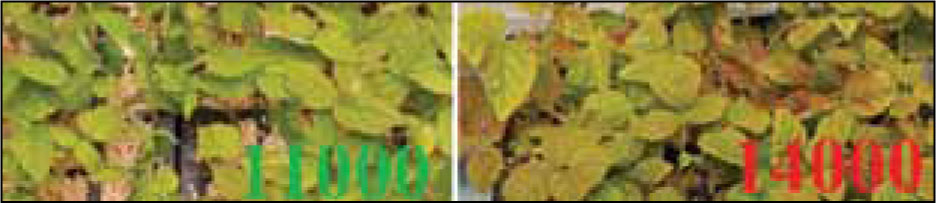
Figure 11.
The influence of the intensity of lighting on the state of the photoassimilating surface of raspberry cuttings in vivo

Figure 12.
Symptoms of magnesium deficiency before (1, 2) and after feeding (3, 4)
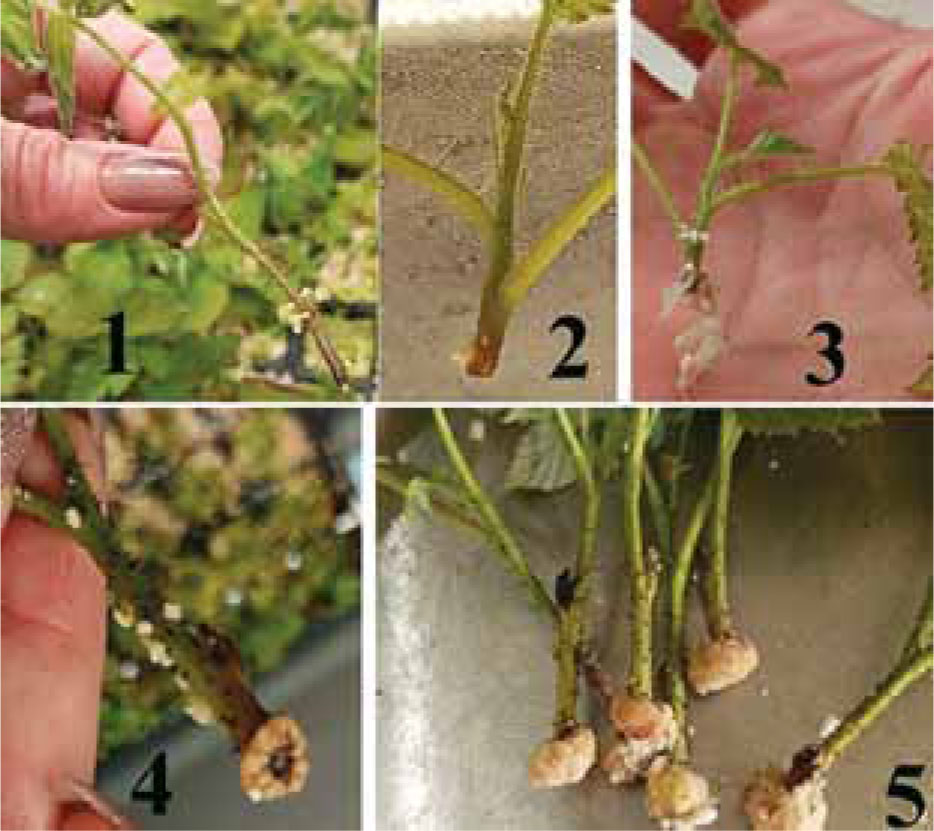
Figure 13.
The condition of raspberry cuttings in vivo in a bioreactor