Have a personal or library account? Click to login
Planting patterns in rubber agroforestry (Hevea brasiliensis) developed by the communities of Menggala Mas Village, Lampung Province, Indonesia Cover

Planting patterns in rubber agroforestry (Hevea brasiliensis) developed by the communities of Menggala Mas Village, Lampung Province, Indonesia

Open Access
|Mar 2024

Figures & Tables

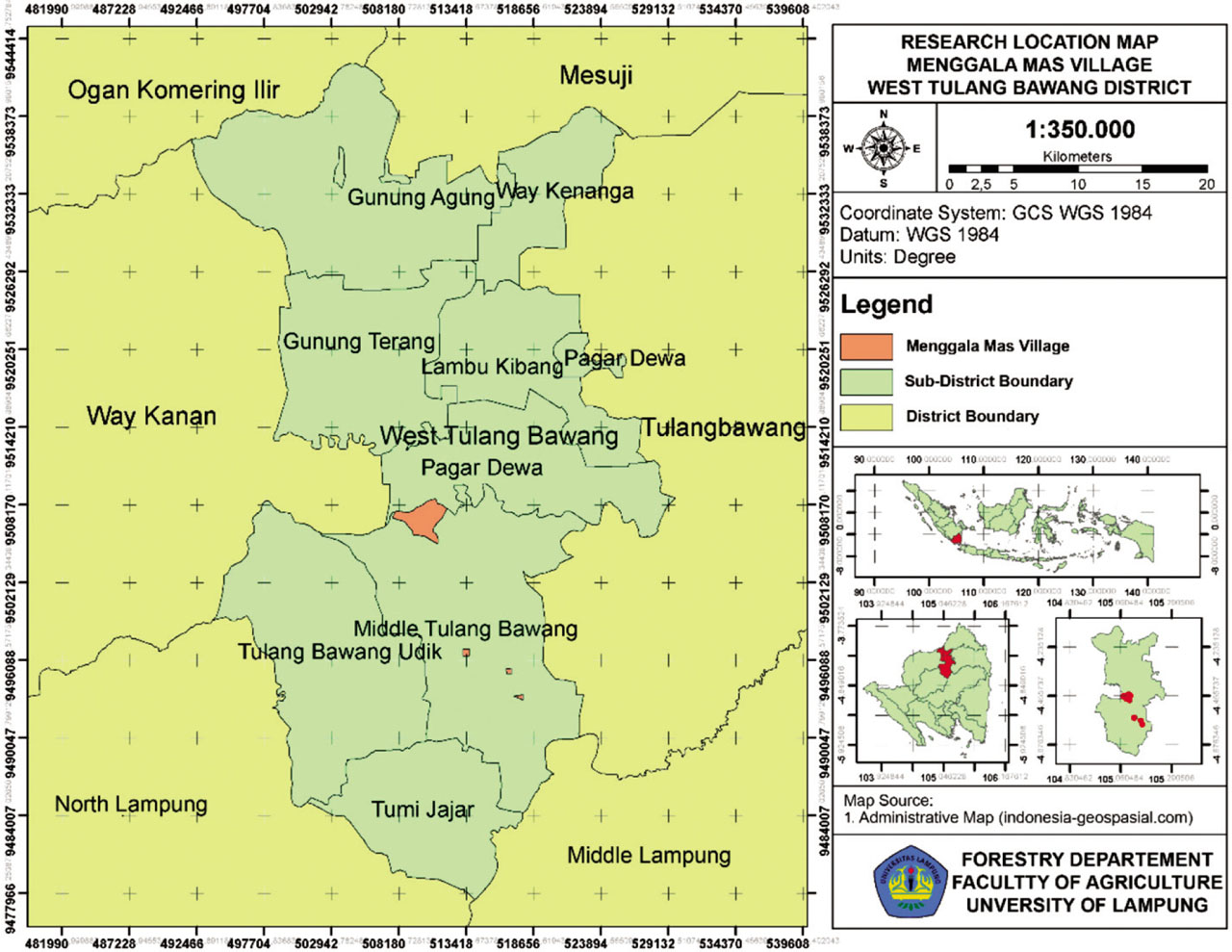
Figure 1.

Map of research location
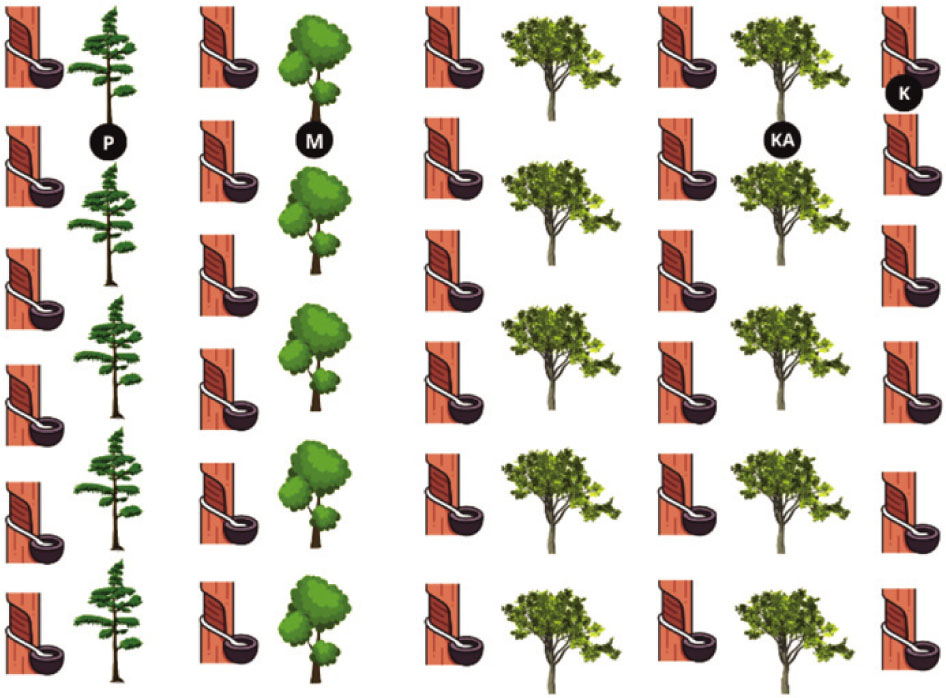

Figure 2.

Alley cropping planting pattern (K – Karet/rubber, KA – Kayu Afrika, P – Pulai, M – Mentru)
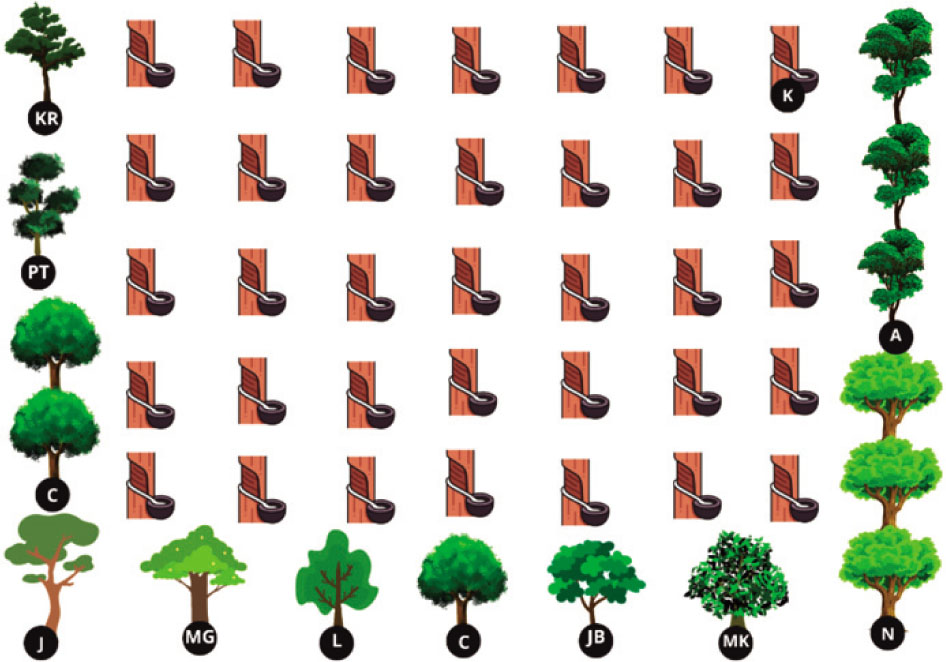

Figure 3.

Trees along border planting pattern (R – karet/rubber, N – nangka/jackfruit, A – akasia, MK – mengkudu, KR – kapuk randu, JB – jambu biji, J – jati, PT – petai)
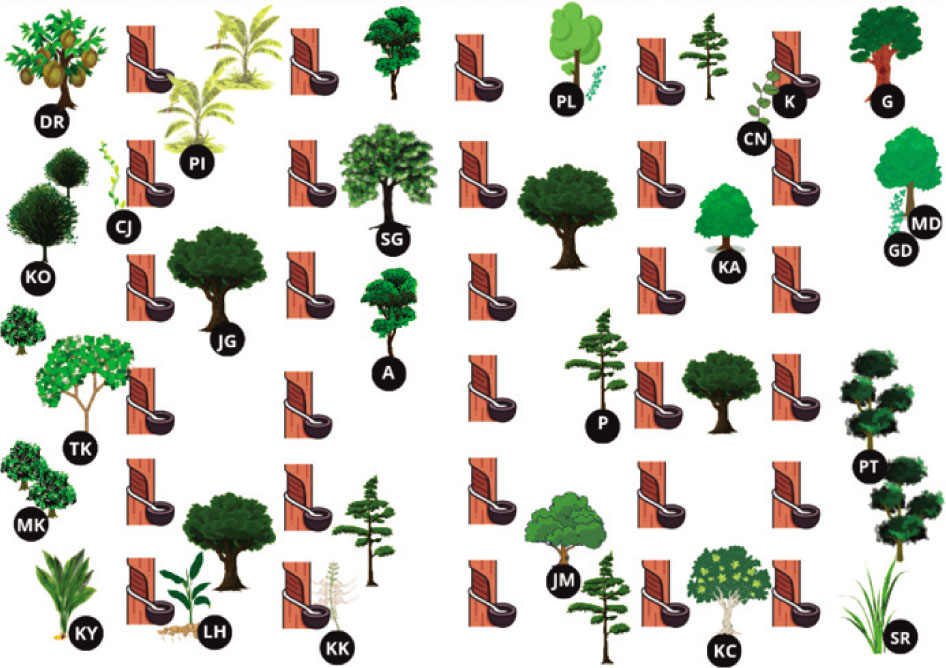

Figure 4.

Random mixture planting pattern (K – karet/rubber, PT – petai, KC – ketepeng cina, A – akasia, JG – jengkol, GD – gadung, G – gaharu, DR – durian, LH – lengkuas hutan, MD – medang, KO – kopi/coffee, KY – kunyit/turmeric, PL – pelangas, KA – kakao, KK – kumis kucing, SG – sungkai, P – pisang/banana, CJ – cabe jawa, CN – cincau, SR – sereh, JM – jambu monyet, TK – takokak, P – pulai, MK – mengkudu)
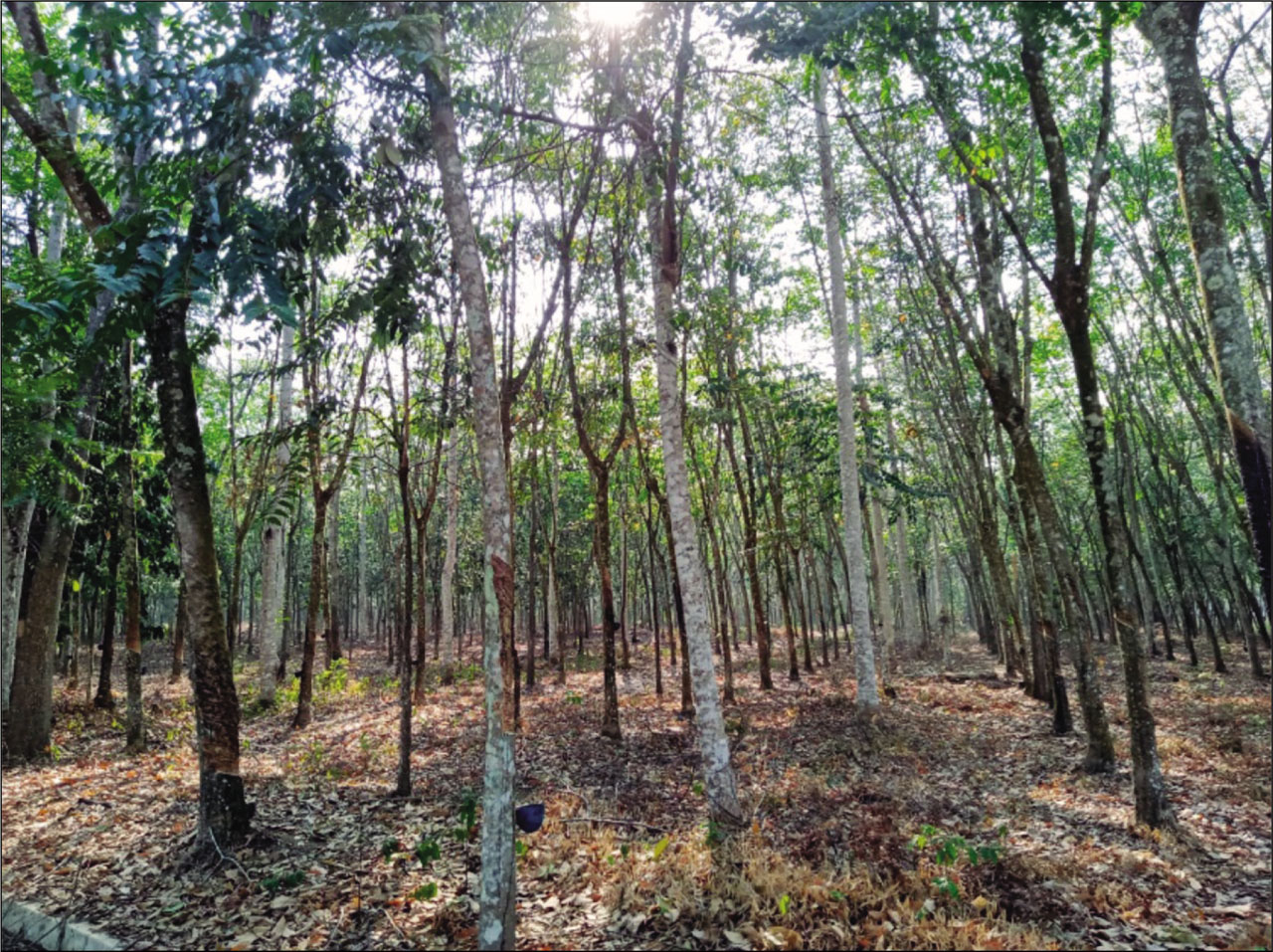

Figure 5.

Rubber agroforestry
Rubber agroforestry

Plants species of rubber agroforestry in Menggala Mas Village

No.Plants speciesBenefit
123
1Karet/rubber (Hevea brasiliensis)
  • – the sap is a raw material for balls, tires and objects made of rubber

  • – the flesh of the seeds is used as fish food

  • – the seed shells are used as handicrafts

  • – the wood is used to make plywood

2Kayu afrika (Maesopsis eminii)
  • – the wood is used for light construction materials, containers, boxes and plywood

  • – kayu afrika leaves are used for livestock feed because their dry matter content reaches 35% and can be digested well by livestock

3Pulai (Alstonia scholaris)
  • – its beautiful crown is used as an ornamental plant

  • – the soft trunk of the tree can be used as a building material and craft material

  • – the root bark is used to treat vertigo, reduce hypertension and treat insomnia

4Akasia (Acacia auriculiformis)
  • – the wood is used for building materials and furniture

5Gaharu (Aquilaria malaccensis)
  • – the wood is the main material for good-quality furniture

  • – wood chips can be used to make incense and perfume

  • – the wood is used as a material for making chests

6Jati (Tectona grandis)
  • – the wood is used for making household furniture, furniture and building materials

7Mentru (Schima wallichii)
  • – the wood is used as a building material to make houses

  • – the wood is also used as a raw material for shipbuilding

8Medang (Phoebe hunanensis)
  • – the wood is used for furniture such as cupboards, chairs, tables and plywood

  • – the bark is used as a raw material for mosquito coils

9Pelangas (Aporosa aurita)
  • – the wood is used for building materials such as frames, doors and windows

10Sungkai (Peronema canescens Jack)
  • – the wood is used as a building material, for making furniture, floors and wall boards

  • – the leaves are used as a fever medicine, mouthwash to reduce toothache and to treat malaria

11Bambu tali (Gigantochola apus)
  • – the stems are used as craft materials, building/house building materials, cooking utensils, herbal medicine and children’s toys

  • – young bambu tali stems are used as food

12Kapuk randu (Ceiba pentandra)
  • – the fruit is used to fill mattresses, bolsters and pillows

  • – the leaves are usually used by rubber farmers as a rubber lubricant, so that the rubber can be easily removed when sold

  • – the leaves are also used as animal feed

13Jengkol (Archidendron pauciflorum)
  • – the fruit is used as a cooking ingredient, for making crackers and as a fresh vegetable

14Petai (Parkia speciosa)
  • – the fruit is used as a cooking ingredient or as a fresh vegetable

15Mangga/mango (Mangifera indica)
  • – the fruit is taken to eat or sell; usually, mangoes are processed into various dishes such as juice, petisan, chili sauce, ice cream, salad and jam

16Cempedak (Artocarpus integer)
  • – the fruit is taken to eat or sell

  • – the seeds can be consumed by boiling

17Nangka/jackfruit (Artocarpus heterophyllus)
  • – ripe fruit is taken to eat or sell

  • – unripe fruit can be used as a cooking ingredient

18Maja (Crescentia cujete)
  • – the flesh of the fruit is used by farmers to poison or eradicate pests such as rats

  • – the hard skin of the maja fruit is usually used as a scoop

  • – the leaves are used to treat skin diseases such as itching, rashes and boils

19Durian (Durio zibethinus Murr)
  • – the fruit is taken to eat or sell

  • – the flesh of the fruit is usually used as a basic ingredient for making Tempoyak, a typical Lampung food

20Rambutan (Nephelium lappaceum)
  • – the fruit is taken to eat or sell

21Kakao (Theobroma cacao)
  • – Ripe fruit flesh can be consumed directly

  • – the seeds are sold for making chocolate

22Lamtoro (Leucaena leucocephala)
  • – the seeds are used as a cooking ingredient

  • – the leaves are used as a medicine for open wounds

  • – the seeds are used to treat diabetes mellitus and strengthen bones

23Jambu biji (Psidium guajava)
  • – the leaves are used to treat diarrhoea

  • – the fruit can be consumed directly or made into juice

24Jambu air (Syzygium aqueum)
  • – the fruit can be consumed directly or pickled

25Mengkudu (Morinda citrifolia L.)
  • – the fruit is used as a natural rubber solidifier

  • – the fruit is used as a medicine to lower bad cholesterol which can cause stroke and heart disease

26Kopi/coffee (Coffea sp.)
  • – coffee beans can be sold or kept for own use

  • – the seeds are used as a raw material for making coffee

  • – coffee beans that have become coffee powder can be used as a traditional medicine to heal wounds

27Pisang/banana (Musa paradisiaca)
  • – the fruit can be sold or consumed by the family

  • – the leaves are used as food wrappers

  • – banana blossoms and unripe fruit are taken for fresh vegetables

28Singkong/cassava (Manihot utilisima)
  • – the tubers are sold or consumed personally

  • – the young leaves are used as fresh vegetables or as a cooking ingredient

  • – Leaves and stems are used as animal feed

29Jambu monyet (Anacardium occidentale)
  • – the young leaves are used as fresh vegetables

  • – the fruit is made into juice

  • – the seeds are made into processed cashew nuts

30Takokak (Solanum torvum)
  • – the fruit is used as a cooking ingredient

31Ketepeng cina (Senna alata)
  • – the leaves are used as a traditional medicine to cure tinea versicolor, ringworm, scabies and as a worm medicine

32Lengkuas hutan (Alpinia malaccensis)
  • – the rhizome is used as a spice to season dishes and treat ulcers or wounds

33Gadung (Dioscorea hispida)
  • – the starch of gadung tubers is used as a rubber solidifier, so that the harvested latex becomes harder/suppler

34Kumis kucing (Orthosiphon aristatus)
  • – the leaves and flowers are used as medicine to treat urinary tract infections, kidney stones, urinary tract infections and stomach acid

35Kunyit/turmeric (Curcuma longa)
  • – the rhizome is used as a kitchen spice, medicine for ulcers and to relieve menstrual pain

36Kunyit merah/red turmeric (Curcuma domestica)
  • – the rhizome is used as a kitchen spice and prevents heart disease, Alzheimer’s and cancer

37Cincau (Cyclea barbata)
  • – cincau juice is used as an ingredient in drinks such as cincau ice, which is rich in antioxidants

38Cabe jawa (Piper retrofractum)
  • – the fruit is used as a traditional medicine to treat low blood pressure, influenza, shortness of breath and headaches and cure diabetes

39Talas (Colocasia esculenta)
  • – the tubers are used as food ingredients such as talas chips

40Sereh (Cymbopogon citratus)
  • – the stems are used as a kitchen spice and cooking fragrance, and sereh essential oil can repel mosquitoes

41Tebu/sugarcane (Saccharum officinarum)
  • – the stems are used as a basic ingredient for making sugar or can be used as a sugar cane juice drink

DOI: https://doi.org/10.2478/ffp-2024-0004 | Journal eISSN: 2199-5907 | Journal ISSN: 0071-6677
Language: English
Page range: 33 - 45
Submitted on: Jan 12, 2024
Accepted on: Jan 26, 2024
Published on: Mar 8, 2024
Published by: Forest Research Institute
In partnership with: Paradigm Publishing Services
Publication frequency: 4 issues per year

© 2024 Indra Gumay Febryano, Yanne Permata Sari, Susni Herwanti, Afif Bintoro, published by Forest Research Institute
This work is licensed under the Creative Commons Attribution-NonCommercial-NoDerivatives 4.0 License.