
Introduction
Agroforestry is a land management system offered to overcome problems arising from changes in land use and food problems (Roslinda et al. 2023). Agroforestry generally includes mixed gardens, fields covered with trees, fields, fallow lands (scrubs), home gardens and wider community plantation forests (Janzen et al. 2023). Agroforestry systems maintain levels of biodiversity between natural forests and pure agricultural land use, thereby increasing connectivity or maintaining biodiversity in fragmented forest landscapes (Haggar et al. 2019). This diverse combination can help forest communities from the risk of price variability and loss of income, food security, crop failure and other unexpected problems; therefore, the level of biodiversity in land cultivation will influence the level of food security in the area (Wulandari et al. 2019). One example of the application of an agroforestry system that has long been implemented by the Indonesian people is rubber plants.
Rubber agroforestry system is an agroforestry pattern for rubber that aims to increase the productivity of crops, including rubber itself as the main product and also by-products such as fruit, wood, rattan, etc. (Budiman et al. 1994). Rubber agroforestry with other economic plants can increase the productivity of land and the rubber plant itself (Sahuri 2019). Being similar in structure and biodiversity to secondary forests in the mature phase, rubber plantations are included in complex agroforestry systems (Gouyon et al. 1993). Rubber agroforestry is a form of complex agroforestry that is generally composed of rubber tree vegetation (Hevea brasiliensis) as the main component and various species of lianas, herbs and forest trees. These plants are kept intentionally or unintentionally for certain purposes, whether as a producer of fruit, firewood or boards (Kassa et al. 2023). Utilisation of rubber agroforestry technology can support rubber farmers by providing them quite high profits (Malahayati and Masui 2019). This system is considered a better way to improve soil properties and overall environmental quality than rubber monoculture (Isaac and Borden 2019). Soil surface cover from fallen leaf litter and the extensive root system in the rubber agroforestry system increases organic carbon and soil nitrogen, helps increase soil aggregation and reduces soil erosion, so that various species of plants can thrive side by side with rubber (Chen et al. 2017).
From the components of these plant species, it is easy to determine what patterns farmers apply in developing rubber agroforestry. To determine the success of an agroforestry system, the pattern of selecting plant species composition and management methods is very important (Huang et al. 2023). The agroforestry pattern is a type that has great prospects and is very promising for farmers to achieve their goals, and the presence of filler plant species can enrich biodiversity in rubber agroforestry (Mellisse et al. 2018). Therefore, this research aims to explain the planting pattern of rubber agroforestry developed by the community.
Method
This research was conducted in March–October 2023 in Menggala Mas Village, Tulang Bawang Tengah District, Tulang Bawang Barat Regency, Lampung Province, Indonesia (Fig. 1). The key informants selected using purposive sampling were the village head (one person), the agricultural instructor (one person) and rubber agroforestry farmers (six persons). The collected data was then analyzed qualitatively. Data was obtained through involved observation, in-depth interviews, and documentation studies and then analyzed to explain the planting patterns of rubber agroforestry that were developed by the community.
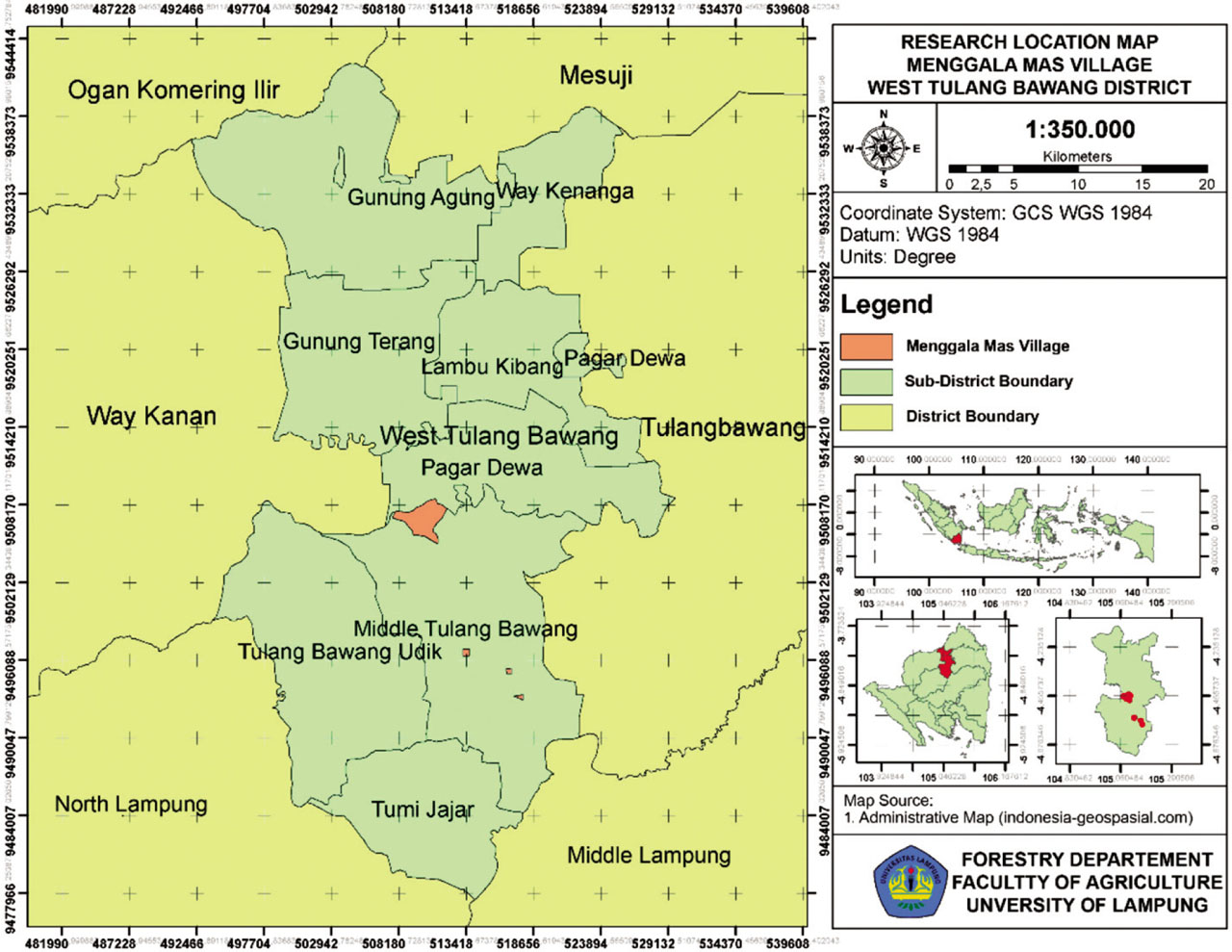
Figure 1.
Map of research location
Results and discussion
Overview of Research Locations
Menggala Mas Village is one of the villages in Tulang Bawang Barat Regency. Topographically, the regency is a lowland area with a tropical climate with alternating rainy and dry seasons throughout the year. Average temperature 25–31°C, rainfall is between 57 and 299 mm/year, with the average humidity being 85.2%. Tulang Bawang Barat Regency area is a lowland with a height of 39 m above sea level. This height is suitable for cultivating rubber plants (Digilib Unila 2023). Menggala Mas Village has an area of 1,592 ha with productive land of 863 ha. Geographically, the boundaries of the Menggala Mas Village area are as follows:
To the North, it borders Pagar Dewa Village, Pagar Dewa District.
To the East, it borders Penumangan Village, Tulang Bawang Tengah District.
To the South, it borders Bandar Dewa Village, Tulang Bawang Tengah District.
To the West, it borders Pagar Iman Village, Negeri Besar District.
The population of Menggala Mas Village is 1,460 people with a ratio of 742 men and 718 women. The number of people of productive age is 672, while the population in the poor category consists of 601 people. Menggala Mas is a village that is quite good in terms of its agricultural potential, especially rubber and cassava commodities. Around 80% of the people make their living as rubber farmers and the rest work as traders, breeders, fishermen, agency employees and others. Most people in this village are from the Lampung Pepadun tribe (Tiyuh Menggala Mas Official Website 2022). Communities develop their gardens according to land conditions and their ability to manage the land. This ability comes from the local knowledge they have. Communities that have relatively limited land tend to develop agroforestry systems. Management using this system is considered more profitable because people can harvest plant commodities simultaneously, in addition to meeting their daily needs. The components that make up gardens owned by farmers are very diverse, ranging from species of trees to herbs, shrubs, under-growth and annual plants.
Since ancient times, the development of community rubber plantations has been considered successful. This is because the community has local knowledge about rubber development. However, as time goes by, many problems such as low rubber prices and minimal land area require farmers to optimize their land. Several communities have been motivated to learn to develop rubber agroforestry by combining local knowledge they gained from previous generations and other information, so that more and more people are starting to get to know rubber agroforestry (Jayathilake et al. 2023). Rubber agroforestry is a type of complex agroforestry in which land use techniques involving many species of trees that grow naturally or are deliberately planted are applied on one land, so that it resembles a forest (Sumilia et al. 2019).
Planting Patterns of Rubber Agroforestry
The Menggala Mas community initially cultivated the land without being familiar with the agroforestry cropping system. They cultivated the land in a very simple way and followed the habits of their ancestors. However, as time goes by, other plants besides rubber grow either deliberately planted or naturally, which is usually called rubber agroforestry. The large number of rubber commodities plays an important role as a source of income for local communities, so that they can meet their daily living needs. Rubber is a commodity that occupies quite an important position as non-oil and gas foreign exchange and supports Indonesia’s economic development, so it has good and promising prospects (Jayathilake et al. 2023). Therefore, efforts to increase the productivity of rubber farming businesses continue to be made in its cultivation. Rubber is usually used as a factory raw material in industries, such as for making tires, balls, rubber shoes, gloves, swimsuits, rubber bands, rubber toys and others (Silagy et al. 2024). Rubber-based agroforestry systems are sustainable intercropping systems in which farmers plant multiple crops or grow livestock alongside rubber trees to increase their income and/or livelihood while gaining ecological benefits (Chama et al. 2023). Rubber-based agroforestry is an agricultural practice that aims to slow the loss of soil organic matter and reduce the volume of water runoff (Zhu et al. 2018). The spacing of trees in a rubber agroforestry system must be appropriate to control competition for light and nutrients (Wijayanto and Briliawan 2022). The planting distance for rubber monoculture is usually 4 × 5 m and for agroforestry is 3 × 6 m.
A sustainable planting system is an important part of a sustainable agricultural system, one of which is characterized by a planting pattern (Evizal and Prasmatiwi 2021). The agroforestry planting pattern is a type of management that has very good prospects and is very promising for farmers to achieve their goals (Idris et al. 2019). Agroforestry planting patterns support future forestry development (Novasari et al. 2023), are the best practices for sustainable management from both economic and environmental perspectives (Markum et al. 2021), increase land productivity (Nandini et al. 2023) and support people’s livelihoods (Sulistiyowati et al. 2023). Most of Indonesia’s population lives in rural areas, which depends more on nature through agricultural businesses and is encouraged to utilize their land optimally, but quite a few farmers have limited land (Markum et al. 2021). Limited land use encourages farmers to come up with innovations in spatial patterns of free choice to farmers (Kaur et al. 2023). The characteristics of agroforestry planting patterns depend on the land owner and the characteristics of the land. The final goal to be achieved is prioritising production, so that people create different planting patterns from one land to another (Rezgui et al. 2023). Before implementing an agroforestry system, it is necessary to know that there is a good and appropriate planting pattern (Willmott et al. 2023). Based on the planting pattern, there are three agroforestry planting patterns applied by people in the community on their rubber agroforestry land, namely, alley cropping, trees along border and random mixture.
Alley Cropping
The alley planting pattern combines forestry and agricultural crops (Fig. 2). Alley cropping is a planting system where annual plants are planted in an alley between two rows of hedgerows, usually in the form of trees or shrubs (Evizal and Prasmatiwi 2021). The planting pattern for forestry plants resembles an alley (Idris et al. 2019). Plants in the alley include kayu afrika (Maesopsis eminii), pulai (Alstonia scholaris) and mentru (Schima wallichii).
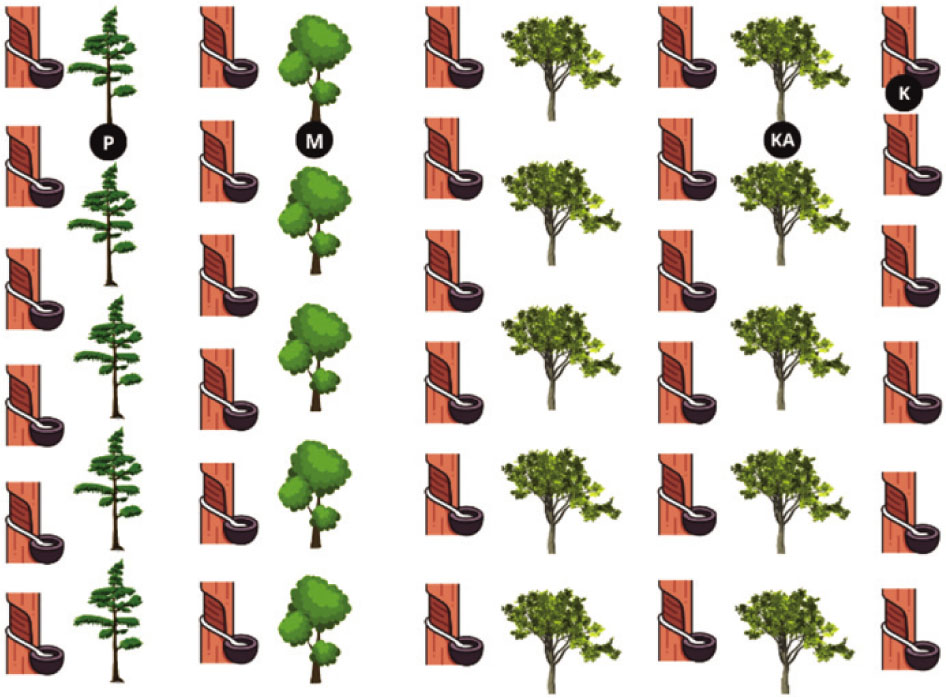
Figure 2.
Alley cropping planting pattern (K – Karet/rubber, KA – Kayu Afrika, P – Pulai, M – Mentru)
The dominant plant combinations include rubber–pulai and rubber–mentru–kayu afrika planted in the middle of rows of rubber trees. These plants can complement the rubber plant as an alley plant, which, according to farmers, have benefits for extracting its wood. The spacing between interplants is 6 m. According to farmers, this species of plant is easy to grow and is suitable for planting alongside rubber plants. They can sell the potential wood obtained from kayu afrika and mentru wood species or use them as building materials for their purposes. Pulai plants are usually widely cultivated to be later sold as ornamental plants which are widely used on roadsides or in tourist attractions in Tulang Bawang Barat Regency. Meanwhile, rubber wood can also be sold to make plywood or used simply as firewood.
Trees Along Border
This agroforestry planting pattern is a pattern for arranging plant space like a fence (Fig. 3). The way to plant forestry plants uses a fence form, namely, the tree components are arranged at the edge of the land and the agricultural plants are in the middle (Idris et al. 2019). The community combines various multipurpose tree species (MPTS) and forestry plants such as akasia (Acacia auriculiformis), jati (Tectona grandis), kapuk randu (Ceiba pentandra), petai (Parkia speciosa), nangka/jackfruit (Artocarpus heterophyllus), cempedak (Artocarpus integer), mango (Mangifera indica), lamtoro (Leucaena leucocephala), jambu (Psidium guajava) and mengkudu (Morinda citrifolia). The dominant plant combinations in this planting pattern are combinations of rubber–akasia, rubber–jackfruit–cempedak and rubber–petai–jati.
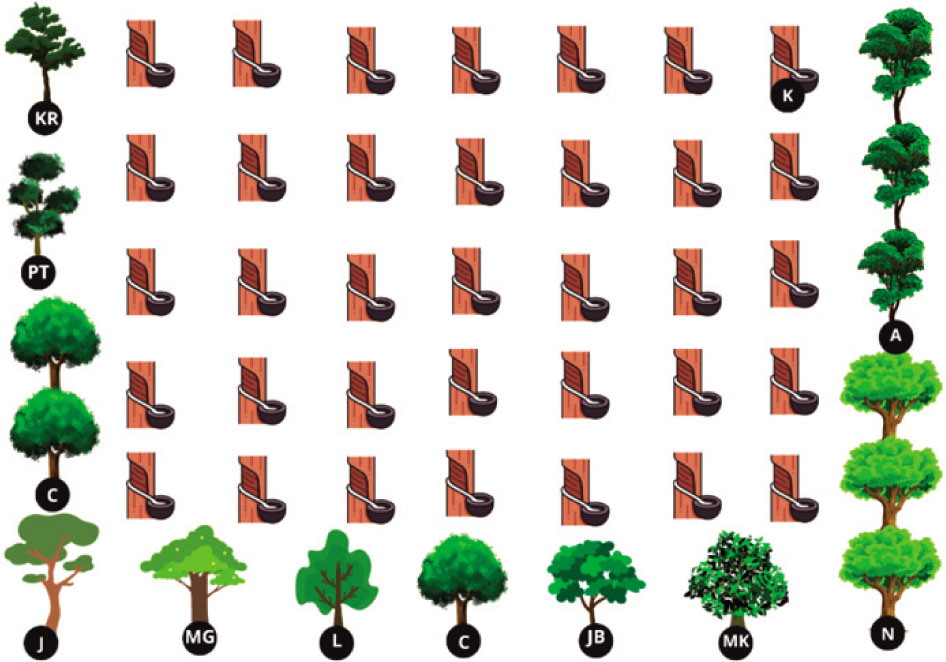
Figure 3.
Trees along border planting pattern (R – karet/rubber, N – nangka/jackfruit, A – akasia, MK – mengkudu, KR – kapuk randu, JB – jambu biji, J – jati, PT – petai)
People deliberately plant these plants as garden boundary marks or fences so that the rubber sap is not taken by other people. Selecting the plant species that provide many benefits according to farmers is followed, as the majority plant MPTS species for their fruit and trees for their wood. In line with research (Naharuddin 2018) which states that trees planted around land usually function as fences or land borders. This is under planted edge trees which can act as land ownership boundary markers, living fences, fire breaks, windscreens and can also act as protectors or soil binder if planted on unstable soil/edge of ravines.
Random Mixture
The random pattern is the pattern most widely applied by the community because this planting pattern can be said to have no systematic distribution model (Fig. 4). Random mixture is a random agroforestry planting pattern, between forestry plants, agricultural plants, herbs and shrubs that grow unevenly distributed on a land (Willmott et al. 2023). The filler plants are very diverse, such as akasia (Acacia auriculiformis), gaharu (Aquilaria malaccensis), medang (Phoebe hunanensis), pelangas (Aporosa aurita), pulai (Alstonia scholaris), sungkai (Peronema canescens Jack), jengkol (Pithecellobium lobatum), petai (Parkia speciosa), mengkudu (Morinda citrifolia L.), jambu monyet (Anacardium occidentale), durian (Durio zibethinus Murr), coffee (Coffea sp.), kakao (Theobroma cacao), banana (Musa paradisiaca), takokak (Solanum torvum), ketepeng cina (Senna alata), gadung (Dioscorea hispida), lengkuas hutan (Alpinia malaccensis), turmeric (Curcuma longa), kumis kucing (Orthosiphon aristatus), cabe jawa (Piper retrofractum), cincau (Cyclea barbata), sereh (Cymbopogon citratus) and others.
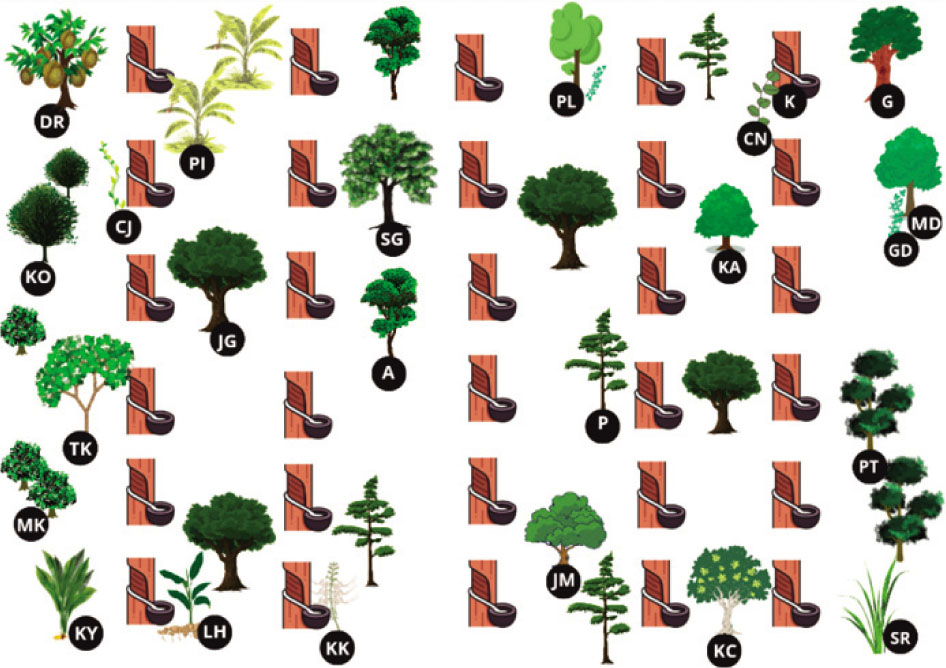
Figure 4.
Random mixture planting pattern (K – karet/rubber, PT – petai, KC – ketepeng cina, A – akasia, JG – jengkol, GD – gadung, G – gaharu, DR – durian, LH – lengkuas hutan, MD – medang, KO – kopi/coffee, KY – kunyit/turmeric, PL – pelangas, KA – kakao, KK – kumis kucing, SG – sungkai, P – pisang/banana, CJ – cabe jawa, CN – cincau, SR – sereh, JM – jambu monyet, TK – takokak, P – pulai, MK – mengkudu)
The dominant plant combinations used include rubber–jengkol, rubber–petai–jengkol–akasia, rubber–jackfruit–cempedak, rubber–pulai–mengkudu–jengkol and rubber–banana–gadung–sungkai. These plants are deliberately planted by the community, and some of them grow naturally. The species of plants that are widely planted are jengkol, petai and banana; this is because many people in this village are from the Lampung tribe and like to eat fresh vegetables. The community said that it often holds celebrations every day, namely, eating a dish of ‘seruit’ (a typical Lampung regional food), many of the ingredients of which are taken from their land. In addition, rubber agroforestry with bananas can increase organic carbon and nitrogen-fixing microbes (Tetteh et al. 2019). Gadung and mengkudu plants are trusted by village communities as natural rubber condensants which make it easier for farmers to process rubber latex traditionally. Jackfruit and cempedak plants are seasonal plants that, if harvested once, will produce very abundant fruit on one tree. The species of plant is suitable for planting with rubber plants. This proves that competition for nutrients is not that significant. Akasia and sungkai plants are those plants whose wood quality is beyond doubt, so many farmers have planted these plants randomly in rubber plantations. Planting woody plant species is for not only obtaining results from the wood, but also as a long-term investment for the community. This random planting also aims to reduce hot temperatures, when farmers work in the dry season. It is usually during the dry season, when rubber loses a lot of leaves. The presence of various species of plants during the rainy season will reduce the risk of flooding in the land and soil erosion (Zhao et al. 2023).
The random mixture planting pattern is the pattern most widely applied in community rubber plantations because it has been a teaching passed down from generation to generation. In general, the reason people choose the mixed gardening pattern is because it has been continued from their ancestors, and thus, it has been carried out from generation to generation. So, most farmers in the area apply the mixed gardening pattern in their forest land. Even though the care or management of a random mixture pattern is more difficult because of the variety of species, farmers choose to use a random mixture planting pattern because according to them, the income they get is higher from a variety of plant species.
The biggest reasons for people to develop rubber agroforestry are income factors and ecological factors for the rubber land itself. Landowners who have other income or do not just work as rubber farmers tend to only grow rubber in monoculture. In contrast, landowners who only depend on their livelihood as rubber farmers, they will maximize their land using agroforestry. The planting distance for rubber monoculture is usually 4 × 5 m, while for agroforestry it is 3 × 6 m. In half a hectare of monoculture, there are usually 300 stems and in 1 ha, there are 600 stems. Meanwhile, for half a hectare of rubber agroforestry, there are around 250 stems and for 1 ha, there are 500 stems.
The phenomenon at the research location is that rubber production always increases every year because the older the rubber tree, the more rubber the tree produces, but the price of rubber itself is often unstable or experiences ups and downs (Jayathilake et al. 2023). Apart from price factors, rubber farmers’ income is influenced by land area. The larger the land cultivated, the income generated will increase (Muthuri et al. 2023). Farmers who have a narrow arable area are racking their brains to improve their narrow land to make it more productive using agroforestry or what farmers usually call mixed rubber plantations. Rubber agroforestry land is usually called ‘Omou’ or ‘Pelan’, which is taken from the Lampung language because most of the population is from the Lampung tribe. Omou is a garden/forest that the community uses as the main source of income to meet its daily living needs. Usually, in managing the community they still use the local knowledge they have, but this knowledge is no longer considered valid and the younger generation is less interested to learn by using it (Febryano et al. 2023). The climate factor is a factor that farmers are very worried about because changing climate is one of the factors that farmers cannot control (Nyagumbo et al. 2017). Therefore, some communities implement an agroforestry planting system that combines forestry plants and agricultural plants (agrisilviculture), namely, a combination of rubber trees with seasonal plants, fruit, herbs and plants that are beneficial to local communities (Fig. 5).
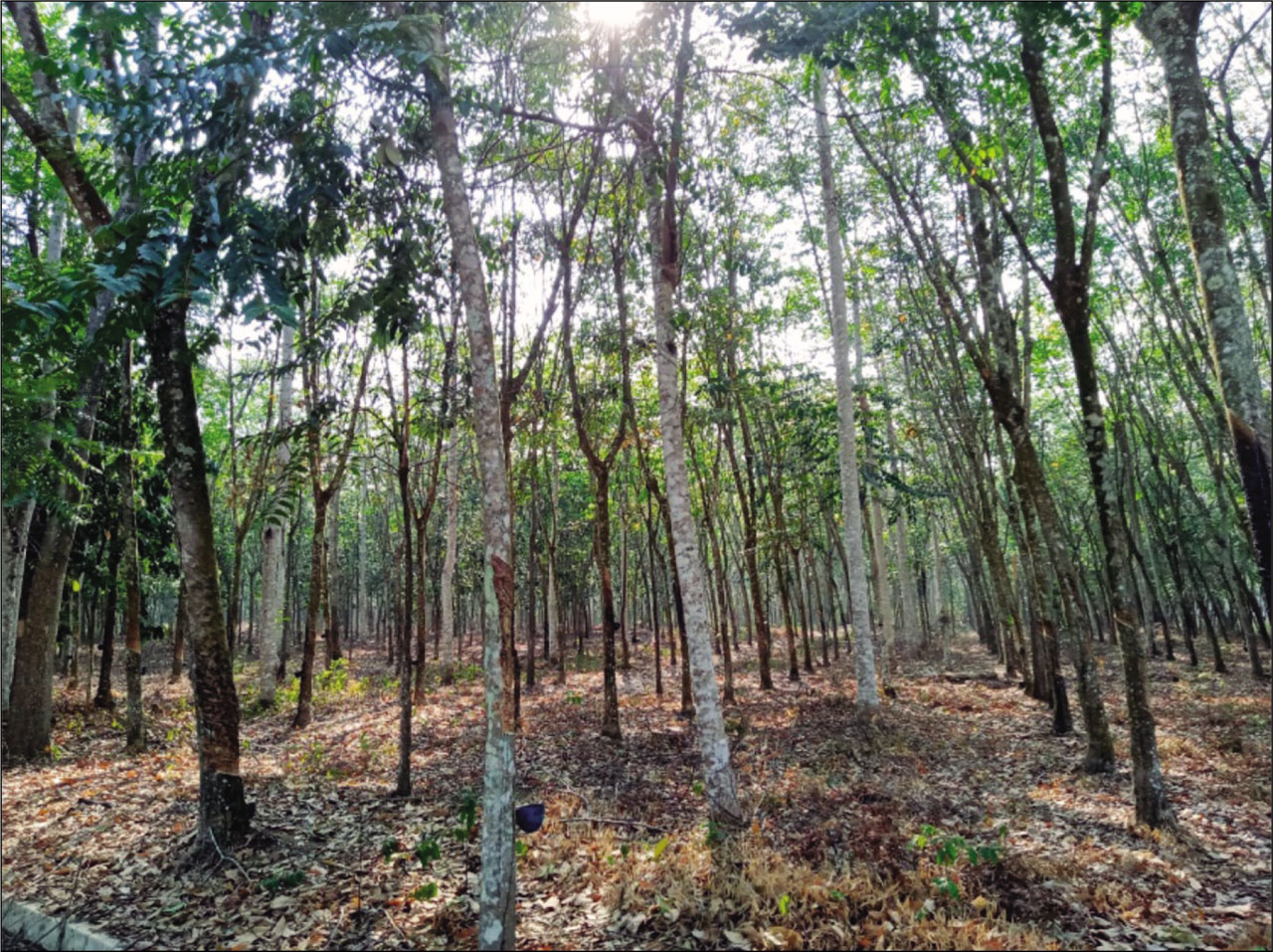
Figure 5.
Rubber agroforestry
The dominant plant species combined with rubber trees in Menggala Mas Village are kayu afrika (Maesopsis eminii), pulai (Alstonia scholaris), akasia (Acacia auriculiformis), mentru (Schima wallichii), jengkol (Pithecellobium lobatum), petai (Parkia speciosa), cempedak (Artocarpus integer) and jackfruit (Artocarpus heterophyllus). Combining plant species in the garden is more profitable because it can increase the household income or can be consumed by the family alone, but with affordable capital. This system makes a major contribution to people’s lives in direct income, but with little capital. The uniqueness of agroforestry land is that it can optimize land productivity by varying the species composition within one land and the management system (Langenberger et al. 2016).
The choice of agroforestry plant species depends on the situation, conditions and needs of the local community. Local ecological knowledge is closely related to decision-making in planting and maintaining trees (Salampessy et al. 2017). Priority is given to choosing species of plants that can provide benefits to the welfare of the community, both directly and indirectly. Apart from rubber plants as the main crop, other agroforestry plants managed by the community at the research location consist of woody tree species, MPTS, medicinal plants, fruit, shrubs, vines and other agricultural plants, which are indicators of the species of plants favoured by residents. This species of plant is deliberately planted or grows naturally on a plot of land or garden. From an ecological aspect, farmers’ habit of planting as many plants as this has a positive impact. The more diverse the species planted that made environmentally stable (Xue et al. 2023).
Furthermore, well-managed agroforestry practices can boost crop productivity by creating a favourable micro-climate, controlling pest outbreaks, improving soil structure, fertility and soil water content, enhancing crop pollination and providing habitat (Bentrup et al. 2019; Kim and Isaac 2022). Agroforestry also has many benefits for the society, especially in improving the economy and food security (Herwanti et al. 2022). Community dependence on the surrounding forests is commonplace, especially for communities living close to natural forests that manage local plants (Hidayat 2017). There were 41 plants species of rubber agroforestry on community land, both forestry and agricultural plants, which are presented in Tab. 1.
Table 1.
Plants species of rubber agroforestry in Menggala Mas Village
| No. | Plants species | Benefit |
|---|---|---|
| 1 | 2 | 3 |
| 1 | Karet/rubber (Hevea brasiliensis) |
|
| 2 | Kayu afrika (Maesopsis eminii) |
|
| 3 | Pulai (Alstonia scholaris) |
|
| 4 | Akasia (Acacia auriculiformis) |
|
| 5 | Gaharu (Aquilaria malaccensis) |
|
| 6 | Jati (Tectona grandis) |
|
| 7 | Mentru (Schima wallichii) |
|
| 8 | Medang (Phoebe hunanensis) |
|
| 9 | Pelangas (Aporosa aurita) |
|
| 10 | Sungkai (Peronema canescens Jack) |
|
| 11 | Bambu tali (Gigantochola apus) |
|
| 12 | Kapuk randu (Ceiba pentandra) |
|
| 13 | Jengkol (Archidendron pauciflorum) |
|
| 14 | Petai (Parkia speciosa) |
|
| 15 | Mangga/mango (Mangifera indica) |
|
| 16 | Cempedak (Artocarpus integer) |
|
| 17 | Nangka/jackfruit (Artocarpus heterophyllus) |
|
| 18 | Maja (Crescentia cujete) |
|
| 19 | Durian (Durio zibethinus Murr) |
|
| 20 | Rambutan (Nephelium lappaceum) |
|
| 21 | Kakao (Theobroma cacao) |
|
| 22 | Lamtoro (Leucaena leucocephala) |
|
| 23 | Jambu biji (Psidium guajava) |
|
| 24 | Jambu air (Syzygium aqueum) |
|
| 25 | Mengkudu (Morinda citrifolia L.) |
|
| 26 | Kopi/coffee (Coffea sp.) |
|
| 27 | Pisang/banana (Musa paradisiaca) |
|
| 28 | Singkong/cassava (Manihot utilisima) |
|
| 29 | Jambu monyet (Anacardium occidentale) |
|
| 30 | Takokak (Solanum torvum) |
|
| 31 | Ketepeng cina (Senna alata) |
|
| 32 | Lengkuas hutan (Alpinia malaccensis) |
|
| 33 | Gadung (Dioscorea hispida) |
|
| 34 | Kumis kucing (Orthosiphon aristatus) |
|
| 35 | Kunyit/turmeric (Curcuma longa) |
|
| 36 | Kunyit merah/red turmeric (Curcuma domestica) |
|
| 37 | Cincau (Cyclea barbata) |
|
| 38 | Cabe jawa (Piper retrofractum) |
|
| 39 | Talas (Colocasia esculenta) |
|
| 40 | Sereh (Cymbopogon citratus) |
|
| 41 | Tebu/sugarcane (Saccharum officinarum) |
|
Conclusion
The community applies three agroforestry planting patterns: alley cropping with dominant combinations of rubber (Hevea brasiliensis) – pulai (Alstonia scholaris) and rubber–mentru (Schima wallichii) – kayu afrika (Maesopsis eminii); trees along border with dominant combinations of rubber–akasia (Acacia auriculiformis), rubber–jackfruit (Artocarpus heterophyllus) – cempedak (Artocarpus integer) and rubber–petai (Parkia speciosa) – jati (Tectona grandis); and random mixture (random pattern) with dominant combinations of rubber–jengkol (Pithecellobium lobatum), rubber–petai–jengkol–akasia, rubber–jackfruit–cempedak, rubber–pulai–mengkudu (Morinda citrifolia L.)–jengkol and rubber–banana (Musa paradisiaca) – gadung (Dioscorea hispida) – sungkai (Peronema canescens Jack). Forty-one plant species were found. The reason local communities want to implement this agroforestry system is because rubber agroforestry can provide direct and indirect benefits, namely, more diverse plant species, so that the benefits obtained are greater; also, the products can be sold or consumed by the family, or used as a fence, fire break or land barrier, for providing shade to reduce heat while farmers work, and to reduce the risk of flooding and soil erosion to support soil and water conservation in ‘Omou‘ (garden/forest). The government and agricultural extension workers are need to provide regular guidance and outreach regarding rubber agroforestry development strategies.