
Table 1.
Forest stands where plant material was collected for genetic analyses. The origin of the plant material is indicated in brackets
| No. | Forestry division | Area (ha) | Tree age (years) | Geographical coordinates |
|---|---|---|---|---|
| 1 | Cybinka (PL) | 1.05 | 72 |
|
| 2 | Krosno 232 (PL) | 3.18 | 92 |
|
| 3 | Krosno 90 (PL) | 1.14 | 39 |
|
| 4 | Mieszkowice (PL) | 1.31 | 50 |
|
| 5 | Pińczów (PL) | 3.19 | 38 |
|
| 6 | Strzelce (PL) | 1.36 | 40 |
|
| 7 | Wołów (PL) | 2.86 | 46 | N 51 25 12.5 |
| 8 | Oborniki Śląskie (HU) | 1.09 | 15 |
|
| 9 | Buckow (DE) | 1.10 | 58 | N 52 33 32.8 |
Table 2.
Nuclear microsatellite loci used in the analysis of genetic diversity of R. pseudoacacia
| Locus | Repeat | Primer sequence (5′–3′) | Ta. (°C) | Size range (bp) | No. of alleles | GenBank NCBI accession no. |
|---|---|---|---|---|---|---|
| Rops15 | (CT)20 | GCCCATTTTCAAGAATCCATATATTGG | 54 | 112–254 | 43 | AB120731 |
| TCATCCTTGTTTTGGACAATC | ||||||
| Rops16 | (CT)13 | AACCCTAAAAGCCTCGTTATC | 56 | 195–223 | 15 | AB120732 |
| TGGCATTTTTTGGAAGACACC | ||||||
| Rops18 | (AC)8 | AGATAAGATCAAGTGCAAGAGTGTAAG | 54 | 135–219 | 13 | AB120733 |
| TAATCCTCGAGGGAACAATAC |
Table 3.
The genetic diversity indexes for each locus
| Locus | Na | Ho | uHe | FIS |
|---|---|---|---|---|
| Rops15 | 20 | 0.968 | 0.716 | −0.378 |
| Rops16 | 19 | 0.677 | 0.555 | −0.252 |
| Rops18 | 6 | 0.051 | 0.063 | 0.121 |
[i] Na – number of alleles; Ho – observed heterozygosity; uHe – unbiased genetic diversity; FIS – inbreeding coefficient.
Table 4.
Genetic diversity of populations of R. pseudoacacia revealed by microsatellite loci
| Forest stands | Ho | He | H | F |
|---|---|---|---|---|
| Cybinka | 0.445 | 0.291 | 0.295 | −0.310 |
| Krosno232 | 0.600 | 0.469 | 0.473 | 0.076 |
| Krosno90 | 0.620 | 0.353 | 0.358 | −0.757 |
| Miechów | 0.67 | 0.373 | 0.380 | −0.820 |
| Pińczów | 0.552 | 0.632 | 0.663 | 0.068 |
| Strzelce | 0.472 | 0.446 | 0.453 | −0.060 |
| Wołów | 0.623 | 0.456 | 0.472 | −0.306 |
| Oborniki Śl. | 0.44 | 0.49 | 0.501 | 0.145 |
| Buckow | 0.67 | 0.40 | 0.406 | −0.663 |
| Total | 0.56 | 0.433 | 0.445 | −0.260 |
[i] He – average expected heterozygosity; H – heterozygosity; Ho – observed heterozygosity; F – fixation index
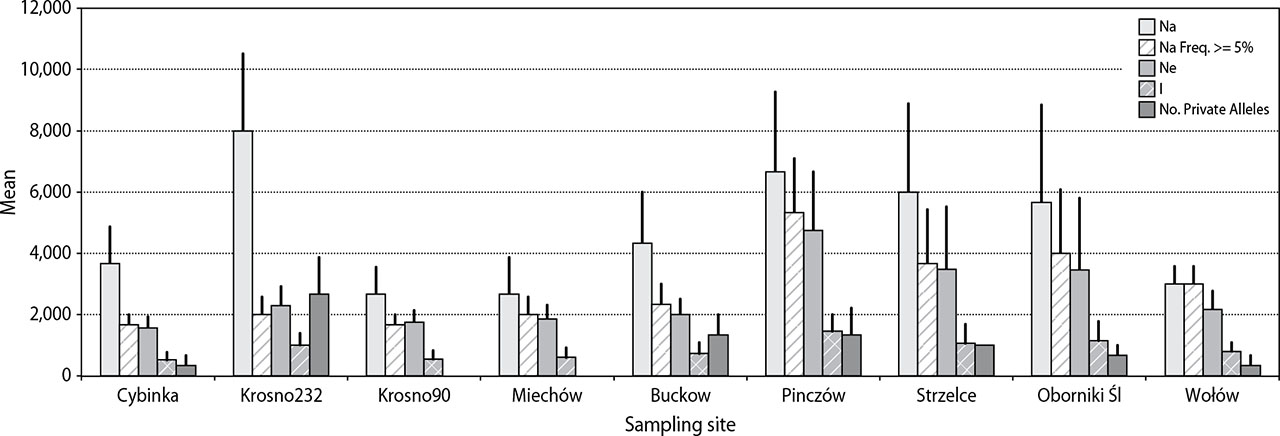
Figure 1.
Allelic patterns for R. pseudoacacia populations. Na – number of alleles per locus, Ne – number of effective alleles, I – Shannon's information index
Table 5.
The mean FIS and FIT values for population of R. pseudoacacia
| F-statistics | Value | P |
|---|---|---|
| FST | 0.412 | 0.001 |
| FIS | −0.170 | 0.649 |
| FIT | 0.246 | 0.001 |
| Nm | 0.771 |
Table. 6
Analysis of molecular variance (AMOVA) of genetic diversity of R. pseudoacacia populations
| Source | df | SS | MS | Est. var. | % |
|---|---|---|---|---|---|
| Among pops | 8 | 88.163 | 11.020 | 0.335 | 37 |
| Within pops | 275 | 157.488 | 0.573 | 0.573 | 63 |
| Total | 283 | 245.651 | 0.908 | 100 |
[i] df – degrees of freedom; SS – sum of squares; MS – mean square; est. var. – estimated variance.
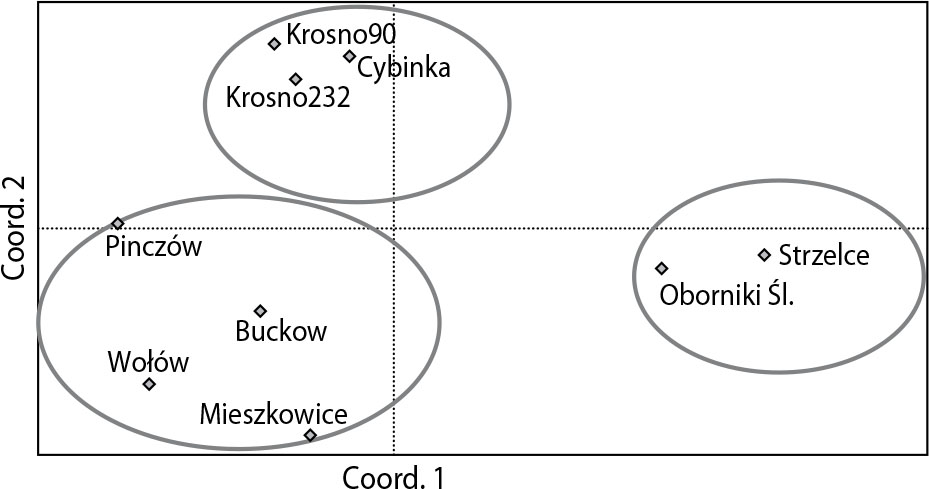
Figure 2.
Relationships among the populations of Robinia pseudoacacia. A principal coordinate analysis (PCoA) based on pairwise genetic distance estimates for all populations. Percentages of total variance explained by coordinates 1 and 2 accounting for 68.99 and 14.23%, respectively