
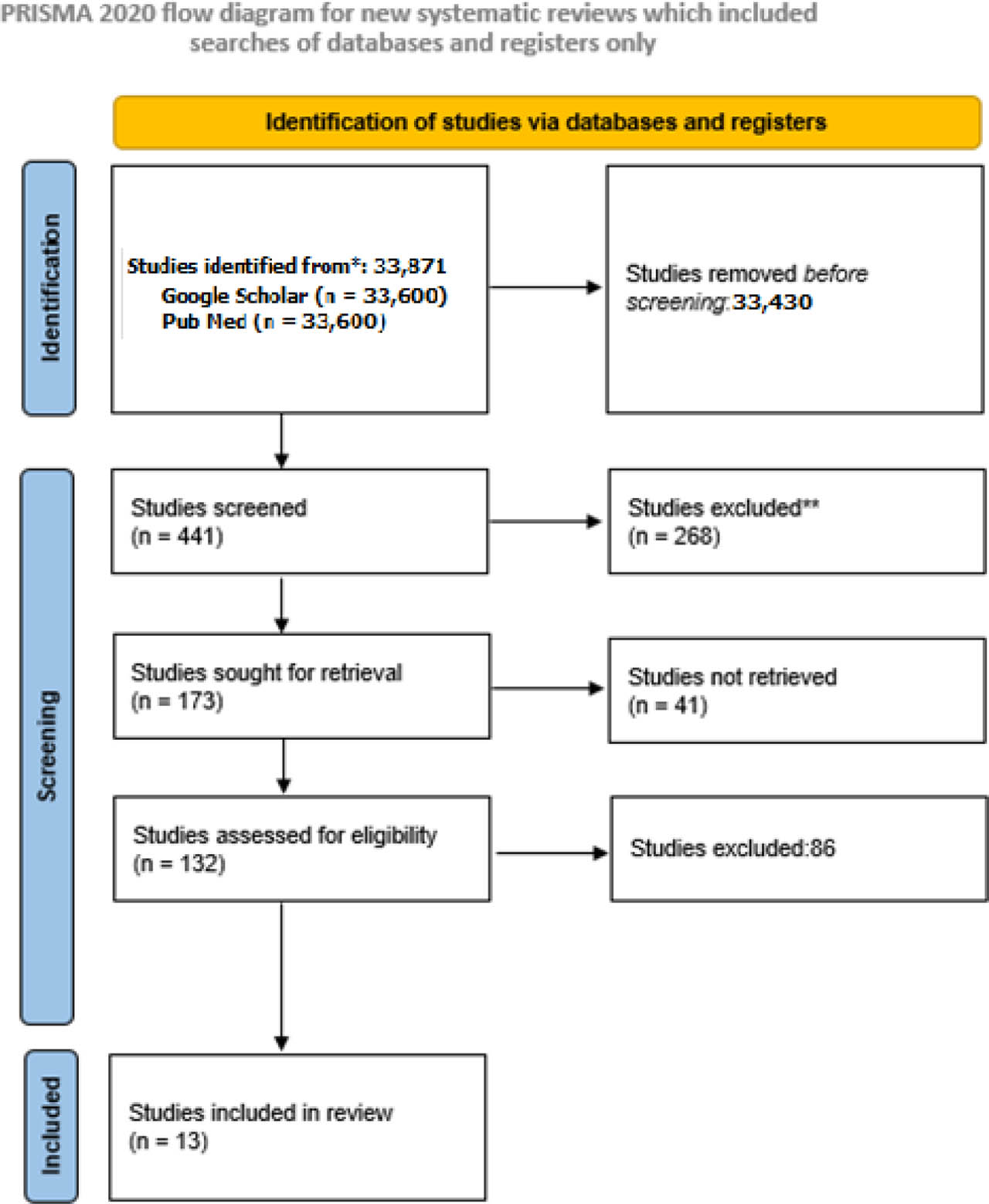
Chart 1:
PRISMA 2020 flow diagram for new systematic reviews which included searches of databases and registers only
Source: Page MJ, et al. BMJ 2021; 372:n71. doi: 10.1136/bmj.n71.
This work is licensed under CC BY 4.0. To view a copy of this license, visit https://creativecommons.org/licenses/by/4.0/
Table 1:
Findings of Systematic Review Studies.
| M | F | ||||
|---|---|---|---|---|---|
| Ferrell et al. (2020) | 211 | 268 | Miscellaneous cancers | FACIT-Sp12, Psychological Distress Scale, FACT-G QOL | Cancer patients have spiritual needs. Spiritual care should be provided to patients as a component of oncology and palliative care |
| Delgado-Guay et al. (2021) | 130 | 195 | Gastrointestinal (23%), breast (13%), gynecological (12%), other (26%) | FICA, ESAS-FS, PSWQ-A, CES-D, COPE & RCOPE, FACIT - Sp - Ex | Spirituality/religiosity is correlated with higher quality of life. These cancer patients need increased spiritual/religious support |
| Park et al. (2021) | 99 | 105 | Lung (21.6%), stomach (11.3%), colorectal (18.6%), other (43.7%) | FACIT-Sp12, EORTC QLQ-C15-PAL | Self-reported spirituality and religiosity showed better convergence with the feeling of inner struggle |
| Cannon, Dokucu & Loberiza (2022) | 350 | 201 | Leukemia, lymphoma, multiple myeloma (51.36%), breast, colorectal, prostate (36.47%), other (12.15%) | SF 12 Health Survey | Spirituality is important for improving both pQOL and mQOL of cancer survivors, while religiosity may have some impact on pQOL |
| Majda et al. (2022) | 45 | 56 | Urogenital (54%), digestive (46%) | DSES, EORTC QLQ-C30, EORTC QLQ-FA12 | Spirituality and religiosity positively influenced quality of life in areas such as physical, emotional, and social functioning |
| Tsoho & Soylar (2024) | 0 | 91 | Breast | EORTC QLQ-C30, FACIT-Sp12 | The level of quality of life and spiritual well-being of breast cancer patients was found to be poor. It is necessary to meet the needs of breast cancer patients with more psychospiritual interventions |
| Chen et al. (2021) | 0 | 705 | Gynecological | EORTC QLQ-SWB32, EORTC QLQ-C30, Hospital Anxiety & Depression Scale | Spiritual well-being is associated with lower anxiety and depression and better quality of life. Healthcare providers should provide spiritual care with psychological counseling |
| Lebowa et al. (2023) | 40 | 43 | Multiple | QLQ-C30, Centrality of Religiosity Scale by S. Huber, Emotions-toward-God Scale by S. Huber, Bartczuk.24, R-cope, The Religious Comfort and Strain Scale by J. Exline, Changing of Beliefs and Goals in the Illness Scale by D. Krok | High importance of spirituality and religiosity for patients' health-related quality of life |
| Yilmaz & Cengiz (2020) | 58 | 61 | Myeloma | FACIT-Sp12, v. 4, FACT-G, v. 4 | Spirituality and religiosity contributed positively to the quality of life of cancer survivors |
| Brandão et al. (2021) | 108 | Gastrointestinal (69.3%), breast (30.7%) | EORTC-QLQ-C30 WHOQOL-SRPB | Positive association of spirituality/religiosity with quality of life in women with breast cancer | |
| Nazam & Husain (2024) | 137 | 163 | Breast | Herth Hope Index, Meaning in Life Scale, Religious Spiritual Struggle Scale, and WHO-QOL-BRIEF | Addressing religious and spiritual concerns is critical to improving the overall quality of life of cancer patients |
| Narayanan et al. (2020) | 89 | 49 | Gallbladder, (20.7%), breast, (11.7%), other (67.6%) | Ironson–Woods Spirituality/Religiousness (SR), MDASI, BSI | Religious engagement is common among cancer patients and is rarely associated with psychological distress |
| Damen et al. (2021) | 144 | 187 | Kidney (100%) | ESAS, PDI, QUAL-E, RSS-14 | Spiritual/religious conflict may compromise the well-being of cancer patients receiving palliative care |
[i] List of Research Tools with Detailed Terminology: FACIT-Sp12 – Functional Assessment of Chronic Illness Therapy–Spiritual Well-Being (12-item scale), Psychological Distress Scale – Κλίμακα Ψυχολογικής Δυσφορίας, FACT-G QOL – Functional Assessment of Cancer Therapy – General (Quality of Life), FICA – Faith, Importance, Community, Address (Spiritual History Tool), ESAS-FS – Edmonton Symptom Assessment System – Financial Stress, PSWQ-A – Penn State Worry Questionnaire – Abbreviated, CES-D – Center for Epidemiologic Studies Depression Scale, COPE – Coping Orientation to Problems Experienced, RCOPE – Religious Coping Scale, FACIT - Sp - Ex – Functional Assessment of Chronic Illness Therapy – Spirituality Expanded, EORTC QLQC15-PAL – European Organisation for Research and Treatment of Cancer, Quality of Life Questionnaire Core 15 Palliative, SF 12 Health Survey – Short Form 12 Health Survey, DSES – Daily Spiritual Experience Scale, EORTC QLQ-C30 – European Organisation for Research and Treatment of Cancer Quality of Life Questionnaire Core 30, EORTC QLQ-FA12 – European Organisation for Research and Treatment of Cancer Quality of Life Questionnaire – Fatigue Module 12, EORTC QLQ-SWB32 – European Organisation for Research and Treatment of Cancer Quality of Life Questionnaire – Spiritual Wellbeing 32, Hospital Anxiety & Depression Scale (HADS), Centrality of Religiosity Scale (by S. Huber), Emotions-toward-God Scale (by S. Huber, Bartczuk), The Religious Comfort and Strain Scale (by J. Exline), Changing of Beliefs and Goals in the Illness Scale (by D. Krok), WHOQOL-SRPB – World Health Organization Quality of Life Instrument – Spirituality, Religiousness and Personal Beliefs, Herth Hope Index, Meaning in Life Scale, Religious Spiritual Struggle Scale, WHO-QOL-BRIEF – World Health Organization Quality of Life – Brief, Ironson–Woods Spirituality/Religiousness (SR) by Ironson–Woods, MDASI – M.D. Anderson Symptom Inventory, BSI – Brief Symptom Inventory, ESAS – Edmonton Symptom Assessment Scale, PDI – Pain Disability Index, QUAL-E – Quality of Life at the End of Life, RSS-14 – Religious and Spiritual Struggles Scale (14-item version).