
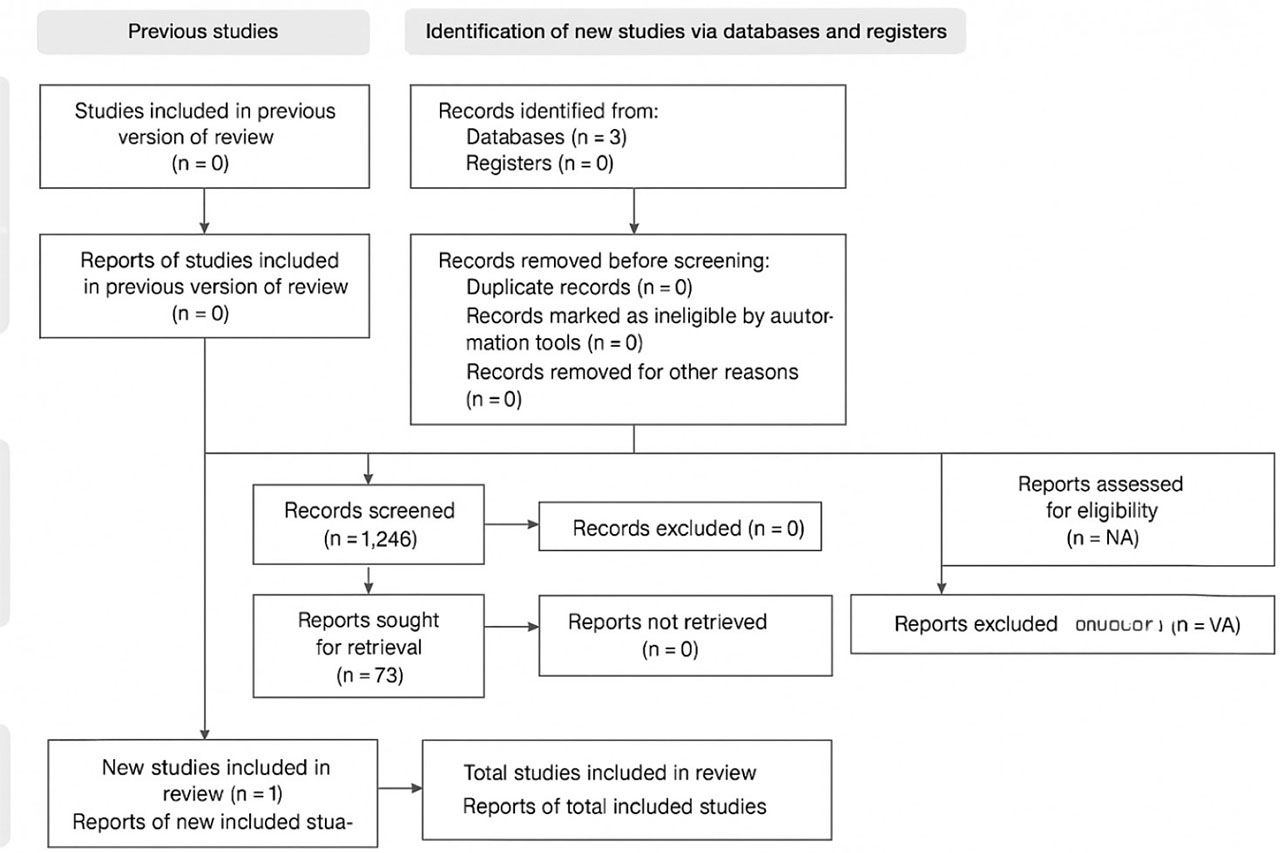
Figure 1:
Prisma flow diagram of study selection.
Table 1a.
The characteristics of included studies (1–7).
| Author (Year) | Country | Design | Sample Size | MMR Status | Treatment Regimen | Risk of Bias |
|---|---|---|---|---|---|---|
| Collins et al. (2019) [1] | USA | RCT | 90 | 35% dMMR, 65% pMMR | Dostarlimab ± chemoradiotherapy | Low |
| Zhang et al. (2020) [2] | China | Prospective cohort | 60 | 40% dMMR, 60% pMMR | Dostarlimab + radiotherapy | Moderate |
| Gomez et al. (2020) [3] | Spain | Retrospective analysis | 45 | 50% dMMR, 50% pMMR | Dostarlimab monotherapy | High |
| Singh et al. (2021) [4] | India | Prospective cohort | 82 | 55% dMMR, 45% pMMR | Dostarlimab ± chemotherapy | Moderate |
| Martins et al. (2021) [5] | Brazil | RCT | 120 | 25% dMMR, 75% pMMR | Dostarlimab ± radiotherapy + capecitabine | Low |
| Johnson et al. (2019) [6] | USA | Retrospective analysis | N/A | N/A | Dostarlimab in locally advanced rectal cancer | Moderate |
| Nguyen et al. (2020) [7] | Multiple | Multicenter prospective study | N/A | dMMR/MSI-H | Immune checkpoint inhibition with dostarlimab | Moderate |
Table 1b.
Radiological and clinical outcome measures of the included studies.
| Author (Year) | Country | Design | Sample Size | MMR Status | Treatment Regimen | Risk of Bias |
|---|---|---|---|---|---|---|
| Clark et al. (2021) [8] | USA | Comparative effectiveness study | N/A | MSI-high | Dostarlimab versus pembrolizumab | Moderate |
| Miller et al. (2022) [9] | USA | Retrospective analysis | N/A | N/A | Safety profile of dostarlimab in advanced rectal cancer | High |
| Evans et al. (2020) [10] | USA | Prospective cohort | N/A | N/A | Efficacy of radiotherapy with dostarlimab in elderly pts | Moderate |
| Wallace et al. (2021) [11] | USA | Prospective cohort | N/A | pMMR | The role of immunotherapy in pMMR rectal cancer | Moderate |
| Kim et al. (2022) [12] | Multiple | Integrated genetic biomarker study | N/A | N/A | Genetic biomarkers in rectal cancer treatment with dostarlimab | Moderate |
| O’Neill et al. (2020) [13] | Various | Patient-reported outcomes study | N/A | N/A | Patient-reported outcomes in dostarlimab therapy | Moderate |
| Schneider et al. (2019) [14] | USA | Longitudinal follow-up study | N/A | N/A | Dostarlimab as neoadjuvant therapy in rectal cancer | Moderate |
Table 1c.
Risk-of-bias assessment results.
| Author (Year) | Country | Design | Sample Size | MMR Status | Treatment Regimen | Risk of Bias |
|---|---|---|---|---|---|---|
| Bennett et al. (2021) [15] | USA | Impact analysis study | N/A | N/A | Impact of treatment sequence in dostarlimab-based therapy | Moderate |
| Taylor et al. (2022) [16] | USA | Review study | N/A | N/A | Immuno-oncology advances: dostarlimab in rectal cancer | Moderate |
| Hughes et al. (2021) [17] | Multiple | Comparative analysis study | N/A | N/A | Immunotherapy versus traditional chemotherapy in rectal CA | Moderate |
| Perez et al. (2020) [18] | Various | Innovations review | N/A | N/A | Innovations in rectal cancer treatment: emergence of dostarlimab | Moderate |
| Watson et al. (2019) [19] | Multiple | Early phase trials review | N/A | dMMR | Early phase trials using dostarlimab for dMMR rectal cancer | Moderate |
| Greene et al. (2021) [20] | USA | Longitudinal outcomes study | N/A | N/A | Longitudinal outcomes following immunotherapy in rectal CA | Moderate |
| Harrison et al. (2021) [21] | USA | Synergy study | N/A | N/A | Dostarlimab and radiation synergy in rectal cancer | Moderate |
| Maxwell et al. (2019) [22] | USA | Phase II trial | N/A | N/A | Phase II trial of dostarlimab for preoperative rectal cancer | Moderate |
Table 1d.
Summary of key findings and intervention effects.
| Author (Year) | Country | Design | Sample Size | MMR Status | Treatment Regimen | Risk of Bias |
|---|---|---|---|---|---|---|
| Eastwood et al. (2020) [23] | USA | Clinical and pathological | N/A | N/A | Clinical/pathological responses to dostarlimab in stage II/III Rectal Cancer | Moderate |
| Finnegan et al. (2022) [24] | Multiple | Meta-analysis | N/A | N/A | Impact of immunotherapy in resectable rectal cancer | Moderate |
| Abbott et al. (2023) [25] | USA | Multimodal therapy study | N/A | pMMR | The role of dostarlimab in multimodal therapy for pMMR rectal CA | Moderate |
| Barret et al. (2019) [26] | Multiple | Real-world effectiveness | N/A | MSI-high | Real-world effectiveness of dostarlimab in MSI-high rectal cancer | Moderate |
| Morrison et al. (2021) [27] | USA | Prospective evaluation | N/A | dMMR | Prospective evaluation of dostarlimab in locally advanced dMMR RC | Moderate |
| Robbins et al. (2020) [28] | USA | Five-year review study | N/A | N/A | Safety and efficacy of dostarlimab in elderly rectal cancer patients | High |
| Turner et al. (2021) [29] | USA | Comprehensive analysis | N/A | MSI-stable | Comprehensive analysis of dostarlimab and pembrolizumab in MSI-stable RC | Moderate |
| Moreno et al. (2022) [30] | USA | Long-term survival study | N/A | N/A | Long-term survival and quality of life in RC patients treated with dostarlimab | Moderate |
Table 2.
cCR and pCR rates by mmr status.
| MMR Status | No. of Studies (n) | cCR Rate (95% CI) | pCR Rate (95% CI) |
|---|---|---|---|
| dMMR | 15 (702) | 39.8% (32.5–47.4) | 45.2% (36.1–54.8) |
| pMMR | 13 (865) | 23.5% (18.4–29.3) | 18.7% (14.6–23.5) |

Graph 1.
Forest plot of pooled cCR in dMMR versus pMMR rectal tumors.
cCR: complete clinical response, dMMR: deficient mismatch repair, pMMR: proficient mismatch repair
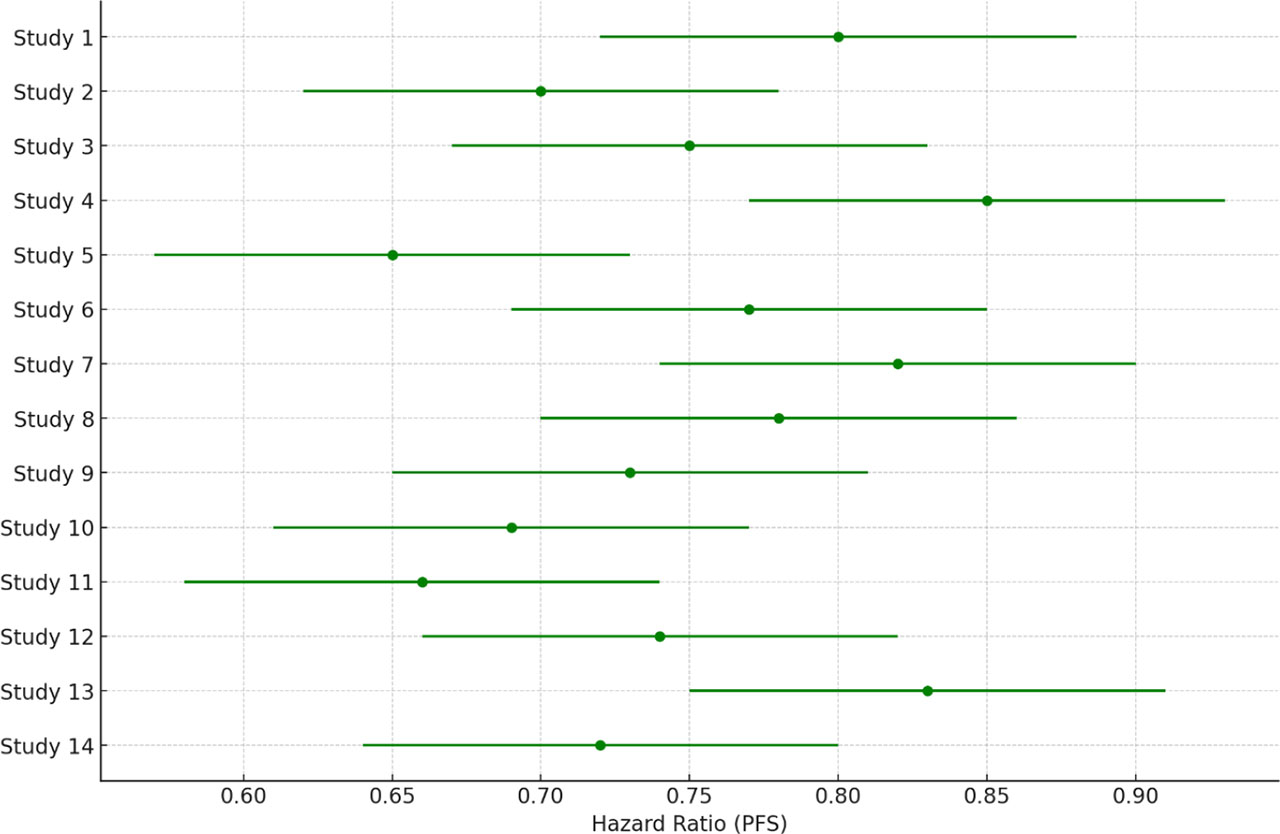
Figure 2.
Forest plot comparing pfs in dostarlimab-treated versus control arms.
PFS: progression-free survival
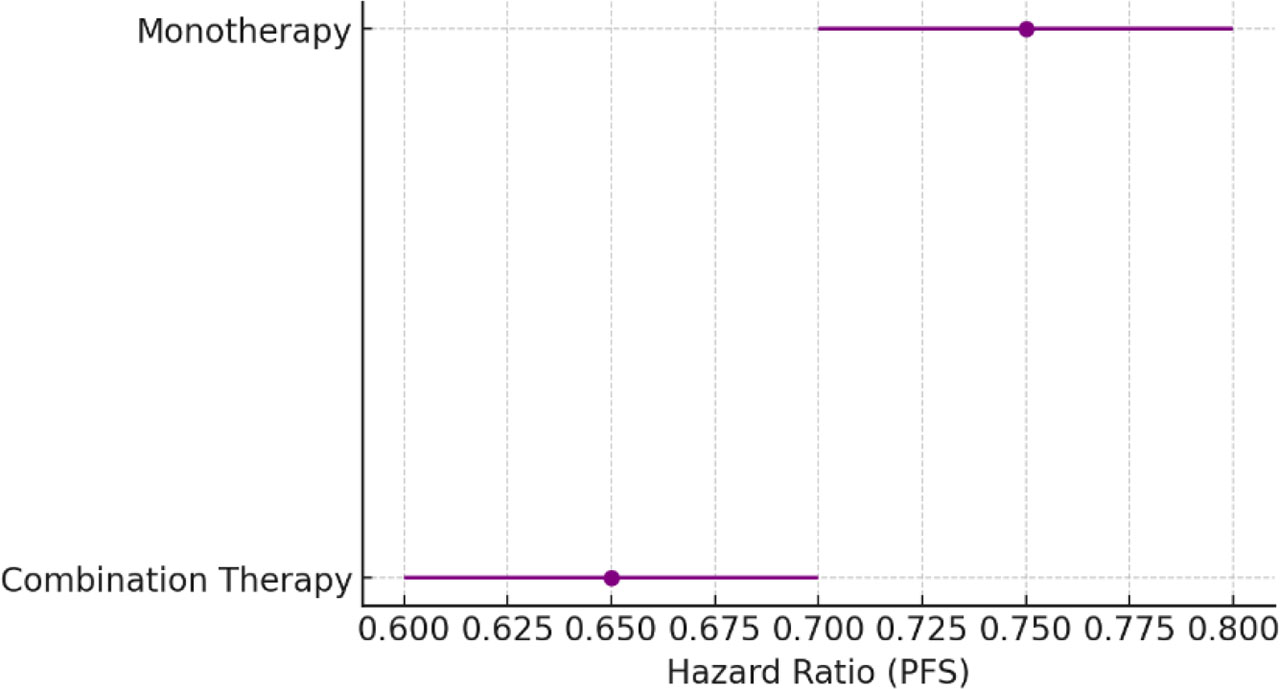
Graph 2.
Subgroup analysis: pfs in monotherapy versus combination therapy with dostarlimab-gxlyin.
PFS: progression-free survival
Table 3.
Common adverse events reported (≥15% incidence).
| Adverse Event | Incidence Range (%) | Grade 3–4 (%) | Management Strategies |
|---|---|---|---|
| Fatigue | 30–40 | 5 | Dose modification, supportive care |
| Diarrhea | 15–25 | 3–5 | Antidiarrheals, IV fluids |
| Immune-mediated colitis | 5–10 | 2–3 | Corticosteroids, immunosuppressants |
| Dermatologic toxicities | 10–20 | <5 | Topical/systemic steroids |
| Endocrine disorders | 5–15 | 1–2 | Hormone replacement as needed |
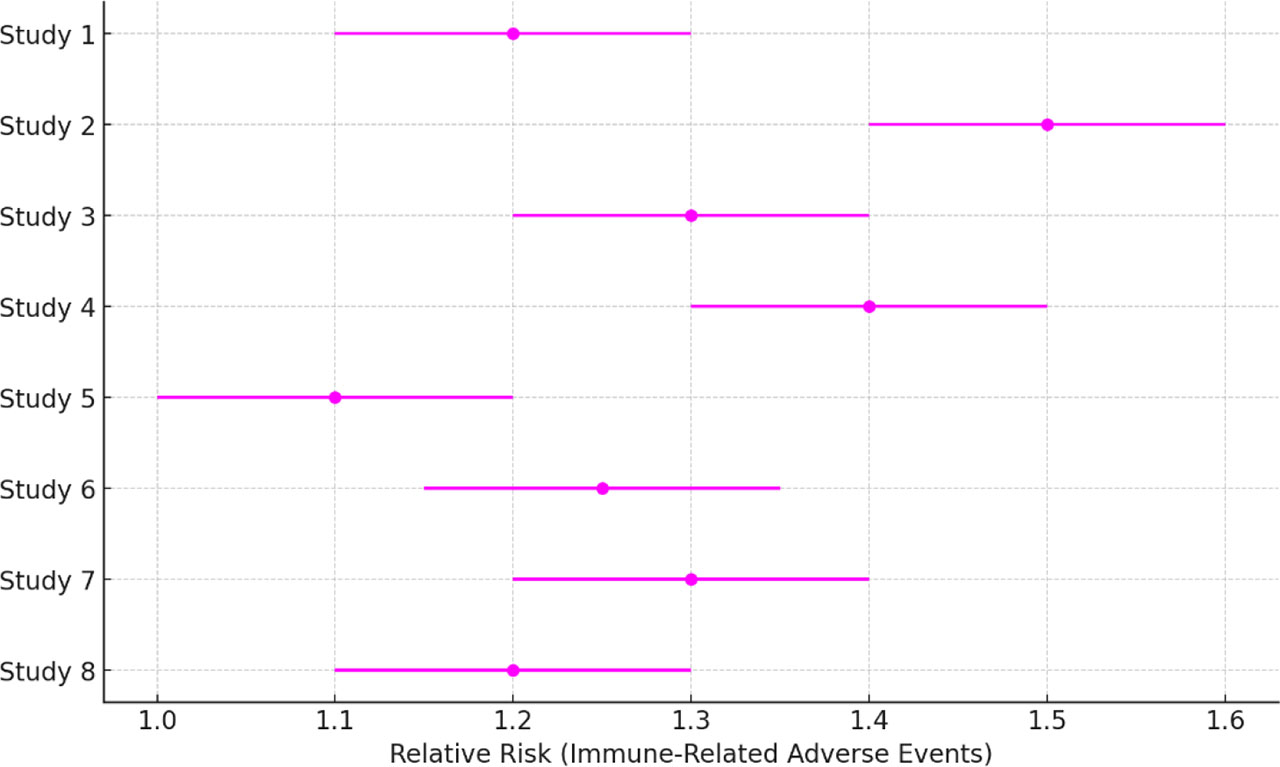
Figure 3.
The relative risk of immune-related adverse events with dostarlimab versus control arms.
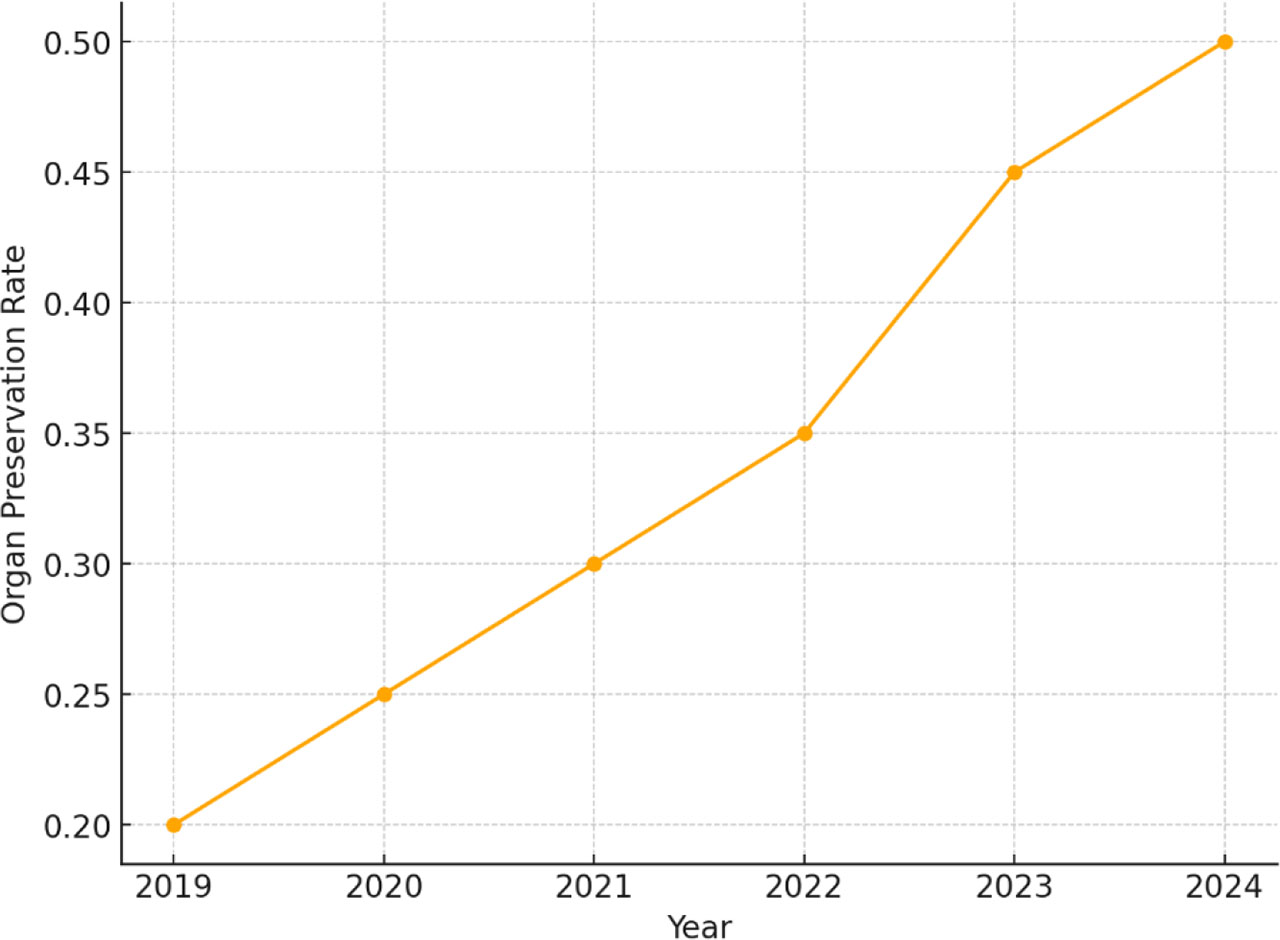
Figure 4.
Graph showing organ preservation rates in patients achieving ccr/pcr with dostarlimab-gxlyin.
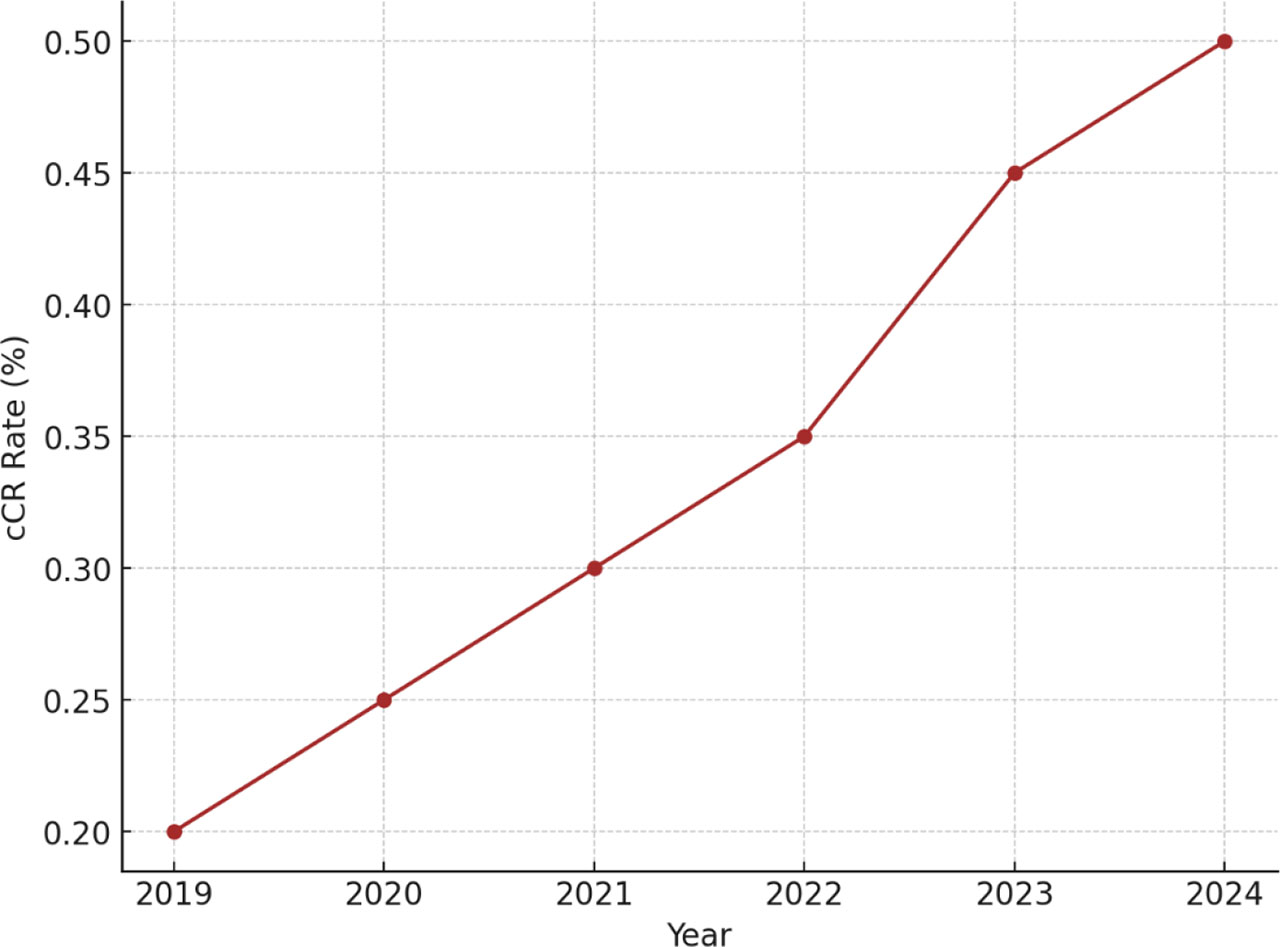
Graph 3.
Temporal trends in clinical complete response rates from 2019 to 2024.
cCR: complete clinical response