
1. Introduction
Acute myeloid leukemia (AML) is the most prevalent form of leukemia found in adults and is characterized by clonal expansion of blast cells within the peripheral blood and bone marrow. This leads to ineffective blood cell production in bone marrow[1]. Recent advancements in management guidelines have led to an increase in cure rates, reaching up to 15% for patients over 60 years old and about 40% for those under 60. However, the prognosis in elderly population is still very poor[2]. On the other hand, acute lymphoblastic leukemia (ALL) is characterized by the malignant proliferation of lymphoid progenitor cells within the bone marrow, bloodstream, and extramedullary regions. While 80% of ALL cases occur in children, there are significant challenges when this disease arises in adults. In the United States, the incidence of ALL is 1.6 cases per 100,000 people[3]. ALL incidence shows a bimodal pattern. The first peak happens in childhood, and the second peak occurs around age 50[4]. Endocan is a soluble dermatan sulfate proteoglycan that is expressed especially in endothelial cells but can also be detected in serum/plasma[5]. Endocan levels have been observed to increase in cancer patients, including those with untreated acute leukemia. Furthermore, obvious changes in its levels are affected by chemotherapy and inflammation[6]. Endocan expression levels were significantly reduced in patients who achieved remission after chemotherapy. However, this level increased again as acute leukemia recedes. In contrast, endocan expressed no change before and after chemotherapy in patients who did not experience remission[6]. A recent study has examined the predictive value of endocan in different types of human cancers. This analysis looked at two main areas: the local expression of endocan and the levels of endocan in serum and plasma. The results indicate that higher levels of endocan are linked to a worse prognosis in gastrointestinal cancers, such as gastric and colorectal cancer, as well as in hepatocellular cancer.[7] Additional research indicates that elevated levels of endocan are associated to a worse prognosis in pancreatic neuroendocrine tumors[8], non-small-cell lung cancer[9], ovarian cancer[10], melanoma[11], and prostate cancer[12].
2. Aim of the Work
To examine initial levels of endocan expression and to follow up on endocan levels at day 28 after chemotherapy and its relation to remission status in patients with acute leukemia.
2.1. Subjects and Methods
Study design: Our research team conducted a prospective observational study at Ain Shams University Hospitals, specifically in the Internal Medicine Department, Clinical Hematology, and Stem Cell Transplantation Unit. Over a period of six months, our target population consisted of patients with de novo acute leukemia who had recently been diagnosed and were treatment naïve.
Duration of the study: Six months
Inclusion criteria: Patients over the age of 18 years with de novo acute leukemia
Exclusion criteria:
Patients with other solid neoplasms
Patients with autoimmune diseases
Sample size: Forty-five patients with de novo acute leukemia either myeloid or lymphoid before and at day 28 after induction chemotherapy.
Clinical assessment: All recruited patients underwent a comprehensive assessment that included a thorough medical history, a full clinical examination, and various laboratory investigations. These investigations comprised routine and general evaluation tests, which included complete blood count (CBC); liver function tests (LFTs): aspartate transaminase (AST), alanine transaminase (ALT), total and direct bilirubin, and serum albumin; coagulation profile: prothrombin time (PT), international normalized ratio (INR), and partial thromboplastin time (PTT).
Additionally, disease-specific laboratory tests were performed, including bone marrow aspiration, flow cytometry, cytogenetic studies, and karyotyping using G-banding and fluorescence in situ hybridization (FISH) to identify genetic abnormalities.
A pilot study involving 10% of the sample assessed the feasibility and clarity of methods.
2.2. Statistical analysis
We used IBM SPSS (Statistical Package for Social Science) version 27 to code and manage the collected data. We presented quantitative data as means, standard deviations, and ranges when they were parametric. For non-parametric data, we provided medians and interquartile ranges (IQR). Qualitative variables were shown as counts and percentages. To compare qualitative data, we used the chi-square test or Fisher's exact test if any expected count was below 5. We applied the independent t-test for quantitative data with a parametric distribution. For non-parametric data, we used the Mann–Whitney test to compare two groups. The Wilcoxon Rank test was used for comparisons of two paired groups with non-parametric data. When comparing more than two groups with non-parametric quantitative data, we used the Kruskal–Wallis test. We calculated Spearman correlation coefficients to check how two quantitative parameters relate to each other in the same group. We used Kaplan–Meier analysis to assess the relationship between overall survival and other parameters, applying the log-rank test. We set the confidence interval to 95%, and the accepted margin of error was set to 5%. So, the P-value was introduced as follows: P-value > 0.05 is non-significant, P-value < 0.05 is significant, and P-value < 0.01 is considered highly significant.
3. Results
The patients in the study had an average age of 31.38 ± 10.36 years. Additionally, 55.6% (n = 25) of the patients were females, while 44.4% (n = 20) were males. According to the diagnosis, 44.4% (n = 20) were identified as having acute myeloid leukemia (AML), 51.1% (n = 23) had acute lymphoblastic leukemia (ALL), and 4.4% (n = 2) were diagnosed with biphenotypic leukemia. Among the AML cases, classified according to the French–American–British (FAB) classification, the distribution was as follows: 25% (n = 5) were classified as M1, 20% (n=4) as M2, 20% (n=4) as M3, 20% (n=4) as M4, and 15% (n = 3) as M5. For the cases of ALL, 47.8% (n=11) were categorized as B-cell ALL, while 52.2% (n = 12) were classified as T-cell ALL (Table 1).
Table 1:
Patient characteristics and disease categorization of analyzed patients.
| Total no. = 45 | ||
|---|---|---|
| Age | Mean ± SD | 31.38 ± 10.36 |
| Range | 14–56 | |
| Gender | Female | 55.6% (n = 25) |
| Male | 44.4% (n = 20) | |
| Comorbidities | Negative | 68.9% (n = 31) |
| Positive | 31.1% (n = 14) | |
| Diagnosis | AML | 44.4% (n = 20) |
| ALL | 51.1% (n = 23) | |
| FAB (AML) | Mixed phenotypic | 4.4% (n = 2) |
| M1 | 25% (n = 5) | |
| M2 | 20% (n = 4) | |
| M3 | 20% (n = 4) | |
| M4 | 20% (n = 4) | |
| M5 | 15% (n = 3) | |
| (ALL) | B ALL | 47.8% (n = 11) |
| T ALL | 52.2% (n = 12) |
Statistical analysis revealed a highly significant correlation between the median initial endocan level and the median post-induction endocan level, with a P-value of 0.000 (Table 2; Figure a).
Table 2:
Comparison between initial endocan level and post-induction endocan.
| Initial | Post-induction | Test value | P-value | Sig. | ||
|---|---|---|---|---|---|---|
| Endocan | Median (IQR) | 1950 (1637–2400) | 385 (234–500) | −5.481≠ | 0.000*** | HS*** |
| Range | 1100–2400 | 150–1617 |
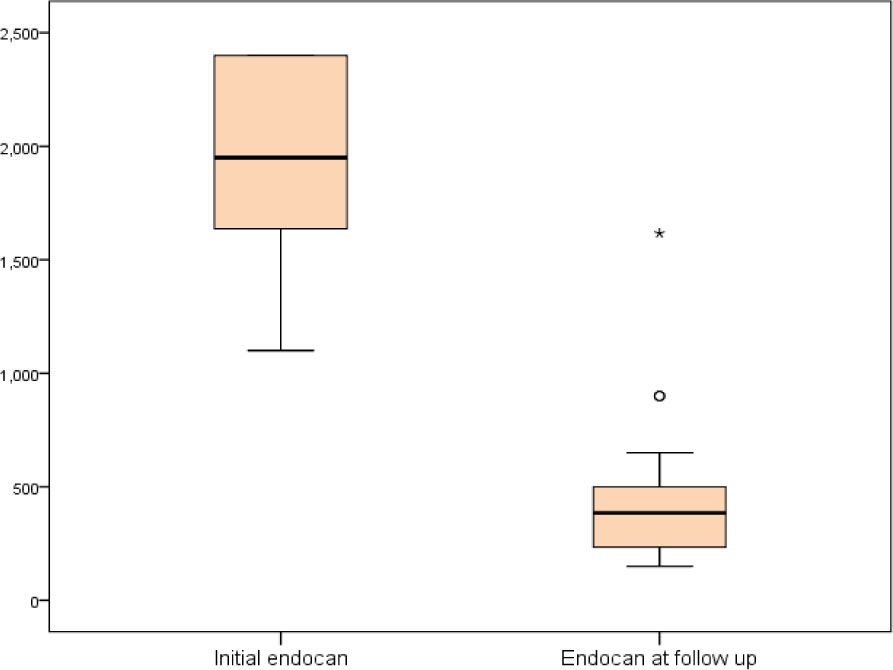
Fig. (a):
Comparison between initial endocan level and post-induction endocan level among the examined patients.
A nearly significant correlation was found between the initial endocan levels in responders and non-responder patients. The median initial endocan level in responders was 1915 ng/L, compared to a median endocan level of 2400 ng/L in non-responders, with a P-value of 0.066. In AML patients, this correlation approached significance with a P-value of 0.057, whereas in ALL patients, we found no significant correlation between median initial endocan expression in responders and non-responder patients, as demonstrated by a P-value of 0.578 (Tables 3 and 4).
Table 3:
Comparison of endocan levels in responders and non-responder patients.
| Responders | Non-responders | |||||
|---|---|---|---|---|---|---|
| No. = 40 | No. = 5 | |||||
| Initial endocan | Median (IQR) | 1915 (1582–2377.5) | 2400 (2300–2400) | −1.841≠ | 0.066* | NS |
| Range | 1100–2400 | 1885–2400 | ||||
| Post-induction endocan | Median (IQR) | 342 (231.5–500) | 496 (404–500) | −1.300≠ | 0.193* | NS |
| Range | 150–1617 | 302–615 |
Table 4:
Endocan levels in responders versus non-responders AML and ALL patients.
| Responders | Non-responders | |||||
|---|---|---|---|---|---|---|
| No. = 18 | No. = 2 | |||||
| Initial endocan | Median (IQR) | 1898 (1566–2356) | 2400 (2400–2400) | 1.905≠ | 0.057** | NS |
| Range | 1100–2400 | 2400–2400 | ||||
| Post-induction endocan | Median (IQR) | 388 (320–492) | 399 (302–496) | 0.126≠ | 0.900* | NS |
| Range | 202–900 | 302–496 |
| Responders | Non-responders | |||||
|---|---|---|---|---|---|---|
| No. = 20 | No. = 3 | |||||
| Initial endocan | Median (IQR) | 2251 (1663.5–2400) | 2300 (1885–2400) | 0.556≠ | 0.578* | NS |
| Range | 1150–2400 | 1885–2400 | ||||
| Post-induction endocan | Median (IQR) | 246 (210–510.5) | 500 (404–615) | 1.233≠ | 0.218* | NS |
| Range | 150–1617 | 404–615 |
However, no statistically significant correlation was observed between the post-induction endocan levels in responder patients and those in non-responders. The median post-induction endocan level in responder patients was 342 ng/L, while in non-responders, it was 496 ng/L, resulting in a P-value of 0.193 (Tables 3 and 4).
Regarding correlation of initial endocan level and the all-studied parameters, a statistically significant positive correlation was expressed between initial endocan and both LDH and initial bone marrow evaluation, with P-values of 0.001 and 0.002, respectively (Figure b and c).
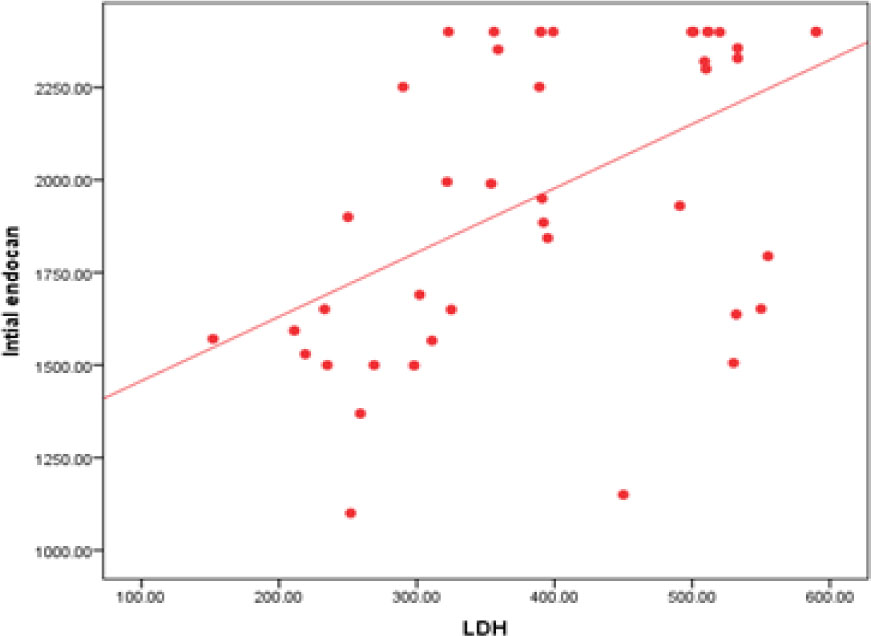
Fig. (b):
Correlation between initial endocan level and LDH level among the studied patients.
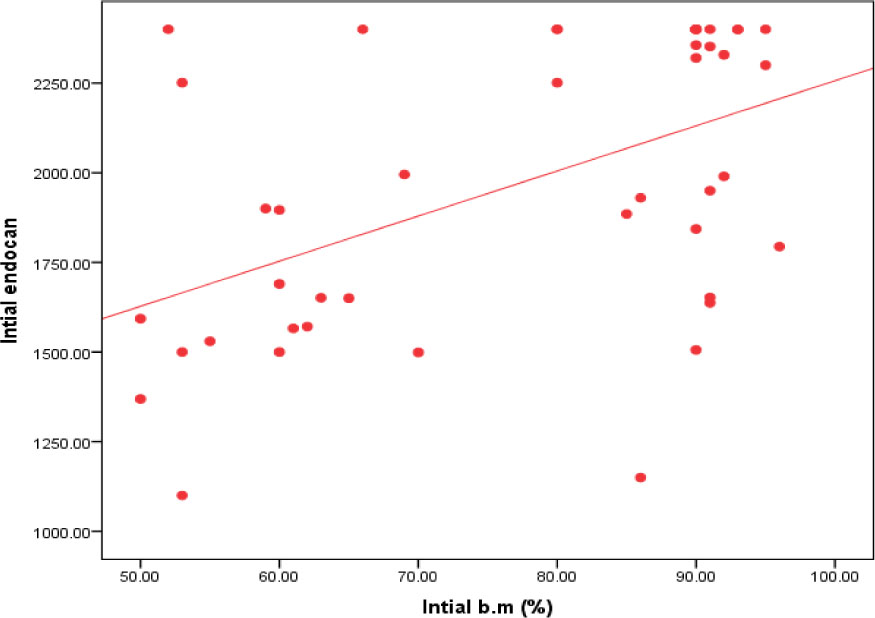
Fig. (c):
The correlation between initial endocan and initial bone marrow blasts percentage among the studied patients.
The assessment of endocan level in comparison with gender, comorbidities, and complications revealed non-significant correlation as indicated by P-value 0.963, 0.088, and 0.417, respectively.
In our study, mortality rate was 13.3% (n = 6), and overall survival (OS) was 3.87 months with a standard deviation of 1.73. Regarding remission status, 88.9% (n=40) were in complete remission (CR), while 11.1% (n=5) were not in remission. The mean ± SD of progression-free survival (PFS) was 3.44 ± 1.73 (Table 5).
4. Discussion
Our study assessed the initial expression of endocan levels and their follow-up at day 28 after induction chemotherapy, as well as their relation to remission status in patients with acute leukemia. This prospective observational study comprised 45 patients diagnosed with de novo acute leukemia. Endocan levels were assessed before and after the induction of chemotherapy.
Research conducted by Hatfield et al. (2011) examined endocan expression in 40 untreated AML patients (median age 61 years, 21 men and 19 women) and six ALL patients, and those levels were compared with 21 healthy controls and reported no significant associations between endocan levels and patient age or FAB classification (6). Our findings align with this, as we also did not observe a statistically significant relationship between endocan levels and age or FAB classification.
Steiner et al. (2018) had investigated endocan levels in 42 newly diagnosed MM patients, their age was ranging from 60 to 79 years, with 19 female patients and 23 male patients and showed a significant correlation between serum endocan and plasma cell percentage in the examined bone marrow, indicated by a P-value of 0.04[13]. Our study found a significant positive correlation between leukemic cell percentages and endocan levels with a P-value of 0.002. These findings suggest that infiltrating cells of the bone marrow may secrete angiogenic molecules, chemokines, and cytokines, which could stimulate overexpression of endocan.
Steiner et al. (2018) also showed statistically significant correlation between endocan level and LDH in multiple myeloma patients as indicated by a P-value of 0.009[13]. We agree with their findings, as we observed a significant positive correlation with a P-value of 0.001.
Roccaro et al. (2006) have observed in a cohort study involving multiple myeloma patients that endocan is not suitable for detecting relapse or refractoriness in multiple myeloma (MM)[14]. Reduced angiogenic activity in the bone marrow may explain this finding in relapsed or heavily pretreated MM patients, particularly after proteasome inhibitor-based therapies. This decrease in angiogenesis in relapsed or refractory MM leads to a lower secretion of angiogenesis molecules and cytokines into peripheral blood. As a result, there is presumably a reduced level of circulating endocan. Additionally, research by Reikvam et al. (2022) on patients with acute leukemia illustrated no significant difference in pre-induction endocan levels between responders and non-responder patients by statistical analysis[5].
Additionally, a research study conducted by Lin et al. (2017) involved 73 patients diagnosed with pancreatic neuroendocrine tumors following initial surgery or diagnostic sampling. The patients had a median age of 55 years (range 19–86, mean 52.8 years), and the follow-up lasted from 0.7 to 263 months (mean 87.5 months). The study found that elevated expression of endocan is an independent risk factor for recurrence, with a P-value of 0.018[8].
In our research, we examined the median initial endocan levels in both responders and non-responder acute myeloid leukemia (AML) patients. The findings revealed a nearly significant correlation, with a P-value of 0.057, which could be a result of the limited number of participants. The median initial endocan level for patients who achieved complete remission was 1915 ng/L, while it was higher at 2400 ng/L for those who did not achieve remission. While in ALL patients, the correlation between the median initial endocan levels in responders and non-responder patients was non-significant, as demonstrated by a P-value of 0.578.
Reikvam et al. (2022) reported a significant decrease in post-induction endocan compared to the initial levels before induction, indicated by a P-value of less than 0.0004[5]. We found similar results in our research, with highly significant correlation between median initial endocan levels and mean post-induction levels, yielding a P-value of 0.000. This decreases likely indicates a lower burden of leukemia cells. In summary, we found a positive correlation between the leukemic cells' percentage in bone marrow and the initial levels of endocan. Additionally, a significant decrease in the median post-induction endocan levels was observed compared to the initial levels.
4.1. Limitation
While the expression of endocan was found to be significantly elevated in patients with acute leukemia, its ability to detect non-responder patients was inconclusive. The study emphasizes the need for larger sample sizes and further investigation into the interplay between endocan level and non-remission in acute leukemia patients. Overall, these findings contribute to the understanding of endocan level potential prognostic significance in acute leukemia patients and warrant further exploration of its role in leukemogenesis.
5. Conclusion
Pre-induction endocan levels are significantly higher in patients with acute leukemia compared to levels measured after remission induction. There is a nearly significant correlation between endocan levels and remission status in patients with acute myeloid leukemia (AML), with non-responder patients showing higher values. But no significant correlation is observed in patients with acute lymphoblastic leukemia (ALL). Furthermore, a significant positive correlation was found between initial endocan and both lactate dehydrogenase and the initial bone marrow evaluation. Therefore, endocan levels may have potential prognostic significance in acute leukemia. Further larger trials are needed to validate the endocan levels as a prognostic biomarker in acute leukemia patients.
Notes
[10] Ethical approval
Before starting the study, the researchers obtained written permission from the dean of faculty of medicine at Ain Shams University Hospital, ensuring the confidentiality of participants' information. The purpose and goals of the study were clearly communicated to them to ensure their active participation.
[11] Consent to participate
Informed consent was obtained from all individual participants included in the study. The researchers introduced themselves to the participants and asked them to join the study after explaining its purpose. They gave each participant clear information about the study's goals and the benefits of taking part. They addressed all ethical concerns throughout the project.
[12] Consent to publish
Additional informed consent was obtained from all individual participants for whom identifying information is included in this article.
[13] Contributed by Authors' contributions
All authors contributed to the study conception and design. Material preparation, data collection, and analysis were performed by Rasha Magdy Mohamed Said, Tamer Mohamed Ahmed, Rana Zakria Abbas, Heba Samy Agamy, Raed Akram Shamkh, and Basma Saeid Mansour Ali. The first draft of the manuscript was written by Basma Saeid Mansour Ali, and all authors commented on previous versions of the manuscript. All authors read and approved the final manuscript.
[14] Financial disclosure Funding
The study was totally afforded by the researchers, and no external support was provided for this work.