
1. Introduction
Worldwide, one in every 100,000 persons is diagnosed with acute lymphoblastic leukemia (ALL) yearly[1]. There are two age peaks of presentation of the disease: one in children aged 1 to 4 years and the other one in adults above 50 years old. Older ages with ALL have a worse prognosis and higher rates of mortality[2].
Thyroid dysfunction is seen in childhood ALL. Studies showed affection of up to 18% of ALL patients. However, few studies assessed this in adults with ALL[3]. Moreover, it was reported in a recent study that hypothyroidism occurred in the induction phase[4]. Another study conducted on children with different non-pituitary cancers reported a decline in FT4 3 months after initiating treatment[5].
In this context, one should differentiate between euthyroid sick syndrome (ESS) as a physiologic state and pathologic thyroid or central insult that will need therapy[6,7,8]. Gökbuget et al. found hypothyroidism in 5% and hyperthyroidism in 1% of adults with ALL in a questionnaire-based study[9].
More recently, cellular expression of thyrotropin-releasing hormone (TRH) was found to positively correlate with the outcome of adult acute myeloid leukemia (AML). This was more significant than ALL and they related this to some genetic changes occurring specifically in AML[10].
Thus, the aim of this study was to assess the thyroid profile in adult ALL and find out the relationship between TRH level and the clinical outcome of the patients.
2. Patient and Methods
A prospective observational study was conducted between January 2024 and June 2024. Forty-four newly diagnosed ALL patients of both genders were chosen among those attending the Hematology and Oncology department at Ain Shams University Hospitals. All study subjects were above 15 years old. They were evaluated both at the time of diagnosis and following the first round of induction therapy. Patients who had relapsed disease, had long-standing thyroid disorder prior to the development of ALL, had other comorbidities such as renal failure, chronic liver disease, autoimmune, or endocrinal disorders were excluded.
3. Methodology
3.1. Study Tools
Detailed clinical assessment and laboratory evaluation were done for all patients. A full history was obtained from all patients, with a special emphasis on personal history (age and gender), present history (full analysis of symptoms especially anemic symptoms, symptoms of recurrent infections, and bleeding tendency), past history (diabetes mellitus, hypertension, surgical intervention, chemotherapy, and radiotherapy exposures), family cancer history, and drug allergy. All patients were clinically examined thoroughly.
Investigations included complete blood count, blood film, bone marrow aspirate (flowcytometry, cytogenetics, and karyotyping), and pre- and post-chemotherapy thyroid profile (T3 by 3,5,3′-Triiodothyronine ELISA Test Kit, T4 by enzyme immunoassay test kit, T4, BIOS, thyroid-stimulating hormone (TSH) by enzyme immunoassay test kit, and TSH, BIOS, TRH by ELISA Kit, BT LAB).
In the TRH assay, the wells are initially coated with a Human TRH antibody. When the sample containing TRH is introduced, it binds to the antibodies on the plate. Following this, a biotinylated Human TRH antibody is added, which attaches to the TRH present in the sample. Subsequently, Streptavidin-horseradish peroxidase (HRP) is introduced, which binds to the biotinylated TRH antibody. Any unbound Streptavidin-HRP is eliminated during a washing step. Next, a substrate solution is introduced, resulting in color development that reflects the amount of Human TRH present in the sample. The reaction is stopped by adding an acidic stop solution, and the absorbance is subsequently measured at 450 nm.
For the T3 assay, the ELISA test operates on a solid-phase, one-step competitive incubation principle. In this setup, T3 competes with a T3 antigen linked to HRP conjugate for a limited amount of purified anti-T3 that is pre-coated in the wells. During the washing phase, any unbound HRP conjugate is eliminated. After adding chromogen solutions A and B and allowing for incubation, the results are analyzed using an enzyme microplate reader.
3.2. Definition of Thyroid Profile results
Euthyroid is defined as TSH and thyroid hormones within the reference range. Subclinical hypothyroid is a mild form of hypothyroidism where the only abnormal hormone level is an elevated TSH[11]. Central hypothyroid results from diseases of the pituitary and/or hypothalamus causing low TSH and/or TRH with low thyroid hormones[12]. ESS is a non-thyroidal illness that happens during critical conditions. Most commonly, a diminished free and total T3 with low to normal T4 and TSH is found[13]. Subclinical hyperthyroid is a mild form of hyperthyroidism where the only abnormal hormone level is a low TSH[11]. Primary hyperthyroidism is a form with elevated T3 and T4 and low TSH[14].
3.3. Statistical analysis
Data analysis was performed using the Statistical Package for Social Sciences (SPSS) version 16.0 (SPSS Inc., Chicago, Illinois, USA). The Kolmogorov–Smirnov test was initially applied to assess the normality of the data. For normally distributed variables, mean and standard deviation (SD) were reported, while median and inter-quartile range (IQR) were used for non-normally distributed data. Qualitative variables were summarized using frequency counts and percentages. In the statistical analyses, a p value greater than 0.05 was deemed non-significant, whereas a p value less than 0.05 indicated significance.
3.4. Ethical considerations
Confidentiality and privacy were preserved for all the study subjects. The protocol for this study was approved by the Research Ethics Committee, Faculty of Medicine, Ain Shams University, Cairo, Egypt (FWA000017585).
All participants in the study (or their parents) signed informed consents before enrollment. All the study procedures and potential risks were discussed with them at the time the consents were given.
4. Results
As regards basic data, a total of 44 patients were included in the study, 37 males and 7 females. Their ages ranged from 15 to 60 years (mean age 29.56 ± 13.91 years). Few patients showed comorbidities such as diabetes mellitus, hypertension, and chronic kidney disease. The remaining 41 patients (94%) did not show any comorbidities. Fundus abnormalities were found in 18 patients (41%). Almost all patients had enlarged lymphadenopathy and/or hepatosplenomegaly (43/44, 97.8%). Extramedullary disease was uncommon (1/44, 2.2%). CNS disease was negative in all cases. The median of TLC was 37.50 × 10³/ul (with IQR = 16.20–76.00), while the median of platelets was 51.00 × 10³/ul (with IQR = 31.00–102.00) (Table 1).
Table 1:
Demographic data of the study population.
| Baseline clinical characteristics | Patient group (N = 44) |
|---|---|
| Age (years), mean (SD), (range) | 29.56 13.91, (15–60) |
| < 39 years | 84% (37/44) |
| > 40 years | 16% (7/44) |
| Gender | |
| Male | 84% (37/44) |
| Female | 16% (7/44) |
| Type of ALL | |
| B-ALL | 77.2% (34/44) |
| T-ALL | 22.7% (10/44) |
| Karyotyping | |
| Normal | 96% (42/44) |
| Abnormal | 4% (2/44) |
| Cytogenetics | |
| Philadelphia chromosome (+) | 18.18% (8/44) |
| Philadelphia chromosome (−) | 77.27% (34/44) |
| Others (7q31/7q22& monosomy 7 negative, Del7q31+11 positive) | 4% (2/44) |
| Comorbidities | |
| NonComorbid (DM, HTN, CKD) | 94% (41/44) |
| 6% (3/44) | |
| Chemotherapy regimen | |
| HCVAD | 57% (25/44) |
| CALGB | 34% (15/44) |
| Total 15 | 5% (2/44) |
| Others | 4% (2/44) |
| Minimal residual disease (MRD) | 0.009 (0.001–0.06) |
| Positive (>0.01 %) | 27% (12/44) |
| Negative (<0.01 %) | 54% (24/44) |
| Not available as patient died in induction | 19% (8/44) |
| Disease status after induction | |
| Remission | 59% (26/44) |
| Relapsed | 22 % (10/44) |
| Patient died during induction | 18% (8/44) |
| 6 months survival rate | |
| Alive | 70% (31/44) |
| Dead | 30% (13/44) |
| Disease-free survival (months),(SD), range | 7.85 (6.46), 2–24 |
With regard to risk stratification of the study population, 11 cases were high risk (24%), 33 cases were low risk (76%), 34 cases were B-cell acute lymphoblastic leukemia (B-ALL) (78%), and 10 cases were T-cell acute lymphoblastic leukemia (T-ALL) (22%). Karyotype was abnormal in only two patients (4%). Philadelphia chromosome was positive in 8/44 (18%) and negative in 34/44 (78%). Uncommon mutations included 7q31/7q22 plus monosomy 7 negative in one case (2%) and Del7q31+11 positive in another patient (2%) (Table 1).
The most commonly used therapeutic regimens were HCVAD (25/44, 55%) and CALGB (15/44, 43%). Two patients (5%) received a total of 15 regimens, and two patients were resistant and received multiple chemotherapy regimens (Table 1).
As regards thyroid status, all initial T3, T4, TSH, and TRH were statistically significantly lower than post-chemotherapy results (with p value = 0.001, 0.007, 0.035, and < 0.00,1 respectively) (Table 2).
Table 2:
Thyroid function tests of the study population before and after chemotherapy induction.
| Initial | Post-chemo | t | p | |
|---|---|---|---|---|
| Mean ± SD | Mean ± SD | |||
| T3 | 2.94 ± 0.79 | 3.25 ± 0.80 | 3.73 | 0.001 |
| T4 | 1.35 ± 0.40 | 1.54 ±0.39 | 2.87 | 0.007 |
| TSH | 1.64 ± 1.22 | 1.94 ± 1.09 | 2.17 | 0.035 |
| TRH | 124.40 ± 96.03 | 338.16 ± 167.08 | 7.86 | < 0.001 |
Post-induction chemotherapy T3, T4, TSH, and TRH levels did not differ significantly between patients receiving HCVAD or CALGB (Table 3).
Table 3:
Post-induction chemotherapy thyroid function tests of patients receiving HCVAD Vs those receiving CALGB.
| HCVAD | CALGB | t | p | |
|---|---|---|---|---|
| Mean ± SD | Mean ± SD | |||
| T3 | 3.22 ± 0.85 | 3.53 ± 0.52 | 1.11 | 0.054 |
| T4 | 1.59 ± 0.36 | 1.50 ± 0.32 | 0.67 | 0.511 |
| TSH | 1.69 ± 1.19 | 2.31 ± 1.04 | 1.49 | 0.146 |
| TRH | 344.45 ± 178.86 | 317.01 ± 158.93 | 0.42 | 0.674 |
Initial T3 and T4 did not show a statistically significant correlation with age, comorbidity, TLC, Hb, platelets, risk stratification, initial bone marrow aspirate, initial flow, karyotyping, cytogenetics, overall survival, disease status, disease-free survival, post-chemotherapy MRD, and post-chemotherapy aspirate (Table 4).
Table 4:
Correlations between initial thyroid function tests and different factors.
| Initial T3 | Initial T4 | Initial TSH | Initial TRH | |||||
|---|---|---|---|---|---|---|---|---|
| r | p | r | p | r | p | r | p | |
| Age | −0.07 | 0.648 | 0.19 | 0.211 | −0.26 | 0.085 | 0.001 | 0.995 |
| Comorbidity | 0.23 | 0.129 | 0.01 | 0.948 | 0.05 | 0.744 | 0.23 | 0.129 |
| TLC | 0.001 | 0.995 | 0.18 | 0.513 | 0.11 | 0.472 | 0.08 | 0.601 |
| Hb | 0.10 | 0.513 | 0.07 | 0.648 | 0.05 | 0.744 | 0.07 | 0.648 |
| Platelets | 0.17 | 0.264 | 0.10 | 0.513 | 0.03 | 0.845 | 0.01 | 0.948 |
| Risk stratification | 0.01 | 0.948 | 0.26 | 0.085 | 0.17 | 0.264 | 0.03 | 0.845 |
| Diagnosis | 0.19 | 0.211 | 0.27 | 0.073 | 0.20 | 0.188 | 0.29 | 0.053 |
| Initial bone marrow aspirate | −0.14 | 0.359 | −0.29 | 0.053 | −0.19 | 0.211 | −0.01 | 0.948 |
| Initial flow | −0.21 | 0.166 | −0.20 | 0.188 | −0.29 | 0.053 | −0.08 | 0.601 |
| Karyotyping | −0.17 | 0.264 | 0.02 | 0.896 | −0.14 | 0.359 | 0.07 | 0.648 |
| Cytogenetics | −0.23 | 0.129 | −0.001 | 0.995 | −0.18 | 0.513 | −0.07 | 0.648 |
| Overall survival | −0.001 | 0.995 | −0.04 | 0.794 | −0.09 | 0.557 | −0.30 | 0.045 |
| Disease status | −0.12 | 0.432 | −0.13 | 0.395 | −0.16 | 0.294 | −0.21 | 0.166 |
| Disease-free survival | −0.04 | 0.794 | −0.01 | 0.948 | −0.33 | 0.027 | −0.30 | 0.045 |
| Post-chemotherapy MRD | −0.16 | 0.294 | −0.10 | 0.513 | −0.17 | 0.264 | −0.11 | 0.472 |
| Post-chemotherapy aspirate | −0.07 | 0.648 | −0.11 | 0.472 | −0.04 | 0.794 | −0.04 | 0.794 |
Initial TSH showed a statistically significant negative correlation with disease-free survival (with r = −033 and p = 0.027). However, it did not show a statistically significant correlation with the above-mentioned parameters. Initial TRH showed a statistically significant negative correlation with overall survival and disease-free survival (with r = −030 and −030 and p = 0.45 and 0.45, respectively). However, it did not show a statistically significant correlation with the above-mentioned parameters (Table 4).
Multiple regression analysis showed that initial TSH was the most significant determining factor of disease-free survival (with = −0.34 and p = 0.029). On the other hand, multiple regression analysis showed that karyotyping was found to be the most significant determining factor of overall survival in multiple regression analysis (with = 0.46 and p = 0.049, respectively).
Post-chemotherapy T3, T4, TSH, and TRH did not show a statistically significant correlation with overall survival, disease-free survival, post-chemotherapy MRD, and disease status.
The Kaplan–Meier curve assessment of disease-free survival with both pre- and post-chemotherapy thyroid profiles showed the best results with euthyroid state and sick euthyroid syndrome (Figures 1 and 2).
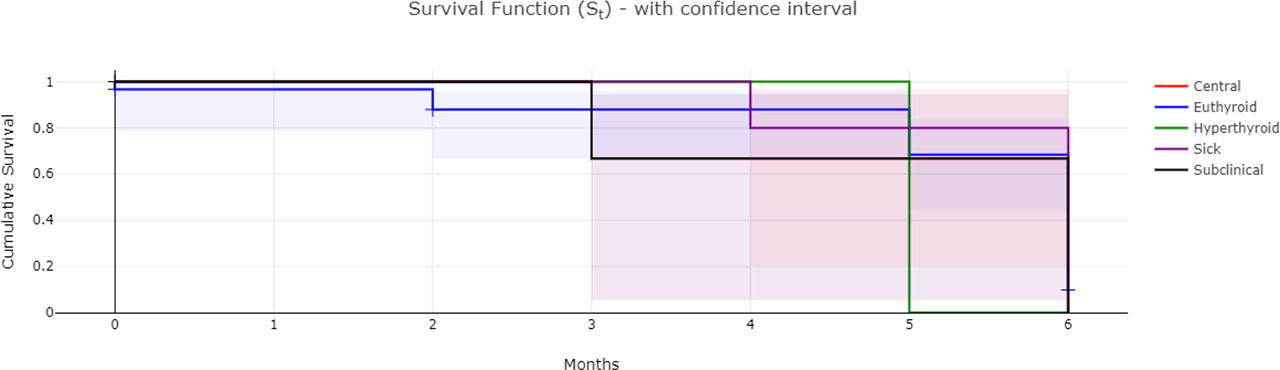
Figure 1:
Relation of the type of initial thyroid profile to overall survival in ALL by Kaplan–Meier assessment.
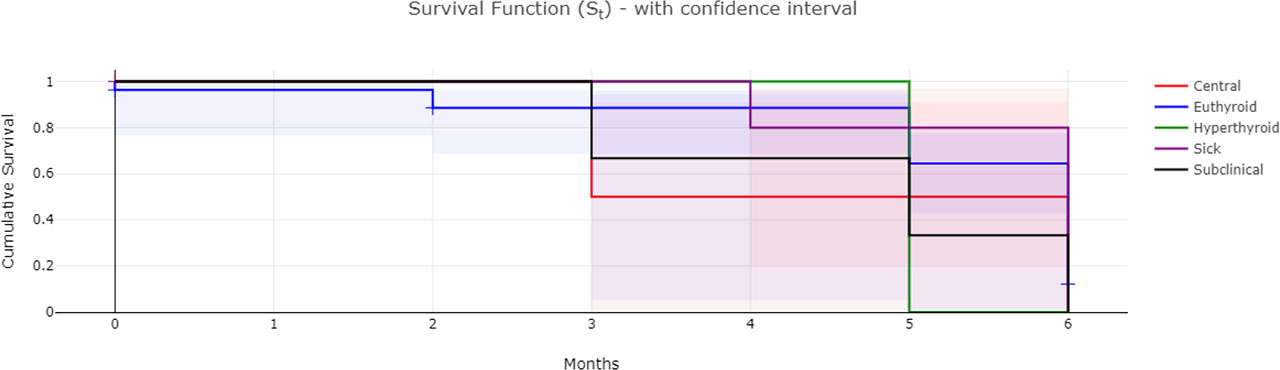
Figure 2:
Relation of the type of post-induction thyroid profile to overall survival in ALL by Kaplan–Meier assessment.
5. Discussion
ALL can lead to different complications in different body systems including the thyroid functions. This may be due to the disease process itself or the therapeutic regimens, which was studied thoroughly in pediatric more than adult ALL. To our knowledge, the association between this thyroid dysfunction and the outcomes of adult ALL has not been previously investigated.
In this study, a total of 44 patients were included. Their mean age was 29.56 ± 13.91 years. The majority of patients (84%) were between 15 and 39 years old. Seven patients were 40–60 years old. A significant male preponderance was observed (84%). There is an agreement with several articles (15–18) that explain the analysis and outcomes as we recruited the patients of the current investigation using the convenience sample method.
B-ALL subtype was more commonly encountered among the patients of the current study (34 patients = 77.2%) than T-ALL (10 patients = 22.8%). Malakoutikhah et al. (17) reported a similar distribution of B-All.
Thyroid profile before initiating induction chemotherapy was euthyroid in 29 patients (65.91%), ESS in 7 patients (15.91%), subclinical hypothyroid in 3 patients (6.81%), subclinical hyperthyroid in one patient (2.27%), central hypothyroid in 3 patients (6.81%), and hyperthyroid in one patient (2.27%). Pasqualin et al. (19) found that mild primary hypothyroidism was frequently encountered in ALL patients.
Initial TRH showed a statistically significant negative correlation with overall survival (p = 0.45). Both initial TRH and TSH showed a statistically significant negative correlation with disease-free survival (p = 0.027 and 0.045, respectively). Regression analysis showed that initial TSH is the only significant determining predictor of disease-free survival (p = 0.029).
Post-induction thyroid profile was euthyroid in 25 patients (56.82%), euthyroid sick syndrome in 6 patients (13.64%), subclinical hypothyroid in 2 patients (4.55%), subclinical hyperthyroid in (2.27%), central hypothyroid in 2 patients (5.55%), and hyperthyroid in 1 patient (2.27%). Seven patients (15.91%) died, so they do not have a post-induction results.
All initial T3, T4, TSH, and TRH were statistically significantly lower than post-chemotherapy induction (with p value = 0.001, 0.007, 0.035, and < 0.001, respectively). Howard and Pui[20] considered peripheral hypothyroidism and central hypothyroidism as rare complications in ALL in the induction phase in the absence of cranial irradiation. However, the included protocols and dosage used were different from the ones used in our current study. Karakaya et al.[21] reported accidentally discovered hypothyroidism with no symptoms in only 1 of 38 disease survivors. No thyroid gland structural abnormalities were found in ultrasound. Thyroid autoantibodies were undetected. The patient had not had any previous cranial radiation.
With regard to other hematological malignancies, Gao et al.[10] found that the TRH cellular expression level was higher in AML patients than those with ALL, CLL, CML, and MDS. They assessed the cellular expression, but neither the serum level nor the whole thyroid functions were tested.
The demonstrated lower initial thyroid profile in our current study might reflect the direct effect of ALL itself rather than the mere effect of therapeutic regimens.
The correlation matrix of the initial thyroid profile showed a statistically significant negative correlation between overall survival with initial TRH (with p = 0.45). On the other hand, disease-free survival showed a statistically significant negative correlation with initial TSH and TRH (with p = 0.027 and 0.45, respectively). Gao et al.[10] measured the cellular expression of TRH, found a positive correlation with overall survival in AML, and attributed this to genetic subtypes of the disease. They also found that this expression is significantly lower in ALL and other malignancies. However, in our work, we measured the serum level of TRH which is the metabolic active fraction and subject to changes by the glucocorticoids used for therapy.
This relation between the initial TRH and TSH with disease outcome was not considered before in previous studies. Thus, they might be used among other predictors of disease outcome.
The post-induction thyroid profile did not show any significant correlation with the disease outcome parameters. This may reflect that therapy is not involved in the alteration of the thyroid profile.
Post-induction thyroid profile did not vary between the two most commonly used chemotherapy regimens (HCVAD and CALGB). However, T3 was higher in CALGB than HCVAD, which might reflect the central effect of dexamethasone on the hypothalamus-pituitary axis keeping in mind the lower daily dose of dexamethasone in CALGB (9/m2/dose) compared with higher daily dose in HCVAD (40 mg/dose/day). There was no difference found by Kranjčec et al.[22] between dexamethasone and prednisone regarding rates of central hypothyroidism. Rose et al.[23] found that up to 16% of patients with central hypothyroidism have not had any radiotherapy. This agrees with our results that the patient with central hypothyroidism did not receive cranial irradiation. Rose et al.[23] and Baronio et al.[24] suggested that chemotherapeutics alone can affect the hypothalamus-pituitary-thyroid axis of cancer survivors, especially those of young age. Haugen[25] and Gupta and Lee[26] indicated that high doses of glucocorticoids play a crucial role in suppressing TRH secretion from the hypothalamus, which in turn leads to a decrease in TSH secretion from the pituitary gland. This may also result in the release of an abnormally glycosylated and, thus, inactive form of TSH.
The Kaplan–Meier curve assessment of disease-free survival showed the best results in euthyroid state followed by ESS. Van den Berghe[6] did not recommend treating hypothyroidism that develops during periods of acute illness as this might be considered completely normal and even protective.
6. Conclusion
Thyroid hormonal profile is initially affected in some patients with adult ALL. Euthyroid status is most commonly encountered with initial assessment. Abnormalities included ESS, hypothyroidism, and hyperthyroidism. Significant improvement in the thyroid profile after induction phase ensures the role of disease rather than therapy itself. Initial TRH and TSH have a negative prognostic impact on ALL outcome. Moreover, the euthyroid status and ESS were associated with the best survival of ALL.