
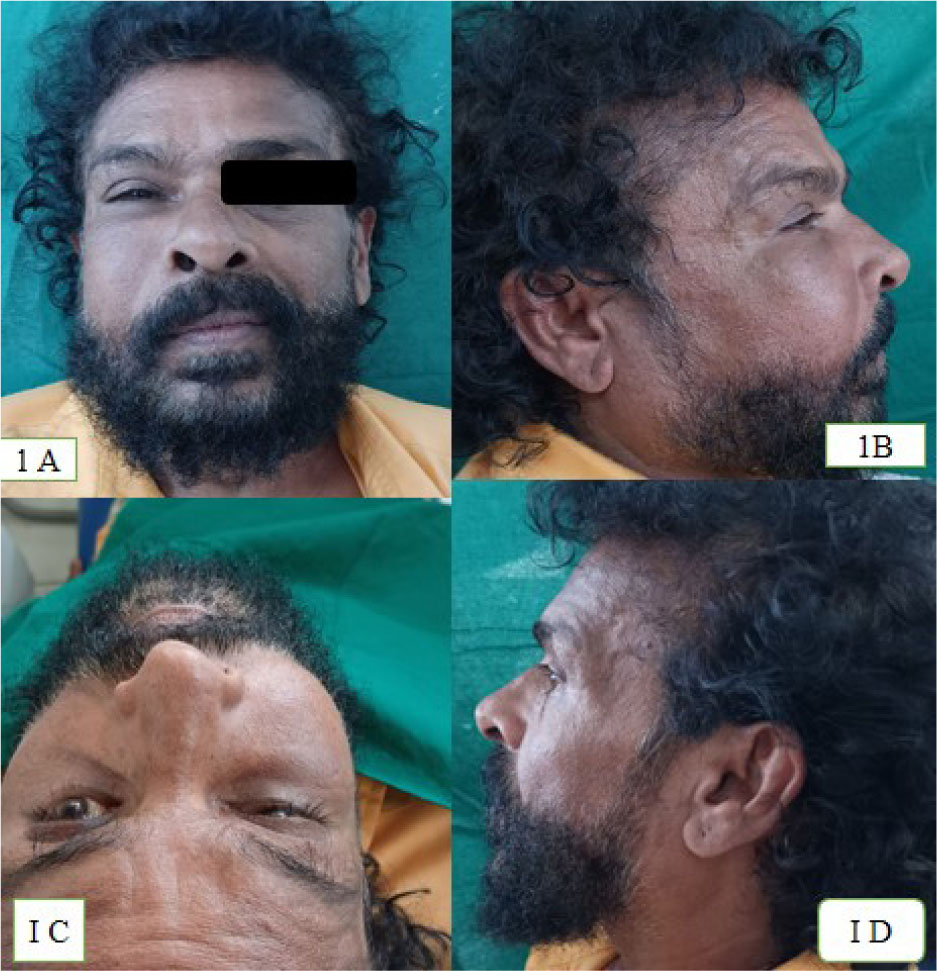
Figure 1:
Extraoral swelling seen with respect to middle one third of right side of face. 1A and 1B: Extension of swelling involving the ala of nose medially, laterally along the vertical line drawn from outer canthus of eye, superiorly involving the infraorbital region with sunken eyes, and inferiorly along the horizontal line drawn from right commissure of lip. 1C: Bird’s view showing the swelling involving the infraorbital region with respect to right side with subsequent shrinking of right eye. 1D: Left profile view showing the normal appearance when compared to the right side.
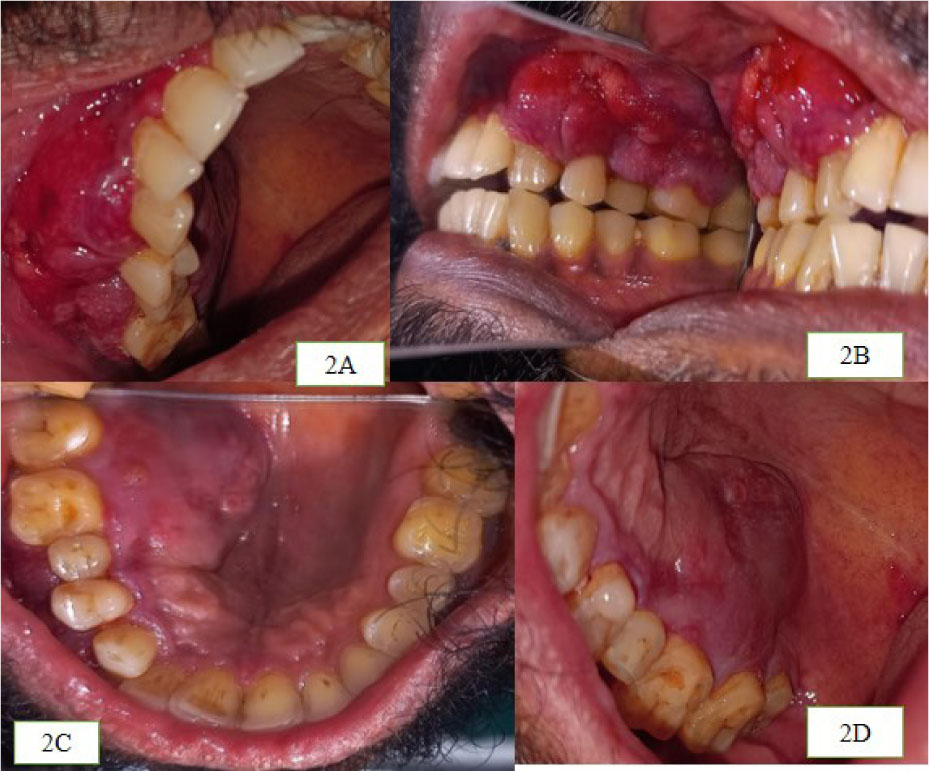
Figure 2:
Intraoral swelling present with respect to vestibular region and palate. 2A and 2B: Proliferative vascular growth seen extending from the attached gingiva with respect to 12 to interdental space between 16 and 17 and superiorly involving the buccal vestibule 2C and 2D: Well-defined ovoid swelling seen extending from the interdental space between 15 and 16 was seen crossing the midline and posteriorly extending till the junction of hard and soft palate.
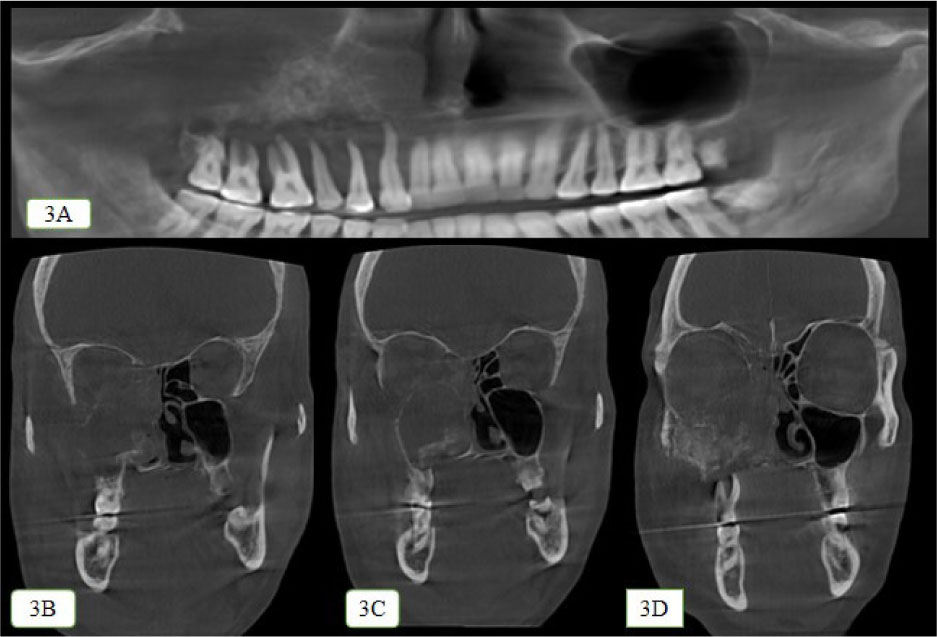
Figure 3:
CBCT images showing the radiographic presentation of the lesion. 3A: Panoramic reconstructed image showing an ill-defined mixed radiolucent radiopaque lesion in the right maxilla, extending mediolaterally from nasal septum to zygoma and superoinferiorly from right orbit to maxillary alveolus and palate along with bone loss present around 13–18 region. 3B, 3C, 3D: Axial section showing the destruction of the floor of right orbit, anterolateral, and posterolateral wall of right maxillary sinus and nasal septum.
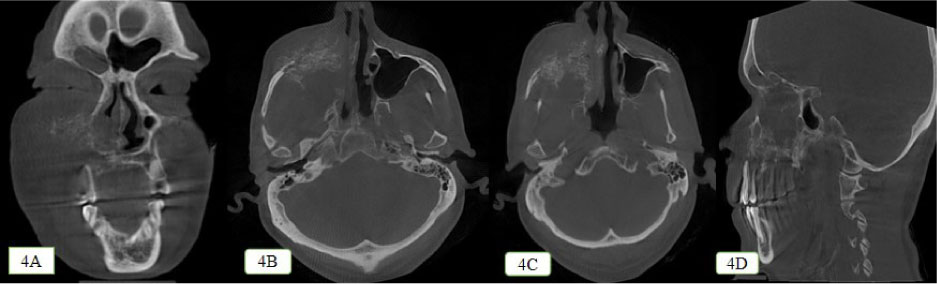
Figure 4:
The unique radiographic pattern shown by adenocarcinoma as a result of destruction. 4A: Coronal section showing the mixed radiolucent radiopaque lesion causing destruction of nasal septum and giving rise to sunburst appearance. 4B and 4C: Axial section showing the mixed radiolucent radiopaque lesion showing destruction of nasal septum and zygoma giving the sunburst appearance. 4D: Sagittal section showing the sunburst pattern with respect to the floor of right maxillary sinus and nasal septum along with bone loss seen with respect to 13–18 region.
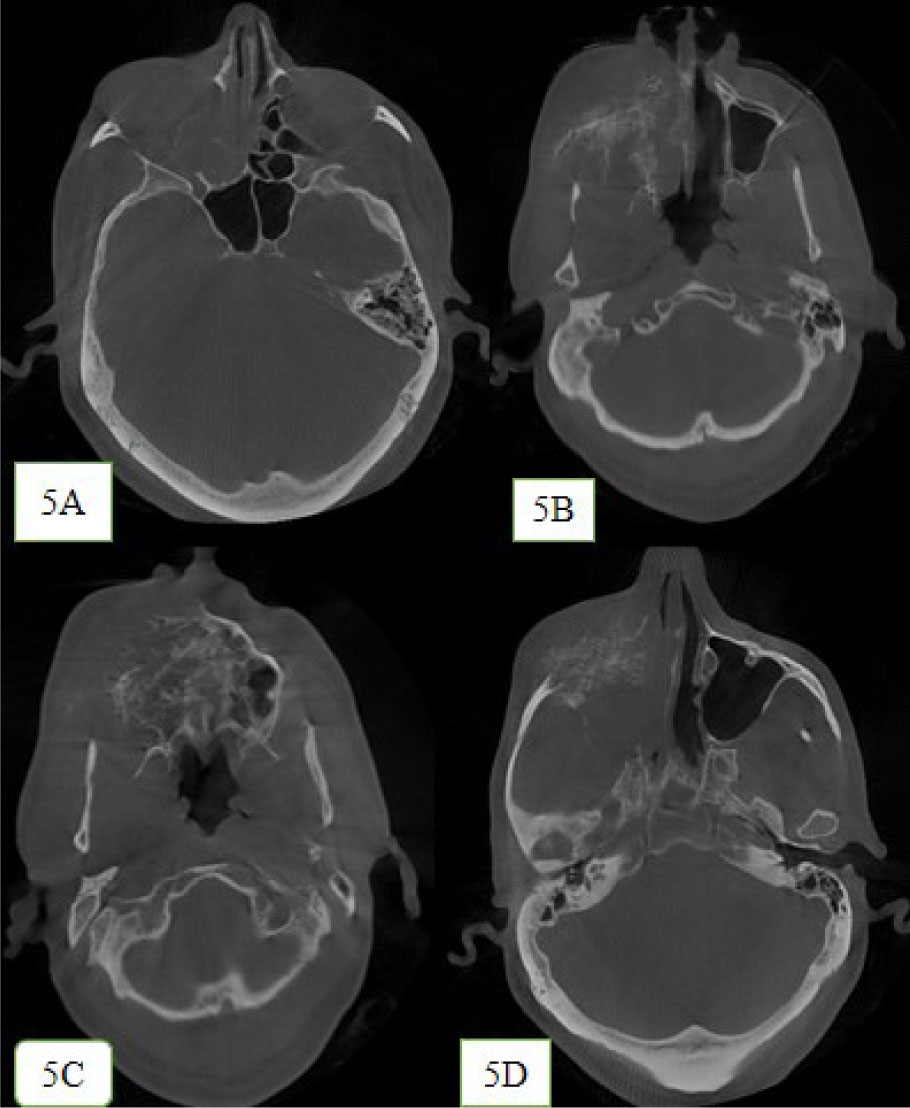
Figure 5:
Destruction pattern of the lesion in axial view. 5A: Destruction of the right lateral wall of nasal cavity and inferior turbinates. 5B: Mixed radiolucent radiopaque lesion caused destruction of anterolateral and posterolateral wall and floor of right maxillary sinus and nasal cavity. 5C: The mixed radiolucent radiopaque lesion seen crossing the midline of the palate at the posterior region. 5D: Mixed radiolucent radiopaque lesion produces sunburst appearance at the right zygoma region
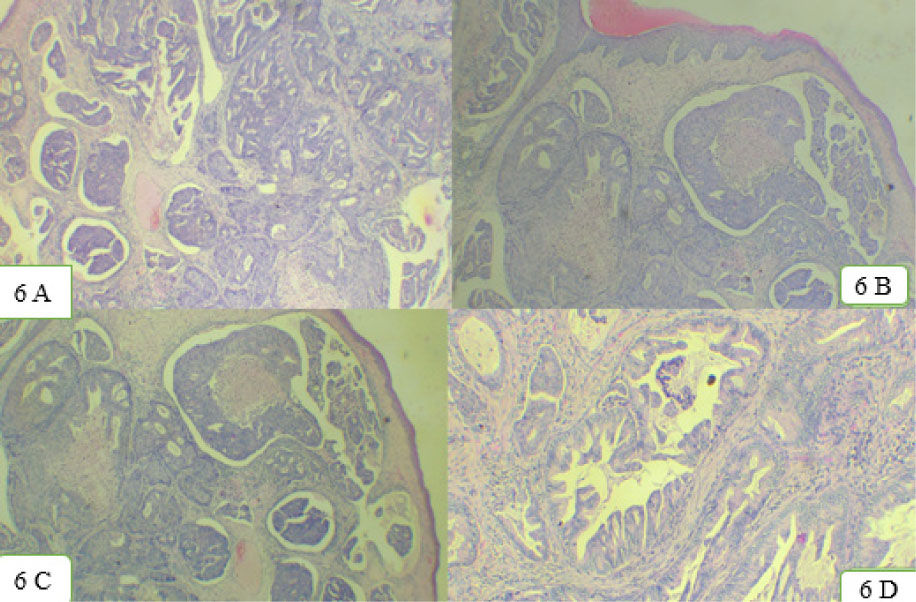
Figure 6:
Histopathological images. 6A–6D: Pleomorphic tumor cells exhibited hyper chromatic vesicular nuclei and eosinophilic cytoplasm were arranged in glandular, cribriform, and papillary pattern. Glands with intraluminal necrosis were noted along with lymphovascular and perineural invasion.
Table 1:
Immunohistochemical and Histopathological features of Intestinal Sinonasal Adenocarcinoma.
| IMMUNOHISTOCHEMICAL MARKERS | HISTOPATHOLOGICAL FEATURES |
|---|---|
| Pancytokeratin and CK7: Indicates keratin producing cells | Tubulo-glandular architecture: Consists of tubules and glands |
| MUC2: Mucin protein | Papillary appearance: Papillary elements |
| CK20, CDX2, and SATB2: Negative inITAC | Colonic resemblance: Histopathological resemblance to colonic adenocarcinoma |
| S100 protein, SOX10, and Discovered on GIST-1(DOG1): Indicatesneuroendocrine differentiation | Signet ring cell morphology |
| Carcinoembryonic Antigen (CEA): Weak expression than colonicadenocarcinoma | Goblet cells : Present in papillary and mucinous subtypes |
| Chromogranin: Numerous Chromogranin positive cells compared tocolonic adenocarcinoma | Positive mitotic activity |