
Table 1:
Patients’ characteristics. PSA pre-RT: PSA values detected at the time of PSMA-PET before the start of RT. PSA post-RT: PSA values detected at the first follow-up check 3 months after the end of RT. PSADT: PSA doubling time. BF: biochemical failure at the first follow-up check 3 months after the end of RT.
| Number of patients | 70 | |
|---|---|---|
| Age | 59–84 years | Mean 71.1 years (SD 5.1) |
| PSA pre-RT | 0.2–5.69 ng/mL | Mean 0.81 ng/mL (SD 0.91) |
| PSA post-RT | 0.01–1.55 ng/mL | Mean 0.11 ng/mL (SD 0.24) |
| PSADT | 3–87.2 months | Mean 14 months (SD 16) |
| BF | 2/70 patients | |
| Follow-up | 6–60 months | Mean 24 months |
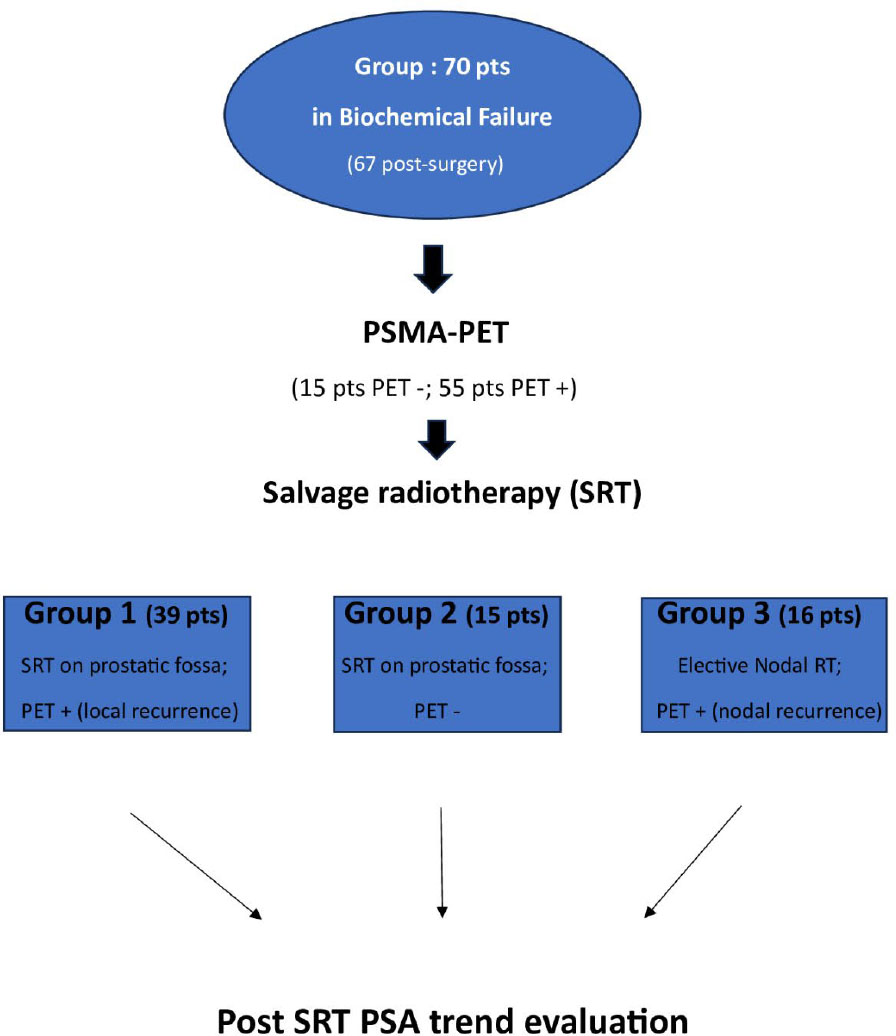
Figure 1:
Flowchart of the study.
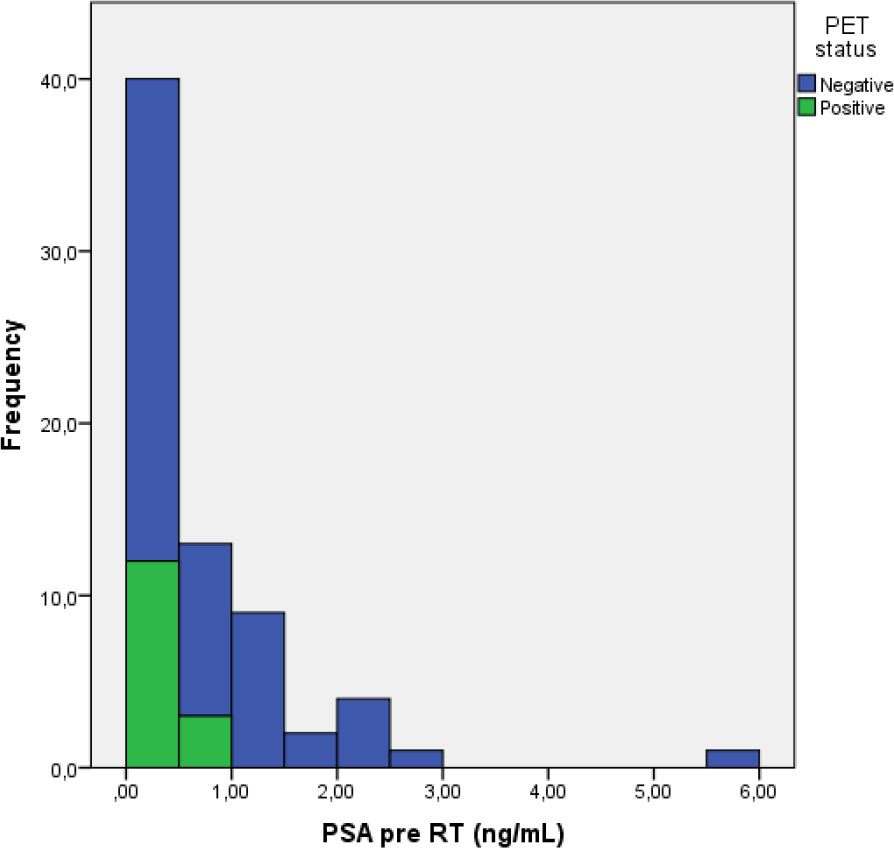
Figure 2:
PSA value distribution divided by PET status: the green bars represent patients with negative PET; the red bars represent patients with positive PET.
Table 2:
Results of PSA trend (increase or decrease) post radiotherapy in function of the PET status for whole patient group. SRT: salvage radiotherapy.
| Whole patient group | PSA trend post SRT | ||
|---|---|---|---|
| Decreases | Increases | ||
| PET status | Positive | 53 | 2 |
| Negative | 15 | 0 | |
Table 3:
Results of PSA trend post radiotherapy in function of the PET status for patients irradiated on the prostatic fossa after surgery. SRT: salvage radiotherapy.
| PSA trend post SRT | |||
|---|---|---|---|
| Decreases | Increases | ||
| Group | Group 1 | 39 | 0 |
| Group 2 | 15 | 0 | |