
1. Introduction
In the last decade, the availability of PET scan in current clinical practice (first choline and then 68Ga-PSMA) has radically changed the therapeutic approach for prostate cancer (pCa) first in the initial staging of patients at high metastatic risk and then in the sensitivity of early detection of disease after primary treatment[1].
In the currently defined situation of “biochemical failure” (BF) after primary treatment, PET has provided a new diagnostic key that can help to identify early signs of disease outbreaks that cannot be detected with conventional imaging[2].
The current definitions of BF of pCa after primary therapy[3, 4] differ depending on the type of treatment received on the primary tumor, surgery, or radical radiotherapy (RT).
Three sub-clinical disease conditions can be traced back to biochemical recurrence of pCa:
- Progression of neoplastic cells in the site of the primary lesion (prostate/prostatic fossa)
- Progression of neoplastic cells outside the site of the primary lesion
- Intra and extra treated primary site progression
In these conditions, the increase in the PSA value beyond a threshold defined by international criteria and the value of the doubling time (PSADT) are today the main determining factors for choosing the best therapeutic approach.
Salvage radiation therapy (SRT) has been known for years as an effective treatment in the recovery of a significant proportion of patients to a new state of biochemical control after post-surgical biochemical recurrence of pCa[5, 6].
Currently, SRT can be recommended both on the site of the primary cancer[7] and on PET positive sites of extraprostatic disease when classifiable in a situation of metastatic oligorecurrence[8,9,10,11].
In this setting, a 68Ga-PSMA-PET scan, although very sensitive in detecting even small neoplastic localizations, has limitations mainly due to:
- a reduction in diagnostic sensitivity as the PSA value decreases and the PSADT value increases[12, 13],
- an increased frequency of false bone localizations for PSA values <= 5 ng/mL[14, 15], and
- the possibility of false negativity due to lack of PSMA expression by prostatic neoplasms with neuroendocrine differentiation[16, 17].
A series of patients in BF after surgery or radical RT for pCa in our center, who were not hormonally managed and candidates for SRT, underwent PSMA-PET scans before starting SRT treatment.
The biochemical profiles after treatment were monitored in terms of PSA trend.
This retrospective analysis evaluated the sensitivity and accuracy of PSMA-PET scans in detecting neoplastic foci based on the assumption that radiotherapy reduces the number of neoplastic cells and the PSA value when directed at an anatomical site infiltrated by pCa cells.
2. Materials and methods
From January 1, 2018, to December 1, 2022, 70 patients who presented with BF based on the above criteria after primary treatment of pCa (radical prostatectomy or radiotherapy limited to the prostatic region, without pelvic irradiation) were treated with SRT.
The characteristics of the group, based on the PSA value at the start of radiotherapy treatment and the PSADT, are summarized in Table 1.
Table 1:
Patients’ characteristics. PSA pre-RT: PSA values detected at the time of PSMA-PET before the start of RT. PSA post-RT: PSA values detected at the first follow-up check 3 months after the end of RT. PSADT: PSA doubling time. BF: biochemical failure at the first follow-up check 3 months after the end of RT.
| Number of patients | 70 | |
|---|---|---|
| Age | 59–84 years | Mean 71.1 years (SD 5.1) |
| PSA pre-RT | 0.2–5.69 ng/mL | Mean 0.81 ng/mL (SD 0.91) |
| PSA post-RT | 0.01–1.55 ng/mL | Mean 0.11 ng/mL (SD 0.24) |
| PSADT | 3–87.2 months | Mean 14 months (SD 16) |
| BF | 2/70 patients | |
| Follow-up | 6–60 months | Mean 24 months |
The ASTRO criterion[3] was used for the definition of the state of BF after prostatectomy, with a threshold of 0.2ng/mL.
The RTOG-ASTRO Phoenix criterion[4] was used for the definition of BF after RT, with a threshold of 2ng/mL above the post-treatment nadir.
The Memorial Sloan Kettering Cancer Center online calculator was used to calculate the PSADT[18].
All patients who presented with biochemical recurrence were evaluated with the PSMA-PET scan. The examination was performed within 3 months from the RT treatment start. No patient was treated with hormone therapy before, during, or after radiotherapy treatment until any response to treatment was seen, and no patients were treated with PSADT < 3 months.
Sixty-five patients underwent first-line surgical treatment. Twenty-seven patients underwent prostatectomy, while 38 patients underwent prostatectomy with pelvic lymph node dissection. Regarding post-operative risk classification, 36 patients were classified as high risk, 16 as intermediate risk, and 13 as low risk.
Based on the irradiated volumes and the results of the PSMA-PET, the patients were divided into three groups:
Group 1: patients irradiated on the prostatic fossa after surgery and PET scan indicative of local recurrence
Group 2: patients irradiated on the prostatic fossa after surgery and negative PET.
Group 3: patients irradiated on pelvic nodal chains with PET indicative of pelvic lymph node recurrence of disease after surgery or after RT.
The flowchart of the study is shown in Figure 1.
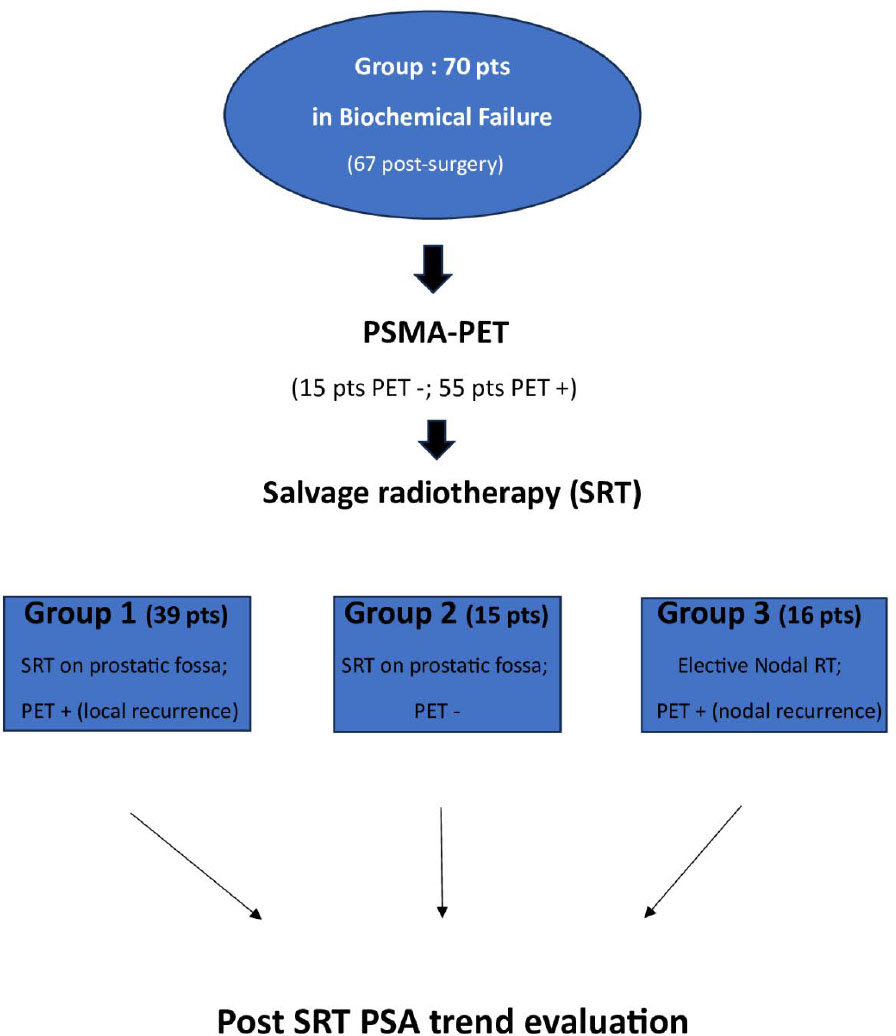
Figure 1:
Flowchart of the study.
Patients who presented with intraprostatic disease recurrence after RT were excluded from the analysis as they were undergoing hormone-suppressive treatment.
Of the 70 patients analyzed, 55 had a positive scan for disease recurrence in the prostatic fossa (39 patients) or in the lower pelvic lymph nodes (16 patients) with a maximum number of 3 metastatic lymph nodes; 15 patients had a negative exam for disease localizations.
None of the patients presented a simultaneous recurrence of the disease in the prostatic fossa and at the pelvic level.
2.1. Features of the SRT treatment
All patients were treated with volumetric arc IMRT with Rx of 6Mv energy. The constraints and OARs met RTOG consensus criteria[19] and the reference atlas RTOG[20].
The patients who presented a PET positive scan for local recurrence after prostatectomy were irradiated on the prostatic fossa at a dose of 70Gy in 35 fractions (SRT for clinical recurrence) according to the volume indicated by the EORTC consensus[21].
Patients who presented a PET negative scan after prostatectomy were irradiated on the prostatic fossa at a dose of 66Gy in 33 fractions (SRT for biochemical recurrence) according to the volume indicated by the EORTC consensus.
The patients who presented a PET positive scan for pelvic lymph node/nodes relapse (1–3 lesions) were irradiated with the Elective Nodal radiotherapy technique on the lymph node involved chain or chains (if bilateral positive lymph nodes) at a dose of 45Gy in 25 fractions with SIB on the PET positive lymph nodes up to a dose of 56.25Gy according to retrospective studies showing similar irradiated volumes, techniques, and doses[22][23].
2.2. Follow-up characteristics
All treated patients were regularly followed for the first year every 3 months, every six months up to the 3rd year, annually up to the 5th year from the end of the RT, with PSA measurement at each follow-up examination. The minimum follow-up was 6 months, and the maximum was 5 years (mean 24 months).
Patients who are presented at the 1st follow-up check (3 months after the end of SRT) with a decrease in the PSA value compared to the PSA value at start were considered responders to treatment.
Patients who are presented at the 1st follow-up check with a stability or increase in the PSA value compared to the PSA value at start were considered non-responders to treatment.
At the time of analysis, all patients were alive. Seven patients showed clinical progression detected by PSMA-PET (three in the lymph nodes and four in the bone); of these seven, five received androgen deprivation therapy and two received androgen receptor signaling inhibitor therapy, until further disease progression.
3. Statistical analysis
Variables were preliminarily tested for normal distribution with the Shapiro–Wilk’s W test, and data were expressed as mean ± standard deviation (SD) when normally distributed. Continuous variables with non-normal and normal distribution were analyzed by Mann–Whitney U test and t-test for unpaired samples, respectively, as appropriate. Difference in categorical variables was analyzed using the c2.
PSA values were compared between:
PET+ and PET− patients before RT
all patients before and after RT
Sensitivity, specificity, and accuracy were defined as follows: Sensitivity = TP/(TP + FN), Specificity = TN/(TN + FP), Accuracy = (TP + TN)/(TP + FN + TN + FP), where:
TP = true positive (positive PET and PSA value decreases after RT)
FP = false positive (positive PET and PSA value increases after RT)
TN = true negative (negative PET and PSA value increases after RT)
FN = false negative (negative PET and PSA value decreases after RT)
Sensitivity, specificity, and accuracy were calculated in the following patient groups:
Whole patient group
Group 1+2 (patients irradiated on the prostatic fossa)
Group 1+2 with PSA pre-RT ≤ 1ng/mL
4. Results
Seventy patients were analyzed, of which 15 (21%) had a negative pre-RT PET scan and 55 (79%) had a positive exam (39 on the prostatic fossa and 16 on the pelvic lymph nodes).
The distribution of the number of patients in function of the pre-RT PSA value, divided by PET status, is shown in Figure 2.
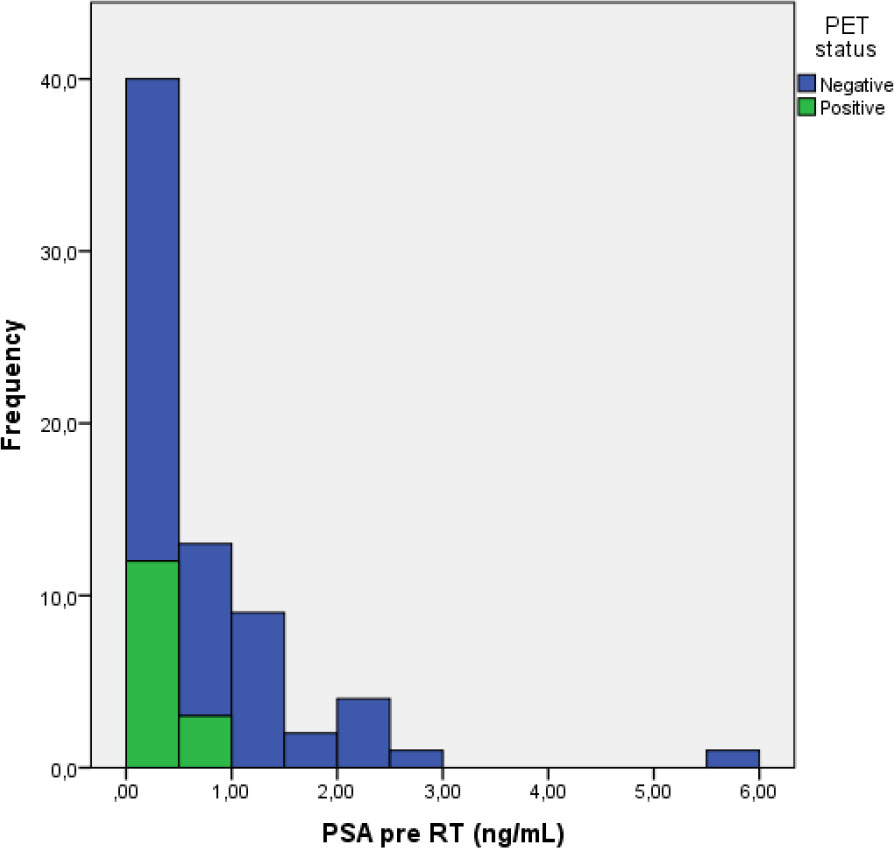
Figure 2:
PSA value distribution divided by PET status: the green bars represent patients with negative PET; the red bars represent patients with positive PET.
Before radiotherapy, the mean PSA value of PET+ (Group 1 + 3) patients was significantly higher than that of PET− (Group 2) patients (1.04 ng/mL vs 0.47 ng/mL, p < 0.001).
After radiotherapy, the mean PSA value decreased significantly in the whole patient group (mean 0.8 ng/mL pre-SRT vs 0.1 ng/mL post-SRT, p < 0.001).
In the whole group, 68 patients (97%) had a decline in PSA at follow-up 3 months after RT; only 2 patients, who were in the PET+ group, had an increase in the PSA value.
Detailed results of the PSA trend for the three patient groups as defined above are shown in Tables 2, 3, and 4.
Table 2:
Results of PSA trend (increase or decrease) post radiotherapy in function of the PET status for whole patient group. SRT: salvage radiotherapy.
| Whole patient group | PSA trend post SRT | ||
|---|---|---|---|
| Decreases | Increases | ||
| PET status | Positive | 53 | 2 |
| Negative | 15 | 0 | |
Table 3:
Results of PSA trend post radiotherapy in function of the PET status for patients irradiated on the prostatic fossa after surgery. SRT: salvage radiotherapy.
| PSA trend post SRT | |||
|---|---|---|---|
| Decreases | Increases | ||
| Group | Group 1 | 39 | 0 |
| Group 2 | 15 | 0 | |
Table 4:
Results of PSA trend post radiotherapy in function of the PET status for patients irradiated on the prostatic fossa after surgery with PSA ≤ 1 ng/mL. SRT: salvage radiotherapy.
| Group 1+2 with PSA ≤ 1 ng/mL | PSA trend post SRT | ||
|---|---|---|---|
| Decreases | Increases | ||
| Group 1 | 25 | 0 | |
| Group 2 | 15 | 0 | |
According to definitions above and data shown in Tables 2, 3, and 4, sensitivity and accuracy were calculated and reported in Table 5.
Table 5:
Sensitivity and accuracy calculated for the whole group and for the subgroups 1+2 and 1+2 with PSA ≤ 1 ng/mL.
| Sensibility | Accuracy | |
|---|---|---|
| Whole patient group | 78% | 76% |
| Group 1+2 | 72% | 72% |
| Group 1+2 with PSA ≤ 1 ng/mL | 62% | 62% |
Since there were no patients with a negative PET and with a PSA value that increases after RT (True Negative), specificity was not computed.
In the group of 54 patients irradiated on the prostate bed, a decrease in the PSA value after SRT was observed in all cases. As a result, all PET-negative patients in this group are considered to be false negatives.
The mean pre-RT PSA value differs significantly between PET-positive and PET-negative patients (1.04 ng/mL vs 0.47 ng/mL, p<0.001). Additionally, the pre-RT PSA for PET-negative patients varies between 0.25 and 0.96 ng/mL.
Therefore, by reducing the analysis to a pre-RT PSA range of 0.2–1 ng/mL, the sensitivity of PET decreases from 72% to 62%. In other words, it is possible to state that, in this PSA range, the probability of a false-negative PET scan increases to 40%.
In Group 3, only two patients had biochemical progression after SRT. Therefore, the accuracy of the PET scan is 92%.
Adverse histological features were compared with PSMA-PET positivity: a significant correlation was found with surgical margin status (p = 0.05), while extra capsular disease extent and Gleason score ≥ 8 show no significant correlation.
5. Discussion
Metabolic diagnostics in the staging and follow-up of pCa has become increasingly common in the last decade[24].
Choline-PET and, more recently and effectively, PSMA-PET allow early detection of both secondary extraprostatic sub-clinical localizations of the disease and neoplastic recurrences after primary treatment so much so that in the recent EAU Guidelines, PSMA-PET is strongly recommended for high-risk patient staging[25].
In the case of biochemical recurrence during follow-up after a primary surgical or radiation treatment, a PSMA-PET scan is positive in about 2/3 of patients and can significantly change the therapeutic approach to the disease[26].
However, the biochemical threshold beyond which the scan examination is recommended has not yet been clearly defined.
The criteria for defining a state of biochemical recurrence are clear and universally accepted, but the threshold of PSA value beyond which a PSMA-PET scan provides a significant diagnostic power and therefore a significant clinical benefit is not yet defined.
After surgical treatment, the PSMA-PET detection rate is correlated to the PSA value at the time of the examination[2], with detection rates of less than 40% for PSA values <0.5 ng/mL[27] and less than 30% for PSA values below the threshold of 0.2 ng/mL[28].
The numerous supporting evidence of the efficacy of early SRT on the prostatic fossa[29] collides with the reduced detection capability of the PET scan at these low values[30] and therefore makes it difficult to justify the cost/benefit ratio of the exam.
Since the effectiveness of SRT is evident, it is now accepted that a patient in a state of biochemical recurrence after surgery and negative at restaging with PSMA-PET should be started on radiation treatment anyway[31].
In the case of biochemical progression after radiation therapy treatment for primary pCa, the increase in PSA values during follow-up may be due to numerous factors: recovery of function of the irradiated organ[32], immune response[33], flare phenomenon due to diffuse radiation received to the testes during primary RT[34, 35], local disease recurrence, or extra-prostatic progression.
These conditions reduce the sensitivity of the exam and make it much more ambiguous to define a recommended PSA threshold beyond which a PET scan is recommended[36].
In the limited available studies, the mean PSA value when PSMA-PET was performed after radical RT varies between 4 and 5 ng/mL[37].
Data demonstrate that after radical RT and radical prostatectomy, the capacity of PSMA scan to detect extraprostatic disease increases with an increase in PSA: after radical RT from 33% with a PSA value <0.5 ng/mL to 93% with values ranging from 1 to <2 ng/mL; after radical prostatectomy from 53.3% with PSA 0.5 to <1 ng/mL to 79% for values ranging from 1 to <2 ng/mL[38].
Pfister et al. (2020)[37] evaluated the specificity and sensitivity of PSMA-PET in detecting pelvic nodal metastases after primary radiation therapy to the prostate in a series of patients undergoing salvage prostatectomy and pelvic lymphadenectomy for histologically proven prostatic recurrence. Of the 102 patients evaluated at pathological proof after lymphadenectomy, PSMA-PET had a sensitivity of 90% (12.1% false negatives) and a specificity of 98% (92.7% true positives).
Considering these results, the question is whether there is a simpler way to evaluate the sensitivity and specificity of PET in detecting pCa foci in BF situations, both at the lymph node level (after radiation therapy or surgery) and at the prostatic fossa after surgery.
If radiation is considered an effective treatment in reducing cancer cells in the irradiated sites, and if PSA values are directly related to number of pCa cells, then SRT can be used as a test whose results, in terms of PSA progression or reduction, are indicative of the presence or absence of neoplastic cells in the irradiated site. The outcome of SRT can also be used to evaluate the results of the diagnostic PET scan performed.
In the case of SRT to the prostatic fossa with a negative PET scan, a decrease or an increase in PSA levels after treatment can inform us whether the PET scan was falsely negative or truly negative because in the case of neoplastic microfoci outside the prostate fossa, the PSA will tend to rise, and in the case of neoplastic microfoci both inside and outside the prostate fossa, the PSA will tend to fall temporarily (due to reduction of irradiated clones) and then to rise again.
In the case of SRT with a positive PET scan on the prostatic fossa or on pelvic-lumboaortic metastatic lymph nodes, the SRT test will inform us if the PET scan was truly positive through a reduction in PSA levels.
The results of this series of patients show that for PSA values between 0.2 and < 1 ng/mL and in the case of a negative PET scan, irradiation of the prostatic fossa can lead to a good biochemical response. These data indicate a low sensitivity of the PET test in detecting neoplastic foci in this setting.
Moreover, in the PSA range between 0.2 and 1 ng/mL, the sensitivity of PET is 62%; therefore, in this PSA range, the probability to have a false-negative test increases to 40%.
As regard to the patients treated with a positive scan, our results are in line with the literature data in demonstrating a good accuracy (92%) of PET and confirming the efficacy of the SRT.
6. Conclusions
The data of this study must be interpreted with caution for the limitations due to the low number of cases and the stringent criteria used in our center to propose an SRT treatment on the prostatic fossa in negative PSMA patients (mean PSADT 14 months, mean PSA value at SRT start 0.81 ng/mL).
In the situation of a negative PSMA-PET scan in post-surgery BF patients with a PSA value less than 1 ng/mL, it seems appropriate to propose an SRT treatment on the prostatic fossa.
In optimizing the cost/benefit ratio, we also suggest caution in prescribing a PSMA scan test in patients with a PSA value lower than 0.5 ng/mL.
Notes
[3] Ethical statement
All procedures were performed in accordance with the ethical standards of the institutional and/or national research committee and with the 1964 Helsinki declaration and its later amendments or comparable ethical standards.
Informed consent was obtained from all individual participants included in the study. The study was approved by the company ethics committee.