
1. Introduction
Clinical outcome of elderly acute myeloid leukemia (AML) patients is generally frustrating with less than 20% showing 2-year overall survival, due to tumor behavior, poor tolerance to chemotherapy, physical and cognitive function impairment with aging, and high prevalence of comorbidity.[1]
Frail patients have a vulnerable state due to an age-related impairment in functional and physiological capacity.[2] Increased vulnerability affects their susceptibility to poor health outcomes such as falls, prolonged and recurrent hospitalization, illness-related complications, disability, and death.[3]
The main goal of geriatric assessment in hematology patients is tailoring of appropriate management plan by identifying patients who can tolerate the usual chemotherapy doses and frail patients who will benefit from treatment adjustment.[4]
Geriatric 8 (G8) is a screening tool recommended by the International Society of Geriatric Oncology (SIOG) as a self-administered assessment.[5,6]
Also, Geriatric Assessment in Hematology (GAH) was introduced by hematology groups and geriatricians as an internally reliable, rapid, and valid scale for evaluation of older hematological patients.[7]
1.1. Aim of the work
To study if geriatric assessment using G8 and GAH can be of value in the initial workup of elderly acute leukemia patients and if their use can be independently correlated with mortality or morbidity.
2. Subjects and Methods
2.1. Patient Selection
A prospective cohort study was conducted in the Hematology Unit of Internal Medicine Department at Ain Shams University Hospital between June 2022 and March 2023. It was conducted in conformity with the standards of the ethical committee of Faculty of Medicine, Ain Shams University, Cairo, Egypt. An informed consent was obtained from all subjects in the study.
The study included 32 newly diagnosed AML patients aged ≥60 years, taking into consideration the retirement age in Egypt, which is 60 years.[8,9] Then, patients were subdivided into two groups (frail patients and non-frail patients) using G8 and GAH scores.
2.2. Study Tools
G8 questionnaire: It consists of eight items covering multiple geriatric assessment domains (appetite changes, weight loss, mobility, neuropsychological problems, body mass index, medication, self-reported health, and patient age). Overall, the G8 score ranges from 0 (heavily impaired) to 17 (not at all impaired), with a cutoff for potential frailty of ≤14 (Fig. 1).[10]
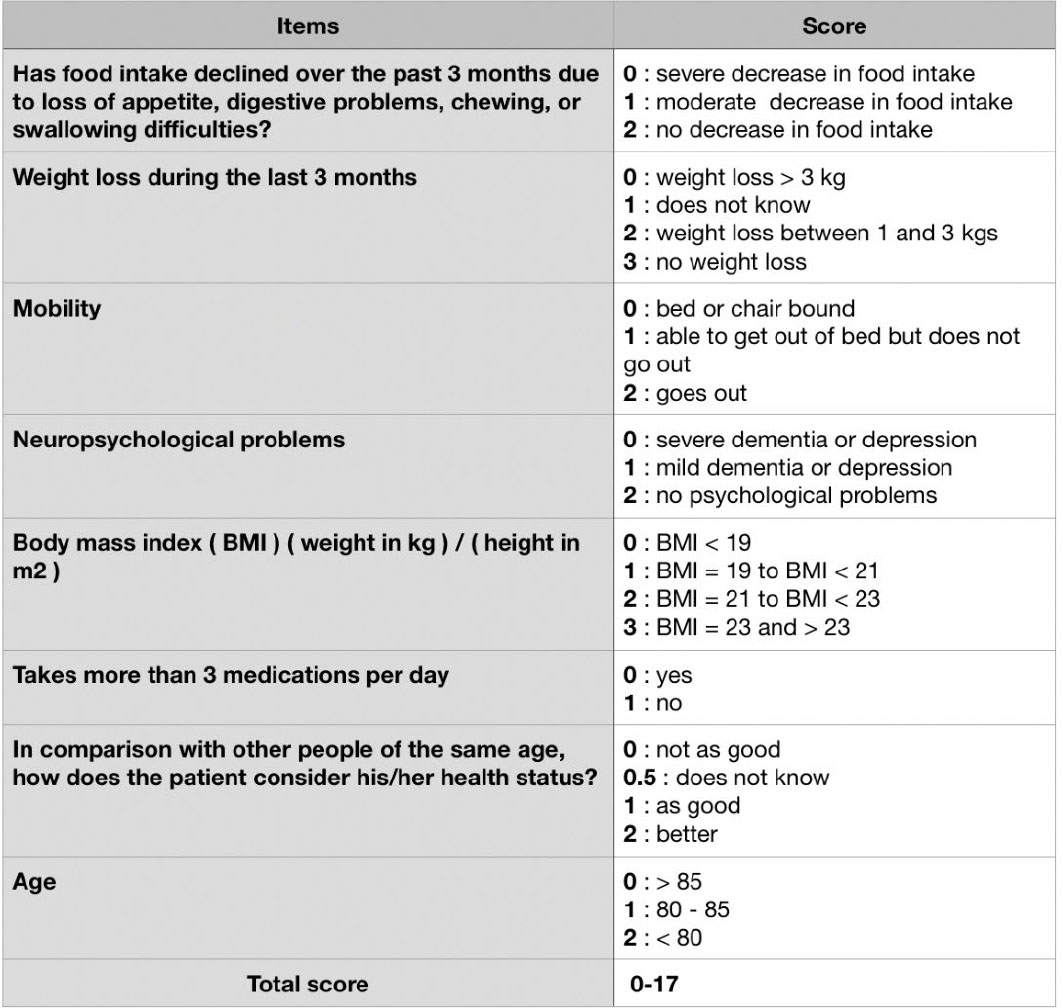
Figure 1:
G8 score.
The GAH scale, described by Bonanad et al. (2015), has eight scale dimensions (number of drugs, gait speed, mood, activities of daily living, subjective health status, nutrition, mental status, and comorbidity) (Fig. 2).[7] The optimal cutoff point for the GAH scale that indicates high risk of toxicity was 42, with 68.5% sensitivity and 55.8% specificity.[11]
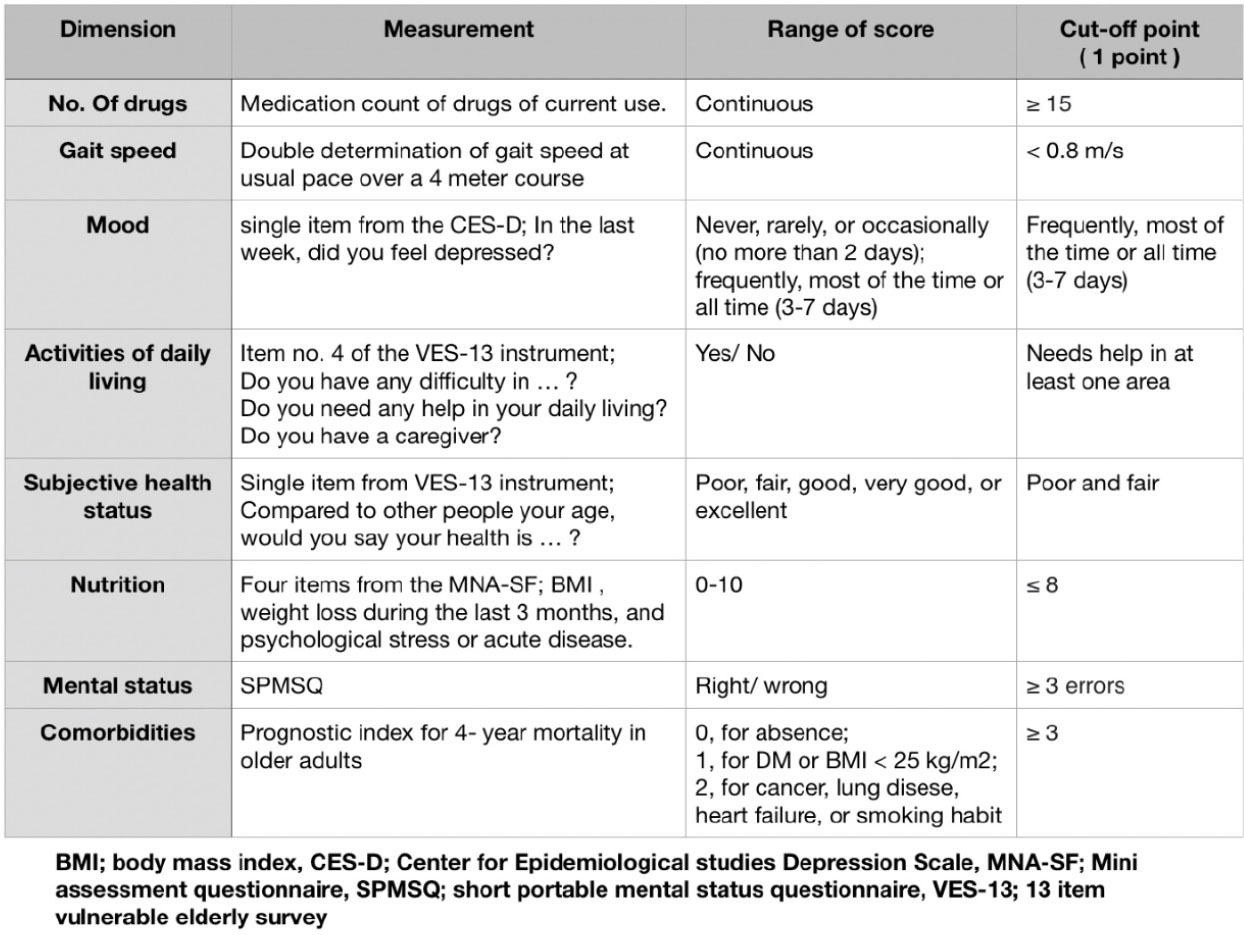
Figure 2:
GAH score.
2.3. Study Procedures
All recruited patients were assessed by thorough medical history, full clinical examination, laboratory investigations including complete blood count with differential, liver and kidney function tests, lactate dehydrogenase (LDH), viral screening tests (HBsAg, HCVAb, and human immunodeficiency virus antibodies [HIV Abs]), bone marrow aspiration, immunophenotyping, and cytogenetics. Echo cardiography was done for all patients as well.
Frailty was initially assessed according to both G8 and GAH scores by a trained hematologist physician.
Patients were followed up regarding treatment outcome, occurrence of complications, and mortality rates for 6 months following initial diagnosis.
Response criteria were defined according to European Leukemia Net (ELN) recommendations.[12]
2.4. Statistical Analysis
The collected data were coded and managed by IBM Statistical Package for Social Sciences (SPSS), version 23. Parametric data were presented as mean, standard deviations and ranges, while nonparametric data were presented as median and interquartile range (IQR). Also, qualitative data were added as number and percentages. Chi-square test was used in the comparison of any introduced qualitative data. Independent t-test was used for those with quantitative data and parametric distribution, while Mann–Whitney test was used to compare between two groups with quantitative data and nonparametric distribution. Spearman correlation coefficients were used to assess any correlation between two quantitative parameters in the same group. Confidence intervals were set to 95%, and the accepted margin of error was set to 5%. P-values >0.05 were considered nonsignificant, while P < 0.05 was considered significant and P < 0.01 was considered highly significant.
3. Results
Our study included 32 newly diagnosed elderly AML patients with a mean age of 64.9 years (60–86). Half of our patients were frail (n = 16) and half of them were non-frail on assessment by using G8 and GAH scores. The mean age was significantly high in the frail group compared to the non-frail group (67.3 years in the frail group vs. 62.5 years in the non-frail group, P-value 0.016). Comorbidities with DM and HTN were significantly higher in frail patients compared to non-frail patients (P-values 0.033 and 0.012, respectively). Our patients were categorized as diabetic if their fasting plasma glucose was ≥126 mg/dL, 2-h plasma glucose was ≥200 mg/dL, or glycated hemoglobin (HbA1c) was ≥6.5%. Also, they were considered hypertensive if the blood pressure was ≥130 and/or ≥80 mmHg.[13,14]
According to NCCN guidelines[15], 23 of our patients had intermediate-risk category (79.3%), five patients had favorable risk (17.24%), while only one patient had adverse risk (3.44%). Such a cytogenetic risk stratification did not reveal a statistical significance with patients' frailty status (Table 1).
Table 1:
Comparison between frail and non-frail patient regarding demographic data, comorbidities and risk category.
| No. = 32 | Total | NF | F | Test value | P-value | Sig. | |
|---|---|---|---|---|---|---|---|
| No. = 16 | No. = 16 | ||||||
| Age | Mean ± SD | 64.94 ± 6.14 | 62.56 ± 3.93 | 67.31 ± 7.1 | −2.566• | 0.016 | S |
| Range | 60 – 86 | 60 – 75 | 60 – 86 | ||||
| DM | No | 25 (78.1%) | 15 (93.8%) | 10 (62.5%) | 4.571* | 0.033 | S |
| Yes | 7 (21.9%) | 1 (6.2%) | 6 (37.5%) | ||||
| HTN | No | 13 (40.6%) | 10 (62.5%) | 3 (18.8%) | 6.348* | 0.012 | S |
| Yes | 19 (59.4%) | 6 (37.5%) | 13 (81.2%) | ||||
| Viral hepatitis | No | 29 (90.6%) | 14 (87.5%) | 15 (93.8%) | 0.368* | 0.544 | NS |
| Yes | 3 (9.4%) | 2 (12.5%) | 1 (6.3%) | ||||
| Favorable | 5 (17.2%) | 1 (6.2%) | 4 (30.8%) | ||||
| Cytogenetics | Intermediate | 23 (79.3%) | 15 (93.8%) | 8 (61.5%) | 4.670* | 0.097 | NS |
| Adverse | 1 (3.4%) | 0 (0.0%) | 1 (7.7%) | ||||
(2 + 5) was the most common protocol used in our study, applied for 10 patients (31.25%), while oral etoposide and (2 + 7) were the least used protocols (each one was given only to a single patient) (Table 2). Azacitidine was not administered to our patients due to financial constraints as all the recruited patients were uninsured.
Table 2:
Treatment protocols used in all patients.
| Treatment Protocol | Total | Percentage | F | NF |
|---|---|---|---|---|
| 2+5 | 10 | 31.25% | 4 | 6 |
| 2+7 | 1 | 3.12% | 0 | 1 |
| 3+7 | 7 | 21.87% | 0 | 7 |
| Oral Etoposide | 1 | 3.12% | 1 | 0 |
| PETHEMA Induction | 4 | 12.5% | 3 | 1 |
| S/C Cytarabine | 6 | 18.75% | 5 | 1 |
| Supportive Treatment | 3 | 9.37% | 3 | 0 |
In our study, incidence of complications (neutropenic fever, pneumonia, abscess, or sepsis) revealed no significant correlation with patient's frailty status. The ECOG performance score was significantly higher in frail patients compared to non-frail patients (P-value <0.001). The median hospitalization of non-frail group was significantly higher than that of frail group (P-value <0.009) (Table 3).
Table 3:
Comparison between frail and non-frail patient regarding incidence of complications, ECOG performance and hospitalization.
| F | ||||||
|---|---|---|---|---|---|---|
| No. = 16 | No. = 16 | |||||
| Complications | NF | 21 (65.6%) | 10 (62.5%) | 11 (68.8%) | 0.139* | 0.710 |
| Pneumonia | 8 (25.0%) | 6 (37.5%) | 2 (12.5%) | 2.667* | 0.102 | |
| Abscess | 7 (21.9%) | 4 (25.0%) | 3 (18.8%) | 0.183* | 0.669 | |
| ECOG score | Sepsis | 7 (21.9%) | 2 (12.5%) | 5 (31.2%) | 1.646* | 0.200 |
| Median (IQR) | 1 (0 – 2) | 0 (0 – 1) | 2 (2 – 3) | −4.589≠ | <0.001 | |
| Range | 0 – 4 | 0 – 1 | 1 – 4 | |||
| Hospitalization | Median (IQR) | 22.5 (17 – 31.5) | 27.5 (21.5 – 33) | 17.5 (11 – 23) | −2.603≠ | 0.009 |
| Range | 5 – 60 | 15 – 60 | 5 – 50 |
At 1 month, the overall response in patients who received induction treatment (n = 22) was (63.63%), with seven patients showing complete response (31.8%) and seven patients showing partial response (31.8%).
Early mortality occurred in five out of 32 patients (15.6%), while mortality at 6 months reached 53.1%. Mortality was significantly correlated with the cytogenetic risk in the period of follow-up, being higher in adverse cytogenetic risk group compared to the intermediate and favorable cytogenetic risk groups (P < 0.001).
Response to treatment at 1 month showed a significant statistical difference between both frail and non-frail groups on using the G8 and GAH scores (P-value 0.002). CR and PR rates were higher in non-frail group, while resistance and mortality rate were higher in frail group. Mortality at 3 and 6 months follow-up was significantly higher in frail group when compared to the non-frail group on using both G8 and GAH scores. with a P-value of 0.001 (Table 4).
Table 4:
Comparison between frail and non-frail patient regarding survival at one month, three and six months.
| F | |||||
|---|---|---|---|---|---|
| No. (%) | |||||
| Re-evaluation after one month | CR | 7 (43.8%) | 0 (0.0%) | 15.209 | 0.002 |
| PR | 5 (31.2%) | 2 (12.5%) | |||
| R | 4 (25.0%) | 9 (56.2%) | |||
| Died | 0 (0.0%) | 5 (31.2%) | |||
| Re-evaluation after 3 months | Alive | 16 (100.0%) | 7 (43.8%) | 12.522 | <0.001 |
| Died | 0 (0.0%) | 9 (56.2%) | |||
| Re-evaluation after 6 months | Alive | 12 (75.0%) | 3 (18.8%) | 10.165 | 0.001 |
| Died | 4 (25.0%) | 13 (81.2%) |
The 6-months survival curve showed a significantly better survival in non-frail group compared to frail group on using both G8 and GAH scores (Figs 3, 4).
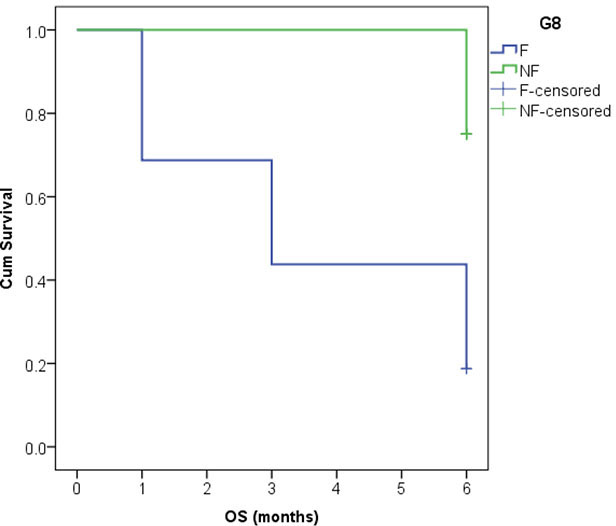
Figure 3:
Cumulative survival curve in frail and non-frail patients using G8 score.
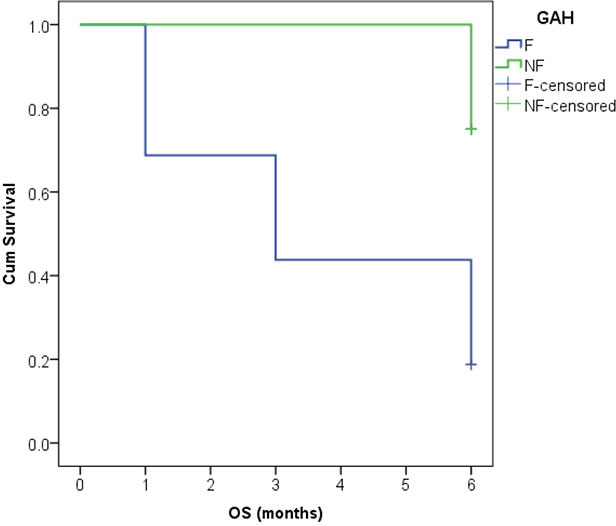
Figure (4):
Cumulative survival curve in frail and non-frail patients using GAH score.
4. Discussion
In our study, we included 32 elderly AML patients who were 60 years or older, according to the Egyptian census definition of the elderly population, and reclassified them as frail and non-frail using G8 and GAH scores.[16] It was found that the mean age of frail patients was significantly higher. This is supported by Atakul and Akyar's 2019 study, which involved 90 patients with hematological diseases, who were aged 65 years or older. The study found that women aged 75 years and older were more likely to be frail than those who were younger. The researchers used a modified version of the Edmonton Frailty Scale to assess frailty.[17]
Comorbidities with DM and HTN were significantly higher in frail patients compared to non-frail patients (P-values 0.033 and 0.012, respectively). In line with our results, Vetrano et al. (2018) and García-de-Alba-García et al. (2020) reported that frailty and prefrailty are observed more in patients with DM and HTN.[18, 19]
In our study, hospitalization days were higher in non-frail patients and the total incidence of complications did not reveal a significant difference between frail and non-frail patients. This is different from the results of Gi-June Min et al. (2023), who studied elderly patients with a median age of 63 years. They found that frail patients had a higher incidence of prolonged hospitalization days (≥40) in their study (P = 0.005). In addition, frail patients had a significantly higher incidence of nonfatal toxicities (P = 0.044). (20) It is possible that the high mortality rate of our frail patients caused their hospitalization to be shorter, resulting in a lower overall incidence of complications in the frail group compared to the non-frail group.
Also, this could be attributed to treatment schedule as more aggressive treatment protocols (e.g., 3 + 7 protocol) were more frequently used in non-frail patients, while less-aggressive protocols (such as oral etoposide and S/C cytarabine) were used more frequently in frail patients (Table 2).
It is worth noting that our study had a relatively small number of patients compared to other studies. For example, Petrov et al. (2022) conducted their study on 237 AML patients, while Lee et al. (2022) included 1166 veterans with newly diagnosed AML in their study. Both studies reported that frail patients had higher rates of intensive care unit (ICU) admissions.[21, 22]
According to our results, the 6-month overall survival was significantly better in the non-frail group compared to the frail group on using both G8 and GAH scores. Like our results, Umit et al. (2018) showed that both G8 and VES13 scores has strong survival prediction (P = 0.001).[23]
Also, in concordance with our results, Gi-June Min et al. (2023), found that decreased physical functions by short physical performance battery (SPPB) and depressive symptoms by the Korean version of the short form of geriatric depression scales (SGDS-K) were significantly associated with low survival rate, while gait speed and sit-and-stand speed were very useful measurements for survival outcome prediction.[20]
Also, in accordance with our results, Budziszewska et al. (2015), who conducted their study in 509 elderly AML patients, found that fit patients showed a significantly long overall survival than frail subjects (P < 0.05).[24]
Similarly, Klepin et al. (2013) conducted their study on 74 elderly AML patients and found that frail patients with low baseline physical performance have an overall survival of 6.0 months, compared to 16.8 months in patients with better physical performance (P = .018).[25]
Among 87 hospitalized older adults with different clinical diagnoses such as heart failure, chronic obstructive lung disease, pneumonia or stroke, Volpato et al. (2011) found that frail patients with moderate physical impairment (with an SPPB score 5–7) had 2.6 times higher risk of death or recurrent hospitalization than non-frail patients.[26]
This study has some limitations. The small sample size may have affected our results, so further large-scale studies with more elderly patients are essential to establish our results.
5. Conclusion
The main goal of geriatric assessment in patients with hematological malignancies is to guide therapeutic decisions by identifying fit patients, who can tolerate standard treatment, and frail patients, who may benefit from adjustments of therapy. So, a comprehensive assessment is recommended for proper management of such patients.
Based on G8 and GAH scores, frail patients were more susceptible to a higher incidence of early mortality and lower overall survival compared to non-frail patients.
Frailty scores (G8 and GAH) and adverse risk cytogenetics were independent predictors of response at 1 month and overall survival at 6 months, irrespective to the ECOG performance score.
Our findings support using the G8 and GAH scores as a feasible frailty assessment tool in the initial assessment of newly diagnosed elderly AML patients. Both scores were independent prognostic predictors in elderly AML patients.
Abbreviations
- AML
(acute myeloid leukemia)
- ELN
(European Leukemia Net)
- G8
(Geriatric 8)
- GAH
(Geriatric Assessment in Hematology)
- SIOG
(the International Society of Geriatric Oncology)
- SPPB
(short physical performance battery)
- SGDS-K
(short form of the Geriatric Depression Scale-Korean version)
- DM
(diabetes mellitus)
- HTN
(hypertension).