
1. Introduction
Penile cancer is a rare form of malignancy in men. Globally, in 2020, 36,068 new cases (0.2% of all cancers) were reported with an age-standardized incidence rate of 0.80 per 100,000 person-years. In the same year, mortality due to penile cancer was 13,211 deaths (0.1% of all cancers) with an age-standardized mortality rate of 0.29 per 100,000 person-years.[1] The incidence and mortality of penile cancer are generally higher in developing countries, but its incidence is increasing in most European countries.[2] Risk factors associated with penile cancer include human papilloma virus (HPV) infection, smoking, obesity, uncircumcised, phimosis, poor hygiene, and low socioeconomic status.[3] In addition to physical problems, penile cancer can also cause significant disturbances in the patient's urinary and sexual functions, which result in a lower health-related quality of life (HRQoL) of penile cancer patients than the normal population.[4,5]
Most penile cancers are classified as squamous cell carcinoma, manifesting as small, painless lesions that enlarge over time to form warts, small crusty bumps, ulcers, or blisters that spread over the entire penis.[3] The cancer cells may follow predictable patterns of spread. First, the cancer spreads to the sentinel lymph nodes, usually in the superficial lymph nodes near the central and superior aspects of the saphenofemoral junction, then progresses to the inferior and deep inguinal nodes, and finally to the pelvic nodes.[6] Presence of inguinal lymph node metastasis (LNM) is one of the most significant prognostic factors for patients with penile cancer.[7] The 5-year survival percentage of penile cancer patients decreases according to the regional LNMs as follows: from 90% to 100% in no involvement of lymph nodes (pN0) to 80% in unilateral lymph nodes (pN1), 40% in multiple unilateral or bilateral inguinal lymph nodes (pN2), and only 11% in patients with already involved fixed inguinal or pelvic lymph nodes (pN3).[3]
Early diagnosis of penile cancer is important to prevent metastases and improve treatment success. Unfortunately, most patients with penile cancer tend to delay treatment, with 15%–50% delaying more than a year from onset. The first penile cancer diagnosed in most patients, up to 65.3%, had metastases in the lymph nodes.[8] Penile cancer is diagnosed based on an investigation of lesions and other abnormalities from a physical examination of the penis and groin, cytology, and histology, and suspected metastases need to be confirmed by lymph node biopsy or pelvic imaging.[3] However, about 25% of patients have micrometastasis, which is difficult to detect by biopsy and imaging.[7] On the other hand, the spread of penile cancer cells through lymphatic vessels provides the potential for using compounds involved in lymphangiogenesis, such as programmed death-ligand 1 (PD-L1), C-reactive protein (CRP), neutrophil/lymphocyte ratio (NLR), and Ki-67, in predicting the development of lymphatic metastases in penile cancer.[7,9,10] Detection of biomarkers proven to have prognostic value for lymphatic metastasis in penile cancer can assist physicians in making clinical decisions. This study aims to identify biomarkers that might be used to assess the risk or likelihood of developing lymphatic metastases in penile cancer.
2. Material and Methods
2.1. Study screening and selection process
The Preferred Reporting Items for Systematic Review and Meta-Analyses (PRISMA) guidelines were used in this literature review to properly identify relevant studies.[11] A literature search was conducted using the medical literature database PubMed, Scopus, ScienceDirect, EMBASE, and EBSCOHost for studies published until February 7, 2023. The search strategy used medical subject headings (MeSH) with words related to penile cancer, lymphangiogenesis, and metastasis. Various biomarkers that have been known before are also mentioned as synonyms of lymphangiogenesis. The search queries used in the search included ((“penile cancer” OR “penile squamous cell carcinoma” OR “penile carcinoma”) AND (“lymphangiogenesis” OR “lymphangiogeneses” OR T cell OR PD-1 OR PD-L1 OR VEGF OR FGFD OR TGF OR IL-6 OR COX-2) AND (“metastases” OR “metastasis” OR “lymphogenic metastases”)). Manual searches were also added to the literature list. The literature obtained was then deduplicated and screened according to eligibility criteria.
The Population, Intervention, Comparison, and Outcome (PICO) principle used in this review was penile cancer patients as the population, lymphangiogenesis marker as the intervention, other marker related to metastasis as comparison, and correlation of marker related to metastatic penile cancer as the outcome. The eligible studies included were selected based on the following: 1) original research studies (prospective/retrospective cohort, case control, cross sectional); 2) complete lymphangiogenesis marker analysis; and 3) full text can be retrieved for article screening. Studies evaluating other diseases related to lymphangiogenesis or studies in the form of review articles, commentaries, or letters to editors were excluded.
The selection processes of the study initiated with assessing the clarity of the eligibility criteria and the consistency of each author's decisions. The literature was screened by two reviewers independently (I.W.Y. and S.N.M) for the study's eligibility. First, the studies were screened by the title and the abstract and then proceeded to full-text screening. In disagreement with the study selection, the third author (A.A.W.L) helped to reach a complete consensus.
2.2. Risk of bias assessment
Quality assessment was performed by two reviewers (I.W.Y. and R.S.). The quality of the included literature was evaluated using the Newcastle–Ottawa Quality Assessment scale. This assessment consists of three aspects, namely, the selection of the study group (maximum 4 points), comparability of the groups (maximum 2 points), and assessment of the exposure or outcome of interest (maximum 3 points), with a maximum total value of 9 points. In the presence of discrepancy, two reviewers (I.W.Y. and R.S.) discussed the consensus.
2.3. Data extraction
Data of identified studies were extracted, which included author, published year, location, study settings, included samples (cancer type, stage, cell line), markers used, and the diagnostic value or impact on LNM.
3. Results
3.1. Study characteristics
A total of 21 studies met the inclusion criteria and became eligible studies. The literature selection process shown in Fig. 1. The geographic locations where the studies were conducted were Europe (n = 10), Asia (n = 7), North America (n = 2), and South America (n = 2). The characteristics of the selected studies are summarized in Table 1, while the marker evaluations are presented in Tables 2 and 3. Out of all 21 studies, 15 studies were considered to have good quality, while there were six studies with fair quality, as shown in Table 4. All the studies with fair quality had unclear representations of the patients or inadequate definition of cases. The lowest score was found was given for a study by Hu et al. Then, the authors extracted and analyzed the data qualitatively for an objective measurement based on the topic.
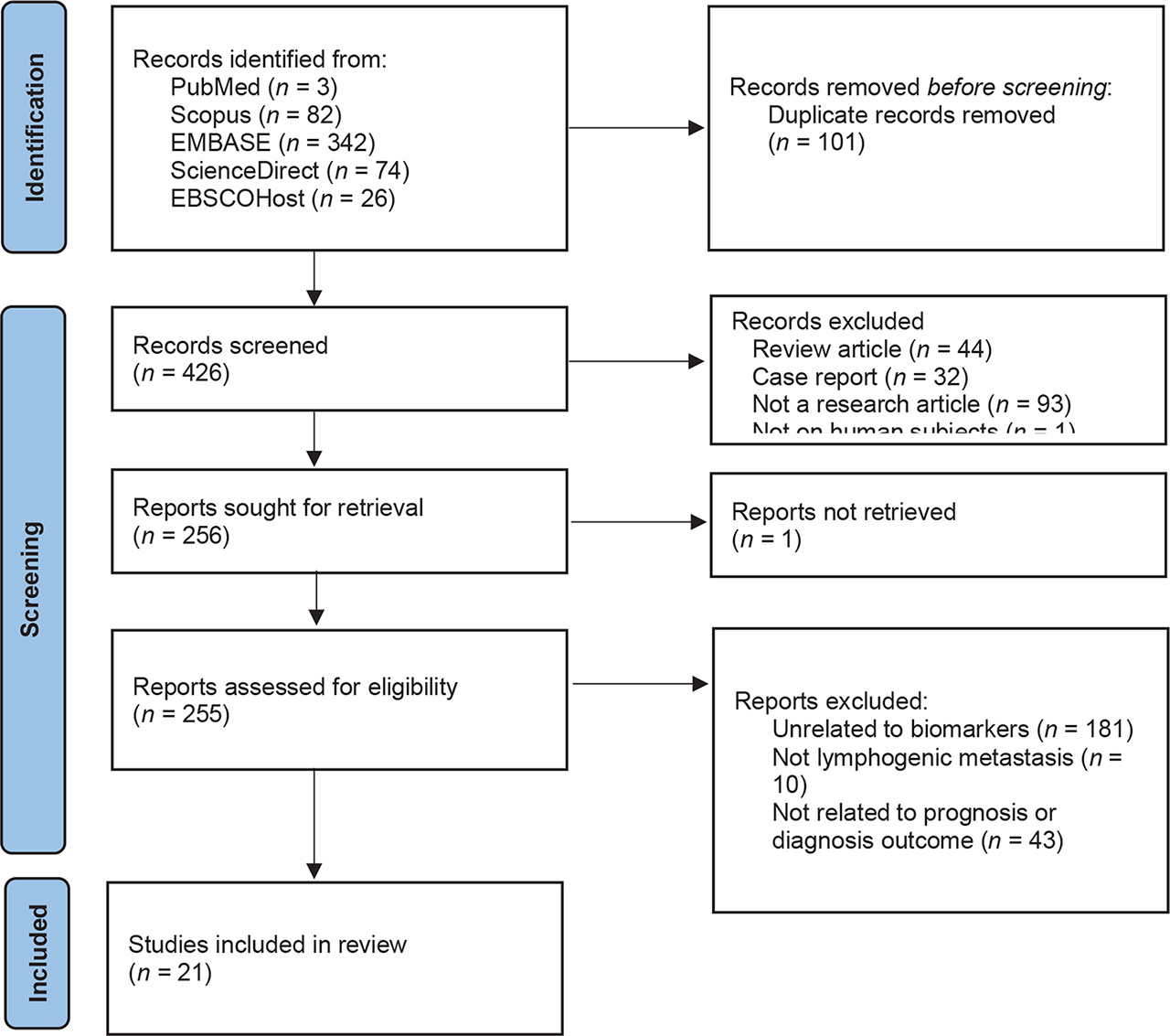
Figure 1:
PRISMA flow chart PRISMA, Preferred Reporting Items for Systematic Review and Meta-Analysis.
Table 1:
Summary of eligible studies.
| Author | Year | Location | Settings | Total samples | Type of patients |
|---|---|---|---|---|---|
| De Bacco et al.12 | 2020 | Porto Alegre, Brazil | Prospective cohort | 40 patients | Penile squamous cell carcinoma |
| Udager et al.13 | 2016 | Ann Arbor, USA | Retrospective observational study | 37 patients | Penile squamous cell carcinoma |
| Ottenhof et al.14 | 2018 | Amsterdam, the Netherlands | Retrospective observational study (immunohistochemistry analysis) | 487 patients | Penile squamous cell carcinoma |
| Hu et al.15 | 2020 | Changsha, China | Prospective cohort | 84 patients | Penile squamous cell carcinoma |
| Steffens et al.16 | 2013 | Hannover, Germany | Retrospective cohort study | 79 patients | Penile cancer |
| Al Ghazal et al.17 | 2013 | Ulm, Germany | Retrospective cohort study | 51 patients | Penile cancer patients underwent radical or partial penectomy (pT1–pT4) |
| Jindal et al.18 | 2021 | Bengal, India | Prospective observational study | 69 patients | Penile cancer; pT1 (15), pT2 (37), pT3 (16), pT4 (1) with inguinal node dissection |
| Protzel et al.19 | 2007 | Helios-Kliniken Schwerin, Germany | Retrospective observational study (immunohistochemistry analysis) | 28 patients | Invasive penile squamous cell carcinoma |
| Cocks et al.20 | 2017 | North America | Prospective cohort | 53 patients | Invasive penile squamous cell carcinoma tissue |
| Mo et al.21 | 2021 | Hunan, China | Retrospective observational study | 81 patients | Penile cancer patients underwent surgery |
| Mo et al.22 | 2020 | Hunan, China | Retrospective observational study | 76 patients | Penile cancer patients underwent surgery |
| Mo et al.23 | 2020 | Hunan, China | Retrospective observational study | 76 patients | Penile cancer patients underwent surgery |
| Murta et al.24 | 2022 | Sao Paulo, Brazil | Prospective observational study | 24 patients | Penile cancer diagnosed in hospital |
| Ayoubian et al.25 | 2021 | Homburg, Germany | Preclinical studies (microarray analysis) | 30 patients | Penile squamous cell carcinoma; pT1a, pT1b, pT2, pT3; metastatic; nonmetastatic |
| Mohr et al.26 | 2022 | Homburg, Germany | Preclinical studies (immunohistochemistry staining analysis) | Three patients | HPV-positive penile cancer cell lines (primarius derived, metastasis derived) |
| van der Fels et al.27 | 2020 | Groningen, the Netherlands | Pilot prospective observational study | 22 patients | Penile squamous cell carcinoma |
| Zhou et al.28 | 2018 | Guangzhou, China | Prospective observational study | 114 patients | Penile squamous cell carcinoma cell lines (Penl1, Penl2, and 149RCa) |
| Fenner et al.29 | 2018 | Rostock, Germany | Preclinical study (immunohistochemistry analysis) | Four patients | Penile cancer cell lines |
| Zhu et al.30 | 2013 | Shanghai, China | Retrospective observational study (immunohistochemistry analysis) | 73 patients | Penile squamous cell carcinoma |
| Minardi et al.31 | 2011 | Ancona, Italy | Retrospective observational study (immunohistochemistry analysis) | 39 patients | Penile squamous cell carcinoma |
| Protzel et al.32 | 2011 | Rostock, Germany | Retrospective observational study | 29 patients | Invasive penile squamous cell carcinoma patients underwent surgical resection |
Table 2:
Summary of markers used.
| Author | Year | PD-L1 | CRP | NLR and LMR | Ki-67 | Chemokine motif ligands | miRNAs | Other biomarkers |
|---|---|---|---|---|---|---|---|---|
| De Bacco et al.12 | 2020 | (+) | p16 | |||||
| Udager et al.13 | 2016 | (+) | ||||||
| Ottenhof et al.14 | 2018 | (+) | HLA | |||||
| Hu et al.15 | 2020 | (+) | (+) | |||||
| Steffens et al.16 | 2013 | (+) | ||||||
| Al Ghazal et al.17 | 2013 | (+) | ||||||
| Jindal et al.18 | 2021 | (+) | ||||||
| Protzel et al.19 | 2007 | (+) | ||||||
| Cocks et al.20 | 2017 | (+) | CD8 | |||||
| Mo et al.21 | 2021 | CXCL5 | ||||||
| Mo et al.22 | 2020 | CXCL13 | ||||||
| Mo et al.23 | 2020 | CCL20 | ||||||
| Murta et al.24 | 2022 | Differentially expressed miRNAs | DEGs | |||||
| Ayoubian et al.25 | 2021 | miR-137 and miR-328-3p | ||||||
| Mohr et al.26 | 2022 | S100A8 and S100A9; CD147 | ||||||
| van der Fels et al.27 | 2020 | PSMA, VEGF, EGFR, and EpCAM | ||||||
| Zhou et al.28 | 2018 | sLAMC2 | ||||||
| Fenner et al.29 | 2018 | EF21 | ||||||
| Zhu et al.30 | 2013 | CA IX | ||||||
| Minardi et al.31 | 2011 | D2-40 | ||||||
| Protzel et al.32 | 2011 | Annexins I, II, and IV |
[i] DEG, differentially expressed gene
Table 3:
Summary of the main findings on notable biomarkers as a prognostic factor.
| Author | Year | p-value | Marker used | Summary of findings |
|---|---|---|---|---|
| De Bacco et al.12 | 2020 | p = 0.002 | PD-L1, p16 | There was statistical correlation between PD-L1 and p16 expression (p = 0.002). There was a two-fold relationship in LN involvement of patients who expressed PD-L1 (69.2% of patients with LN involvement had PD-L1 expression and only 30.8% had LN involvement with PD-L1-). p16 was expressed in 38.5% of patients with LN involvement without significant difference |
| Udager et al.13 | 2016 | p = 0.024 | PD-L1 | Twenty-three (62.2%) of 37 primary tumors were positive for PD-L1 expression, and there was strong positive correlation of PD-L1 expression in primary and metastatic samples (p = 0.72; 0.032 < p < 0.036). Primary tumor PD-L1 expression was significantly associated with regional LNM (p = 0.024) |
| Ottenhof et al.14 | 2018 |
| Nonclassical HLA class I PD-L1 | Tumor PD-L1 expression was significantly associated with LNM; diffusely PD-L1–positive tumors had higher odds of LNM in comparison to tumors to marginal PD-L1 expression only (OR 4.16, p < 0.01) and tumors with combined negative/margin PD-L1 expression (OR 3.28, p < 0.01). Upregulation of nonclassical HLA class I molecules (combined score of HLA-E and HLA-G) was associated with a higher odds of LNM compared to normal expression (OR 2.28, p = 0.02). In the multivariable analysis, diffuse PD-L1 expression was the only immunological factor that remained significantly associated with LNM, although the lower limit of the confidence interval was just above 1 (OR 2.81, 95% CI [1.01–7.81], p < 0.05) |
| Hu et al.15 | 2020 |
|
| PD-L1 and NLR increased the predictive accuracy of the clinical model. PD-1 and NLR were considered independent predictors of LNM; NLR model risk analysis: OR = 10.93 (2.81–42.53, p-value <0.01); PD-L1 model risk analysis: OR = 5.16 (1.29–20.58, p-value 0.02) |
| Steffens et al.16 | 2013 | p = 0.007 | CRP | A significantly elevated CRP level (>15 vs. ≤15 mg/l) was found more often in patients with nodal disease at diagnosis (50.0 vs. 14.6%, p = 0.007) |
| Al Ghazal et al.17 | 2013 | p = 0.04 | CRP | The mean CRP value was significantly higher in patients with nodal disease than in those without it: 24.7 versus 12.4 mg/dl (p = 0.04) |
| Jindal et al.18 | 2021 | p = 0.001 | NLR, LMR | NLR >3 and LMR ≤3 were significantly associated with the presence of inguinal LN involvement (p = 0.001 and 0.026, respectively) |
| Protzel et al.19 | 2007 | p = 0.005 | Ki-67 | None of the patients with weak Ki-67 expression had LNM, whereas eight patients with moderate Ki-67 staining (47%) and all seven patients with a strong Ki-67 expression displayed LNMs (p = 0.005). The statistical analyses revealed that Ki-67 labeling index is related to distant metastasis (p = 0.026) |
| Cocks et al.20 | 2017 | p = 0.0057 | CD8, Ki-67 | CD8 and Ki-67 expression in stromal immune cells correlated with distant metastasis (p = 0.0057). Tumors with higher CD8 and Ki-67 expression in the stromal immune cells were more likely to metastasize |
| Mo et al.21 | 2021 | p = 0.018 | CXCL5 | Preoperative serum CXCL5 levels were significantly associated with pelvic LNM (p = 0.018). |
| Mo et al.22 | 2020 | p < 0.001 | CXCL13 | Higher preoperative serum CXCL13 level was detected in PC cohorts than in healthy male controls (p < 0.001) |
| Mo et al.23 | 2020 | p = 0.007 | CCL20 | Preoperative serum CCL20 level was significantly associated with pelvic LNM (p = 0.007) |
| Murta et al.24 | 2022 | n/a | DEmiRs and DEGs | Upregulation of miR-421 and miR-744-5p is associated with metastasis of LN in penile cancer patients (based on total cohort) |
| Ayoubian et al.25 | 2021 |
| miR-137 miR-328-3p | Lower fold value in miR-137 (−3.7 [p = 0.004] and −8.54 [p = 0.004]) and miR-328-3p (−2.7 [p = 0.007] and −1.98 [p = 0.032]) in metastatic cells with negative HPV, implying lower expression |
| Mohr et al.26 | 2022 | n/a | S100A8 and S100A9; CD147 | All metastasis cell lines were stained positive for S100A8 and S100A9 (100%). All HPV+ metastasis cell lines (LM) were also positive for CD147 marker |
| van der Fels et al.27 | 2020 | n/a | The monoclonal antibodies PSMA, VEGF, EGFR, and EpCAM expression | High immunoreactivity score of VEGF and EGFR expression in metastatic LN involvement and primary tumor; however, EGFR is not expressed in tumor without metastasis. PSMA and EpCAM ae not expressed in the tumor cell at all |
| Zhou et al.28 | 2018 | n/a | sLAMC2 | LAMC2 was overexpressed in PSCC tissues, and the LAMC2 expression level was higher in metastatic LN tissues than in primary cancer tissues |
| Fenner et al.29 | 2018 | p < 0.001 | EF21 |
|
| Zhu et al.30 | 2013 | p = 0.85 | CA IX | The probability of LNM was 38.1% and 45.2% in CA IX low- and high-expression categories, respectively. CA IX was associated with LNM with OR 1.149 (p = 0.85) despite not being significant |
| Minardi et al.31 | 2011 | p = 0.326 | D2-40 | All patients whose intratumoral cells were D2-40 negative were N0, whereas all N+ patients were positive, with 66.7% strongly so. All deceased patients had high-level cell D2-40 expression. N+ patients accounted for 16.7% and 35.7% of samples with moderate and strong D2-40 reactivity, respectively (p = 0.326, χ2 test) |
| Protzel et al.32 | 2011 |
|
| There was a significant correlation between strong ANX AI expression at the invasion front and the occurrence of LNM (p = 0.001). Analysis of ANX AII expression showed no significant correlation with clinical data. Strong expression of ANX AIV at the invasion front was significantly associated with LNM (p = 0.019) |
[i] CA IX, carbonic anhydrase IX; CI, confidence interval; CRP, C-reactive protein; DEG, differentially expressed gene; DEmiRs, differentially expressed miRNAs; EGFR, epidermal growth factor receptor; HLA, human leukocyte antigen; LMR, lymphocyte/monocyte ratio; LN, lymph node; LNM, lymph node metastasis; NLR, neutrophil/lymphocyte ratio; OR, odds ratio; PD-L1, programmed death ligand-1; PSMA, prostate-specific membrane antigen; VEGF, vascular endothelial growth factor
Table 4:
NOS risk of bias assessment.
| Author | Year | Selection | Comparability | Exposure | Total score | |||||
|---|---|---|---|---|---|---|---|---|---|---|
| Adequate definition of patient cases | Representativeness of patient cases | Selection of controls | Definition of controls | Control for important or additional factors | Ascertainment of exposure | Same method of ascertainment for participants | Nonresponse rate | |||
| Mohr | 2022 | * | * | * | * | * | 5 | |||
| Ayoubian | 2021 | * | * | * | * | * | * | 6 | ||
| Jindal | 2021 | * | * | * | * | * | * | 6 | ||
| Hu | 2020 | * | * | * | * | * | 4 | |||
| De Bacco | 2020 | * | * | * | * | * | 5 | |||
| van der Fels | 2020 | * | * | * | * | * | * | 6 | ||
| Zhou | 2018 | * | * | * | * | * | * | 6 | ||
| Cocks | 2017 | * | * | * | * | * | 5 | |||
| Udager | 2016 | * | * | * | * | * | * | 6 | ||
| Al Ghazal | 2013 | * | * | * | * | * | * | 6 | ||
| Steffens | 2013 | * | * | * | * | * | * | 6 | ||
| Murta | 2022 | * | * | * | * | * | 5 | |||
| Mo | 2021 | * | * | * | * | * | * | * | * | 8 |
| Mo | 2020 | * | * | * | * | * | * | * | * | 8 |
| Mo (2) | 2020 | * | * | * | * | * | * | * | * | 8 |
| Fenner | 2018 | * | * | * | * | 4 | ||||
| Ottenhof | 2018 | * | * | * | * | * | * | 6 | ||
| Zhu | 2013 | * | * | * | * | * | * | * | 7 | |
| Minardi | 2011 | * | * | * | * | * | * | * | 7 | |
| Protzel | 2011 | * | * | * | * | * | * | * | 7 | |
| Protzel | 2007 | * | * | * | * | * | * | * | 7 | |
[i] NOS, Newcastle–Ottawa scale
[ii] Green rows signify good-quality studies, yellow rows signify fair quality studies
3.2. Markers of Metastasis in Penile Cancer
3.2.1. Programmed death-ligand 1
Four studies assessed PD-L1 as a predictor of lymphatic metastasis in penile cancer. A study reported that patients with positive biomarker PD-L1 presented with larger tumors (median 4.25 cm, p = 0.027) and higher-grade tumors (77.8% of grade II and III vs. 22.2% of grade I). PD-L1 was expressed in all patients with grade III PSCC (p = 0.061). The lymph node involvement was two times higher in patients with positive biomarker PD-L1 than in the negative group (69.2% vs. 30.8%, respectively).[12] Other studies reported that 62.2% of primary tumors were positive for PD-L1 expression, and there was a strong positive correlation between PD-L1 expression in primary and metastatic samples (p = 0.72). Primary tumor with PDL1 expression was significantly associated with regional LNM (p = 0.024).[13] Moreover, high expression of PD-L1–positive tumors had a higher risk of LNM than marginal PD-L1 expression (odds ratio [OR] 4.16, p < 0.01) or combined negative/margin PD-L1 expression (OR 3.28, p < 0.01).[14] In a study with C-indexes of nomogram, PDL1 was considered an independent predictor of LNM with model risk analysis OR of 5.16 (95% confidence interval [CI] 1.29–20.58, p = 0.02).[15]
3.2.2. C-reactive protein
CRP was assessed in two studies. A significantly elevated CRP level (>15 vs. ≤15 mg/L) was found more often in patients with LNM at diagnosis (50.0% vs. 14.6%, p = 0.007).[16] Similar result was found in another study where the mean CRP value was significantly higher in patients with nodal disease than in those without it (24.7 vs. 12.4 mg/dL, p = 0.04).[17]
3.2.3. NLR and lymphocyte/monocyte ratio
Two studies assessed NLR and lymphocyte/monocyte ratio (LMR) and showed that penile cancer patients with NLR >3 and LMR ≤3 have been associated with inguinal lymph node involvement (p = 0.001 and 0.026, respectively).[18] In the same study with C-indexes of nomogram as mentioned before, NLR was also considered an independent predictor of LNM with an OR of 10.93 (2.81–42.53, p < 0.01).[15]
3.2.4. Ki-67
The Ki-67 protein was assessed in two studies. The first study showed that patients with a high Ki-67 expression displayed LNMs compared to patients with marginal Ki-67 expression or moderate Ki-67 staining (p = 0.005). Instead of tumor staging, the K-i67 labeling index was more related to distant metastasis (p = 0.026).[19] Other studies found that tumors with higher Ki-67 expression and CD8 expression in stromal immune cells were correlated with distant metastasis (p = 0.0057).[20]
3.2.5. Chemokine motif ligands
Three studies assessed chemokine motif ligands, namely, CXCL5, CXCL13, and CCL20. The preoperative serum levels of CXCL5, CXCL13, and CCL20 in penile cancer patients were higher than in the control group. The test for CXCL5 (p = 0.018), CXCL13 (p = 0.005), and CCL20 (p = 0.007) showed a significant result for pelvic lymph node involvement.[21,22,23]
3.2.6. MicroRNA
Several microRNAs (miRNAs) were assessed in two studies. A cohort study found that the upregulation of miR-421 and miR-744-5p was associated with LNM in penile cancer patients.[24] Regarding the other miRNAs, that is, miR-137 and miR-328-3p, the expression levels for miR-137 (p = 0.004) and miR-328-3p (p = 0.032) were lower in metastatic penile squamous cell carcinoma compared to nonmetastatic tumors.[25]
3.2.7. Other biomarkers
Several other limited studies have reported various biomarkers that have not been mentioned as candidate predictors of lymphatic metastasis in penile cancer. In one study, it was reported that all metastatic cell lines of penile cancer stained positive for S100A8 and S100A9 (100%). All HPV+ metastasis cell lines (LM) were also positive for CD147 marker.[26] High immunoreactivity of vascular endothelial growth factor (VEGF) and epidermal growth factor receptor (EGFR) expression was found in metastatic lymph node involvement and primary tumor of penile cancer. EGFR was not expressed in tumor without metastasis.[27] The expression of Laminin Subunit Gamma 2 (LAMC2) was significantly upregulated at the mRNA and protein level in the penile cancer tissues compared to normal epithelial tissues, and its expression was found to be higher in lymph node metastatic lesions than in primary cancer tissues.[28]
The transcription factor E2 promoter binding factor 1 (E2F1) was found to be highly expressed and significantly higher in metastatic penile cancer primary tumor and LNMs than in nonmetastatic tumors.[29] The upregulation of nonclassical human leukocyte antigen (HLA) class I molecules (combined score of HLA-E and HLA-G) was associated with a higher odds of LNM compared to normal expression (OR 2.28, p = 0.02).[14] Despite not being significant, carbonic anhydrase IX (CA IX) was associated with LNM with OR 1.15 and p = 0.85.[30] The immunohistochemical expression of D2-40 was investigated, and it was found that all patients whose intratumoral cells were D2-40 negative were no lymph node involved, whereas all patients with LNM were positive for D2-40, with 66.7% strongly so.[31] Lastly, the strong expression of annexins I and IV at the invasion front was associated with LNM (p = 0.001 and p = 0.019, respectively).[32]
4. Discussion
There were 21 selected studies with more than 20 evaluated biomarkers for predicting lymphatic metastasis in penile cancer. Of the many biomarkers, PD-L1 is the most studied biomarker (four studies). CRP, NLR, and Ki-67 are the next most evaluated biomarkers. Specific miRNA and chemokine motif ligands and other biomarkers have been studied to a limited extent.
PD-L1 overexpression is significantly positively related to high-grade tumor and lymphatic metastasis of penile cancer in several studies. The PD-L1 transmembrane protein is a costimulatory ligand, in conjunction with its PD-1 receptor, which has a role in T-cell activation, proliferation, and cytotoxic secretion in cancer for degenerating antitumor immune responses. During inflammatory conditions, immune cells, such as some activated T and B cells, macrophages, and dendritic cells, express PD-L1, which is known as an adaptive immune mechanism in cancer cells against antitumor response.[33] When PD-L1 is upregulated due to the tumor microenvironment, it will trigger T-cell apoptosis, which inhibits the effector T-cell antitumor immune response.[34] This activation of the proliferative and survival signaling pathway initiated by PD-L1 suggests a role in subsequent tumor progression. The role of PD-L1 has been extensively studied in the metastasis of various urological malignancies and has been recognized as a predictor of LNM and shorter cancer-specific survival in penile cancer.[35]
Another mechanism underlying the initiation and movement of primary penile tumors to lymph nodes is inflammatory conditions, in which inflammatory markers such as CRP and NLR are known to be biomarkers that were evaluated in several studies included in this review. CRP is an acute-phase reactant which increases during several conditions, one of which is cancer. It is mainly produced by the liver in response to an inflammatory stimulus involving increased cytokine expression. Besides tumor progression promoting liver damage and production of CRP, CRP is also thought to influence tumor progression by either increasing cytotoxic T-cell recruitment and subsequent tumor cell lysis or by prolonging immune recruitment, which can lead to a more sustained proinflammatory and pro-tumorigenic microenvironment.[36] In addition, neutrophilia and lymphopenia also represent a systemic inflammatory response and an active immune response. This condition can be caused by stimulation of tumor-associated macrophages (TAMs), to secrete interleukin (IL)-1β, and tumor-associated neutrophils (TANs), which potentiates systemic neutrophilic inflammation and then triggers metastatic progression.[37] Apart from being independent predictors of metastasis and overall survival in penile cancer patients, CRP and NLR are also known to be predictors of overall survival in prostate cancer, cervical adenocarcinoma, lung cancer, and esophageal cancer.[9]
The strength of our study is that this is the first systematic review exploring the use of biomarkers in lymphatic metastasis. This study also reviewed various biomarkers on the topic, which gives more objective and potential in determining which biomarkers can predict lymphatic metastasis in penile cancer. Despite this strength, our analysis was limited as the majority of the included studies were preclinical (immunohistochemistry or miRNA analysis) studies. Moreover, each study had different outcomes and measurement methods, which might be biased in objective cumulative conclusion. More reviews and additional research in the future, especially in clinical settings and those evaluating the biomarkers whose studies are still limited, need to be persuaded to increase the validity of the potential of lymphangiogenesis biomarkers as predictors of lymphatic metastasis, especially in penile cancer.
5. Conclusion
Lymphangiogenesis marker has the potential to be a predictor of lymphatic metastasis in penile cancer. PD-L1, CRP, and NLR are biomarkers that are widely known and proven to be significantly associated with an increased risk of high-grade tumor and lymphatic metastasis in penile cancer.
Acknowledgements
None.
Notes
[5] Contributed by Author contributions
I.W.Y: conceived and designed the study, wrote the manuscript, analyzed the data
S.N.M: wrote the manuscript, analyzed the data
R.S.: revised the manuscript, analyzed the data
A.A.W.L: designed the study, revised the manuscript
All authors read and approved the final manuscript.
[6] Funding
No funding resources to disclose.
[7] Conflicts of interest Conflict of interest
All authors declare no competing interests.